

I Warmly Welcomed My 22-Year-Old Daughter’s Boyfriend When She Brought Him Home For Dinner — Until She Kept Dropping Her Fork, I Noticed Something Under The Table, And I Secretly Dialed 911 From The Kitchen
My name is David. I am fifty years old, and for almost two decades, the title that mattered most to me was not mechanic, neighbor, homeowner, or friend. It was father. My daughter, Emily, was only three years old when my wife, Sarah, passed away. One morning, we were a family of three.
By sunset, it was just me and a little girl with curls in her hair, clutching a stuffed rabbit and asking when Mommy was coming home.
I still remember kneeling in front of her in the hallway, trying to explain something I barely understood myself.
Emily looked at me with those wide brown eyes and said, “But you’re staying, right, Daddy?”
That question shaped the rest of my life.
I stayed.
Through nightmares.
Through fevers.
Through school plays where she searched the crowd for the mother who wasn’t there.
Through awkward ponytails, packed lunches, teenage tears, college applications, and every small heartbreak that came before the big ones.
I raised Emily alone, but I never thought of her as a burden.
She was the reason I got up every morning.
She was the reason I learned to cook more than three meals.
She was the reason I painted the house yellow because she said it looked “less lonely.”
As she grew older, Emily became quiet in the way creative people often are.
She noticed colors in clouds.
She kept sketchbooks under her pillow.
She could turn a plain birthday card into something that made people cry.
When she graduated college with a degree in graphic design, I sat in the audience and cried behind my sunglasses like a fool.
She laughed at me afterward and said, “Dad, you’re embarrassing.”
But she hugged me longer than usual.
Not long after graduation, she got a job downtown at a small creative startup.
She was proud of herself, and I was proud of her too.
Still, something changed during those months.
At first, it was subtle.
She came home later.
She checked her phone more often.
She stopped singing in the kitchen while making coffee.
When I asked if work was stressful, she smiled too quickly and said, “Just busy.”
I believed her because I wanted to.
Emily had always been private about dating.
I never pried.
I only told her one thing when she was old enough to start going out.
“Choose someone who respects you. Love without respect is a trap.”
She rolled her eyes then, the way daughters do when fathers try to sound wise.
But she listened.
Or at least, I thought she did.
One warm Thursday evening, I was in the garage fixing a squeaky cabinet door when Emily stepped inside.
She stood near the workbench, twisting the strap of her purse around her fingers.
“Dad?” she said.
I looked up from the screwdriver.
“What’s up, kiddo?”
She was twenty-two, but I still called her that.
Her cheeks flushed.
“I’m bringing my boyfriend over for dinner tonight.”
The screwdriver slipped slightly in my hand.
I tried not to look too surprised.
“Boyfriend?”
She nodded.
“He’s been wanting to meet you.”
I wiped my hands on a rag.
“How long have you been seeing him?”
“Almost five months,” she said quickly.
Five months.
That number hit me harder than I expected.
Not because she owed me every detail of her life, but because Emily and I had always shared things eventually.
“And I’m just hearing about him now?” I asked gently.
She looked down.
“His job keeps him on the road a lot. And I didn’t know the right time to tell you.”
Something in her voice bothered me.
She sounded excited, yes.
But beneath that excitement was fear.
Not ordinary nervousness.
Not the cute anxiety of introducing your boyfriend to your protective father.
Something sharper.
I stepped closer.
“Emily, are you happy?”
Her eyes lifted to mine.
For one second, her face changed.
The mask slipped.
Then she smiled.
“Of course, Dad.”
I wanted to ask more.
I wanted to say, Tell me the truth.
But she was already backing toward the door, saying he would arrive at seven.
So I did what fathers do when they do not know how to fix what they cannot yet see.
I cooked.
I made roast chicken, mashed potatoes, Caesar salad, and green beans with garlic because Emily used to steal them from the pan as a child.
I bought a bottle of sparkling cider because she still loved it.
And I baked an apple pie from Sarah’s old recipe.
The house smelled like cinnamon and butter by the time the doorbell rang.
Seven sharp.
Emily stood beside him on the porch.
His name was Mark.
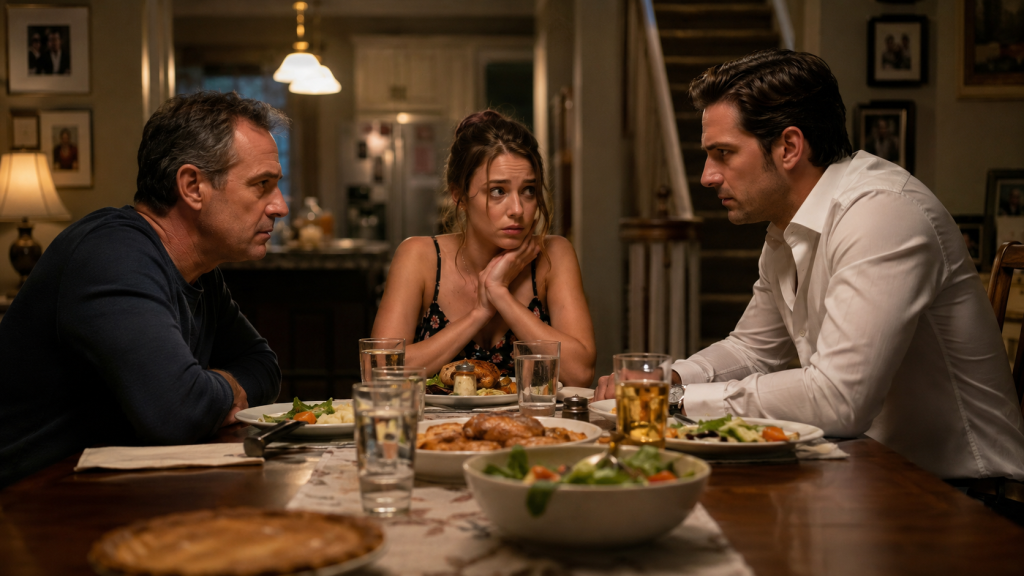
He was tall, broad-shouldered, and dressed neatly in a white button-down shirt with sleeves rolled to his forearms.
His hair was perfectly styled.
His smile was practiced.
He extended his hand.
“Mr. Harris,” he said. “It’s nice to finally meet you.”
“David is fine,” I replied.
His handshake was firm.
Too firm.
Not painful, but calculated.
His eyes stayed on mine as if the handshake was a test.
I had met men like him before.
Men who treated every room like a courtroom and every conversation like a negotiation.
Emily stood slightly behind his shoulder.
That bothered me.
She never stood behind anyone.
“Come in,” I said.
Dinner started politely.
Mark complimented the house.
He said Emily had told him I worked with my hands.
I told him I ran a small repair business.
He said he worked in cybersecurity.
“Mostly private contracts,” he added.
“That sounds interesting,” I said.
“It is,” he replied. “You learn a lot about people when you know how they hide things.”
He laughed softly.
Emily did not.
I noticed that immediately.
She sat across from me, Mark beside her.
Her plate was full, but she barely ate.
When I asked about her new design project, she opened her mouth to answer, but Mark touched her wrist.
Just lightly.
To anyone else, it might have seemed affectionate.
But Emily stopped speaking.
Mark answered for her.
“She’s been busy. Still learning discipline in the workplace.”
I looked at my daughter.
Her eyes were on her plate.
“Emily has always had discipline,” I said.
Mark smiled.
“Of course. I only mean she’s young.”
The first fork dropped during the salad.
It slipped from Emily’s hand and clattered to the floor.
She flinched like the sound had struck her.
“I’m sorry,” she whispered.
“It’s just a fork,” I said, standing.
“I’ll get it,” she said quickly.
She bent down before I could move.
When she rose, her face was pale.
Mark leaned toward her.
“Careful,” he murmured.
The word was soft.
The threat inside it was not.
A few minutes later, her napkin fell.
Then she knocked over her water glass.
The water spread across the tablecloth.
Emily froze.
For a second, no one moved.
Then Mark’s jaw tightened.
“Emily,” he said quietly.
My daughter’s hands began to shake.
“I’m sorry,” she said again.
I grabbed a towel from the sideboard.
“No harm done,” I said. “Happens all the time.”
But it did not happen all the time.
Not with Emily.
She had steady hands.
She had always had steady hands.
When she dropped her fork a third time, I leaned down with her.
That was when I saw it.
Under the table, her right leg was trembling uncontrollably.
Her dress had shifted just enough to reveal a dark bruise around her ankle, stretching upward along her calf.
Not a small bruise from bumping into furniture.
Not an accident.
My breath stopped.
Emily saw me see it.
For one second, her eyes locked on mine.
And in that second, my little girl, the child who once asked if I was staying, silently begged me to help her.
I felt something inside me go very still.
Rage came first.
Hot and blinding.
I wanted to grab Mark by the collar and slam him against the wall.
But I knew that would only make things worse.
Men like Mark did not fear anger.
They fed on it.
If I reacted too soon, Emily might pay for it later.
So I smiled.
It was the hardest smile of my life.
“Emily,” I said, keeping my voice light. “Help me bring out the pie.”
Mark’s eyes snapped toward her.
“She can sit,” he said.
Too fast.
Too sharp.
I looked at him and gave a harmless chuckle.
“Nonsense. She knows where the plates are. Besides, I always burn myself trying to cut that thing.”
Emily stood slowly.
Mark’s hand moved toward her wrist again.
I stepped between them before he touched her.
“Two minutes,” I said.
For the first time that evening, Mark’s smile disappeared.
Emily followed me into the kitchen.
The second the swinging door closed behind us, she broke.
Her hand flew to her mouth as silent tears spilled down her cheeks.
I reached for her, but she shook her head, terrified.
“Dad,” she whispered, “he’ll hear.”
My heart cracked.
“What did he do to you?”
She squeezed her eyes shut.
“He won’t let me leave.”
I kept my voice low.
“What do you mean?”
“He took my phone. He checks my messages. He drives me to work sometimes and waits outside. He said if I told anyone, he’d hurt you.”
The room tilted.
I gripped the counter to steady myself.
“How long?”
Her shoulders shook.
“Two months. It got worse after I tried to break up with him.”
I wanted to cry.
I wanted to apologize for every time I believed her when she said she was fine.
But there was no time.
From the dining room, Mark called, “Emily?”
She flinched.
I looked toward the old landline mounted near the fridge.
I had almost removed it a dozen times.
That night, it saved us.
I picked it up and dialed 911 with my back turned toward the dining room.
The operator answered.
“911, what is your emergency?”
I spoke softly but clearly.
“This is David Harris. I need police at my home. My adult daughter is in danger. Her boyfriend is here. She says he has threatened her and taken her phone. I have seen injuries.”
Emily covered her face with both hands.
The operator asked for the address.
I gave it.
Then I said, “He is in my dining room. We are in the kitchen. Please send help quietly.”
From the dining room, the chair scraped.
“Emily?” Mark called again.
His voice was louder now.
The operator told me to stay on the line if I could.
I placed the phone on the counter without hanging up.
Then I took the largest kitchen knife from the counter and slid it quietly into a drawer.
Not because I planned to use it.
Because I did not want Mark to.
Emily stared at me, trembling.
“Stay behind me,” I whispered.
The kitchen door swung open.
Mark stood there.
No smile now.
His eyes went from Emily’s tears to my face, then to the phone on the counter.
“What’s going on?” he asked.
I stepped in front of Emily.
“Pie,” I said. “She got emotional. You know how daughters are.”
His gaze sharpened.
“Emily. Come here.”
She did not move.
His face changed.
It was subtle, but I saw the real man then.
The charm fell away.
The polite guest vanished.
What remained was cold control.
“I said come here,” he repeated.
“No,” I said.
The word landed between us like a dropped glass.
Mark looked at me slowly.
“Excuse me?”
“She’s staying where she is.”
He laughed once.
A short, ugly sound.
“You don’t know anything about our relationship.”
“I know enough.”
Emily’s fingers clutched the back of my shirt like she was three years old again.
Mark took a step forward.
“You should be careful, David. Emily is unstable. She exaggerates. She gets emotional.”
I held his stare.
“Funny. She never did before you.”
His mouth tightened.
“You have no idea what she’s like when you’re not around.”
“And you have no idea what I’m like when my daughter is scared.”
For a moment, silence filled the kitchen.
Then Mark reached into his pocket.
My body tensed.
He pulled out Emily’s phone.
He held it up with a smile.
“Looking for this?” he asked her.
Emily let out a small broken sound.
That sound nearly destroyed my restraint.
“You need to leave,” I said.
Mark slipped the phone back into his pocket.
“I’ll leave when Emily leaves with me.”
“No,” Emily whispered.
Mark’s head turned toward her.
“What did you say?”
Her voice shook, but she said it again.
“No.”
His expression hardened.
Before he could move, red and blue lights flashed faintly through the front window.
Mark saw them.
His eyes widened.
Then his face twisted with fury.
“You called the police?” he snapped.
I did not answer.
He lunged toward the back door.
I stepped to block him.
He shoved me hard enough that my shoulder hit the refrigerator.
Emily screamed.
But before Mark reached the hallway, the front door burst open.
“Police!” a voice shouted.
Mark froze.
Two officers entered with hands raised in caution, telling everyone to stay where they were.
Mark immediately changed.
It was almost impressive.
His hands went up.
His voice softened.
“Officers, there’s been a misunderstanding. My girlfriend’s father is overreacting.”
Emily stepped from behind me.
Her face was wet.
Her voice was small but clear.
“He took my phone. It’s in his pocket.”
One officer looked at Mark.
“Sir, keep your hands visible.”
Mark scoffed.
“This is ridiculous.”
The other officer asked Emily if she was hurt.
She nodded.
The officer’s expression shifted.
Careful.
Professional.
Kind.
“Would you like medical help?”
Emily looked at me.
I nodded.
“Yes,” she whispered.
Mark kept talking.
He said Emily was dramatic.
He said I was old-fashioned.
He said fathers always hated boyfriends.
But the officers were not listening to his performance.
They found Emily’s phone in his pocket.
They asked why he had it.
He said she had given it to him.
Emily shook her head.
“No, I didn’t.”
Then one officer asked if she wanted to make a statement.
Emily looked terrified.
I thought she would say no.
Instead, she straightened.
“Yes,” she said.
That single word was the bravest thing I had ever heard.
They took Mark outside.
As he passed me, he leaned close enough that only I could hear him.
“You just made things worse.”
I looked at him and said, “No. You did.”
The door closed behind him.
For the first time all evening, the house was quiet.
Emily stood in the kitchen, shaking so badly I thought her knees might give out.
I pulled a chair toward her.
“Sit, sweetheart.”
She lowered herself into it and covered her face.
Then she began to sob.
Not delicate tears.
Not the kind people cry when they want comfort.
These were deep, exhausted sobs from someone who had been holding fear inside for too long.
I knelt in front of her.
“I’m sorry,” I said.
She shook her head.
“Dad, no.”
“I should have known.”
“You couldn’t. I hid it.”
“I’m your father.”
“And I was ashamed.”
That word cut me.
Ashamed.
My daughter had been hurt and controlled, and somehow she thought the shame belonged to her.
I took her hands gently.
“Listen to me. None of this is your fault.”
She cried harder.
“I thought I was smart. I thought I would never let someone treat me that way.”
“That’s how people like him work,” I said. “They don’t start with cruelty. They start with charm.”
She looked at me.
“He was so kind at first.”
“I know.”
“He brought me coffee at work. He remembered everything I liked. He said I was special.”
I swallowed hard.
“And then?”
“Then he said my friends were bad influences. He said my coworkers were jealous. He said you were too involved in my life.”
I closed my eyes.
There it was.
Isolation.
The oldest trick in the book.
“He made me feel like loving you meant betraying him,” she whispered.
I felt tears burn behind my eyes.
“Oh, Emily.”
“I tried to leave. He cried. Then he yelled. Then he grabbed my arm. After that, I just kept thinking if I stayed calm, he’d go back to how he was.”
I wanted to say something wise.
Something healing.
But all I could do was hold her hands.
An ambulance arrived soon after.
Emily was checked by paramedics.
Then she gave her statement to the officers in the living room.
I sat nearby, close enough for her to see me, far enough to let her speak for herself.
Each sentence seemed to cost her something.
She told them about the phone.
The threats.
The monitoring.
The way he waited outside her office.
The way he became angry when she wore certain clothes.
The way he apologized afterward and promised it would never happen again.
The officers listened.
They gave her information about protective orders and victim support services.
One officer, a woman with silver hair pulled into a bun, knelt slightly in front of Emily.
“You did the right thing tonight,” she said.
Emily’s lips trembled.
“I almost didn’t.”
“But you did.”
After they left, the house felt strange.
The dinner still sat cold on the table.
The apple pie had never been served.
A glass lay on its side, water dried into the tablecloth.
It looked like the remains of a normal evening, but nothing about that night had been normal.
Emily stood in the dining room and stared at her chair.
“I kept dropping things on purpose,” she said quietly.
I turned to her.
“What?”
She wiped her face.
“I wanted you to notice. I couldn’t say it out loud. He was watching me. So I dropped the fork. Then the napkin. Then the glass.”
My chest tightened.
“You were signaling me?”
She nodded.
“I remembered something you told me when I was little.”
“What?”
“When Mom died, I used to get scared at night. You told me if I ever needed help but couldn’t speak, I should knock three times on the wall.”
I remembered.
She had been four.
Afraid of monsters.
Afraid of losing me too.
“So tonight,” she whispered, “I dropped three things.”
I could not hold back then.
I pulled her into my arms and cried.
“I heard you,” I said.
She clung to me.
“I was so scared you wouldn’t.”
“I will always hear you.”
That night, Emily slept in her old room.
I sat in the hallway outside her door until dawn.
Not because I thought Mark would come back immediately.
The police had taken him.
But fear does not disappear just because danger leaves the room.
Around three in the morning, Emily opened her door.
She found me sitting on the floor with a blanket around my shoulders.
“Dad?”
“Yeah?”
“Can you sit inside?”
I stood up.
“Of course.”
She climbed into bed, and I sat in the chair near the window.
Just like I had when she was little and had nightmares.
For a while, neither of us spoke.
Then she said, “Do you think I’m weak?”
“No.”
“You didn’t even pause.”
“Because the answer is no.”
She stared at the ceiling.
“I feel weak.”
“You survived something designed to make you feel that way.”
Her eyes filled again.
“I don’t know how to be normal after this.”
I looked at the moonlight on her wall.
“You don’t have to be normal tomorrow. You just have to be safe.”
The next few weeks were not easy.
There were statements.
Calls.
Court dates.
Security changes.
Emily took time off work.
Her manager, thankfully, was kind and understanding.
We changed the locks.
Installed cameras.
Saved every message Mark had sent her.
Some were sweet.
Some were terrifying.
Seeing them made me understand how trapped she had been.
One message said, “No one will believe you.”
Another said, “Your father can’t protect you forever.”
I stared at that one for a long time.
Then I printed it and handed it to the police.
Mark’s confidence began to crack when evidence replaced his charm.
Emily obtained a protective order.
I went with her to every appointment she wanted me at.
But I also learned when to step back.
That was hard.
A father’s instinct is to wrap his child in armor.
But healing is not armor.
Healing is giving someone back the power that was taken from them.
So I asked before hugging her.
I knocked before entering her room.
I let her decide who to tell and when.
Some days she seemed almost herself.
Other days, a sudden sound made her flinch.
Once, while washing dishes, she dropped a spoon and burst into tears.
I turned off the faucet and said nothing.
I simply stood there until she let me hold her.
A month later, we finally threw away the tablecloth from that night.
It still had a faint stain where the water had spilled.
Emily folded it slowly.
“I hate that this happened in our home,” she said.
“So do I.”
“This was supposed to be the safe place.”
I looked around the kitchen.
“It still is.”
She looked uncertain.
I took the folded tablecloth from her.
“A safe place isn’t a place where nothing bad ever happens. It’s a place where the truth can come out and someone believes you.”
Her eyes softened.
Then she nodded.
We bought a new tablecloth the next day.
Yellow.
Her choice.
“Less lonely,” she said with a small smile.
The first real sign of healing came three months later.
Emily asked if she could host dinner.
“Just you and me,” she said.
I pretended not to understand how much courage that took.
She made pasta from scratch, burned the garlic bread, and laughed for the first time in what felt like forever.
Halfway through dinner, her fork slipped from her hand.
It hit the floor with a sharp clatter.
We both froze.
For one second, the past came rushing back.
Then Emily looked at me.
I looked at her.
And somehow, we both started laughing.
Not because it was funny.
Because the sound no longer belonged to him.
She bent down, picked up the fork, and said, “I’m okay.”
I believed her.
A year has passed since that night.
Emily still goes to therapy.
She still has hard days.
But she also has good ones.
She moved into a new apartment six blocks from my house, not because she had to escape me, but because she was ready to build a life that belonged to her.
She adopted a gray cat named Pixel.
She started painting again.
Her work was featured in a small local gallery, and I stood in the corner crying behind my sunglasses like always.
One painting stopped me cold.
It showed a kitchen at night.
A phone on the counter.
A yellow glow spilling across the floor.
In the corner, barely visible, a father’s hand shielding his daughter from a dark doorway.
The title was Three Drops.
When I asked her about it, she smiled.
“You heard me,” she said.
I nodded.
“I always will.”
I used to think protecting my daughter meant warning her before danger came.
Teaching her lessons.
Watching for red flags.
Standing guard at the door.
But I know better now.
Sometimes protecting someone means staying calm when your heart is breaking.
Sometimes it means noticing what they cannot say.
Sometimes it means making a phone call from the kitchen while pretending everything is fine.
And sometimes, the bravest person in the room is not the one blocking the doorway.
It is the one who drops a fork, then a napkin, then a glass, hoping someone who loves her will understand.
Emily once asked me if I was staying.
She was three years old then, lost in grief too big for her tiny body.
I told her yes.
I meant it then.
I mean it now.
No matter how old she gets.
No matter how far life carries her.
No matter how quiet her cry for help may be.
I am her father.
And I will always stay.
THE END! THANK YOU FOR READING!