

I brought my late grandmother’s necklace into a pawn shop — and the moment the dealer saw it, he went pale and whispered, “We’ve been searching for you for twenty years.” After the divorce, I walked away with nothing except a cracked phone, two trash bags of clothes, and my grandmother’s old necklace.
That was the whole inventory of my life. No house. No savings. No marriage. No baby. My husband, Tyler, had abandoned me three weeks after my miscarriage. He did not cry with me. He did not hold my hand through the hospital discharge papers. He did not even look ashamed when I found the messages on his laptop from a woman named Brielle, twenty-four years old, with perfect hair, perfect skin, and no idea that she was stepping into the ruins of my life.
When I confronted him, Tyler barely blinked.
“You’ve changed, Allison,” he said, standing in our kitchen like he was the injured one. “You’re always sad. Always tired. I can’t live like this anymore.”
I was still bleeding.
Still waking up at night with my hands on my stomach.
Still seeing the tiny folded blanket in the nursery we never got to use.
But somehow my grief had become inconvenient to him.
He left that same night.
Two days later, his lawyer sent papers.
By the time everything was finished, Tyler kept the house because his name had been on the mortgage before we married.
He kept the car because it was “technically” his.
He kept the bank account because he had emptied most of it before the divorce was final.
And I kept my grandmother’s necklace.
It had been in a worn blue velvet box, tucked inside a shoebox at the back of my closet.
I had protected it for more than twenty years.
My grandmother, Merinda, had pressed it into my palm when I was nine years old, not long before she passed.
I still remembered her hands.
Thin.
Warm.
Smelling faintly of lavender soap.
“Never sell this unless life gives you no other choice,” she had whispered. “And if you ever do, do not take it to just anyone. Go downtown. Find the old shop with the brass wolf above the door.”
At nine, I thought she was telling me a fairy tale.
At thirty-two, hungry and almost homeless, I finally understood what “no other choice” meant.
For weeks after the divorce, I survived on diner tips and pure stubbornness.
I rented a tiny studio above a laundromat, where the pipes groaned all night and the windows rattled whenever a truck passed.
Every morning, I tied my hair back, painted a smile over my exhaustion, and served coffee to strangers who complained if their eggs were too soft.
Every night, I counted cash on my kitchen counter.
Rent.
Electric.
Phone bill.
Food.
There was never enough.
Then, one Friday evening, I climbed the stairs after a twelve-hour shift and saw the red notice taped across my door.
FINAL WARNING.
My landlord’s handwriting sat beneath it in angry black marker.
Pay by Monday or vacate.
I stood in the hallway with my work shoes aching around my swollen feet, and something inside me gave out.
I went inside.
I shut the door.
Then I sank onto the floor and cried so hard I could not breathe.
When the tears finally stopped, my eyes drifted toward the closet.
The shoebox was on the top shelf.
I took it down with shaking hands.
Inside, beneath old birthday cards and a faded photograph of my grandmother, lay the necklace.
It was unlike anything I had ever owned.
Gold, but not bright yellow gold.
Something warmer.
Older.
The chain was thick and delicate at the same time, made of tiny woven links that looked almost handmade.
The pendant was oval, about the size of a silver dollar, with a deep blue stone at the center.
Around the stone was a pattern of tiny leaves and thorns.
On the back, almost hidden by age, were three engraved initials.
M.L.R.
Merinda L. Rhodes.
My grandmother.
I lifted it from the box and felt its weight settle in my palm.
Heavy.
Warm.
Too beautiful for the life I was stuck in.
“I’m sorry, Nana,” I whispered. “I just need one more month.”
I cried the entire night over what I was about to do.
The next morning, I walked downtown.
The city was still waking up.
Delivery trucks blocked the streets.
Coffee shops glowed.
Rainwater collected along the curb in shining gray puddles.
I passed two jewelry stores, but I did not stop.
My grandmother’s words kept echoing in my mind.
Find the old shop with the brass wolf above the door.
I had never noticed it before.
But there it was, wedged between a watch repair place and a closed tailor shop.
A narrow brick storefront with dusty windows.
Above the door hung a tarnished brass sign shaped like a wolf’s head.
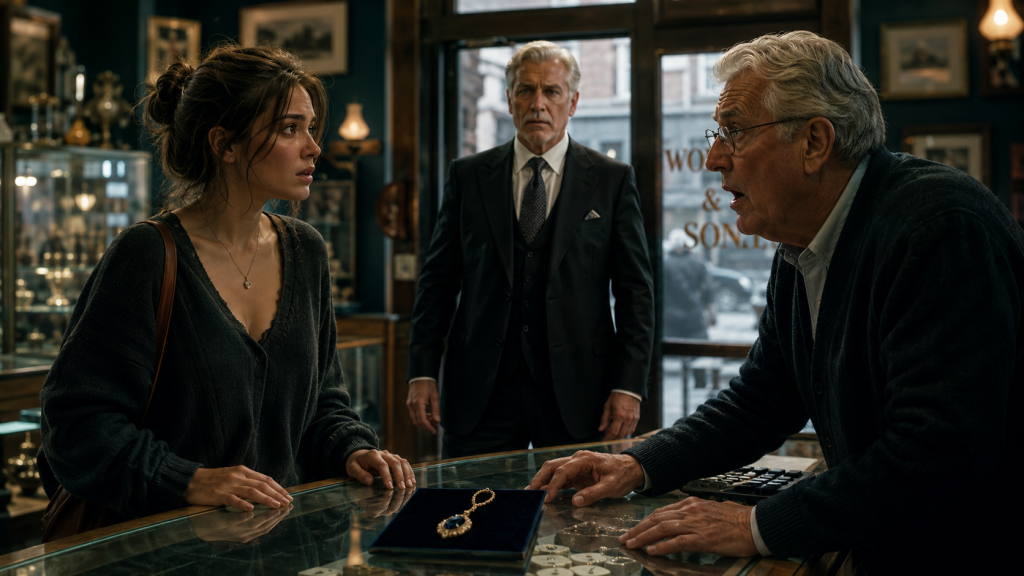
WOLF & SONS PAWN AND ESTATE GOODS.
My stomach tightened.
I pushed open the door.
A bell chimed overhead.
The shop smelled like old wood, metal polish, and rain-soaked coats.
Glass cases lined the walls, filled with watches, rings, pocketknives, medals, brooches, and things that had once mattered deeply to someone.
Behind the counter stood an elderly man with silver hair and wire-framed glasses.
He looked up from a ledger.
“Can I help you, ma’am?”
My throat felt dry.
“I need to sell this,” I said.
I placed the necklace on the counter like it might hurt me.
The old man barely glanced at it at first.
Then his hands froze.
His eyes sharpened.
The color drained from his face so quickly I thought he might collapse.
He reached for the pendant, then stopped, as if afraid to touch it.
“Where did you get this?” he whispered.
“It was my grandmother’s,” I said. “I only need enough for rent.”
His gaze snapped up.
“What was your grandmother’s name?”
“Merinda L. Rhodes,” I answered. “Why?”
The old man’s mouth opened.
Then shut.
He stumbled back like the counter had shocked him.
“Miss,” he said, voice trembling, “you need to sit down.”
My stomach dropped.
“Is it fake?”
“No,” he breathed. “It’s real.”
I frowned.
“What does that mean?”
Instead of answering, he grabbed a cordless phone from beneath the register.
His fingers shook as he pressed a speed dial.
“I have it,” he said when someone answered. “The necklace. She’s here.”
My blood went cold.
I stepped back.
“Who are you calling?”
He covered the receiver, his eyes wide with something between fear and relief.
“Miss… the master has been searching for you for twenty years.”
Before I could ask what that meant, a lock clicked behind the showroom.
The back door slowly opened.
When I saw who stepped inside, I gasped.
The man who entered was tall, silver-haired, and dressed in a black suit that looked too expensive for that dusty little pawn shop.
But it was his eyes that made me stop breathing.
They were pale gray.
The exact same unusual shade as my grandmother’s.
He stared at me like he had seen a ghost.
For a long moment, nobody moved.
Then he whispered one word.
“Elena?”
My heart lurched.
“That was my mother’s name,” I said.
His face crumpled.
The old dealer lowered his head respectfully.
“Sir,” he said, “this is Merinda’s granddaughter.”
The silver-haired man covered his mouth with one hand.
For a second, I thought he might cry.
He stepped closer, but I backed away.
“Who are you?” I demanded.
“My name is Adrian Vale,” he said softly. “Your grandmother saved my life.”
I stared at him.
“My grandmother was a seamstress. She lived in a little house with a leaking roof and canned peaches every summer. She didn’t save anyone’s life.”
“She saved mine,” he said. “And she saved your mother’s, too. At least for a while.”
The shop seemed to tilt.
“What are you talking about?”
Adrian looked at the necklace.
“That piece was never just jewelry.”
The old dealer reached beneath the counter and pressed a hidden latch.
Metal shutters slid down over the front windows with a heavy clank.
I spun toward the door.
“Let me out.”
“You are not a prisoner,” Adrian said quickly. “But people have searched for that necklace for decades. Dangerous people. If anyone followed you here, we needed privacy.”
“Dangerous people?” I laughed once, sharp and bitter. “I came here because I can’t pay rent.”
Adrian’s expression softened.
“I know that may be true. But you did not come here by accident.”
He reached into his coat and took out a leather folder.
From inside, he removed an old photograph.
He placed it on the counter.
My knees almost gave out.
It was my grandmother.
Younger.
Standing on the steps of a grand stone mansion beside a beautiful dark-haired woman holding a baby.
The baby had a tiny blue ribbon around her wrist.
On the back of the photo, written in faded ink, was a name.
Elena.
My mother.
I touched the edge of the photograph.
“I don’t understand,” I whispered.
Adrian’s voice dropped.
“Your mother was born Elena Vale.”
“No,” I said immediately. “My mother’s last name was Rhodes.”
“Merinda changed it to protect her.”
The words struck me so hard that I could not speak.
All my life, my mother had been a mystery.
She died when I was five.
A car accident, my grandmother said.
There were no cousins.
No aunts.
No grandfather.
No family stories.
Only Nana Merinda and me.
Whenever I asked about where we came from, Nana’s face would close like a locked door.
“Some pasts are safer when buried,” she would say.
I thought it meant heartbreak.
I never imagined it meant danger.
Adrian opened the folder further.
“There was a family called Vale,” he said. “Old money. Hotels, shipping, land, investments. My father had two children. Me and my younger sister, Clara. Clara was your mother’s birth mother.”
My breath caught.
“My grandmother was not my grandmother?”
“She was,” Adrian said firmly. “Not by blood perhaps, but by every true meaning of the word. Merinda worked in our household for years. She loved Clara like a daughter. And when everything fell apart, she risked her life to protect Clara’s baby.”
I looked at the necklace.
“What happened?”
Adrian’s jaw tightened.
“My brother-in-law, Victor, married Clara for money. When he learned my father had created a separate trust for Clara’s child, he became desperate. That trust could only be unlocked with three things: bloodline verification, a legal archive key, and that necklace.”
I picked it up.
“This?”
“Yes. The pendant contains a hidden mechanism. Inside is a micro-engraved crest and a small key. Without it, the trust could not be claimed.”
I shook my head.
“This sounds insane.”
“I know.”
“My mother died in a car accident.”
Adrian went quiet.
The old dealer looked down.
My hands turned cold.
“What?” I whispered.
Adrian’s eyes filled with grief.
“Your mother’s accident was never properly investigated. Merinda believed Victor arranged it after finding out Elena had survived.”
The room blurred.
I grabbed the counter to steady myself.
“No. No, my grandmother would have told me.”
“She planned to,” Adrian said. “But Victor’s men were still watching. Merinda disappeared with you after your mother died. We searched for her for years. Then we heard she had passed, but we never found you. The records had been changed.”
I remembered Nana moving us often when I was little.
Different apartments.
Different towns.
Never staying long.
I remembered her checking windows at night.
Whispering on the phone in the kitchen.
Telling me not to answer the door unless I knew who it was.
I had thought she was just nervous.
Now every memory rearranged itself into something darker.
The necklace lay between us, shining under the pawn shop lights.
“If this is true,” I said slowly, “then why now?”
Adrian looked at me with a sadness that made him seem older.
“Because Victor died six months ago.”
I swallowed.
“And?”
“And his son has been trying to find the necklace ever since. Without it, the trust remains frozen. With it, the rightful heir can finally claim what Clara intended for her bloodline.”
I almost laughed again.
“My bloodline? I’m a waitress who lives above a laundromat.”
“You are Clara Vale’s granddaughter,” Adrian said. “And Elena Vale’s daughter.”
I pulled away from the counter.
“No. I can’t do this.”
Adrian nodded.
“I understand.”
“No, you don’t. My husband left me. I lost my baby. I am being evicted. I came here to sell the only thing I had left of the woman who loved me, and now you’re telling me I belong to some rich family with murder and trusts and hidden keys?”
My voice cracked.
“I don’t want a fortune. I want one person in my life who doesn’t leave.”
The silence afterward was unbearable.
Then Adrian stepped back, giving me space.
“Merinda did not leave you,” he said quietly. “She carried you as far as she could. Maybe today is the day you find out how far her love really reached.”
Those words broke something open in me.
I looked down at the necklace.
For the first time, I noticed a tiny seam around the blue stone.
The old dealer handed Adrian a small velvet tool roll.
Adrian did not touch the necklace.
He only nodded toward it.
“It should open for you.”
My fingers trembled as I pressed the edge of the pendant.
Nothing happened.
Then I remembered Nana’s hands.
The way she always turned the pendant three times before tucking it under her blouse.
I turned the blue stone once.
Twice.
Three times.
There was a tiny click.
The pendant opened.
Inside was not empty.
A folded piece of paper lay beneath the stone, so thin it looked like dried flower petals.
Behind it was a miniature photograph.
I lifted it carefully.
The photograph showed a baby wrapped in a yellow blanket.
On the back, in my grandmother’s handwriting, were the words:
Allison, age six weeks. Elena’s daughter. Clara’s heir. Keep her safe.
My legs gave out.
Adrian caught a chair and slid it behind me just in time.
I sat down, shaking.
My whole life had been hidden in a necklace.
My grandmother had carried the truth around her neck.
Then she had given it to me.
Not as jewelry.
As proof.
As protection.
As a door back to where I came from.
But doors do not always open into safety.
Two hours later, I was in the back office of the pawn shop with Adrian, the dealer, and a lawyer named Ms. Hart who arrived carrying two locked briefcases.
She was a small woman with sharp eyes and a calm voice.
She scanned the paper from the necklace.
Then she scanned my birth certificate, my ID, and the old hospital bracelet Adrian had preserved from my mother’s file.
Finally, she looked at me.
“Ms. Rhodes,” she said, “you are the legal heir to the Clara Vale Preservation Trust, pending a final bloodline test.”
“How much?” I asked numbly.
The lawyer exchanged a glance with Adrian.
“After twenty years of asset growth, the trust is valued at approximately forty-eight million dollars.”
I stared at her.
Then I laughed.
Not because it was funny.
Because the number was too large for my brain to hold.
That morning, I had been worried about nine hundred dollars of rent.
Now a stranger in a suit was telling me that my dead mother’s family had left me more money than I could spend in ten lifetimes.
But all I could think about was my grandmother eating canned soup for dinner so I could have school shoes.
My grandmother sewing late into the night.
My grandmother telling me, “One day, sweetheart, the world will give back what it took.”
I had thought she meant kindness.
She meant this.
Ms. Hart closed the folder.
“There is one complication.”
Of course there was.
Adrian’s expression hardened.
“Victor’s son.”
The lawyer nodded.
“Marcus Vale filed a claim three months ago, arguing that Clara’s heir died with Elena. If he learns Allison is alive, he may challenge the trust. He may also attempt intimidation.”
I looked from one face to another.
“What kind of intimidation?”
Before anyone answered, my cracked phone buzzed on the table.
Tyler’s name flashed across the screen.
I almost ignored it.
Then another message appeared.
Tyler: Heard you’re still in town. Need to talk.
I frowned.
He had not checked on me once after the divorce.
Not after the miscarriage.
Not after I moved.
Not after I started working double shifts.
Now suddenly he needed to talk.
Another message came.
Tyler: It’s about that necklace.
My blood turned to ice.
I slowly lifted the phone and showed Adrian.
His face changed.
“How does he know about the necklace?”
I shook my head.
“I never told him anything. He knew it was my grandmother’s, that’s all.”
Adrian took out his own phone.
“Do not answer him.”
But Tyler called.
The ringtone echoed through the office like a warning bell.
I stared at the screen.
Then I answered and put it on speaker.
“What do you want?” I said.
Tyler’s voice came smooth and familiar.
“Allison, don’t be hostile. I just heard you might be selling your grandmother’s necklace.”
My skin crawled.
“From who?”
A pause.
“People talk.”
“No, they don’t. Not about me.”
He sighed.
“You always make everything dramatic.”
The old anger rose in my chest, but this time it did not own me.
“Say what you called to say.”
Another pause.
Then his voice sharpened.
“That necklace is marital property. If it’s worth something, half belongs to me.”
I almost laughed.
“You abandoned me, emptied our account, and left me with two trash bags.”
“That’s not how the law works.”
Ms. Hart silently held out her hand for the phone.
I gave it to her.
“Mr. Rhodes?” she said calmly.
“Who is this?”
“Counsel for Ms. Rhodes. Any future communication regarding property claims should be directed through legal channels. I should also warn you that the necklace was inherited before the marriage and is not marital property.”
Tyler went silent.
Then a different voice came onto the line.
A male voice I did not know.
“Tell Allison this is bigger than she understands.”
Adrian stood up slowly.
His face went white with rage.
“Marcus,” he said.
The line went dead.
For the first time, real fear entered the room.
Adrian ordered private security to take me to a safe hotel.
I protested at first.
I was tired of men making decisions around me.
But when we stepped outside the pawn shop, a black SUV was parked across the street.
Its windows were dark.
The engine was running.
The old dealer locked the shop behind us with shaking hands.
“We have to go,” Adrian said.
That night, in a hotel suite bigger than my entire apartment, I sat by the window and watched the city lights blur through tears.
There was a king-sized bed behind me.
Fresh flowers on the table.
Food I had not ordered.
Clean towels folded like fans.
It felt unreal.
But grief does not disappear just because the room gets nicer.
I still missed my baby.
I still felt the shape of Tyler’s betrayal.
I still heard my grandmother’s voice.
Near midnight, Adrian knocked softly.
He stood at the door holding a small wooden box.
“I found something you should have,” he said.
Inside was a bundle of letters tied with blue ribbon.
The first one was addressed in my grandmother’s handwriting.
To my Allison, when the truth finally finds her.
My hands shook as I opened it.
My dearest girl,
If you are reading this, then I am sorry. I wanted to tell you everything myself, but fear is a cruel master, and love sometimes looks like silence.
Your mother was brave. She loved you more than her own life. When danger came for her, she made me promise one thing: protect Allison, even if she grows up hating the secrets.
You were never abandoned. You were hidden.
You were never unwanted. You were treasured.
That necklace is not wealth, my darling. It is a map back to yourself.
Do not let greedy hands convince you that you are small.
You come from women who survived fire.
Now survive it with your head high.
I pressed the letter to my chest and sobbed.
Adrian sat across from me, silent and patient.
For the first time in months, someone did not tell me to stop crying.
The next morning, everything moved quickly.
Ms. Hart arranged the bloodline test.
Adrian provided documents from the Vale estate.
Security moved me from the hotel to a private residence outside the city.
And Tyler kept calling.
I did not answer.
By the third day, his messages turned ugly.
Tyler: You owe me.
Tyler: Don’t forget who took care of you.
Tyler: You think rich people will love you? They’ll use you.
Then came the message that made my hands stop shaking and my spine straighten.
Tyler: Marcus says you can still walk away with something if you sign. Don’t be stupid.
I showed Ms. Hart.
She smiled for the first time.
It was not a warm smile.
It was the kind of smile a knife might have if it could speak.
“Excellent,” she said. “Now we have proof of coordination.”
A week later, the bloodline test came back.
Positive.
I was Elena Vale’s daughter.
Clara Vale’s granddaughter.
The lawful heir.
Marcus filed an emergency challenge within hours.
The hearing was scheduled for Friday morning.
I walked into the courthouse wearing the only nice dress I owned, one Adrian’s assistant had quietly had cleaned and pressed.
Around my neck was my grandmother’s necklace.
Not hidden.
Not tucked away.
Visible.
Tyler was there.
He stood beside Marcus Vale, looking restless and pale.
Marcus was handsome in a cold way, with slicked-back hair and a smile that never reached his eyes.
When Tyler saw me, he looked me up and down like he was trying to recognize the woman he had thrown away.
I did not look away.
Inside the courtroom, Marcus’s lawyer argued that my claim was suspicious.
Convenient.
Possibly fraudulent.
He suggested I had been manipulated by Adrian.
He implied that my grandmother had stolen the necklace.
At that, I nearly stood up.
But Ms. Hart touched my arm.
“Wait,” she whispered.
Then she presented the evidence.
The photograph.
The hospital bracelet.
The letters.
The trust documents.
The necklace mechanism.
The recording of Tyler’s call.
The messages mentioning Marcus.
By the time she finished, Marcus’s smile was gone.
Then Adrian took the stand.
He spoke of his sister Clara.
Of my mother Elena.
Of Merinda’s courage.
Of twenty years spent searching.
His voice broke only once.
“When Merinda disappeared with the child, I was angry,” he said. “For years, I thought she had stolen my niece from us. But now I understand. She was the only one brave enough to save her.”
I looked down at the necklace.
For the first time, I did not feel poor wearing it.
I felt protected.
Then Tyler was called.
He tried to lie.
He said Marcus had only contacted him recently.
He said he was worried about me.
He said he never wanted money.
Ms. Hart showed the text messages.
Then bank records.
Then a transfer from Marcus’s associate to Tyler two days before Tyler called me.
The courtroom went silent.
The judge looked at Tyler over her glasses.
“Mr. Rhodes, did you accept payment to pressure your ex-wife into surrendering inherited property?”
Tyler’s mouth opened.
Nothing came out.
That was answer enough.
Marcus’s claim collapsed before lunch.
The judge confirmed my status as the lawful heir and referred the attempted coercion for further investigation.
When we stepped outside the courtroom, Tyler followed me into the hall.
“Allison,” he said.
I stopped.
For one wild second, I saw the man I had married.
The man who once kissed my forehead in grocery store aisles.
The man who painted the nursery yellow with me.
Then I saw the man who left me bleeding and grieving because my sadness bored him.
“What?” I asked.
His eyes flicked toward Adrian, then back to me.
“I made mistakes.”
“Yes,” I said.
“I was scared.”
“So was I.”
He swallowed.
“I didn’t know the necklace was worth that much.”
That almost made me smile.
“There it is.”
His face reddened.
“No, I mean… I didn’t know what you were going through.”
“You knew,” I said quietly. “You just didn’t care until my pain came with money.”
He looked down.
“I loved you once.”
I touched the necklace.
“And I loved the person I thought you were.”
Then I walked away.
The months that followed were strange.
The trust did become mine, though Ms. Hart helped me place most of it under careful management.
I did not buy a mansion.
Not at first.
I paid my rent.
Then I bought the entire laundromat building and gave every tenant six months free while repairs were made.
I returned to the diner one last time, not to work, but to leave envelopes for the women who had covered shifts for me when I cried in the bathroom.
I paid off medical debts for three families from the miscarriage support group I had joined silently online.
I created a foundation in my grandmother’s name.
The Merinda Rhodes Shelter Fund.
For women who had to leave with trash bags.
For women who were told grief made them hard to love.
For women who needed one more month to become free.
Adrian and I grew close slowly.
Not like a fairy tale.
Like family.
Awkward at first.
Careful.
He told me stories about Clara and Elena.
I told him about Nana.
Sometimes we cried.
Sometimes we laughed.
On the anniversary of my grandmother’s death, Adrian took me to the old Vale estate.
It stood beyond iron gates at the end of a road lined with oak trees.
Huge.
Beautiful.
Lonely.
Inside, in a locked room, hung a portrait of my mother.
Elena.
She had my mouth.
My dark hair.
My sad eyes.
For years, I thought I had no one’s face.
Now I stood in front of hers and finally saw where I came from.
Adrian left me alone in the room.
I took out Nana’s letter and read it again beneath my mother’s portrait.
You were never abandoned. You were hidden.
I cried, but this time the tears felt different.
Not empty.
Not hopeless.
Like rain after a fire.
A year after I walked into the pawn shop, the brass wolf still hung above the door.
The old dealer refused to let me buy him a new storefront.
Said it would ruin the charm.
But I did restore the building.
Quietly.
The shop became a place where people could bring heirlooms for honest appraisal without being cheated.
A small plaque beside the counter read:
In honor of Merinda Rhodes, who knew that some treasures are not meant to be sold, only returned.
Sometimes I still wear the necklace.
Not because it is worth millions.
But because it reminds me of the woman who carried my truth when I was too young to carry it myself.
The day I entered that pawn shop, I thought I was losing the last piece of my grandmother.
Instead, she gave me back my mother.
My name.
My family.
My future.
And most of all, myself.
I used to believe rock bottom was the place where life ended.
Now I know it can also be the place where hidden doors open.
Sometimes you walk in desperate, holding the only thing you have left.
Sometimes the man behind the counter goes pale.
Sometimes the past reaches out through gold and stone and whispers:
We have been searching for you.
And sometimes, after years of being abandoned, betrayed, and forgotten, you finally learn the truth.
You were never lost.
You were being protected until you were strong enough to come home.
THE END! THANK YOU FOR READING!