

After my six-year-old daughter won first place in an important competition, she ran to tell my parents, glowing with pride. But they crushed her with one sentence. “It’s nothing compared to what your cousin did.” When I saw her little face fall, I stood up and made an announcement that turned them white.
My six-year-old daughter, Lily Whitaker, had spent three months practicing for the Illinois Young Voices Recitation Competition. Every evening after dinner, she stood in our living room with her tiny sneakers planted on the rug, reciting her poem with careful little hand gestures and a serious face that made me want to laugh and cry at the same time.
The poem was called “The Little Lantern.”
It was about a small lantern shining in the dark, not because it was the brightest light in the world, but because it refused to go out.
Lily loved that line most.
“A little light is still a light,” she would say, lifting one hand dramatically toward the ceiling.
My wife, Hannah, would clap every single time like Lily had just performed on Broadway.
I would whistle.
Lily would bow, giggle, and then ask, “Again?”
And we would let her do it again.
Some nights, she stumbled over the words.
Some nights, she forgot an entire line and froze, her cheeks turning pink.
Some nights, she threw herself onto the couch and declared that she was never going to win because the other kids were older and probably knew “fancier poems.”
But every morning, she picked up the paper again.
That was what made me proudest.
Not the competition.
Not the ribbon.
Not the certificate.
It was the fact that my little girl kept trying.
The competition was held on a Saturday afternoon in a small auditorium attached to a community arts center in Oak Brook.
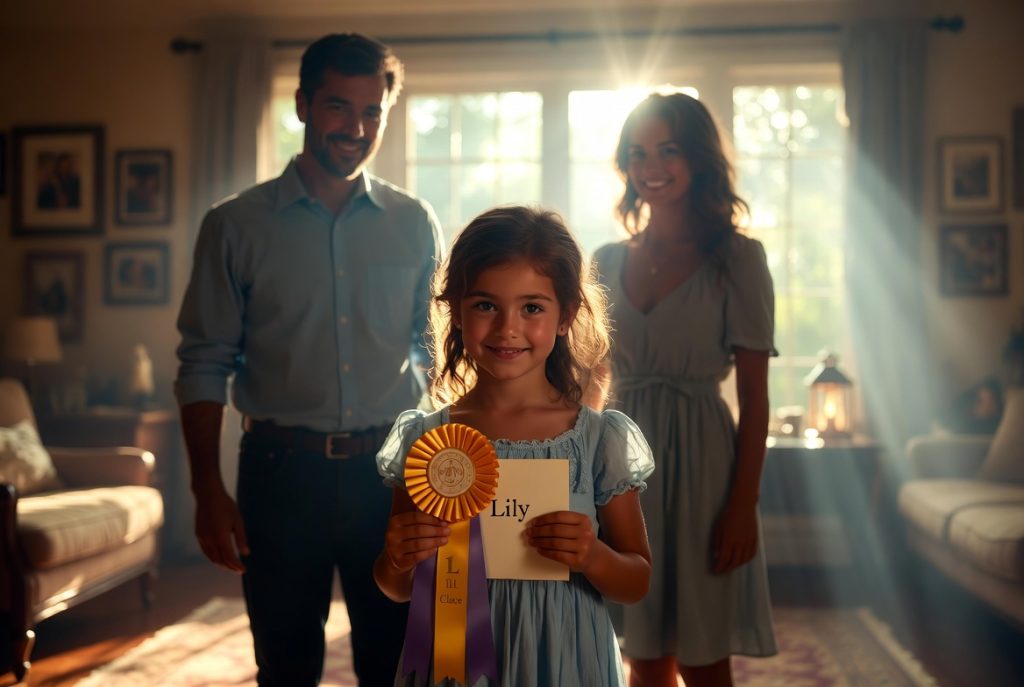
Lily wore a pale blue dress Hannah had ironed twice, white tights, and shiny shoes she kept looking down at because she said they made her feel “official.”
Before her turn, she held my hand so tightly that my fingers went numb.
“What if I mess up?” she whispered.
“Then you keep going,” I said.
“What if everyone laughs?”
“Then I’ll stand up and make a weird face so they laugh at me instead.”
She giggled, but her eyes were still nervous.
Hannah knelt in front of her and smoothed a loose curl behind her ear.
“Lily Grace Whitaker,” she said softly, “you already won in our house.”
Lily frowned. “But not here.”
“Here is just extra,” Hannah said.
That Saturday afternoon, when Lily’s name was called, she walked onto the stage like her shoes had suddenly become too heavy.
She stood behind the microphone, looked out at the rows of parents, judges, and restless children, and for a second, I saw panic flash across her face.
I leaned forward.
Hannah gripped my arm.
Then Lily took a breath.
A deep, brave breath.
And she began.
Her voice trembled on the first line.
By the third line, it steadied.
By the middle of the poem, the whole room had quieted.
Her tiny hands moved exactly the way she had practiced, her eyes bright with concentration.
When she reached the final line, she lifted her chin.
“A little light is still a light,” she said, “and even the smallest glow can guide someone home.”
The room clapped.
Not polite clapping.
Real clapping.
Lily stared out at the audience as if she could not believe the sound was for her.
I wiped my eyes before anyone could see.
Hannah did not even try to hide her tears.
When the winners were announced, I told myself not to care too much.
She was six.
She had been brave.
That was enough.
Third place went to a boy who had recited a funny poem about a dragon.
Second place went to a girl who was eight and had the confidence of a tiny lawyer.
Then the judge smiled and said, “And first place goes to our youngest finalist today, Lily Whitaker.”
For one second, Lily froze.
Then she looked at me from the stage, her brown eyes wide, as if asking whether she had heard correctly.
“You won, sweetheart,” I mouthed.
Her mouth opened.
Then she ran to accept the gold ribbon like it was a crown.
She stood there with the certificate in both hands, her chest rising and falling fast, her smile so wide it looked almost painful.
That was the image I wanted to keep forever.
My little girl, proud of herself.
Not asking permission.
Not comparing.
Not apologizing.
Just shining.
After the competition, we took pictures outside the auditorium.
Hannah made Lily hold the ribbon up.
I made her pose like a superhero.
Lily asked if we could get ice cream.
I said yes before she even finished the question.
Then Hannah said, “Maybe we should stop by your parents’ house first. They’re only twenty minutes away.”
My smile tightened before I could stop it.
Hannah noticed.
She always noticed.
“They’re her grandparents,” she said gently.
“I know.”
“She wants to tell them.”
I looked at Lily in the back seat, holding her certificate in her lap like it was made of glass.
She was humming to herself.
“She does,” I said.
But deep down, I felt the old heaviness settle in my chest.
My parents, Patricia and Richard Whitaker, lived in Naperville in a two-story brick house with trimmed hedges, polished floors, and a kitchen that always smelled faintly of lemon cleaner.
From the outside, it looked warm.
Inside, warmth had always depended on performance.
When I was a child, my parents did not exactly ignore me.
They attended my games.
They asked about my grades.
They remembered birthdays.
But love in our house had always come with a scoreboard.
If I got an A, they asked why it was not an A-plus.
If I scored a goal, they asked why I had missed the earlier shot.
If I drew a picture, my mother would say, “That’s nice, but your cousin Ethan was already winning art contests at your age.”
There was always someone better.
Someone smarter.
Someone more disciplined.
Someone more impressive.
And for most of my life, I believed that was normal.
Then my brother’s son, Mason, was born.
Mason was ten now, and to my parents, he might as well have been carved from gold.
He was a smart kid.
That was true.
He loved science, built little robots, and once explained black holes to me using a pancake.
I liked Mason.
Lily liked Mason too.
But my parents had turned his achievements into a weapon.
Every family dinner became a Mason report.
Mason tested above grade level.
Mason got invited to a regional science program.
Mason’s teacher said he was gifted.
Mason read chapter books early.
Mason knew multiplication before second grade.
Meanwhile, Lily’s drawings were “sweet.”
Her dancing was “cute.”
Her stories were “imaginative, but she should learn focus.”
I had brushed it off too many times.
I told myself they did not mean harm.
I told myself old habits were hard to break.
I told myself Lily was too young to notice.
I was wrong.
She noticed everything.
Still, when we pulled into my parents’ driveway, Lily bounced in her booster seat.
“Can I show Grandma first?” she asked.
“Of course,” Hannah said.
I turned off the car and looked at my wife.
She gave me a quiet look that said, Stay close.
I nodded.
Lily burst through their front door holding the certificate with both hands.
“Grandma! Grandpa! I won first place!”
My mother was sitting at the kitchen island, scrolling through photos on her phone.
My father sat at the breakfast table with his newspaper folded beside his coffee mug.
Neither of them stood.
Neither of them smiled the way grandparents should smile when a six-year-old runs in with joy spilling out of her.
My mother glanced up.
“Oh,” she said. “That’s nice.”
Lily’s smile flickered, but she pushed forward.
She placed the certificate on the counter with trembling pride.
“I was the youngest one in my group,” she said.
My father folded his newspaper with a sigh.
“Well,” he said, “it’s nothing compared to what your cousin Mason did. He got invited to that regional science program. Now that’s impressive.”
The room went still.
Not silent.
Still.
Like even the air had stopped moving.
Lily blinked.
Her fingers slowly curled around the edge of her certificate.
My mother added, “Mason has always been advanced. Competitions like this are cute, but you know, some children are naturally gifted.”
Lily looked down.
And I watched my daughter shrink in front of them.
It happened so quickly.
One moment, she had been standing tall, glowing with pride.
The next, her shoulders rounded inward.
Her smile disappeared.
Her certificate lowered against her dress.
It was like someone had reached into her little chest and dimmed the light.
Hannah’s face hardened.
“She is six,” she said.
My mother gave a careless wave.
“We’re just being realistic.”
Something inside me snapped quietly.
Not loudly.
Not violently.
Just a clean, final break.
I walked over, picked up Lily’s certificate, smoothed the bent corner, and handed it back to her.
Then I turned to my parents.
“I have an announcement,” I said.
My father frowned.
“Daniel, don’t be dramatic.”
“No,” I said. “You’re going to listen.”
My voice was calm, but it filled the kitchen.
“From today on, Lily will not be coming here to beg for approval from people who make a child feel small. You will not compare her to Mason. You will not dismiss her achievements. And you will not be allowed near her until you understand what you just did.”
My mother’s face drained of color.
My father went white.
Because they knew I meant it.
Lily gripped my hand.
And for the first time in years, I stopped being their quiet son.
My mother opened her mouth, but no words came out.
That frightened her more than shouting would have.
I had never been the son who made scenes.
I was the son who swallowed things.
I was the son who laughed awkwardly when they insulted me.
I was the son who changed the subject when my father went too far.
I was the son who told Hannah, “They’re just like that,” when she asked why I kept accepting crumbs from people who had full plates for everyone else.
Not anymore.
My father stood from the table slowly, his jaw tight.
“You are overreacting.”
I looked at Lily.
Her eyes were shining with tears she was trying hard not to let fall.
“No,” I said. “I am finally reacting the right amount.”
My mother pressed a hand to her chest.
“We love her.”
I almost laughed.
Not because it was funny.
Because it was so easy for people to say love after they had already used their words like knives.
“Love does not sound like comparison,” I said.
My mother flinched.
Hannah stepped beside me, her hand resting gently on Lily’s shoulder.
“She worked for this,” Hannah said. “For three months. Every night. She was nervous and she did it anyway. You had one job today. One. Be happy for her.”
My father looked embarrassed now, but embarrassment was not the same as remorse.
“She needs to learn that the world won’t clap for everything,” he said.
“She did not ask the world to clap,” I said. “She asked her grandparents.”
That landed.
For a moment, even my father had no answer.
Lily’s little voice broke the silence.
“I was proud,” she whispered.
My mother’s face crumpled.
But I did not let that change the truth of the moment.
Because adults often waited until children were wounded before they became sorry.
I crouched in front of Lily.
“You should be proud,” I told her. “You stood on a stage. You used your voice. You kept going even though you were scared. That is brave.”
A tear slipped down her cheek.
“Was it good?” she asked.
“It was beautiful,” I said.
Hannah wiped Lily’s cheek with her thumb.
“It was the best thing I saw all day.”
My mother stepped forward.
“Lily, sweetheart—”
I stood immediately.
“No.”
My mother froze.
“You do not get to fix this by making her comfort you,” I said.
Her mouth opened again.
I continued, “You don’t get to hurt a child and then rush in for forgiveness because you feel guilty. Not today.”
My father’s face darkened.
“Watch your tone.”
That sentence took me back thirty years.
I was eight again, standing in that same kitchen with a math test in my hand.
Ninety-four percent.
My father had looked at it and said, “Where did the other six points go?”
I had felt so ashamed.
Not because I had failed.
Because I had almost succeeded and still somehow disappointed him.
Now my daughter stood beside me, holding her own certificate.
And I finally understood something.
The little boy I had been could not defend himself.
But the man I had become could defend her.
I stepped closer to my father.
“My tone is the least important thing in this room.”
He stared at me, stunned.
“You think I don’t remember?” I said.
My mother’s eyes flickered.
“Daniel…”
“No. We’re not skipping over it this time.”
Hannah looked at me carefully, but she did not stop me.
I turned back toward my parents.
“My whole life, nothing was ever enough. Good grades were not good enough. Sports were not good enough. My job was not impressive enough. My house was not big enough. My choices were not smart enough. And I let you talk to me that way because I thought that was what family did.”
My voice shook then, but I did not lower it.
“But Lily is not going to inherit that.”
The silence that followed felt heavier than shouting.
My mother lowered herself onto the kitchen stool.
“I didn’t know you felt that way.”
I stared at her.
“Yes, you did.”
She looked down.
“You just didn’t think I would ever say it.”
My father muttered, “This is ridiculous.”
“No,” Hannah said sharply. “What’s ridiculous is that your granddaughter came here with the happiest news of her life, and you turned it into a ranking.”
My father pointed toward the door.
“If this is how you’re going to speak in my house—”
“Then we will leave,” I said.
And we did.
I took Lily’s hand.
Hannah picked up Lily’s little cardigan from the back of a chair.
My mother rose quickly.
“Daniel, wait.”
I paused at the doorway, not because she deserved it, but because Lily was looking at me.
My mother’s voice trembled.
“We didn’t mean to hurt her.”
“That’s not enough,” I said.
My father scoffed.
“What do you want, an apology ceremony?”
I looked straight at him.
“I want you to become people who don’t need to be begged into kindness.”
His face changed.
Just a little.
Like the words had found a crack.
Then Lily turned back toward them.
Her voice was small.
“Grandpa, I practiced a lot.”
My father looked at her certificate.
For the first time, really looked.
“I’m sure you did,” he said, but the words came too late and too thin.
Lily nodded, not smiling.
Then she walked out with us.
That night, we did not go for ice cream right away.
Lily said she did not want any.
That broke my heart more than the kitchen scene had.
Lily never turned down ice cream.
At home, she went to her room and placed the certificate on her desk.
The ribbon stayed in her hand.
Hannah sat beside her on the bed.
I stood in the doorway, afraid to say the wrong thing.
Lily looked at the ribbon for a long time.
“Is Mason better than me?” she asked.
Hannah closed her eyes for half a second.
I walked into the room and sat on the floor in front of her.
“No,” I said.
“But Grandma said he’s gifted.”
“Mason is good at science,” I said. “You are good at speaking and telling stories. And you are still learning many things. People are not better or worse because they shine in different ways.”
Lily touched the gold ribbon.
“Then why did they say that?”
I took a breath.
Because they were careless.
Because they had been careless for years.
Because some adults mistook comparison for motivation.
Because my parents had never learned how to celebrate without measuring.
But she was six.
So I said, “Because sometimes grown-ups say unkind things when they should know better.”
She looked at me.
“Will they say sorry?”
“I don’t know,” I answered honestly.
“Can I still be proud?”
My throat tightened.
“Yes,” I said. “You can always be proud of something you worked hard for.”
Hannah reached over and brushed Lily’s hair back.
“And we are proud of you every day.”
Lily leaned into her mother.
After a while, she whispered, “Can we put it where people can see?”
I stood.
“Yes.”
We framed the certificate that night.
Not the next day.
Not when we had time.
That night.
I found an old black frame in the closet, cleaned the glass, and placed the certificate inside.
Hannah helped Lily choose the spot.
Right in the living room, above the small bookshelf where we kept family photos.
Then Lily taped the ribbon beside it because she said the ribbon should not be “trapped behind glass.”
When it was done, she stood back and looked at it.
Her face was still tired from crying, but something had returned to her eyes.
A little glow.
A little light.
Still a light.
The next morning, my phone rang at 8:12.
My mother.
I watched the screen until it stopped.
She called again at 8:16.
Then again at 8:24.
Hannah came into the kitchen and saw my face.
“Your mom?”
I nodded.
“You don’t have to answer.”
“I know.”
That was new.
Knowing I had a choice.
When the voicemail appeared, I listened on speaker.
My mother’s voice was shaky.
“Daniel, I barely slept. I think yesterday got out of hand. Your father feels awful too, though he may not say it correctly. Please call me. I want to talk about Lily.”
I put the phone down.
Hannah watched me.
“What do you think?”
“I think she still said yesterday got out of hand, not that they hurt Lily.”
Hannah nodded slowly.
“That matters.”
It did.
By noon, my father sent a text.
You embarrassed your mother. We were only being honest. Kids need resilience.
I stared at the message for a long time.
Then I typed back:
Lily showed resilience when she walked onto a stage at six years old and performed in front of strangers. What she needed from you afterward was love.
He did not answer.
Two days passed.
Lily went to school.
She showed her teacher the ribbon.
Her teacher sent us a photo of Lily standing in front of the class while everyone clapped.
When I picked her up, she was smiling again.
“Mrs. Alvarez said I can recite my poem at Friday assembly,” she said.
“That’s amazing.”
“Do you think Grandma and Grandpa would come?”
The question hit me harder than I expected.
Children’s hearts are so generous.
Even after being hurt, they still look back toward the people who hurt them, hoping those people will become better.
“I don’t know,” I said.
“Do you want them to?”
She thought about it.
“I want them to clap this time.”
I swallowed.
“That makes sense.”
That evening, after Lily went to bed, Hannah and I sat in the living room under the framed certificate.
“I don’t want to keep her from them forever,” I said.
“I know,” Hannah replied.
“But I don’t want to hand her back to people who haven’t changed.”
“Then don’t.”
I rubbed my hands over my face.
“My mother might understand. My father…”
Hannah leaned forward.
“Daniel, your father does not have to understand everything. But he does have to behave.”
That sentence stayed with me.
The next afternoon, my mother showed up at our door.
Alone.
Her eyes were swollen, and she held a small gift bag.
I did not invite her in right away.
For once, she seemed to understand that the doorway was a boundary, not a formality.
“Is Lily home?” she asked.
“Yes.”
“Can I see her?”
“Not until we talk.”
She nodded quickly.
“I know.”
We stood on the porch.
The June air smelled like cut grass and rain.
My mother twisted the handle of the gift bag.
“I’ve been thinking,” she said. “About what you said.”
I waited.
She looked down.
“I used to think comparison pushed children to do better. My parents did it to me. Your father’s parents did it to him. We thought it made us strong.”
“It made me feel invisible,” I said.
She flinched.
“I didn’t know.”
This time, I did not let her hide there.
“You didn’t ask.”
Her eyes filled.
“No. I didn’t.”
That was the first honest thing she had said.
She took a breath.
“When Lily came in, I was looking at pictures your brother sent of Mason at the science program orientation. I had him in my head. And when Lily showed us her certificate, I treated it like it was smaller because it was different.”
Her voice broke.
“That was wrong.”
I said nothing.
She continued, “It was not cute. It was not nothing. It was hers. And she deserved joy from us.”
My chest tightened.
That was closer.
Much closer.
“What about Dad?”
My mother looked away.
“Your father is ashamed.”
“That’s not the same as sorry.”
“I know.”
“Is he willing to say it to her?”
She hesitated.
And there was my answer.
I nodded.
“Then he is not ready.”
My mother wiped her cheek.
“I brought something for her.”
I looked at the bag.
“What is it?”
“A little display stand for her ribbon. And a card.”
“Does the card say what you just said?”
She nodded.
“I wrote it three times because the first two sounded like excuses.”
For the first time since Saturday, something in me softened.
Not enough to forget.
Not enough to pretend.
But enough to open the door a little.
“I’ll read it first,” I said.
“Of course.”
I took the card.
Inside, in my mother’s careful handwriting, it said:
Dear Lily,
I am sorry for not celebrating your wonderful achievement. You worked hard, you were brave, and you deserved to hear that we were proud of you. I was wrong to compare you to Mason. Your light is your own, and it matters.
Love,
Grandma
I read it twice.
Then I looked at my mother.
“This is a real apology.”
She nodded, crying now.
“I want to give it to her myself, if you’ll allow it. And if she doesn’t want to hug me, I won’t ask.”
That mattered too.
I opened the door wider.
“Wait here.”
I went upstairs.
Lily was coloring at her desk.
“Grandma is here,” I said gently. “She wrote you a card. She wants to apologize. You do not have to talk to her unless you want to.”
Lily’s eyes widened.
“Is Grandpa here?”
“No.”
“Is he mad?”
“I don’t know. But Grandma came to say sorry for herself.”
Lily thought about it.
Then she slid off the chair.
“I want to hear.”
We went downstairs together.
My mother stood when she saw Lily, but she did not rush forward.
She clutched the card in both hands.
“Hi, sweetheart,” she said softly.
Lily stood half behind my leg.
“Hi.”
My mother crouched carefully, lowering herself to Lily’s height.
“I was wrong on Saturday,” she said. “You came to show us something special, and I made you feel like it didn’t matter. That was unkind. I should have said congratulations. I should have told you I was proud. I am very sorry.”
Lily stared at her.
My mother held out the card.
“I wrote it down too, so you can keep it if you want.”
Lily took it.
She could read some of the words herself, but Hannah helped her with the rest.
When Hannah finished, Lily looked at my mother.
“My poem was about a lantern.”
My mother nodded.
“Your dad told me.”
“It said a little light is still a light.”
My mother’s chin trembled.
“That’s a beautiful line.”
Lily hugged the card to her chest.
“I don’t want to be compared.”
“I won’t compare you again,” my mother said.
Lily looked at me, checking.
I gave her a small nod.
Then she said, “You can see my ribbon.”
My mother followed her into the living room like someone entering a church.
Lily pointed to the wall.
“There.”
My mother looked at the framed certificate and the ribbon hanging beside it.
For once, she did exactly what she should have done from the beginning.
She clapped.
Not loudly.
Not dramatically.
Just warmly.
“Oh, Lily,” she said. “It’s wonderful.”
Lily’s smile returned slowly.
It was not the same unguarded smile from competition day.
But it was real.
Trust does not return all at once.
Sometimes it peeks out carefully, checking whether the room is safe.
My father did not apologize that week.
Or the next.
He sent stiff messages about how families should not “cut each other off over one comment.”
I did not respond to those.
Then Friday came.
Lily wore the same blue dress to school for assembly.
Hannah and I sat in the back of the school gym on folding chairs.
My mother came too.
She asked first.
I said she could come if Lily wanted her there.
Lily agreed, but made one rule.
“Grandma has to clap for everybody,” she said.
My mother promised.
The children performed songs, short speeches, and poems.
When Lily walked onto the small stage, she searched the crowd until she found us.
Hannah waved.
I gave her two thumbs up.
My mother pressed both hands over her heart.
Lily smiled.
Then she recited “The Little Lantern” again.
This time, her voice did not tremble.
When she finished, the gym filled with applause.
My mother stood up.
She stood first.
Lily saw her.
And the smile that spread across my daughter’s face nearly broke me.
After the assembly, Lily ran to us.
Hannah hugged her.
I lifted her off the ground.
My mother waited.
She did not force herself into the moment.
That was new too.
Lily turned to her.
“Did you like it?”
My mother crouched.
“I loved it. You were brave and clear, and I understood every word.”
Lily beamed.
Then my mother said, “I brought someone who wants to talk to you. But only if you want.”
I looked past her.
My father stood near the gym doors.
He looked smaller somehow.
Not physically.
Just less certain.
His hands were in his pockets.
His face was pale.
Lily saw him and went quiet.
I set her down but kept my hand on her shoulder.
My father approached slowly.
“Daniel,” he said.
I did not answer.
He looked at Hannah.
Then at Lily.
For several seconds, he seemed to fight with himself.
Pride is a stubborn thing.
In some men, it grows like armor.
In my father, it had become almost a second skin.
But standing in that school gym, surrounded by paper decorations and the sound of children laughing, something in him cracked.
He cleared his throat.
“Lily,” he said, “I was wrong.”
Lily blinked.
My father swallowed.
“What you did was impressive. Not cute. Not small. Impressive. You practiced, and you got up there, and you won first place. Then today, I watched you do it again.”
His voice grew rough.
“I should have said congratulations. I should never have compared you to Mason.”
Lily looked down at her shoes.
My father continued, “Your dad is right. Grandparents are supposed to make children feel safe. I didn’t do that.”
I felt Hannah’s hand find mine.
My father looked at me then.
“And I didn’t always do that for you either.”
The gym noise faded around me.
For a second, I was back in that old kitchen with the ninety-four percent test.
Back on the soccer field.
Back at my college graduation, when he said my degree was useful but not prestigious.
Back in every moment I had waited for him to say, “I am proud of you,” without adding a correction.
My throat tightened.
My father’s eyes were wet.
“I thought pressure made people better,” he said. “Maybe I just made them feel alone.”
No one moved.
Then Lily, with the simple honesty only children have, asked, “Are you going to do it again?”
My father let out a shaky breath.
“I’m going to try very hard not to.”
She considered that.
Then she said, “If you do, Daddy will make you leave.”
My mother covered her mouth.
Hannah looked away, trying not to laugh.
My father nodded seriously.
“That sounds fair.”
Lily held up her assembly sticker.
“I got a star today too.”
My father looked at it like it was a medal from the president.
“That is an excellent star.”
Lily smiled.
Not fully.
Not completely.
But enough.
Over the next few months, things changed slowly.
Not perfectly.
Perfect change only happens in movies.
Real change is awkward.
It stumbles.
It forgets itself and has to be reminded.
My father still started to say, “Mason just—” once during dinner.
He stopped mid-sentence.
Looked at Lily.
Then said, “Actually, Lily, tell me about your art project.”
My mother started keeping a small calendar on her fridge with both grandchildren’s events written in different colors.
Mason’s science fair.
Lily’s recitation assembly.
Mason’s robotics club.
Lily’s library reading day.
Not ranked.
Not measured.
Just remembered.
And something surprising happened.
Mason seemed relieved too.
One Sunday afternoon, while the adults were drinking coffee, I found Mason and Lily building a blanket fort in my parents’ living room.
Mason was explaining how to keep the roof from collapsing.
Lily was decorating the entrance with paper stars.
“I’m the lantern queen,” she announced.
Mason nodded solemnly.
“And I’m the engineer.”
They worked together for almost an hour.
No competition.
No scoreboard.
Just two children allowed to be different.
I stood in the hallway watching them, and my mother came beside me.
“They’re sweet together,” she said.
“They always were,” I replied.
She looked ashamed.
“I think we made it harder than it had to be.”
“Yes,” I said.
The truth no longer needed softening.
She accepted it with a small nod.
That evening, before we left, my father walked Lily to the car.
She was carrying a drawing she had made for him.
It showed a tiny lantern on a hill under a sky full of stars.
My father held it carefully.
“I’m going to put this in my office,” he said.
Lily narrowed her eyes.
“Where people can see?”
He nodded.
“Where people can see.”
She smiled.
“Good.”
Then she climbed into the car.
As I buckled her seatbelt, she whispered, “Daddy?”
“Yes?”
“I think Grandpa is learning.”
I looked back at my father, standing in the driveway with the drawing in his hands.
“Yeah,” I said. “I think he is.”
She leaned back against the seat.
“And I’m still proud.”
I smiled.
“That’s the most important part.”
On the drive home, Lily fell asleep with her head tilted against the window.
Hannah reached over and squeezed my hand.
“You did the right thing,” she said.
I looked at the road ahead, the evening sky turning gold over the suburbs.
For years, I had believed keeping peace meant staying quiet.
But peace built on silence is not peace.
It is just fear wearing polite clothes.
That day in my parents’ kitchen, I had not destroyed our family.
I had drawn a line around my daughter’s heart and told everyone, including myself, that they were not allowed to step on it.
And in doing that, I had drawn a line around the child I used to be too.
The one who had waited so long to hear that he was enough.
Maybe my parents would keep learning.
Maybe they would fail sometimes.
Maybe we would have more hard conversations.
But Lily’s ribbon still hung in our living room.
Her certificate stayed framed where everyone could see it.
And every now and then, she would stand beneath it and recite her favorite line again, louder than before.
“A little light is still a light.”
Then she would look at me.
And I would clap first.
Always.
THE END! THANK YOU FOR READING!