

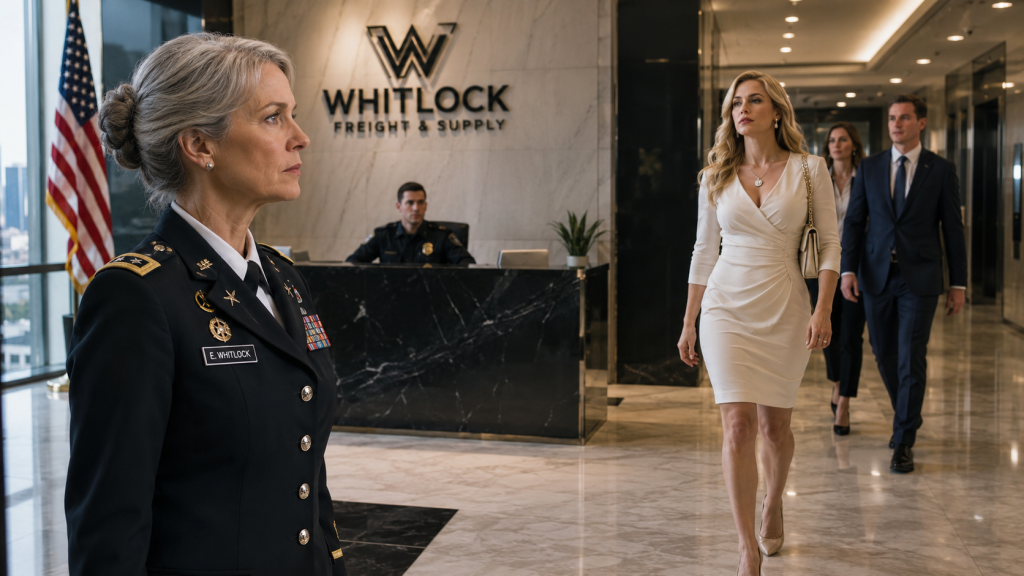
The security guard laughed when I told him I was there to surprise my husband. Not a nervous laugh. Not the kind of laugh a person gives when they are uncomfortable. It was casual, amused, almost pitying, as if a gray-haired woman in an Army dress uniform had just walked into the lobby of one of Nashville’s most expensive logistics firms and claimed she owned the moon.
“I’m sorry,” I said, because I honestly thought I had misheard him. The guard leaned back in his chair, still smiling. “Ma’am, Mr. Whitlock’s wife is already upstairs.” For a moment, the lobby seemed to tilt.
The marble floor, the steel elevators, the glass walls overlooking downtown Nashville, the American flag standing beside the receptionist’s desk—everything stayed exactly where it was, yet nothing made sense anymore.
“My husband,” I said slowly, “is Graham Whitlock.”
The guard’s smile weakened.
“Yes, ma’am.”
“And you’re telling me his wife is already here?”
He glanced toward the private elevator bank.
“She comes in almost every day.”
The words landed softly, but they split something open inside me.
I had driven three hours from Fort Campbell after receiving unexpected leave. I had not called Graham because I wanted to surprise him. After thirty-one years of marriage, after missed anniversaries, holiday dinners over video calls, and birthdays celebrated with packages mailed across oceans, I thought we had earned one old-fashioned romantic moment.
I imagined walking into his office.
I imagined his face lighting up.
I imagined him taking me into his arms and whispering, “Eleanor, you’re home.”
Instead, a twenty-six-year-old security guard was looking at me like I was confused.
Then he said the sentence that changed my life.
“There she is now.”
I turned.
A woman stepped out of the executive elevator wearing a cream designer dress, nude heels, and a diamond pendant that caught the lobby lights like a blade.
She was younger than me by at least fifteen years. Blonde, polished, confident. The kind of woman who had never had to wonder whether dust from a military convoy would ever wash out of her hair.
Two employees passing through the lobby smiled at her.
“Morning, Mrs. Whitlock,” one of them said.
Mrs. Whitlock.
My name.
My place.
My life.
The woman gave a graceful little nod, then looked directly at me.
Our eyes met for half a second.
Something flickered across her face.
Not confusion.
Not surprise.
Recognition.
Then she walked past me as if I were a stranger.
I should have shouted. I should have followed her. I should have marched upstairs and demanded to see Graham.
But thirty-two years in the United States Army had trained certain instincts into my bones.
When the ground shifts beneath you, you do not scream.
You assess.
You breathe.
You gather facts before you fire.
So I turned back to the guard and forced a smile.
“Must be a misunderstanding,” I said.
He looked relieved.
“Happens more than you’d think.”
No, I thought.
It doesn’t.
Outside, the Tennessee sun hit my face with cruel brightness. I walked to a bench near the curb and sat down with my small overnight bag beside my polished shoes.
Cars moved in and out of the parking garage. Employees hurried past carrying coffee and laptops. Life continued all around me, ordinary and careless.
My phone buzzed.
A text from Graham.
Miss you, Ellie. Counting the days.
I stared at those words until they blurred.
He thought I was still stationed overseas for another month. He thought I was waking up in a military housing unit thousands of miles away, not sitting outside his office after being told another woman had taken my name.
The obvious answer was an affair.
But affairs hide.
This woman was not hidden.
She walked through his company like she owned the building. Employees greeted her. Security recognized her. No one whispered. No one acted guilty.
That meant this was bigger than betrayal.
This was replacement.
That afternoon, I checked into a hotel under my maiden name, Eleanor Hayes.
Not because I was afraid of Graham finding me, but because I needed silence. I needed a place where I could stop being a wife and start thinking like the officer I had spent my adult life becoming.
From the window of my room, I could see the Nashville skyline glowing gold in the late afternoon.
Somewhere in that city, my husband was probably having lunch with the woman everyone believed was his wife.
I opened my laptop.
The first thing I searched was his company website.
Whitlock Freight & Supply.
Founded by Graham Whitlock.
Chief Executive Officer.
Community leader.
Husband.
Patriot.
Visionary.
There were photographs from charity galas, ribbon cuttings, veterans’ fundraisers, hospital donations, golf tournaments.
And there she was.
Again and again.
The blonde woman stood beside him in nearly every picture. Her hand rested on his arm. His smile looked warm, proud, familiar.
The captions called her “Graham’s wife, Celeste.”
Celeste Whitlock.
I clicked photo after photo until my fingertips went cold.
In one picture, she wore my pearl earrings.
In another, she stood in front of my house on Christmas Eve, holding a glass of wine beside the fireplace I had helped design.
Then I saw the photo that made the room disappear.
Graham and Celeste on the stage at last year’s Veterans Honor Dinner.
Behind them hung a massive American flag.
On Celeste’s neck was my silver star pendant—the one Graham had given me after my promotion to colonel.
The caption read:
Graham and Celeste Whitlock, proud supporters of military families.
Military families.
I closed the laptop so hard the desk shook.
For nearly a minute, I could not move.
Then my phone rang.
It was my daughter, Audrey.
“Mom?” she said. “Are you back in the States?”
My chest tightened.
“Why?”
There was a pause.
“Because Dad just called me. He sounded panicked. He asked if I had heard from you.”
I stood slowly.
“What exactly did he say?”
Audrey’s voice dropped.
“He said if you contacted me, I should tell him immediately.”
The hotel room went silent.
My husband knew.
Somehow, Graham knew I was home.
And by the fear in my daughter’s voice, I understood something even worse.
He was not worried about our marriage.
He was worried about what I might discover next.
“Audrey,” I said carefully, “I need you to tell me the truth. Do you know a woman named Celeste?”
She did not answer.
That silence was the first confession.
My hand tightened around the phone.
“How long?”
“Mom,” she whispered, “Dad said it was complicated.”
I closed my eyes.
Complicated.
That was the word cowards used when the truth was too ugly to say out loud.
“He said you and he were separated emotionally,” Audrey continued. “He said you knew. He said you stayed married for appearances because of your military career.”
A laugh escaped me, sharp and humorless.
“I have spent half my life defending people who sleep safely under flags they never had to carry,” I said. “And your father told you I agreed to let another woman wear my name?”
Audrey started crying.
“I didn’t know what to believe. You were gone so much. He said you didn’t want family drama.”
I sat down slowly on the edge of the bed.
“When did you first meet her?”
“Last year,” she said. “At the company Christmas party.”
My heart clenched.
The party I had missed because I was overseas.
“Dad introduced her as his wife?”
Audrey’s breathing shook.
“Yes.”
The word cut through me cleanly.
“And you said nothing?”
“I tried,” she said quickly. “I asked him after. He got angry. He said I was being disrespectful. He said you had given him permission to live separately, but not legally separate because of taxes and company holdings.”
“Company holdings?”
Another silence.
My pulse slowed.
That was not heartbreak anymore.
That was a clue.
“What papers did he have you sign?”
Audrey sniffed.
“I don’t know. He said it was routine. Something about family trust updates. He said because you were overseas, he needed me to sign as witness.”
“When?”
“Last October.”
“Was Celeste there?”
Audrey’s voice became very small.
“Yes.”
“Was she wearing my pendant?”
This time, Audrey openly sobbed.
“I’m sorry, Mom.”
I looked toward the darkening window.
Outside, Nashville glittered like nothing bad had ever happened there.
“Send me everything you remember,” I said. “Dates. Names. Offices. Who else was there. And Audrey?”
“Yes?”
“Do not tell your father you spoke with me.”
After I hung up, I remained sitting for a long time.
Then I opened the small side pocket of my overnight bag and removed my field notebook.
The cover was worn. The corners were bent. I had carried it through deserts, airports, command centers, and sleepless nights when the only thing between order and chaos was a woman with a pen making a list.
I wrote three words on the first clean page.
Graham.
Celeste.
Trust.
Then I began.
By midnight, I had found the first crack.
The Whitlock Family Trust had been updated eleven months earlier.
Public records showed a filing connected to Whitlock Freight & Supply, three residential properties, and a charitable foundation created in my name.
The Eleanor Whitlock Veterans Family Fund.
My name.
I had never signed anything.
I had never approved any foundation.
Yet there were photos online of Graham and Celeste presenting checks to local organizations, smiling beneath banners with my name printed in blue and silver.
The woman wearing my pendant had not only taken my place beside my husband.
She had been using my military service as a costume.
At 6:10 the next morning, I called the one person Graham would never expect me to call.
Mara Bennett.
My attorney.
Mara had represented soldiers in ugly divorces, business disputes, and inheritance fights for twenty years. She was small, sharp-eyed, and had the rare gift of sounding calm while sharpening a knife.
“Eleanor,” she said. “I thought you were overseas.”
“So did my husband.”
There was a pause.
Then Mara said, “Tell me everything.”
I did.
I told her about the guard. The woman upstairs. The company photos. The pendant. Audrey’s confession. The trust. The foundation.
When I finished, Mara did not gasp. She did not apologize. She did not offer soft words.
She said, “Do not confront him yet.”
“I wasn’t planning to.”
“Good. Because if he changed trust documents using your name or forged your consent, this may not be just adultery. It may be fraud.”
Fraud.
There it was.
The word that made everything click into place.
“You need documents,” Mara said. “Original signatures. Not copies. Bank records. Foundation filings. Company shareholder agreements. Property transfers. Anything with your name on it.”
“How long will that take?”
“Longer than you want,” she said. “Unless he thinks he can still control the story.”
I looked at my uniform hanging neatly by the closet.
Graham had always loved me most in uniform.
Not because he respected the sacrifice.
Because it made him look honorable.
“Then I’ll give him a stage,” I said.
Two nights later, Whitlock Freight & Supply hosted its annual Patriot Leadership Gala at a grand hotel downtown.
I knew because the company website had advertised it for months.
Graham would be there.
Celeste would be there.
Half of Nashville’s donors, executives, veterans, and reporters would be there.
The public story mattered to Graham more than the private truth ever had.
So I chose the public story.
At 7:30 p.m., I arrived at the gala in full dress uniform.
The ballroom was bright with chandeliers. Round tables glittered with crystal glasses. Red, white, and blue banners hung across the walls. A string quartet played near the entrance.
People turned as I walked in.
Some recognized the uniform before they recognized me.
Then whispers began.
“Is that Colonel Whitlock?”
“I thought she was overseas.”
“That’s Graham’s real wife, isn’t it?”
Real wife.
How strange to hear people say it like a discovery.
Across the room, Graham stood near the stage in a black tuxedo.
Beside him was Celeste.
She wore a navy satin gown, her blonde hair swept over one shoulder.
And at her throat, glowing beneath the ballroom lights, was my silver star pendant.
For one second, I forgot every plan.
I forgot Mara’s warning.
I forgot the guests, the cameras, the carefully laid strategy.
All I saw was that pendant.
Graham had given it to me in our kitchen twenty years ago.
He had held it in his palm and said, “You earned every star they ever pin on you.”
I had believed him.
Now it rested against another woman’s skin like a stolen medal.
Graham saw me.
His face drained of color so quickly that Celeste turned to see what he was staring at.
When she saw me, her hand flew to the pendant.
That was enough.
Guilt has reflexes.
I smiled.
Not warmly.
Not kindly.
Just enough to let them know I was not there to collapse.
I was there to stand.
Graham crossed the room fast.
“Ellie,” he said under his breath. “What are you doing here?”
“Attending a veterans’ gala in my name.”
His jaw tightened.
“This is not the place.”
“No,” I said. “This is exactly the place.”
His eyes darted toward the guests.
“You’re emotional.”
That nearly made me laugh.
Emotional.
Men like Graham always reached for that word when a woman stood too still.
“I’m very calm,” I said.
“Please,” he whispered. “Let’s go somewhere private.”
“Private is where you built this.”
He flinched.
Behind him, Celeste approached slowly.
Up close, she was beautiful in the polished way expensive things were beautiful. But her eyes were nervous now.
“Eleanor,” she said softly.
I looked at her.
“You know my name.”
Her lips parted.
Graham stepped between us.
“Celeste, don’t.”
That told me everything.
Celeste swallowed.
“I was told you knew.”
“No,” I said. “You were told what you needed to hear so you could enjoy what wasn’t yours.”
Her face reddened.
Graham grabbed my elbow.
Not hard enough to bruise.
Hard enough to remind me that he still thought he could move me.
I looked down at his hand.
“Remove it.”
He did.
A man in a gray suit approached from the stage.
“Mr. Whitlock? We’re ready for your remarks.”
Graham forced a smile.
“Of course.”
Then he leaned close to me and whispered, “Do not embarrass me.”
I met his eyes.
“You should have thought of that before you gave my name to another woman.”
He walked to the stage as if the floor had turned to glass beneath him.
Celeste remained near me, her fingers still touching my pendant.
“Take it off,” I said.
She blinked.
“What?”
“The necklace. Take it off.”
Her eyes filled with tears.
“I didn’t steal it.”
“No,” I said. “You only wore it.”
Slowly, with trembling fingers, she unclasped the chain.
The pendant slid into her palm.
She held it out.
I did not take it.
“Place it on the table.”
She obeyed.
Then she whispered, “He said you abandoned him.”
I looked at the woman who had walked through my home, worn my jewelry, accepted my name, and stood beside my husband as if history began when she entered the room.
“I was serving my country,” I said. “Not abandoning my marriage.”
Onstage, Graham began speaking into the microphone.
His voice rolled through the ballroom, smooth and confident.
“Tonight, we gather to honor sacrifice, loyalty, and the families who stand behind those who serve…”
Loyalty.
The word almost made the chandeliers shake.
Mara had told me not to confront him.
She had also told me to gather proof.
So I did not walk onstage.
I did not shout.
I simply turned and made my way to the audiovisual table near the back of the room.
A young technician looked up.
“Can I help you, ma’am?”
I showed him my military ID.
“I’m Colonel Eleanor Whitlock. My name is on the foundation hosting this event. I need the presentation paused after his remarks.”
He looked nervous.
“I’d need approval.”
“You have it.”
He hesitated.
Then he glanced toward the stage, toward the banners with my name, toward my uniform.
“Yes, ma’am.”
When Graham finished speaking, applause filled the room.
He smiled like a man who thought he had survived.
Then the big screen behind him changed.
Not to the sponsor slideshow.
Not to the next donor video.
To the first image I had sent the technician from my phone.
A charity gala photo of Graham and Celeste.
Caption: Graham and Celeste Whitlock.
The room quieted.
Graham turned slowly.
The next image appeared.
Celeste at my house.
Celeste wearing my earrings.
Celeste wearing my pendant.
Then came the public foundation filing with my typed name beneath an electronic signature I had never made.
A murmur moved through the room.
Graham’s face went from pale to furious.
“Turn that off,” he snapped.
The technician froze.
I stepped forward.
“No,” I said clearly.
Every head turned toward me.
I walked toward the stage, my polished shoes clicking against the floor.
The ballroom had gone so silent I could hear my own breathing.
I stopped at the front.
“My name is Colonel Eleanor Hayes Whitlock,” I said. “I have been married to Graham Whitlock for thirty-one years. Until three days ago, I did not know another woman was being publicly introduced as his wife.”
Someone gasped.
Celeste covered her mouth.
Graham hissed, “Eleanor.”
I looked at him.
“Not another word.”
He stopped.
That was the first time in thirty-one years I saw Graham understand that my calm was not weakness.
It was command.
“I did not authorize the Eleanor Whitlock Veterans Family Fund,” I continued. “I did not sign the trust changes filed last year. I did not consent to my name, military service, home, or personal property being used to create a public image for this company.”
Several people turned toward Graham.
A reporter near the back lifted her phone.
Good.
Let them record.
Let the truth have witnesses.
Graham stepped toward the microphone.
“My wife is tired,” he said, forcing a chuckle that died quickly. “She’s been under tremendous stress overseas.”
I smiled.
That was his mistake.
Because every woman in that room recognized that tone.
The tone men used when they were losing and wanted the world to call it concern.
“I have commanded soldiers under fire,” I said. “I can manage a ballroom.”
A ripple moved through the crowd.
Not laughter exactly.
Recognition.
I removed a folded envelope from inside my jacket.
“My attorney has already requested the original documents bearing my alleged signature. She has also notified the foundation board that all financial activity under my name is disputed pending investigation.”
Graham’s eyes sharpened with fear.
There it was.
Not shame.
Not regret.
Fear.
Money had always reached him faster than love.
The gala ended early.
Of course it did.
People pretended to leave politely, but they whispered all the way out. Phones glowed in hands. Reporters waited near the doors. Board members cornered Graham. Celeste disappeared into a side hallway, crying.
I stood near the stage and took my pendant from the table where she had left it.
The silver star was warm from the lights.
I closed my fist around it.
Graham came to me after the room had nearly emptied.
His tuxedo collar was crooked now. His perfect hair had come undone at the front.
“You have no idea what you just did,” he said.
“Yes,” I replied. “I do.”
“You destroyed me.”
“No, Graham. I arrived late to the destruction you had already started.”
His face twisted.
“You were never here. Do you understand that? You were gone for years. I built everything while you chased rank and medals.”
I studied the man I had loved since I was twenty-four.
The man who had once mailed me handwritten letters during deployment.
The man who had held our newborn daughter with tears in his eyes.
Or maybe I had loved the outline of him, and he had spent three decades slowly filling it with someone else.
“I missed birthdays because I was serving,” I said. “You missed the truth because lying was easier.”
He lowered his voice.
“Think about Audrey.”
“I am.”
“She’ll be humiliated.”
“She was already used.”
He looked away.
That confirmed what Mara would later prove.
Audrey had signed as a witness on documents she did not understand.
Graham had told her it was routine family paperwork.
Celeste had been present.
And my signature had been forged.
The investigation took seven months.
Seven long months of depositions, subpoenas, headlines, and calls from people who suddenly wanted to tell me what they had “always suspected.”
The foundation’s accounts were frozen.
The trust changes were challenged.
Two board members resigned.
The company’s financial officer admitted under oath that Graham had instructed him to “process Eleanor’s consent digitally” while I was overseas.
Graham claimed I had approved everything verbally.
Then Mara produced my deployment records.
On the date I supposedly signed the trust update, I had been in a secure briefing twelve time zones away.
There was a room full of officers who could prove it.
Celeste testified too.
I expected lies from her.
Instead, she cried through most of it.
“He told me they had an arrangement,” she said. “He said Eleanor was done with the marriage but didn’t want a divorce because of public image. He said the pendant was a family piece he wanted me to wear because I was part of his future.”
Mara asked her, “Did he ever legally marry you?”
Celeste looked down.
“No.”
“Did you allow people to call you Mrs. Whitlock?”
“Yes.”
“Did you know Colonel Whitlock was alive?”
“Yes.”
“Did you ever speak to her?”
“No.”
“Why?”
Celeste covered her face.
“Because I was afraid if I asked too many questions, I would lose everything.”
At least she was honest about that.
Graham was not.
Even at the end, he tried to perform.
In mediation, he sat across from me in an expensive suit and said, “Ellie, we don’t have to let lawyers decide our life.”
I almost smiled.
“Our life?” I repeated.
He leaned forward.
“I made mistakes.”
“You committed fraud.”
His jaw tightened.
“I was lonely.”
“So you created a second wife?”
He looked wounded, as if my words were the cruel part.
“You don’t know what it felt like,” he said. “Coming home to an empty house.”
I thought of all the nights I had slept in narrow beds, under humming lights, boots beside me in case sirens sounded.
I thought of every anniversary I had spent holding a phone, telling him I was sorry.
I thought of every time he said he understood.
“You had a house,” I said quietly. “I had a duty. There’s a difference.”
In the final settlement, I kept the house.
The real one.
The one with the fireplace I designed.
The one where my daughter took her first steps.
The one where another woman had stood in my jewelry and smiled for Christmas photos.
I kept my pension.
I recovered my share of the company holdings.
The foundation was dissolved, then rebuilt under a new independent board with no connection to Graham, no staged galas, no fake family photos.
This time, it helped actual military families.
Quietly.
Properly.
Without Graham’s face on the banner.
Graham resigned from Whitlock Freight & Supply before the board could remove him.
Publicly, he called it “stepping back to focus on family.”
Privately, the company bought out his remaining interest at a number far smaller than his pride could bear.
Celeste left Nashville.
I heard she moved to Florida and started using her maiden name again.
I did not hate her forever.
Hate takes energy.
And I had already given too much of my life to people who mistook my discipline for absence.
Audrey and I took longer to heal.
At first, she could barely look at me without crying.
“I should have told you,” she said one afternoon at my kitchen table.
The same table where Graham had once helped her with math homework.
I poured tea into two cups.
“Yes,” I said.
She flinched.
I reached across the table and touched her hand.
“But he was your father. And he used that.”
Her tears spilled over.
“I believed him.”
“I know.”
“Do you hate me?”
The question broke what was left of my anger.
I moved around the table and pulled my daughter into my arms.
“No,” I whispered. “Never you.”
That was the day we began again.
Not perfectly.
Not quickly.
But honestly.
A year after the gala, I stood in the same Nashville hotel ballroom for a smaller event hosted by the rebuilt foundation.
No chandeliers blazing for show.
No giant portraits of donors.
No Graham.
Just veterans, spouses, widows, children, caseworkers, and volunteers.
Audrey stood beside me, helping check in families at the door.
Around my neck was the silver star pendant.
My pendant.
Not because a man had given it to me.
But because I had earned the life it represented.
Before my speech, I stepped into the hallway for a moment of quiet.
The same hallway where reporters had waited after my marriage cracked open in public.
I touched the pendant and thought about the woman I had been that morning in the lobby.
The woman who had driven three hours with hope folded neatly in her overnight bag.
The woman who had expected love.
The woman who had been told her husband’s wife was already upstairs.
I wished I could go back and hold her hand.
I wished I could tell her that humiliation would not be the end of her story.
That betrayal would not erase her name.
That being replaced in someone else’s lie did not mean she had lost her place in the world.
A young security guard near the ballroom entrance looked at me and smiled respectfully.
“Colonel Whitlock,” he said, “they’re ready for you.”
For a second, I thought of correcting him.
Then I didn’t.
Whitlock was the name I had carried through war, motherhood, marriage, betrayal, courtrooms, and rebirth.
Graham had tried to give it away.
But it had never belonged to him alone.
I walked into the ballroom with my shoulders straight.
Audrey saw me from the registration table and smiled.
Not a careful smile.
Not a guilty one.
A real smile.
The kind that says something broken has not vanished, but has started becoming something stronger.
When I reached the podium, the room quieted.
I looked at the faces before me.
Military spouses.
Young soldiers.
Old veterans.
Children sitting beside parents in uniform.
People who understood that service is not always loud. Sometimes it is waiting. Sometimes it is forgiving. Sometimes it is rebuilding your life after someone you trusted uses your sacrifice against you.
I placed both hands on the podium.
“My name is Colonel Eleanor Hayes Whitlock,” I began. “And for a long time, I thought loyalty meant enduring quietly.”
The room stayed still.
I touched the silver star at my throat.
“But I learned something important. Loyalty without truth is just a cage. Love without respect is just ownership. And a name means nothing if you surrender it to someone who only wants the benefits of your silence.”
Audrey wiped her eyes.
I smiled at her.
Then I looked back at the room.
“So tonight, this foundation begins again. Not as a monument to one man’s image, but as a promise to the families who hold everything together while someone they love is far from home.”
Applause rose slowly.
Then fully.
Then like thunder.
I stood there beneath the lights, no longer someone’s abandoned wife, no longer a woman replaced in photographs, no longer a shadow hidden behind another woman’s stolen title.
I was Eleanor.
A soldier.
A mother.
A woman who had driven three hours to surprise her husband and found the truth waiting upstairs.
And for the first time in years, I was not counting the days until someone came home to me.
I was already home.
THE END! THANK YOU FOR READING!