

My mother died at eighty-nine on a rainy Thursday morning, in the same bedroom where she had sung me to sleep as a child. For three weeks after the funeral, I moved through her house like a ghost.
Every room still carried her. Lavender soap in the bathroom. Old paperbacks stacked beside the armchair. The faint scent of rose lotion on the pillowcase. Her cardigan still hung behind the bedroom door, one sleeve turned inside out as if she had just taken it off and planned to come back for it.
But she was gone.
And I was alone in the house where I had grown up, trying to decide what to keep, what to donate, and what parts of my life I was brave enough to touch.
My husband, Daniel, kept offering to help.
My daughter, Claire, called every night.
But grief made me selfish.
I wanted to be alone with the house.
I wanted to hear the floorboards creak the way they did when I was eight, hiding behind the banister while my mother wrapped Christmas presents.
I wanted to sit in the silence and remember her before strangers came in with boxes and tape and turned her life into inventory.
The bedroom renovation was supposed to be simple.
New paint.
New flooring.
Maybe a brighter curtain.
My mother’s wallpaper had been there since the eighties, pale blue with little white flowers. In the sunlight, the edges looked almost silver. As a child, I used to trace the pattern with my finger while she brushed my hair.
I never thought the wall itself had been hiding something.
I found it on the fourth day.
I was peeling wallpaper near the window when my putty knife hit a strange bump behind the plaster.
At first, I thought it was old damage.
Then a corner of yellowed paper appeared.
I pulled gently.
A sealed envelope slid out from behind the wallpaper and landed at my feet.
For a long moment, I just stared.
The envelope was brittle with age, cream-colored, sealed with tape that had turned brown. On the front, written in my mother’s neat handwriting, was my name.
Margaret.
Not Maggie.
Not sweetheart.
Margaret.
That alone made my hands shake.
My mother only called me Margaret when something was serious.
In the top corner was a date.
Forty-one years ago.
I was forty-one.
My chest tightened so sharply I had to sit on the edge of the bed.
I told myself not to open it.
I told myself it might be something ordinary. Some insurance note. Some forgotten memory. Some sentimental letter she had written when I was a baby and hidden away for me to find someday.
But my fingers already knew the truth before my mind did.
This was not ordinary.
I opened it carefully, tearing the edge as little as possible.
Inside were three folded pages.
The first sentence made the room spin.
If you are reading this, I am gone.
I pressed a hand over my mouth.
The letter continued.
When you were six weeks old, a woman came to our door in the middle of a storm. She was soaked through, barefoot, and bleeding from one hand. She held you against her chest and begged me to take you. She said your father was dangerous. She said if she kept you, he would find you both.
My breathing stopped.
I read the words again.
Then again.
When you were six weeks old.
A woman came to our door.
She held you.
Begged me to take you.
Your father was dangerous.
The room around me blurred.
My father had died when I was nine, or at least that was what I had been told.
A quiet man, my mother said.
A man who worked too hard.
A man whose heart failed suddenly.
There were no pictures of him in the house. My mother always said it hurt too much to look at them.
I had believed her.
I had believed everything.
I kept reading, my hands trembling so badly the paper rattled.
I did not plan to lie to you forever. At first, I told myself I was only keeping you safe until the woman came back. But days became months. Months became years. You became my daughter in every way that matters. I loved you before I knew how much I was allowed to love you.
Tears dropped onto the page.
I wiped them quickly, afraid to stain the ink.
Her name is Evelyn Hart. She was your birth mother. She never abandoned you. Please believe that. She visits every birthday. She parks across the street in a blue car and watches the house for two hours. She always asks if you are happy. I always tell her yes.
I stood so quickly the letter slipped from my lap.
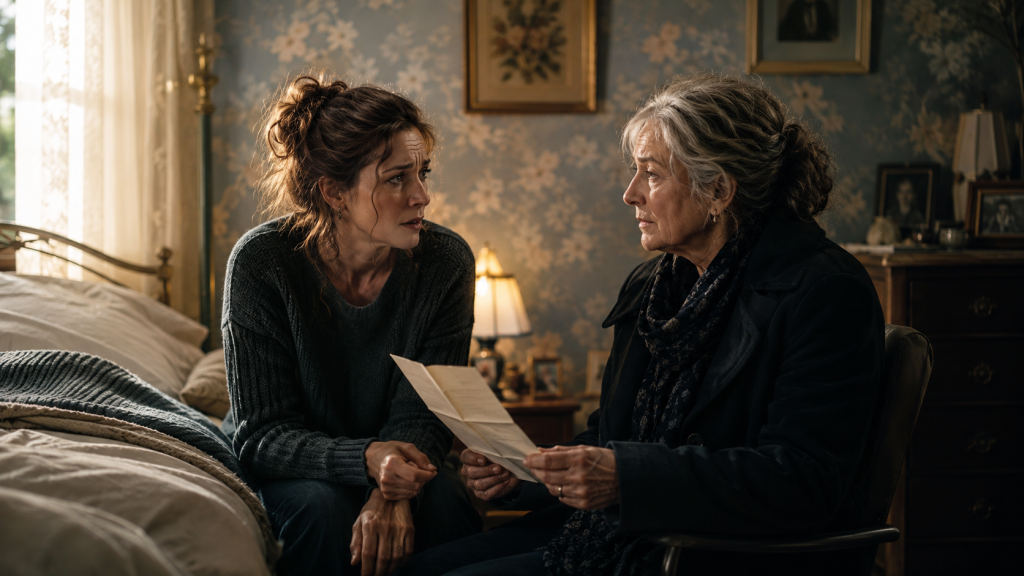
Every birthday.
A blue car.
Across the street.
My birthday had been three days earlier.
I ran downstairs so fast I nearly tripped.
My hands fumbled with my phone as I opened the Ring camera footage from the front porch.
The date loaded.
I dragged the timeline back to the afternoon.
Cars passed.
A delivery van stopped.
A neighbor walked his dog.
Then, at 2:13 p.m., a blue Honda pulled up across the street.
I froze.
The car stayed there.
One hour.
Then two.
No one got out.
The driver’s face was hidden behind the windshield glare, but I could see the shape of her head, the slight movement of her hand as she wiped her cheek.
At 4:11 p.m., the Honda drove away.
My stomach twisted.
I checked the year before.
Same date.
Same time.
Same car.
Then the year before that.
And the year before that.
The camera archive only went back five years, but there she was.
Every birthday.
Always watching.
Always leaving.
Last year, there was something else.
At 3:02 p.m., a woman stepped out of the blue Honda. She wore a gray coat and walked slowly toward the porch.
She placed a small velvet box beside the front door.
Then she touched the doorframe with two fingers, like a blessing, and hurried back to the car.
I remembered that box.
A gold bracelet.
One hundred eighty dollars, according to the receipt inside.
No card.
No name.
My mother had said, “Maybe one of your clients sent it.”
I had laughed and put it in my jewelry drawer.
Now I ran upstairs, dug through the drawer, and found it.
A delicate gold bracelet with a tiny engraved heart.
On the inside, so small I had never noticed it before, were three letters.
E.H.M.
Evelyn Hart.
Mother.
I sank onto the floor and sobbed.
Not quiet crying.
Not dignified grief.
The kind of sobbing that feels like something ancient is tearing through your chest.
My mother had lied.
But she had also loved me.
My birth mother had given me away.
But she had also stayed.
And somewhere between those two impossible truths, my whole life cracked open.
I don’t know how long I sat there before the sound of an engine made me lift my head.
At first, I thought grief was playing tricks on me.
Then I heard it again.
A car idling outside.
I stood and walked to the window.
Across the street, beneath the old maple tree, was the blue Honda.
My heart began to pound.
For a moment, I could not move.
Then I took the bracelet, the letter, and my courage, and walked downstairs.
The afternoon air was cold.
The sky was gray, heavy with the kind of rain that waits before falling.
I opened the gate and stepped onto the sidewalk.
Inside the car, the woman looked up.
She was older than I expected.
Late sixties, maybe early seventies.
Thin face.
Silver hair pulled into a low bun.
Hands gripping the steering wheel.
But when her eyes met mine, I felt the world tilt.
She had my eyes.
Not similar.
The same.
The same green-gray color.
The same dark ring around the iris.
The same sadness, sitting deep like a secret.
She opened the car door slowly, as if she feared sudden movement might scare me away.
“Margaret,” she whispered.
My knees almost buckled.
I held up the letter.
“Are you Evelyn?”
Her lips trembled.
“Yes.”
The word came out like a confession and a prayer.
“Are you my mother?”
She closed her eyes.
A tear slid down her cheek.
“Yes,” she said. “I am.”
For a moment, neither of us moved.
I had imagined this kind of scene in movies.
Long-lost family.
Tears.
Embraces.
Music swelling.
But real life is not that graceful.
Real life is awkward breath, shaking hands, and forty-one years standing between two women on a quiet street.
“Why didn’t you come sooner?” I asked.
The question came out harsher than I intended.
Her face folded with pain.
“I did,” she said. “I came every year.”
“That is not the same.”
“I know.”
“You watched from across the street.”
“I know.”
“You left gifts and disappeared.”
“I know.”
My voice cracked.
“You let me grow up thinking my mother was my mother and my father was dead.”
Evelyn flinched.
“Your mother was your mother,” she said softly. “Never doubt that. Ruth saved you. Ruth loved you. Ruth did what I could not do.”
“What you could not do?” I repeated. “You mean keep me?”
Her hand went to her throat.
“I wanted to keep you more than I wanted to breathe.”
“Then why didn’t you?”
She looked past me, toward the house.
Fear crossed her face.
Not sadness.
Fear.
Old fear.
Deep fear.
“Because your father would have killed us both.”
The street seemed to go silent.
A dog barked somewhere far away.
A curtain moved in a neighbor’s window.
“My father died when I was nine,” I said.
Evelyn shook her head.
“No, Margaret.”
The cold went through me.
“What do you mean no?”
“He didn’t die when you were nine.”
“My mother told me he did.”
“She told you that because she had to.”
I stared at her.
Her face had gone pale.
She reached into her coat pocket and pulled out an old photograph.
The edges were worn soft.
In the picture, a young woman sat in a hospital bed, smiling weakly as she held a newborn wrapped in a yellow blanket.
The baby’s face was red and wrinkled.
The young woman’s eyes were mine.
On the back, written in my mother Ruth’s handwriting, were the words:
Tell her the truth only when he cannot hurt her anymore.
My hands turned cold.
“Who was he?”
Evelyn looked over her shoulder as if the answer might be standing behind her.
“His name was Victor Hale.”
The name meant nothing to me.
But the way she said it made my skin crawl.
“He was charming at first,” she continued. “Everyone loved him. He wore suits. Donated to charity. Knew judges. Knew police officers. Knew how to smile while ruining lives.”
I swallowed.
“And you were with him?”
“I was twenty-two,” she said. “He was thirty-eight. I thought he loved me. By the time I learned what he really was, I was pregnant with you.”
Rain began to fall in tiny drops.
Neither of us moved.
“He controlled everything,” she said. “My money. My phone calls. My friends. He told me if I ever left, he would take my baby and make sure I never saw her again.”
My fingers tightened around the photograph.
“Then how did you escape?”
“For six weeks, I pretended to be weak. I pretended I had accepted everything. Then one night, during a storm, he went to meet someone. I wrapped you in a blanket and ran.”
“To Ruth?”
She nodded.
“Ruth was my mother’s cousin. We had not spoken in years, but she was the only person I knew who lived quietly enough to hide you. I begged her to keep you for one night.”
“One night,” I whispered.
Her tears fell freely now.
“I came back three days later. Ruth told me Victor had already been there. He had found my mother. Threatened her. Broken her arm. He knew I had help. Ruth said if I took you back then, he would follow me straight to you.”
My stomach turned.
“So she kept me.”
“She saved you.”
“But why not call the police?”
Evelyn laughed once, bitter and broken.
“I did. Twice. The first report disappeared. The second officer told Victor where I was staying.”
A chill moved through me.
“What happened to him?”
Evelyn looked at the house again.
“That is why I am here.”
The words made every hair on my arms rise.
“What do you mean?”
“Ruth called me six months ago,” she said. “She said she was tired. She said she had hidden the letter behind the wallpaper and wanted me to know where it was. She told me if anything happened to her, I had to come.”
“My mother died of a stroke.”
Evelyn’s face tightened.
“I know what they said.”
I stepped back.
“Are you saying someone hurt her?”
“I am saying Ruth was afraid before she died.”
My heart slammed against my ribs.
“Afraid of who?”
Evelyn opened her mouth, but before she could speak, a voice came from behind me.
“Margaret?”
I turned.
Daniel stood on the porch, holding his phone, confusion written across his face.
“I saw you on the camera,” he said. “Who is this?”
I tried to answer.
No words came.
Evelyn stared at him, and something in her expression changed.
Recognition.
Then fear.
She whispered, “Who is he?”
“My husband,” I said.
Daniel walked down the steps slowly.
He smiled politely, but his eyes were sharp.
“Everything okay?”
Evelyn did not answer him.
She looked at me.
“How long have you been married?”
“Fifteen years,” I said.
Her face went white.
“What is his last name?”
Daniel frowned.
“Hale,” he said. “Daniel Hale.”
The world stopped.
For one second, no one breathed.
Evelyn whispered, “No.”
Daniel looked from her to me.
“What is going on?”
I stared at my husband.
“Hale?”
He blinked.
“Yes. You know my last name, Maggie.”
But I wasn’t hearing him anymore.
Victor Hale.
Daniel Hale.
My father.
My husband.
The rain fell harder.
Evelyn grabbed my wrist.
“Margaret, get away from him.”
Daniel’s face hardened.
“Excuse me?”
I pulled my wrist back, confused and terrified.
“Daniel, who is Victor Hale?”
His expression changed so quickly I almost missed it.
A flicker.
A shadow.
Then calm.
Too much calm.
“Where did you hear that name?”
My mouth went dry.
“Answer me.”
Daniel slipped his phone into his pocket.
“My grandfather,” he said.
Evelyn made a sound like she had been struck.
“Victor had a son?”
Daniel looked at her.
“He had several.”
My knees weakened.
“Several?”
Daniel smiled faintly, but there was no warmth in it.
“My grandfather was complicated.”
Evelyn stepped closer to me.
“Margaret, listen to me. Victor built families like shields. He used bloodlines, marriages, money. If Daniel is his grandson, he may have known exactly who you were.”
“That is insane,” Daniel snapped.
But his voice was not shocked.
It was angry.
I looked at him.
“Did you know?”
His jaw tightened.
“Know what?”
“That I was connected to Victor Hale.”
“Maggie, you are grieving. You found some old letter, and now this stranger is filling your head with nonsense.”
“She is not a stranger.”
Daniel’s eyes flashed.
“No? She leaves you on a doorstep for forty-one years and suddenly she’s family?”
The words hit hard.
Evelyn flinched, but she did not back away.
I stared at him.
“You knew where the letter was,” I said suddenly.
Daniel frowned.
“What?”
“The renovation. You were the one who told me to start with my mother’s bedroom wall.”
His face went still.
“You said the wallpaper was peeling,” I continued. “You said I should remove it before calling painters.”
“That is a normal suggestion.”
“But then you insisted I let your contractor come tomorrow.”
He said nothing.
My heartbeat became a drum.
“You wanted the wall opened before I found the letter.”
Daniel’s mouth tightened.
“Maggie, stop.”
Evelyn whispered, “Ruth said someone had been asking about the house.”
I turned to her.
“What?”
“Six months ago. A man came by claiming to be from a historical preservation office. He asked about the original structure, old walls, sealed spaces.”
I looked at Daniel.
The rain ran down his face, but he did not wipe it away.
For the first time in fifteen years, my husband looked like someone I did not know.
“Why?” I asked.
His silence answered before he did.
Then, slowly, he said, “Because Ruth had something that belonged to my family.”
The street seemed to tilt beneath me.
“What?”
Evelyn’s voice was barely audible.
“The ledger.”
Daniel looked at her.
“So you do know.”
Evelyn’s fear turned into rage.
“You people are still hunting for it after all these years?”
“What ledger?” I demanded.
Evelyn turned to me.
“Victor kept records. Payments. Names. Properties. Police. Judges. Doctors. People he bought. People he blackmailed. Ruth must have taken it when she took you.”
Daniel’s face darkened.
“She stole it.”
“She protected a baby,” Evelyn snapped.
He ignored her and looked at me.
“Maggie, listen carefully. That ledger could destroy innocent people.”
“Innocent?”
“My family,” he said.
I almost laughed.
The sound came out broken.
“You married me because of a ledger?”
His expression softened.
For a second, he looked like my Daniel again.
The man who held my hand when Claire was born.
The man who made coffee every Sunday.
The man who kissed my forehead when I cried at my mother’s funeral.
“No,” he said. “Not at first.”
“At first?”
He looked away.
“My father asked me to get close to Ruth’s daughter. He thought Ruth had hidden something. I was twenty-nine. I thought it was a stupid family obsession.”
I felt sick.
“But you did it.”
“I met you,” he said. “And everything changed.”
“No.”
“Maggie—”
“No. Do not make this romantic.”
“I loved you.”
“You investigated me.”
“I married you because I loved you.”
“But you found me because they sent you.”
He had no answer.
The rain soaked through my sweater.
I heard Evelyn crying quietly beside me.
My whole life had become a hallway of locked doors, and every door opened to another lie.
I took one step back from Daniel.
Then another.
“Leave,” I said.
His face hardened.
“This is my house too.”
“No,” I said. “It was my mother’s house. And she left it to me.”
Daniel’s eyes shifted toward the upstairs window.
The bedroom.
The wall.
The hiding place.
“You don’t even know what you’re holding,” he said.
“I know enough.”
“You know nothing.”
Then he moved toward the gate.
Evelyn stepped in front of me.
Daniel stopped.
For a moment, I thought he might push past her.
Instead, he smiled.
A cold smile.
“Ruth should have burned it.”
Then he walked back to his car and drove away.
I stood in the rain until his taillights vanished.
Evelyn touched my arm.
“We have to go inside.”
Inside, the house felt different.
Not like my mother’s home anymore.
Like a crime scene.
We locked the doors.
Then I called Claire.
My daughter was fourteen, staying at a friend’s house for the weekend. I told her to stay there. I told her not to answer calls from her father.
She asked why.
I lied for the first time the way mothers lie when fear is bigger than truth.
“I’ll explain soon.”
Evelyn and I went upstairs.
The letter had said nothing about a ledger, but my mother had always been careful.
Too careful.
I remembered the things she never let me touch.
The locked sewing box.
The fireplace tools.
The old cedar chest.
The loose brick behind the bedroom fireplace that she once slapped my hand away from when I was ten.
My breath caught.
“The fireplace,” I said.
Evelyn followed my gaze.
Together, we knelt before the small white fireplace in my mother’s bedroom.
The bricks were old, painted over several times.
One near the left corner sat slightly uneven.
I pressed it.
Nothing.
Evelyn handed me a screwdriver from the renovation bag.
I worked the edge slowly.
The brick shifted.
Behind it was a dark hollow space.
My heart pounded as I reached inside.
My fingers touched cloth.
I pulled out a bundle wrapped in oilskin and tied with twine.
Inside was a black leather ledger, cracked with age.
There was also a cassette tape.
And another letter.
This one had my mother’s handwriting on the outside.
For Margaret and Evelyn.
My hands shook as I opened it.
My dearest girls, if you are reading this together, then I did one thing right.
I covered my mouth.
Evelyn began to cry.
The letter continued.
Victor Hale was not just dangerous. He was powerful because people allowed him to be. I took the ledger from his study the night Evelyn brought you to me. I did not know what it was then. I only knew he wanted it more than he wanted the child.
I kept it hidden because it was the only reason he did not kill me.
Every few years, someone came looking. Men in suits. Men pretending to be inspectors. Once, a young man came to my garden and asked too many questions. I later learned his name was Daniel Hale.
My stomach twisted.
Your husband may love you, Margaret. I cannot know his heart. But I know he came from them. I know the Hale family does not let go of what it thinks it owns.
I looked away, tears burning my eyes.
Evelyn squeezed my hand.
The final page was shorter.
If Victor is still alive, do not go to the police first. The ledger names police. Go to Attorney Samuel Price. He has copies of my adoption papers, Evelyn’s original statement, and the safe deposit key. Trust no one else until you know who they serve.
At the bottom was a phone number.
I recognized the name.
Samuel Price had handled my mother’s will.
He had looked me in the eye at the funeral and said, “When you are ready, call me. There are things your mother wanted discussed privately.”
I had thought he meant bank accounts.
I had been so naive.
I called him immediately.
He answered on the second ring.
“Margaret,” he said quietly.
“You knew.”
There was a pause.
“Yes.”
Anger rose in me.
“Everyone knew except me.”
“No,” he said. “Very few knew. And Ruth made me promise not to tell you unless the letter was found or Evelyn came forward.”
“She is here.”
Another pause.
Then his voice changed.
“Lock the doors. Do not let Daniel in. I am coming now.”
I looked at Evelyn.
“He knows Daniel?”
Samuel heard me.
“Margaret, Daniel came to my office two days after Ruth died asking about the estate inventory.”
My stomach dropped.
“What did you tell him?”
“That he was not my client.”
“And then?”
“And then someone broke into my office last night.”
For a second, I could not speak.
“Was anything taken?”
“No. Because Ruth taught me caution.”
He lowered his voice.
“I have the copies. But if you found the original ledger, do not let it leave your sight.”
The call ended.
Evelyn and I sat in my mother’s bedroom, the ledger between us.
For almost an hour, we read.
Names.
Dates.
Payments.
Properties transferred through shell companies.
Judges listed beside dollar amounts.
Doctors beside false certificates.
Police officers beside notes like “cooperative,” “owned,” and “use if necessary.”
Then I saw my own name.
Not Margaret.
Baby girl, Evelyn Hart.
Next to it was a date.
Six weeks after my birth.
Beside that, Victor had written:
Asset removed. Woman missing. Ledger missing. Find child.
I felt like I might be sick.
Evelyn turned away, shaking.
On the next page was another note, written years later.
Ruth Millner raising child as her own. Leave in place. Child may be useful later.
My blood went cold.
Useful later.
That was what I had been.
Not lost.
Not forgotten.
Stored.
Watched.
A future tool for a family that saw people as property.
Then I found Daniel’s name.
Daniel Hale. Contact established. Ruth’s daughter trusts him. Continue.
The date was sixteen years ago.
One year before I married him.
I closed the ledger.
The room spun.
Evelyn whispered, “I am so sorry.”
I shook my head.
Sorry was too small.
Before I could answer, headlights flashed across the bedroom wall.
A car pulled into the driveway.
Then another.
Evelyn rushed to the window.
“It’s him.”
Daniel stood outside with two men I did not recognize.
Samuel Price’s car turned onto the street at the same time.
For one terrible moment, everyone seemed to arrive at once.
The doorbell rang.
Then Daniel’s voice came through the door.
“Maggie. Open the door.”
I did not move.
He rang again.
“Maggie, we need to talk like adults.”
Samuel hurried up the walkway, holding a leather briefcase over his head against the rain.
Daniel turned toward him.
Even through the window, I saw the anger on my husband’s face.
Samuel did not stop.
He came straight to the porch and said something I could not hear.
Daniel stepped in front of him.
One of the men moved closer.
I grabbed my phone and called 911.
When the dispatcher answered, I said, “My husband is trying to enter my house with two unknown men. I am afraid for my safety.”
Daniel looked up at the upstairs window.
He knew.
His face changed.
Then he smiled.
And that smile frightened me more than his anger.
Because it said he still believed he could win.
The police arrived seven minutes later.
Two officers stepped out.
My relief lasted only until I saw Daniel shake one of their hands.
Like old friends.
Evelyn whispered, “No.”
I remembered my mother’s letter.
Do not go to the police first. The ledger names police.
Samuel looked up at the window and shouted, “Margaret, do not open the door unless I say so.”
One officer frowned at him.
Daniel spoke calmly.
“My wife is having a breakdown after her mother’s death. There is an elderly woman inside manipulating her.”
The words floated up to me like poison.
A breakdown.
Manipulating.
He was building the story before I even opened my mouth.
I stepped onto the upstairs balcony with my phone recording.
“My name is Margaret Hale,” I called down. “I am not having a breakdown. I have evidence related to Victor Hale, and I am requesting a supervisor and state police.”
The officer’s expression changed slightly.
Daniel’s smile disappeared.
Samuel raised his voice.
“I am Samuel Price, attorney for the estate of Ruth Millner. I also have sealed documents relevant to an ongoing criminal matter. I request state-level intervention.”
The second officer looked uncomfortable.
The first one reached for his radio.
Daniel turned and said something sharp to him.
That was when I knew.
My mother had been right.
The system around Victor had not disappeared.
It had aged.
Changed names.
Changed uniforms.
But it still existed.
I went back inside and looked at Evelyn.
“We need copies.”
She nodded.
We photographed every page of the ledger.
Every page.
Every name.
Every note.
Then I emailed them to Samuel, Claire, Daniel’s sister, and three news outlets whose names Samuel texted me from outside.
My finger hovered before sending to Claire.
She was my daughter.
Fourteen years old.
Still a child.
But if something happened to me, she needed the truth somewhere beyond Daniel’s reach.
I pressed send.
Downstairs, shouting began.
Then more sirens came.
Not local police this time.
State troopers.
By the time I opened the door, Daniel no longer looked calm.
He looked furious.
“You have no idea what you just did,” he said.
I stood behind Samuel.
“Yes,” I said. “I do.”
He looked at me then, really looked at me.
For one second, I saw grief in him.
Maybe he had loved me.
Maybe some part of him had wanted a normal life.
Maybe he had spent fifteen years pretending so well he had fooled himself too.
But love that begins as surveillance is not love.
A marriage built on a mission is not a marriage.
A family that treats a child like an asset does not get to call itself family.
The troopers took statements until after midnight.
Evelyn gave hers first.
Then Samuel.
Then me.
Daniel tried to leave twice.
He was stopped both times.
By morning, the ledger was in state custody, Samuel had filed emergency motions, and I had changed every lock in the house.
Claire came home that afternoon.
I told her enough.
Not everything.
No child needs every horror at once.
She cried when I told her her father had lied.
Then she asked, “Does that mean Grandma wasn’t really my grandma?”
The question broke me.
I pulled her into my arms.
“No,” I said. “She was your grandma. Love makes family too.”
Evelyn stood in the doorway, watching us with tears in her eyes.
Claire looked at her.
“And she is?”
I took a breath.
“She is my first mother.”
Claire stared for a long moment.
Then, with the strange grace children sometimes have when adults are falling apart, she walked over and hugged Evelyn.
Evelyn made a sound I will never forget.
Not a sob.
Not a laugh.
Something in between.
A life opening after decades of being locked shut.
The investigation took months.
The ledger did what Ruth knew it would do.
It cracked foundations.
A retired judge resigned from a private board.
Two officers were suspended.
A medical examiner’s old reports were reopened.
Properties tied to the Hale family were frozen.
And Victor Hale?
He was not dead.
He was ninety-one, living under private care in a gated estate three counties away.
Too old, some people said, to answer for anything.
Too frail.
Too confused.
Too late.
But when state investigators showed him a copy of the ledger, Samuel told me his hands shook with rage, not confusion.
He knew exactly what it was.
He knew exactly what he had lost.
Daniel was charged with conspiracy, obstruction, and attempted theft of estate evidence.
He pleaded not guilty.
Through his lawyer, he claimed he had only wanted to protect me from “distressing family history.”
I laughed when Samuel read that aloud.
Protect me.
That word had been used by everyone.
Victor used it as a threat.
Daniel used it as a lie.
Ruth used it as a burden.
Evelyn used it as a sacrifice.
But I had learned something by then.
Protection without truth can become another kind of cage.
One year after my mother’s funeral, I finished the bedroom.
I painted the walls soft cream.
I kept the white fireplace.
I placed Ruth’s letter in a glass frame on the desk, not hidden anymore.
Beside it, I placed the photograph of Evelyn holding me in the yellow blanket.
Two mothers.
Two women who had loved me in opposite directions.
One by holding on.
One by letting go.
On my forty-second birthday, Evelyn came to the house.
Not in the blue Honda across the street.
Not hiding.
Not watching from a distance.
She parked in the driveway.
She walked up the front steps.
She knocked once, even though I had given her a key.
When I opened the door, she held a small velvet box.
I smiled through tears.
“Another bracelet?”
She shook her head.
“This one has a card.”
Inside was a simple silver locket.
In the locket were two tiny photos.
Ruth on one side.
Evelyn on the other.
The card said:
For all the birthdays I missed from the porch.
I hugged her then.
Not carefully.
Not politely.
I held her the way a daughter holds a mother when the years between them finally stop fighting back.
Later that evening, Claire lit candles on the cake.
Samuel came by with flowers.
My neighbors brought food.
For the first time since my mother died, the house did not feel haunted.
It felt full.
Before dinner, I stepped outside alone.
The maple tree across the street swayed gently in the wind.
For forty-one years, that spot had held a woman’s grief.
A blue car.
A birthday watch.
A mother who loved from a distance because coming closer could have destroyed me.
I walked across the street and stood where Evelyn used to park.
From there, I could see my bedroom window.
The porch.
The gate.
The life she had watched but never entered.
I used to think secrets were buried because people were ashamed.
Now I know some secrets are buried because someone is trying to survive long enough for the truth to matter.
My mother Ruth hid a letter behind wallpaper.
My mother Evelyn hid her love behind a windshield.
And I had spent forty-one years believing my life began with an ordinary family story.
It did not.
It began in fear.
It survived because of courage.
And it became mine the day I finally opened the wall and found the truth waiting behind it.
When I went back inside, Evelyn was helping Claire set the table.
She looked up at me and smiled nervously, still not quite sure she was allowed to belong.
I smiled back.
“You’re home,” I said.
Her face crumpled.
And this time, when she cried, she did not cry from the car across the street.
She cried in the kitchen.
With her daughter.
With her granddaughter.
With the ghosts finally quiet.
And the truth, at last, sitting openly in the light.
THE END! THANK YOU FOR READING!