

My sister told our parents I dropped out of medical school. That was the lie that erased me from my own family for five years. It cost me my tuition help, my apartment, my health insurance, my holidays, my place at the dinner table, and eventually, the two empty chairs I had saved at my wedding.
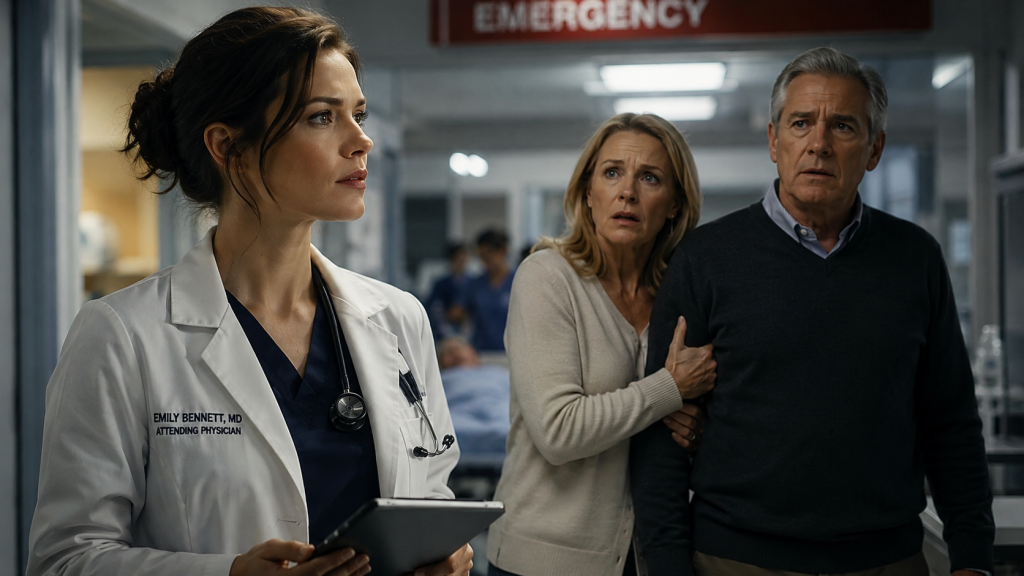
For five years, my parents believed I was a liar, a failure, and a shame they were better off not mentioning. Then last month, my sister was rushed into the emergency room. And when her attending physician walked in, my mother grabbed my father’s arm so hard it left bruises.
Because the doctor standing in front of them was me.
The first time my mother saw me in five years, I was standing beneath emergency-room lights with her favorite daughter’s blood on my gloves.
She made a sound like the air had been punched from her lungs.
My father froze beside her, his face slack, his hand half-raised as if he wanted to reach for me but had forgotten whether he had the right.
“Dr. Bennett?” the trauma nurse called.
I kept my eyes on the chart because looking at my parents for too long would have made me human, and in that moment, I could not afford to be human.
“Thirty-two-year-old female,” I said. “Severe abdominal pain, fainting, blood pressure dropping. Type and crossmatch. Get surgery on standby.”
My sister, Claire, lay curled on the stretcher, gray-faced and trembling. Her blonde hair was plastered to her forehead with sweat. Even through the oxygen mask, I saw the second she recognized me.
Her eyes widened.
Not with relief.
With fear.
“Emily?” she whispered.
I had imagined that moment so many times.
During Christmases spent eating instant noodles in my apartment while my family posted photos around a dining table I used to set.
During night shifts when I ran on four hours of sleep and vending-machine coffee.
During my residency graduation, when I scanned the auditorium even though I knew they were not coming.
During my wedding, when my husband Daniel squeezed my hand as the usher quietly removed two empty chairs from the front row.
In every fantasy, I had the perfect speech ready.
I would tell Claire exactly what she had done.
I would tell my parents exactly how easily they had abandoned me.
I would watch the truth crush them.
But reality did not give me room for revenge.
Reality gave me a patient who was bleeding internally.
“Possible ruptured ectopic pregnancy,” I said, my voice steady. “Ultrasound now.”
My mother gasped.
“Pregnancy?” she said.
Claire squeezed her eyes shut.
I did not look at my mother.
“This is not a family discussion,” I said. “This is a medical emergency.”
The nurse moved fast. The room filled with controlled urgency, the kind that scares families because everyone is moving quickly but no one is panicking. To us, panic wastes time. To families, calm looks like cruelty.
My father finally spoke.
“Emily,” he said.
My name sounded strange in his mouth after five years.
I turned just enough to meet his eyes.
“Mr. Bennett,” I said. “Please step back.”
He flinched.
Maybe it was the name. Maybe it was the distance. Maybe it was the fact that the daughter he had cut off now stood between life and death for the daughter he had chosen.
Five years earlier, Claire had called our parents while I was studying for my second-year pathology exam.
I still remembered the exact page of the textbook. Inflammatory bowel disease. Yellow highlighter in my hand. Half a cup of cold coffee beside me.
My father called once.
Only once.
“Tell me she’s lying,” he said.
My heart had started pounding before I even knew what had happened.
“Who?” I asked. “What are you talking about?”
“Claire says you failed out.”
I sat up so fast my notebook slid to the floor.
“What?”
“She says you’ve been lying to us for months. She says you lost your tuition money gambling. She says you’re involved with a married professor.”
Every accusation landed like a slap.
“Dad, that is insane. Call the school. Call the dean. Check the tuition account. I can prove everything.”
Behind him, I heard Claire crying.
Not quiet crying.
Performance crying.
The kind she had perfected as a child, when she broke something and somehow I ended up apologizing.
My mother’s voice came on the line.
“Emily, stop it.”
“Mom, please listen to me.”
“No. We’re done being manipulated.”
“I’m not manipulating anyone. Claire is lying.”
My mother went cold.
“Do not blame your sister because you got caught.”
That sentence changed my life.
By midnight, my parents had cut off my rent, tuition support, and health insurance.
My father sent one final message.
We didn’t raise a liar.
Then they blocked me.
I sent transcripts. Enrollment verification. Exam results. Letters from faculty. Screenshots from the university portal. Copies of tuition payments. I sent everything by certified mail.
Claire intercepted the package because she was “helping” with their mail while Mom recovered from minor surgery.
I did not know that then.
I only knew my parents never responded.
Later, Daniel helped me piece it together.
Claire had blocked my number on both their phones. She showed them fabricated messages from me, full of demands, insults, and threats. She told them I was spiraling. She told them I was dangerous. She told them not to engage.
And because Claire had always been fragile, charming, and endlessly forgiven, they believed her.
She was the golden child.
I was the responsible one.
And responsible children are easiest to abandon because everyone assumes they will survive.
I did survive.
Barely.
I took emergency loans. I tutored undergraduates until midnight. I cleaned lab equipment on weekends. I moved into a basement room with a window that faced a brick wall. I rationed groceries. I learned which clinics offered discounted care. I wore the same black flats until the soles split.
There were nights I studied with a blanket wrapped around my shoulders because I was afraid to turn on the heat.
There were mornings I washed my hair in cold water and told myself doctors had survived worse.
There were holidays when I almost called home from borrowed phones just to hear my mother say hello.
But pride saved me when love did not.
I graduated medical school without them.
I opened my residency match envelope with Daniel beside me instead of my parents.
I became an emergency medicine physician because I knew what it felt like when life collapsed without warning.
I married Daniel in a small garden ceremony. He was a civil-rights attorney with kind eyes and a spine made of steel. When my parents did not come, he did not tell me to forgive them. He did not say family was family. He did not ask me to be the bigger person so everyone else could stay small.
He only kissed my forehead and said, “The people who deserve to see you today are here.”
After the wedding, I stopped trying to prove myself to people committed to misunderstanding me.
But Daniel did not stop collecting evidence.
Every returned letter.
Every tuition statement.
Every blocked call record.
Every document from my grandfather’s education trust.
That trust was the thread Claire never realized would unravel everything.
My grandfather had been a quiet man, practical and fair. Before he died, he created equal education funds for Claire and me. Mine was supposed to cover medical school. Claire’s covered her business degree, which she never finished but somehow never had to explain.
When I was cut off, I assumed my parents had withdrawn their help from their own accounts.
Then, two years later, a trust notice arrived at my old campus mailbox by mistake.
It showed withdrawals from my education fund.
Withdrawals I had never authorized.
Daniel’s expression changed when I showed him.
Not angry.
Focused.
The kind of focused that made opposing counsel nervous.
“This is not just family betrayal,” he said. “This may be fraud.”
We hired a forensic accountant quietly.
For months, Daniel and the accountant traced signatures, bank transfers, tuition records, and notarized documents. Several withdrawals from my trust had been redirected to accounts linked to Claire. Some forms had my name on them.
But the signatures were wrong.
Daniel wanted one final document before filing suit.
A notarized authorization from the year everything fell apart.
We were waiting on a subpoena response when Claire came into my emergency room.
Now she was being rolled toward ultrasound, and my parents stood against the wall like strangers caught trespassing in my life.
“Emily,” my mother whispered. “You’re really a doctor.”
I looked at her.
“Yes,” I said. “And Claire is bleeding internally.”
The words snapped her back into the moment.
She covered her mouth.
My father looked toward the hallway where Claire had disappeared.
“Is she going to die?”
I heard the father in his voice then.
The same father who had once carried me on his shoulders at county fairs. The same father who taught me how to change a tire. The same father who looked me in the eye and decided I was not worth a phone call to the dean.
“I am going to do everything medically appropriate for her,” I said.
My mother’s eyes filled.
“Even after…”
She did not finish.
“Especially after,” I said. “Because I took an oath.”
That seemed to hurt her more than cruelty would have.
The ultrasound confirmed what I suspected. Claire needed immediate surgery. I transferred care to the surgical team, gave a clean handoff, and stepped out only when another attending arrived to relieve me.
I did not operate on her. I was emergency medicine, not surgery. But more than that, I knew the conflict was too heavy. Saving Claire’s life had to be clean. No one would ever be able to say I used a hospital room for revenge.
When I stepped into the family consultation room, my parents were sitting side by side.
They looked older than I remembered.
My mother’s hair had more gray. My father’s shoulders had softened. For years, I had pictured them frozen in the moment they abandoned me, powerful and certain.
Now they looked small.
Guilt does that when it finally arrives late.
My mother stood the second I entered.
“Emily,” she said. “Please.”
I closed the door behind me.
“Claire is in surgery,” I said. “They are controlling the bleeding. She is receiving blood products. The surgeon will update you when there is more information.”
My father nodded slowly.
“Thank you.”
I almost laughed.
Not because anything was funny.
Because thank you was so small compared to five years of silence.
My mother stepped forward.
“We didn’t know.”
I looked at her hand as it reached toward me.
That same hand had once returned my wedding invitation unopened.
I had recognized the handwriting on the envelope when it came back.
Not at this address.
“No,” I said quietly. “You chose not to know.”
She stopped.
My father shut his eyes.
“I asked you to call the dean,” I said. “I asked you to check the tuition account. I sent documents. I begged you to verify one thing before destroying my life.”
“We never got them,” my mother whispered.
“Because Claire intercepted them.”
My mother shook her head automatically.
“No. She wouldn’t…”
Then she stopped.
Because for the first time, she heard herself.
She heard the old reflex rising again. Defend Claire first. Question Emily last.
My father opened his eyes.
“What documents?”
Before I could answer, the door opened behind me.
Daniel stood there in his suit, tie loosened, a thick folder in his hand. He had arrived straight from court. He took in the room in one glance: my parents, pale and trembling; me, still in scrubs; the past sitting between us like a third parent.
“Sorry,” he said to me. “I came as soon as I got your message.”
My mother stared at him.
She had met Daniel once.
At a coffee shop six years earlier, when we were newly dating and she still liked to tell people I was going to be a doctor. She had hugged him then. Told him he was lucky.
She had not attended our wedding.
Daniel walked to my side.
Then he held up the folder.
“The accountant got the final records,” he said.
My father’s face tightened.
“What records?”
Daniel looked at me, asking permission without words.
I nodded.
He set the folder on the table and opened it.
“These are withdrawals from Emily’s education trust,” he said. “Multiple transfers over several years. The money did not go to Emily’s tuition. It went through accounts connected to Claire.”
My mother sank back into her chair.
“No.”
Daniel placed another page down.
“These are authorization forms bearing Emily’s name.”
My father leaned over the table, squinting.
“That’s her signature.”
“No,” Daniel said. “It’s not.”
He placed a copy of my real signature beside it. Then another. Then another.
Even my father could see it.
The forged one had tried too hard.
Too round. Too careful. Like someone copying a shape instead of writing a name they owned.
My mother started crying.
Daniel was not finished.
“And this,” he said, removing the final page, “is the notary log. Claire signed as witness on one of the documents. The notary also recorded the phone number used for confirmation.”
He slid the paper across the table.
My father read it.
His lips parted.
It was my mother’s old phone number.
The one Claire had controlled while “helping” after surgery.
My mother covered her face.
For a long moment, nobody spoke.
Then my father whispered, “How much?”
Daniel did not soften it.
“Just under eighty-seven thousand dollars.”
My mother made a broken sound.
I looked away.
Not because I pitied her.
Because part of me still did.
That was the cruelest thing about family. They could carve you open, and some wounded child inside you would still want them to stop bleeding too.
My father stood abruptly.
“I’m going to call the police.”
“No,” I said.
He turned to me.
“Emily—”
“No,” I repeated. “You are going to sit down. Claire is in surgery. No one is making this hospital room into a spectacle.”
My voice was calm, but it carried enough authority that he sat.
Daniel glanced at me with quiet pride.
My mother whispered, “Why didn’t you sue before?”
I looked at her for a long time.
“Because I was busy becoming the person you told everyone I wasn’t.”
Her face crumpled.
“I am sorry.”
The words came out small.
I had imagined those words for five years. I thought they would feel like water after thirst.
They did not.
They felt like someone handing me a cup after the house had burned down.
“I don’t know what to do with that,” I said honestly.
My father’s eyes were wet now.
“I failed you.”
“Yes,” I said.
He nodded like the word struck him exactly where it should.
“I should have checked.”
“Yes.”
“I should have believed you.”
“No,” I said. “You should have investigated. Belief is emotional. Facts were available.”
Daniel’s mouth tightened slightly, the closest he came to a smile.
My mother looked at him.
“Did she suffer?”
Daniel’s expression changed.
He looked at me first.
I answered before he could.
“Yes.”
My mother sobbed.
I did not comfort her.
The surgeon came in forty minutes later.
Claire had survived.
The ectopic pregnancy had ruptured, but they had controlled the bleeding. She would need recovery, monitoring, and follow-up care. She was lucky.
Lucky.
The word followed me down the hall.
Claire was lucky.
She had lied, stolen, forged, and destroyed five years of my life, and still, when her body failed her, a trained team moved heaven and earth to save her.
I stood outside her recovery room long after my shift should have ended.
Daniel stood beside me.
“You don’t have to go in,” he said.
“I know.”
But I did.
Claire looked impossibly small in the hospital bed. Without makeup, without the bright smile and practiced tears, she looked like a frightened little girl wearing a grown woman’s consequences.
Her eyes opened when I stepped in.
For a moment, neither of us spoke.
Then she began crying.
“I thought you’d let me die.”
I walked to the foot of the bed.
“That says more about you than it does about me.”
She flinched.
“I was scared,” she whispered.
“Of dying?”
She shook her head.
“Of you telling them.”
There it was.
Not regret.
Fear of exposure.
The old Claire, alive and well beneath the oxygen tube.
I felt something inside me go still.
“You almost died today,” I said. “And that is what you’re scared of?”
Her tears came faster.
“You don’t understand what it was like.”
I almost laughed again.
“What what was like?”
“Being compared to you,” she said. “All the time. Emily the smart one. Emily the responsible one. Emily going to be a doctor. I couldn’t breathe in this family because of you.”
I stared at her.
For five years, I had wondered why.
Money had explained part of it.
Jealousy explained the rest.
“You could have built your own life,” I said.
“You made it look easy.”
“It was never easy.”
Her face twisted.
“You don’t know what it’s like to disappoint them.”
That time, I did laugh.
Quietly.
Once.
“Claire, you turned me into a disappointment so you wouldn’t have to be one.”
She looked away.
I stepped closer.
“You lied and said I dropped out. You told them I gambled away tuition. You accused me of sleeping with a married professor. You blocked my number on their phones. You intercepted my mail. You forged my signature. You stole my education money.”
Her eyes squeezed shut.
“Stop.”
“No,” I said. “You stopped my life for five years. You can listen for two minutes.”
She began shaking.
“I needed the money.”
“For what?”
She did not answer.
“Designer trips? Credit cards? Your boyfriend’s failed startup? The apartment downtown you told Mom your company paid for?”
Her eyes opened.
So she knew.
Of course she knew.
Daniel’s accountant had found more than bank transfers. He had found a life built on money meant for mine.
“I was going to pay it back,” she whispered.
“No, you weren’t.”
Her mouth trembled.
“I’m sorry.”
I looked at her, searching for the sister I used to protect. The little girl who crawled into my bed during thunderstorms. The teenager who borrowed my sweaters and never returned them. The maid of honor I once assumed she would be.
I found only a stranger who had learned that tears worked better than truth.
“Are you sorry because you hurt me,” I asked, “or because everyone knows?”
She said nothing.
That was answer enough.
When I left the room, my parents were waiting in the hallway.
My mother stood.
“Can we see her?”
I nodded.
Then I walked past them.
“Emily,” my father called.
I stopped but did not turn.
“What happens now?”
That was the question, wasn’t it?
For years, they had decided what happened to me.
They had cut me off. Silenced me. Rewritten me. Mourned a living daughter because a lying one was easier to believe.
Now they wanted me to decide the ending.
I turned back.
“What happens now is that Daniel files the civil claim. The forged documents go to the authorities. Claire gets medical care because she is a patient, not because she is innocent. And you two decide whether the truth matters only when it hurts you.”
My mother pressed a hand to her chest.
“Will you ever forgive us?”
The hallway seemed to hold its breath.
Five years ago, I would have said yes before she finished asking.
The old Emily wanted her mother so badly she would have crawled through broken glass for a phone call.
But that Emily had slept in a freezing basement room.
That Emily had worked three jobs.
That Emily had stood in a wedding dress and watched two chairs disappear.
That Emily had become Dr. Bennett without them.
“I don’t know,” I said. “But I know this. Forgiveness will not be your shortcut around accountability.”
My father nodded slowly, tears falling freely now.
“You’re right.”
It was the first time in five years he had said those words to me.
I went home with Daniel after sunrise.
The sky was pale blue, the kind of morning that makes the world look innocent even after a terrible night.
In the car, I stared at my hands.
Clean now.
No gloves. No blood. No chart.
Just my wedding ring and faint marks from where the hospital soap had dried my skin.
Daniel drove without speaking for a while.
Then he reached across the console and took my hand.
“You saved her.”
“I did my job.”
“You did more than that.”
I watched the hospital shrink in the side mirror.
“I thought it would feel different,” I said.
“What?”
“Being proven right.”
Daniel squeezed my hand.
“How does it feel?”
I thought about my mother’s face when she saw my name on my coat. My father reading the forged signature. Claire crying because exposure frightened her more than death.
“It feels late,” I said.
He nodded.
The lawsuit was filed two weeks later.
The hospital kept Claire’s medical information private, as it should. But the financial case did not stay quiet for long. Fraud rarely does when family members start blaming each other.
Claire claimed stress. Then confusion. Then that I had given permission years ago. Then that our grandfather had wanted her to have the money because I was “unstable.”
Daniel dismantled each lie with documents.
The notary records.
The bank transfers.
The phone logs.
The intercepted mail.
The fake messages.
My parents gave sworn statements. My father cried during his. My mother admitted that she had never called my school, never checked my records, never opened the possibility that Claire was lying because believing Claire had been easier than facing conflict.
Claire eventually settled the civil case.
The criminal matter continued without my involvement.
I did not attend every hearing. I had patients. A marriage. A life.
But my parents attended.
Every time.
At first, I thought they were there for Claire.
Then one afternoon, my father waited outside the courthouse and handed Daniel an envelope.
Inside was a cashier’s check.
Not enough to fix everything.
Nothing could fix everything.
But it was the full amount they had personally withdrawn from their own accounts after cutting me off, plus interest.
A note was folded around it.
Emily,
We should have protected you. We should have known your character better than Claire’s performance. We are not asking this money to buy forgiveness. We are returning what never should have been taken from you.
Dad and Mom.
I read it three times.
Then I put it in a drawer.
I did not cash the check for a month.
My mother started writing letters.
Not texts. Not dramatic voicemails. Letters.
At first, I did not open them.
Then one night, Daniel placed a cup of tea beside me and said, “You can read them without deciding anything.”
So I did.
My mother wrote about memories.
How I used to fall asleep with books on my chest.
How I cried the first time I saw a deer hit by a car.
How proud she had been when I got into medical school.
Then, in the fourth letter, she stopped hiding behind memories.
She wrote:
I loved being needed by Claire. I loved feeling like she depended on me. You were strong, and I mistook that for not needing love. That was my failure, not yours.
That sentence stayed with me.
Not because it healed me.
Because it was finally true.
My father showed up at the hospital three months later.
Not in the emergency room.
At the front desk, holding flowers and looking deeply uncomfortable.
Security called me.
“There’s a man here asking for Dr. Bennett. Says he’s your father.”
I almost told them to send him away.
Instead, I went downstairs.
He stood when he saw me.
The flowers were yellow tulips, my favorite.
I hated that he remembered.
“I’m not here to pressure you,” he said quickly. “I just wanted to say congratulations.”
“For what?”
He swallowed.
“Your promotion. Your husband told me.”
I looked at him sharply.
“Daniel told you?”
“He replied to one email,” Dad said. “Only to say you’d been made department lead and that I should not show up unless I understood you owed me nothing.”
That sounded like Daniel.
My father held out the flowers.
“I am proud of you,” he said. “I know that may mean nothing now. But I should have been saying it all along.”
I took the flowers because refusing them would have been another kind of effort, and I was tired of giving him effort.
“Thank you,” I said.
He nodded, eyes wet.
Then he left.
No demand. No hug. No request to see me again.
Just accountability, finally learning how to stand quietly.
Claire recovered physically.
Emotionally, I do not know.
We have not spoken since the hospital except through lawyers.
Sometimes people ask if I miss having a sister.
The truth is, I miss the sister I thought I had.
I miss a version of Claire that may have never existed outside my own hope.
But I do not miss the woman who destroyed me to feel bigger.
My parents and I are not magically repaired.
There are no Sunday dinners yet.
No smiling family photos.
No easy return to what was.
There cannot be.
Some betrayals do not break a bridge.
They burn the land on both sides.
But last week, my mother came to my house for coffee.
It was the first time she had ever been inside the home Daniel and I built together.
She stood in the entryway, staring at our wedding photo on the wall.
In it, I am laughing. Daniel is looking at me like I hung the moon. Behind us, two rows of chairs are full except for the front corner, where the usher had already removed the empty ones.
My mother touched the frame with trembling fingers.
“I missed this,” she whispered.
I stood beside her.
“Yes,” I said. “You did.”
She cried then.
Quietly.
Not the way Claire cried, loudly and strategically, looking to see who was watching.
My mother cried like a woman finally understanding that grief can be deserved.
I let her cry.
Then I handed her a tissue.
It was not forgiveness.
Not yet.
But it was not nothing.
That evening, after she left, Daniel found me in the kitchen.
“How was it?” he asked.
I looked toward the window, where the last light of evening was turning the glass gold.
“Hard,” I said.
“Do you regret it?”
I thought about the emergency room.
About Claire’s face when she realized I would save her anyway.
About my father’s bruised arm where my mother had clung to him.
About my name stitched on a white coat they were never supposed to see.
“No,” I said. “I don’t regret surviving long enough for the truth to arrive.”
Daniel smiled softly.
Later that night, I opened the drawer and took out my parents’ check.
The money had once represented abandonment.
Then justice.
Now it represented something quieter.
A debt acknowledged.
I deposited it the next morning.
Not because it fixed the past.
Because refusing repayment would not make me nobler. It would only keep me tied to their mistake.
I used part of it to start a scholarship fund at my old medical school.
For students who lose family support.
For students studying under blankets in cold rooms.
For students eating noodles on holidays while becoming something no one at home believes they can be.
The first recipient sent me an email two months later.
Dear Dr. Bennett,
Thank you for believing in me when my family doesn’t.
I read that sentence in my office between patients.
Then I closed the door and cried.
Not because it hurt.
Because something broken had finally become useful.
Five years ago, my sister told a lie and my parents chose it over me.
Last month, that lie ended under emergency-room lights.
People think the most powerful moment was when my mother saw my name on my coat.
But it was not.
The most powerful moment came later, when I stood over Claire’s hospital bed and realized I no longer needed her confession to know who I was.
I was not the dropout.
I was not the liar.
I was not the shame.
I was the daughter who survived being erased.
The wife who was loved without conditions.
The doctor who saved the sister who ruined her.
And the woman who finally understood that walking away from people who abandoned you is not cruelty.
Sometimes, it is the first honest medicine you ever give yourself.
THE END! THANK YOU FOR READING!