

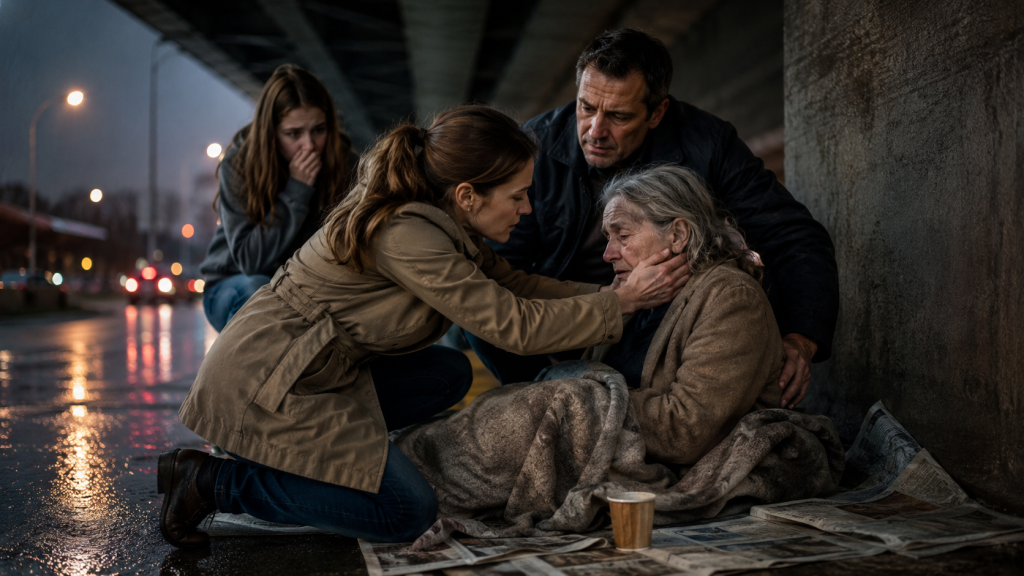
We froze when we found Mom sleeping on newspapers beneath a highway overpass. The rain had turned the city silver that night. Every streetlight looked blurred behind the mist, and the passing cars made long hissing sounds through the puddles.
My husband, Daniel, and I had only stopped at the corner market because our daughter wanted apples and hot chocolate before we drove home. It was supposed to be an ordinary Friday night. Then I saw the woman curled beneath the concrete shadow of the overpass.
At first, I noticed only the thin coat.
Then the gray hair.
Then the hands.
My mother’s hands.
For three full seconds, none of us moved.
The grocery bag slipped from Daniel’s hand. Apples rolled across the wet concrete, bumping against the curb and disappearing under the parked cars.
“Mom?” I whispered.
The woman stirred.
Her eyes opened slowly.
Shame crossed her face before recognition did.
That broke me more than anything.
Not the newspapers under her body. Not the damp blanket pulled over her legs. Not the empty paper cup beside her.
It was the shame.
As if she had done something wrong by being found.
I ran to her and dropped to my knees.
“Mom,” I said again, this time louder, trembling. “Oh my God. Mom, what happened?”
Her lips moved, but no sound came out.
Daniel was already beside me, pulling off his coat. He wrapped it around her shoulders while I touched her face with both hands. Her skin was ice-cold.
My daughter, Emma, stood behind us, crying silently.
Grandma had always smelled like lavender lotion and fresh laundry.
Now she smelled like rain, pavement, and fear.
“What happened to your four-hundred-fifty-thousand-dollar house?” I asked, fighting tears.
Mom lowered her eyes.
For a second, I thought she might faint.
Then she whispered, “Your brother and his wife sold it while I was in the hospital.”
The words struck harder than the rain.
I stared at her.
“No,” I said.
It was the only word I could find.
Mom looked away.
Daniel’s face changed.
The warmth disappeared from his expression, replaced by something still and cold. I had seen that look only once before, years ago, when he testified in a federal corruption case. It was not anger, exactly. It was focus.
The kind of calm that came before people lost their freedom.
“Claire,” he said quietly, “get her in the car.”
But I could not move.
My mother was seventy-four years old. She had worked as a school secretary for thirty-two years. She had saved every penny after my father died, paid off her little brick house, planted roses every spring, and kept every birthday card we had ever given her.
She was the woman who brought soup when neighbors were sick.
The woman who remembered everyone’s favorite cake.
The woman who once drove six hours in a snowstorm because I had postpartum fever and Daniel was deployed.
And now she was sleeping under an overpass.
Because my brother sold her house.
Because Kyle, my own brother, had done this.
Daniel crouched in front of her.
“Margaret,” he said gently, using her first name with the respect he always gave her, “did you sign anything?”
Mom swallowed.
“They told me they were insurance papers.”
My stomach turned.
“Who told you?”
“Kyle,” she whispered. “And Vanessa.”
The rain kept falling.
Cars kept passing above us, thundering over the bridge like the world had not just split open beneath it.
Three months earlier, Mom had undergone heart surgery.
It had been serious, but the doctors were hopeful. She needed time in the hospital, then rehabilitation. I had been working two states away on a contract I could not leave without losing my job. Daniel had been handling a major audit, and we had called Mom every night.
Kyle and Vanessa had volunteered to handle everything.
They sounded so kind at first.
“We’ll collect her mail,” Kyle said.
“We’ll pay the bills,” Vanessa added.
“She shouldn’t worry about anything,” Kyle promised.
I cried on the phone thanking them.
I thanked them.
That memory burned through me now like acid.
Every night, when I called, Kyle gave me updates.
“She’s resting.”
“The doctors say she’s improving.”
“She ate soup today.”
“Don’t worry, Claire. We’ve got it.”
Vanessa texted photos of flowers in Mom’s hospital room.
One picture showed her smiling beside Mom’s bed, holding a vase of yellow tulips.
The caption said: Taking good care of our queen.
I had believed them.
I had sent money for groceries.
I had sent money for “extra medical supplies.”
I had sent money for “home repairs before Mom comes back.”
I had sent Kyle eight thousand dollars over ten weeks.
And while I was thanking him for helping our mother, he was stealing the roof from over her head.
Daniel helped Mom stand.
Her legs trembled so badly he lifted her into his arms.
She weighed almost nothing.
In the car, Emma wrapped her own hoodie around Mom’s knees. My fifteen-year-old daughter, who still left wet towels on the floor and complained about homework, held her grandmother’s hand like she was afraid she might disappear.
“Grandma,” Emma whispered, “why didn’t you call us?”
Mom’s eyes filled.
“I tried,” she said. “My phone stopped working.”
I closed my eyes.
Daniel looked at me through the rearview mirror.
We both understood.
Her phone had not stopped working by accident.
At our house, we put Mom in the guest room.
I helped her out of the wet coat, ran a warm bath, washed her hair, and pretended not to notice how her ribs showed beneath her nightgown. She kept apologizing.
“I’m sorry, honey.”
“You have nothing to be sorry for.”
“I didn’t want to be trouble.”
“You are not trouble.”
“I thought Kyle would come back.”
That sentence almost made me collapse.
Even after everything, some part of her had waited for him.
After the bath, I made tea and toast. She could only eat half a slice.
Daniel sat across from her at the kitchen table with a legal pad, his laptop, and the plastic grocery bag Mom had carried beneath her blanket.
“Margaret,” he said softly, “I need you to tell me everything from the beginning. Take your time.”
Mom nodded.
Her hands shook around the mug.
“They came to the rehab center,” she began. “Kyle said there were forms from the insurance company. He said if I didn’t sign them, the hospital might not release funds for my aftercare.”
Vanessa had brought the papers.
Of course she had.
Vanessa, with her manicured nails and sweet voice and fake concern.
Mom said she had been tired that day. Her medication made her dizzy. Her vision blurred when she tried to read. Kyle told her the papers were routine.
“He said, ‘Mom, we already explained this to Claire. She agrees.’”
I made a sound like I had been slapped.
“I never agreed to anything.”
Mom nodded quickly.
“I know that now. But I was so tired. And Vanessa said the nurse needed the forms before dinner.”
“Was a nurse present?” Daniel asked.
“No.”
“Was a notary present?”
Mom paused.
“There was a woman. She came in for maybe five minutes. Vanessa knew her. She said she was just there to witness my signature.”
Daniel wrote something down.
“Did she ask you whether you understood what you were signing?”
Mom thought for a moment.
“No. She asked for my ID. Vanessa had my purse.”
Daniel’s jaw tightened.
Then Mom described how, two weeks later, Kyle told her the house needed emergency repairs. He said there was mold in the walls and a problem with the furnace. He claimed it was unsafe for her to return.
He moved her into a motel “just for a few nights.”
The room was prepaid for one week.
When the week ended, Mom called him.
He did not answer.
She called Vanessa.
Blocked.
She asked the motel clerk to call.
Kyle answered that time.
“He told me I was ungrateful,” Mom whispered. “He said he had ruined his credit helping me. He said I should be thankful I had a room at all.”
Her voice broke.
“Then the motel said nobody had paid for another night.”
I pressed my fist to my mouth.
Mom spent two nights in the motel lobby before the manager made her leave. A church volunteer gave her a blanket. Someone at a soup kitchen told her where people slept when it rained.
That was how she ended up under the overpass.
For eighteen days.
Eighteen days.
While Kyle and Vanessa were posting vacation photos from Scottsdale.
Daniel asked if she had kept anything.
Mom reached into the grocery bag and pulled out a stack of documents protected inside a plastic folder.
Hospital discharge papers.
Rehab paperwork.
Motel receipts.
A photocopy of the deed.
A crumpled business card from the notary.
A bank statement showing the last Social Security deposit before her account was drained.
And one folded piece of paper that made Daniel go completely still.
“What is it?” I asked.
He unfolded it carefully.
It was a power of attorney document.
At least, it was pretending to be one.
Mom’s signature sat at the bottom, uneven and weak.
Above it, the document granted Kyle authority over her finances, property, medical decisions, bank accounts, investments, and real estate.
Everything.
Daniel read the notary stamp.
Then he looked at the business card.
Same name.
“Claire,” he said, “take Emma upstairs.”
“No.”
“Claire.”
“I’m staying.”
He held my gaze for a second, then nodded once.
His anger never reached his voice. That frightened me more than shouting would have.
Daniel had spent years supervising financial investigations for a federal inspector general’s office. Kyle always called him “just a government accountant,” usually with a smirk.
He had no idea what Daniel actually did.
Daniel specialized in tracing fraud patterns. False invoices. Stolen funds. Forged authorizations. Vulnerable adult exploitation involving interstate transfers.
He knew how money moved.
He knew how criminals hid it.
Most importantly, he knew how to preserve evidence before people realized they were being watched.
Daniel photographed every document.
Then he stepped out onto the back porch and made one phone call.
His voice was quiet.
“I need an emergency preservation request tonight. Possible deed fraud, vulnerable adult exploitation, forged power of attorney, and proceeds moving across state lines.”
He listened.
Then he looked toward the dark city.
“No,” he said. “Do not alert the subjects.”
When he came back inside, Mom had fallen asleep in the chair.
Her chin rested against her chest. She looked impossibly small.
I stood behind her, touching her damp hair.
“What happens now?” I asked.
Daniel closed his laptop.
“Now we stop the money from disappearing.”
“Can you do that?”
He looked at the papers on the table.
“If the sale proceeds touched a financial institution under federal reporting obligations, and if the documents were forged or obtained under false pretenses, we may be able to freeze movement quickly.”
“Tonight?”
“Tonight.”
By midnight, Mom was in the guest room under clean blankets.
Emma refused to leave her side, so I let her sleep in the armchair with a pillow.
Daniel worked at the kitchen table until almost three in the morning.
He traced everything he could access legally through the documents Mom had saved.
The deed transfer.
The notary stamp.
The title company.
The sale amount.
The buyer.
The wire deposit.
The sudden withdrawals from Kyle and Vanessa’s joint account.
“They moved fast,” he said.
“Because they knew it was dirty?”
“Yes.”
At 3:17 a.m., Daniel’s phone rang.
He listened without speaking, then wrote down a case number.
When he hung up, he exhaled.
“A judge approved emergency preservation on the accounts connected to the sale proceeds.”
I covered my mouth.
“What does that mean?”
“It means they can’t move the money.”
“And the house?”
“The title company has been ordered to halt final disbursement pending review. If the transfer was based on fraudulent authority, it can be unwound.”
I started crying then.
Not loudly.
Just silently, with my hands gripping the edge of the counter.
Daniel came around the table and pulled me against him.
“I should have known,” I said.
“No.”
“I should have gone to see her.”
“Claire, they lied to you. They isolated her. They used her illness.”
“He’s my brother.”
Daniel’s voice hardened.
“That did not stop him.”
At 5:40 a.m., another call came.
By sunrise, two patrol cars and one unmarked sedan were outside Kyle’s house.
I know this because Vanessa called first.
I let it go to voicemail.
Then Kyle called.
Then Vanessa again.
Then Kyle seventeen times.
Mom woke up when the phone started buzzing on the nightstand.
She looked at it and froze.
“That’s him,” she whispered.
I sat beside her.
“You don’t have to answer.”
But she stared at the screen for a long time.
Then she said, “I want to hear what he says.”
I put it on speaker.
“Kyle,” I said.
His breathing was ragged.
“Claire, what the hell did you do?”
My entire body went cold.
“What did I do?”
“There are police at my house.”
“Good.”
“Good? Are you insane? Vanessa is crying. They froze our accounts. They said something about financial exploitation.”
Mom flinched at the sound of his voice.
I looked at her trembling hands and felt something inside me turn to steel.
“Then explain why you left our mother under a bridge.”
Silence.
For the first time in his life, Kyle had no immediate answer.
Then he said, “That is not what happened.”
“What happened, then?”
“She refused help.”
Mom closed her eyes.
“She wanted independence,” Kyle continued. “She said she didn’t want to live with us. She gets confused, Claire. You know that.”
Daniel, standing near the doorway, lifted his eyes slowly.
That was Kyle’s mistake.
He was going to claim our mother was confused.
After using her signature to sell her house.
“You said I agreed to the papers,” I said.
Another pause.
“What?”
“Mom said you told her I agreed.”
“You’re twisting things.”
“Did you sell her house?”
“She signed the paperwork.”
“She thought they were insurance forms.”
“That’s not my fault if she didn’t read—”
Mom made a small sound.
I interrupted him.
“She was recovering from heart surgery.”
Kyle’s voice rose.
“Vanessa and I handled everything while you were off living your perfect life two states away. You don’t get to judge me.”
“I sent you money.”
“You sent pennies compared to what we spent.”
Daniel took one step closer.
I knew he wanted me to keep Kyle talking.
“How much did you spend?” I asked.
Kyle hesitated.
“Enough.”
“The motel was paid for one week.”
“She was supposed to go to assisted living.”
“Where?”
No answer.
“Kyle, where?”
Behind him, Vanessa shouted something.
Then I heard her clearly.
“Tell her about the will!”
Everything went quiet.
Even Daniel’s expression changed.
I looked at Mom.
Her eyes opened.
“What will?” I asked.
Kyle cursed under his breath.
Vanessa was crying now, but it did not sound like guilt. It sounded like panic.
Kyle came back on the line.
“Claire, listen to me carefully. Mom changed her will.”
Mom sat up slowly.
“No, I didn’t.”
Kyle ignored her.
“She left the house to me because I was the one taking care of her.”
Mom’s voice cracked.
“Kyle, I never did that.”
For the first time, he spoke directly to her.
“Mom, don’t start. You know Vanessa and I sacrificed everything. Claire only shows up when there’s money.”
My mother looked as if he had struck her.
Daniel reached over and ended the call.
The kitchen became painfully silent.
Then Daniel said, “We need to find the attorney who supposedly drafted that will.”
Mom shook her head.
“I never changed my will. Your father and I made one years ago. Everything was split between you and Kyle, except the house was supposed to stay available if either of you needed it. I kept the original in the lockbox.”
“What lockbox?” I asked.
“The one in my bedroom closet.”
I already knew the answer before Daniel asked.
“Did Kyle have access?”
Mom nodded.
“He took it when he said he was organizing things.”
By nine in the morning, Daniel had spoken with an elder law attorney named Ruth Caldwell. She was a sharp-voiced woman who had been prosecuting estate fraud before I learned to drive. She agreed to meet us immediately.
When Ruth arrived at our house, she wore a navy suit and carried a leather briefcase that looked older than I was.
She listened to Mom’s story without interrupting.
Then she reviewed the documents.
When she got to the power of attorney, she leaned back and removed her glasses.
“This is garbage,” she said.
Mom blinked.
“Garbage?”
“Legal-looking garbage, but garbage. The language is too broad, the witness procedure is questionable, and if you were under medication without proper capacity review, this document is vulnerable. Very vulnerable.”
For the first time since we found her, Mom looked like she could breathe.
Ruth examined the notary card.
“I know this name.”
Daniel looked at her.
“Bad?”
“Very bad. She was investigated two years ago for notarizing signatures without proper witnesses. Charges didn’t stick, but her commission was suspended temporarily.”
Daniel’s eyes sharpened.
“Is she currently active?”
Ruth checked on her tablet.
“Yes. Reinstated last year.”
Then Ruth looked at Mom.
“Margaret, I’m going to ask you something difficult. Did your daughter-in-law ever pressure you to leave things to Kyle?”
Mom lowered her eyes.
“Many times.”
My heart sank.
“She said Claire had Daniel, and Emma, and a good house. Kyle had struggled. She said it was only fair.”
“Did Kyle know?”
Mom’s lips trembled.
“He was sitting beside her.”
Ruth closed the folder.
“I’ll file an emergency petition today. We’ll request temporary guardianship protection, a freeze on disputed assets, and an order preventing disposal of property. We’ll also challenge the deed transfer and any recent will.”
“Can they go to jail?” I asked.
Ruth looked at me over her glasses.
“That depends on what investigators find. But based on what I see, they should be very afraid.”
They were.
By noon, Vanessa had deleted her social media.
By one, Kyle texted me.
You’re destroying this family.
I showed Mom.
She stared at the message for a long time.
Then she said, “He destroyed it when he left me in the rain.”
That was the first time I heard anger in her voice.
Not sadness.
Not confusion.
Anger.
And I was proud of her for it.
The next week unfolded like a storm.
The title company confirmed that the house sale had been rushed. Kyle had presented the power of attorney and claimed Mom was unable to attend closing due to “medical fragility.”
Vanessa had communicated mostly by email, pushing for urgent completion because “the seller needed funds for long-term care.”
No long-term care facility had ever been contacted.
No repair estimates existed.
No mold report.
No furnace issue.
Nothing.
The buyers were a young couple who had no idea anything was wrong. They had already ordered furniture and scheduled movers. When they learned what had happened, the wife cried on the phone and apologized to my mother.
Mom told her, “You didn’t do this, sweetheart.”
That was who Mom was.
Even homeless under a bridge, she still had room to comfort someone else.
Two weeks later, we attended the first court hearing.
Mom wore a soft blue dress I bought her and the pearl earrings my father had given her on their fortieth anniversary. Her hands shook, so Emma held one and I held the other.
Kyle and Vanessa sat across the courtroom.
I barely recognized them.
Kyle looked thinner, pale, and furious.
Vanessa wore black and dabbed at her eyes with a tissue, performing grief like a woman auditioning for sympathy.
When Mom walked in, Kyle stood halfway.
“Mom,” he said.
She looked at him once.
Then she looked away.
That hurt him.
I could tell.
Good.
The judge reviewed the emergency filings. Ruth presented hospital medication records, rehab notes, motel receipts, banking irregularities, and the questionable power of attorney.
Then Daniel’s preservation records showed that within forty-eight hours of receiving house sale proceeds, Kyle and Vanessa had transferred large sums into three accounts, paid off credit cards, purchased airline tickets, and moved fifty thousand dollars into an investment account under Vanessa’s maiden name.
The judge’s expression darkened.
Kyle’s attorney argued that Mom had willingly signed everything.
Ruth stood.
“Your Honor, Mrs. Whitaker was recovering from cardiac surgery, medicated, physically weak, and misled into signing documents she believed related to insurance. Within weeks, she was removed from her own home, placed in a motel, abandoned, and later found sleeping under a highway overpass.”
The courtroom went silent.
Ruth continued.
“The respondents claim this was done for her benefit. Yet not one dollar of the proceeds paid for her care.”
The judge turned to Kyle.
“Mr. Whitaker, where is your mother’s money?”
Kyle opened his mouth.
Closed it.
Vanessa whispered something.
The judge’s voice sharpened.
“I asked you.”
Kyle said, “We were managing it.”
“For what purpose?”
“For her future care.”
“Then why was she homeless?”
Kyle looked down.
That was the first honest thing he had done.
The judge issued temporary orders that day.
The sale was suspended.
The proceeds remained frozen.
Kyle’s authority under the power of attorney was revoked pending investigation.
Mom was placed under temporary protective status, with me named emergency guardian for financial matters until the court completed review.
When the gavel struck, Mom began to cry.
Not because she had won everything back.
Not yet.
But because someone in authority had finally said, without hesitation, that what happened to her was wrong.
Outside the courthouse, Kyle approached us.
Daniel stepped in front of Mom.
Kyle glared at him.
“You think you’re some hero?”
Daniel said nothing.
Kyle turned to me.
“This is your fault. You always wanted Mom to yourself.”
I laughed once.
It came out broken and bitter.
“I found her under a bridge.”
His face twitched.
“She was being dramatic.”
Mom stepped around Daniel.
Her voice was soft, but everyone heard it.
“I called you, Kyle.”
He froze.
“I called you from the motel lobby. I called you from the church office. I called you from a stranger’s phone. You answered once.”
Kyle’s mouth trembled.
Mom continued.
“You told me I was a burden.”
Vanessa snapped, “We were under pressure!”
Mom looked at her.
“No, Vanessa. I was under a bridge. You were under pressure.”
For the first time, Vanessa had no reply.
The investigation deepened.
The notary admitted she had not properly witnessed Mom signing the documents. She claimed Vanessa told her Mom had already reviewed everything and that it was “just a formality.”
Emails recovered from Vanessa’s account showed something worse.
Weeks before Mom’s surgery, Vanessa had messaged Kyle:
If we wait until she dies, Claire gets half. If she signs POA now, we can control the house.
Kyle replied:
She’ll sign whatever if we tell her it’s medical.
That message became the sentence that ended him.
I read it three times before I understood that my brother had planned this before Mom ever went into the hospital.
Before the surgery.
Before the weakness.
Before the medication.
He had looked at our mother and seen a chance.
When Ruth showed Mom the printed emails, I expected her to sob.
She did not.
She touched the page with one finger.
Then she said, “I raised him better than this.”
That was all.
The criminal charges came six weeks later.
Financial exploitation of a vulnerable adult.
Fraudulent conveyance.
Forgery-related charges.
Conspiracy.
Wire fraud review due to interstate movement of funds.
The house sale was officially reversed after the court found the deed transfer invalid. The young couple found another home, and Mom wrote them a letter apologizing for the pain they had been dragged into.
They sent flowers.
Kyle sent nothing.
Vanessa tried to make a deal first.
She claimed Kyle pressured her. Kyle claimed Vanessa handled the paperwork. The notary claimed they both lied. Everyone pointed at everyone else.
But the documents told the truth.
Money always does.
Three months after we found Mom beneath the overpass, I drove her back to her house.
The roses were overgrown.
The mailbox was dented.
Someone had removed the curtains from the front window.
But it was still hers.
Mom stood on the walkway for a long time.
I waited beside her.
Daniel and Emma stayed near the car, giving her space.
Finally, Mom took out the key Ruth had recovered from Kyle’s belongings.
Her hand shook as she slid it into the lock.
The door opened with a soft groan.
Inside, the house smelled stale, empty, and unfamiliar.
Vanessa had taken the good china.
Kyle had taken Dad’s tools.
Several pieces of furniture were missing.
But on the living room wall, above the fireplace, my parents’ wedding photo still hung.
Mom walked to it slowly.
She touched my father’s face behind the glass.
“I’m home, David,” she whispered.
That was when I cried.
Not quiet tears this time.
Real ones.
The kind that bend your body.
Mom turned and held me.
For a moment, I was not forty-six years old. I was a little girl again, crying into my mother’s shoulder while she told me everything would be all right.
Except now I was the one who had to help make it true.
We spent the next several weeks restoring the house.
Daniel installed new locks and security cameras.
Emma planted fresh flowers.
I replaced the curtains.
Neighbors came by with casseroles, cleaning supplies, and stories of how Kyle had told them Mom was moving into “a luxury senior residence.”
Mrs. Alvarez from next door cried when she saw Mom.
“I knew something was wrong,” she said. “Your son said you didn’t want visitors.”
Mom closed her eyes.
Isolation.
That was how they did it.
They made everyone believe she had chosen to disappear.
One afternoon, while cleaning the bedroom closet, we found Dad’s old lockbox behind a stack of blankets.
Kyle had missed it.
Inside were birth certificates, savings bonds, my parents’ original will, and a letter from my father addressed to “My Maggie, if I go first.”
Mom sat on the bed and opened it with trembling hands.
His handwriting was neat and steady.
My dearest Maggie,
If you are reading this, then I have gone ahead of you. I know you will try to be strong for the children. You always do. But promise me one thing. Do not let anyone make you small. Not grief, not age, not loneliness, not even our children if they forget the love that raised them.
This house is yours. Not because of money, but because every corner of it knows your hands. Stay as long as your heart wants to stay.
And if anyone ever tries to take peace from you, remember that kindness is not weakness.
I love you beyond this life.
David.
Mom pressed the letter to her chest.
For a long time, none of us spoke.
That letter became her anchor.
The trial did not happen quickly. Cases like that never do. But the plea hearings came first.
Vanessa accepted a deal.
Kyle resisted until the emails, bank records, and notary testimony left him nowhere to hide.
The last time I saw my brother before sentencing, he looked smaller than I remembered.
He asked to speak to Mom.
Ruth advised against it, but Mom agreed on one condition: Daniel and I stayed in the room.
Kyle sat across from her in a courthouse conference room, wearing a wrinkled suit and the expression of a man who still believed apology was a key that could unlock consequences.
“Mom,” he said, voice breaking, “I messed up.”
Mom watched him quietly.
“I don’t know what got into me.”
“Yes, you do,” she said.
He flinched.
“It was money, Kyle.”
Tears filled his eyes.
“Vanessa kept saying we were drowning. The debts, the mortgage, the credit cards. I thought I could fix everything and then somehow make it right later.”
“You left me outside.”
“I didn’t know you were under a bridge.”
“You knew I had nowhere to go.”
He looked down.
That was answer enough.
Mom’s voice remained gentle, and somehow that made it worse.
“When you were seven, you broke your arm climbing the maple tree. You cried because you thought I’d be angry. Do you remember what I told you?”
Kyle wiped his face.
“You said accidents matter less than truth.”
Mom nodded.
“This was not an accident. And you hid from truth until police brought it to your door.”
He sobbed then.
I wanted to feel sorry for him.
Some small part of me did.
But then I remembered Mom’s thin coat.
The newspapers.
The way she apologized for being found.
And pity turned into something colder.
Kyle whispered, “Can you forgive me?”
Mom closed her eyes.
When she opened them, they were wet but steady.
“I am working on freeing my heart from hatred,” she said. “But forgiveness does not mean I will protect you from what you did.”
Kyle covered his face.
Mom stood slowly.
Daniel offered his arm.
Before leaving, she looked back at her son.
“I hope prison teaches you what my love could not.”
At sentencing, the judge spoke plainly.
He said elder exploitation was not merely theft of property. It was theft of safety, dignity, and trust.
Kyle received prison time.
Vanessa received a shorter sentence and restitution obligations.
The notary lost her commission permanently and faced her own penalties.
Most of the money was recovered.
Not all.
But enough.
Enough to repair Mom’s home.
Enough to restore her savings.
Enough to pay for counseling, medical care, and new security.
But no amount of money could erase those eighteen nights beneath the overpass.
Sometimes, months later, I would find Mom standing by the front window during rainstorms.
She would watch the streetlights shimmer on the wet pavement.
I never asked what she was thinking.
I already knew.
Trauma does not leave just because the locks are changed.
But healing came slowly.
It came in small things.
Mom baking again.
Mom laughing at Emma’s jokes.
Mom sitting in the garden with dirt under her fingernails.
Mom inviting neighbors for coffee.
Mom sleeping through the night.
On her seventy-fifth birthday, we threw a party in her backyard.
Nothing fancy.
Just string lights, folding chairs, barbecue, and a chocolate cake with too much frosting because that was how she liked it.
Neighbors came.
Old coworkers came.
The young couple from the failed house sale came too, bringing their baby daughter, whom they had named Rose.
Mom held that baby under the evening lights and smiled for the first time in a way that reached her eyes.
Later, after everyone left, she handed me a folder.
“What’s this?” I asked.
“My new will.”
I stiffened.
“Mom—”
She touched my hand.
“It’s all right. Ruth helped me. Everything is clear now.”
I opened the folder.
The house would go into a trust. Emma would inherit some of Dad’s savings for college. A portion would be donated to a local elder advocacy center. Kyle was named only once.
I read the sentence twice.
My son, Kyle Whitaker, is intentionally omitted for reasons known to him and to this family.
My throat tightened.
“Are you sure?” I asked.
Mom looked toward the garden.
“I love my son,” she said. “But love is not permission.”
That sentence stayed with me.
Love is not permission.
Not permission to lie.
Not permission to steal.
Not permission to abandon someone and still demand loyalty.
A year after the night under the overpass, Mom asked Daniel to drive her there.
I did not want her to go.
Neither did he.
But she insisted.
So the three of us went just before sunset.
The city looked different in daylight. Less cruel, somehow. The concrete pillars were stained with rain and exhaust. Cars thundered overhead. A few people sat nearby with bags and blankets, living inside the kind of desperation most of us pretend not to see.
Mom carried four tote bags filled with socks, water bottles, snacks, hygiene kits, and clean blankets.
She handed them out quietly.
No speeches.
No pity.
Just dignity.
One older man thanked her and asked if she worked with a church.
Mom smiled.
“No,” she said. “I just remember what cold feels like.”
When we reached the exact place where we had found her, she stopped.
The newspapers were gone.
The rain was gone.
But I could still see her there.
Curled small beneath Daniel’s coat.
Ashamed of someone else’s crime.
Mom looked at the ground for a long moment.
Then she reached into her purse and pulled out my father’s letter.
She did not open it.
She just held it.
“I thought that night was the end of me,” she said softly.
Daniel stood beside her.
“It wasn’t.”
“No,” she said. “It was the end of who I allowed myself to be for other people.”
She turned to me.
“I kept making excuses for Kyle because he was my child. I told myself he was stressed, unlucky, misunderstood. But sometimes people are not lost, Claire. Sometimes they are choosing the road.”
I wiped my eyes.
“And we are not required to be robbed just because we love the thief.”
The sun dropped lower behind the highway, turning the concrete gold.
Mom slipped the letter back into her purse.
Then she took my hand.
“Take me home.”
So we did.
We took her home to the brick house with the roses.
To the kitchen where soup simmered again.
To the bedroom where clean sheets smelled like lavender.
To the garden where Emma had painted a little wooden sign that said Grandma’s Roses.
Life did not become perfect.
Kyle wrote letters from prison. Mom read some and left others unopened. Vanessa’s family blamed us until the court records became public. Some relatives said we should have handled it privately.
Mom answered that best.
At Thanksgiving, when one cousin hinted that prison was “a bit much for family,” Mom set down her fork and said, “Family does not require silence from the wounded so the guilty can stay comfortable.”
No one mentioned it again.
As for me, I learned that betrayal does not always arrive wearing a stranger’s face.
Sometimes it has your brother’s smile.
Sometimes it knows where your mother keeps her spare key.
Sometimes it says, “Don’t worry, we’ve got it,” while already planning what to take.
But I also learned that justice can begin in the smallest moment.
A daughter recognizing her mother’s hands in the rain.
A husband making one quiet phone call.
A frightened old woman holding on to a plastic grocery bag full of proof because somewhere inside her, beneath all that shame, she still knew the truth mattered.
People later called Daniel a hero.
He always shook his head.
“Margaret saved herself,” he would say. “She kept the evidence.”
Mom never saw it that way at first.
But eventually, she did.
One evening, almost two years later, I found her on the porch watching Emma practice driving in the empty church parking lot across the street.
Mom laughed every time Emma hit the brake too hard.
“She drives like your father,” Mom said.
“Dad was a terrible driver.”
“The worst.”
We sat together in the warm air, listening to crickets and distant traffic.
After a while, Mom said, “I used to feel embarrassed that you found me like that.”
I looked at her.
“Mom.”
“I did,” she admitted. “I thought people would see me as foolish. Weak.”
“You were betrayed.”
“I know that now.”
She reached for my hand.
“But I’m glad you found me.”
My eyes burned.
“So am I.”
She squeezed my fingers.
“Not because you saved me from the street. Because you saw me there and still saw me as your mother.”
The words broke something open inside me.
I leaned my head against her shoulder like I had when I was small.
“You’ll always be my mother.”
“And you,” she whispered, kissing my hair, “were always my home before that house ever was.”
The roses bloomed heavier that spring than they had in years.
Red, pink, white, and yellow.
Mom said it was because Daniel used too much fertilizer.
Emma said it was because Grandma yelled encouragement at them every morning.
I think it was because the ground remembered her.
Because some things, once rooted deeply enough, cannot be stolen.
Not by greed.
Not by lies.
Not even by the people who know exactly where to cut.
Kyle took her house for a while.
He took her money.
He took her safety.
He even took her belief that her own child could never do such a thing.
But he did not take her name off that deed forever.
He did not take her dignity forever.
And he did not take her family.
Not the real one.
The real family was there the night the rain turned the city silver.
The real family knelt on wet concrete.
The real family wrapped a coat around her shoulders.
The real family listened when she whispered the truth.
And by sunrise, the people who thought an old woman would be too weak, too ashamed, and too forgotten to fight back learned something they should have known from the beginning.
My mother was not abandoned.
She was found.
And once she was found, she was never going to be silent again.
THE END! THANK YOU FOR READING!