

My parents told my twelve-year-old daughter she had to give one hundred dollars toward her cousin’s birthday gift. “If you don’t help,” my mother told her, “don’t expect everyone to treat you like family.”
I didn’t yell. I didn’t argue. I simply decided to show them exactly what “not family” looked like. By the next morning, my phone had fifty-three missed calls. But it started the evening before, when Mia came home with her hands hidden beneath the kitchen table.
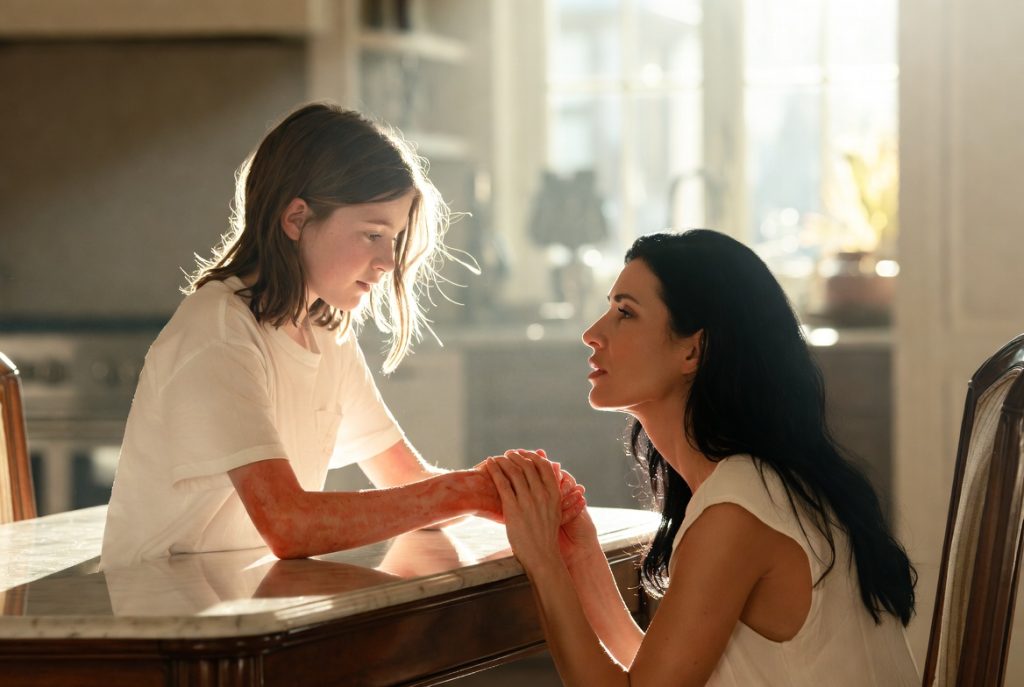
She sat there quietly, both palms pressed flat against the wood, like she was trying to hide something from me. Her backpack was still on the floor beside her chair. Her hair was messy from the wind, and her cheeks were too pale.
“Hey,” I said gently, setting my purse down. “What happened?”
Mia blinked, then looked at me with that careful expression children wear when they are trying to decide how much truth will get them in trouble.
“I just worked,” she said.
I froze in the doorway.
“Worked where?”
“Mrs. Novak’s house,” she answered. “All afternoon. She gave me twenty dollars.”
Then she shifted her fingers and winced.
That was when I saw her hands.
They were red and raw around the knuckles. Her wrists looked tired. She kept rubbing one thumb like it hurt to move it.
“Mia,” I said softly, pulling out the chair beside her. “Why did you need money?”
She looked down at the table.
“It’s not for me.”
A cold weight settled in my chest.
“Then who is it for?”
Her voice became very small.
“It’s for Sophie.”
Sophie was my sister Heather’s daughter. She was also twelve, just like Mia, but in my parents’ house, Sophie was treated like royalty. Sophie got the best chair at dinner, the biggest piece of cake, the most attention, the loudest applause. Mia got polite smiles and afterthoughts.
“What do you mean, it’s for Sophie?” I asked.
“They’re collecting money for her birthday,” Mia whispered.
“Who is collecting?”
“Everyone.”
“How much?”
She swallowed.
“One hundred dollars.”
For a second, I just stared at her.
Mia and Sophie were the same age. There was no version of love where one child should scrub a neighbor’s house until her hands hurt so another child could get a better birthday gift.
“Who told you to give that money?”
Mia’s eyes filled.
“Grandma.”
My mother.
She said it like Grandma’s word was final. Like an adult had made a rule and Mia had no choice but to obey.
“What exactly did she say?”
Mia wiped her cheek with the back of her hand.
“She said if I didn’t contribute, I shouldn’t expect to be treated like family.”
For a moment, I couldn’t breathe.
No grandmother should ever say that to a child.
No adult should ever make a little girl believe love had a price tag.
But my daughter’s hands were sore.
Her shoulders were hunched.
And worst of all, she believed it.
“I didn’t want to ask you,” Mia rushed to explain. “I thought it had to be my money. Grandma said everyone should contribute from their own pocket. I broke my piggy bank, but it still wasn’t enough.”
I reached for her hands carefully.
“You did nothing wrong.”
“I shouldn’t have told you,” she whispered.
That nearly broke my heart.
I kissed her forehead, then walked into the living room with my phone.
Not to scream.
Not yet.
Some foolish part of me still hoped my mother would deny it. I still wanted to believe there had been a misunderstanding.
She answered cheerfully.
“Hi, sweetheart. Everything okay?”
“Mom,” I said, keeping my voice steady, “Mia told me you asked her for one hundred dollars toward Sophie’s birthday gift.”
There was a pause.
Not shock.
Calculation.
“Yes,” my mother said. “That’s right.”
“She’s twelve.”
“So?” Mom replied. “Twelve-year-olds can work. They can learn responsibility.”
My pulse pounded in my ears.
“Did you tell her that if she didn’t pay, she shouldn’t expect to be treated like family?”
My mother didn’t even hesitate.
“Yes. She needs to learn what supporting family means. Responsibility. Values.”
Values.
As if my daughter’s aching hands were a lesson.
As if making a child feel unwanted was wisdom.
Something inside me went completely still.
“Okay,” I said.
“Eleanor—”
I ended the call.
I stood there with the phone in my hand, listening to Mia move nervously in the kitchen. And for the first time in years, the entire pattern became painfully clear.
I was the oldest.
I had always been taught to understand. To help. To give. To be useful.
When I was twelve, I worked small jobs too. Babysitting. Dog walking. Cleaning houses for neighbors. My parents called me mature, then quietly used my money for groceries and bills.
Heather never had to do that.
Leo never had to do that.
When college came, there was no money for me. Later, somehow, there was money for them.
When my parents retired, the same story continued.
Eleanor contributes.
Eleanor understands.
Eleanor helps.
Every month, small payments left my bank account.
Mom and Dad’s mortgage help.
Heather’s mortgage help.
A little for Heather’s kids.
A little for Leo.
A little for family utilities.
Small names.
Small amounts.
An entire system disguised as love.
My husband Thomas had seen it long before I did.
“They treat Sophie like a princess,” he once told me, “and Mia like an afterthought.”
I told myself he was exaggerating.
Then Mia came home with sore hands.
I called Heather next.
“Did you know Mia was asked to give one hundred dollars toward Sophie’s birthday?”
“Oh, yeah,” Heather said casually.
My stomach tightened.
“Heather, she’s twelve.”
“It’s for something special,” Heather said. “Horse camp. Sophie’s friends are going. It costs nine hundred dollars.”
“So your twelve-year-old wants a nine-hundred-dollar camp, and mine is supposed to help pay for it?”
Heather sighed like I was being difficult.
“Come on, Eleanor. It’s just one hundred dollars. Mia does little jobs now. She has income. She’s responsible, like you were. I thought you’d be proud.”
There it was.
The same old script, now being passed down to my daughter.
“No,” I said.
Heather’s voice cooled.
“No what?”
“My daughter is not paying for Sophie’s horse camp.”
“You’re being dramatic.”
“We are not contributing.”
“Family should support family, Eleanor.”
I looked toward the kitchen, where Mia was pretending not to listen.
Then I hung up.
I opened my banking app.
The recurring payments stared back at me.
Mom and Dad mortgage help — four hundred fifty dollars.
Heather mortgage help — three hundred dollars.
Heather kids — seventy-five dollars.
Leo support — one hundred dollars.
Family utilities — sixty dollars.
I stared at them for a long time.
For years, I had told myself these payments were kindness.
Now I saw them clearly.
They were not kindness.
They were expectations.
They were rent I had been paying for a place in my own family.
I tapped the first one.
Cancel.
Confirm.
Then the next.
Cancel.
Confirm.
One by one, I shut them all off.
No warning.
No explanation.
Just consequences.
When Thomas came home, he stopped in the doorway and saw me sitting at the computer.
“What are you doing?” he asked.
I looked up at him.
“Taking my life back.”
His shoulders relaxed like he had been waiting years to hear those words.
Before he could answer, Mia appeared in the doorway holding a wrinkled envelope.
“I have ninety dollars now,” she said quickly. “I only need ten more. I can ask Mrs. Novak if she needs more cleaning tomorrow.”
I crossed the room and took the envelope from her hands.
Then I took a ten-dollar bill from my purse and placed it in her palm.
She looked confused.
“You’re not going,” I said. “You’re not paying. We are not sending them anything.”
“But Grandma said—”
“Mia, listen to me.” I knelt in front of her. “You do not pay for love. If someone says your place in a family has a price, that is not love. That is a transaction.”
Her lips trembled.
“Everyone will be mad.”
“Let them.”
Then I opened the family group chat and typed one clear message.
Mia will not be attending Sophie’s birthday because she was told to contribute one hundred dollars toward Sophie’s gift, and I will not allow adults to pressure my child that way. We will not be coming.
I pressed send.
The chat stayed silent for three seconds.
Then my phone started ringing.
My mother called first.
I let it ring.
Then Heather.
Then Leo.
Then Dad.
Within minutes, the group chat exploded.
Mom wrote, “How dare you embarrass this family?”
Heather wrote, “Sophie is crying now. Are you happy?”
Leo added, “You always make everything about yourself.”
I looked at Mia, standing beside Thomas with her arms wrapped around herself. She looked terrified, like their anger still had the power to reach her through the screen.
So I typed one more message.
Since family support matters so much, I have stopped all payments I have been making for everyone. From now on, each household will support itself.
For a moment, there was nothing.
No typing bubbles.
No calls.
Just silence.
Then my phone lit up like fireworks.
My mother called again.
This time, I answered.
Her voice was sharp and shaking.
“Eleanor, you cannot just cut us off.”
I looked at Mia’s red hands and felt no guilt at all.
“You told my daughter family had a price,” I said calmly. “Now you’re learning what happens when I stop paying it.”
Dad’s voice came through in the background, panicked.
“The mortgage payment is tomorrow.”
I smiled sadly.
“Then maybe Sophie can contribute.”
And I hung up.
The next morning, I woke up to fifty-three missed calls.
There were messages too.
Mom said I was cruel.
Dad said they could lose the house.
Heather said I had ruined Sophie’s birthday.
Leo said I had changed.
That one almost made me laugh.
He was right.
I had changed.
But not in the way he meant.
I made breakfast for Mia like it was any normal Saturday. Pancakes, strawberries, and hot chocolate with too many marshmallows.
She sat quietly at the table.
“Are they still mad?” she asked.
“Yes,” I said honestly.
“Because of me?”
“No.” I sat across from her. “Because of me. Because I finally said no.”
She stared down at her plate.
“I don’t want Grandma to hate me.”
I reached across the table and took her hand.
“If someone only loves you when you obey them, that is not love you need to chase.”
Her eyes filled again, but this time she didn’t look ashamed.
At noon, my parents showed up at our door.
Heather was with them.
Sophie sat in the car, staring at her phone.
My mother knocked like she owned the house.
Thomas stood beside me when I opened the door.
Mom didn’t greet me. She looked past me toward the kitchen.
“Where is Mia?”
“Inside,” I said. “And you will not speak to her.”
My mother’s face hardened.
“She owes Sophie an apology.”
“No,” I said.
Heather stepped forward.
“Eleanor, this is ridiculous. Sophie has been crying all morning.”
“Then comfort your daughter,” I said. “Mine spent yesterday scrubbing floors because adults made her feel unwanted.”
Heather rolled her eyes.
“She chose to work.”
“She is twelve.”
Dad looked exhausted and angry at the same time.
“We have bills, Eleanor. You know that.”
“I know,” I said. “I have been paying them.”
Mom crossed her arms.
“That is what family does.”
“No,” I said. “That is what I did. And you mistook it for something you were owed.”
My mother stared at me like she didn’t recognize me.
“You would really abandon your own parents?”
I thought about all the times I had shown up.
All the birthdays I organized.
All the checks I sent.
All the emergencies that were never emergencies until they needed my money.
Then I thought about Mia’s hands.
“I am not abandoning you,” I said. “I am refusing to let you use my daughter the way you used me.”
For the first time, my father looked away.
Heather scoffed.
“You always wanted to be the victim.”
Thomas stepped forward.
“That’s enough.”
His voice was calm, but firm enough that everyone went quiet.
“You came here to pressure a child. That ends today.”
Mom’s eyes flashed.
“You can’t keep Mia from us.”
I opened the door wider.
“I can keep her from people who make her feel like love must be earned with money.”
My mother’s mouth opened, then closed.
For once, she had no perfect answer.
Heather turned toward the car.
“Come on. We’re leaving.”
But before she reached the driveway, Sophie got out.
She walked toward us slowly, her face red from crying.
Mia appeared behind me in the hallway.
For a second, the two girls just looked at each other.
Then Sophie whispered, “I didn’t know.”
Heather snapped, “Sophie, get in the car.”
But Sophie didn’t move.
“I didn’t know Grandma said that to you,” she told Mia. “I thought everyone was just giving money because they wanted to.”
Mia looked at the floor.
Sophie’s voice cracked.
“I don’t want the horse camp if it made you feel bad.”
Heather’s face went pale.
“Sophie.”
But Sophie ignored her.
“I’m sorry,” she said.
Those two words did what all the adults had failed to do.
They made Mia breathe again.
My mother looked furious, not because a child had been hurt, but because the truth had spoken out loud.
I stepped back and closed the door gently.
Behind it, Mia leaned into me and cried.
Not the frightened tears from the night before.
Different tears.
Relieved tears.
Free tears.
That evening, I received one final message from my mother.
“You will regret turning your back on family.”
I stared at it for a long moment.
Then I typed back.
“No. I regret waiting so long.”
After that, I blocked her number.
Heather’s too.
Leo’s too.
Not forever, maybe.
But long enough for peace to feel normal in my house.
A week later, Mia’s hands had healed.
She used the ninety dollars she had earned to buy herself a set of paints, a sketchbook, and a small silver bracelet with a tiny heart charm.
At the register, she looked up at me.
“Is it okay if I spend it on me?”
I smiled.
“Yes, baby. It was always yours.”
That night, she sat at the kitchen table painting a picture of our family.
Me.
Thomas.
Herself.
Our little house with yellow windows.
No one stood outside demanding payment.
No one held a gift over anyone’s head.
When she finished, she showed it to me proudly.
At the bottom, in careful handwriting, she had written one sentence.
Family is where love does not cost anything.
I framed it the next day.
THE END! THANK YOU FOR READING!