

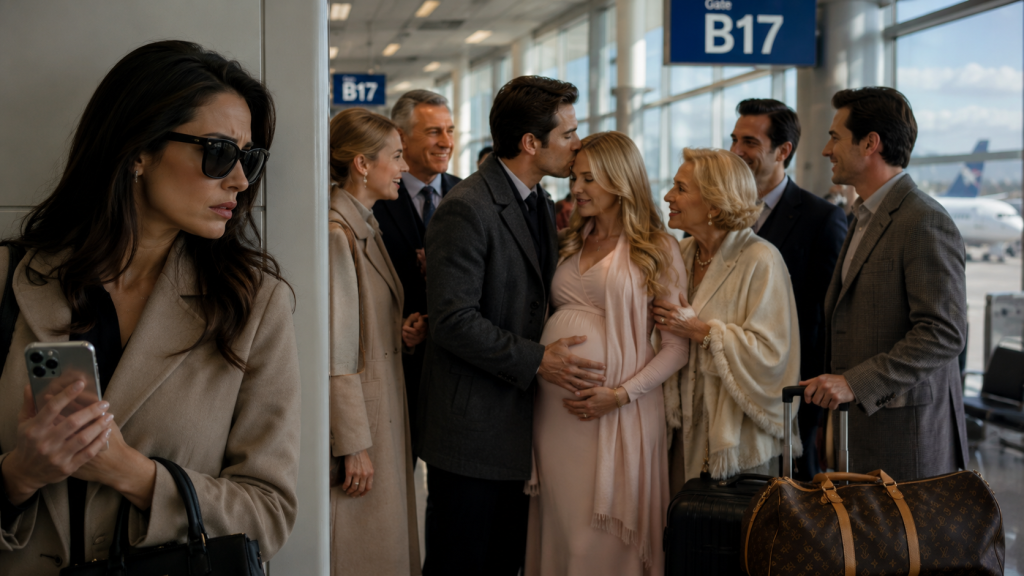
My Husband and Six Relatives Flew His Pregnant Mistress to Miami—So I Froze Their Assets… At 3:18 on a Friday afternoon, I watched my husband kiss a heavily pregnant woman at Gate B17 while his mother adjusted the woman’s cashmere scarf like she was already family.
Not a polite kiss. Not a mistaken kiss. A slow, tender, hand-on-the-belly kiss. And standing around them, laughing as if they were sending a princess off to give birth, were all six of his relatives: his parents, his sister, her husband, and two cousins I had hosted for Thanksgiving three years in a row.
My husband, Ethan Caldwell, had told me he was in Denver for a manufacturing conference.
Instead, he was at Boston Logan International Airport, boarding a first-class flight to Miami with another woman who looked ready to deliver his child any day.
I stood behind a pillar near the business lounge, wearing sunglasses I had bought in a panic from a Hudson News kiosk.
My hands were shaking so badly that my phone nearly slipped from my fingers.
The woman beside Ethan was beautiful in a soft, calculated way — long blonde hair, pale pink maternity dress, a diamond bracelet that caught the terminal lights.
Margaret Caldwell, my mother-in-law, pressed a cup of tea into her hands and cooed, “Tessa, sweetheart, don’t stand too long. My grandson needs you comfortable.”
My grandson.
The words went through me like a blade.
For ten years, Margaret had held my hands across dinner tables and whispered, “Amelia, don’t worry. Babies come when God is ready.”
For ten years, Richard Caldwell had kissed my forehead and told me I was the daughter he never had.
For ten years, Ethan had said, “You are enough for me.”
But now I saw the truth.
I had not failed to give them a family.
They had simply replaced me.
My best friend Lena had called me twenty minutes earlier while I was leading a quarterly strategy meeting at Hartwell Designs, the luxury fashion company my father built from a single sewing room in Providence.
“Amelia,” she had said, her voice trembling, “isn’t Ethan supposed to be in Colorado?”
“Yes,” I said. “Why?”
“My cousin works for the airline. She just sent me a picture. Ethan is at Logan. He’s checking in for Miami. And he’s not alone.”
I had ended my meeting with the calm of a woman made of marble, walked to my car, and driven through Boston traffic without remembering a single red light.
Now I stood ten yards from my marriage’s corpse.
Ethan slid his hand around Tessa’s waist.
She looked up at him like he had rescued her from the whole world.
His sister Madison snapped photos on her phone.
Her husband, Blake, joked about “baby Caldwell arriving with a better passport than any of us.”
The cousins, Noah and Claire, laughed like this was all perfectly normal.
Like I was not Ethan’s wife.
Like I was already gone.
My heart did not break loudly.
It froze.
That was worse.
A loud heartbreak gives you tears, screams, something human.
Mine turned into a hard, silent thing.
I raised my phone and took pictures.
One of Ethan kissing Tessa’s temple.
One of Margaret touching the pregnant belly.
One of Richard raising a champagne flute in the airport lounge.
One of all of them standing together like a perfect family portrait from which I had been erased.
Then I heard Ethan say something that made my blood stop.
“Once Amelia signs the year-end papers, everything is ours before the baby comes.”
Richard’s eyes shifted left and right.
“Keep your voice down.”
“She trusts me,” Ethan said with a little smile. “She signs whatever I put in front of her.”
For a second, the noise of the airport disappeared.
The rolling suitcases.
The gate announcements.
The crying toddler nearby.
Everything vanished except that sentence.
She signs whatever I put in front of her.
The boarding call came.
Margaret hugged Tessa.
Richard patted Ethan on the back.
Madison cried happy tears.
They walked toward the jet bridge together, leaving me behind with a phone full of evidence and ten years of lies burning in my pocket.
I did not confront them.
Not there.
Not yet.
People think betrayal makes you reckless.
Sometimes it makes you precise.
I waited until they disappeared, then walked out of the terminal into the cold November air.
Boston’s sky was gray and low, the kind that presses down on buildings and people and secrets.
I sat in my car for a full minute before starting the engine.
My father, Charles Hartwell, had warned me before he died.
“Love generously, Amelia,” he told me, “but never hand anyone the keys to your life.”
Back then, I thought he meant money.
Now I knew he meant survival.
I drove home to our brownstone in Beacon Hill, the one Ethan always called “our legacy,” though my father had paid for most of it before the wedding.
The house smelled faintly of white lilies, my favorite flowers, arranged that morning by the housekeeper.
Their sweetness felt obscene.
In the living room, our wedding portrait hung above the fireplace.
Ethan in black tie.
Me in ivory silk.
Margaret crying in the front row.
Richard smiling like a proud second father.
I stared at the photo and whispered, “You all knew.”
Then I went upstairs to my father’s old study, opened the safe, and pulled out everything that mattered.
Stock certificates.
Trust documents.
Foundation records.
Property deeds.
Corporate voting agreements.
And my father’s final letter to me.
The letter began with one line.
My darling Amelia, if you ever feel surrounded, remember you are not alone.
I sat behind his desk and made the first call.
“Margaret Reed,” my attorney answered, groggy but alert. “Amelia? What happened?”
“My husband has another woman,” I said. “She’s pregnant. His whole family helped him take her to Miami to give birth. And I think they’re planning to steal Hartwell Designs.”
Silence.
Then Margaret’s voice hardened.
“Do not let them know you know.”
“I won’t.”
“Good. Because if they’re moving money or shares, we need evidence before they panic.”
I looked at the wedding portrait through the open study door.
“They already made one mistake,” I said. “They thought I was weak.”
That night, while Ethan’s plane flew south, I copied three years of corporate emails, foundation transfers, internal contracts, and security footage.
By dawn, I had a folder named CALDWELL.
Inside it was the beginning of their ruin.
And by sunrise, I understood one thing with perfect clarity.
They had flown to Miami for a baby.
But they were coming back to a war.
By Monday morning, Ethan was still texting me photos of fake conference rooms in Denver.
One showed a hotel ballroom with navy chairs.
Another showed a breakfast buffet.
The third was a selfie of him in a suit, captioned, Exhausted. These meetings are brutal. Miss you.
I stared at the picture and noticed the reflection in the window behind him.
Palm trees.
Miami sunlight.
A woman’s pink dress on the chair.
I forwarded everything to Margaret Reed.
She arrived at my house before nine with two associates and a court order already drafted.
Margaret Reed was in her sixties, elegant in the way sharp knives are elegant, and she had represented my father for thirty years.
The moment she stepped into his study, she placed her briefcase on the desk and said, “Show me everything.”
I did.
Airport photos.
Text messages.
Corporate transfers Ethan had asked me to approve.
Draft year-end documents that would have shifted voting rights from my family trust into a new management entity Ethan controlled.
Email chains between Richard and a private banker.
Calendar invites for meetings I had never attended but where my electronic signature had appeared.
Margaret’s face grew colder with each document.
“Your father protected you well,” she said finally. “Hartwell Designs is not marital property. But Ethan has been trying to move voting control through shell companies.”
My throat tightened.
“He said they were tax efficiency documents.”
“Of course he did.”
“Can they take the company?”
“Not if we move before they return.”
She looked at one of the airport photos, the one where Ethan’s hand rested over Tessa’s pregnant belly.
“This,” she said, tapping the image, “is not legally necessary, but it is very useful.”
“Why?”
“Because it proves motive. He had a second household to fund and a child he intended to position as heir.”
The word heir made me laugh once, sharply.
“Heir to what? My father’s company?”
Margaret Reed’s eyes softened for half a second.
“Not anymore.”
At 9:42 a.m., the bank locked the joint investment accounts pending legal review.
At 10:15, corporate cards tied to Ethan, Richard, Madison, Blake, Noah, and Claire were suspended.
At 11:03, the board of Hartwell Designs received formal notice that any document bearing my signature from the past ninety days was under investigation.
At 11:27, the family foundation’s outgoing transfers were frozen.
At 12:06, Margaret Reed filed an emergency motion to prevent Ethan from accessing trust-controlled assets.
At 12:18, my phone rang.
Ethan.
I watched his name flash across the screen.
For ten years, that name had meant home.
Now it looked like evidence.
I answered.
“Amelia,” he snapped, not bothering to sound loving. “Why is my card declined?”
Behind him, I heard Margaret Caldwell shouting, and somewhere nearby, Tessa asking what was happening.
I looked at my father’s portrait on the wall.
“Because,” I said calmly, “your baby shower is over.”
There was silence.
Then Ethan laughed once, nervously.
“What are you talking about?”
“Gate B17,” I said.
His breathing changed.
I could hear the exact moment he understood.
“Amelia—”
“First-class tickets to Miami. Your mother adjusting Tessa’s scarf. Your father drinking champagne. Madison taking photos. You kissing her stomach.”
“Listen to me.”
“No.”
“Amelia, you don’t understand.”
“I understand that your mistress is pregnant. I understand that your family knew. I understand that you told them I sign whatever you put in front of me.”
Another silence.
This time, deeper.
More dangerous.
Then Ethan lowered his voice.
“You followed me?”
I almost smiled.
Even caught, he reached for accusation.
“No, Ethan. Your arrogance stood in public.”
He exhaled sharply.
“Don’t do anything stupid.”
“I already did,” I said. “I married you.”
Then I hung up.
For the next hour, my phone lit up like a storm.
Ethan called seventeen times.
Margaret Caldwell called twelve.
Richard sent one message.
We can discuss this like family.
Madison sent three.
Please don’t ruin Dad.
Please think of the baby.
This isn’t Tessa’s fault.
That last one stopped me.
I stared at the words until they blurred.
It was not Tessa’s fault that Ethan betrayed me.
But it was Tessa’s choice to stand in an airport accepting affection from my in-laws while wearing a diamond bracelet bought through a company account.
Margaret Reed took my phone gently from my hand.
“Do not reply.”
“I wasn’t going to.”
“Good. Let them talk through attorneys now.”
But the Caldwells were not the kind of people who respected silence.
By five that evening, Margaret Caldwell was standing outside my brownstone, pounding on the door with the brass knocker.
I watched her from the upstairs window.
She wore a cream wool coat and pearls, always pearls, like respectability could be clasped around the throat.
“Amelia!” she shouted. “Open this door immediately!”
I went downstairs, but I did not open it.
I spoke through the intercom.
“Leave.”
Her voice trembled with rage.
“How dare you freeze accounts while my grandson’s mother is in a hospital suite?”
Hospital suite.
Not hospital room.
Suite.
Paid for by me, no doubt.
“Then Ethan can pay for it,” I said.
“He is your husband!”
“And Tessa is his problem.”
“You are being cruel.”
That word nearly made me open the door.
Cruel.
For ten years, she had smiled in my face while arranging another woman’s place in my husband’s life.
For ten years, she had called me daughter while preparing to make someone else the mother of her grandson.
“No, Margaret,” I said. “Cruel was letting me set a Thanksgiving table for people who knew my marriage was dead.”
She went quiet.
Then, softer, she said, “You never gave Ethan a child.”
There it was.
The truth beneath all the perfume.
I pressed my hand flat against the door.
“No. But I gave your family money, reputation, access, and patience. You mistook all of them for weakness.”
“You can’t keep him from his own child.”
“I don’t want to keep him from his child. I want to keep him from my father’s company.”
“You vindictive little—”
I cut off the intercom.
Outside, she shouted a few more times.
Then she left.
That night, I slept in my father’s study.
Not because I was afraid, but because it was the only room in the house where I still felt protected.
The next morning, the first article appeared online.
LOCAL FASHION EXECUTIVE IN FAMILY LEGAL DISPUTE.
By noon, three more sites had picked it up.
Someone had leaked just enough to make me look unstable.
Anonymous sources said I had “suffered emotional distress over private family matters.”
Another said I had “abruptly disrupted financial operations after a misunderstanding.”
A misunderstanding.
That was what they called a pregnant mistress on a first-class flight.
I called Lena.
She answered on the first ring.
“Tell me what you need.”
“Truth,” I said.
Within two hours, Lena contacted a journalist she trusted.
Not a gossip writer.
A business journalist.
At four that afternoon, I released a short statement.
I will not comment on private marital issues. However, as majority voting trustee of Hartwell Designs, I have requested a full independent review of unauthorized attempts to alter corporate control, foundation transfers, and trust-protected assets. Hartwell Designs remains stable, employee salaries remain protected, and all legal actions are being taken to defend the company my father built.
No emotion.
No mistress.
No baby.
Just power.
By evening, the story changed.
Now reporters were asking why Ethan Caldwell had access to documents that could shift control of Hartwell Designs.
They were asking who authorized transfers to vendors connected to his relatives.
They were asking why a foundation account had paid for “medical hospitality services” in Miami.
That phrase was Margaret Reed’s favorite discovery.
Medical hospitality services.
A luxury birth suite.
Private nursing.
A seaside apartment booked for six weeks.
A maternity stylist.
All arranged through a vendor Ethan had labeled as “executive wellness consulting.”
When Margaret Reed showed me the invoices, I did not cry.
I laughed.
Not because it was funny.
Because the betrayal was so complete it had become absurd.
“Are you all right?” she asked.
“No,” I said. “But I am awake.”
Ethan came home three days later.
Not alone.
Richard was with him.
They arrived at the brownstone at 7:30 p.m., both wearing suits, both looking like men who had rehearsed authority in the car.
I let them in because Margaret Reed was sitting beside me in the living room with a recorder on the table.
Ethan stopped when he saw her.
“This is between husband and wife.”
“No,” I said. “It became larger than that when you tried to transfer corporate control.”
Richard raised both hands, trying to sound reasonable.
“Amelia, emotions are high. Let’s not destroy years of family over paperwork.”
“Paperwork is exactly what you tried to use to destroy me.”
Ethan’s face tightened.
“I never wanted to destroy you.”
“You wanted me erased quietly.”
“No. I wanted everyone taken care of.”
That almost broke me.
Everyone.
The baby.
Tessa.
His parents.
His sister.
His cousins.
Everyone except the wife whose name opened every door they walked through.
I looked at him carefully.
“How long?”
He looked away.
“Amelia—”
“How long?”
Richard sighed.
“This isn’t productive.”
I turned to him.
“You don’t get to manage my pain.”
Ethan swallowed.
“Two years.”
The room tilted for a moment.
Two years.
Seven hundred days of lies.
Two anniversaries.
Two Christmas mornings.
Two times I had sat beside Margaret while she told me miracles took time.
“And the baby?” I asked.
Ethan closed his eyes.
“Yes.”
The word was quiet.
But it landed like a verdict.
Margaret Reed leaned forward.
“Did you or did you not attempt to have Mrs. Caldwell sign documents transferring voting control of Hartwell Designs into Caldwell Management Partners?”
Ethan’s eyes flashed.
“I was trying to modernize governance.”
“Did you disclose that Caldwell Management Partners was created by your father?”
Richard said, “That structure was temporary.”
Margaret Reed smiled without warmth.
“Temporary theft is still theft.”
Ethan stood abruptly.
“I will not sit here and be insulted.”
I rose too.
“Then leave.”
He looked stunned.
For years, I had begged him to stay emotionally.
At dinners.
In arguments.
In empty bedrooms.
Now, when I finally told him to leave, he seemed unable to understand the language.
“Amelia,” he said softly. “I made mistakes. Terrible ones. But I love you.”
I looked at the man I had built a life around.
The man who had kissed another woman while planning to rob me.
“No,” I said. “You love what loving me gave you.”
His face went pale.
Richard placed a hand on his shoulder.
“Come on.”
They left without another word.
The next weeks were ugly.
Not loud ugly.
Legal ugly.
Accountant ugly.
Deposition ugly.
Email-after-email ugly.
The independent review uncovered a pattern of access abuse that made even Margaret Reed go silent.
Ethan had used my trust in him to place documents before me during busy days, charity events, and travel mornings.
“Just routine,” he would say.
“Sign here.”
“Your team already reviewed it.”
Sometimes they had.
Sometimes they had not.
But my father had protected me better than Ethan knew.
Major control transfers required secondary verification from trustees.
That verification had never happened.
Ethan had been building a bridge to a locked door.
And now he was standing on that bridge while it burned.
Tessa gave birth in Miami two weeks later.
A boy.
I learned this not from Ethan, but from Madison’s social media.
She posted a photo of tiny feet wrapped in a blue blanket.
Welcome to the world, little prince.
She deleted it eight minutes later.
But not before Lena screenshotted it.
I stared at the picture for a long time.
The baby had done nothing wrong.
He had not chosen lies.
He had not chosen greed.
He had not chosen to be born into a family that mistook inheritance for love.
For the first time since Gate B17, I cried.
Not for Ethan.
Not for the marriage.
For the version of myself who had spent ten years believing patience would be rewarded.
Lena came over that night with soup and no questions.
She sat beside me on the kitchen floor while I cried into a dish towel.
When I finally quieted, she said, “What do you want now?”
I wiped my face.
“My name back.”
“You never lost it.”
“I know,” I whispered. “But I stopped using it like it mattered.”
The divorce filing went public in December.
By then, Hartwell Designs had stabilized.
The board removed Ethan from every advisory role.
Richard resigned from the foundation.
Madison and Blake’s consulting contracts were terminated.
Noah and Claire lost corporate retainers they had no business receiving in the first place.
Margaret Caldwell sent one final message.
You have destroyed this family.
I replied once.
No. I stopped funding its lies.
Then I blocked her.
Ethan fought at first.
He wanted the brownstone.
Then he wanted a settlement.
Then he wanted privacy.
Margaret Reed gave him none of the first, little of the second, and none of the third beyond what the law required.
In mediation, he looked exhausted.
There were shadows under his eyes.
His suit fit badly.
He sat across from me at a long glass table, no longer the charming husband from charity galas, no longer the golden son of the Caldwell family.
Just a man whose plan had failed.
“I never thought you would do this,” he said during a break.
I looked at him.
“That was your mistake.”
“I thought you loved me.”
“I did.”
“Then how can you be so cold?”
I almost laughed.
Cold.
They always call a woman cold when she stops burning herself to keep others warm.
“I am not cold, Ethan. I am finished.”
He looked down.
“Tessa says I should fight harder.”
“Then let Tessa pay your legal bills.”
His mouth tightened.
For a second, I saw the old Ethan — offended, entitled, furious that I was not softer.
Then it passed.
Maybe he was too tired to perform.
Maybe I was too free to care.
The divorce was finalized in early spring.
I kept the brownstone.
Hartwell Designs remained mine.
The frozen accounts were divided according to law, but every improper transfer was accounted for, returned, or credited against Ethan’s settlement.
He left with less than he expected.
Far more than he deserved.
On the first warm day in April, I walked into Hartwell Designs wearing a white suit and my mother’s pearl earrings.
Not Margaret Caldwell’s pearls.
My mother’s.
The lobby smelled of leather, coffee, and fresh fabric.
Employees paused when they saw me.
Some smiled.
Some looked nervous.
News travels fast in a company.
So does betrayal.
I stepped into the main design floor where my father’s first sewing machine sat inside a glass case.
For years, I had passed it quickly, afraid of the weight of his legacy.
That morning, I stopped.
The machine was black iron, scratched at the base, still beautiful.
My father had built everything from that beginning.
Not for Ethan.
Not for the Caldwells.
For me.
For the people who worked there.
For a name that meant something before marriage tried to swallow it.
At nine, I stood before the senior team.
“I know the past few months have been difficult,” I said. “You have heard rumors, headlines, and maybe some truths. But I want you to hear this from me. Hartwell Designs is not collapsing. It is not changing hands. It is not being sold, diluted, or quietly moved into anyone else’s control.”
The room was silent.
I continued.
“My father built this company with discipline. I intend to run it with the same. There will be changes. There will be audits. There will be accountability. But there will also be stability. Your jobs matter. Your work matters. And from now on, no one will use this company as a private wallet again.”
For a second, no one moved.
Then someone began clapping.
Soon the whole room followed.
The sound filled the design floor, rising past the racks of silk, wool, lace, and unfinished gowns.
I stood there, not smiling exactly, but breathing.
Really breathing.
That evening, I went home to the brownstone.
The wedding portrait was gone.
In its place above the fireplace hung a framed photograph of my father in his first sewing room, sleeves rolled up, measuring fabric with a pencil behind his ear.
The white lilies had been replaced with blue hydrangeas.
The house no longer smelled like a life I was pretending to live.
It smelled like mine.
Weeks later, a small envelope arrived with no return address.
Inside was a photo of the baby.
No note.
No explanation.
Just a sleeping child with Ethan’s mouth and Tessa’s fair hair.
I sat with it for a long time.
Then I placed it in a drawer.
I did not hate him.
That surprised me.
Maybe healing begins when hate becomes too heavy to carry.
The child was innocent.
But innocence did not require me to sacrifice myself.
That was the lesson I had learned too late and exactly on time.
One year after Gate B17, I flew to Paris for Hartwell Designs’ first European showroom opening.
As the plane lifted from Boston, I looked down at the city where my marriage had ended and my life had returned.
My phone was in airplane mode.
My hands were steady.
In my carry-on was a folder of contracts I had read myself, signed myself, approved myself.
No one beside me.
No husband telling me where to sign.
No mother-in-law smiling with knives behind her teeth.
No family pretending love while reaching for my father’s legacy.
Just me.
Amelia Hartwell Caldwell no longer felt like my name.
So before the showroom opening, I changed the placard outside my office.
Amelia Hartwell.
Founder’s Daughter.
Chief Executive Officer.
On opening night, cameras flashed.
Champagne glittered.
Models moved through the room in silk gowns inspired by my father’s earliest sketches.
A journalist asked me what had inspired the new collection.
I looked around at the fabric, the lights, the women standing tall in clothes designed not to decorate them, but to honor them.
Then I smiled.
“Survival,” I said. “And the beauty of no longer asking permission.”
Later, alone on the balcony overlooking Paris, I thought of that afternoon at Gate B17.
The kiss.
The hand on the pregnant belly.
The laughter.
The sentence that had tried to reduce me to a signature.
She signs whatever I put in front of her.
I closed my eyes and let the night air touch my face.
He had been wrong.
I did not sign whatever he put in front of me.
I signed the end.
I signed the freeze.
I signed the divorce.
I signed my own name back into my life.
And somewhere far behind me, the Caldwells were still explaining how everything fell apart.
But I knew the truth.
Nothing fell apart.
It was revealed.
And once I saw clearly, I did what my father had taught me to do.
I protected what mattered.
I walked away from what did not.
And I never again handed anyone the keys to my life.
THE END! THANK YOU FOR READING!