

I finally surrendered my brother’s old golden retriever to the shelter on a Thursday morning when the sky was the color of wet cement and my whole life felt like something packed into boxes.
His name was Buddy, though my brother, Caleb, used to call him “Captain” because that dog followed him everywhere like a loyal soldier. Caleb had been gone for almost eleven months, and Buddy had been sleeping beside my bed every night since the funeral, breathing heavily, dreaming with his paws twitching, still waiting for footsteps that would never come back.
I tried to keep him.
I really did.
I told myself Caleb would have wanted me to. But then I lost my old job, found a new one two towns over, and moved into an apartment with a strict no-large-dogs rule. The landlord had already warned me twice.
“One more complaint,” he said, “and you’ll both be out.”
I was twenty-nine, broke, exhausted, and ashamed of how relieved I felt when I finally made the call.
Buddy sat in the passenger seat during the drive to Maple Ridge Animal Shelter, his gray muzzle resting on the window ledge, his cloudy brown eyes watching the road like he knew exactly where we were going.
He did not bark.
He did not whine.
That almost made it worse.
At every red light, I found myself reaching over to scratch behind his ear, whispering, “I’m sorry, boy. I’m so sorry.”
He only turned his head and pressed his nose into my palm, warm and damp, as if he was comforting me instead of the other way around.
When we reached the shelter, the building smelled like bleach, fear, and old blankets. Dogs barked somewhere in the back, their voices bouncing off concrete walls. Buddy stepped down slowly from the car, his hips stiff, his tail low but still wagging once when I said his name.
A young shelter worker with tired eyes handed me a clipboard.
“Owner surrender?” she asked.
I flinched at the word owner, because Buddy had never felt like mine. He had been Caleb’s shadow, Caleb’s last piece, the only living thing that still remembered him the way I did.
“My brother passed away,” I said, gripping the pen. “I can’t keep him anymore.”
The worker’s expression softened for half a second, then returned to business.
“Just standard intake,” she said. “There’s a fifty-dollar surrender fee.”
Fifty dollars to hand over the last heartbeat from my brother’s life.
I paid it with a debit card that nearly declined, then knelt in front of Buddy while she prepared his paperwork.
“Be good, okay?” I whispered. “Someone better than me will come for you.”
Buddy looked at me for a long moment.
Then he did something strange.
He picked up his favorite ratty chew toy from where it had fallen beside my bag and dropped it at my feet.
It was hideous, honestly. A faded rubber duck with one missing wing, patched with old bite marks and years of dried slobber. Caleb had bought it for him during a road trip to Vermont, and Buddy had guarded it like treasure ever since.
I tried to push it back toward him.
“No, Buddy. You keep it.”
But he nudged it toward me again with his nose.
The shelter worker smiled sadly. “Maybe he wants you to have something.”
I swallowed hard, picked up the toy, and stood before I could change my mind.
Buddy did not resist when they clipped a shelter leash to his collar.
He walked away with the worker, but at the doorway, he stopped and looked back.
That look followed me home.
For two weeks, I avoided thinking about him. I worked double shifts, unpacked dishes, pretended silence was peace, and shoved the rubber duck into a kitchen drawer because seeing it made my chest ache.
Then the shelter called.
The woman on the phone spoke gently, which told me everything before she said the words.
“I’m sorry, Ms. Harper. Buddy passed in his sleep last night. He was comfortable. He wasn’t alone.”
I sat down on the kitchen floor because my knees simply stopped working.
I had abandoned him, and he had died waiting for someone who never came.
The guilt was sharp, but not sharp enough to make me brave.
Instead of going to collect his collar, instead of asking what his last moments were like, I thanked her and hung up.
That night, I opened the drawer, took out the old rubber duck, and stared at it for nearly an hour.
“I’m sorry,” I whispered again, but this time there was no warm nose pressing into my hand.
By morning, I decided I could not keep it.
I told myself it was just a toy.
A dirty, ruined, smelly toy.
A reminder I did not deserve.
I dropped it into the trash, but it landed wrong, split against the metal edge of an empty can, and tore open along a seam I had never noticed before.
Something small clinked against the bottom of the bin.
I froze.
At first, I thought it was a piece of metal from the toy, but when I reached in with trembling fingers, I pulled out a small rusted key wrapped in plastic and folded paper.
The paper was yellowed, soft from age, but the handwriting stopped my breath.
Caleb’s handwriting.
Messy. Slanted. Familiar enough to hurt.
My hands shook as I unfolded the note.
It said:
“If he gave you this, it means they found me, or they finally made sure I couldn’t come back. Don’t trust the accident report. Don’t trust Uncle Martin. And whatever you do, do not open the blue door alone.”
I read it once.
Twice.
A third time.
Then I noticed something written on the back in smaller letters.
“Buddy knows where I hid the truth.”
But Buddy was dead.
For a long time, I simply sat there with the key in one hand and the note in the other, listening to my refrigerator hum like nothing in the world had changed.
Uncle Martin.
The name felt wrong in my mouth.
He was our mother’s younger brother, the only family member who had stayed close after our parents died. He handled Caleb’s funeral arrangements. He helped sell Caleb’s house. He stood beside me at the cemetery with a hand on my shoulder, telling me, “Your brother was reckless, Emma. Always was. We have to accept it.”
The official report said Caleb had driven off Pine Hollow Road during a storm.
No other cars involved.
No witnesses.
Just wet pavement, a broken guardrail, and my brother’s truck found at the bottom of a ravine.
They said it was instant.
They said he had probably been tired.
They said there was no reason to investigate further.
I believed them because grief makes you desperate for simple answers.
But Caleb’s note had been hidden inside Buddy’s toy.
Not in a drawer.
Not in a safe.
Inside the one thing Caleb knew Buddy would protect.
My phone buzzed on the counter, and I nearly screamed.
It was Uncle Martin.
For a moment, I stared at his name glowing on the screen, my heart punching against my ribs.
I had not spoken to him in weeks.
The message read:
Heard from Maple Ridge about Buddy. Sorry, kiddo. Caleb loved that dog. Let me know if you need help cleaning out old things.
Old things.
My hand tightened around the key.
I typed nothing back.
Instead, I opened my laptop and searched for the accident report I had saved months ago. I had read it only once before because the words had felt too cold. This time, I read every line.
The report mentioned the truck.
The rain.
The ravine.
The estimated time of death.
But there was something I had never noticed before.
The responding officer wrote that Caleb’s truck had been found with the driver’s side door open.
His phone was missing.
His wallet was missing.
And Buddy had been found two miles away, soaking wet, sitting outside the old Harper family property.
I leaned closer to the screen.
The old Harper property.
Our grandparents’ farm.
The place Caleb and I had spent summers as kids.
The place Uncle Martin inherited after Grandma died.
The place with the blue cellar door.
My stomach turned cold.
I remembered that door immediately.
It was at the back of the old barn, painted a strange bright blue that never seemed to fade. Caleb and I used to dare each other to touch it when we were little because Grandma always said, “That door stays locked. It’s not for children.”
Uncle Martin used the barn for storage now. At least, that was what he always said.
I looked down at the rusted key.
Then I understood why Buddy “knew.”
Because after Caleb’s accident, Buddy had gone there.
Not home.
Not to me.
There.
I stood so fast my chair scraped the floor.
For ten minutes, I paced my apartment, telling myself not to be stupid. Caleb was gone. Buddy was gone. Maybe the note was old. Maybe Caleb had been paranoid. Maybe Uncle Martin had nothing to do with anything.
Then I remembered how Uncle Martin had pushed me to sell Caleb’s house quickly.
How he had insisted on taking Caleb’s boxes “to sort them properly.”
How he had told me Buddy was “too much responsibility” after the funeral.
And how angry he looked when Buddy growled at him during the estate meeting.
Buddy had never growled at anyone before.
Not until Uncle Martin.
I grabbed my keys.
The Harper farm sat forty minutes outside town, past a ribbon of back roads and fields that looked forgotten by time. The house had been empty for years, its white paint peeling, its porch sagging, its windows dark. The barn stood farther back, half hidden behind overgrown grass and maple trees.
As I drove up the gravel path, my headlights swept across the old blue door.
My breath caught.
The paint was chipped now, but still unmistakable.
Bright blue.
Too bright for a place so dead.
I parked behind a cluster of trees, turned off the engine, and sat there with the key in my palm.
Do not open the blue door alone.
Caleb had written that.
So I didn’t.
I called the only person I could think of.
Detective Nora Bennett had been Caleb’s friend in high school before she became a county detective. She came to the funeral, hugged me, and said, “If you ever need anything, Emma, call me.”
At the time, I thought she meant casseroles and grief support.
Now I prayed she meant it.
She answered on the third ring.
“Emma?”
“Nora,” I whispered. “I found something Caleb hid.”
There was a pause.
“What kind of something?”
“A key. A note. He said not to trust the accident report. He said not to trust Uncle Martin.”
Silence.
Then her voice changed, low and steady.
“Where are you?”
“At the old Harper farm.”
“Do not go inside anything. Do not touch anything else. Stay in your car. I’m coming.”
I almost obeyed.
I really almost did.
But then I saw movement near the barn.
A flashlight beam flickered behind the slats.
Someone was already inside.
My blood went cold.
I ducked lower in my seat as the barn door slid open.
Uncle Martin stepped out.
He was carrying a cardboard box.
Even from a distance, I recognized his heavy coat, his stiff walk, the way his head turned sharply as if he was listening for ghosts.
He loaded the box into his SUV, then went back inside.
I took one photo.
Then another.
My phone shook so badly the pictures blurred.
A few minutes later, another car pulled up.
A dark sedan.
A woman got out wearing a county clerk’s badge clipped to her jacket.
I knew her too.
Patricia Vale.
She had notarized Caleb’s estate forms.
She and Uncle Martin spoke near the barn entrance. I could not hear them, but I saw him point toward the blue door. Patricia shook her head. He grabbed her arm.
She pulled away.
That was when my phone lit up.
Uncle Martin calling.
The sound felt impossibly loud in the car.
I silenced it.
A second later, a message came through.
Where are you, Emma?
I stopped breathing.
Another message followed.
Your landlord said you left in a hurry.
My skin prickled.
He had called my landlord?
Then one more message:
Don’t do something Caleb would regret.
That was not concern.
That was a warning.
Headlights flashed behind me.
For one terrifying second, I thought Uncle Martin had found me.
But it was Nora.
She got out of her car wearing jeans, a dark jacket, and the face of someone who had already believed more than she wanted to admit.
I hurried to her and handed her the note.
She read it under the glow of her phone.
Her jaw tightened.
“Emma,” she said quietly, “I need you to tell me exactly where you found this.”
“Inside Buddy’s toy.”
“Buddy gave it to me at the shelter. Before he died.”
Something flickered in her eyes.
“Caleb came to me two weeks before his accident,” she said.
My breath stopped.
“What?”
“He said he thought someone was stealing from your grandparents’ estate. Land deeds. mineral rights. old accounts. He didn’t have proof yet. He asked me off the record what he’d need to reopen old property records.”
“Why didn’t you tell me?”
“Because after he died, Martin said Caleb had been drinking and spiraling. He gave everyone the same story. And the report closed fast.”
“Caleb didn’t drink.”
“I know.”
Before I could respond, the barn door opened again.
Uncle Martin stepped out with Patricia behind him.
This time, Patricia was crying.
Nora pulled me behind her car.
“Stay here,” she said.
Then she walked forward, flashlight raised.
“Martin Harper.”
Uncle Martin froze.
Patricia looked like she might collapse from relief.
“Nora?” Martin’s voice carried through the cold air. “What are you doing here?”
“Same question.”
He laughed once, dry and ugly.
“This is private property.”
“Then you won’t mind explaining why you’re removing boxes from a property tied to an active concern regarding Caleb Harper’s death.”
His face changed.
Only for a second.
But I saw it.
Fear.
Then anger.
“Emma,” he called, looking past Nora. “Come out. Don’t let her twist things. Your brother was sick. He made up stories.”
I stepped from behind the car.
“My brother hid a note in Buddy’s toy.”
His face went pale.
Not surprised.
Caught.
“Where is the dog?” he asked.
That question told me everything.
Not “What note?”
Not “What are you talking about?”
Where is the dog?
“He’s gone,” I said.
For the first time since I was a child, Uncle Martin looked truly shaken.
Then his expression hardened.
“You stupid girl,” he said softly.
Nora reached for her radio.
Martin moved fast.
He turned, grabbed Patricia, and shoved her toward his SUV.
Nora shouted for him to stop, but Patricia stumbled and fell, and Martin used the distraction to run toward the barn.
Not away.
Toward the blue door.
Nora sprinted after him.
I followed before I could think.
Inside, the barn smelled like mold, old hay, and gasoline. My flashlight beam jumped over stacked crates, rusted tools, and torn tarps. At the back, the blue door stood open.
Beyond it was a narrow staircase leading underground.
Nora turned to me.
“I told you to stay back.”
“I’m not leaving now.”
She looked like she wanted to argue, but footsteps echoed below.
We descended carefully.
The stairs led to an old storm cellar I barely remembered. The air was colder underground, damp and stale. At the bottom was a small room with concrete walls and shelves of jars long emptied and thick with dust.
But behind one shelf was a second door.
Not blue.
Metal.
Uncle Martin was there, trying to force it open with a crowbar.
“Step away,” Nora ordered.
He turned, sweating, wild-eyed.
“You don’t understand what your brother did,” he snapped.
“What did he do?” I asked.
“He ruined everything.”
Nora raised her phone, recording now.
“Explain.”
Martin laughed bitterly.
“Our father left that land to me. Me. But your grandmother hid accounts, deeds, mineral rights under your mother’s name. Then after she died, it should have gone to me. But Caleb found the records. He thought he was some hero.”
“So you killed him?” I whispered.
His eyes cut to mine.
“I didn’t kill him. He ran.”
Nora’s voice was calm, but hard. “From whom?”
Martin said nothing.
Then Patricia appeared at the bottom of the stairs, shaking, holding her arm.
“From him,” she said.
Martin spun toward her.
Patricia flinched but kept talking.
“Caleb found out Martin had been forging documents for years. I notarized some of them. I thought they were legitimate at first. Then I realized signatures didn’t match. When Caleb confronted me, I told him I would help fix it.”
Her voice broke.
“Martin found out.”
Martin screamed at her to shut up.
But it was too late.
Nora had everything recorded.
“What happened the night Caleb died?” Nora asked.
Patricia looked at me.
“I’m sorry,” she whispered.
My whole body went numb.
“Tell me.”
She swallowed hard.
“Caleb came here. He had the original documents. He hid copies somewhere. Martin showed up. They argued. Caleb tried to leave, but Martin blocked his truck. Caleb ran into the storm with Buddy.”
Martin’s face twisted.
“He slipped,” he barked. “He ran like a coward through the woods and slipped near the road.”
“Then why was his truck in the ravine?” Nora asked.
Martin’s mouth closed.
Patricia answered.
“Because Martin moved it.”
The room seemed to tilt.
Nora stepped closer. “You helped falsify the report?”
Patricia shook her head, sobbing.
“I didn’t know until later. Martin had friends. People owed him favors. The truck was staged. Caleb wasn’t found where he fell.”
My chest tightened until I could hardly breathe.
“Where was he found?”
No one answered.
“Where was my brother found?”
Patricia pointed toward the metal door.
“Back there.”
The room went silent.
I thought grief had already broken every part of me.
I was wrong.
Uncle Martin lunged for the crowbar, but Nora was faster. She tackled him against the shelf, jars crashing around them. Patricia screamed. I stumbled back, hitting the wall.
Nora pinned him down and cuffed him while he cursed all of us.
“You think this changes anything?” he spat. “You don’t have the documents. Caleb hid them too well.”
Then I remembered the note.
Buddy knows where I hid the truth.
And suddenly, I understood.
Not the barn.
Not the blue door.
Buddy.
Buddy had gone two miles from the accident scene to the farm because Caleb had trained him to find something here. But after Caleb died, Buddy had not stayed at the blue door forever. He had come home carrying his toy.
The toy had the key.
But maybe the key was not for the blue door.
I looked at the small rusted key in my hand.
The metal door had a modern lock.
This key was old.
Tiny.
Like a lockbox key.
“Caleb didn’t hide the truth in the cellar,” I said.
Nora looked up from where Martin sat cuffed and furious.
“He hid directions to it.”
We searched the cellar after backup arrived. Behind the metal door, they found old bloodstained boards, torn fabric from Caleb’s jacket, and enough evidence to reopen everything. But the documents were not there.
Martin refused to speak.
Patricia gave a full statement.
By dawn, the farm was surrounded by police tape, and I stood outside wrapped in Nora’s coat while the sun rose pale over the fields.
I should have felt relief.
Instead, I felt only one thought repeating.
Buddy knew.
And I had given him away.
Nora drove me back to my apartment. I did not sleep. I sat on the floor beside the drawer where the rubber duck had been, staring at the torn pieces I had pulled from the trash.
At noon, my phone rang.
Maple Ridge Animal Shelter.
I almost didn’t answer.
“Ms. Harper?” It was the same worker who had taken Buddy in. “I’m sorry to call again, but you asked us not to contact you unless something important came up.”
“I didn’t ask that.”
A pause.
“Oh. A man called after Buddy was surrendered. Said he was your uncle. He asked to be notified if anyone came for the dog or his belongings.”
My blood chilled.
“What belongings?”
“Buddy’s collar. His blanket. And the old leash he had when he came in.”
I closed my eyes.
“Do you still have them?”
“Yes. We were going to dispose of them tomorrow, but…”
“I’m coming.”
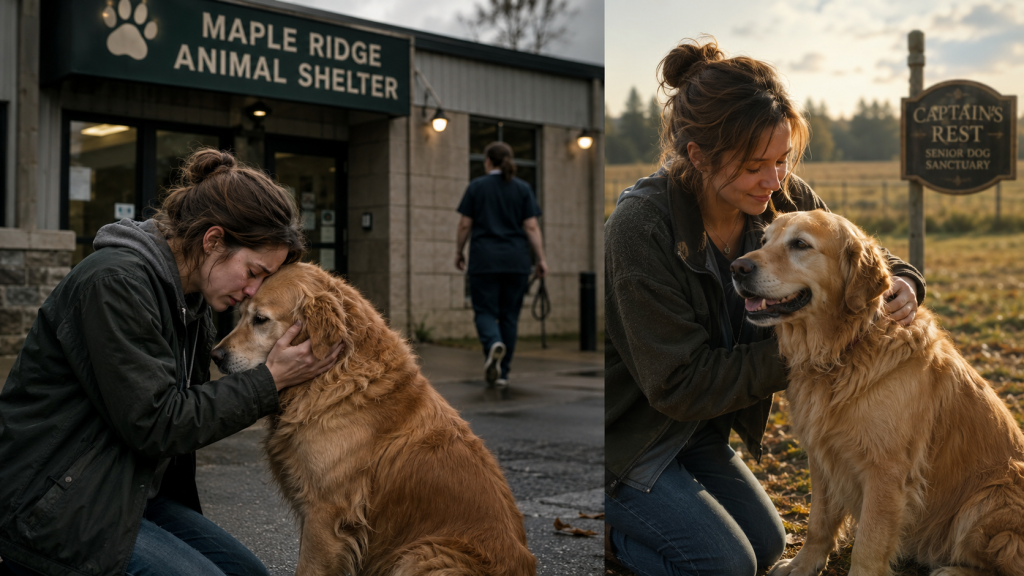
When I arrived, the shelter worker brought out a small paper bag. Buddy’s collar was inside, along with a frayed blue leash and a folded blanket that smelled faintly like him.
I pressed the blanket to my face and cried in a way I had not allowed myself to cry before.
“I’m sorry,” I said.
The worker touched my shoulder gently.
“He wasn’t alone, you know. I sat with him the last hour. He kept his paw on that blanket.”
I nodded, unable to speak.
As I lifted the collar, something hard pressed against my palm.
Buddy’s name tag was thicker than I remembered.
I turned it over.
The back was scratched with tiny marks.
Not random.
Letters.
B.H. UNDER CAPTAIN’S TREE.
Captain.
Caleb’s nickname for Buddy.
Captain’s Tree.
I knew exactly where it was.
At our childhood home, there was an enormous oak behind the creek where Caleb had buried “treasures” when we were kids. Bottle caps. Baseball cards. A silver button from Dad’s old coat. Buddy used to dig there constantly until Caleb finally built a little wooden marker that read CAPTAIN’S TREE.
The house had been sold after Caleb died.
But the oak was still there.
I drove there before sunset.
The new owners were an older couple named the Whitmans. I knocked with shaking hands and told them a softened version of the truth: that my late brother had hidden something sentimental near the oak tree when we were children.
Mrs. Whitman looked at my face and did not ask questions.
“Take all the time you need,” she said.
The backyard looked smaller than I remembered. The creek was thinner. The grass was neat. But the oak still stood, wide and strong, its branches reaching over the yard like arms.
At its base, half buried in moss, was the old wooden marker.
CAPTAIN’S TREE.
I knelt and dug with my hands because I had not thought to bring a shovel. Dirt packed under my nails. Roots scraped my wrists. The ground was cold and stubborn, but I kept digging until my fingers hit metal.
A small lockbox.
Old.
Rusty.
The key fit.
Inside were envelopes wrapped in plastic. Property deeds. Bank records. Copies of forged signatures. Photos of Martin meeting with county officials. A flash drive sealed in a waterproof bag.
And one more letter.
This one was addressed to me.
Emma,
If you are reading this, I am either hiding badly or gone for good. I’m sorry. I wanted to tell you everything, but I needed proof first. Martin has been stealing from this family for years. Not just money. Land. Records. Anything he could bury.
Buddy is the only one I trust completely. I trained him to take the toy to you if I gave the command. If he gave it to you, it means he did his job.
Please don’t blame him.
And please don’t blame yourself.
You always think leaving means failing someone. It doesn’t. Sometimes love arrives late, but it still arrives.
I love you, little sister.
Caleb
I folded over the letter and held it to my chest.
For the first time in eleven months, I felt my brother close enough to hear.
The evidence in that box destroyed Uncle Martin’s life.
Within weeks, the accident report was reopened. Two officers involved in the original cover-up were suspended. Patricia took a plea deal in exchange for testimony. Martin was charged with fraud, obstruction, evidence tampering, and later, after the investigation confirmed what Patricia had said, charges connected to Caleb’s death.
The newspapers called it “The Harper Farm Scandal.”
I hated that name.
To them, it was a headline.
To me, it was my brother.
It was Buddy.
It was a rubber duck in a kitchen drawer and a dog’s last gift.
Caleb’s property was eventually restored to his estate. The money Martin had stolen could never bring him back, but it paid for something Caleb would have loved.
I bought twelve acres outside town and opened a senior dog sanctuary.
Not a shelter.
A home.
The first building had wide windows, heated floors, soft beds, and a front porch facing the sunset. Above the entrance, I hung a wooden sign.
CAPTAIN’S REST.
On opening day, Nora stood beside me while the first dogs arrived: old, gray-muzzled, unwanted, limping, gentle souls with cloudy eyes and tired hearts.
I thought I would break down.
Instead, I smiled.
Because for once, goodbye did not feel like abandonment.
It felt like a promise.
A month later, Maple Ridge Animal Shelter called again.
For a second, fear grabbed my throat.
But this time, the worker sounded almost shy.
“We have someone here you might want to meet.”
He was an old golden retriever mix, thinner than Buddy, with one torn ear and eyes so brown they made my chest ache. He had been surrendered by a family moving overseas.
“He keeps carrying this around,” the worker said.
She handed me a faded rubber ball.
I knelt in front of him.
He sniffed my hand, then pressed his nose into my palm.
Warm.
Damp.
Trusting.
I closed my eyes.
“Hi, Captain,” I whispered.
His tail thumped once.
Then again.
And somewhere in that small sound, I finally forgave myself.
Because Buddy had not died abandoned.
He had finished Caleb’s mission.
He had carried the truth as far as his old body could carry it.
And when he could not walk any farther, he placed it at my feet.
So I spend my mornings now at Captain’s Rest, opening gates for dogs no one has room for anymore. I sit with them on bad days. I learn their favorite songs. I remember their names after they are gone.
And every Thursday morning, when the sky is gray and the world feels heavy, I take Buddy’s collar from the small wooden box on my desk.
I run my thumb over his scratched name tag.
Then I whisper the words I should have said before I walked away.
“You were a good boy, Captain.”
And this time, I know he hears me.
THE END! THANK YOU FOR READING!