

On Christmas morning, my millionaire son knelt by the tree and asked, “Mom, has the $5,000 Amanda sends you each month finally made you comfortable?” I hugged the blanket tighter around my shoulders and whispered, “Son, I haven’t had heat in this house since November.”
For a moment, the only sound was the old wall clock ticking above the mantel. Outside, snow pressed against the windows in thick white sheets. Inside, my breath came out in small clouds. The living room smelled faintly of dust, canned soup, and the pine candle I had burned halfway down because I could not afford a real tree.
My son, Daniel Whitmore, stared at me as if I had spoken another language.
He was forty-two years old, successful, handsome, and polished in that quiet way wealthy men become when the world keeps opening doors for them. His wool coat probably cost more than my monthly pension. His shoes had no salt stains on them, even though the roads outside were buried in snow.
Yet right then, kneeling beside my artificial Christmas tree with its cracked ornaments and flickering lights, he looked like the little boy who used to ask me why the power went out when bills were late.
“What do you mean you haven’t had heat?” he asked.
I tried to smile, but my lips trembled from the cold. “The furnace broke. I didn’t want to worry you.”
Daniel slowly rose to his feet.
His eyes moved around the room as if he was seeing my house for the first time.
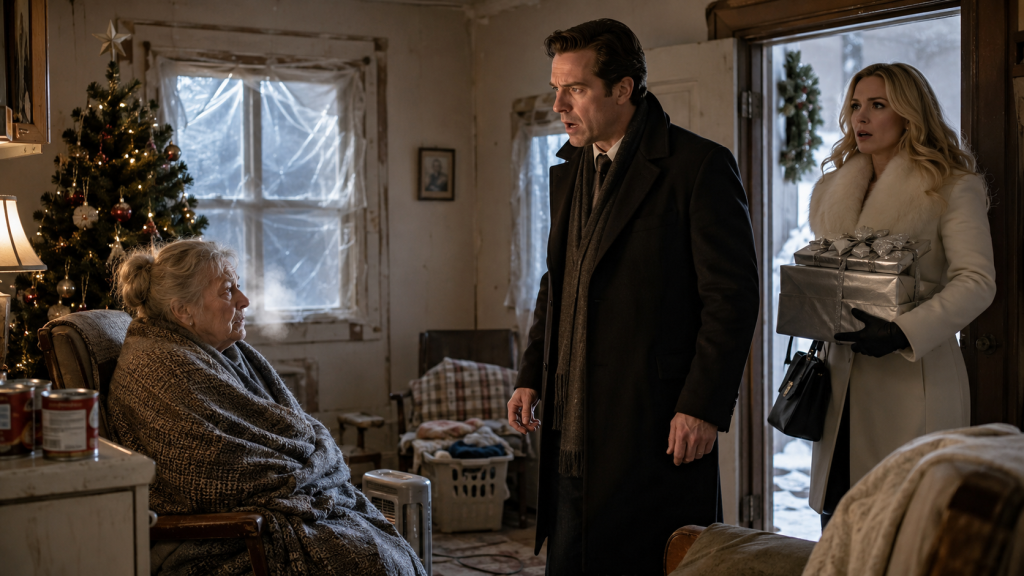
The taped plastic over the windows.
The gray blankets nailed over the hallway door to trap warmth in the living room.
The small space heater beside my chair, unplugged because I could not afford another electric bill like the one that came in December.
The canned soup stacked on the kitchen counter.
The unopened medical letters near my Bible.
His face changed.
“Mom,” he said carefully, “Amanda told me she set up automatic payments. Five thousand dollars every month. For over a year.”
I blinked at him.
The words did not make sense at first. They floated there in the frozen room like smoke.
“Five thousand?” I repeated.
“Yes,” Daniel said. “Every month. I told her I wanted you taken care of. I asked her to handle it because she said you were too proud to accept money directly from me.”
My fingers tightened around the blanket.
Amanda.
My daughter-in-law.
Elegant Amanda, with her soft voice, designer handbags, and careful smiles. Amanda, who always smelled like jasmine perfume and money. Amanda, who hugged me with her cheek turned away, as if poverty might stain her skin.
“Amanda told me you were struggling with the new hotel project,” I said slowly. “She said I shouldn’t bother you. She said you and she were sending what you could.”
Daniel’s jaw hardened.
“What you could?” he asked.
I nodded.
“She brought me groceries twice. She gave me envelopes sometimes. Two hundred dollars. Maybe three hundred. She said it was all she could spare without upsetting you.”
Daniel stepped back as if the floor had shifted beneath him.
“That money was for you,” he said. “Your heat. Your groceries. Your medication. Everything.”
Before I could answer, the front door opened.
Cold wind rushed into the house.
Amanda walked in carrying gifts wrapped in silver paper, her blonde hair smooth beneath a white cashmere hat. Snowflakes rested on her shoulders like diamonds. She smiled brightly, then froze when she saw Daniel’s face.
“Merry Christmas,” she said, her voice careful.
Daniel turned toward her.
“Where is the money?” he asked.
Amanda blinked. “What money?”
“The $5,000 a month I’ve been sending my mother through your account.”
Her smile thinned.
“Daniel,” she said quietly, “not here.”
“Yes,” he said. “Here.”
The room seemed colder than before.
Amanda set the gifts down one by one, as if buying time. Her diamond bracelet flashed under the weak yellow light. I noticed the bracelet because I had seen the same one in a magazine at the doctor’s office. It cost more than my car had been worth when it finally died in July.
I looked at my son.
Then at his wife.
And suddenly I remembered every time Amanda had said, “Your mother is proud. She doesn’t want charity.”
Daniel’s voice dropped.
“Did my mother receive one dollar of it?”
Amanda’s face changed.
Not guilt.
Annoyance.
“That money was being managed,” she said. “Your mother wouldn’t know what to do with that much.”
Daniel went still.
The stillness frightened me more than shouting would have.
“Managed?” he repeated.
Amanda lifted her chin. “I used it where it was needed.”
“Where it was needed?” Daniel asked.
“She had a roof,” Amanda said, gesturing around my little house. “She survived, didn’t she?”
My son looked at the frost on the inside of my window.
Then at my trembling hands.
Something broke in his face.
“You bought yourself a new car in March,” he said.
Amanda’s cheeks turned pink. “That was different.”
“You told me it was a business bonus.”
“It was,” she snapped.
“It was my mother’s money.”
“Daniel, don’t embarrass me in front of her.”
“Her?” he said, his voice suddenly sharp. “That is my mother.”
I tried to stand, but my knees shook under me.
Daniel crossed the room and caught me before I fell. Without a word, he removed his expensive coat and wrapped it around my shoulders. It was warm from his body and smelled like cedar and snow.
I had not felt warmth like that in weeks.
The kindness of it nearly made me cry.
Amanda watched us, her mouth pressed into a thin line.
Daniel pulled out his phone.
“I want every bank statement,” he said. “Every transfer. Every receipt. Every lie.”
Amanda laughed once.
It was a sharp, ugly sound that did not belong on Christmas morning.
“And if I refuse?” she asked.
Daniel looked at the silver gifts under my cheap tree.
“Then I call my attorney before noon.”
Amanda’s smile vanished.
And then, from inside her purse, a second phone began ringing.
Not the phone she usually carried. Not the sleek gold one she always placed face down on tables.
This sound came from deeper inside her bag.
A small black phone.
Amanda moved too quickly to grab it, but Daniel was faster.
He reached into the purse, pulled out the phone, and looked at the screen.
His face drained of color.
The caller name read: Mother Whitmore Account.
I saw it too.
Amanda whispered, “Give that back.”
Daniel did not move.
The phone stopped ringing.
Then a message appeared.
Transfer delayed. Need confirmation before noon. Same destination?
Daniel looked at his wife.
“What destination?” he asked.
Amanda’s voice went soft. “Daniel, you don’t understand.”
“No,” he said. “I think I’m finally starting to.”
He unlocked the phone.
Amanda lunged forward, but he stepped away from her.
“Daniel,” she said, and for the first time, I heard fear in her voice. “Please.”
He scrolled.
I watched his face as he read message after message.
His anger did not explode.
It sank.
It became something colder.
Something heavier.
“What is Blue Harbor Holdings?” he asked.
Amanda said nothing.
Daniel looked up. “I asked you a question.”
She swallowed. “An investment account.”
“With my mother’s money?”
Amanda’s eyes flicked toward me, then away.
I suddenly felt ashamed, though I had done nothing wrong. That is how people like Amanda survive. They make their victims feel embarrassed for being robbed.
Daniel kept scrolling.
“Transfers every month,” he said. “Five thousand from my account. Then four thousand seven hundred sent to Blue Harbor Holdings. Three hundred withdrawn in cash.”
He looked at me.
“Mom,” he said gently, “is that what she gave you?”
I nodded, tears burning my eyes.
“Sometimes less,” I whispered. “Sometimes she said you had business trouble.”
Daniel shut his eyes.
For one terrible second, I saw the boy he had been.
The child I raised alone after his father died.
The little boy who sold lemonade with me outside church when we needed money for school shoes.
The teenager who promised me, “Someday, Mom, you’ll never worry about bills again.”
He had kept that promise.
But the money had never reached me.
Amanda crossed her arms. “I handled it because someone had to. Your mother lives in a fantasy. She would have given it away to neighbors, church people, strangers.”
“I would have paid my heat bill,” I said quietly.
Amanda looked at me as if I had slapped her.
Daniel turned on her.
“She could have frozen to death.”
“Oh, please,” Amanda snapped. “She is dramatic. She has always been dramatic. Every old woman complains about being cold.”
The words hung in the room like poison.
I saw Daniel’s hands curl into fists at his sides.
But he did not shout.
He looked at his wife with the kind of calm that means love has finally died.
“Take off your coat,” he said.
Amanda blinked. “Excuse me?”
“Take off your coat.”
“Daniel, don’t be ridiculous.”
He pointed toward the hallway. “Go stand by the back door for five minutes without it.”
Amanda stared.
“What?”
“My mother lived without heat since November,” he said. “You think cold is dramatic? Stand there for five minutes.”
Amanda’s lips parted.
The room was silent.
I touched his sleeve. “Daniel, please.”
He looked down at me, and his face softened.
“I’m sorry, Mom.”
That apology broke me.
Not because he owed it.
But because I had waited so long to hear someone say they were sorry for what had happened to me.
For a year, Amanda had made me feel ungrateful for needing help.
Every month, she would arrive in her polished SUV and hand me a small envelope like she was feeding a stray animal.
“Daniel is under pressure,” she would say. “Don’t call him about money.”
Once, when my arthritis medicine ran out, I asked if she could speak to Daniel for me.
She smiled and said, “Your son has important people depending on him now. You can be strong a little longer, can’t you?”
So I was strong.
I ate crackers for dinner.
I wore three sweaters to bed.
I washed my clothes in cold water because the water heater barely worked.
I lied to my son every Sunday when he called from airports, hotels, or meetings.
“How are you, Mom?”
“Fine, sweetheart.”
“Do you need anything?”
“No, I’m just proud of you.”
I thought loving him meant not being a burden.
Amanda had used that love like a weapon.
Daniel dialed a number.
Amanda’s face tightened.
“Who are you calling?”
“My attorney.”
“On Christmas?”
“Yes.”
“Daniel, think about what you’re doing.”
“I am.”
He held the phone to his ear.
Amanda stepped closer. “You are going to destroy our marriage over this?”
Daniel looked at her.
“No,” he said. “You already did.”
She went pale.
The call connected.
“Richard,” Daniel said into the phone. “I’m sorry to bother you on Christmas morning. I need you to document something immediately. I have evidence of financial abuse and theft involving funds meant for my mother.”
Amanda made a small sound.
“Daniel,” she whispered.
He ignored her.
“Yes,” he continued. “My wife redirected monthly support payments for over a year. I have the device. I have transfer records. I want preservation letters sent today. Banks, accountants, everything.”
Amanda moved toward the door.
Daniel lowered the phone.
“If you leave with that purse, I call the police.”
She stopped.
The woman who had walked into my house like a queen now stood trapped between the Christmas tree and the frozen window, clutching her leather gloves like a frightened girl.
“You wouldn’t,” she said.
Daniel ended the call and looked at her.
“Try me.”
For the first time, Amanda’s mask slipped completely.
Her eyes sharpened.
“You think I stole from her?” she hissed. “After everything I did for you? After standing beside you at dinners, smiling at investors, making your life look perfect?”
“My mother was freezing.”
“You always choose her,” Amanda snapped.
Daniel stared. “I barely saw her this year because you told me she wanted space.”
“She did want space.”
I shook my head. “No, I didn’t.”
Amanda turned on me. “You don’t get to act innocent. You never liked me.”
“I tried to love you,” I said.
My voice was weak, but the words were true.
I had tried.
I invited her for Sunday dinners.
I gave her my mother’s pearl earrings on her wedding day because Daniel said she loved vintage jewelry.
I made her favorite lemon cake the first Christmas after they married.
She took one bite and said sugar made her bloated.
Still, I tried.
Because Daniel loved her.
And I loved Daniel more than my pride.
Amanda looked away first.
Daniel walked to the kitchen table and picked up the stack of unopened medical letters.
“What are these?”
“Nothing,” I said quickly.
He opened one.
His eyes scanned the page.
Then another.
Then another.
“Mom,” he whispered. “Why didn’t you tell me?”
I looked down at my hands.
Because mothers are foolish sometimes.
Because pride and love can look the same when you are old and tired.
Because I remembered being poor with him as a child, and I never wanted him to feel that shame again.
“Your heart tests,” he said. “You missed two appointments.”
“I couldn’t drive,” I said. “And the bus stop is too far in the snow.”
Daniel pressed his palm against his mouth.
Amanda muttered, “She exaggerates everything.”
Daniel slammed the letter onto the table.
The sound made us both jump.
“Say one more word,” he said, “and I swear you will regret it.”
Amanda’s eyes filled with angry tears.
“You’re humiliating me.”
“No,” he said. “I’m meeting you.”
That was when headlights swept across the front window.
A black SUV pulled into the driveway.
Then another.
For one strange second, I thought I was imagining them. My little street never saw cars like that. Especially not on Christmas morning.
Daniel looked outside and frowned.
Amanda’s face turned white.
A man in a dark coat stepped out of the first SUV, followed by a woman carrying a folder.
Daniel opened the door before they could knock.
Cold air rushed in again.
“Mr. Whitmore,” the man said. “I’m sorry to disturb you. I’m Michael Grant from Whitmore Group security. Mrs. Whitmore requested emergency assistance through the family office.”
Daniel slowly turned to Amanda.
“You called security?”
Amanda lifted her chin, trying to recover her dignity. “I felt unsafe.”
The security man looked past Daniel into the room.
He saw me wrapped in Daniel’s coat.
He saw Amanda standing with her expensive gifts.
He saw the taped windows and the blankets and the frost.
Something in his expression changed.
Daniel stepped aside.
“Come in, Michael.”
Amanda quickly said, “Actually, there’s no need. We were just leaving.”
“No,” Daniel said. “You’re staying.”
The woman with the folder entered behind Michael.
She was older, maybe in her sixties, with silver hair pinned neatly at the back of her head. Her eyes moved around the room, taking in everything.
“Mr. Whitmore,” she said, “I’m Elaine Porter from the family office.”
Amanda looked alarmed. “Elaine?”
Elaine did not smile.
“I received Mrs. Whitmore’s alert and reviewed the emergency access notes attached to her request.”
Daniel narrowed his eyes. “What notes?”
Elaine opened the folder.
“Mrs. Whitmore claimed your mother was mentally unstable, financially reckless, and had been harassing the family for money.”
My stomach dropped.
Daniel turned slowly toward his wife.
Amanda said nothing.
Elaine continued, “She also requested last month that all direct contact from your mother be filtered through her office.”
Daniel’s voice was barely audible.
“You blocked my mother?”
Amanda looked at the floor.
Elaine pulled out another document.
“There is more.”
Amanda snapped, “Elaine, that is confidential.”
Elaine looked at Daniel. “Not from him. He is the principal.”
She handed him the folder.
Daniel read.
His face hardened with every line.
“What is this trust amendment?” he asked.
Amanda’s voice shook. “Daniel, I can explain.”
Elaine answered instead.
“Mrs. Whitmore submitted draft instructions to redirect future elder-care funds into a managed domestic support trust under her control.”
“My control?” Amanda said quickly. “For efficiency.”
Daniel kept reading.
Then he stopped.
His eyes lifted.
“Upon my death,” he said, “my mother’s support would terminate?”
I felt the room tilt.
Amanda reached for him. “That was just estate planning language. Standard.”
Daniel stepped back from her touch.
“My mother raised me alone,” he said. “You tried to erase her.”
Amanda’s elegant face twisted.
“She already had you for forty years,” she cried. “When was it my turn? Every holiday, every decision, every big moment, there she was in the background like a ghost. Poor Margaret. Saint Margaret. Your perfect mother who suffered so much.”
I flinched at my own name in her mouth.
Daniel looked stunned.
“You were jealous of my mother?”
Amanda laughed bitterly.
“Jealous? No. I was tired. Tired of competing with a woman who could call once and make you leave a board dinner. Tired of you saying, ‘Mom sacrificed everything.’ What about what I sacrificed?”
“You sacrificed my mother’s heat,” Daniel said.
The room went silent.
Amanda’s tears stopped.
Maybe because there was no answer to that.
Elaine cleared her throat gently.
“Mr. Whitmore, based on what I’ve seen, I strongly recommend freezing Mrs. Whitmore’s discretionary access to household financial channels until this is reviewed.”
Amanda whipped around. “You can’t do that.”
Daniel looked at Elaine.
“Do it.”
Amanda gasped. “Daniel!”
He did not look at her.
“Freeze every card connected to my accounts. Lock every family office authorization. Cancel any pending transfers. Then arrange immediate furnace repair for my mother today, whatever it costs.”
Elaine nodded.
“And a doctor,” Daniel added. “Today.”
“Of course.”
Amanda stared at him as if he had become a stranger.
“What am I supposed to do?” she asked.
Daniel finally faced her.
“You can start by telling the truth.”
She laughed through her nose.
“The truth? Fine. I used the money. Some went into investments. Some paid for things we needed.”
“We?”
“Yes, we,” she snapped. “Do you know how expensive our life is? The charity boards, the dinners, the clothes people expect me to wear as your wife? You think your investors respect a man whose wife looks ordinary?”
Daniel looked at her bracelet.
“My mother ate soup from cans.”
Amanda’s voice rose. “And I was supposed to live like a clerk so your mother could sit on five thousand dollars a month?”
“She was supposed to live with heat.”
Amanda opened her mouth.
Nothing came out.
Then Michael the security man spoke quietly.
“Mr. Whitmore, would you like Mrs. Whitmore escorted to the vehicle?”
Amanda turned red. “I am not being escorted like some criminal.”
Daniel looked tired suddenly.
So tired.
“No,” he said. “She can leave by herself. But she leaves the phone, the purse, and any documents connected to my mother’s funds.”
Amanda clutched her purse. “Absolutely not.”
Elaine stepped forward. “Mrs. Whitmore, the device appears to contain records tied to Mr. Whitmore’s accounts. Removing it may complicate your legal position.”
Amanda’s hand loosened.
For a long moment, she stood there breathing hard.
Then she dropped the purse onto the sofa.
The sound was soft.
Final.
She picked up her silver gifts, then seemed to realize how absurd they looked in her arms. Expensive packages in a freezing house.
She dropped them too.
At the door, she turned back.
“You’ll regret this, Daniel.”
He did not answer.
She looked at me.
For one second, I thought she might apologize.
Instead she said, “You finally got what you wanted.”
I looked at my son, standing broken in my little living room.
Then I looked at Amanda.
“No,” I said softly. “I wanted my family.”
Her face flickered.
Then she left.
The door closed behind her.
Nobody moved.
Outside, one SUV started, then pulled away.
Inside, the Christmas lights flickered weakly on the artificial tree.
Daniel sat down beside me as if his legs had given out.
He buried his face in his hands.
“I’m sorry,” he whispered.
I reached for him.
My fingers were stiff from cold, but I placed them on his hair the way I had when he was small.
“You didn’t know.”
“I should have known.”
I wanted to argue, but the truth was complicated.
A son should know when his mother is freezing.
A mother should tell her son when she is suffering.
Love had failed in both directions because pride stood between us wearing a pretty name.
“I should have told you,” I said.
He lifted his head.
His eyes were wet.
“You called me less,” he said. “I thought you were upset with me.”
“I thought you were busy.”
“Amanda said you needed independence.”
“She told me you needed peace.”
We sat with that for a moment.
Two people who loved each other, separated by a woman who understood exactly which lies sounded like kindness.
Elaine made calls from the kitchen.
Michael stepped outside to speak with the repair company.
Within an hour, men were in my basement working on the furnace.
A doctor came before lunch.
Daniel stayed beside me the entire time.
He warmed soup on the stove himself, burning the bottom because he had forgotten how low my old burners ran. When I laughed, he looked startled, then laughed too.
It was the first real warmth in the house.
By evening, the furnace coughed, rattled, then roared back to life.
Heat moved through the vents slowly, like mercy returning to a place that had almost forgotten it.
Daniel stood in the hallway with his hand over one vent, crying silently.
I pretended not to see.
Some tears are private, even when they fall in front of you.
The next week was a storm.
Not of snow, but of truth.
Daniel’s attorney found everything.
Amanda had opened a separate account using a name that sounded like an elder-care fund. She had forwarded Daniel edited confirmation emails. She had blocked my number during certain hours and deleted my voicemails from Daniel’s shared office phone.
She had even written notes under my name claiming I preferred “limited contact” because I was embarrassed by my modest lifestyle.
For thirteen months, Daniel had sent sixty-five thousand dollars.
I had received less than four thousand.
The rest had gone to luxury clothes, credit card balances, a secret investment account, and payments to Amanda’s mother, who had apparently been helping her hide the transfers.
Daniel filed for divorce in January.
Amanda fought loudly at first.
She claimed misunderstanding.
Then stress.
Then emotional neglect.
But records do not care about excuses.
By February, her lawyers wanted settlement talks.
By March, Daniel had moved out of their mansion and into a hotel suite downtown. Not one of his luxury suites for investors, but a simple room where he said he could think.
Every Sunday, he came to my house.
At first, he arrived with groceries, medicine, and envelopes I refused to take.
“Mom,” he said one afternoon, placing a folder on my table, “please don’t make love harder than it has to be.”
Inside the folder was a new bank account in my name only.
Enough money to repair the roof, replace the furnace, pay every medical bill, and never count soup cans again.
I stared at the papers.
“I don’t need all this.”
Daniel smiled sadly.
“You needed it in November.”
That silenced me.
So I signed.
Not because money heals betrayal.
It does not.
But heat matters.
Medicine matters.
Dignity matters.
And sometimes accepting help is not weakness.
Sometimes it is allowing the people who love you to finally do what they should have done sooner.
In April, Daniel drove me to the cardiologist himself.
In May, he planted flowers along my front walk, sweating through a dress shirt because he had come straight from a meeting.
In June, he sat on my porch with two glasses of lemonade and told me the divorce was almost final.
“Do you miss her?” I asked.
He watched a bee move through the lavender.
“I miss who I thought she was.”
That answer broke my heart a little.
Because betrayal does not only steal money.
It steals the person you believed you loved.
I reached across the small table and touched his hand.
“You’ll be all right.”
He nodded.
“So will you.”
By the next Christmas, my house looked different.
Not rich.
Just cared for.
New windows.
A working furnace.
Fresh paint on the porch.
A real tree in the living room, tall and fragrant, covered with old ornaments Daniel remembered from childhood.
He came early that morning carrying two mugs of coffee and a crookedly wrapped present.
No Amanda.
No silver paper.
No cold silence.
Just my son in an old sweater, smiling at me like he had finally found his way home.
“Mom,” he said, setting the coffee down, “are you warm enough?”
I looked around the room.
At the fire glowing in the hearth.
At the quilt over my knees.
At the son I had almost lost to lies, pride, and distance.
Then I smiled.
“Yes,” I said. “I’m warm.”
He sat beside me.
For a while, neither of us opened gifts.
We just watched the snow fall.
After some time, Daniel reached into his pocket and pulled out a small velvet box.
My chest tightened.
“Daniel, I told you not to buy me expensive things.”
“It isn’t expensive,” he said. “Not like that.”
Inside was a simple silver key.
I looked at him, confused.
He smiled.
“I bought the house next door.”
I stared at him.
“The Henderson place?”
He nodded. “I’m not moving in permanently yet. But I want to fix it up. Stay there on weekends. Maybe more.”
My eyes filled.
“You don’t have to do that.”
“I know,” he said. “That’s why I want to.”
I closed the box carefully.
For years, I had thought comfort meant money.
A paid bill.
A warm room.
A full refrigerator.
And yes, those things matter more than people admit.
But that morning, I learned comfort could also be a son choosing the house next door.
A phone call answered.
A truth spoken before it was too late.
Daniel looked at the tree and laughed softly.
“What?”
He pointed at an ornament hanging near the top.
It was a clay star he had made in second grade, painted gold with his name scratched crookedly across the back.
“You kept that?”
I smiled.
“I kept everything that mattered.”
His smile faded a little, but not sadly.
He reached for my hand.
This time, neither of us apologized.
We had already done enough of that.
Instead, we sat in the warmth and let Christmas be Christmas again.
And when the old wall clock ticked over the mantel, it no longer sounded like time slipping away.
It sounded like time being given back.
THE END! THANK YOU FOR READING!