

My children stood on the sidewalk wearing soot-covered pajamas with nowhere safe to go, yet my own parents refused to let us spend even a single night under their roof. They were far more concerned about preserving my sister’s picture-perfect life than helping their daughter whose home was still smoldering behind her.
But before the sun came up, Grandma arrived—and everything changed. My son, Mason, had just turned six. My little girl, Ellie, was only four. Both of them stood shivering on the curb, their pajamas stained with ash as firefighters continued spraying water into what had once been our family kitchen.
At exactly 1:18 a.m., part of the roof had caved in.
The sound was something I knew I would never forget. Not a crash, exactly. More like a wounded animal giving up.
One minute, I had been sleeping beside Ellie because she had a nightmare.
The next, the smoke alarm screamed.
I opened my eyes to a gray haze crawling along the ceiling.
For one frozen second, my mind refused to understand.
Then Mason shouted from his room.
“Mommy!”
I ran barefoot down the hallway, coughing so hard my chest burned. I grabbed Mason first. Then Ellie. I shoved both children into their coats without socks, without shoes that matched, without thinking of anything except getting them out.
The kitchen was already glowing orange behind the door.
Heat pushed against my face like an open oven.
By the time I dragged the children outside, neighbors were shouting, someone was calling 911, and Ellie was sobbing into my neck.
My husband, Ryan, was working an overnight shift at the hospital. I called him three times before the firefighters made me step farther away.
When he finally answered, I could barely speak.
“Ryan,” I gasped. “The house is on fire.”
There was a silence on the line so sharp it frightened me.
Then he said, “Are you out?”
“Yes. The kids are out.”
“Claire, listen to me. Do not go back in. I’m leaving now.”
But he was forty minutes away. The hospital was short-staffed, and he had borrowed a coworker’s car because ours had been in the shop.
So I stood there alone, holding my children, watching flames eat the little yellow house Ryan and I had painted ourselves.
The house where Mason took his first steps.
The house where Ellie drew purple flowers on the hallway wall and I pretended to be angry before secretly taking a photo.
The house where every birthday candle, every Christmas morning, every ordinary Tuesday had lived.
And now it was breaking apart in front of me.
A firefighter wrapped a blanket over my shoulders and asked if we had somewhere to go.
I nodded before I even thought about it.
“My parents,” I said.
Because of course my parents would take us in.
They were fifteen minutes away. They had four bedrooms. They had a finished basement. They had a clean guest room my mother always said was “for family.”
I believed that.
Even then.
Even after years of being the daughter who was tolerated rather than cherished.
I believed it because disaster makes you reach for the oldest comfort you know.
At 2:37 a.m., with smoke still clinging to my hair and my children shaking in the backseat, I drove to my parents’ house.
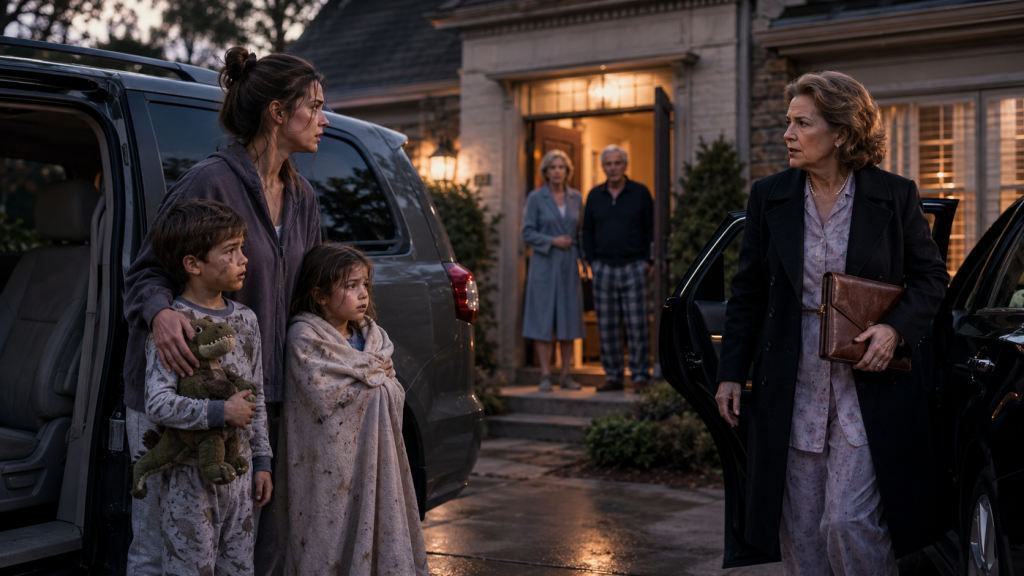
I had slipped into sneakers without socks, Ellie was wrapped tightly in a blanket, and Mason refused to let go of the stuffed dinosaur whose corner had melted in the fire.
His little fingers kept rubbing the burned spot.
“Will our house be okay?” he whispered.
I looked at him in the rearview mirror and forced myself not to cry.
“We’re okay,” I said. “That’s what matters.”
But children know when adults are lying by omission.
Mason turned his face toward the window and said nothing else.
When we pulled into my parents’ driveway, every window was dark except the small lamp in the foyer.
I carried Ellie to the front door while Mason leaned against my leg, half asleep, coughing softly.
I rang the bell once.
Then again.
Finally, the porch light came on.
My mother opened the front door and stared at us as though we had tracked mud across her clean floor.
“Oh, Claire,” she said. “What happened?”
For a moment, I just looked at her.
My face was streaked with soot. My hair smelled like smoke. My children were barefoot inside their pajama pants, wrapped in blankets from the fire truck.
“Our house caught fire,” I answered quietly. “Please… we just need somewhere to sleep tonight.”
My father stepped into the hallway behind her, tightening the belt of his bathrobe.
“Everyone made it out alive?”
“Yes.”
“Then settle down,” he replied, speaking as if my panic was the biggest problem.
Mason started coughing again while Ellie buried her face against my coat.
My mother glanced toward the driveway instead of looking at her grandchildren.
“Your sister and Brad will be here in the morning,” she said. “We can’t have the kids coughing all over the guest room.”
For a second, I honestly thought I’d heard her wrong.
“My children just watched their home burn to the ground.”
Dad released a weary sigh.
“Vanessa has been planning this visit for weeks. She’s already under enough pressure getting ready for the baby shower.”
My younger sister, Vanessa, was seven months pregnant, happily married to a successful dentist, and living comfortably in a five-bedroom home with a white kitchen, a pool, and a nursery already decorated in cream and gold.
She had not been displaced by a fire.
She had not carried two terrified children through smoke.
She had not left her whole life behind in a burning house.
Mom softened her tone, but not her decision.
“Vanessa needs a peaceful environment right now. She’s worked so hard to create a beautiful life. You know how emotional pregnancy makes her.”
Behind us, smoke still drifted into the night sky.
I looked at the black streaks covering my children’s sleeves, and something inside me cracked beyond repair.
“So you’re saying we can’t stay here… even for one night?”
Dad folded his arms.
“There’s a motel off the highway.”
“My purse burned in the fire.”
Mom exchanged a quick glance with Dad before looking back at me.
“Claire, don’t turn this into something ugly.”
Something ugly.
That was what she called it.
Not abandonment.
Not cruelty.
Not turning away her grandchildren while their home was still burning.
Something ugly.
I stood there for one more second, hoping one of them would change their mind.
Hoping my father would look at Mason’s bare feet and feel something.
Hoping my mother would see Ellie’s trembling hands and remember that she had once held me when I was small.
But neither of them moved.
So I climbed back into the minivan with my children.
We sat there until dawn with the heater barely running, waiting because the emergency shelter wouldn’t begin accepting families until seven o’clock.
I had less than a quarter tank of gas. My phone battery was at nine percent. Ryan was still trying to get to us, but a wreck had shut down the highway between the hospital and our side of town.
Mason slept with his head against the window.
Ellie woke every few minutes asking if the fire was coming back.
“No, baby,” I whispered every time. “It can’t hurt us here.”
But I wasn’t sure that was true.
At 5:42 a.m., a black sedan slowly pulled into my parents’ driveway.
At first, I thought it was one of the neighbors.
Then I saw the small silver cross hanging from the rearview mirror.
My grandmother stepped out wearing her church coat over her pajamas. Her gray hair was tucked under a scarf, and a worn leather folder rested in one hand.
Grandma Ruth was eighty-two years old, five feet tall, and sharper than anyone in our family wanted to admit.
She looked first at my children huddled inside the van.
Then she turned toward the front door of my parents’ house.
The anger in her eyes said everything before she spoke a single word.
I opened the van door.
“Grandma?”
She came straight to me and touched my face with both hands.
“My poor girl,” she whispered.
That broke me.
Not the fire. Not the smoke. Not standing on my parents’ porch while they refused us.
Those three words broke me.
I folded into her arms like I was eight years old again.
Grandma held me for exactly two seconds before she pulled back, looked at the house, and tightened her grip around the folder.
“Stay here with the children.”
“What are you doing?”
“What should have been done years ago.”
She walked up the porch steps with her cane in one hand and the folder in the other.
Then she struck the front door so hard the porch light trembled.
My mother opened it wearing the same annoyed expression, but it disappeared the moment she saw Grandma’s face.
“Mom? What are you doing here?”
“Where are my great-grandbabies?” Grandma asked, her voice low and shaking.
Dad stepped forward behind Mom.
“This is not your concern.”
Grandma lifted the leather folder.
“It became my concern the moment you turned your own daughter away after a fire.”
Mom glanced toward the van, then lowered her voice.
“Claire has always been dramatic. The children are fine.”
Grandma’s eyes narrowed.
“They are sitting in a cold van wearing smoke-covered pajamas.”
“Vanessa is coming in a few hours,” Dad said. “She’s pregnant. She needs rest.”
Grandma laughed once, but there was no humor in it.
“Vanessa has had rest her entire life because Claire paid for it.”
I froze beside the van.
Dad’s face changed.
Not a lot. Just enough.
“Don’t start,” he warned.
Grandma stepped into the doorway.
“Oh, I am starting. And this time, I am finishing.”
My mother’s lips parted.
“Mom, please. Not here.”
“Why not here?” Grandma asked. “You had no shame letting Claire sleep in a car outside this house. Why should I have shame telling the truth on the porch?”
Ellie stirred in my arms, and Mason opened his eyes.
“What’s Grandma Ruth saying?” he whispered.
“I don’t know,” I said.
But my stomach had already begun to twist.
Grandma turned toward me.
“Claire, come here.”
I hesitated.
“Grandma—”
“Bring the children.”
I lifted Ellie and took Mason’s hand. We walked slowly up the driveway.
My mother looked like she wanted to block the door, but Dad grabbed her wrist.
Grandma opened the folder and pulled out a stack of yellowing papers.
Bank records.
A copy of a will.
A letter in handwriting I recognized from old birthday cards.
My grandfather’s handwriting.
Grandpa Henry had died when I was nine. I remembered his warm laugh, the smell of peppermint in his coat pocket, and the way he used to call me “little bird.”
Grandma unfolded the letter carefully.
“This house,” she said, looking at my parents, “was never left to you.”
The morning went silent.
Dad’s jaw tightened.
Mom whispered, “Don’t.”
Grandma ignored her.
“Henry left this property in trust for Claire.”
My knees nearly weakened.
“What?”
Grandma looked at me with tears in her eyes.
“Your grandfather knew how they treated you, sweetheart. He saw it before I wanted to admit it. Vanessa was the baby, the golden child, the one they spoiled. But you were the one he worried about.”
My mother snapped, “That is not fair.”
Grandma turned on her.
“Not fair? You want to talk about fair while your granddaughter coughs smoke into a blanket?”
Dad stepped out onto the porch.
“Claire was a child. We managed the house until she was old enough. That was legal.”
Grandma pulled another document from the folder.
“You were supposed to transfer the trust when Claire turned twenty-five.”
I stared at my father.
I was thirty-four.
Dad looked away.
Grandma continued.
“You didn’t. Instead, you took loans against the house. You used the trust account Henry created for Claire’s education. You paid for Vanessa’s private school, Vanessa’s wedding, Vanessa’s down payment, Vanessa’s baby shower.”
My mother’s face went red.
“We used family money for family needs.”
“No,” Grandma said. “You used Claire’s money to build Vanessa’s perfect life.”
I could not breathe.
Pieces of my childhood began rearranging themselves inside my head.
The way Vanessa always had new clothes while I wore hand-me-downs.
The way my parents said there was no money for my college applications, then sent Vanessa to a private university.
The way Grandma quietly mailed me checks when I was nineteen and struggling.
The way Dad always changed the subject when Grandpa’s will came up.
I looked at Mom.
“Is this true?”
She crossed her arms.
“You were always independent. Vanessa needed more support.”
I almost laughed.
Independent.
That was what they called a child who learned not to ask because every answer was no.
Grandma handed me the letter.
My fingers trembled as I opened it.
Dear Claire,
If you are reading this, I hope you are grown, strong, and loved the way you deserve to be loved.
This house is for you.
Not because walls matter more than people, but because I want you to always have a place where no one can tell you that you do not belong.
You were born into a family that may not always see your worth. I see it.
You are my little bird.
No one clips your wings.
Grandpa Henry
The words blurred.
For a moment, all I could hear was Mason coughing behind me.
Then a car door slammed.
A white SUV had pulled into the driveway.
Vanessa stepped out wearing a cream maternity dress and holding a designer overnight bag. Her husband, Brad, followed with two garment bags and a tray of expensive coffees.
Vanessa stopped when she saw all of us on the porch.
“What is going on?”
No one answered.
Then she looked at me.
“Oh my gosh, Claire. You smell like smoke.”
I almost smiled at the absurdity of it.
Grandma turned toward her.
“Your sister’s house burned last night.”
Vanessa’s eyes widened.
“Is everyone okay?”
“Yes,” I said quietly.
She looked genuinely shaken for half a second.
Then her gaze moved to my parents.
“Wait… why is she still outside?”
That question landed harder than anything else.
Because for the first time, Vanessa sounded confused by them.
Not aligned with them.
Confused.
Mom quickly walked down the steps.
“Sweetheart, don’t stress yourself. Claire arrived in the middle of the night. We were just figuring things out.”
Grandma snapped, “You told her to go to a motel.”
Vanessa blinked.
“What?”
Dad said, “This is being exaggerated.”
But Vanessa had already looked at my children.
At Mason’s gray-stained pajamas.
At Ellie’s bare feet tucked under my coat.
Her face changed.
“You made them sleep in the van?”
Mom’s voice sharpened.
“Vanessa, you don’t understand. We had to think of your health.”
“My health?” Vanessa placed a hand on her belly. “Mom, I’m pregnant, not made of glass.”
Brad stepped forward, his expression hard.
“Are those kids okay? Do they need a doctor?”
“I’m taking them to the ER once Ryan gets here,” I said.
Brad nodded immediately.
“I’ll drive you.”
Dad looked irritated.
“Brad, stay out of this.”
Brad stared at him.
“No.”
That one word stunned my father silent.
Vanessa turned to me, tears filling her eyes.
“Claire, I didn’t know.”
I wanted to believe her.
Part of me did.
But pain is not reasonable when it is fresh.
“You never asked,” I said.
Her face crumpled.
Grandma held up the documents.
“You also need to know that the house you and Brad live in was partly paid for with money stolen from Claire’s trust.”
Vanessa went completely still.
“What?”
Mom said quickly, “That is not how it happened.”
Grandma handed her the records.
Vanessa read the first page.
Then the second.
Brad leaned over her shoulder.
The color drained from his face.
“Vanessa,” he said slowly, “this transfer is the same amount your father gave us for the down payment.”
Vanessa looked at Dad.
“You told me it was from your retirement account.”
Dad’s expression hardened.
“We helped you. That’s what parents do.”
Vanessa’s voice shook.
“No. You stole from my sister and called it helping me.”
Mom began to cry then, but not the kind of crying that comes from remorse.
It was angry crying.
Cornered crying.
“You have no idea how difficult it was raising you girls. Claire was stubborn from the day she was born. Vanessa was sensitive. She needed gentleness.”
Grandma stared at her.
“Claire needed parents.”
The words cut through the porch like a blade.
For once, my mother had no reply.
Ryan arrived ten minutes later in a borrowed car, still wearing hospital scrubs.
He ran up the driveway and wrapped all three of us in his arms.
When he saw my parents standing there, something dark crossed his face.
“You left them outside?”
Dad tried to speak.
Ryan held up one hand.
“Don’t.”
Ryan was not a loud man. He spent twelve-hour shifts calming frightened families, holding the hands of elderly patients, speaking softly to children who were scared of needles.
But in that moment, his quietness was more dangerous than shouting.
He took Ellie from my arms and looked at Mason.
“We’re going to the hospital. Then we’re going somewhere warm.”
Grandma touched his arm.
“You’ll go inside first.”
Ryan frowned.
“Inside?”
Grandma looked at me.
“This is Claire’s house.”
I shook my head.
“I don’t want it.”
“Not because of them,” Grandma said. “Because your grandfather wanted you to have a place where no one could turn you away.”
Dad stepped forward.
“You cannot just throw us out.”
Grandma’s smile was cold.
“I am not throwing you out this second. The attorney will handle that. But today, you will move aside and let your daughter and her children shower, rest, and eat in the house that should have belonged to her nine years ago.”
Mom clutched her robe.
“Vanessa’s shower decorations are in the guest room.”
Vanessa turned to her, horrified.
“Mom.”
That was all she said.
But it was enough.
For the first time in my life, my sister did not let my mother hide behind her.
Brad took the coffees from the car, walked past my parents, and handed one to Ryan.
Then he said, “I’m taking Mason to get shoes from the store after the hospital.”
Mason looked up.
“Can I get dinosaur ones?”
Brad smiled gently.
“Any ones you want, buddy.”
My parents moved aside.
Not because they were sorry.
Because there were too many witnesses now.
Inside, the house smelled exactly the same as it had when I was a child. Lemon polish. Coffee. Mom’s lavender candles.
The guest room was immaculate, with pale blue bedding and a vase of fake white flowers on the dresser.
My mother hovered near the door.
“Don’t let the children touch the curtains.”
Ryan turned around slowly.
“Leave.”
Mom flinched.
“What?”
“Leave the doorway,” he said. “Now.”
She did.
I bathed Ellie first. The water turned gray around her tiny feet. She cried when I washed smoke from her hair, asking if her dolls were gone.
I told her I didn’t know.
Mason sat on the closed toilet lid holding his dinosaur, staring at nothing.
That scared me more than the crying.
After the hospital checked them for smoke inhalation and gave us instructions, Grandma’s attorney arrived at the house by noon.
His name was Mr. Calloway, and he carried himself like someone who had been waiting years for this.
He confirmed everything.
The trust.
The house.
The missing funds.
The forged delay papers my father had filed.
The unauthorized withdrawals.
The transfers disguised as “family expenses.”
Grandma had suspected for years, but Grandpa’s old attorney had retired, and the records had been buried. A month earlier, while cleaning her attic, she had found the original leather folder behind a loose panel in Grandpa’s old desk.
“She called me immediately,” Mr. Calloway said. “We were preparing to contact you this week.”
I looked at my parents.
“This week?”
Grandma squeezed my hand.
“I am sorry I was not faster.”
I shook my head.
“You came.”
That was all that mattered.
By evening, Vanessa had canceled her baby shower weekend.
She stood in the kitchen with red eyes, one hand pressed to her belly.
“I’m going to repay every dollar I can,” she said.
I was too tired to know what to feel.
“You don’t have to fix what they did.”
“But I benefited from it.”
“You didn’t know.”
She swallowed.
“No. But I also didn’t look too closely. I liked being the easy daughter. The celebrated daughter. It was comfortable.”
I looked away.
She stepped closer.
“I’m sorry, Claire.”
Those words were not magic.
They did not erase years.
But they were the first honest words she had given me in a long time.
“I don’t know how to be sisters with you,” I admitted.
Vanessa nodded, crying quietly.
“Then let me start by being decent.”
The legal process took months.
Insurance covered some of the fire damage, but our little yellow house was declared unsafe. We salvaged what we could—three photo albums, Ryan’s wedding ring from the bathroom dish, Ellie’s melted music box, and Mason’s dinosaur books, smoke-stained but readable.
My parents fought everything.
They claimed confusion.
They claimed family misunderstanding.
They claimed Grandpa had “intended” for them to manage the property permanently.
But documents do not care about excuses.
Neither did Grandma.
She attended every meeting in her church coat, cane resting against her knee, eyes clear and merciless.
In the end, the court ordered the house transferred to me and required my parents to repay a portion of the misused trust funds through the sale of their lake property.
They moved into a rental condo twenty minutes away.
My mother called once.
Not to apologize.
To say, “I hope you’re happy tearing this family apart.”
I looked around the kitchen—my kitchen now—where Ellie was coloring at the table, Mason was building a dinosaur fort, and Ryan was making pancakes for dinner because the children had requested “breakfast at night.”
Then I said, “No, Mom. You did that. I’m just not pretending anymore.”
I hung up before she could answer.
Grandma moved into the downstairs bedroom two weeks later.
She claimed it was because her knees hated the stairs at her old apartment.
But I knew the truth.
She wanted to be near the children.
And maybe near me too.
Every morning, she sat on the back porch with coffee while Mason read dinosaur facts aloud. Ellie followed her everywhere, calling her “Grandma Great,” which made Ruth laugh until she cried.
Vanessa came by slowly at first.
She brought groceries.
Then baby clothes for Ellie’s dolls.
Then a handwritten apology that was six pages long.
When her son was born, she asked if I wanted to meet him.
I almost said no.
Then Mason asked, “Is he our cousin?”
“Yes,” I said.
“Then we should say hi.”
Children make some things simple.
So we went.
The baby was tiny and red-faced, sleeping against Vanessa’s chest. She looked exhausted and softer than I had ever seen her.
“His name is Henry,” she said.
I looked at her.
“After Grandpa?”
She nodded.
“If that’s okay.”
My throat tightened.
“I think he would like that.”
A year after the fire, Ryan and I planted a small maple tree in the front yard of the house Grandpa had left me.
Mason insisted on placing his repaired stuffed dinosaur near the hole for “supervision.” Ellie wore a pink dress and rain boots even though the sky was clear.
Grandma stood beside me, leaning on her cane.
“You know,” she said, “your grandfather used to say trees remember kindness.”
I smiled.
“Do you think that’s true?”
“I think houses do.”
I looked back at the house.
For most of my life, it had represented rejection. A place where I stood outside waiting to be chosen and never was.
But now the windows glowed warm.
The porch had chalk drawings on it.
The guest room was no longer preserved for appearances. It had toys, extra blankets, and a sign Ellie made that said: Family sleeps here.
Not perfect family.
Not picture-perfect family.
Real family.
The kind that opens the door.
That night, after the children were asleep, I found Grandma sitting alone in the living room with Grandpa’s letter in her lap.
“Are you okay?” I asked.
She wiped her eyes quickly.
“I wish he could see you here.”
I sat beside her.
“Maybe he can.”
She smiled and took my hand.
For a long time, neither of us spoke.
Then she said, “The night of the fire was terrible. But it burned away something that needed to go.”
I thought about my parents’ closed door.
My children in the cold van.
Grandma’s cane striking the porch.
The folder.
The truth.
And finally, the key in my hand.
“Yes,” I whispered. “It did.”
The fire took our first home.
But it gave me back the one I never knew had been mine.
And more than that, it showed me the difference between relatives and family.
Relatives share your blood and still leave you outside.
Family arrives before sunrise in a church coat over pajamas, carrying the truth in one hand and enough love in the other to change everything.
That was the morning I stopped begging for a place in my parents’ hearts.
Because Grandma reminded me I had already inherited something better.
A home.
A name.
A truth.
And a door that would never again be closed to my children.
THE END! THANK YOU FOR READING!