

My in-laws sent my six-year-old daughter a cute brown teddy bear for her birthday. She smiled for a second. Then she suddenly froze and asked, “Mommy, what is it?”
When I looked closer, my face went pale. I did not scream. I did not call them. I did not throw the bear away. I acted. And three days later, police were standing at my in-laws’ front door.
My name is Claire Mason, and until that week, I thought the worst thing my in-laws could do was insult me behind my back.
I was wrong.
For Lily’s sixth birthday, Daniel and I had planned a small party at home.
Nothing fancy.
Pink balloons.
A homemade strawberry cake.
A few classmates from school.
A table covered with paper crowns, crayons, cupcakes, and juice boxes.
Lily had been counting down to that day for almost a month. Every morning, she would run into our bedroom and announce exactly how many days were left until she turned six.
“Six is a big girl number,” she told me seriously.
I agreed every time.
Daniel always smiled and said, “Too big. I might need to put a brick on your head to stop you growing.”
Lily would laugh, climb into his lap, and say, “Daddy, that doesn’t work.”
The morning of her birthday was bright and warm.
Sunlight came through the curtains in the living room, turning the carpet gold. Lily wore a lavender dress with tiny white flowers on it and insisted on wearing her sparkly shoes even though we were not leaving the house.
At ten in the morning, a box appeared on our porch.
It was wrapped in shiny gold paper and tied with a satin pink ribbon.
Lily saw it through the window before I did.
“Mommy!” she shouted. “A present!”
She ran barefoot across the living room, then stopped at the door because she knew the rule. She was not allowed to open the front door without me.
I wiped flour from my hands and followed her.
There was no return label on the box, but I recognized the handwriting on the gift tag immediately.
To our precious Lily.
Love, Grandma Margaret and Grandpa Walter.
My stomach tightened.
Daniel had not spoken to his parents in almost eight months.
Not since the night Margaret showed up uninvited at our house, let herself in with an old spare key Daniel forgot she still had, and told Lily that Mommy was “being mean” because I would not let her sleep over at Grandma’s house on a school night.
That had been the final straw.
Before that, there had been years of little things.
Margaret feeding Lily candy after I said no.
Margaret telling Daniel that I was “turning him against family.”
Margaret crying whenever we set boundaries.
Walter staying quiet in the background, then calling Daniel later to say, “Your mother is heartbroken. You know how she gets.”
The last argument had been ugly.
Daniel took back the spare key.
He told them visits had to be planned.
He told them they could not undermine us in front of Lily.
Margaret pointed at me and said, “This is your doing. You took my son, and now you’re taking my granddaughter.”
Daniel told her to leave.
After that, silence.
No calls.
No birthday cards.
No apology.
Until the gold box appeared.
Lily looked up at me with hopeful eyes.
“Grandma and Grandpa remembered!”
I forced a smile because it was her birthday, and I did not want to poison her joy with adult problems.
“They did,” I said softly.
Daniel came in from the kitchen, holding a bowl of frosting. His smile faded when he saw the tag.
“Claire,” he said quietly.
I gave him a look that meant, Not now.
Lily bounced on her toes.
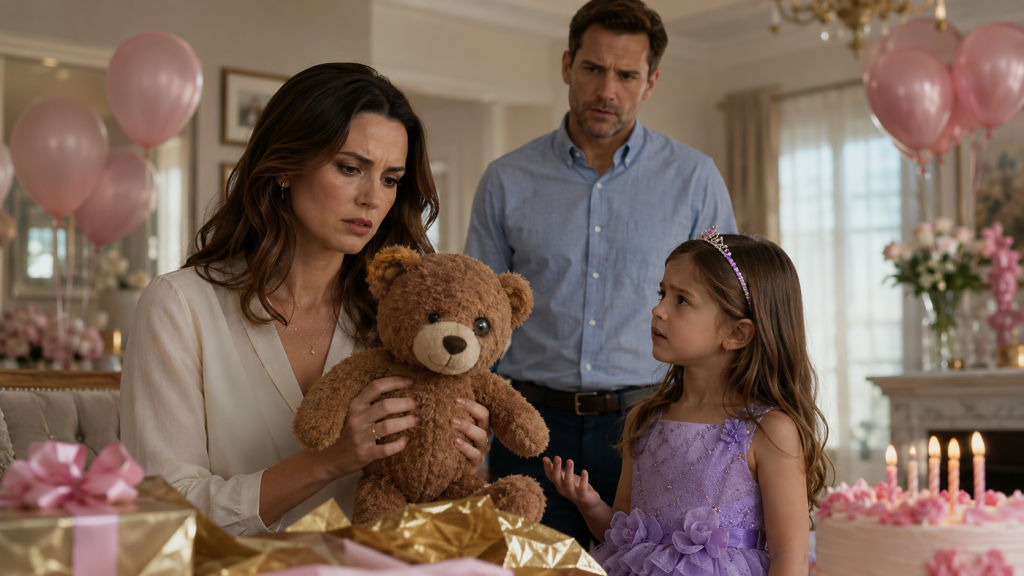
“Can I open it?”
Daniel swallowed. Then he nodded.
“Go ahead, birthday girl.”
She tore into the wrapping paper with both hands, sending gold scraps all over the rug.
Inside was a brown teddy bear.
It looked innocent.
Soft fur.
Round ears.
A red bow around its neck.
Black button eyes.
A stitched smile.
The kind of toy a grandmother would choose from a gift shop window.
Lily gasped and hugged it instantly.
“Oh, he’s so cute!”
For three seconds, she was happy.
Then her arms loosened.
Her smile disappeared.
She held the bear away from her body.
“Mommy,” she whispered. “What is it?”
At first, I thought she meant the tag tucked under the bow.
“What is what, honey?”
She pointed at the bear’s face.
“That.”
I stepped closer.
The bear’s right eye looked normal.
Glossy and flat.
But the left eye was different.
There was a tiny dark circle in the center.
Too deep.
Too perfect.
Like a pinhole.
My mouth went dry.
I took the bear gently from Lily.
“Sweetheart,” I said, somehow keeping my voice calm, “go help Daddy put candles on the cake.”
She frowned.
“Is it broken?”
“Maybe,” I said. “I’ll check it.”
Daniel saw my face.
He put the frosting bowl down slowly.
Lily looked between us.
“Daddy?”
Daniel immediately forced a bright smile.
“Come on, bug. I need help choosing where the candles go.”
That distracted her just enough.
She followed him into the kitchen, but Daniel glanced back at me over his shoulder.
His eyes asked the question neither of us wanted to say out loud.
I carried the bear down the hallway into our bedroom and shut the door behind me.
For a second, I just stood there, holding that soft little toy in my hands.
My daughter had hugged it.
Pressed it against her chest.
Carried it close to her face.
A chill ran through me.
I placed the bear on the dresser.
Then I turned off the bedroom light.
The curtains were half closed, dimming the room.
I stared at the bear’s left eye.
A faint glimmer stared back.
My heart began pounding so hard I could hear it in my ears.
I turned the light back on.
I did not touch the eye.
I did not rip the bear open.
I remembered something my brother Aaron had once told me.
Evidence is only useful if you do not destroy it.
Aaron was a detective in another county. He had been a cop for fifteen years, and even though he was usually calm about everything, he had warned me once that hidden cameras could be disguised in ordinary objects.
Smoke detectors.
Phone chargers.
Clocks.
Toys.
At the time, I had thought he was being paranoid.
Now I wished he had been.
I turned the bear over carefully.
There was a seam down its back, stitched neatly beneath the fur.
Near the battery compartment, I felt something hard.
Not a music box.
Not stuffing.
A small square shape.
My fingers went cold.
Daniel came into the bedroom and shut the door behind him.
“What is it?” he whispered.
“I don’t know.”
But we both knew.
He stepped closer and looked at the eye.
His face changed.
“No,” he breathed.
I moved the fur near one of the bear’s legs and found something that made my stomach twist.
A tiny hidden switch beneath the stitching.
Daniel covered his mouth.
For a moment, he looked like he might be sick.
“My parents sent that,” he said.
I nodded.
He shook his head.
“No. My mother is controlling. She’s manipulative. She’s cruel when she wants to be. But this?”
His voice cracked.
“She wouldn’t.”
I wanted to believe that too.
For Lily.
For him.
For the part of me that did not want to live in a world where grandparents could send something like that to a child.
But wanting something did not make it true.
I took photos of the bear from every angle.
The eye.
The switch.
The tag.
The box.
The wrapping paper.
Then I placed the bear carefully in an empty drawer and closed it.
My hands were shaking.
“What are you doing?” Daniel asked.
“Calling Aaron.”
He nodded, but his face was pale.
I stepped into the bathroom, locked the door, and called my brother.
He answered on the third ring.
“Happy birthday to my favorite niece,” he said.
“Aaron,” I said, and my voice sounded strange even to me.
He went silent immediately.
“What happened?”
I told him everything.
The gift.
The eye.
The hidden switch.
The hard square inside the bear.
Aaron did not interrupt once.
When I finished, he said, “Claire, listen to me carefully. Do not open it yourself. Do not cut it. Do not destroy it. Do not call them. Do not text them.”
My throat tightened.
“You think it’s what I think it is?”
“I think you need to treat it like evidence.”
I gripped the edge of the sink.
“Evidence of what?”
He paused.
Then he said, “A recording device. Maybe a camera. Maybe audio. Maybe both.”
I shut my eyes.
“Lily hugged it.”
“I know.”
“She asked me what it was. She knew something was wrong.”
“Kids notice things,” Aaron said gently. “That may have saved you.”
I started crying then.
Quietly.
Not dramatic sobs.
Just hot tears falling down my face while I tried not to make noise because my daughter was in the kitchen decorating her own birthday cake.
Aaron’s voice softened.
“Claire, put it in a paper bag, not plastic. Keep the box and wrapping too. Wash your hands after handling it. I’m going to make a call.”
“To who?”
“To someone in your jurisdiction.”
“Aaron, will they take this seriously?”
His voice hardened.
“They will after I’m done talking to them.”
The rest of Lily’s birthday felt like acting in a play while the house burned behind the curtain.
I smiled.
I sang.
I helped children glue glitter stars onto paper crowns.
I watched Lily blow out six candles while Daniel stood beside me with his arm around my waist, gripping me too tightly.
Every few minutes, his eyes drifted toward the hallway.
I knew he was thinking about the bear.
So was I.
At the end of the party, after the last child left and Lily fell asleep on the couch with cake frosting still at the corner of her mouth, Daniel carried her upstairs.
When he came back down, his face was different.
Not shocked anymore.
Not confused.
Angry.
Quietly, dangerously angry.
He stood in the middle of the living room and said, “I need to call them.”
“No.”
“Claire, I need to hear my mother deny it.”
“No,” I repeated. “Aaron said not to contact them.”
“They sent something into our home.”
“I know.”
“They sent something to our daughter.”
“I know.”
His eyes filled with tears.
“My own parents.”
I crossed the room and took his hands.
“This is exactly why you can’t call them right now. Because if they did this, they deserve police at their door, not a warning.”
Daniel lowered his head.
For a long moment, he said nothing.
Then he whispered, “What kind of father doesn’t see this coming?”
I grabbed his face gently and made him look at me.
“A father who trusted that his parents still had a line they wouldn’t cross.”
His jaw trembled.
“I should have protected her.”
“You did,” I said. “You backed me when we set boundaries. You took the key. You stopped the visits.”
“It wasn’t enough.”
“No,” I said softly. “It was them who weren’t enough.”
The next morning, an officer came to our house.
His name was Detective Harris.
He was older than I expected, with tired eyes and a calm voice.
Aaron had clearly spoken to him because he did not treat me like an overreacting mother.
He listened.
He photographed the bear.
He took the wrapping paper, the box, and the tag.
He asked about my in-laws.
I told him everything.
The surprise visits.
The undermining.
The arguments.
The spare key.
The way Margaret called Lily “my baby” and corrected me when I said “my daughter.”
Detective Harris wrote it all down.
Daniel sat beside me, stiff and silent.
When Harris asked if his parents had ever threatened us, Daniel hesitated.
Then he said, “My mother once told Claire that a child belongs with the family that loves her most.”
Detective Harris looked up.
“When was that?”
“About a year ago.”
“What was the context?”
I answered because Daniel seemed unable to.
“It was after I said Lily couldn’t spend the weekend at their house. She was sick. Margaret said I was using illness as an excuse to keep Lily away.”
Harris nodded.
“Any messages?”
“Some,” I said.
I showed him my phone.
Margaret’s texts were not openly threatening, but they were disturbing when read together.
You’re making a mistake keeping Lily from us.
One day she’ll understand who really loved her.
Grandmothers have rights too, Claire.
You won’t control this forever.
Detective Harris photographed the messages.
Then he said the words that made the room feel smaller.
“We’ll need the device examined.”
“How long?” Daniel asked.
“Could be quick if it’s obvious. Could take longer if it’s modified.”
“And if it is a camera?” I asked.
Harris looked at me.
“Then we find out who purchased it, who activated it, whether it recorded, whether anything was transmitted, and whether anyone accessed it.”
Daniel stood suddenly and walked to the window.
His shoulders rose and fell as he breathed.
I knew he was trying not to break.
Two days passed.
I did not sleep.
Every creak in the house made me look toward Lily’s room.
Every car passing outside made my body tense.
I checked every stuffed animal in her bedroom.
Every night-light.
Every picture frame.
Every toy that had ever come from Margaret and Walter.
I felt ridiculous and terrified at the same time.
On the second night, Lily found me sitting on the floor of her room, surrounded by her stuffed animals.
She rubbed her eyes sleepily.
“Mommy?”
I jumped.
“What are you doing?” she asked.
I forced a smile.
“Just cleaning, baby.”
She looked at the pile.
“At night?”
I opened my arms, and she came to me.
She curled into my lap like she had when she was smaller.
“Was the teddy bad?” she whispered.
I stroked her hair.
“The teddy had something inside it that should not have been there.”
“Did Grandma put it there?”
My throat tightened.
Children understand more than adults want them to.
“We don’t know yet.”
Lily was quiet.
Then she whispered, “Grandma said you don’t like sharing me.”
My chest hurt.
“When did she say that?”
“Before. At her house.”
Daniel and I had allowed short visits with us present until eight months earlier. I remembered Margaret taking Lily into the kitchen to “help with cookies” while we sat in the living room.
“What else did Grandma say?”
Lily picked at the sleeve of my shirt.
“She said if I ever missed her, I could tell her secrets. She said some secrets are special and Mommy doesn’t need to know everything.”
I went cold.
I held her tighter.
“You never have to keep secrets from Mommy and Daddy,” I said carefully. “Not ever. Surprises are okay, like birthday gifts. But secrets that make your tummy feel weird are not okay.”
Lily nodded.
“Did I do something wrong?”
“No,” I said immediately. “You did exactly right. You told Mommy.”
She rested her head on my chest.
“I didn’t like the bear’s eye.”
“You were very brave.”
She fell asleep in my arms ten minutes later.
I stayed there long after, holding her and staring into the dark room.
The next morning, Detective Harris called.
Daniel put the phone on speaker.
Harris did not waste time.
“It was a camera,” he said.
The room went silent.
My knees weakened, and I sat down hard in a chair.
Daniel gripped the edge of the table.
“What kind?”
“A wireless hidden camera with audio capability. It was built into the toy after purchase. Not factory installed.”
I covered my mouth.
Daniel’s voice was barely audible.
“Was it recording?”
“Yes.”
The word landed like a physical blow.
Harris continued.
“It had a memory card and transmission capability. We’re still analyzing the full contents, but initial review shows test recordings before the package was delivered.”
“Test recordings where?” I asked.
“At another residence.”
Daniel shut his eyes.
“My parents’ house.”
“That appears to be the case,” Harris said.
My stomach twisted.
“Was there anything from our house?”
“A short clip. Likely from when your daughter first opened it. It appears you removed it before it captured anything further.”
I started shaking.
That one decision.
That one moment when Lily asked, “What is it?”
That had saved us from something worse.
Daniel asked, “Can you prove who accessed it?”
“We traced the setup account to an email address connected to Margaret Mason.”
Daniel made a sound I had never heard from him before.
Half gasp.
Half grief.
Harris continued, “We also found the companion app connected to a tablet registered at the same address. We’re applying for a warrant.”
Daniel looked at me.
His face was white.
“My mother,” he whispered.
I reached for his hand.
But he pulled away, not from me, from the truth.
Three days after the birthday party, police went to Margaret and Walter’s house.
Daniel and I were asked to come to the station, not the house.
Harris said it was better that way.
Still, Daniel wanted to be nearby.
So we sat in a small interview room with beige walls and a metal table while officers executed the warrant across town.
Lily was with my sister.
I had packed her favorite pajamas, her bunny blanket, and the cereal she liked.
She thought it was a sleepover.
I hoped she would remember it that way.
Daniel sat across from me, staring at his hands.
“They’re going to deny it,” he said.
“Probably.”
“My mother will cry.”
“Probably.”
“My father will say he didn’t know.”
I said nothing.
Daniel looked up.
“You think he knew?”
“I think he has spent your whole life choosing not to know things.”
That hurt him.
I saw it.
But it was true.
Walter had always hidden behind silence.
When Margaret insulted me, he looked away.
When she violated boundaries, he sighed and said she loved too hard.
When Daniel tried to confront her, Walter told him to be patient.
Silence had been his loyalty.
The door opened.
Detective Harris stepped inside.
He looked tired.
But there was something in his expression that told me they had found more.
Daniel stood.
“What happened?”
Harris placed a folder on the table.
“Margaret admitted to purchasing the camera.”
Daniel froze.
My heart pounded.
“She admitted it?”
“She claimed she bought it because she was worried about Lily.”
“Worried?” I repeated.
Harris nodded.
“She stated that she believed you were isolating the child from extended family and wanted to make sure Lily was safe.”
Daniel laughed once.
A broken, humorless sound.
“She sent a hidden camera into our home because she was worried?”
“That is her statement.”
“What about my father?”
“He claims he knew she was sending a teddy bear, but not that it contained a device.”
Daniel sank back into the chair.
“Do you believe him?”
Harris did not answer directly.
“We recovered the tablet. The app was installed. There were saved test clips from inside their home. There were also searches on the tablet related to hidden cameras, recording laws, and grandparents’ rights.”
I felt sick.
“Grandparents’ rights?”
Harris nodded.
“Several searches. Also searches related to custody disputes.”
Daniel stared at him.
“Custody?”
“That doesn’t mean they had a legal plan,” Harris said. “But it suggests intent to gather information.”
The room felt like it tilted.
Margaret had not just wanted to see Lily.
She had wanted evidence.
Footage.
Something she could twist.
A messy living room.
Me raising my voice.
Daniel arguing.
Anything.
Anything she could use to paint us as bad parents.
I thought of every exhausted night.
Every moment I had cried in the kitchen after a long day.
Every time Lily had thrown a tantrum because I said no.
What would Margaret have done with those pieces of our life?
Cut them apart?
Show them to a lawyer?
Post them online?
My hands curled into fists.
“What happens now?” I asked.
Harris explained the legal process.
Charges would depend on the prosecutor.
The device, the transmission, the intended recording, and the fact that it was hidden in a child’s toy all mattered.
There would be reports.
Statements.
Possibly court.
Possibly a protective order.
Daniel sat silently through all of it.
When Harris left the room, Daniel did not move for a long time.
Then he said, “I want to see her.”
“No,” I said.
“Claire—”
“No. Not because I’m protecting her. Because I’m protecting you.”
His eyes were wet.
“She’s my mother.”
“I know.”
“She put a camera in our daughter’s toy.”
“I know.”
His face twisted.
“How do both things exist?”
I moved to his side of the table and wrapped my arms around him.
He broke then.
Not loudly.
Not dramatically.
Just folded forward and cried into my shoulder like something inside him had finally snapped.
I held him as tightly as I could.
That night, Margaret called Daniel seventeen times.
He did not answer.
Walter called twice.
Then came the texts.
Daniel, this has gone too far.
Your mother made a mistake, but she loves Lily.
Do not destroy this family over one misunderstanding.
Then Margaret’s messages started.
Danny, please.
I only wanted to know she was okay.
Claire has poisoned you.
A grandmother’s love is not a crime.
You will regret keeping my baby from me.
My baby.
Not our granddaughter.
Not Lily.
My baby.
Daniel read that one and turned off his phone.
The next morning, we filed for a protective order.
I expected to feel guilty.
I did not.
The hearing happened quickly.
Margaret appeared with swollen eyes, clutching tissues, dressed in a pale blue cardigan like someone’s idea of a harmless grandmother.
Walter sat beside her, looking gray and smaller than usual.
When Margaret saw Daniel, she reached out both hands.
“My son,” she cried.
Daniel stepped back.
Her face changed for one second.
Only one.
The crying stopped.
Her eyes hardened.
Then the mask returned.
The judge listened to Detective Harris.
He reviewed the preliminary report.
He looked at the photos of the bear.
He read the messages.
Margaret’s attorney tried to argue that she had made a foolish mistake out of concern.
The judge did not look amused.
“A hidden recording device placed inside a toy given to a minor child is not a communication error,” he said.
Margaret began sobbing.
“I just missed my granddaughter.”
The judge looked at her.
“Missing a child does not entitle you to surveillance inside that child’s home.”
Those words stayed with me.
The protective order was granted.
No contact with Lily.
No contact with me.
No coming near our home, Lily’s school, Daniel’s workplace, or my workplace.
Daniel was allowed to choose whether he wanted contact for himself.
He chose no.
Margaret gasped when he said it.
“Danny, please. You don’t mean that.”
Daniel stood very still.
For the first time in his life, he looked at his mother without fear, guilt, or apology.
“Yes,” he said. “I do.”
She stared at him as if he had slapped her.
Then she pointed at me.
“This is her. She did this.”
Daniel’s voice was quiet.
“No, Mom. You did.”
That was the moment she finally understood.
Not that she had done wrong.
I am not sure Margaret ever truly understood that.
But she understood that crying would not fix it.
That guilt would not bring Daniel back.
That Lily was no longer within reach.
Walter lowered his head.
He did not defend her.
He did not defend us.
As always, he disappeared into silence.
The weeks that followed were strange.
Our house became calmer, but not immediately happier.
Peace after chaos does not always feel like peace at first.
Sometimes it feels like waiting for the next disaster.
Lily asked about the teddy bear twice.
The first time, she asked if the police took it because it was bad.
I told her the truth in a way a six-year-old could understand.
“The bear had something inside it that could watch and listen. That was not okay. Grown-ups are handling it.”
She thought about that.
“Like spying?”
“Yes,” I said. “Like spying.”
“Grandma did spying?”
I took a breath.
“Yes.”
Lily looked down at her hands.
“Is she going to say sorry?”
Daniel, who had been standing in the doorway, closed his eyes.
I knelt in front of Lily.
“I don’t know, sweetheart.”
Lily nodded slowly.
Then she said, “I don’t want presents from her anymore.”
Daniel turned away.
I knew he was crying.
The second time Lily asked, it was bedtime.
She was holding her bunny blanket, staring at the ceiling.
“Mommy?”
“Yes?”
“If someone says they love you but they do scary things, is it still love?”
The question broke my heart.
I lay down beside her.
“I think sometimes people call things love when really they mean control.”
She rolled onto her side.
“What’s control?”
“It’s when someone wants to decide what you do, how you feel, and who you belong to.”
She frowned.
“I belong to me.”
I smiled through tears.
“Yes, baby. You belong to you.”
“And you and Daddy keep me safe.”
“Always.”
She tucked herself against me.
“Then I’m okay.”
I kissed her forehead.
“Yes,” I whispered. “You’re okay.”
But I was not okay for a while.
I checked rooms at night.
I bought a device detector online.
I changed our locks again, even though Margaret no longer had a key.
I changed Lily’s school pickup list.
I warned the office.
I warned the neighbors.
Some people might call that paranoia.
I call it motherhood after betrayal.
Daniel started therapy.
At first, he said it was for the situation.
Later, he admitted it was for his whole life.
He began remembering things differently.
How his mother cried when he wanted to go away for college.
How she called him selfish for spending holidays with friends.
How she treated every boundary like abandonment.
How Walter always told him to apologize first because “peace matters more than pride.”
One night, Daniel sat at the kitchen table long after Lily had gone to bed.
“I used to think my childhood was normal,” he said.
I poured him tea and sat across from him.
“It was normal to you.”
He nodded.
“She always made love feel like a debt.”
That sentence stayed in our house for a long time.
Love felt like a debt.
And Margaret always came to collect.
The criminal case moved slowly.
There were interviews.
Reports.
Delays.
We learned that Margaret had purchased the hidden camera online using a prepaid card, but connected it to her own email because she was not as clever as she thought.
She had tested it in her kitchen.
In one clip, her voice could be heard saying, “Once it’s in her room, we’ll finally know what’s going on.”
Walter’s voice answered from somewhere nearby.
“Margaret, I don’t like this.”
She snapped back, “Then don’t watch.”
That was enough for Daniel.
For months, he had wondered if his father was innocent.
That recording answered the question.
Walter knew enough.
He knew enough to object.
He knew enough to stay.
He knew enough to do nothing.
When Daniel heard that, he walked outside and stood in the backyard alone.
I watched from the window as he covered his face with both hands.
I did not go to him right away.
Sometimes grief needs privacy.
When he came back in, he looked older.
“My father could have stopped her,” he said.
“Yes.”
“He didn’t.”
“No.”
Daniel nodded.
Then he said, “I’m done with both of them.”
I believed him.
Margaret tried to violate the order once.
Not by coming to the house.
She was too careful for that.
She sent a birthday card to Lily through one of Daniel’s cousins.
The envelope had no return address, but inside was Margaret’s handwriting.
My sweet Lily,
Grandma misses you every day.
One day you will know the truth.
No one can keep us apart forever.
Daniel read it once.
Then he called Detective Harris.
The cousin claimed she had no idea what was inside.
Maybe that was true.
Maybe it was not.
Either way, the message was documented.
Margaret received a warning through her attorney.
After that, nothing.
No cards.
No calls.
No gifts.
The silence that followed was different from the silence before.
The first silence had felt like punishment.
This silence felt like a locked door.
Months passed.
Lily turned seven the next year.
This time, her birthday was in our backyard.
Daniel hung string lights between the trees.
I made another strawberry cake.
Aaron came dressed as a magician and performed terrible card tricks that made Lily laugh until she hiccupped.
At one point, she opened a gift from my sister.
It was a stuffed fox.
For half a second, I saw her hesitate.
So did Daniel.
The yard seemed to go quiet around us.
Then Lily turned the fox over, inspected its eyes carefully, and looked at me.
“It’s okay,” she said.
I smiled, though my heart hurt.
“Yes,” I said. “It’s okay.”
She hugged it.
This time, she kept smiling.
Later that night, after everyone had gone home and Lily was asleep with the fox tucked under her arm, Daniel and I sat on the back steps.
The air smelled like grass, frosting, and melted candle wax.
Daniel reached for my hand.
“I hate that she had to learn this so young,” he said.
“So do I.”
“But she also learned that when something feels wrong, she can say it.”
I looked toward Lily’s bedroom window.
A soft night-light glowed behind the curtain.
“That may save her more than once in life.”
Daniel squeezed my hand.
“I’m sorry,” he said.
I turned to him.
“For what?”
“For bringing them into your life.”
“You didn’t do what they did.”
“No. But I ignored things for too long.”
“We both tried to keep peace.”
He looked down.
“Peace with people who only wanted access.”
That was the truth.
Margaret had called it love.
She had called it concern.
She had called it family.
But love does not hide cameras in children’s toys.
Concern does not require secrecy.
Family does not mean surrendering your home, your privacy, or your child’s safety to someone else’s obsession.
A year later, the case ended with a plea.
Margaret avoided jail, but she did not avoid consequences.
Probation.
Fines.
Mandatory counseling.
No contact with Lily.
No unsupervised contact with minors outside approved family settings.
Daniel did not attend the final hearing.
Neither did I.
We had already said everything that mattered.
The day the order was finalized, Daniel took Lily to the park.
I stayed home and cleaned out the hall closet.
At the back, I found an old photo album Margaret had given us when Lily was born.
The first pages were sweet.
Daniel holding newborn Lily.
Walter smiling beside the hospital bed.
Margaret kissing Lily’s tiny hand.
For a moment, I felt the sadness of what could have been.
A grandmother who loved without possessing.
A grandfather who protected instead of hiding.
A family that respected the word no.
Then I turned the page.
There was a photo of Margaret holding Lily at three months old.
On the back, in Margaret’s handwriting, it said:
My baby girl.
Not our granddaughter.
Not Lily.
My baby girl.
I closed the album.
Then I placed it in a box with the old cards, the printed messages, and the copy of the protective order.
I did not keep it because I missed her.
I kept it because someday Lily might ask questions.
And when she did, I would tell her the truth.
Not with hatred.
Not with fear.
With clarity.
Some people love you in ways that feel warm at first.
They bring gifts.
They say sweet words.
They cry when you pull away.
But real love respects locked doors.
Real love listens when you say stop.
Real love does not need to watch you in secret to feel close to you.
That night, Lily ran into the kitchen wearing pajamas covered in stars.
“Mommy,” she said, “Daddy says I can choose the movie because I’m the bravest girl in the house.”
I looked at Daniel over her head.
He smiled softly.
“Well,” I said, scooping Lily into my arms, “Daddy is right.”
She giggled.
“I choose the cartoon with the fox.”
“Of course you do.”
Daniel made popcorn.
Lily carried her stuffed fox to the couch.
We curled under a blanket together, the three of us, while rain tapped gently against the windows.
Our home felt quiet.
Not empty quiet.
Not frightened quiet.
Safe quiet.
The kind of quiet that comes after the locks are changed, the truth is spoken, and the people who confuse control with love are finally kept outside.
Halfway through the movie, Lily looked up at me.
“Mommy?”
“Yes, baby?”
“If I see something weird again, I should tell you?”
I kissed the top of her head.
“Always.”
“Even if a grown-up says not to?”
“Especially then.”
She nodded, satisfied, and turned back to the movie.
Daniel reached across the blanket and took my hand.
I held on.
A teddy bear had arrived at our door wrapped in gold paper and pink ribbon.
It was supposed to look like love.
But my daughter saw what the adults almost missed.
A tiny dark circle.
A wrong eye.
A secret hidden behind something soft.
And because she trusted that uneasy feeling, because she asked one small question, everything changed.
Three days later, police were at my in-laws’ door.
But the real ending was not the police.
It was not the court order.
It was not Margaret crying in front of a judge or Walter finally being forced to admit silence had consequences.
The real ending came much later.
On an ordinary rainy night.
With popcorn on the couch.
With my daughter safe under a blanket.
With my husband’s hand in mine.
With no one watching us.
No one listening.
No one standing outside our family pretending they had a right to break in.
Just us.
Safe.
Together.
Free.
THE END! THANK YOU FOR READING!