

My parents announced they were bringing twenty guests to my lake house and ordered me to fill the fridge. When I said no, Mom laughed and asked if I really thought I could stop them. By Friday morning, Dad was screaming, “What did you do to the house?”
I had worked twelve hours at St. Mercy Medical Center, most of it on my feet, most of it watching people beg for one more breath under fluorescent lights. By the time I parked outside my apartment in Portland, Oregon, my scrubs smelled like antiseptic and coffee, and my phone had been buzzing for twenty minutes.
Family group chat.
Dad had tagged me three times.
Dad: We’re using your lake house this weekend. Twenty guests.
Mom: Fill the fridge and behave.
My younger brother, Kyle, added a row of laughing faces.
I stared at the messages until the letters blurred.
My lake house was not family property.
It was mine.
I bought it after six years of double shifts, overtime, skipped vacations, and living with roommates who stole my groceries and used my shampoo.
It was a small blue house near Devils Lake, with white trim, a creaky deck, two bedrooms, and a view of water that turned gold at sunset.
It was not fancy.
It was not huge.
But it was quiet.
And after growing up in a house where my parents treated my paycheck, my car, my time, and even my emotions like things they owned, quiet felt like luxury.
I typed one word.
Me: No.
Mom replied immediately.
Mom: 😂😂😂 You really think you can stop us?
Dad sent a voice message, but I did not play it.
I already knew the tone.
Command disguised as family love.
The same tone he used when I was nineteen and he emptied my savings account because Kyle “needed help” buying a truck.
The same tone Mom used when she cried at my college graduation because I had “abandoned the family” by moving two hours away.
The same tone they used last summer, when they took the spare key from under the planter, invited friends to my lake house without asking, left beer cans in the hot tub, broke a lamp, and told me I was being dramatic when I asked them to pay for the damage.
I sat in my parked car with my hands on the steering wheel.
Rain tapped against the windshield.
For a moment, I almost answered the way I always used to answer.
Fine.
Okay.
Just this once.
Please don’t yell.
Then I looked at the badge clipped to my scrub top.
Claire Bennett, RN.
I had held dying patients’ hands because their own families could not make it in time.
I had seen what regret did to people.
I had watched strong men cry because they waited too long to say no, to say sorry, to tell the truth, to choose peace.
And I realized I was thirty-four years old, exhausted, independent, and still afraid of two people who had trained me to feel guilty for owning anything they could not control.
So I did not argue.
I took a shower.
I changed clothes.
I made one call to my neighbor, Mrs. Harper, who lived across the gravel road from the lake house.
She was seventy-two, widowed, sharp-eyed, and nosy in the way only a good neighbor can be.
“Margaret,” I said, “if any cars show up this weekend, they do not have permission to enter.”
She paused.
“Your parents again?”
“Yes.”
There was a quiet little breath on the other end of the line.
Then she said, “Good. I’ll keep an eye out.”
After that, I opened my laptop and logged into the smart security system.
I changed every door code.
I disabled the old garage keypad.
I turned off the guest Wi-Fi.
I activated the cameras.
Then I called the locksmith who had helped me after my father “borrowed” the place last summer and left a cracked sliding door handle behind.
By noon the next day, the locks were changed.
By three, I had emailed the sheriff’s office non-emergency line with a written statement.
No one had permission to enter my property.
No one had permission to use the house.
No one had permission to access the garage, dock, hot tub, or deck.
I attached screenshots of the family group chat.
Then I slept.
For the first time in years, I slept without replaying arguments in my head.
Friday morning, my phone exploded.
Forty missed calls.
Dad’s name filled the screen again and again.
Mom called.
Kyle called.
Aunt Linda called.
Then Dad called again.
I answered on the forty-first call.
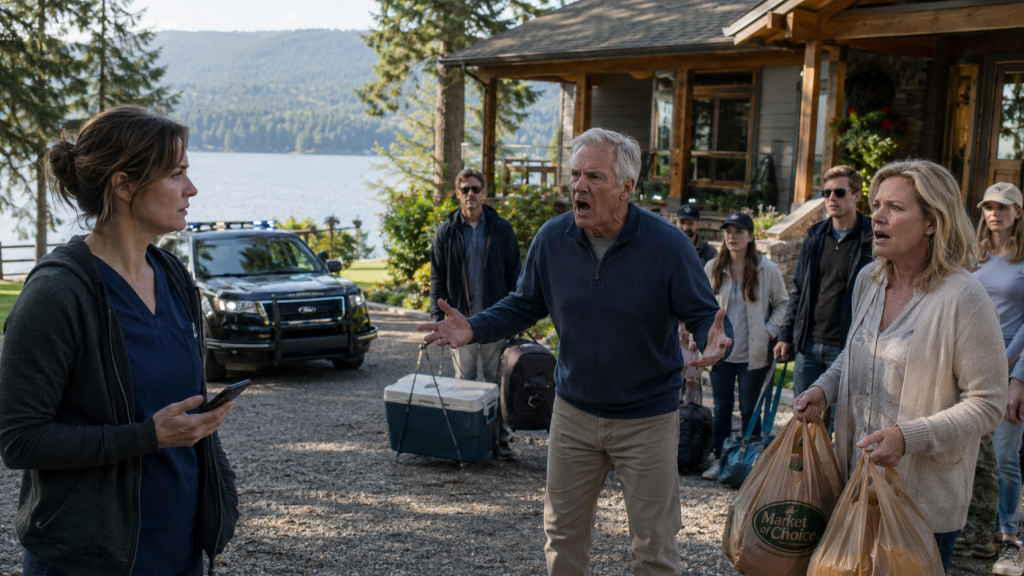
“What did you do to the house?” he screamed.
His voice echoed, windy and furious.
I heard Mom in the background yelling, “Tell her to stop acting crazy!”
I sat up slowly in bed.
“Good morning.”
“Don’t you good morning me! The front door code doesn’t work. The garage is locked. There are cameras everywhere. Your mother is standing outside with groceries melting, and everyone is staring at us!”
“Then everyone should leave.”
“This is a family weekend!”
“No,” I said. “It was a break-in attempt with witnesses.”
For once, there was silence.
Then Dad lowered his voice.
“Open the door, Claire.”
I picked up my tablet and looked at the live camera feed.
Twenty people stood on my porch.
Coolers.
Beach bags.
Folding chairs.
Two cousins I barely spoke to.
Three of Kyle’s friends.
Aunt Linda and her husband.
My parents, standing at the front door like the owners of a resort they had been denied entry to.
And Kyle, wearing sunglasses and grinning like this was still funny.
Behind them, a sheriff’s cruiser was turning into the driveway.
Dad saw it too.
His shoulders stiffened.
Mom stepped away from the door, suddenly arranging her face into the expression she used when strangers were watching.
Soft.
Wounded.
Motherly.
The sheriff stepped out of his cruiser.
I recognized him from the email reply I had received the night before.
Deputy Ramos.
He looked calm, but not casual.
“Morning,” he said.
Dad immediately put on his church voice.
“Officer, thank goodness. My daughter is having some kind of episode. This is our family lake house, and she changed the locks without telling anyone.”
I almost laughed.
The deputy did not.
He glanced at his tablet, then up at the camera above the porch.
“Are you Claire Bennett?” he asked.
I pressed the speaker button through the security app.
“Yes. This is my property. No one there has permission to enter.”
Mom gasped like I had slapped her.
Kyle muttered, “She’s serious?”
Dad’s face darkened.
“Claire, stop embarrassing us.”
Deputy Ramos raised a hand.
“Sir, the owner filed notice yesterday. If you stay after being told to leave, this becomes trespassing.”
The porch went silent.
Not just quiet.
Silent.
The kind of silence that happens when people realize the family joke has turned into a legal problem.
Aunt Linda shifted her beach bag higher on her shoulder.
One of Kyle’s friends whispered, “Dude, you said this was your parents’ place.”
Kyle turned red.
Mom stepped toward the camera.
“Claire, after everything we did for you?”
There it was.
The old hook.
The old chain.
After everything we did for you.
After feeding you.
After raising you.
After giving you life.
As if parenting was a loan, and I had been born owing interest.
My throat tightened, but my voice stayed calm.
“You mean after years of taking?”
Dad pointed at the camera.
“You ungrateful little—”
“Careful,” Deputy Ramos said.
Dad snapped his mouth shut.
For a second, I thought it might end there.
They would leave angry.
They would call me selfish.
Mom would write a dramatic post online about daughters who forget their parents.
Kyle would make jokes.
Aunt Linda would say I had gone too far.
But then Dad did what Dad always did when reality refused to obey him.
He pushed.
He lunged for the porch handle and yanked it hard.
The alarm screamed.
A sharp metallic cry ripped through the morning air.
People jumped back.
Mom clutched her chest.
Someone cursed.
Deputy Ramos moved fast.
“Step away from the door.”
Dad threw up his hands.
“I’m her father!”
“You are not the property owner,” the deputy said.
That was when Mrs. Harper crossed the gravel road.
She wore a yellow raincoat, rubber boots, and the determined expression of a woman who had been waiting a long time to say something.
In her hands was a folder.
“Deputy,” she called, “you need to see what they did here last summer.”
Mom’s head whipped around.
“Margaret, stay out of this.”
Mrs. Harper did not even look at her.
She handed the folder to Deputy Ramos.
“I took photos because Claire was out of town, and I knew they’d deny it later.”
My heart stopped.
I had known Mrs. Harper had seen the mess last summer.
I had not known she had documented it.
Deputy Ramos opened the folder.
The camera angle caught only part of it, but I saw enough.
Photos.
My deck covered in bottles.
The hot tub water cloudy and foaming.
A cracked flowerpot near the back steps.
Mud tracked through the kitchen.
A broken lamp lying beside the sofa.
My father standing by the grill with a beer in his hand.
My mother laughing on my deck with six people I did not know.
Kyle carrying a case of alcohol through my sliding door.
Dad stared at the folder as if the pictures were personal insults.
“You were spying on us?”
Mrs. Harper finally looked at him.
“No, Robert. I was watching over Claire’s home because someone needed to.”
The words hit me harder than I expected.
Someone needed to.
My whole life, I had watched over my family.
I watched my tone.
I watched Mom’s moods.
I watched Dad’s anger.
I watched Kyle get handed everything I had to earn.
And here was this woman across the road, not related to me by blood, protecting something I had built because she understood it mattered.
Mom’s voice sharpened.
“This is ridiculous. Claire wouldn’t even have that house if we hadn’t raised her.”
Mrs. Harper laughed once.
Not kindly.
“I remember Claire at twenty-six, coming here on weekends after night shifts, painting that porch herself. I remember her sleeping in a camping chair because she couldn’t afford a mattress yet. I remember her eating canned soup on the dock while she fixed this place board by board.”
Aunt Linda looked uncomfortable.
I had never told anyone that.
Not my parents.
Not my brother.
I had not wanted them to know how hard it was, because they would either mock me for struggling or take credit for the finished result.
Deputy Ramos closed the folder.
“Ms. Bennett,” he said toward the camera, “do you want them removed from the property?”
My father froze.
Mom’s mouth opened.
Kyle took one step back.
The question hung in the air.
Do you want them removed?
It sounded simple.
But it carried thirty-four years of birthday guilt trips, stolen savings, broken boundaries, unpaid loans, family dinners where my life was picked apart like leftovers, and every time I had smiled to keep the peace while my stomach burned.
Dad must have heard something in the silence.
His voice changed.
“Claire.”
Not angry this time.
Warning.
“Think very carefully before you answer.”
And there it was again.
The threat behind the word family.
I looked at the camera feed.
My mother stood on my porch in white linen pants and gold sandals, holding a cooler she had expected me to fill.
My father stood beside her, furious that the world had rules he could not shout through.
Kyle stood behind them, no longer laughing.
I inhaled slowly.
“Yes,” I said. “I want them removed.”
Mom made a wounded sound.
Aunt Linda whispered, “Claire, honey—”
“No,” I said, louder. “Do not honey me. All of you came to my home after I told you no. You brought guests. You expected me to stock the fridge and play hostess for people I did not invite. You thought I would be too tired, too guilty, or too scared to stop you.”
No one spoke.
“So now you know,” I said. “I am not scared anymore.”
Deputy Ramos turned to the group.
“You heard the owner. Everyone needs to leave.”
For a minute, nobody moved.
Then one of Kyle’s friends picked up his backpack.
“Yeah, I’m out.”
That broke the spell.
People began gathering coolers and bags.
A cousin mumbled something about not wanting drama.
Aunt Linda avoided the camera.
Mom stood frozen, tears now spilling down her cheeks in the very practiced way that had ended every argument in her favor since I was a child.
“You are humiliating your mother,” Dad said.
I almost smiled.
“No,” I said. “You did that when you brought twenty people to a locked door.”
Kyle stepped closer to the camera.
“Claire, come on. It was just a weekend.”
I stared at his face on the screen.
My baby brother.
The golden son.
The one who received help, forgiveness, money, excuses.
When he wrecked Dad’s car at seventeen, they blamed the rain.
When I got a B in chemistry, Mom did not speak to me for two days.
When he quit community college twice, they said he was finding himself.
When I worked double shifts through nursing school, they asked why I could not visit more.
“It was never just a weekend,” I said.
Kyle’s expression flickered.
For a second, I thought maybe he understood.
Then he said, “You’re really choosing a house over family?”
I nodded, though he could not see me.
“No. I’m choosing myself over people who only call themselves family when they want something.”
Dad’s face twisted.
“We are done with you,” he said.
The old Claire would have collapsed.
The old Claire would have begged.
The old Claire would have opened the door just to make that sentence go away.
But the woman sitting in bed with tired eyes and an aching back only felt relief.
“Okay,” I said.
That was all.
Okay.
Dad stared at the camera like he wanted to reach through it.
Then Deputy Ramos stepped between him and the door.
“Sir. Time to leave.”
One by one, they walked away.
Coolers back into trunks.
Beach chairs folded.
Guests whispering.
Mom crying louder whenever someone looked at her.
Kyle climbed into his truck and slammed the door.
Dad was last.
Before leaving, he turned toward the house and said, “You’ll regret this.”
Deputy Ramos heard him.
“So will I need to include that in the report?” he asked.
Dad’s jaw clenched.
He got into the car.
The caravan pulled out of my driveway.
When the last vehicle disappeared down the road, Mrs. Harper looked up at the porch camera.
“You did good, Claire,” she said.
I burst into tears.
Not loud tears.
Not dramatic tears.
Just quiet, shaking ones that seemed to come from somewhere very old inside me.
I cried for the little girl who learned to hide birthday money in socks.
I cried for the teenager who worked at a diner and handed half her tips to her mother for “family expenses.”
I cried for the nursing student who studied in hospital break rooms because home was never peaceful.
I cried for the woman who bought a lake house and still had to prove it belonged to her.
My phone buzzed again.
Mom.
I let it ring.
Then came a text.
Mom: I hope you are happy. Your father is devastated.
Another.
Mom: Everyone saw what you did.
Another.
Mom: A daughter should honor her parents.
I typed back slowly.
Me: Parents should respect their daughter.
Then I blocked her.
My thumb hovered over Dad’s contact.
For years, blocking my father felt impossible.
Like locking a door during a storm.
But I had just watched him stand on my porch, tell a sheriff my home was his, and threaten me when he did not get his way.
So I blocked him too.
Then Kyle.
Then Aunt Linda.
The silence that followed was almost frightening.
No buzzing.
No commands.
No guilt.
Just the faint hum of my apartment refrigerator and rain against the window.
Two hours later, Deputy Ramos called.
He explained that no arrests had been made because everyone left after the formal warning, but he had filed an incident report. He also advised me to save every message, keep the security footage, and consider a formal trespass notice if they returned.
I thanked him.
Then he paused.
“Ms. Bennett?”
“Yes?”
“For what it’s worth, you handled that better than most people would.”
I swallowed hard.
“Thank you.”
After we hung up, I drove to the lake house.
I had not planned to.
I was exhausted.
But something in me needed to stand there, on my own porch, after they were gone.
The drive took almost two hours.
By the time I arrived, the sky was clearing.
The lake was steel gray, rippling under a soft wind.
Mrs. Harper came over with two mugs of tea before I had even unlocked the door.
“You looked like you might need this,” she said.
I laughed through a tired sigh.
“You saw me arrive?”
“I see everything,” she said.
We sat on the deck in folding chairs.
For a while, neither of us spoke.
Across the water, a couple of ducks drifted near the reeds.
The air smelled like pine, wet wood, and distant smoke from someone’s fireplace.
Finally, I said, “Did you really take all those photos last summer?”
“I did.”
“Why didn’t you tell me?”
She looked at me over the rim of her mug.
“Because you weren’t ready.”
That made my chest ache.
“I should have stopped them sooner.”
“Maybe,” she said. “But sometimes people don’t get strong all at once. Sometimes they get strong one locked door at a time.”
I looked at the house.
My house.
The porch I had painted pale gray.
The flower boxes I had built crookedly and then kept because they made me laugh.
The secondhand table near the window.
The wind chime I bought after my first full year of owning the place.
So many small things.
So many pieces of proof that I had built a life with my own two hands.
“I thought they’d stop once I had something of my own,” I said.
Mrs. Harper shook her head.
“People who feel entitled to you do not stop when you own something. They stop when you make consequences more uncomfortable than respect.”
I sat with that sentence for a long time.
The next week was ugly.
Not at my lake house.
There, everything was peaceful.
But online, in texts from unfamiliar relatives, and in voice mails from blocked numbers, my family performed the tragedy of Claire the Ungrateful Daughter.
Aunt Linda messaged from a new number to say my mother had cried all weekend.
A cousin said I had ruined a family tradition that had not existed until my parents invented it.
Kyle sent an email with the subject line: You embarrassed everyone.
Inside, he wrote one sentence.
Hope the empty house keeps you warm.
I stared at it for a long moment.
Then I replied.
It does.
After that, I called an attorney.
Not because I wanted revenge.
Because I finally understood that people like my parents treated kindness as weakness and silence as permission.
The attorney helped me send certified trespass notices to my parents and Kyle.
She also helped me write a demand letter for the damages from the previous summer, using Mrs. Harper’s photos and my repair receipts.
The total was not enormous, but it mattered.
Broken lamp.
Hot tub cleaning.
Door repair.
Deep cleaning.
Damaged linens.
Replacement keypad.
For once, I was not swallowing the cost of their behavior.
Two weeks after the letters were delivered, my father called from an unknown number.
I almost did not answer.
But I was sitting at my kitchen table after a night shift, drinking coffee, staring at the lake through the window, and I felt strangely calm.
So I picked up.
“You sent us a bill?” he said.
“No. My attorney sent you a demand letter.”
He scoffed.
“Attorney. Listen to you.”
I said nothing.
“You think paperwork makes you better than us?”
“No.”
“You think that little house makes you important?”
“No.”
“Then what do you want?”
The question surprised me.
Because for once, I had an answer.
“I want you to leave me alone.”
He breathed hard into the phone.
“You don’t mean that.”
“Yes, I do.”
“Your mother is sick over this.”
“Then she should speak to a doctor.”
“She misses you.”
“No,” I said softly. “She misses access.”
Another silence.
This one felt different.
Less like shock.
More like recognition.
Dad lowered his voice.
“You’ve changed.”
I looked around my quiet kitchen.
At the clean counters.
At the lake beyond the glass.
At my work shoes by the door.
At the life I paid for with hours he never respected.
“Yes,” I said. “I have.”
He hung up.
I did not cry that time.
A month passed.
Then two.
The demand letter was ignored until my attorney filed in small claims court.
That was when my parents suddenly wanted to talk.
Not apologize.
Talk.
Mom emailed me a long message about family, forgiveness, and how memories mattered more than money.
She did not mention the broken lamp.
She did not mention the hot tub.
She did not mention laughing when I told her no.
She did not mention standing on my porch with twenty guests and expecting my home to open like a hotel.
I forwarded the email to my attorney.
In court, my parents looked smaller.
Maybe because they were sitting under fluorescent lights instead of standing in the middle of a family gathering where everyone already knew their roles.
Mom wore pearls.
Dad wore his best jacket.
Kyle came too, though he sat in the back and avoided my eyes.
The judge reviewed the photos.
The receipts.
The messages.
The incident report.
My father tried to explain that families shared things.
The judge asked if his name was on the deed.
“No, but—”
The judge asked if he had written permission.
“No, but she’s our daughter.”
The judge looked at him over her glasses.
“Your daughter is an adult property owner. Not a hotel manager.”
I pressed my lips together to keep from smiling.
In the end, the judge ordered them to pay for the damages.
Not a fortune.
Not enough to change my life.
But enough to draw a line.
Enough to say, officially, in a room with a seal on the wall, that what was mine was mine.
After court, Mom approached me in the hallway.
Her eyes were wet, but I knew those tears.
They were not grief.
They were strategy.
“Claire,” she whispered. “Please. Can we stop this now?”
I looked at her.
For the first time, I noticed how tired she looked when she was not performing for a crowd.
There was a part of me that still wanted a mother.
Not a woman who used guilt like a leash.
A real mother.
One who would ask if I had eaten after a long shift.
One who would visit my lake house and bring flowers instead of demands.
One who would say, “I am proud of what you built.”
But wanting something did not make it real.
“It is stopped,” I said. “That’s the point.”
Her face tightened.
“So you’re cutting off your family?”
“No,” I said. “I’m cutting off the part that keeps cutting me.”
Dad came up behind her.
“This is nonsense.”
I looked at him once.
Then I walked away.
Kyle followed me outside.
“Claire.”
I stopped near my car.
He shifted from one foot to the other.
Without the sunglasses, without the audience, he looked younger than thirty.
Almost like the boy who used to sneak into my room during thunderstorms.
“Did you really have to take it this far?” he asked.
I laughed once, not because it was funny, but because I was tired.
“Kyle, you stood on my porch and laughed while they tried to take over my home.”
He looked down.
“I didn’t think it was that serious.”
“That’s because it never happens to you.”
He flinched.
I opened my car door.
He said, “I’m sorry.”
I paused.
It was not perfect.
It was not enough.
But it was the first time anyone in my family had said those words without adding a condition.
I looked back at him.
“For what?”
He swallowed.
“For laughing. For acting like it was normal. For letting them treat your stuff like it belonged to everybody.”
I studied his face.
“Did Mom tell you to say that?”
“No.”
“Did Dad?”
He gave a small, bitter smile.
“Dad hasn’t spoken to me since I told him he should pay you.”
That surprised me.
Kyle shoved his hands into his pockets.
“I’m not saying I understand everything. But I saw the photos. I saw how they talked to the judge. And I realized… they would have done it to me too, if I had anything they wanted.”
There it was.
Not full understanding.
But a crack.
Sometimes that was where truth began.
“I need time,” I said.
He nodded.
“Yeah. I figured.”
I got into my car.
Before I closed the door, he said, “For what it’s worth, the house is really nice.”
My throat tightened.
“Thanks.”
That weekend, I drove back to the lake alone.
No guests.
No coolers.
No orders.
Just me, a bag of groceries I bought for myself, and a stack of books I had been meaning to read for months.
I cleaned the fridge.
Not because anyone told me to fill it.
Because I wanted fresh strawberries, iced coffee, eggs, and the good cheese that cost too much but made me happy.
I opened the windows.
I washed the deck chairs.
I hung a new sign near the front door.
PRIVATE PROPERTY.
But under it, inside the house where only I could see, I taped a small note to the wall by the kitchen.
This home is peaceful because I protect it.
That evening, Mrs. Harper came over with blackberry cobbler.
We sat on the deck while the sun lowered itself into the lake.
The water turned gold.
Then pink.
Then deep blue.
For the first time in a long time, my phone was face down on the table, silent.
No missed calls.
No commands.
No one asking what I had done to the house.
Because the answer was simple.
I had protected it.
I had protected the porch I painted with aching hands.
I had protected the rooms I paid for hour by hour.
I had protected the quiet I spent years believing I did not deserve.
And maybe most importantly, I had protected the woman who lived there.
Me.
A few months later, a postcard arrived at the lake house.
No return address.
The handwriting was Kyle’s.
On the front was a picture of Devils Lake at sunset.
On the back, he had written:
I get it now. I’m trying to be different. No pressure. Just wanted you to know.
I stood at the mailbox for a long time.
Then I carried the postcard inside and placed it on the kitchen counter.
I did not call him right away.
Forgiveness, I had learned, was not a door people could kick open.
It was a gate.
And I held the key.
That night, I lit a candle, made tea, and sat by the window as rain began to fall softly over the lake.
My parents had thought they could stop me from saying no.
They had thought family meant ownership.
They had thought my house would open because they demanded it.
But by Friday morning, when Dad screamed, “What did you do to the house?” he was asking the wrong question.
The real question was what I had done to myself.
And the answer was finally clear.
I had stopped being their spare key.
I had changed the locks.
And for the first time in my life, I was home.
THE END! THANK YOU FOR READING!