

One year after my divorce, my ex-mother-in-law spotted me at the clinic with a smug grin. She told me her son had made the right choice leaving me and was now raising a daughter with my former friend.
I stayed calm, smiled, and said, “Is that what you think?” Then a man stepped inside, and her face went completely pale. A year after the divorce, I was sitting in the waiting room of Westbridge Fertility Clinic in Denver, holding a folder so tightly the corners had bent under my fingers.
The clinic smelled the same as it always had.
Clean floors.
Soft lavender air freshener.
Too much hope trapped beneath fluorescent lights.
Couples whispered around me. A woman across the room wiped her eyes while her husband rubbed slow circles on her back. A younger couple sat hand in hand, staring at the floor like the future had become too heavy to lift.
I knew that feeling.
I had lived in that feeling for four years.
Ryan and I had come to this clinic full of hope once.
We had sat in those same chairs, filling out forms, listening to doctors explain chances and percentages and procedures as though grief could be measured on a chart.
Back then, Ryan had held my hand.
Back then, he had kissed my forehead and told me, “We’re in this together, Claire.”
Together.
That word felt almost cruel now.
I opened the folder in my lap and looked again at the copies inside.
Billing notice.
Embryo storage record.
Transfer appointment.
Consent form.
My name.
My signature.
Except I had never signed it.
I had not been inside Westbridge Fertility Clinic since before the divorce.
I had not authorized anything.
I had not agreed to use one of our frozen embryos.
I had not given Ryan permission to take the only remaining piece of hope I still had left.
And yet, six months after our divorce, Megan Ellis had announced she was pregnant.
Megan.
My former best friend.
The woman who had sat beside me after my second miscarriage and cried into a tissue while telling me, “You don’t deserve this.”
The woman who had brought casseroles to my house when I couldn’t get out of bed.
The woman who had answered Ryan’s late-night calls when he said he needed “someone neutral to talk to.”
Neutral.
That word had been another lie.
I had been stupid enough to believe they felt guilty.
I had been foolish enough to believe Megan’s pregnancy was just bad timing.
A miracle, Patricia Parker called it.
Everyone called it that.
Ryan’s family filled Facebook with photos of tiny pink shoes, nursery walls, and ultrasound frames.
Patricia posted, “God gave our family what it deserved.”
I read that sentence at two in the morning with my hand pressed over my mouth so I wouldn’t scream.
I never commented.
I never called.
I never showed up at Ryan’s house.
I let them have their version of the story.
Until the billing notice arrived in my old email account by mistake.
That was when the world cracked open.
A nurse called my name softly from behind the front desk.
“Mrs. Bennett?”
I looked up.
I had gone back to my maiden name after the divorce, but some records still showed me as Claire Bennett-Parker. The clinic was still untangling the mess.
“Yes,” I said.
“The director will be with you shortly.”
“Thank you.”
I closed the folder again.
That was when I heard her voice.
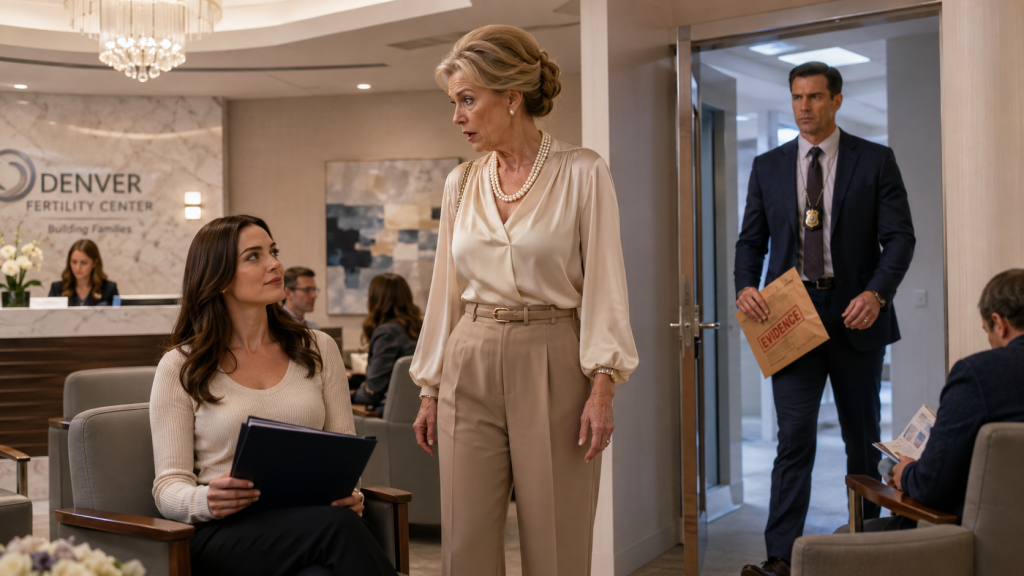
“Well,” Patricia Parker said, loud enough for half the waiting room to hear, “isn’t this interesting?”
My stomach turned before I even looked up.
Patricia stood beside my chair wearing cream slacks, a silk blouse, pearls, and the same smug smile she had worn in court when Ryan told the judge our marriage had been “emotionally empty.”
Emotionally empty.
As if I had not emptied every part of myself trying to build a family with him.
As if I had not injected myself nightly while he complained about the cost.
As if I had not gone through two miscarriages while he told his mother I had become “too fragile.”
Patricia looked me up and down.
Her eyes moved from my folder to my face, then to the clinic logo printed on the wall.
“Hello, Patricia,” I said.
I kept my voice calm.
That seemed to disappoint her.
“I heard you were still alone,” she said.
I did not answer.
She leaned slightly closer, perfume heavy around her.
“Ryan is doing wonderfully, in case you were wondering.”
“I wasn’t.”
Her smile sharpened.
“He and Megan are happy. Very happy. Their daughter is beautiful. Bright eyes. Sweet little curls. She looks like a Parker.”
Something inside me tightened so hard I nearly forgot how to breathe.
I had seen photos.
Of course I had.
Even after I blocked Ryan and Megan, mutual friends sent screenshots with cruel curiosity disguised as concern.
The baby had Ryan’s chin.
But she had my mother’s eyes.
That was what made me start questioning everything before the notice ever arrived.
My mother had soft gray-green eyes that no one in Ryan’s family had.
The baby had them too.
Patricia tilted her head.
“Leaving you was the best choice my son ever made,” she said. “Now he’s raising a daughter with Megan. A real family. Something you could never give him.”
The waiting room went quiet.
Someone turned a page too slowly.
The receptionist froze behind her computer.
I could feel people trying not to listen.
There had been a time when those words would have destroyed me.
A time when I would have gone home, locked the bathroom door, and cried until I couldn’t stand.
But grief changes shape after a while.
Pain becomes quiet.
Quiet becomes sharp.
And sharp things are useful when you are done bleeding.
I looked up at Patricia and smiled.
“Is that what you think?”
Her expression flickered.
Just a little.
“What is that supposed to mean?”
Before I could answer, the clinic door opened behind her.
A tall man in a navy suit stepped inside, carrying a sealed evidence envelope.
Patricia turned.
And the color drained from her face.
She knew him.
Everyone in the Parker family knew him.
Detective Andrew Cole had once investigated Ryan’s business partner for insurance fraud. Ryan had complained for months about him, calling him arrogant, relentless, impossible to charm.
Now Detective Cole walked straight toward us.
He nodded to me first.
“Mrs. Bennett.”
“Detective.”
Then he looked at Patricia.
“Mrs. Parker,” he said. “Good. You’re here too.”
Patricia gripped her handbag.
“Why would I need to be here?”
Detective Cole held up the envelope.
“Because your son’s daughter was created using Mrs. Bennett’s frozen embryo,” he said. “And the consent form appears to have been forged.”
The silence that followed felt physical.
A woman near the window gasped.
The receptionist’s mouth fell open.
Patricia blinked as if she had not understood English.
“That’s ridiculous,” she said.
Detective Cole did not move.
“It’s under investigation.”
Patricia laughed once.
A brittle, ugly sound.
“My son would never do something like that.”
I stood slowly.
“Wouldn’t he?”
Her head snapped toward me.
“You’re desperate,” she hissed. “You couldn’t give him a child, so now you’re trying to steal his.”
I held her stare.
“No, Patricia. Someone already stole mine.”
Her face changed.
Not guilt exactly.
Fear.
Detective Cole turned toward the front desk.
“Please ask Dr. Monroe to join us.”
The receptionist stood quickly and disappeared down the hallway.
Patricia took a step back.
“I’m leaving.”
“No,” Detective Cole said calmly. “You’re not under arrest, but you are part of an active investigation. You can leave if you want, but I wouldn’t recommend doing that before hearing what we already know.”
Patricia stopped.
Her hand trembled against the gold clasp of her purse.
That was when I knew.
She knew something.
Maybe not everything.
But enough.
Dr. Monroe came out moments later with two clinic attorneys behind him. His usually composed face looked gray and exhausted.
“Mrs. Bennett,” he said quietly, “we are prepared to cooperate fully.”
I laughed softly, not because anything was funny, but because those words came one year too late.
“Now?” I asked.
He lowered his eyes.
“We deeply regret—”
“Don’t,” I said.
The word came out sharper than I expected.
He stopped.
I opened my folder and pulled out the consent form.
“Your clinic released one of my embryos based on this.”
Dr. Monroe swallowed.
“It appears so.”
“Appears?”
His attorney touched his arm, but he kept looking at me.
“Yes,” he said. “It appears so.”
I held up the page.
“That is not my signature.”
Patricia lifted her chin.
“How do you know? People sign things and forget.”
I stared at her.
“I did not forget signing away my own child.”
The room fell silent again.
Detective Cole opened the evidence envelope.
“We obtained the appointment logs,” he said. “The transfer was scheduled two weeks after Ryan Parker filed for divorce. The patient file shows authorization from both genetic contributors.”
He placed a copy on the counter.
“My forged signature,” I said.
He nodded.
“And the clinic’s internal access records show that someone viewed Mrs. Bennett’s file multiple times from a staff terminal before the transfer.”
Dr. Monroe looked physically ill.
“We have placed that employee on leave.”
I turned to him.
“What employee?”
He hesitated.
Detective Cole answered instead.
“Linda Graves.”
Patricia flinched.
There it was.
Small.
Fast.
But I saw it.
I remembered Linda Graves.
She had worked the reception desk during my first round of IVF. She had complimented Patricia’s pearl earrings once. Patricia had brought her holiday cookies. I thought she was just being charming.
Patricia looked away.
Detective Cole noticed too.
“You know Ms. Graves?” he asked.
Patricia’s voice rose. “This is absurd.”
“That wasn’t a no.”
“I know many people.”
I stepped closer to her.
“Did you ask her to help Ryan?”
Patricia’s eyes flashed.
“My son deserved to be a father.”
There it was.
Not a confession.
Not yet.
But close enough to make every person in that waiting room understand the shape of the truth.
I felt my hands go cold.
“He was already a father,” I said. “To embryos we created together. But he did not own them. Neither did you.”
Patricia’s lips pressed tight.
“You don’t understand what it was like watching him suffer.”
Something inside me snapped quietly.
“Watching him suffer?” I repeated. “I lost two pregnancies. I bled in hospital bathrooms. I buried baby names in my journal because I couldn’t bear to say them out loud. I sat beside your son while he stared at his phone and told me maybe motherhood just wasn’t meant for me.”
Patricia’s eyes hardened.
“And maybe it wasn’t.”
The words hit the room like ice.
Dr. Monroe looked away.
Detective Cole’s jaw tightened.
But I did not cry.
I had cried enough for people who never deserved my tears.
I nodded slowly.
“Thank you,” I said.
Patricia blinked.
“For what?”
“For finally saying out loud what you all believed.”
Detective Cole slid another page from the envelope.
“There’s more.”
Patricia’s face twitched.
He placed the page beside the first.
It was a visitor record.
Ryan Parker.
Megan Ellis.
Patricia Parker.
Westbridge Fertility Clinic.
March 14.
The day of the transfer.
I stared at the paper.
Even though I had suspected her involvement, seeing it printed in black ink made my breath catch.
“You were here,” I said.
Patricia said nothing.
Detective Cole continued.
“Security footage shows you entering with Mr. Parker and Ms. Ellis. You remained in the administrative area for eighteen minutes before the procedure.”
“That proves nothing,” Patricia said.
“No,” he said. “But it supports what Ms. Graves told us this morning.”
Patricia went still.
Completely still.
Detective Cole watched her carefully.
“Linda Graves gave a statement?”
“She did.”
Patricia’s mouth opened slightly.
He continued.
“She said Ryan Parker contacted her after the divorce filing. He told her Mrs. Bennett was unstable and would refuse to use the embryos out of spite. He asked for help accessing the forms.”
“That’s a lie,” Patricia whispered.
“She said Megan Ellis came in with Ryan. She said you were present. She also said you personally handed her five thousand dollars in cash.”
Patricia’s face collapsed for half a second before she rebuilt it.
“I was helping with medical expenses.”
“You were paying for fraud,” I said.
She turned on me.
“You had no right to keep those embryos locked away forever.”
“They were mine too.”
“They were Parker blood.”
“They were my children.”
My voice broke on the last word.
For the first time, Patricia did not answer immediately.
The waiting room felt miles away.
The people.
The chairs.
The lights.
All of it faded until there was only her, me, and the truth neither of us could escape.
Patricia’s voice dropped.
“I only wanted a grandchild.”
I almost laughed.
A grandchild.
As if that word could soften what they had done.
As if desire could turn theft into love.
“You didn’t get a grandchild, Patricia,” I said. “You helped steal my child.”
Her eyes filled suddenly, but not with remorse.
With panic.
“What happens now?” she asked Detective Cole.
“That depends on the district attorney,” he said. “Forgery, identity fraud, conspiracy, unlawful use of reproductive material. Possibly more, depending on what the clinic records show.”
Patricia gripped the counter.
“And Ryan?”
Detective Cole did not soften.
“We’re speaking with him today.”
“And Megan?”
“Yes.”
Something cruel and broken crossed Patricia’s face.
For one second, she looked like a mother realizing she had not saved her son.
She had ruined him.
Dr. Monroe asked me to come into a private office.
I wanted to refuse.
I wanted everyone in that clinic to keep watching.
I wanted the walls to remember.
But my legs were shaking, and Detective Cole gently said, “Claire, we should sit down.”
So I followed them.
In Dr. Monroe’s office, I sat across from the man who had once told me to stay positive after my second miscarriage.
He folded his hands on his desk.
“There are no words sufficient for what happened.”
“No,” I said. “There aren’t.”
He nodded.
“The clinic failed you.”
I stared at him.
“You didn’t fail me. Failure is losing paperwork. Failure is calling the wrong phone number. Your clinic let strangers use my body, my genetics, my consent, and my grief like paperwork to be moved around.”
His face went pale.
“You’re right.”
Detective Cole sat beside me.
“We need your formal statement today. We’ll also need to discuss what you want regarding the child.”
The child.
Not the embryo.
Not the evidence.
Not the case.
The child.
A little girl with gray-green eyes and soft curls.
A little girl being raised by the woman who betrayed me and the man who abandoned me.
A little girl who had done nothing wrong.
My heart twisted so violently I pressed one hand against my chest.
“I don’t even know her name,” I whispered.
Detective Cole’s expression softened.
“Her name is Lily.”
Lily.
The name landed inside me like a light turning on in an abandoned room.
Ryan and I had once made a list of baby names on a yellow legal pad.
Lily had been mine.
I had written it beside a little star.
Ryan had crossed it out and said it sounded too delicate.
Now he had given it to her anyway.
My hands began to shake.
Dr. Monroe pushed a box of tissues toward me.
I did not take one.
“What happens to her?” I asked.
Detective Cole answered carefully.
“That will involve family court. The criminal investigation is separate. Because you are the genetic mother and your consent was forged, your attorney can petition immediately.”
“My attorney is already waiting,” I said.
For the first time that day, Detective Cole looked surprised.
I opened my folder again and took out a business card.
“After the billing notice, I didn’t come here first. I went to a lawyer.”
He nodded slowly.
“Good.”
Her name was Elaine Porter, and she was the kind of attorney who never raised her voice because she never needed to.
By that afternoon, Elaine had filed emergency motions.
By evening, Ryan was calling me.
I did not answer.
Then Megan called.
I did not answer.
Then Patricia.
Again and again.
I turned my phone off.
The next morning, I woke to someone pounding on my apartment door.
Ryan stood outside wearing the same navy coat he used to wear to church with his mother. His hair was messy. His eyes were wild.
When I opened the door with the chain still latched, he said, “Claire, you have to stop this.”
I looked at him through the gap.
“Stop what?”
“This investigation. The court filing. All of it.”
“You forged my signature.”
He looked over his shoulder like someone might be listening.
“It wasn’t like that.”
I almost smiled.
Of course.
It never was, with men like Ryan.
“It is exactly like that.”
His face twisted.
“You weren’t going to use them.”
“You don’t know that.”
“You hated me.”
“I divorced you after you cheated with my best friend.”
“You were broken before Megan ever happened.”
The words were meant to hurt.
They didn’t.
Not anymore.
I looked at him and finally saw him clearly.
Not as the husband I lost.
Not as the father I hoped he would become.
Just a weak man who thought his disappointment gave him permission to destroy people.
“Where is Lily?” I asked.
His expression changed.
“Don’t call her that.”
“That’s her name.”
“She’s my daughter.”
“She is my daughter too.”
“No,” he snapped. “You don’t get to walk in after a year and pretend to be her mother.”
I leaned closer to the door.
“And you didn’t get to create her behind my back and pretend I didn’t exist.”
He stared at me.
For a second, I thought he might cry.
Then his face hardened.
“You’ll confuse her. You’ll ruin her life.”
“No, Ryan,” I said. “You already did that. I’m going to tell the truth and let the court decide what happens next.”
He stepped closer.
“Claire, please.”
That word almost broke me.
Please.
He had said please when he wanted me to take another loan for treatment.
Please when he wanted me to forgive Megan for “being there” during our separation.
Please when he wanted me not to fight the divorce settlement because he was “already exhausted.”
His please had always meant give me what I want and call it love.
I closed the door.
Three weeks later, Ryan and Megan were arrested.
Patricia was charged soon after.
Linda Graves accepted a plea agreement and gave the prosecutors everything.
Messages.
Payment records.
Copies of fake forms.
Emails where Ryan wrote, “Claire will never agree, but there has to be a way.”
And Megan replied, “Then find one.”
Those words appeared on a screen in court six months later.
I sat at the petitioner’s table with Elaine beside me, my hands folded so tightly my knuckles hurt.
Ryan sat across the aisle.
Megan sat behind him, pale and thin, twisting a tissue in her lap.
Patricia sat beside her attorney, no pearls that day.
No smug smile either.
The judge had already granted temporary supervised contact between me and Lily after DNA testing confirmed what the clinic records proved.
The first time I met Lily, she was wearing a yellow dress and holding a stuffed rabbit.
She was almost one.
She had my mother’s eyes.
When the social worker placed her on the playroom rug between us, I did not rush toward her.
I sat quietly.
I smiled.
“Hi, Lily,” I whispered.
She stared at me for a long moment.
Then she crawled toward the bracelet on my wrist and wrapped her tiny fingers around it.
I cried after she left.
Not in front of her.
Never in front of her.
But in my car, in the parking lot, with both hands over my face.
Because love can arrive with grief attached to it.
Because joy can hurt when it has been stolen from you first.
The custody battle lasted months.
Ryan tried to argue that removing Lily from his home would harm her.
Megan tried to claim she had believed everything was legal.
Patricia tried to pretend she had only been “supporting her son.”
But the evidence did not care about their feelings.
The judge listened to doctors, investigators, psychologists, and attorneys.
He listened to me too.
When Elaine asked me what I wanted, I stood and faced the court.
“I want Lily safe,” I said. “I want her loved. I want her to grow up knowing the truth in a way that does not destroy her. I did not choose how she came into this world. But I will choose what kind of mother I become now.”
Megan broke down crying.
I did not look at her.
Ryan stared at the table.
Patricia closed her eyes.
In the end, the judge granted me primary custody, with a gradual transition plan recommended by child specialists.
Ryan received supervised visitation pending the criminal case.
Megan received none at first, then therapeutic visitation only after evaluation.
Patricia was barred from contact.
When the ruling was read, Patricia made a sound like someone had knocked the air from her body.
She turned toward me.
For one second, I saw the same woman from the clinic.
The woman in pearls.
The woman who had told me I could never give her son a real family.
But there was no smugness now.
Only loss.
Outside the courthouse, reporters waited, but Elaine guided me through a side exit.
Lily was with the court-appointed caregiver in a quiet room downstairs.
When I walked in, she was sitting on a soft mat stacking wooden blocks.
She looked up.
For a moment, she only stared.
Then she smiled.
Not a big smile.
Not a movie moment.
Just a small, uncertain curve of recognition.
“Mama?” she babbled.
The caregiver looked at me gently.
“She’s been practicing that sound all morning. It may not mean—”
“I know,” I whispered.
But my knees nearly gave out anyway.
I sat on the floor beside Lily.
She placed a blue block in my lap like an offering.
I picked it up carefully.
“Thank you,” I said.
She clapped once.
And for the first time in years, something inside me unclenched.
A month later, I saw Patricia again.
It was outside the family court building after one of Ryan’s supervised visitation reviews.
She was thinner.
Older somehow.
She stood near a stone planter, clutching her purse with both hands.
I was carrying Lily on my hip.
Lily wore tiny white shoes and a pink sweater. Her curls lifted in the wind.
Patricia stared at her like a starving woman looking through a bakery window.
I kept walking.
“Claire,” Patricia said.
I stopped, but I did not turn fully.
She swallowed.
“Please. Just one minute.”
Elaine, beside me, stiffened.
I shook my head slightly, telling her it was fine.
Patricia looked at Lily, then at me.
“I never thought it would go this far.”
I studied her face.
That was the closest thing to remorse she had ever offered.
And still, it was about consequences.
Not harm.
“Of course you didn’t,” I said. “You thought I would stay quiet.”
Her lips trembled.
“I loved my son.”
“I loved him too.”
That seemed to surprise her.
I shifted Lily higher on my hip.
“But love without conscience becomes cruelty, Patricia. You didn’t protect Ryan. You taught him that wanting something was enough reason to take it.”
Tears gathered in her eyes.
“Will she ever know me?”
I looked down at Lily.
She was playing with the collar of my coat, unaware of the wreckage adults had built around her life.
“That depends on who you become,” I said. “Not who you pretend to be.”
Patricia covered her mouth.
I walked away before she could answer.
One year later, I took Lily to a park near my apartment.
She was walking by then, unsteady but fearless, chasing pigeons with squeals of delight.
The sun was bright.
The grass was soft.
Her little hand fit perfectly inside mine.
My life did not become simple after the court ruling.
Healing was not a straight road.
There were legal hearings, therapy appointments, sleepless nights, and questions I knew would grow more complicated as Lily grew older.
But there was also breakfast at the kitchen table.
Tiny socks in the laundry.
Board books stacked beside the couch.
Laughter in rooms that had been silent too long.
Sometimes, after Lily fell asleep, I sat beside her crib and thought about the woman I had been in that clinic waiting room.
The woman Patricia tried to humiliate.
The woman Ryan thought would break.
The woman Megan thought she could erase.
I wished I could go back and tell her the truth.
Not that everything would be easy.
Not that justice would fix the grief.
But that she would survive the moment her stolen life came back to her in the form of a child with gray-green eyes.
That she would learn love was not always born in clean beginnings.
Sometimes love came through fire.
Sometimes it arrived after betrayal, carrying both pain and purpose.
Sometimes it looked like a little girl placing a wooden block in your lap and trusting you to stay.
On Lily’s second birthday, I did not throw a huge party.
Just cupcakes, balloons, a few close friends, and my mother’s old silver bracelet tied around my wrist.
Elaine came.
Detective Cole sent a card.
Dr. Monroe sent nothing, which I preferred.
As Lily blew out her candle with more spit than air, everyone laughed.
She clapped for herself.
Then she reached for me.
I lifted her into my arms and kissed her soft curls.
Across the room, my phone buzzed.
A message from an unknown number.
I already knew who it was from before I opened it.
Patricia.
I am sorry, it said.
That was all.
Three words.
Too small for what she had done.
Too late to change anything.
But for the first time, I did not feel rage.
I felt distance.
Beautiful, peaceful distance.
I deleted the message.
Then I turned back to my daughter.
Lily pressed frosting-covered fingers against my cheek and giggled.
“Pretty Mama,” she said.
My heart broke and healed at the same time.
I held her closer.
Behind us, candles flickered.
Friends talked softly.
The apartment glowed with warm afternoon light.
And for once, no one in the world was taking anything from me.
No one was rewriting my story.
No one was calling theft a miracle.
I looked at Lily, at the daughter I had grieved before I ever knew her name, and whispered the only truth that mattered.
“You’re home now.”
She rested her head on my shoulder.
And so was I.
THE END! THANK YOU FOR READING!