

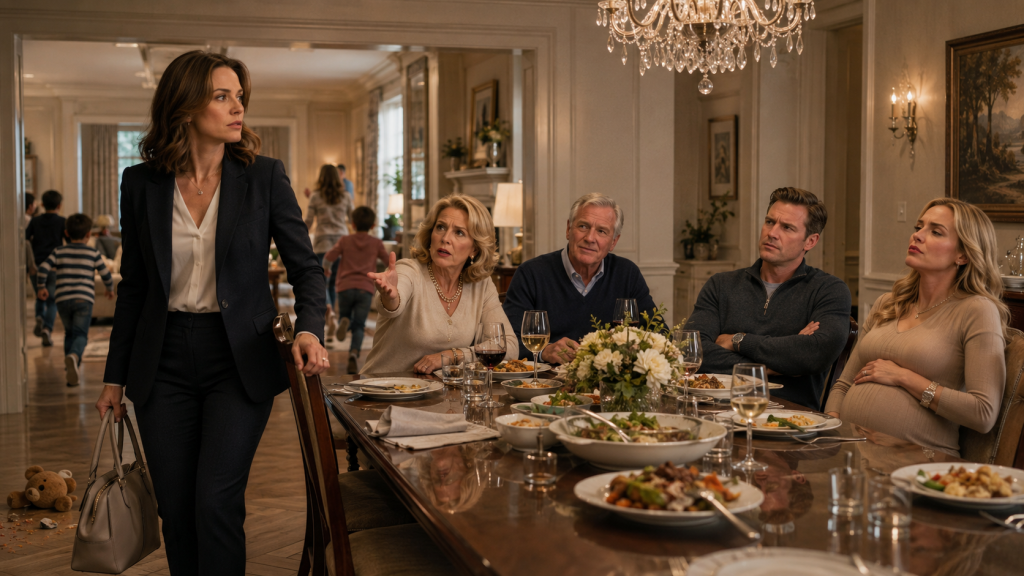
When my brother, Ryan, announced baby number five at Sunday dinner, my parents acted like he had just been promoted to president. Dad stood up first, clapping Ryan on the back. “Great job, son,” he said, beaming across the dining room like Ryan had personally saved the family name.
Mom wiped her eyes with a napkin. “Another blessing.” Across the table, my sister-in-law, Madison, rested one hand on her stomach and smiled like a queen receiving applause.
Their four children were running through the hallway, screaming over a broken toy, while no one but me seemed to hear the crash from the living room.
Then Mom turned to me.
“You’ll handle the kids,” she said.
Not asked.
Said.
I lowered my fork.
“Absolutely not.”
The room went quiet so fast I could hear the refrigerator humming.
Ryan frowned.
“Don’t start, Olivia.”
“I’m not starting anything,” I said. “I’m ending something.”
For eight years, I had been the emergency babysitter, weekend babysitter, unpaid tutor, school pickup, birthday planner, sick-day backup, and the person everyone blamed if one of Ryan’s kids missed a permission slip.
I was thirty-one, single, employed full time, and somehow still treated like spare furniture in my parents’ house.
Madison’s smile vanished.
“You have no family,” she snapped. “This is your training.”
The words landed colder than I expected.
My mother looked away.
My father said nothing.
Ryan only sighed, like I was embarrassing him.
I stood up, placed my napkin beside my plate, and grabbed my purse.
Mom followed me to the door.
“Olivia, don’t be dramatic.”
I looked back at the room, at the people who had decided my life was available because I had not given birth.
“I’m not dramatic,” I said. “I’m done.”
Then I left without another word.
Outside, the evening air felt sharp and clean.
For the first time in years, I did not check if Ryan needed help loading the kids into the minivan.
I did not remind Madison that Caleb had left his backpack by the stairs.
I did not pick up the juice box their youngest had thrown onto my parents’ lawn.
I simply got into my car and drove home.
My apartment was small, quiet, and mine.
No sticky fingerprints on the counters.
No one shouting my name from another room.
No one assuming my paycheck, my weekends, my sleep, and my patience were family property.
I locked the door behind me and leaned against it.
My phone buzzed before I could even take off my shoes.
Mom.
Then Ryan.
Then Madison.
Then Mom again.
I watched the screen light up over and over until it finally went dark.
A few minutes later, the family group chat exploded.
Mom: Olivia, apologize to your brother.
Ryan: You embarrassed Madison.
Madison: You are selfish.
Dad: Family helps family.
I typed one sentence.
Not when family uses family.
Then I turned my phone on silent and slept better than I had in months.
The next morning, my phone rang at 7:42.
I almost ignored it, but the number was local and unfamiliar.
“Hello?”
A calm male voice answered.
“Ma’am, this is Officer Daniels with the Brookhaven Police Department. Am I speaking with Olivia Carter?”
My stomach tightened.
“Yes.”
“Your brother and sister-in-law listed you as the responsible caregiver for four minor children this morning.”
I sat up in bed.
“They what?”
There was a pause.
“Ma’am,” he said carefully, “we need you to come to the station and make a statement. The children were found alone.”
For a moment, I could not breathe.
“What do you mean alone?”
Officer Daniels lowered his voice.
“A neighbor called after seeing the youngest child outside near the street without shoes. Officers arrived and found all four children in the home without an adult present.”
My hand flew to my mouth.
“Are they okay?”
“They are safe now,” he said. “But your name appears on a caregiver authorization form. We need to confirm whether you agreed to supervise them.”
“No,” I said immediately. “I did not agree to anything.”
“Then please come in as soon as possible.”
I threw on jeans, grabbed my purse, and drove to the station with both hands locked around the steering wheel.
All I could think about were the children.
Caleb was seven.
Mia was six.
Jonah was four.
The youngest, Grace, was only two.
They were loud, messy, exhausting, and innocent.
None of this was their fault.
By the time I arrived at the police station, my heart was pounding.
A woman at the front desk directed me down a hallway to a small interview room.
Ryan and Madison were already there.
Madison sat with her arms crossed over her stomach, mascara smudged under her eyes.
Ryan stood by the wall, rubbing the back of his neck.
The moment Madison saw me, her expression changed from frightened to furious.
“Finally,” she hissed. “Tell them you agreed to watch the kids.”
I stared at her.
“I never agreed to anything.”
Ryan stepped forward.
“Olivia, don’t do this.”
“Don’t do what?” I asked.
“Make this worse,” he said. “We had an appointment. Mom said you’d help.”
Officer Daniels looked up from his notes.
“Ms. Carter, did you receive any request to watch the children this morning?”
“No,” I said. “And after last night, they knew I would not.”
Madison let out a sharp laugh.
“They’re your nieces and nephews.”
“They’re your children,” I answered.
The room went still.
Officer Daniels opened a folder and turned it toward me.
Inside was a printed form.
Emergency Caregiver Authorization.
My name was typed under responsible adult.
My phone number was listed.
My address was listed too.
At the bottom was a signature.
Olivia Carter.
Except it was not mine.
My breath caught.
“I didn’t sign that.”
Officer Daniels nodded slowly.
“We suspected that.”
Ryan’s face changed.
Madison looked at the paper, then at me.
“Oh, come on,” she said. “It’s family.”
Officer Daniels did not blink.
“Forgery and child endangerment are serious matters, Mrs. Carter.”
Ryan immediately raised both hands.
“Wait. Nobody endangered anyone. We were gone for twenty minutes.”
“Forty-seven,” Officer Daniels said.
Ryan went silent.
Madison’s mouth opened, then closed again.
The officer continued.
“According to the neighbor, the two-year-old was outside for several minutes before anyone realized no adult was present. The front door was unlocked. The stove was on.”
My knees nearly gave out.
“The stove?”
Madison rolled her eyes.
“I was making breakfast before we left. I forgot.”
I looked at her in disbelief.
“You forgot the stove but remembered to forge my name?”
Her face flushed red.
Ryan snapped, “Olivia.”
“No,” I said, turning on him. “You do not get to say my name like I’m the problem.”
Officer Daniels asked me to sit.
He recorded my statement.
I told him everything.
The Sunday dinners where I was assigned childcare without being asked.
The times Ryan and Madison dropped the kids at my apartment with no warning.
The times my mother said I should be grateful because “a woman without children needs purpose.”
The vacations I missed because they needed me.
The promotions I almost lost because Ryan treated my work schedule like a suggestion.
Then I told him about the night before.
About the announcement.
About Madison saying I had no family.
About me saying no.
Officer Daniels listened without interrupting.
When I finished, he closed his notebook.
“Ms. Carter, based on your statement and the document issue, we’ll be forwarding this for review. Child protective services has also been contacted.”
Madison exploded.
“CPS? Are you serious?”
Officer Daniels looked at her.
“Your children were found unsupervised.”
Ryan turned pale.
“Can we just take them home?”
“That decision is not mine alone,” the officer said.
For the first time that morning, Ryan looked at me not with annoyance, but with fear.
“Liv,” he said softly. “Please.”
I hated that voice.
It was the voice he used when he wanted me to rescue him.
The voice he used when he forgot a school pickup.
The voice he used when he needed money for a late fee.
The voice he used when Madison was overwhelmed and my plans suddenly stopped mattering.
But this time, I did not move.
“No,” I said. “I am not lying for you.”
Madison began to cry.
Not soft tears.
Angry tears.
“You’re destroying our family.”
I looked at her stomach, then at the folder on the table.
“No,” I said. “You are.”
A social worker arrived an hour later.
Her name was Ms. Elaine Porter.
She wore a navy blazer and carried a tablet, but her voice was gentle when she spoke to me.
“Ms. Carter, the children are asking for you.”
That broke something in me.
Not because I wanted responsibility.
Because I loved them.
That was the cruelest part.
I loved those children.
I loved Caleb’s serious little face when he asked questions about planets.
I loved Mia’s drawings of houses with purple roofs.
I loved Jonah’s dinosaur obsession.
I loved Grace’s sleepy little hugs.
But loving them did not mean I had agreed to become their third parent.
“Can I see them?” I asked.
Ms. Porter nodded.
“They’re in the family room.”
Ryan started forward.
“I’m their father.”
She stopped him with one raised hand.
“Not yet.”
His face collapsed.
Madison looked like she might scream.
I followed Ms. Porter down the hallway.
The children were sitting in a bright room with toys and small chairs.
Caleb saw me first.
“Aunt Liv!”
He ran into my arms so hard I almost stumbled.
Mia followed.
Then Jonah.
Grace waddled over last, her hair tangled, one sock missing.
I knelt and held them all.
For a few seconds, I was furious all over again.
Not at them.
Never at them.
At the adults who had made them afraid.
Caleb whispered, “Mommy said you were coming.”
My eyes closed.
“No, sweetheart,” I said carefully. “I didn’t know.”
He pulled back.
“But she wrote your name on the paper.”
I looked up at Ms. Porter.
She heard it too.
Mia sniffled.
“Are Mommy and Daddy in trouble?”
I brushed hair from her face.
“They made a bad choice,” I said. “But you are safe.”
Grace climbed into my lap and put her thumb in her mouth.
I stayed with them until Ms. Porter said it was time.
When I returned to the hallway, my parents had arrived.
Mom was crying.
Dad looked furious.
Ryan stood beside them, speaking quickly.
The moment Mom saw me, she rushed over.
“Olivia, fix this.”
I almost laughed.
Not because it was funny.
Because it was exactly what she had always expected.
Fix this.
Fix dinner.
Fix the schedule.
Fix your brother’s mistake.
Fix your attitude.
Fix the family.
I stepped back before she could grab my arm.
“No.”
Mom blinked.
“This is not the time for stubbornness.”
“You’re right,” I said. “It’s the time for consequences.”
Dad pointed a finger at me.
“Your brother could lose his children because of you.”
I looked at him.
“His children were found alone because of him.”
Dad’s jaw tightened.
“You always were resentful.”
That hurt more than I wanted it to.
Because I had not been resentful at first.
At first, I was happy to help.
When Caleb was born, I babysat so Ryan and Madison could sleep.
When Mia arrived, I brought groceries.
When Jonah came early, I took unpaid leave to sit with Caleb and Mia.
When Grace was born, I cleaned their house for three weekends straight because Madison was recovering.
I had shown up.
Again and again.
But somewhere along the way, gratitude turned into expectation.
Expectation turned into entitlement.
Entitlement turned into ownership.
And when I finally said no, they acted like I had stolen something from them.
“I was not resentful,” I said. “I was exhausted.”
Mom wiped her face.
“Family sacrifices.”
“Then why was I the only one sacrificing?”
No one answered.
Officer Daniels came into the hallway.
“Mr. and Mrs. Carter, we need you both to remain available for questioning.”
My mother stiffened.
“Us?”
“Yes,” he said. “We need to clarify who provided Ms. Carter’s information for the form and who claimed she had agreed to supervise the children.”
Mom’s face went pale.
I looked at her.
“Mom?”
She glanced at Ryan.
Then at Madison.
Then at Dad.
Her silence told me everything.
I felt something cold settle in my chest.
“You gave them my information.”
Mom’s eyes filled again.
“I was trying to help.”
“Who?” I asked. “Them or me?”
She whispered, “You were being difficult.”
I stared at my mother, the woman who had taught me to share, to be kind, to help family.
And suddenly I saw the truth.
She had never seen my kindness as something I gave.
She saw it as something she controlled.
Ryan sat down hard on a bench.
“Mom said you’d calm down by morning.”
Madison folded her arms.
“And you should have.”
I turned to Madison.
“You left four children alone because you assumed I would clean up your mess.”
She looked away.
Dad muttered, “Enough.”
But it was not enough.
Not anymore.
Over the next few days, everything unraveled.
CPS opened an investigation.
Ryan and Madison were allowed supervised contact while the case was reviewed.
The children stayed temporarily with Madison’s older aunt, who lived nearby and had apparently been offering help for years.
Help Madison refused because, according to her aunt, “she preferred free help she could control.”
Officer Daniels called me again two days later.
He told me the signature was being reviewed.
He also told me the police had obtained messages from Madison’s phone.
Messages she had sent to Ryan that morning.
Olivia’s still mad. Just put her down. She’ll fold when they call.
Another message from Ryan.
What if she doesn’t?
Madison replied.
She always does.
I sat on my couch after that call, staring at the wall.
She always does.
Four words.
Eight years of my life.
I had been predictable to them.
Useful.
Reliable.
Easy to guilt.
Easy to shame.
Easy to drag back.
That night, my mother came to my apartment.
I saw her through the peephole holding a casserole dish like this was a normal family disagreement.
I opened the door but did not invite her in.
“Olivia,” she said softly. “Can we talk?”
“You can talk from there.”
Her face tightened.
“I’m your mother.”
“And I’m your daughter,” I said. “Not your employee.”
She looked down at the dish.
“I made your favorite.”
“No, you made what Ryan likes.”
Her mouth opened, then closed.
She had forgotten.
Or maybe she had never noticed.
I crossed my arms.
“What do you want?”
She sighed.
“I want this ugliness to end.”
“So do I.”
“Then withdraw your statement.”
I almost smiled.
There it was.
Not an apology.
Not concern.
A request.
“No.”
“Olivia, please. Your brother is under terrible stress. Madison is pregnant.”
“And that makes forgery okay?”
“She panicked.”
“She left toddlers alone.”
Mom’s eyes flashed.
“You don’t understand because you’re not a mother.”
That sentence would have broken me once.
Now it only confirmed everything.
“You’re right,” I said. “I’m not a mother. But I know children deserve adults who do not use them as weapons.”
Mom’s face crumpled.
“You sound so cruel.”
“No,” I said. “I sound like someone who finally believes her own life matters.”
She left the casserole outside my door.
I threw it away.
A week later, Ryan called.
I did not answer.
He left a voicemail.
His voice sounded smaller than I had ever heard it.
“Liv, I know you’re angry. But the kids miss you. Caleb keeps asking when you’re coming over. Madison’s not doing well. Mom and Dad are fighting. Everything is falling apart.”
He paused.
Then he said the sentence that told me he still did not understand.
“We need you.”
Not I’m sorry.
Not I was wrong.
We need you.
I deleted the voicemail.
The investigation continued.
Ryan and Madison were required to attend parenting classes.
They had to install safety locks, arrange verified childcare, and submit a written plan before the children could return home full time.
The forgery charge did not disappear.
It became part of a formal record.
Madison blamed me to everyone who would listen.
Ryan avoided looking at me at the first supervised family meeting.
My parents told relatives I had “overreacted.”
But Madison’s aunt told the truth.
So did the neighbor.
So did the messages.
And eventually, people stopped calling me cruel.
A month later, Ms. Porter asked if I would be willing to visit the children at their aunt’s house.
Only if I wanted to.
No pressure.
No obligation.
That was the first time any adult in this situation had said those words to me.
Only if I wanted to.
I said yes.
When I arrived, the kids ran toward me like before.
Caleb hugged my waist.
Mia showed me a missing front tooth.
Jonah roared like a dinosaur.
Grace handed me a half-eaten cracker like it was treasure.
I stayed for two hours.
I played games.
I read books.
I laughed.
And when it was time to leave, Caleb asked, “Are you mad at us?”
My heart cracked.
I knelt in front of him.
“Never.”
“Then why don’t you come all the time anymore?”
I took a slow breath.
“Because grown-ups need to ask before they expect help. And Aunt Liv needed to make sure everyone remembered that.”
He thought about that seriously.
“Mommy didn’t ask?”
“No,” I said gently. “She didn’t.”
Mia frowned.
“That’s rude.”
I smiled sadly.
“Yes, sweetheart. It is.”
When I left that evening, I cried in my car.
Not because I regretted what I had done.
Because boundaries hurt when love is tangled inside them.
Two months later, Ryan showed up at my office building.
He waited outside by the parking lot.
I almost walked past him, but he said, “I’m sorry.”
I stopped.
He looked exhausted.
Older.
Less certain of himself.
“I’m sorry,” he repeated. “For all of it.”
I said nothing.
He swallowed.
“I told myself you liked helping. I told myself you were better with the kids than us. I told myself it wasn’t a big deal because you always showed up.”
His eyes reddened.
“But I knew. I knew we were using you.”
That was the first honest thing he had said in years.
“And Madison?” I asked.
He looked away.
“She’s angry.”
“Of course she is.”
“But I’m not here for her,” he said. “I’m here because Caleb asked why Aunt Liv had to call the police to make grown-ups tell the truth.”
My throat tightened.
Ryan wiped his face.
“I didn’t know what to say.”
I looked at my brother.
For the first time, he did not look like the golden son.
He looked like a man facing the mess he had made.
“So what did you say?” I asked.
He exhaled shakily.
“I said sometimes grown-ups get used to taking from people who love them. And sometimes those people have to stop giving so everyone can see the truth.”
I looked away.
“That’s a start.”
He nodded.
“I know I don’t deserve forgiveness.”
“No,” I said. “You don’t.”
He flinched.
“But your kids deserve better,” I continued. “So become better.”
Ryan nodded again.
“I’m trying.”
I believed that he wanted to.
I did not yet know if he would.
There is a difference.
By the time Madison had the fifth baby, everything had changed.
No one called me to ask when I was taking vacation days for childcare.
No one handed me a diaper bag at Sunday dinner.
No one told me I needed training.
Ryan hired a licensed babysitter.
Madison’s aunt helped twice a week.
My parents complained at first about “strangers raising family,” until I asked why they were not volunteering themselves.
That ended the conversation quickly.
I visited the kids sometimes.
On my terms.
With notice.
For joy, not obligation.
And one Sunday, months after that terrible morning, I went back to my parents’ house for dinner.
The table looked the same.
The same white plates.
The same roast chicken.
The same family photos on the wall.
But I was not the same woman sitting there.
Madison barely spoke to me.
Ryan was polite.
Dad avoided the subject.
Mom watched me carefully, as though waiting for the old Olivia to return.
Halfway through dinner, the baby started crying.
Madison shifted in her chair.
Ryan stood immediately.
“I’ve got him,” he said.
No one looked at me.
No one expected me to move.
For some reason, that small moment felt bigger than any apology.
After dinner, Mom followed me to the door again.
Just like the night everything began.
This time, her voice was quieter.
“I didn’t realize how much we put on you.”
I looked at her.
“Yes, you did.”
She looked wounded.
But I did not soften it.
“You realized,” I said. “You just thought I would never stop allowing it.”
Her eyes filled with tears.
“I’m sorry.”
I studied her face.
I wanted that apology for years.
But when it finally came, it did not magically erase the past.
It only opened a door.
A small one.
“We’ll see,” I said.
She nodded.
Outside, the air was cool.
My car waited at the curb.
I walked toward it with my keys in my hand and my shoulders lighter than they had been in years.
Behind me, inside the house, the baby cried again.
This time, nobody called my name.
Nobody demanded.
Nobody assumed.
And when my phone buzzed a minute later, I looked down.
It was a message from Ryan.
Thank you for coming tonight. We’re learning.
I stared at the words for a long moment.
Then I typed back.
Good. Keep learning.
I got into my car and drove home.
Not angry.
Not guilty.
Not owned.
Just free.
Because sometimes the call that changes everything does not come from family.
Sometimes it comes from the police.
Sometimes it comes from consequences.
And sometimes it comes from the quiet voice inside you finally saying the one word everyone hoped you would never learn to say.
No.
THE END! THANK YOU FOR READING!