

My stepfather hurt me almost every day for his own amusement. One afternoon, he knocked me unconscious, and when he brought me to the hospital, my mother claimed, “She slipped while taking a bath.”
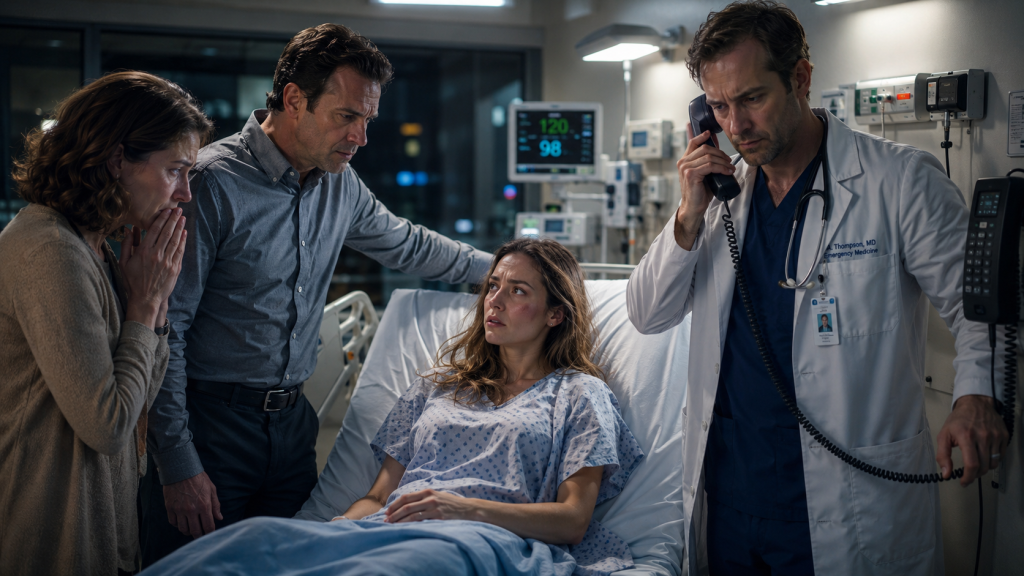
The moment the doctor examined me, he grabbed the phone and dialed 911. The final sound I heard before everything faded into darkness was my stepfather’s laughter.
He laughed as if hurting me was entertainment.
As if my suffering was the highlight of his day.
His name was Victor Payne, though inside our home, everyone referred to him as “sir.”
Especially my mother.
Every evening, he found some excuse to hurt me.
A dish set down too hard.
A shirt folded the wrong way.
A glance he chose to interpret as disrespect.
Sometimes he did not even bother making up a reason.
He would sink into his recliner with a beer in his hand and say, “Violet, come here. I’m bored.”
My mother would immediately lower her gaze.
“Just do what he says,” she once murmured. “Don’t make things worse.”
But every time she stayed silent, she made things worse herself.
Victor loved having an audience.
He enjoyed forcing me to stand in the center of the living room while he humiliated me.
“Look at her,” he would tell my mother. “Twenty-two years old and still completely useless.”
By then, I no longer cried in front of him.
That bothered him more than anything.
“You think you’re brave?” he asked one evening, stepping close enough that I could smell alcohol on his breath.
“No,” I replied evenly. “I think you’re predictable.”
The smile disappeared from his face.
The first blow sent me crashing into the kitchen counter.
The second knocked the breath from my chest.
My mother stood frozen by the sink, twisting her wedding ring as though that small circle of gold could spare her from choosing a side.
“Tell her,” Victor barked.
My mother swallowed hard.
“Apologize, Violet.”
I stared at her.
“For what?”
Victor moved so quickly I barely registered it.
My head struck the tile floor.
Then everything went dark.
When I regained consciousness, harsh hospital lights glared above me.
My mouth tasted like metal.
My body felt heavy, as if someone had filled my bones with wet cement.
Victor stood beside the bed wearing an expression of counterfeit concern.
My mother was holding my hand, but not out of affection.
She was keeping it pinned in place.
A doctor wearing a white coat walked into the room.
He was not old, maybe early forties, with tired eyes and a calm voice.
“What happened?” he asked.
My mother answered before I even had the chance.
“It was because she accidentally slipped while bathing.”
Victor nodded immediately.
“She’s clumsy,” he added. “Always has been.”
The doctor studied my face.
Then my arms.
Then the older marks Victor believed had faded enough to stay hidden.
His expression changed.
Not dramatically.
Not loudly.
But the room suddenly felt different.
The doctor looked at Victor.
Then at my mother.
Then back at me.
“Can you tell me what happened?” he asked gently.
Victor stepped forward.
“She already told you.”
The doctor did not look away from me.
“I asked my patient.”
My mother’s fingers tightened around my wrist.
That was when I understood.
She was afraid I would speak.
Not afraid for me.
Afraid of what would happen to her life if I told the truth.
I looked at the doctor, and my lips parted.
No sound came out.
Victor leaned closer.
“Violet gets confused when she’s upset,” he said.
The doctor turned toward the nurse by the door.
“Please ask security to wait outside this room.”
Victor’s face hardened.
“Security? For what?”
The doctor lifted the phone from the wall.
“I need police in Emergency Room Three,” he said. “Now.”
For the first time that night, Victor stopped smiling.
And in that moment, I knew the trap I had spent years preparing had finally sprung shut.
Victor took one step toward the doctor.
“You don’t know what you’re doing.”
The doctor’s voice remained steady.
“I know exactly what I’m doing.”
My mother stood so fast the chair scraped against the floor.
“This is a misunderstanding,” she said. “My daughter fell. She has always been dramatic.”
I turned my head slowly toward her.
My throat burned.
“Mom.”
She froze.
For one second, I saw the woman she had been before Victor.
The woman who used to braid my hair before school.
The woman who used to sing badly while making pancakes.
The woman who cried at my sixth-grade graduation because I had won a writing award.
Then she blinked, and that woman disappeared.
“Don’t,” she whispered.
The word was not a plea.
It was a warning.
Two police officers arrived before Victor could finish constructing his next lie.
One was a tall woman with dark hair pulled into a tight bun.
The other was a broad-shouldered man with a notepad already in his hand.
The female officer stepped forward.
“I’m Officer Mara Collins,” she said. “Who called?”
“I did,” the doctor replied. “Dr. Evan Mercer.”
Victor laughed once.
It was short and ugly.
“This is absurd. She slipped.”
Dr. Mercer stood between them and my bed like a wall.
“These injuries are inconsistent with a single fall,” he said. “Some are recent. Some are older. Several appear to be in different stages of healing.”
My mother’s mouth trembled.
Victor stared at the doctor with open hatred.
“You’re making a serious accusation.”
“No,” Dr. Mercer said. “I’m making a medical report.”
Officer Collins looked at me.
“Violet, are you safe at home?”
The question broke something inside me.
Not because it was complicated.
Because the answer was so simple.
No.
I had not been safe in years.
My eyes filled with tears, but I refused to let them fall while Victor watched.
My voice came out hoarse.
“No.”
My mother made a small sound beside me.
Victor exploded.
“She’s lying.”
Officer Collins turned sharply.
“Sir, step back.”
“She’s a liar,” he shouted. “She’s been trying to ruin me for years.”
Dr. Mercer nodded toward the security guard now standing outside the room.
Victor noticed him and went still.
That was when I whispered, “Check the black flash drive in my purse.”
Everyone froze.
My mother’s face drained of color so quickly it looked as if the lights had changed.
Victor’s eyes snapped toward me.
“What did you say?”
I swallowed.
“My purse. Inside the small makeup pouch.”
Officer Collins glanced at the male officer.
He carefully picked up my purse from the chair and opened it.
Victor lunged.
He only moved two steps before security caught his arm.
“Don’t touch that,” Victor barked.
Officer Collins’ eyes narrowed.
“Why not?”
Victor said nothing.
The male officer unzipped the makeup pouch and removed a small black flash drive.
My mother sank back into the chair.
Her hands covered her mouth.
For three years, I had recorded everything.
Not every moment.
Not every night.
But enough.
Enough of Victor’s threats.
Enough of his laughter.
Enough of my mother telling me to stay quiet.
Enough of him saying nobody would believe me.
The recordings had begun by accident.
One night, after Victor dragged me into one of his cruel games, I realized my phone had been recording audio inside my hoodie pocket.
At first, I was terrified.
Then I listened.
And for the first time, his voice sounded exactly as monstrous as I knew it was.
Not hidden behind charm.
Not softened by my mother’s excuses.
Not protected by the walls of our house.
Just him.
So I kept recording.
I bought tiny storage drives with cash.
I uploaded copies to email accounts no one knew existed.
I hid one flash drive inside the hollow leg of my desk.
Another beneath the lining of an old winter coat.
And the black one in my purse was bait.
Victor had spent years believing fear made me stupid.
He never understood that fear had made me careful.
Officer Collins held the drive in her gloved hand.
“Does this contain evidence?” she asked.
I looked straight at Victor.
“Yes.”
Victor’s mouth twisted.
“You little snake.”
I smiled through the pain.
“No,” I whispered. “I’m the witness you forgot was still breathing.”
My mother began crying.
For once, Victor did not comfort her.
He stared at me like he was seeing me for the first time.
Not as a weak girl.
Not as a convenient target.
As a threat.
Officer Collins asked Victor and my mother to leave the room.
Victor refused.
Security helped him understand that refusal was not an option.
As they escorted him out, he shouted down the hallway.
“You think this is over? You belong to me, Violet.”
Dr. Mercer’s face hardened.
Officer Collins stepped into the doorway and said coldly, “That statement is going in my report.”
My mother lingered for half a second.
She looked back at me.
I waited for her to say something.
I waited for an apology.
For regret.
For one sentence that proved she still knew how to be my mother.
Instead, she whispered, “Why would you do this to us?”
Something inside me went quiet.
Not broken.
Finished.
“I didn’t do this to us,” I said. “He did. And you helped him hide it.”
She flinched as if I had slapped her.
Then she followed Victor out.
The police interviewed me after the doctor cleared me to speak.
They asked questions gently.
They did not rush me.
They did not call me dramatic.
They did not ask what I had done to provoke him.
Officer Collins sat beside my bed and wrote everything down.
“How long has this been happening?” she asked.
“Since I was sixteen,” I said.
Her pen stopped for half a second.
Then she continued writing.
“Were you a minor when it began?”
“Yes.”
Her jaw tightened.
“And your mother knew?”
I looked at the door.
“Yes.”
That was the first time I said it without trying to protect her.
My mother knew.
She knew when I wore long sleeves in July.
She knew when I stopped eating dinner with them because Victor said watching me chew annoyed him.
She knew when I started locking myself in the laundry room just to breathe.
She knew when teachers asked questions and she laughed too loudly, saying I was always bumping into things.
She knew.
And she chose marriage over mercy.
The next morning, Victor was arrested.
He did not go quietly.
Of course he didn’t.
He shouted that he was being framed.
He demanded a lawyer.
He called my mother useless.
A neighbor recorded part of it on her phone.
By noon, half the street knew.
By evening, everyone knew.
People who had smiled at Victor during barbecues suddenly began telling police that they had “always suspected something.”
I did not hate them for being late.
I only wished someone had been early.
I spent four days in the hospital.
Dr. Mercer checked on me every morning, even when other doctors were assigned.
On the third day, he placed a small envelope on my bedside table.
“What is that?” I asked.
“A contact list,” he said. “Victim support services, legal aid, safe housing options, trauma counseling. You don’t have to use all of them. But you should know they exist.”
I stared at the envelope.
Help had always sounded like something other people received.
People with stronger voices.
Cleaner stories.
Families worth saving.
Dr. Mercer seemed to understand.
“You are not responsible for what happened to you,” he said.
I laughed weakly.
“You sound like you’ve said that before.”
“I have,” he answered. “And I’ll keep saying it until people believe it.”
I looked down at my hands.
“What if I don’t know how to live without being afraid?”
“Then you start by living afraid,” he said gently. “And one day, fear won’t be the loudest thing in the room anymore.”
On the fifth day, a social worker named Alina came to speak with me.
She had kind eyes and a folder full of forms.
“We can help arrange temporary housing,” she said. “Somewhere confidential.”
I nodded.
“Good.”
“Do you have anywhere else you can go? A friend? Relative?”
For years, Victor had made sure I did not.
He called my friends bad influences.
He read my messages.
He made me quit college after one semester because he said I was wasting money.
He told my relatives I was unstable.
Slowly, carefully, he had turned my world into one house, one mother, one monster.
“No,” I said.
Alina did not pity me.
I appreciated that.
“Then we will build from here.”
The phrase stayed with me.
Build from here.
Not rebuild.
That life was not worth rebuilding.
It deserved to be demolished.
Two weeks later, I stood in court for the first emergency protective order hearing.
I wore a navy dress donated by the women’s shelter and flats that pinched my toes.
My hands shook, but my voice did not.
Victor sat across the room in a gray suit, clean-shaven, looking offended rather than ashamed.
My mother sat behind him.
Not beside me.
Behind him.
That told the judge everything before she even opened her mouth.
Victor’s lawyer tried to make me sound unstable.
He asked why I had stayed.
Why I had not reported earlier.
Why I had recorded instead of leaving.
Each question was dressed like logic and sharpened like blame.
I answered every one.
“I stayed because I was afraid.”
“I didn’t report because my mother lied for him.”
“I recorded because I knew people like you would ask why I had no proof.”
The courtroom went silent.
The judge looked over her glasses.
Victor’s lawyer sat down.
Then the prosecutor played the first recording.
Victor’s voice filled the courtroom.
Cruel.
Mocking.
Undeniable.
My mother began sobbing behind him.
Victor did not move.
He only stared at the table.
The second recording was worse.
Not because of Victor.
Because of my mother.
Her voice came through clearly.
“Please just apologize, Violet. He’ll stop if you stop making him angry.”
The judge’s face changed.
Not with surprise.
With recognition.
As if she had heard that sentence too many times from too many mothers, too many partners, too many cowards hiding behind fear.
The protective order was granted.
Victor was forbidden from contacting me.
My mother was warned that any attempt to pressure me on his behalf would be treated seriously.
She looked devastated.
But I was beginning to understand something.
Some people are devastated only when consequences arrive.
Not when harm is happening.
Over the next months, the case grew bigger than Victor expected.
The flash drive led investigators to the rest of my evidence.
The hidden email account.
The dates.
The photos.
The notes I had written after each incident, careful and plain, because I knew emotion would be used against me.
There were hospital records from years before.
School counselor reports.
A neighbor who finally admitted she had heard shouting many nights and once saw me sitting outside in winter without shoes.
Piece by piece, the truth became too heavy for Victor to lift.
He tried to claim the recordings were fake.
Experts confirmed they were real.
He tried to say I injured myself.
Doctors testified otherwise.
He tried to blame alcohol.
The prosecutor said alcohol did not create cruelty.
It only removed the effort of hiding it.
My mother was charged too.
Not for what Victor did with his hands.
For what she did with her silence.
For lying to doctors.
For blocking reports.
For helping conceal years of abuse that began while I was still under eighteen.
When I heard that, I sat on the shelter bed and cried for an hour.
Not because I wanted to save her.
Because a part of me still wanted her to save me.
Even after everything.
Healing was not beautiful at first.
It was paperwork.
Court dates.
Nightmares.
Panic in grocery store aisles when a man raised his voice.
It was learning that locked doors could mean safety instead of captivity.
It was waking up at three in the morning and reminding myself that nobody was coming down the hall.
Alina helped me enroll in community college again.
Dr. Mercer wrote a letter for my scholarship application.
Officer Collins testified at the preliminary hearing and later checked in through the victim advocate.
People began appearing in my life like small lights.
Not saviors.
Witnesses.
There is a difference.
A savior tries to own your recovery.
A witness stands beside you while you reclaim it.
Nine months after the night in the hospital, Victor accepted a plea deal.
His lawyer said it was to “spare the family a trial.”
I almost laughed when the prosecutor told me.
He had never wanted to spare anyone anything.
He only wanted to avoid sitting in a courtroom while every recording played.
At sentencing, I was allowed to speak.
I spent three nights writing my statement.
Then I tore it up.
When the day came, I walked to the front of the courtroom with nothing in my hands.
Victor stood beside his lawyer.
My mother sat two rows back, smaller than I remembered.
The judge asked if I wished to address the court.
I looked at Victor.
For years, I had imagined this moment.
I thought I would scream.
I thought I would curse him.
I thought I would demand that he explain why.
But standing there, I realized something strange.
I no longer needed his answer.
His reasons belonged to him.
His cruelty belonged to him.
His future belonged to the court.
Mine belonged to me.
“My name is Violet Hayes,” I said. “For years, Victor Payne tried to convince me that I was powerless. He made my home a place where fear lived in every room. He laughed when I was hurt. He lied when I needed help. And he believed silence would protect him forever.”
Victor stared straight ahead.
I continued.
“But silence did not protect him. It only delayed the truth. I am not here because I am weak. I am here because I survived long enough to speak. And I want the court to know that what happened to me was not a family matter. It was not discipline. It was not a misunderstanding. It was abuse.”
My mother covered her face.
I did not look at her.
“I lost years of my life,” I said. “But I will not lose the rest of it.”
That was all.
I stepped back.
Victor was sentenced that afternoon.
My mother received probation, mandatory counseling, and a record that would follow her longer than her excuses ever had.
Some people said she deserved worse.
Some said she deserved pity.
I decided she deserved neither from me.
She wrote letters afterward.
Many of them.
At first, I did not open them.
Then one evening, almost a year later, I opened the first.
Dear Violet, it began.
I stopped there.
Not because I was afraid.
Because I realized I did not need whatever came next.
Maybe it was an apology.
Maybe it was another excuse dressed in softer words.
Either way, my peace was no longer available for negotiation.
I folded the letter and placed it back in the envelope.
Then I put it away.
Not destroyed.
Not forgiven.
Just away.
Two years after the hospital night, I graduated from community college with honors.
Dr. Mercer attended the ceremony.
So did Officer Collins and Alina.
They sat together in the third row, clapping louder than anyone.
When my name was called, I walked across the stage with my head high.
For a second, under the bright lights, I remembered another version of myself.
The girl standing in the living room while Victor laughed.
The girl staring at her mother, waiting to be chosen.
The girl hiding flash drives because evidence felt safer than hope.
I wished I could reach back through time and take her hand.
I wished I could tell her that one day, strangers would become safer than family.
That one day, her voice would not shake.
That one day, she would sleep through the night.
After the ceremony, Dr. Mercer handed me a small gift bag.
Inside was a journal with a violet-colored cover.
“I thought you might need somewhere to write the next chapter,” he said.
I smiled.
“For evidence?”
“For yourself.”
That night, I sat beside the window in my small apartment.
It was not fancy.
The couch was secondhand.
The kitchen table had one wobbly leg.
The bedroom closet door stuck if I pulled too hard.
But every inch of that place was mine.
No recliner.
No beer cans.
No footsteps I had to fear.
No one calling me into the room because they were bored.
I opened the journal and wrote the first sentence.
My name is Violet Hayes, and I survived.
Then I paused.
For years, survival had been the whole story.
But now, for the first time, I wanted more than survival.
So I added another line.
Now I am learning how to live.
The pen trembled in my hand.
But this time, it was not from fear.
It was from freedom.
And freedom, I discovered, has its own kind of weight.
At first, it feels too large to carry.
Then slowly, day by day, you grow strong enough to hold it.
I never became the girl I was before Victor.
That girl was gone.
But I became someone else.
Someone wiser.
Someone harder to fool.
Someone gentle in places the world failed to destroy.
Years later, when people asked me when my life changed, they expected me to say it changed in court.
Or when Victor was arrested.
Or when the judge read his sentence.
But the truth was simpler.
My life changed in Emergency Room Three.
Under harsh white lights.
With pain in every breath.
When a doctor looked at me and saw the truth my own mother had spent years refusing to see.
He picked up the phone.
He dialed 911.
And for the first time, someone treated my pain like evidence instead of inconvenience.
That was the moment the house of lies began to collapse.
That was the moment Victor stopped laughing.
And that was the moment I finally understood something he had tried so hard to make me forget.
I did not belong to him.
I never had.
I belonged to myself.
And nobody was ever going to take that from me again.
THE END! THANK YOU FOR READING!