

MY HUSBAND CHOSE HIS FAMILY AND TOLD ME TO PACK MY BAGS — SO I TOOK OUR THREE-YEAR-OLD SON AND VANISHED OVERSEAS.
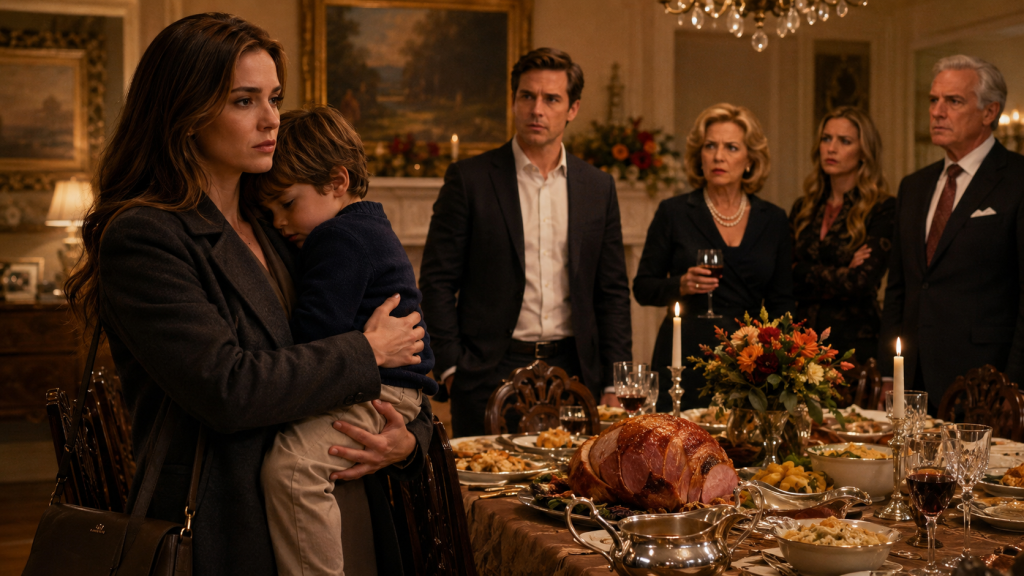
The fight started in the middle of my husband’s parents’ dining room, right between the glazed ham and the silver gravy boat his mother only brought out when she wanted everyone to remember she had money.
I had promised myself I would stay calm that night.
For three years, I had swallowed little insults from the Whitmore family with a smile.
My mother-in-law, Diane, called me “too sensitive.”
My sister-in-law, Brooke, joked that I had trapped my husband, Mark, with a baby.
His father, Richard, never looked up from his bourbon unless he wanted to remind me that I had “married up.”
But that Thanksgiving, Brooke made the mistake of saying it in front of my three-year-old son.
“Noah would be better off raised by people who understand our family standards,” she said, smiling like she had just complimented the pie. “Not by a woman who still acts like she’s one missed paycheck from a trailer park.”
The table went quiet.
Noah sat on my lap, one small hand sticky with cranberry sauce, looking from face to face as if he understood the room had turned dangerous.
I looked at Mark.
He stared at his plate.
“Say something,” I whispered.
He didn’t.
So I did.
I told them I knew why Brooke hated me.
Not because I was poor.
Not because I was different.
Because two months earlier, I had found the missing college fund statement Diane had accused me of stealing.
Brooke had transferred fifteen thousand dollars from Noah’s education account to cover credit card debt, then cried to the family that I was “financially unstable.”
Brooke’s face went white first.
Then red.
“That is a disgusting lie,” she snapped.
I pulled my phone from my purse and opened the screenshots.
Transfer dates.
Account numbers.
Brooke’s email attached to the confirmation.
Diane stood so fast her chair hit the wall.
“You brought this filth into my home?”
“Your daughter took money from my son,” I said.
Richard slammed his fist on the table.
“Enough.”
But it wasn’t enough.
Not for me.
Not after years of being blamed for every crack in their perfect family picture.
Mark finally stood.
For one second, I thought he was coming to my side.
Instead, he turned on me.
“Apologize,” he said through his teeth.
I blinked.
“What?”
“You embarrassed my family. Apologize now, or pack your bags and leave.”
The room fell silent in a way I will never forget.
Diane crossed her arms.
Brooke smirked through wet eyes.
Richard nodded like Mark had finally become the man he wanted him to be.
I looked down at Noah.
He was pressing his face into my sweater, scared of the voices, scared of the people who claimed to love him.
Something inside me went still.
I stood, lifted Noah into my arms, and said, “All right.”
Mark frowned.
“All right what?”
I walked out without another word.
By midnight, while Mark slept in the guest room at his parents’ house, I opened my laptop, used the travel consent form he had signed months earlier for a trip he had forgotten, and bought two one-way tickets.
At four in the morning, I packed only what mattered.
Noah’s clothes.
His favorite dinosaur pajamas.
His stuffed bear with one missing eye.
My passport.
His passport.
The folder of documents I had been quietly building for months.
Bank records.
Messages from Diane.
Voicemails from Brooke.
Screenshots of Mark promising he would “talk to them,” then doing nothing.
Every little proof that I had not imagined the cruelty.
Every little proof that I had begged my husband to protect us and he had chosen silence.
Noah woke up while I was folding his blue sweater.
“Mommy?” he whispered, rubbing his eyes.
I sat beside him on the bed.
“We’re going on an adventure, baby.”
He looked toward the hallway.
“Daddy coming?”
My throat tightened.
“No,” I said softly. “Not today.”
He accepted that with the easy trust of a child who believed his mother could fix anything.
I wished I believed it too.
Outside, the world was still dark.
The streets were empty.
The air smelled like cold rain and fallen leaves.
I buckled Noah into his car seat, loaded one suitcase into the trunk, and sat behind the wheel for a full minute with my hands shaking.
The house behind me was quiet.
The home I had tried so hard to save looked peaceful from the outside.
Inside, it had been killing me slowly.
I drove away before I could change my mind.
At the airport, Noah slept with his cheek against my arm while I watched families move around us.
Couples holding hands.
Grandparents hugging children.
People laughing over coffee and luggage.
I wondered what they saw when they looked at me.
A tired mother.
A woman with no makeup and swollen eyes.
A wife running before anyone could stop her.
When the boarding announcement came, I stood with Noah in my arms and did not look back.
The plane lifted through gray clouds just after sunrise.
Noah slept.
I watched America disappear beneath us.
And for the first time since I had married Mark Whitmore, I allowed myself to breathe.
I chose Portugal because my grandmother had been born there.
Because my mother, before she died, had insisted I apply for dual citizenship.
Because six months earlier, the approval papers had arrived in the mail, and Mark had barely glanced up from his phone when I told him.
“That’s nice,” he had said.
That was all.
He had not asked what it meant.
He had not asked why my hands trembled when I opened the envelope.
He had not understood that the paper in my hands was not just citizenship.
It was a door.
When we landed in Lisbon, Noah woke up confused and cranky.
“Where’s Grandma Diane?” he asked.
I looked at his sleepy face and kissed his forehead.
“Far away.”
He nodded.
“Good.”
One word.
That was all he said.
But it broke something in me.
Because a three-year-old should not feel relief at being away from his own family.
For the first three days, I stayed in a small guesthouse near the coast owned by an old friend of my grandmother’s.
Her name was Teresa.
She was seventy-two, sharp-eyed, and kind in a way that made me cry the first time she put soup in front of me.
“You eat,” she said.
“I’m not hungry.”
“You eat anyway.”
So I did.
Noah sat beside me, swinging his legs under the chair, eating bread and watching the sea through the window.
The ocean was silver that morning.
Soft.
Endless.
Nothing like the cold dining room where Mark had told me to pack my bags.
On the third day, my phone finally stopped being silent.
First came Mark.
Then Diane.
Then Richard.
Then Brooke.
By noon, I had seventy-two missed calls.
By evening, there were ninety-one.
Mark’s first voicemail was angry.
“Claire, where are you? This is insane. You need to come home right now.”
His second was sharper.
“You cannot just take my son because you got upset at dinner.”
His third was colder.
“My father says we need to involve lawyers. Do not make this worse.”
Diane left messages too.
“You have always been dramatic.”
“You are punishing this family.”
“Noah belongs with his father’s people.”
Brooke sent one text.
You ruined everything.
I stared at that message for a long time.
Then I typed back only once.
No. You did.
After that, I blocked her.
The next morning, I rented a small apartment above a bakery.
It had two bedrooms, blue shutters, and a balcony where Noah could watch the street below.
Every morning, church bells rang.
Every afternoon, the smell of warm bread filled the rooms.
At night, Noah slept peacefully for the first time in months.
No nightmares.
No hiding behind my legs.
No asking whether Grandma Diane was angry.
I found work helping Teresa manage her boutique hotel.
It was not glamorous.
I answered emails.
Folded linens.
Checked in tourists.
Translated menus.
But every paycheck was mine.
Every decision was mine.
Every day felt like I was putting a small piece of myself back where it belonged.
For two weeks, I heard nothing from Mark except voicemails I did not answer.
Then the lawyer’s email arrived.
Mark was filing for emergency custody.
He claimed I had kidnapped Noah.
He claimed I was unstable.
He claimed I had fled the country to alienate his son from him.
My body went cold as I read the words.
I sat at the kitchen table while Noah colored beside me, humming softly.
My hands shook so badly I could barely open the folder on my laptop.
Then I remembered something important.
Fear had controlled me for years.
But fear was not proof.
I had proof.
So I sent my lawyer everything.
The signed travel consent form Mark had filled out months earlier, authorizing international travel with Noah.
The bank records showing Brooke’s unauthorized transfer.
The messages where Diane accused me of stealing before the truth came out.
The recording from Thanksgiving.
I had not planned to record the dinner.
But after years of being called a liar, I had started recording conversations whenever I knew the Whitmores would be cruel.
That night, my phone had been face-down beside my plate.
It had captured everything.
Brooke insulting me in front of Noah.
Me exposing the missing money.
Diane defending her.
Richard silencing me.
And Mark telling me to apologize or pack my bags and leave.
The next day, Mark called from a number I did not recognize.
I answered because my lawyer told me to remain calm and keep records of everything.
“Claire,” he said.
His voice was different.
Not angry.
Not proud.
Small.
“What do you want, Mark?”
There was a long silence.
“Are you okay?”
I almost laughed.
Not because it was funny.
Because it was far too late.
“Noah is okay,” I said.
“That’s not what I asked.”
“You lost the right to ask about me when you told me to apologize to the woman who stole from our son.”
He exhaled hard.
“My family didn’t tell me everything.”
“You were there.”
“I know, but—”
“No,” I said. “No but. You were there when Brooke insulted me. You were there when I showed proof. You were there when your mother defended her. You were there when your father shut me down. And you still chose them.”
“I was trying to keep the peace.”
“There was no peace, Mark. There was only me being sacrificed so your family could stay comfortable.”
He said nothing.
In the background, I heard a door close.
Then he whispered, “Brooke admitted it.”
My eyes shut.
“She admitted what?”
“The money. She said she borrowed it and meant to put it back. Mom knew.”
I gripped the edge of the table.
“Diane knew?”
“She found out after. She was going to handle it privately.”
Privately.
That word burned through me.
They had been willing to publicly accuse me.
Publicly humiliate me.
Publicly call me unstable.
But Brooke’s theft deserved privacy.
I looked across the room at Noah.
He was lining up toy cars along the windowsill, sunlight in his hair.
“No,” I said quietly. “This is not private anymore.”
Mark’s voice broke.
“Claire, please come home.”
I looked around the apartment.
The small kitchen.
The open balcony door.
The sea wind moving the curtains.
My son laughing without fear.
“Home is not where people break you and call it family,” I said.
Then I hung up.
The custody case did not go the way the Whitmores expected.
Their lawyers came in loud.
Mine came in prepared.
Mark’s team argued that I had removed Noah without proper agreement.
My lawyer placed the signed consent form on the table.
They argued I was financially reckless.
My lawyer showed Brooke’s transfer records and Diane’s messages blaming me for money she knew her own daughter had taken.
They argued Noah needed stability.
My lawyer played the Thanksgiving recording.
By the time Mark’s own voice filled the room, telling me to pack my bags and leave, he lowered his head.
I did not look at him.
I looked at the judge.
I looked at the papers.
I looked at the truth.
For years, the Whitmores had survived by controlling the room.
They knew how to make people doubt me.
They knew how to sound polished.
They knew how to smile while cutting someone open.
But recordings do not care about family reputations.
Bank statements do not care about silver gravy boats.
And children do not lie about who makes them feel safe.
A child psychologist met with Noah as part of the process.
I was terrified.
Not because I had done anything wrong, but because the Whitmores had taught me that truth could still be twisted.
After the meeting, the psychologist told the court Noah was bonded strongly to me, anxious around conflict, and showed signs of emotional distress linked to exposure to hostile family interactions.
Mark looked like someone had slapped him.
Maybe for the first time, he understood that silence had not protected Noah.
It had taught him fear.
Temporary custody stayed with me.
Mark was granted video calls twice a week, supervised at first because of the ongoing conflict.
Diane and Richard were not allowed contact without my written approval.
Brooke was barred completely until the financial investigation was resolved.
When the order was read, Diane gasped as if she were the victim.
Richard’s face turned dark red.
Brooke started crying.
Mark did not move.
I thought I would feel victory.
Instead, I felt tired.
Deeply, painfully tired.
That night, I took Noah for ice cream near the water.
He chose strawberry and got most of it on his shirt.
“Mommy,” he said, licking his spoon.
“Yes, baby?”
“Do we have to go back to the loud house?”
I swallowed.
“No.”
He smiled.
“Good. I like our blue house.”
Our blue house.
That was what he called the apartment.
That was when I knew I had made the right choice.
Months passed.
Life did not become perfect.
It became peaceful.
There is a difference.
I still woke up some nights with my heart racing.
I still checked locks twice.
I still saved every message, every document, every receipt.
But Noah bloomed.
He learned Portuguese faster than I did.
He made friends at the playground.
He stopped flinching when adults raised their voices nearby.
He began singing in the bathtub again.
That was the thing that made me cry hardest.
Not the court order.
Not Mark’s apology.
Not Brooke’s downfall.
Noah singing.
A child’s simple sound returning to a home that finally felt safe.
Mark kept calling on schedule.
At first, Noah barely spoke to him.
He would show him toys, then wander away.
Mark tried too hard.
He bought expensive gifts.
Sent packages.
Promised visits.
But children know when love feels like panic.
One evening, after Noah ran off to show Teresa his new drawing, Mark stayed on the video call.
“You look better,” he said.
I almost ended the call.
Instead, I said, “I am better.”
He nodded slowly.
“I started therapy.”
I said nothing.
“I know that doesn’t fix anything.”
“No,” I said. “It doesn’t.”
“But I need you to know I’m trying to understand why I let them treat you that way.”
I looked at him on the screen.
The man I had loved once.
The man I had waited for.
The man who had sat silent while his family taught our son that his mother was disposable.
“Mark,” I said, “you did not let them treat me that way. You helped them.”
His face tightened.
But he did not argue.
That was new.
A year earlier, he would have defended himself.
Explained.
Shifted blame.
Now he only nodded.
“You’re right.”
Those two words should have mattered more.
Maybe they would have, if he had said them sooner.
The investigation into Brooke ended quietly, the way wealthy families prefer scandals to end.
She repaid the money.
Richard covered the legal costs.
Diane called it a misunderstanding.
But court records did not use that word.
My lawyer sent me the final confirmation that Noah’s education account had been restored with additional funds placed under strict control.
No one could touch it without my approval.
Not Brooke.
Not Diane.
Not even Mark.
When I read that email, I sat on the balcony with a cup of coffee and watched Noah chase pigeons in the square below.
For once, I did not feel like I had escaped with nothing.
I had escaped with the only thing worth protecting.
Two months later, Mark came to Portugal for his first supervised visit.
I was nervous for days.
I cleaned the apartment twice.
Then hated myself for caring.
Teresa noticed.
“You are not preparing for a king,” she said, folding towels beside me.
“I know.”
“Then stop acting like one is coming.”
I laughed for the first time that day.
Mark arrived wearing a plain navy sweater, no expensive watch, no polished Whitmore arrogance.
He looked thinner.
Older.
Human.
Noah hid behind my leg when he saw him.
Mark crouched down but did not reach for him.
“Hi, buddy.”
Noah stared.
“You were at the loud house.”
Pain moved across Mark’s face.
“Yes,” he said quietly. “I was.”
“You made Mommy sad.”
Mark’s eyes filled.
“I did.”
Noah looked up at me.
I touched his hair.
“It’s okay. You can say what you feel.”
Noah turned back to Mark.
“I don’t want Grandma Diane.”
Mark swallowed.
“You don’t have to see Grandma Diane.”
“Promise?”
Mark looked at me.
Then at Noah.
“I promise.”
It was the first promise I had heard from him that sounded like it cost him something.
The visit lasted two hours.
They built blocks.
Ate pastries.
Walked near the water with the supervisor nearby.
Noah warmed slowly, the way children do when no one forces them.
When Mark left, he did not ask me to come home.
He only said, “Thank you for letting me see him.”
I nodded.
After Noah fell asleep that night, I found a letter in my mailbox.
Not an email.
Not a text.
A real letter.
From Diane.
I almost threw it away unopened.
But curiosity won.
Claire,
I hope you understand that everything I did was for my family.
That was the first line.
I laughed once.
Cold and short.
She wrote that Brooke had been under stress.
That Mark had been confused.
That I had taken things too far.
That families should handle matters privately.
Then near the end, she wrote the sentence that reminded me why I would never go back.
A good wife would have protected her husband from shame.
Not one word about Noah.
Not one word about what her daughter had done.
Not one word about the little boy who had heard his mother insulted across a Thanksgiving table.
I folded the letter, placed it in my legal folder, and made tea.
Some people apologize.
Some people only rearrange blame and call it regret.
Diane was the second kind.
Three months after Mark’s visit, the final custody agreement was signed.
Noah would live with me in Portugal.
Mark would have scheduled calls and gradual visits, with conditions.
No unsupervised contact with Diane, Richard, or Brooke.
No removal of Noah from Portugal without my written consent.
All major decisions required mutual agreement, but residence remained with me.
When the paperwork was complete, I walked out of the lawyer’s office into bright afternoon sunlight.
For a moment, I stood there unable to move.
I had spent so long fighting that peace felt unfamiliar.
Then my phone buzzed.
A message from Mark.
I signed. I won’t fight you anymore.
A second message followed.
I should have chosen you that night.
I looked at the screen for a long time.
Then I typed back.
You should have chosen what was right.
I did not wait for his reply.
That evening, Teresa insisted we celebrate.
She made fish stew, bought a small cake, and invited two neighbors who had become like aunties to Noah.
Noah wore a paper crown from the bakery and declared himself king of the blue house.
Everyone clapped.
He bowed dramatically and knocked over his juice.
I laughed until my stomach hurt.
Later, after everyone left, I carried him to bed.
He was heavy with sleep, his head resting on my shoulder.
“Mommy,” he mumbled.
“Yes?”
“Are we safe?”
I closed my eyes.
That question should never live in a child’s mouth.
But this time, I could answer it.
“Yes, baby. We’re safe.”
He sighed and fell asleep.
I stood there for a long time, holding him.
Thinking about the woman I had been in that dining room.
The woman waiting for her husband to stand up.
The woman who still believed if she explained enough, proved enough, endured enough, someone would finally love her correctly.
I wished I could go back and hold her too.
I wished I could tell her that leaving would feel like falling at first.
That she would shake in airports.
Cry over soup.
Wake up afraid.
Miss a man who had failed her and hate herself for missing him.
But I would also tell her this.
One day, your son will laugh in a kitchen filled with sunlight.
One day, no one will call you too sensitive for bleeding where they cut you.
One day, you will stop begging people to choose you because you finally chose yourself.
A year after that Thanksgiving, I returned to America once.
Not to go back.
Not to reconcile.
Only to attend the final property hearing and close the last legal door.
Mark met me outside the courthouse.
He looked nervous.
“Claire,” he said.
I turned.
He held out an envelope.
“What is it?”
“Something I should have given you a long time ago.”
Inside was a check.
Not for me.
For Noah’s education account.
Far more than Brooke had taken.
“I know money doesn’t fix it,” he said quickly. “I just wanted to do something that didn’t involve words.”
For once, I accepted without arguing.
“Thank you.”
He nodded.
Then he looked past me toward the courthouse steps where Diane and Richard stood waiting.
Diane’s mouth tightened when she saw me.
Richard looked away.
Brooke was not there.
Mark followed my gaze.
“I don’t live with them anymore,” he said.
I looked back at him.
“That’s good.”
“I’m learning,” he said.
“I hope you are.”
He studied my face.
“Do you think there’s ever a chance for us?”
The question did not hurt the way I expected.
Maybe because I already knew the answer.
“No, Mark.”
He looked down.
“I figured.”
“I don’t hate you,” I said. “But I don’t trust the version of myself who stayed with you.”
His eyes lifted.
“That’s fair.”
It was.
And it was also final.
After the hearing, I walked out alone.
Diane tried to stop me near the doors.
“Claire.”
I turned.
She looked smaller than I remembered.
Or maybe I was no longer shrinking in front of her.
“You tore this family apart,” she said.
I looked at her carefully.
At the perfect hair.
The pearls.
The mouth that had shaped years of insults into manners.
“No, Diane,” I said. “I stopped letting you use me to hold it together.”
Her face hardened.
“You’ll regret this.”
I almost smiled.
“I already regretted staying too long.”
Then I walked away.
No dramatic speech.
No shouting.
No tears.
Just my heels against the courthouse floor and the sound of a door closing behind me.
When my flight landed in Lisbon, Noah ran into my arms so hard I nearly dropped my bag.
“Mommy!”
I held him close.
He smelled like sunshine and crayons.
“Did you miss me?”
“So much,” he said. “I made you a picture.”
The picture was waiting on the kitchen table.
Three people stood in front of a blue house.
Noah.
Me.
And Teresa, holding a giant loaf of bread.
Above us, in shaky child letters, he had written:
HOME.
I traced the word with my finger.
For years, I thought home was something you earned by being good enough.
Quiet enough.
Forgiving enough.
I thought home was a husband’s last name.
A dining room seat.
A family that tolerated you as long as you stayed small.
But Noah taught me the truth.
Home is where your child’s shoulders relax.
Home is where your voice does not tremble before you speak.
Home is where no one demands your silence as proof of love.
And sometimes, home is across an ocean, in a small apartment with blue shutters, above a bakery, with your wedding ring tucked away in a drawer you no longer open.
People later asked if I vanished.
I suppose I did.
I vanished from their control.
I vanished from their version of the story.
I vanished from the woman who kept waiting to be defended.
But I did not disappear.
I became visible to myself.
And on the night before the next Thanksgiving, Noah and I stood on our balcony watching lights flicker across the street below.
Teresa called from the kitchen that dinner was ready.
Noah slipped his little hand into mine.
“Mommy?”
“Yes, baby?”
“Are we having happy Thanksgiving now?”
I looked down at him.
At the child I had carried out of that dining room.
At the reason I had crossed an ocean.
At the proof that leaving can be an act of love.
“Yes,” I said, squeezing his hand. “From now on, only happy ones.”
Behind us, the apartment smelled like roasted chicken, warm bread, and cinnamon.
Ahead of us, the sea moved quietly in the dark.
And for the first time in my life, I was not waiting for anyone to choose me.
I had already chosen us.
THE END! THANK YOU FOR READING!