

Every night my son showered at 3 a.m., and I kept convincing myself it was just stress. Then one night, curiosity made me look through the bathroom door. What I saw was so horrifying, so familiar, and so cruel that I moved into a retirement community before the sun came up.
But I couldn’t leave her behind. The night I heard the shower start running at exactly three in the morning, I finally understood who my son truly was. Water hammered through the wall beside my bed, echoing through the darkness like rain against a tin roof.
At first, I lay still.
I stared at the ceiling, listening.
The condo was silent except for that violent rush of water.
No footsteps.
No voices.
Just the shower, roaring as if someone were trying to drown out the whole world.
I slipped out of bed and stood in the dark.
My knees were stiff.
At sixty-five, everything in me moved slower than it once had, but fear had a way of making the body remember speed.
I pulled my robe tight around me and stepped into the hallway in my socks.
The marble floor felt cold beneath my feet.
A faint strip of light glowed under the bathroom door.
It wasn’t fully closed.
That small gap changed everything.
I moved closer.
The water kept pounding.
Then I heard a sound that did not belong in the middle of the night.
A broken little breath.
Not a cry.
Not quite.
The kind of sound someone makes when they are trying very hard not to be heard.
I leaned toward the narrow opening.
And froze.
My son Nicholas stood inside the bathroom wearing soaked pajama pants, his dark hair damp around his forehead, one fist twisted tightly in Hazel’s hair.
Hazel, my daughter-in-law, was fully dressed beneath the freezing shower.
Her cardigan clung to her shoulders.
Water streamed down her sleeves and dripped from her chin.
Her teeth chattered so violently that I could see her jaw trembling.
Nicholas leaned close to her ear and murmured, “Do you still think you can talk back to me?”
His voice was calm.
That was what terrified me most.
There was no rage in his face.
No panic.
No loss of control.
Just cold satisfaction.
Hazel tried to answer, but only a breath came out.
Then he struck her.
Not wildly.
Not in madness.
Deliberately.
Hazel stumbled sideways against the tile wall.
Her lips trembled, but she did not scream.
Only a small, choked sound escaped her, the sound of someone who had learned long ago that louder pain brought harsher punishment.
My hand flew to my mouth.
I knew exactly what I was looking at.
For years, I had been married to a man who treated cruelty like a hobby.
My late husband, Paul, had never needed an audience to feel powerful.
He saved his worst self for closed doors.
He could smile at church, shake hands at school events, kiss my cheek in front of neighbors, then come home and become a stranger before his coat was even off.
I knew that grip.
I knew that tone.
I knew the punishment delivered in private and cleaned up before morning.
And now I was seeing it again.
Not in Paul.
In my son.
The boy I had raised.
The boy whose fevered forehead I had cooled with wet towels.
The boy I had walked to kindergarten.
The boy I had defended every time Paul called him weak.
Nicholas turned his face slightly, and for one terrifying second, I thought he had seen me.
I stepped backward so quickly my shoulder brushed the hallway wall.
The bathroom light cut across the floor like a blade.
Inside, the shower kept running.
Hazel made another quiet sound.
My body remembered fear before my mind could choose courage.
I hurried back to my bedroom.
I shut the door without a sound, climbed beneath the blankets, and lay there shaking so hard the mattress trembled beneath me.
I wish I could tell you I burst into that bathroom and saved her.
I wish I could tell you I became the brave woman I had always wanted someone to be for me.
But I did not.
That night, I was not brave.
I was twenty-seven again.
I was standing in my old kitchen while Paul whispered that nobody would believe me.
I was hiding bruises beneath long sleeves.
I was apologizing for meals that were not too cold, for words I had not meant harshly, for moods I had not caused.
The shower ran for another eleven minutes.
I counted every second.
Then it stopped.
A door opened.
A soft sob.
Another door closing.
Silence.
I did not sleep again.
I had moved into Nicholas’s luxury high-rise condo three months earlier.
At the time, I thought it was kindness.
I had recently retired from the public library after thirty-nine years.
My knees hurt.
My hands ached in cold weather.
The house I had lived in since Nicholas was nine suddenly felt too big.
Too quiet.
Too full of ghosts.
Nicholas arrived one Saturday morning in a black sedan, stepped out wearing an expensive tailored suit, and loaded my bags himself.
“Mom,” he said, “I can’t focus at work unless I know you’re safe.”
He had always known how to sound responsible.
His condo sat on the twenty-seventh floor of a glass tower downtown.
Everything inside looked like a magazine spread.
White marble counters.
Tall windows.
Art I did not understand.
Furniture too beautiful to sit on comfortably.
Nicholas worked in finance and made more money than I ever understood.
Hazel had once been a schoolteacher, but when I asked what grade she taught now, she looked down at her hands.
“I stopped a few years ago,” she said.
Nicholas answered for her.
“We agreed it made more sense for her to focus on home.”
Hazel smiled.
Carefully.
That was the first thing I noticed.
Her smiles always arrived a second too late and disappeared a second too soon.
She was kind to me from the first day.
She carried my bags to the guest room even though Nicholas told her the housekeeper could do it.
She made tea the way I liked it after I mentioned once that chamomile helped my joints.
She folded towels into neat rectangles and left fresh flowers on my nightstand.
But during dinner, she flinched whenever Nicholas spoke.
“Hazel, get Mom another bowl of soup.”
“Hazel, why are you just sitting there?”
“Hazel, don’t interrupt.”
He never raised his voice.
He didn’t have to.
His words landed like orders dressed as normal conversation.
At first, I told myself I was imagining things.
After surviving a cruel marriage, you learn to see storms in clouds that may only be clouds.
I did not want to accuse my son in my own mind.
So I made excuses.
Nicholas was stressed.
Nicholas had a demanding job.
Nicholas had grown up around a hard father and maybe carried more of Paul than I wanted to admit.
Then the showers started.
Every night at exactly 3:00 a.m., water thundered through the walls.
The first time, I asked about it at breakfast.
Nicholas buttered his toast without looking up.
“I shower when I wake up from work stress,” he said.
“At three in the morning?” I asked.
He smiled faintly.
“Markets don’t sleep, Mom.”
Hazel stood beside the table holding a bowl of oatmeal.
Her fingers tightened around the rim.
For half a second, her face went blank with terror.
Then she smiled too quickly.
“He has trouble sleeping,” she said.
Her voice sounded polished.
Practiced.
I nodded because I wanted to believe her.
Then it happened again.
And again.
And again.
Always at three.
Always the same violent rush of water.
Sometimes, after it stopped, I heard a cabinet open.
Sometimes soft footsteps.
Sometimes nothing at all.
Eventually, I stopped sleeping.
I began noticing details I could not unsee.
A bruise around Hazel’s wrist when her sleeve slipped back.
A faint swelling near her cheekbone that she blamed on walking into a cupboard.
The way she checked Nicholas’s face before answering simple questions.
The way she apologized for things that did not require apology.
One afternoon, I found her in the kitchen slicing vegetables.
Her left hand trembled.
A purple mark showed near her hairline.
I stood beside her and said quietly, “Did Nicholas do that to you?”
She jerked so hard the knife clattered onto the cutting board.
“No, Mom,” she said quickly. “I hit my desk.”
“You don’t have a desk.”
The words came out before I could stop them.
Her eyes filled with tears.
Then she blinked them away and turned back to the vegetables.
“I meant the counter.”
It was the kind of lie women tell when the truth is more dangerous than the injury.
That evening, I confronted Nicholas.
Not fully.
Not bravely.
Just enough.
“You need to stop taking showers at three in the morning,” I said as he poured himself sparkling water.
His hand paused.
Hazel stood near the sink, frozen.
Nicholas slowly turned toward me.
The warmth disappeared from his face as if someone had switched off a light.
“Excuse me?”
“I can hear it through the wall,” I said. “It wakes me.”
His jaw tightened.
For the first time since I had moved in, he looked at me the way Paul used to look at me when I had spoken out of turn.
“Enjoy retirement,” he said softly, “and stay out of my business.”
Then he walked past me and slammed the bedroom door so hard the framed photograph on the hallway console rattled.
Hazel did not move.
I looked at her.
She looked down.
That was the moment I should have known.
But knowing something and facing it are not the same.
The next night, when the shower started, I forced myself to stand.
I followed the sound.
I saw.
And everything inside me broke.
By dawn, I had packed two suitcases.
Nicholas came into the kitchen at seven, freshly dressed, clean-shaven, polished as always.
Hazel stood behind him with damp hair pinned neatly at the back of her neck.
Her face looked pale.
Too pale.
“I’m leaving today,” I said.
Nicholas blinked.
“Leaving?”
“I found a retirement community near the outskirts of the city. They have an opening.”
Hazel’s eyes widened.
Nicholas frowned.
“That’s absurd. You just got here.”
“I need more independence.”
“You have independence.”
“No,” I said. “I have a guest room in your condo.”
His face hardened, but he quickly covered it with concern.
“Mom, this looks bad. People will think I couldn’t take care of you.”
There it was.
Not worry.
Image.
Hazel stared at me like I had opened a door and stepped through without offering her a hand.
When I hugged her goodbye, her body trembled against mine.
“Take care of yourself,” I whispered.
She clung to me for one second too long.
Then Nicholas said, “Hazel.”
She let go immediately.
I left with two suitcases and a heart full of shame.
The retirement community was quiet.
It had walking paths, flower beds, group dinners, and women who wore bright scarves and played cards after lunch.
My apartment smelled faintly of fresh paint and lavender cleaner.
The bed was smaller.
The kitchen was smaller.
The silence was enormous.
For the first few nights, I slept with the lamp on.
At three in the morning, I woke anyway.
Every time.
I would open my eyes to darkness and hear phantom water pounding through tile.
I saw Hazel beneath that shower.
Wet hair plastered to her face.
Hands shaking.
Mouth pressed shut because screaming would only make it worse.
Peace is not peace when you carry another woman’s suffering inside your chest.
One afternoon, my old coworker, Marlene, came to visit.
She had worked beside me at the library for twenty-two years and knew more about my marriage than most people alive.
We sat on a bench near the rose garden, drinking lemonade from paper cups.
I told her almost everything.
Not all.
Enough.
Marlene listened without interrupting.
Then she said something I could not ignore.
“You got out because eventually someone believed you.”
I looked down.
“That was different.”
“No,” she said. “It wasn’t.”
“She’s his wife.”
“And you are his mother.”
The words struck hard.
“I’m afraid of him,” I admitted.
Marlene’s expression softened.
“I know.”
“He’s my son.”
“I know that too.”
I pressed my hands together in my lap.
“What if I helped create him?”
Marlene sighed.
“Maybe you taught him kindness. Maybe Paul taught him fear. Maybe Nicholas chose power. But right now, Hazel needs someone who sees clearly.”
That night, I did not sleep.
By morning, I made three phone calls.
The first was to Mr. Rodriguez, an old classmate from night courses I had taken years ago.
He was now a divorce attorney.
The second was to a women’s support organization.
The third was to the front desk, instructing them that Hazel Vale was allowed to visit me anytime, no questions asked.
A week later, Hazel arrived carrying a fruit basket.
She wore a beige coat even though the day was warm.
Her hair was brushed over one side of her face.
But I saw the bruise near her hairline anyway.
It was new.
Fresh enough to make my stomach twist.
“Oh, Hazel,” I said.
She tried to smile.
“Nicholas thought I should check on you.”
“Did he?”
She nodded too quickly.
“He worries.”
I guided her to a bench beneath a maple tree.
The afternoon sun fell through the leaves in broken pieces.
For a while, neither of us spoke.
Then I reached for her hand.
“Don’t lie to me anymore.”
Her fingers went cold in mine.
“I don’t know what you mean.”
“Yes, you do.”
Her throat moved.
I took a breath.
“I saw the bathroom. I saw all of it.”
The color drained from her face.
Her lips parted.
For several seconds, she looked like she might run.
Then she whispered, “Please don’t tell him.”
That sentence told me everything.
Not “You misunderstood.”
Not “It wasn’t what it looked like.”
Only, please don’t tell him.
“I won’t,” I said. “Not without a plan.”
Tears filled her eyes.
Then she did what so many victims do.
She defended him.
“He’s stressed. Work is impossible right now. Sometimes he loses control. He doesn’t mean it. He always apologizes afterward. He loves me.”
I let her finish.
I had said similar words once.
To my sister.
To a nurse.
To myself.
I waited until she had no more excuses left.
Then I took both of her hands and said, “Stop protecting the man who keeps hurting you.”
That broke her.
Hazel collapsed against me, sobbing into my shoulder like a child who had been holding her breath for years.
I wrapped my arms around her and held her while every lie she had built for survival fell apart.
When the truth finally came out, it was worse than I had imagined.
Nicholas controlled everything.
Money.
Phone access.
Her schedule.
Her clothes.
The friends she was allowed to see.
The way she spoke.
The way she laughed.
He had convinced her to quit teaching after their first year of marriage.
At the time, he called it love.
“You deserve rest,” he had told her.
Then rest became dependence.
Dependence became silence.
Silence became a prison.
“He says nobody will believe me,” she whispered. “He says everyone thinks he’s perfect.”
I looked directly at her.
“Perfect men do not need to hurt women in secret.”
Her eyes filled again.
“If I leave, I’ll have nothing.”
“You are not walking away with nothing,” I said.
She looked at me as if I had spoken in another language.
I told her about Mr. Rodriguez.
I told her about the support organization.
I told her we would need evidence.
Dates.
Photographs.
Recordings, if she could safely get them.
Financial records.
Messages.
Anything that could drag private cruelty into public view.
Hazel looked terrified.
But beneath the terror, I saw something else.
A spark.
Small.
Faint.
Still alive.
From that point forward, every day felt electric.
Hazel became careful in a new way.
Not the old carefulness of survival, where every breath depended on Nicholas’s mood.
This was strategic carefulness.
She began sending me photographs she had hidden in a private folder.
Bruises documented with dates.
Broken dishes.
A cracked bathroom tile.
A bedroom door with damage near the handle.
She recorded Nicholas’s voice one afternoon when he trapped her in the kitchen and whispered that nobody would ever choose her over him.
She found bank statements showing money moved into accounts she had never known existed.
She photographed prescription bottles.
She saved threatening messages.
Each piece of evidence felt like a stone added to a path.
Not enough alone.
Together, maybe enough to walk out.
We met twice a week at the retirement community.
Sometimes in my apartment.
Sometimes in the garden.
Sometimes in the little chapel where nobody asked why Hazel cried.
Slowly, something changed in her.
Her shoulders lifted.
Her voice steadied.
She stopped saying “I can’t.”
She began saying “when.”
When I leave.
When I teach again.
When I sleep without listening for footsteps.
When I am free.
For the first time since I had met her, I saw anger beginning to replace obedience.
It made her look younger.
It made her look alive.
Still, everything pointed toward one unavoidable moment.
She would eventually have to tell Nicholas she was leaving.
Mr. Rodriguez advised caution.
The support organization advised an exit plan.
Do not announce it alone.
Do not argue.
Do not wait until midnight.
Do not underestimate a man who feels his control slipping.
But Hazel wanted one thing.
“I need to say it,” she told me. “Not because he deserves an explanation. Because I deserve to hear myself say it.”
I understood that.
Freedom sometimes needs a voice.
We planned for Friday.
She would pack essentials while Nicholas was at work.
A volunteer advocate would wait downstairs in a car.
I would be on the phone.
Mr. Rodriguez would file the emergency petition first thing Monday morning.
But plans can be ruined by one emotion.
Hope.
On Friday afternoon, Nicholas came home early with flowers.
Hazel called me from the bedroom closet, whispering.
“He knows something.”
My blood went cold.
“What did he say?”
“Nothing. He’s being nice.”
Nice was worse.
I had known men like Nicholas.
Cruel men use kindness the way fishermen use bait.
“Leave now,” I said.
“I can’t. He’s in the living room.”
“Hazel.”
“He made dinner reservations,” she whispered. “He’s watching me.”
“Put me on speaker and pretend I’m asking about soup.”
She gave a shaky breath, then did exactly that.
For ten minutes, I talked nonsense about vegetables while listening for Nicholas in the background.
Finally, he called her name.
The line clicked dead.
That night, she texted me only once.
I’m okay. Tomorrow.
I did not believe okay.
But I wanted to.
The next morning, her message arrived at 8:16.
I’m telling him tonight.
My stomach dropped before I even finished reading it.
I called immediately.
She didn’t answer.
I texted.
No response.
I carried my phone all day as though it were attached to an explosive device.
I couldn’t eat.
I couldn’t focus.
I couldn’t sit still.
By sunset, my pulse pounded so hard I felt it in my gums.
Marlene sat with me in the retirement community lounge, pretending to knit though her needles barely moved.
At 10:07 p.m., Hazel called.
I answered before the first ring finished.
For a moment, there was only breathing.
Fast.
Uneven.
Broken.
“Hazel?”
She tried to speak.
The words fell apart.
“Where are you?” I asked.
“At home,” she whispered.
“What happened?”
“I told him.”
I stood so quickly the chair scraped loudly behind me.
“What did he do?”
There was movement.
A heavy thud.
Something crashing into a wall.
Then Nicholas’s voice exploded through the phone.
“Who do you think you’re calling?”
Hazel made a sound I will never forget.
“Give me the phone,” he said.
Then louder.
“Give me the phone.”
I grabbed Marlene’s wrist.
“Call 911,” I mouthed.
She was already moving.
“Hazel!” I shouted. “Hazel, get out of there!”
For one horrifying moment, I could hear both of them breathing.
Then the line went dead.
Something inside me became still.
Not calm.
Not peaceful.
Still.
The way the air becomes still before lightning strikes.
Marlene gave the emergency dispatcher Nicholas’s address while I called the building concierge.
“This is Eleanor Vale,” I said, my voice shaking. “My daughter-in-law is in danger in unit 2704. Send security now. Do not call my son first.”
The concierge hesitated.
“Ma’am, Mr. Vale is the resident—”
“Send security now,” I snapped. “Or explain later why you ignored a woman screaming for help.”
Then I called Mr. Rodriguez.
“It’s happening,” I said.
He did not waste time.
“Police?”
“On the way.”
“Stay on the line with someone. Do not go alone.”
But I was already grabbing my coat.
Marlene followed me to the lobby.
“You are not going by yourself.”
“I have to.”
“I know,” she said. “That’s why I’m coming.”
The drive downtown felt endless.
City lights blurred through the taxi window.
I prayed the whole way there.
Not softly.
Not politely.
I prayed like a woman bargaining with heaven.
Please let her be alive.
Please let me not be too late.
Please do not make me bury another part of myself because I was afraid.
When we reached the glass tower, police cars were already flashing red and blue across the entrance.
Security guards stood near the lobby desk, pale and silent.
An officer stopped me at the doors.
“I’m his mother,” I said. “I’m her emergency contact.”
That was not officially true.
But grief has a way of making truth larger than paperwork.
Before he could answer, I saw her.
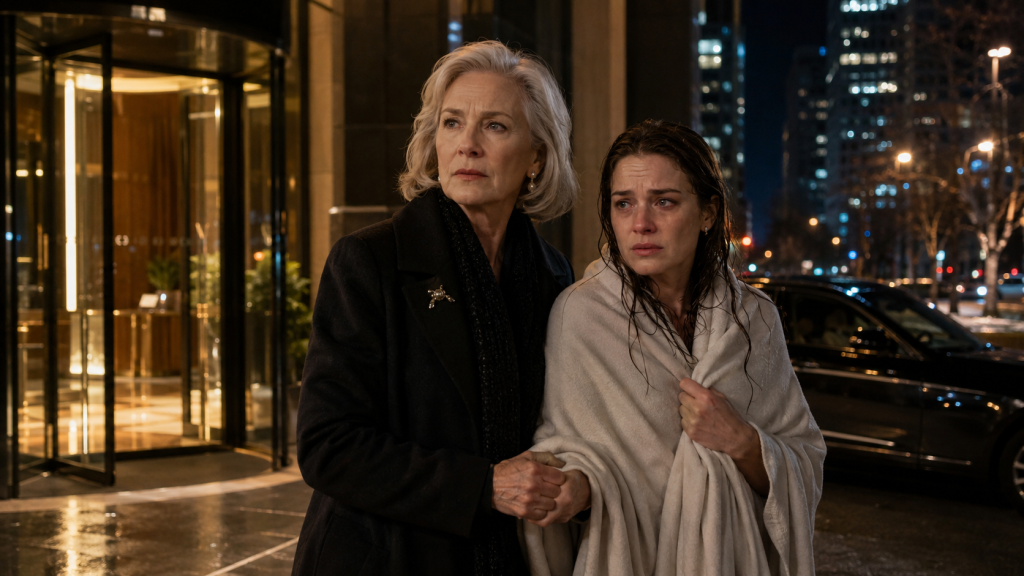
Hazel sat on the lobby floor wrapped in a gray blanket, barefoot, trembling.
Alive.
Her hair hung damp around her face.
One cheek was red.
Her hands clutched the blanket so tightly her knuckles looked white.
I ran to her.
At sixty-five, with stiff knees and bad hips, I ran.
The moment Hazel saw me, she broke.
“I’m sorry,” she sobbed.
“No,” I said, dropping to the floor beside her. “No more sorry.”
She folded into my arms.
I held her there in the lobby of that perfect building while strangers pretended not to stare.
A minute later, the elevator opened.
Two officers brought Nicholas out.
His shirt was wrinkled.
His face was twisted with rage.
For the first time in his adult life, he did not look polished.
He looked exposed.
When he saw me holding Hazel, his eyes burned.
“You,” he spat. “You did this.”
I stood slowly.
Hazel grabbed my sleeve, but I gently moved her hand aside.
Nicholas glared at me.
“You ruined my life.”
I looked at my son.
The boy I had loved.
The man I no longer recognized.
“No, Nicholas,” I said. “You finally met the truth.”
His expression flickered.
For one second, I saw something small and wounded beneath the arrogance.
Then it vanished.
He looked past me at Hazel.
“She’s lying.”
Hazel flinched.
I stepped between them.
“Not anymore.”
The officers led him away.
The doors closed behind him.
And just like that, the man who had filled every room with fear was gone from the building.
But fear does not leave as quickly as the person who caused it.
That night, Hazel came home with me.
She sat in my small apartment wearing borrowed pajamas and drinking tea with both hands wrapped around the mug.
Marlene made toast.
I found an old quilt.
Nobody said much.
Words felt too sharp.
Too small.
At three in the morning, I woke suddenly.
For one confused second, I expected water.
The pounding shower.
The hidden cruelty.
The old nightmare.
But the apartment was silent.
Soft.
Still.
I got up and walked to the living room.
Hazel was asleep on the sofa beneath the quilt.
Her face looked young in the lamplight.
Exhausted, yes.
Bruised, yes.
But not afraid in that moment.
For the first time in years, she slept past three a.m.
The weeks that followed were not easy.
People imagine escape as a single dramatic moment.
A door closing.
A suitcase rolling away.
A police car pulling from the curb.
But escape is not one moment.
It is paperwork.
Court dates.
Frozen accounts.
Restraining orders.
Panic attacks in grocery aisles.
Changing passwords.
Replacing phones.
Remembering how to choose what to eat for breakfast without fearing someone’s reaction.
Hazel cried often.
Sometimes over big things.
Sometimes over small ones.
The first time she bought shampoo by herself, she stood in the store aisle holding the bottle and wept because Nicholas had always chosen the scent.
The first time she laughed loudly at dinner, she covered her mouth immediately, then looked around as if expecting punishment.
The first time she slept in a bed with the door unlocked, she woke every hour.
Healing was not beautiful at first.
It was messy.
Uneven.
Angry.
But it was hers.
Mr. Rodriguez moved quickly.
The evidence Hazel had gathered mattered.
So did the emergency call.
So did the building security footage.
So did my statement.
I sat in his office one rainy morning and told the truth about what I had seen through the bathroom door.
My hands shook the entire time.
When I finished, Mr. Rodriguez slid a box of tissues across the desk.
“You did the right thing,” he said.
“I did it late.”
“But you did it.”
I carried those words with me.
Nicholas hired an expensive attorney.
Of course he did.
He claimed Hazel was unstable.
He claimed I had manipulated her.
He claimed she wanted money.
He claimed stress.
He claimed misunderstanding.
Cruel men are very creative when truth corners them.
But Hazel did not fold.
Not this time.
When she testified, her voice trembled at first.
Then it steadied.
She described the control.
The threats.
The isolation.
The punishments.
The way he used money like a leash.
She did not look at him while she spoke.
She looked at the judge.
At the future.
At herself.
When Nicholas’s attorney asked why she had stayed so long, Hazel took a breath.
Then she answered, “Because I believed him when he told me I had nowhere to go.”
The courtroom went silent.
“And now?” the attorney asked.
Hazel lifted her chin.
“Now I know he lied.”
I cried quietly into my hand.
The divorce took months.
The consequences took longer.
Nicholas lost more than his marriage.
He lost the careful mask he had built.
Colleagues heard.
Neighbors heard.
The building heard.
For years, he had hidden behind polished shoes and expensive watches.
But truth has a sound of its own.
Once released, it travels.
I wish I could say I stopped loving my son.
I did not.
A mother’s love is not a switch.
It is a root.
Sometimes you hate what grew from it.
Sometimes you mourn the fruit.
Sometimes you wonder if you watered the wrong thing without knowing.
I loved the child he had been.
I grieved the man he chose to become.
But I did not protect him from consequences.
That was the difference between love and surrender.
Hazel stayed with me for four months.
Then one morning, she walked into the kitchen wearing a blue dress I had never seen before.
“I have an interview,” she said.
My heart lifted.
“For teaching?”
She nodded.
“Fourth grade.”
I smiled so widely my cheeks hurt.
The school hired her two weeks later.
On her first day back, I made pancakes.
She came out of the bedroom with her hair loose, her eyes nervous, and a name badge clipped to her cardigan.
“How do I look?” she asked.
“Like yourself,” I said.
That made her cry.
But this time, the tears were different.
Not fear.
Not grief.
Release.
Eventually, Hazel found a small apartment near the school.
The day she moved in, we carried boxes up two flights of stairs with help from Marlene and two volunteers from the support organization.
The apartment had old wooden floors, a tiny kitchen, and windows that faced a maple tree.
Hazel stood in the middle of the empty living room and turned slowly.
“It’s quiet,” she said.
“Too quiet?”
She shook her head.
“No. Mine.”
That evening, she invited me to stay for tea.
At exactly three in the morning, I woke on her sofa bed.
For a moment, I listened.
No shower.
No shouting.
No footsteps.
Only the hum of the refrigerator and the faint whisper of traffic outside.
Then I heard Hazel’s bedroom door open.
She stepped into the hallway wearing a robe.
We looked at each other in the dim light.
“You too?” she asked softly.
I nodded.
She came and sat beside me.
Neither of us spoke for a while.
Then Hazel said, “Do you think I’ll ever stop waking up at three?”
I looked toward the dark window.
“I don’t know,” I said honestly. “But someday, when you wake up, it won’t scare you anymore.”
She leaned her head on my shoulder.
We sat there until morning turned the sky pale.
Months passed.
Hazel grew stronger in small, ordinary ways.
She decorated her classroom with paper stars.
She bought yellow curtains.
She learned to drive downtown without checking the rearview mirror every few seconds.
She made friends with a woman named Dana from the school office.
She cut her hair shorter.
She laughed more often.
One Sunday, she came to visit me at the retirement community with a grocery bag in her hand.
“I brought strawberries,” she said.
“You hate strawberries.”
“I used to say that because Nicholas hated them.”
I stared at her.
She popped one into her mouth and smiled.
“They’re actually wonderful.”
That was healing too.
Not just court papers.
Not just safety plans.
Strawberries.
Yellow curtains.
Loud laughter.
Choosing shampoo.
Sleeping with doors unlocked.
The world returning piece by piece.
One afternoon, Nicholas wrote me a letter.
It arrived in a cream envelope, his handwriting sharp and controlled.
I sat at my kitchen table for twenty minutes before opening it.
There was no apology.
Not really.
He blamed stress.
His father.
His career.
Hazel.
Me.
Everyone but himself.
At the bottom, he wrote, I hope one day you remember I am your son.
I folded the letter and placed it back in the envelope.
Then I put it in a drawer.
I did remember.
That was why it hurt.
But being my son did not make him innocent.
And being his mother did not make me responsible for hiding his cruelty.
The next time Hazel visited, she found me staring out the window.
“You got something from him,” she said.
I nodded.
“Are you okay?”
I thought about lying.
Then I shook my head.
“No.”
She sat across from me.
“I’m sorry.”
“So am I.”
We held hands across the table.
Two women who had survived men from the same bloodline.
Two women who had mistaken silence for safety.
Two women learning, very late and very painfully, that truth can hurt less than pretending.
A year after the night of the phone call, Hazel and I attended a small ceremony at her school.
She had been nominated by parents for a teaching award.
She wore a green dress and small pearl earrings.
When her name was called, children cheered.
Actual cheers.
Loud.
Messy.
Beautiful.
Hazel walked to the front of the room with one hand pressed briefly to her heart.
As she accepted the certificate, she looked out across the crowd.
Her eyes found mine.
I was sitting in the second row beside Marlene, crying openly and not caring who saw.
Hazel smiled.
Not carefully.
Not late.
A real smile.
Afterward, we stood outside beneath the flagpole while children ran past us toward their parents.
Hazel held the certificate against her chest.
“I used to think my life ended in that condo,” she said.
I looked at her.
“It didn’t.”
“No,” she said. “It started again after I left.”
The wind moved through the trees.
For a moment, I thought about the bathroom door.
The narrow gap.
The freezing water.
The terrible truth waiting on the other side.
I had spent so much of my life afraid of what I might see if I looked too closely.
But that night, looking saved Hazel.
And maybe, in some strange and painful way, it saved me too.
Because I finally stopped being the woman who stayed silent.
I finally became the woman I had needed all those years ago.
A woman who opened the door.
A woman who told the truth.
A woman who did not leave another woman behind.
That night, Hazel and I had dinner at a small Italian restaurant near the school.
She ordered strawberry lemonade and laughed when I raised an eyebrow.
“What?” she said. “I like strawberries now.”
“I know,” I said.
“And yellow curtains.”
“Yes.”
“And sleeping past three.”
I reached across the table and squeezed her hand.
Outside, the city lights blinked on one by one.
Somewhere downtown, the glass tower still stood.
The condo still existed.
The marble bathroom.
The perfect windows.
The place where everything had looked beautiful from the outside and rotten behind a closed door.
But Hazel was not there.
She was across from me, free, holding a menu, deciding what she wanted for dinner.
Such a simple thing.
Such a holy thing.
When the waiter came, he asked if we were ready.
Hazel looked down at the menu, then up at me.
For years, she had been told what to eat, what to wear, when to speak, when to disappear.
Now she smiled and answered for herself.
“Yes,” she said.
And her voice did not shake.
THE END! THANK YOU FOR READING!