

My boss handed out jars of pickles made by his mother, and everyone in the office laughed at them. They mocked them. They wrinkled their noses. They joked about the smell. And by the end of the day, most of those jars were sitting in the break room trash like they were worthless.
I was the only one who took them home. At the time, I thought I was just saving something made with care. I never imagined one of those jars contained a hidden code that would uncover a company secret powerful enough to destroy careers, expose betrayal, and change the way I looked at everyone around me.
My name is Lucía Herrera, and I worked as a senior account coordinator at Torres & Vale Marketing, a mid-sized agency in San Diego that liked to pretend it was much larger than it really was.
We handled restaurant campaigns, retail launches, nonprofit events, and a few government-adjacent contracts that made the executives walk around like they were important people.
Most days, the office smelled like coffee, printer toner, and expensive perfume.
The people there smiled in meetings and sharpened their knives in private.
I had worked there for four years.
Long enough to know who would help you when a project was falling apart.
Long enough to know who would steal credit if they saw an opening.
And long enough to know that kindness was often mistaken for weakness.
My boss, Alejandro Torres, was different from most of the executives I had worked under.
He was quiet.
Careful.
Sometimes awkward.
He had built the company with his older business partner, Martin Vale, but everyone knew Martin loved attention while Alejandro loved the work.
Martin shook hands with clients.
Alejandro stayed late fixing budgets, checking contracts, and making sure our junior staff did not get blamed when leadership changed direction five minutes before a deadline.
He was not warm in the usual office way.
He did not host happy hours.
He did not give big speeches.
But once, when my mother had surgery and I was too proud to ask for time off, Alejandro quietly moved my deadlines without making me explain my life to the whole department.
I never forgot that.
So when we returned from the New Year holidays and found jars of homemade pickled vegetables waiting in the conference room, I immediately knew they mattered to him.
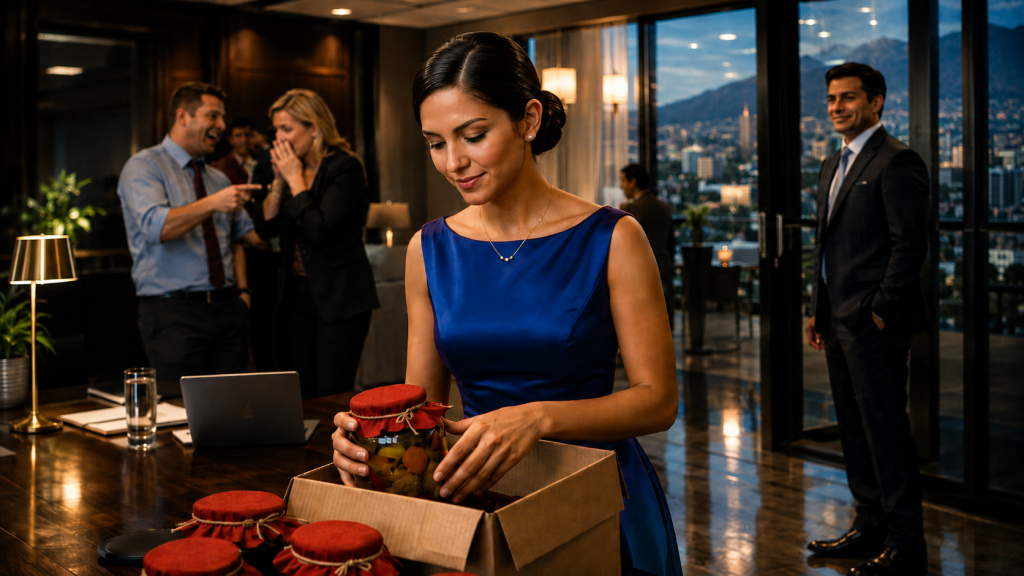
Each jar was tied with a square of red cloth and a thin piece of twine.
The vegetables inside were beautiful in a rustic way: carrots, jalapeños, cauliflower, onions, and strips of nopales floating in amber brine.
A small handwritten tag was tied to each one.
From my mother’s kitchen. Happy New Year.
Alejandro stood by the meeting room door, one hand in his pocket, wearing the uncertain smile of someone who had brought part of his home into a place that might not respect it.
“It’s just a small gift from home,” he said. “My mother made them in Michoacán. Nothing special, but she wanted everyone to have one.”
For one brief moment, the room was quiet.
Then the whispers started.
“Who even eats this anymore?”
“My family would complain about the smell.”
“They should’ve just given us gift cards.”
“I hope this doesn’t leak in my car.”
A few people laughed.
Not loud enough to be openly cruel.
Just loud enough to make sure everyone knew they were above the gift.
I felt my jaw tighten.
Across from me sat Carlos Mendoza, the assistant marketing manager.
Carlos was handsome in the way some men are handsome because they have been told so too many times.
Sharp suit.
Perfect hair.
Smile like a polished knife.
He had joined the company two years after me and somehow already acted like the office belonged to him.
He was close to Martin Vale, which meant he moved through the office with a protection most of us did not have.
Carlos picked up his jar and waved it dramatically.
“Lucía,” he said, raising his voice, “what are you going to do with this? Want to see who can throw it the farthest?”
A few people laughed again.
I looked at the jar in his hand, then at Alejandro.
Our boss was pretending not to hear.
But I saw his shoulders stiffen.
I saw the way his face changed for half a second before he turned away.
That small moment bothered me more than the comments.
I smiled at Carlos, but I did not answer.
The meeting ended.
People took their laptops and coffee cups and walked out.
Some carried the jars only as far as the break room.
By lunchtime, the counter beside the sink was lined with them.
Unopened.
Untouched.
Abandoned.
By four o’clock, several had been tossed into the trash.
The red cloths were stained with coffee.
One jar had cracked, and brine was dripping onto a pile of paper towels.
The cleaning lady, Mrs. Peña, stood there staring at them with a tired expression.
“I don’t know if these are trash or food,” she said.
I looked at the jars.
For reasons I could not explain, something tightened in my chest.
I thought of my grandmother in Oaxaca.
Every winter, she used to ferment vegetables in clay pots behind her kitchen.
Whenever I visited, she would give me a jar wrapped in cloth.
“Make sure you eat well, mija,” she would say.
To other people, it was just vegetables in vinegar.
To me, it was memory.
It was a pair of hands.
It was someone standing in a kitchen for hours because love needed somewhere to go.
Seeing Alejandro’s mother’s jars treated like garbage felt wrong.
So when no one was paying attention, I found an empty cardboard box near the printer room and began collecting them.
One by one.
From the counter.
From the trash.
From under a chair where someone had shoved one with their foot.
Fifteen jars in total.
Carlos saw me carrying the box toward the elevator.
He leaned against the hallway wall and smirked.
“Planning to open a pickle stand?”
I kept walking.
Behind me, he said, “Careful, Lucía. Being too humble won’t get you promoted.”
I stopped.
Turned around.
And said, “Neither will being cruel.”
His smile faded for half a second.
Then the elevator doors opened, and I stepped inside.
At home that evening, I placed the jars across my kitchen counter.
Fifteen little glass soldiers standing in a row.
The red cloths were wrinkled.
The tags were soft from moisture.
The brine glowed under the kitchen light.
I washed each jar carefully.
I trimmed the strings.
I wiped the glass clean.
Then I opened one.
The moment the lid came loose, a warm, tangy aroma rose into the air.
Strong, but gentle.
Nothing like harsh supermarket vinegar.
It smelled alive.
It smelled like garlic, oregano, chiles, and patience.
I took a fork and tasted a piece of carrot.
I closed my eyes.
Perfect.
Exactly like my grandmother’s.
For the first time that week, I felt calm.
I opened a second jar and placed some of the vegetables into a small bowl.
Then, while wiping the bottom of the jar, I noticed something strange.
The base was not smooth.
I turned it over.
At first, I saw nothing but glass and a faint cloudy stain.
Maybe it had been damaged during cooking.
Maybe it was old.
But the texture bothered me.
I scratched gently with my fingernail.
A thin layer peeled away.
Underneath it, something dark appeared.
I froze.
I held the jar closer to the light.
There were words.
Tiny, faint, engraved into the glass base.
I could barely make them out.
Rooster time.
Three.
Seven.
Mesquite tree.
Shade.
I stared at the words until they blurred.
Rooster time.
Three.
Seven.
Mesquite tree.
Shade.
It was not a recipe.
It was not a label.
It was a message.
My heartbeat began to climb.
I checked the other jars.
One by one.
Most had nothing.
On the twelfth jar, there was another mark near the edge of the base.
This one was even smaller.
Two initials.
A.T.
Alejandro Torres.
I sat down at my kitchen table.
The jar stood in front of me, silent and ordinary, as if it had not just opened a door to something I was not supposed to know.
At first, I tried to convince myself it was nothing.
Maybe Alejandro’s mother had reused old jars.
Maybe they had once belonged to some family farm.
Maybe “Rooster time” was a joke between relatives.
But deep down, I knew.
The words felt urgent.
They felt hidden.
They felt like someone had gone through great effort to send a message without being noticed.
And somehow, because everyone else had thrown kindness away, I was the one who had found it.
That night, I barely slept.
Every time I closed my eyes, I saw those words.
Rooster time.
Three.
Seven.
Mesquite tree.
Shade.
By morning, I had searched every possible meaning I could think of.
Rooster time could mean dawn.
Three-seven could mean 3:07.
Or March seventh.
Or Warehouse 37.
Mesquite tree could mean a place.
Shade could mean under something.
Or maybe someone’s nickname.
By six-thirty, I gave up pretending I was not scared.
I wrapped the jar in a towel, placed it inside my work bag, and went to the office early.
The building was quiet when I arrived.
The lights hummed softly overhead.
The receptionist’s desk was empty.
The conference rooms were dark.
Only one office had lights on.
Alejandro’s.
He was already there, standing beside the copy machine with a stack of financial reports in his hand.
His tie was loose.
His eyes looked like he had not slept either.
I stopped in the doorway.
“Mr. Torres?”
He looked up.
“Lucía. You’re early.”
“I need to show you something.”
Something in my voice made his expression change.
He glanced down the hallway.
Then he stepped aside and opened his office door.
“Come in.”
I closed the door behind me.
For a moment, neither of us spoke.
Then I took the jar from my bag and placed it on his desk.
His face went completely still.
All the color drained from his cheeks.
“Where did you get that?” he whispered.
“In one of the jars from yesterday.”
His hand moved toward it, then stopped, as if touching it might burn him.
“You found this?”
“I took the jars home. The others threw them away.”
He closed his eyes.
For a second, I thought he might cry.
Then he picked up the jar and turned it over.
When he saw the engraved words, his hands began to tremble.
“Rooster time,” he murmured.
“You know what it means?”
He did not answer right away.
Instead, he walked to his office door, locked it, and lowered the blinds.
My stomach tightened.
“Alejandro,” I said quietly, forgetting the formal title, “what is going on?”
He sat behind his desk and placed the jar between us.
“My mother didn’t make this message for me,” he said.
“Then who?”
“For whoever was decent enough not to throw her gift away.”
The words chilled me.
He opened the bottom drawer of his desk and removed a worn envelope.
Inside was an old photograph.
The photo showed a dusty property outside a small town.
There was a warehouse with peeling white paint.
On one wall, someone had painted a red rooster.
Beside it stood a wide mesquite tree, its branches bending low and casting a thick pool of shade over the ground.
Alejandro tapped the photo.
“This was my family’s storage property before I moved to the United States. My father used it for farm equipment. After he died, my mother kept it. I thought it was empty.”
“And three-seven?”
“Warehouse 37,” he said. “That’s what my father called it. He numbered all his storage buildings. It was a habit from the old cooperative he worked with.”
I stared at the picture.
“So your mother sent you a code about this warehouse?”
He shook his head slowly.
“My mother called me two weeks ago. She was upset. She said someone had been using the old property. Trucks came at night. Men she didn’t recognize. She said she saw boxes with our company logo.”
My mouth went dry.
“Our company logo?”
“Yes.”
“Why didn’t she call the police?”
“She tried to ask questions first. Then someone came to her house and told her to stop watching things that did not belong to her.”
I felt cold spread across my arms.
Alejandro’s voice lowered.
“She was frightened. She said she didn’t trust the local police because she didn’t know who was involved. She told me she would send proof in a way no one would suspect.”
“The jars,” I whispered.
He nodded.
“She has made pickled vegetables for me every New Year since I moved here. Everyone at the company knows that. No one would question them.”
“But why not tell you directly?”
“She said my phone might not be safe.”
I stared at him.
Before I could ask what that meant, voices sounded outside his office.
Carlos.
I recognized his laugh immediately.
Alejandro moved quickly.
He slipped the photograph back into the envelope and hid the jar in his drawer.
A second later, someone knocked.
Not a polite knock.
A confident one.
“Alejandro?” Carlos called. “Martin wants you in the boardroom.”
Alejandro unlocked the door and opened it.
Carlos stood outside in a navy suit, smiling like he had already won something.
His gaze slid from Alejandro to me.
“Lucía,” he said. “Private morning meeting?”
“I had a question about a client file,” I said.
Carlos’s eyes lingered on my work bag.
For one terrifying second, I wondered if he knew.
Then he smiled.
“Of course.”
Alejandro stepped into the hallway.
“I’ll be there in a minute.”
Carlos did not move.
“Martin said now.”
The air between them tightened.
Alejandro nodded once.
After Carlos walked away, Alejandro turned back to me.
“Do not tell anyone about the jar.”
“I won’t.”
“And Lucía…”
He paused.
“If anything happens today, do not trust Carlos.”
I almost laughed from nerves.
“That was already my policy.”
He gave the smallest possible smile.
Then he went to the boardroom.
For the rest of the morning, the office felt different.
Every laugh sounded too loud.
Every closed door seemed suspicious.
Every email notification made me jump.
At eleven-thirty, I passed the glass wall of the boardroom and saw Alejandro sitting across from Martin Vale, Carlos, and two members of finance.
Martin was speaking with his hands spread wide, like a man explaining something obvious to a room full of children.
Carlos stood near the screen, clicking through slides.
Alejandro’s face was unreadable.
At noon, my inbox pinged.
It was from Alejandro.
No subject.
Only one sentence.
Please print the March vendor reconciliation file and bring it to Archive Room B.
My hands went still over the keyboard.
March.
Three.
Was that connected?
I opened the financial system and found the March vendor reconciliation file.
It was long.
Messy.
Full of invoices, shipping entries, nonprofit donation receipts, and warehouse transfer notes.
One name appeared again and again.
Sol del Norte Outreach.
A charity partner.
I remembered their campaign.
We had designed donation materials for them the previous year.
They provided school supplies, food boxes, and clothing to rural communities.
At least, that was what the campaign said.
I printed the file and walked to Archive Room B.
Alejandro was waiting inside.
So was Mrs. Peña.
The cleaning lady.
She stood beside the shelves holding a folded piece of paper.
I looked from her to Alejandro.
“She knows,” he said.
Mrs. Peña’s face was serious.
“I knew his mother when she first came to visit the office years ago,” she said. “Good woman. Strong hands. Kind eyes.”
She unfolded the paper.
It was a delivery slip.
“I found this in the trash behind the copy room two months ago. I kept it because the name bothered me.”
She handed it to me.
The delivery address was listed as Warehouse 37.
The sender was Torres & Vale Marketing.
The recipient was Sol del Norte Outreach.
But the item description did not say food boxes or campaign materials.
It said electronics inventory, premium client samples, and sealed product kits.
I frowned.
“Why would charity shipments include client samples?”
“They wouldn’t,” Alejandro said.
He opened the March file and pointed to several invoices.
“Products from client campaigns were marked as donated or destroyed. But the quantities don’t match. Someone has been diverting goods through charity shipments.”
“Stolen products,” I said.
“Yes.”
“And Carlos?”
Alejandro’s face hardened.
“Carlos approved the transfer forms. Martin signed off on the vendor payments.”
The room seemed to tilt.
Martin Vale was co-owner of the company.
If he was involved, this was not just an employee stealing inventory.
It was a system.
A protected one.
Alejandro looked at me carefully.
“I need proof before I go to the board.”
“You don’t have enough?”
“I have suspicion. I have irregular files. I have my mother’s warning. But if Martin realizes I’m investigating him, he’ll destroy everything.”
Mrs. Peña lifted her chin.
“Then we get proof before he does.”
I looked at her.
She shrugged.
“People forget cleaning staff has eyes.”
By the end of the day, I understood how deep the secret went.
Carlos had been using fake charity logistics to move expensive promotional products, electronics, and luxury client samples out of company storage.
Martin had approved invoices from shell vendors that supposedly handled transport.
The products were then moved to Warehouse 37 in Michoacán, where they were repackaged and sold through private distributors.
The charity name gave the shipments moral cover.
No one questioned donations.
No one audited generosity.
Worse, some of our clients had been billed twice.
Once for the original products.
Again for replacement inventory after the “missing” goods were marked as damaged or donated.
It was clean.
Cruel.
And profitable.
That night, Alejandro called his mother from a secure phone.
He put her on speaker.
Her voice was small but steady.
“Alejandro?”
“Mamá, I found the message.”
There was a long silence.
Then she exhaled.
“Gracias a Dios.”
He looked at me.
“Lucía found it.”
Another silence.
Then his mother said, “The good one.”
My throat tightened.
Alejandro explained what we had found.
His mother listened quietly.
Then she said, “There is more.”
Alejandro’s hand tightened around the phone.
“What more?”
“They came again,” she said. “Two nights ago. More boxes. More trucks.”
“Did they see you?”
“No. But they know someone is watching. Today a man came to the market and told me old women should not look out windows after dark.”
Alejandro closed his eyes.
I felt anger rise in my chest.
This was no longer just about money.
They had threatened his mother.
His mother continued.
“The rooster shadow falls on the ground at seven in the morning. Under the mesquite tree, your father buried the old lockbox after the flood. I put what I could inside.”
Alejandro looked up sharply.
“The lockbox?”
“Yes. Your father’s blue one.”
“What did you put in it?”
“Photos. Truck plates. Papers that fell from a box. And one small drive.”
The room went silent.
One small drive.
Proof.
The next morning, everything changed.
Alejandro did not come to the office.
Neither did Carlos.
Martin arrived at ten o’clock and called an emergency leadership meeting.
By then, whispers were moving through the office like smoke.
“Did you hear Alejandro is being investigated?”
“Someone said he misused company funds.”
“I heard Martin found irregular transfers.”
“I heard Alejandro might resign.”
My stomach twisted.
At eleven, an email went out to all staff.
Effective immediately, Alejandro Torres will take administrative leave pending review of internal financial irregularities.
I read the sentence three times.
They were framing him.
Carlos appeared near my desk at eleven-fifteen.
He looked relaxed.
Almost cheerful.
“Rough day,” he said.
I kept my face calm.
“For who?”
His smile widened.
“For people who don’t know when to mind their own business.”
I looked at my screen.
“I have work to do.”
He leaned closer.
His voice dropped.
“You should be careful, Lucía. Loyalty is admirable. But misplaced loyalty can ruin a career.”
I slowly turned to him.
“Is that advice?”
“No,” he said. “A kindness.”
Then he walked away.
By lunch, my access to the March vendor files was revoked.
By two, Mrs. Peña told me two men from security had searched Alejandro’s office.
By three, my computer froze and restarted on its own.
When it came back, several folders were missing from my desktop.
I felt panic rise.
But I had already saved copies.
Not on the company server.
Not on my laptop.
On an old external drive I kept in my purse because my grandmother had taught me never to trust a single basket with all the eggs.
At five-thirty, as people began leaving, I received a text from an unknown number.
Parking garage. Level P2. Now.
For a moment, I considered ignoring it.
Then another message arrived.
Bring nothing company-owned.
I knew it was Alejandro.
I took the stairs instead of the elevator.
Level P2 smelled like concrete and exhaust.
Alejandro stood beside a gray sedan, wearing a baseball cap and a jacket I had never seen before.
He looked exhausted.
“My mother is safe,” he said before I could ask. “I moved her to my cousin’s house.”
I exhaled.
“Good.”
“I’m going to Mexico tonight.”
“To get the lockbox?”
He nodded.
“I need the drive before Martin sends someone else.”
“I’m going with you.”
“No.”
The answer came too fast.
I crossed my arms.
“You need someone who knows the files. You need someone who can connect the drive to the records here.”
“It’s dangerous.”
“So is staying here and pretending Carlos won’t come after me.”
Alejandro looked away.
For the first time, I saw not my boss, but a son.
A frightened, angry son trying to protect his mother.
“I can’t ask you to do this,” he said.
“You didn’t ask.”
We drove south before sunrise.
The trip felt unreal.
Office buildings gave way to highways.
Highways gave way to border lines, dust, heat, and wide open land.
Alejandro said little.
But when he did speak, it was about his mother.
Her name was Rosalía.
She had raised him after his father died.
She sold food, cleaned houses, grew herbs in cracked clay pots, and mailed him jars every year even after he became a man with a corner office.
“She said food is how the poor prove they still have something to give,” Alejandro said quietly.
I looked out the window and thought about every person in our office who had laughed.
Not because the jars were bad.
Because they had come from someone humble.
Late that afternoon, we reached the old property.
Warehouse 37 stood exactly as it had in the photograph.
White paint peeling.
Red rooster fading on the wall.
Mesquite tree bending low beside it.
The sun had shifted west, but the shade beneath the tree remained thick and cool.
Alejandro walked toward it slowly.
The ground was dry.
Cracked.
He knelt near the roots and began digging with a small shovel from the trunk.
After a few minutes, metal scraped against metal.
He stopped.
Together, we cleared away dirt until the blue lockbox appeared.
It was old.
Dented.
But sealed.
Alejandro opened it with a key his mother had hidden inside a rosary pouch.
Inside were photographs.
Delivery slips.
A small black flash drive.
And a folded note written in Spanish.
Alejandro read it silently.
His eyes filled with tears.
He handed it to me.
My English translation would never capture the full weight of it, but the meaning was clear.
My son,
Your father always said shade tells the truth because people hide there when they think the sun cannot see them.
I watched them from the kitchen window.
I wrote what I could.
I saved what I could.
I do not know who you can trust, but I know this: a person who throws away food made by old hands will also throw away truth.
So I hid the message where only respect could find it.
May God send it to the right person.
Mamá.
I pressed my fingers against the paper.
“She trusted kindness,” I whispered.
Alejandro wiped his face quickly.
“She trusted you.”
Before I could answer, the sound of an engine rolled across the property.
We both turned.
A black SUV pulled through the gate.
Then another.
Carlos stepped out of the first one.
He was not smiling now.
Martin Vale stepped out behind him.
My blood went cold.
“Well,” Martin called, adjusting his cuffs. “This is disappointing.”
Alejandro stood, holding the lockbox behind him.
Carlos looked at me.
“I told you to leave the pickles in the trash.”
I swallowed hard.
Alejandro moved slightly in front of me.
Martin sighed like we had inconvenienced him.
“Let’s not make this dramatic. Hand over the box. We’ll say Alejandro had a breakdown, Lucía got confused, and everyone goes home.”
“You threatened my mother,” Alejandro said.
Martin’s face remained calm.
“I protected the company from a woman who didn’t understand business.”
Carlos laughed softly.
“She understood enough to hide proof from you.”
Martin’s eyes sharpened.
For the first time, he looked afraid.
“Give me the drive.”
Alejandro lifted his chin.
“No.”
The next few seconds happened very quickly.
Carlos stepped forward.
I stepped back.
My hand was already in my jacket pocket.
And my phone was already connected to the call I had started before we entered the property.
Mrs. Peña’s nephew was a federal investigator in Tijuana.
She had called him the night before.
He had told us not to confront anyone.
We had not listened completely.
But we had listened enough to share our location.
Sirens sounded in the distance.
Martin heard them first.
His face changed.
Carlos turned toward the road.
Alejandro looked at me.
“You called them?”
I nodded.
“I don’t like single baskets.”
Within minutes, vehicles surrounded the property.
Martin tried to talk.
Carlos tried to blame him.
The men who came with them tried to disappear behind the warehouse.
But the drive, the photos, the slips, and the active shipment inside Warehouse 37 gave them nowhere to hide.
Inside the building were boxes from three major clients.
Products marked as destroyed.
Donation labels printed with fake charity codes.
Invoices connected to shell companies Martin controlled.
The truth had been sitting in the shade, waiting for someone to care enough to dig.
The investigation lasted months.
Martin Vale resigned before he was formally arrested.
Carlos was fired, then charged for fraud and conspiracy related to the stolen shipments.
Several finance employees were questioned.
Two quit before they could be dismissed.
Sol del Norte Outreach turned out to be a stolen name.
A real charity existed, but it had no idea its identity had been used to cover theft.
When the story reached our clients, Torres & Vale nearly collapsed.
But Alejandro did something nobody expected.
He told the truth publicly.
All of it.
He did not hide behind lawyers.
He did not pretend leadership had everything under control.
He stood in front of the staff and said, “This company survived because one person respected a gift everyone else threw away.”
He did not say my name at first.
I was grateful.
I hated attention.
But then Mrs. Peña, standing in the back with her mop cart, said loudly, “Say her name.”
The room went silent.
Alejandro looked at me.
Then he smiled.
“Lucía Herrera.”
People turned.
Some looked ashamed.
Some looked impressed.
Some looked like they were calculating how to become my friend.
I did not care.
The only person I looked at was Mrs. Peña.
She winked.
Three months later, Alejandro’s mother visited the office.
Rosalía Torres was smaller than I expected.
Silver hair.
Brown hands.
Sharp eyes that missed nothing.
She arrived carrying a basket covered with red cloth.
The room went quiet when she entered.
This time, no one laughed.
No one whispered about the smell.
No one asked for gift cards.
Rosalía walked directly to me.
“You are Lucía,” she said.
“Yes.”
She took both my hands in hers.
Her palms were warm and rough from work.
“You took them home,” she said.
I nodded.
“I couldn’t leave them there.”
Her eyes softened.
“Then you understood.”
I did not trust myself to speak.
She opened the basket and took out one jar.
This one was tied with blue cloth.
“For you,” she said.
I smiled.
“Is there another secret code under this one?”
Rosalía laughed.
“No, mija. Only carrots.”
Then she leaned closer.
“But check anyway. It is good to stay curious.”
That afternoon, Alejandro called a company-wide lunch.
No fancy catering.
No imported desserts.
Just trays of rice, beans, roasted chicken, tortillas, and Rosalía’s pickled vegetables placed in the center of every table.
For once, people ate quietly.
Not because they were uncomfortable.
Because they finally understood.
A homemade jar was not cheap.
It was time.
It was memory.
It was family.
It was a woman in a small kitchen protecting her son with the only weapon she knew would travel unnoticed: food made with love.
Later, as I stood near the window, Alejandro came beside me.
“I never thanked you properly,” he said.
“You did.”
“No. I thanked you for helping expose the fraud. But I never thanked you for what came before.”
I looked at him.
“For what?”
“For seeing value when everyone else saw trash.”
Outside, the afternoon sun moved across the office floor.
For a moment, I thought of my grandmother.
Her clay pots.
Her warm kitchen.
Her voice telling me to eat well.
I thought of every quiet gift the world teaches us to overlook.
Every old hand.
Every humble offering.
Every warning hidden beneath something ordinary.
And I realized something.
Secrets are not always locked inside safes.
Sometimes they are wrapped in red cloth.
Sometimes they sit abandoned in a break room.
Sometimes truth waits patiently inside the thing everyone else is too proud to respect.
That night, I took Rosalía’s blue-cloth jar home.
I placed it on my kitchen counter.
Then, smiling to myself, I turned it over.
The base was smooth.
No code.
No warning.
No hidden message.
Only glass.
But taped beneath the blue cloth was a tiny folded note.
I opened it and read five simple words:
Kindness always finds the truth.
I kept that note.
Not because it helped solve a crime.
Not because it saved a company.
But because it reminded me that the smallest acts are never as small as they seem.
Everyone else threw the jars away.
I took them home.
And because of that, the truth finally came out.
THE END! THANK YOU FOR READING!