

My parents said they could only afford to take one daughter on vacation, so they chose my sister and left me behind. When they came home, my room was empty, every piece I had ever bought was gone, and the silence told them I was never coming back.
They thought I would spend those two weeks watering plants, collecting mail, and waiting quietly for their photos from Italy. Instead, I spent those days proving something they had ignored for years. Almost everything that made that house comfortable had my name on the receipt.
And the daughter they treated like a backup plan had finally learned how to leave without asking permission.
My name is Victoria Harris, and for most of my life, I thought being useful was the same thing as being loved.
I learned it young.
When my little sister Lily cried, everyone ran.
When I cried, my mother told me I was old enough to understand.
When Lily wanted something, it became a family emergency.
When I needed something, it became a lesson about patience, sacrifice, and how money did not grow on trees.
By the time I was twelve, I knew how to make dinner when Mom had a headache.
By fourteen, I knew how to calm Dad down when the bills came in.
By sixteen, I knew how to tell myself that being forgotten did not hurt as much if I stayed busy enough.
Lily was the pretty one.
The delicate one.
The one who “needed more support.”
I was the responsible one.
That word followed me everywhere like a chain.
Responsible Victoria could work after school.
Responsible Victoria could skip senior trip because Lily needed braces.
Responsible Victoria could take community college classes part-time because the family car broke down.
Responsible Victoria could wait.
I waited through my twenties.
I waited while Lily got birthday parties with balloon arches and custom cakes.
I waited while my father bragged about her internships, even the ones she quit after three weeks.
I waited while my mother called me her “right hand” and then treated me like furniture.
I paid bills because they asked.
I helped with the mortgage because they panicked.
I bought appliances because “we all use them.”
I covered Lily’s car payment because “her credit will be ruined.”
And every time I gave them money, time, energy, or another piece of myself, they said the same thing.
“We’ll make it up to you.”
They never did.
The night everything changed smelled like rosemary, garlic, and roasted chicken.
My mother always believed a good Sunday dinner could soften any uncomfortable conversation, especially the ones she had already decided I would lose.
I had prepped the chicken, peeled the potatoes, steamed the green beans, and set the table while Lily laughed upstairs on the phone and my father watched a game in the living room.
At six sharp, everyone sat down.
Lily slid into her chair glowing like the whole room had been built around her.
I took my usual seat, the one with the wobble nobody else wanted.
“This looks amazing, Mom,” Lily said, reaching for the platter.
My mother smiled.
“Victoria helped.”
Helped.
One small word for the hands that had done almost everything.
I stared down at my plate and told myself not to care.
I had become good at that.
The conversation moved around me the way it always did.
Dad talked about golf.
Mom talked about a handbag she wanted.
Lily talked about a friend’s engagement ring, calling it “sweet” in that careful tone people use when they mean small.
I nodded, passed the potatoes, and tried to feel like part of the family sitting three feet from me.
Then Mom set down her wine glass, leaving a red ring on the lace doily, and said, “Oh, that reminds me. I booked the tickets today.”
My heart actually lifted.
For months, they had been talking about Italy for their thirtieth anniversary.
Rome, Florence, maybe the Amalfi Coast.
They had said “family trip” more than once.
I had saved little amounts from my office job, picturing myself walking through a sunlit street with a paper cup of gelato, finally part of a memory instead of the person making sure everyone else got one.
“That’s great,” I said. “When do we leave?”
The table changed.
Not loudly.
Not dramatically.
But something shifted.
Dad looked down at his phone.
Lily suddenly got very interested in her water glass.
Mom gave me that soft smile she used right before disappointment became my responsibility.
“Well, sweetie,” she said, “we ran the numbers. We can only afford to take one of you girls.”
I blinked.
“One of us?”
“Obviously your father and I are going,” she said, almost laughing. “It’s our anniversary.”
“So you’re taking Lily.”
Mom reached over and squeezed Lily’s hand.
“She’s had such a hard year.”
Lily lowered her eyes in a performance of sadness she had perfected since childhood.
Her hard year meant a short breakup, a job she quit because her manager “had bad energy,” and a few weeks of everyone tiptoeing around her feelings.
My hard years were different.
My hard years had receipts.
I had helped with the mortgage.
Paid for groceries.
Covered the washer and dryer.
Co-signed Lily’s car loan.
Paid that same car loan when she stopped making payments.
Bought the couch Mom loved.
Bought the TV Dad bragged about.
Bought the refrigerator everyone opened without once asking who was still paying for it.
Dad finally looked up.
“Victoria, you’re twenty-nine. You’re an adult. You can take your own vacation anytime you want.”
The fork slipped from my fingers and tapped my plate.
Not loud.
But loud enough for me to remember it.
I stared at him.
Anytime I wanted?
I wanted to laugh.
I wanted to ask him what vacation he thought I could afford after paying for everyone else’s life.
But old habits are powerful.
Instead, I sat still.
Lily smiled across the table.
“Don’t worry, Vicki. I’ll send pictures.”
Dad chuckled.
Mom smiled at her like she had said something adorable.
And something inside me went quiet.
Not angry.
Not dramatic.
Just quiet.
The kind of quiet that happens when a door closes somewhere deep inside you and you realize you are not going to knock on it again.
“That sounds wonderful,” I said. “I hope you have the best time.”
They accepted it instantly.
Of course they did.
Good Victoria understood.
Good Victoria swallowed things.
Good Victoria cleared plates, wrapped leftovers, wiped the wine ring from the doily, and never made anyone feel uncomfortable about what they had taken from her.
That night, I sat in my small bedroom with my laptop open and my phone beside me.
Downstairs, they were watching TV, laughing like nothing had happened.
My room felt like a place where a life had been stored instead of lived.
Bills clipped together on my desk.
Books I kept meaning to read.
A printer that rattled when it worked.
A gray quilt on the bed I had bought myself because nobody ever asked what I needed.
I opened my banking app.
At first, I told myself I was only checking something.
Then I set the date range back ten years.
The numbers started appearing like witnesses.
Five hundred eight dollars to Mom for a roof repair.
Three hundred to Lily for textbooks.
One thousand two hundred toward Dad’s credit card.
Two thousand seven hundred sixty-four for the refrigerator.
Monthly car payments for Lily, over and over.
Grocery charges.
Phone bills.
Insurance.
The big one was eight thousand four hundred twenty-one dollars for the mortgage refinance Mom promised they would repay within a year.
That money had been my school fund.
My chance to finish my degree.
My escape hatch.
They never paid it back.
The printer groaned to life after midnight, pushing out bank statements page by page.
I sat on the floor with a highlighter and a calculator, circling every transfer, every receipt, every “temporary” family expense that had somehow become mine forever.
When I finally wrote the total on a yellow legal pad, I stared at it until it stopped looking like money.
One hundred twelve thousand four hundred nineteen dollars.
That number was my twenties.
That number was every coat I did not buy.
Every class I did not take.
Every apartment I never applied for because my savings never stayed mine long enough.
It was the cost of being called responsible.
It was the price of being the daughter they remembered when something broke.
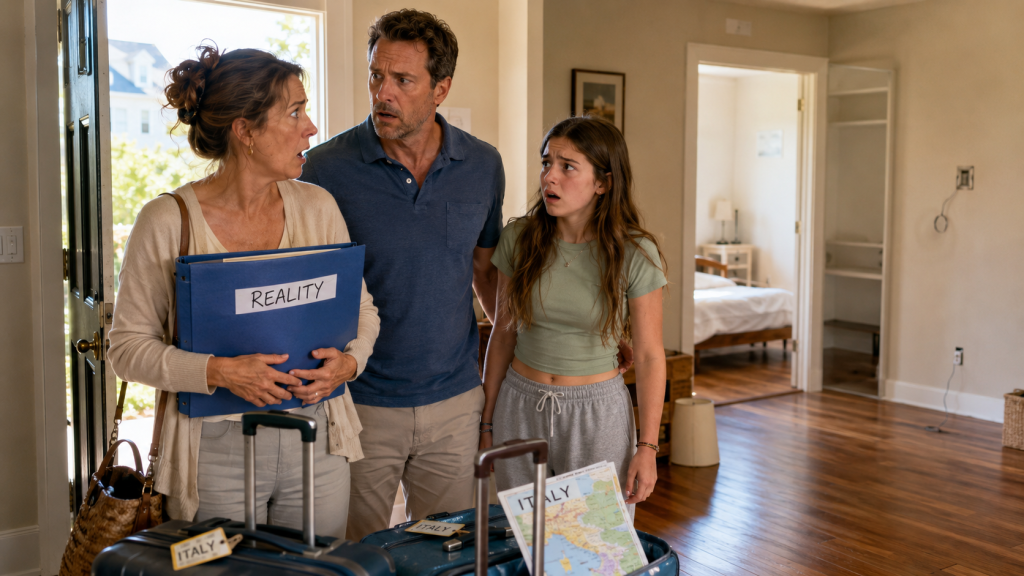
I found an old blue expandable folder in my closet and started filling it.
Bank statements.
Appliance receipts.
The car loan with my signature as co-signer.
Screenshots of messages asking for money.
Email promises that began with “just this once.”
On the front of the folder, I wrote one word in black marker.
REALITY.
For the next two weeks before the trip, I became invisible on purpose.
I hemmed Lily’s pants for Italy.
Drove Mom to Target for travel-size bottles.
Listened while Dad complained about airport parking.
Smiled when Lily showed me dresses for Rome.
At night, I packed quietly, scanned receipts, signed paperwork for a remote job in another state, and paid a deposit on a small furnished cabin in a mountain town I had only seen in pictures.
It was not glamorous.
It was not Italy.
But it had my name on the lease.
That was enough.
I did not tell anyone.
Not because I was afraid.
Because I finally understood that announcing my pain had never changed anything.
They would have guilted me.
Mocked me.
Asked me who would take care of the house.
They would have turned my leaving into a betrayal before admitting what had pushed me to the door.
So I moved in silence.
The morning they left, the sky was bright and blue.
Their suitcases rolled across the hallway.
Lily complained her bag was overweight.
Mom checked her passport seven times.
Dad loaded the trunk like a man preparing for an expedition.
“Keep an eye on the mail, sweetie,” Mom said, giving me a distracted hug.
“Don’t touch my room,” Lily added, already looking at her phone.
“I won’t,” I said.
Dad called from the driveway, “Try to enjoy the quiet.”
“I will,” I answered.
They laughed as the car backed out.
Lily waved from the back seat.
Mom waved too.
Dad gave one short honk before turning the corner.
They thought they were leaving me behind.
They had no idea they had just given me the one thing I needed.
Time.
The moment their car disappeared, I locked the front door.
Then I stood in the hallway and listened.
For the first time, the house did not feel like home.
It felt like a storage unit for other people’s comfort.
I walked into the living room and looked at the couch.
Cream fabric.
Deep cushions.
Mom had cried over it at the furniture store because she said it made the room feel elegant.
I had paid for it on my card.
The salesman had congratulated my mother on her taste.
No one congratulated me for working overtime to cover it.
I took pictures from every angle and listed it online.
Within two hours, a young couple came with a rented truck and carried it away.
The empty space it left behind looked like a missing tooth.
I thought I would cry.
I did not.
Next went the coffee table.
Then the TV stand.
Then the big television Dad had spent months showing off to his friends.
He used to slap the back of it and say, “Best picture quality on the market.”
He never said, “My daughter bought it.”
The man who purchased it asked if I was redecorating.
“Something like that,” I said.
By evening, the living room echoed.
I slept better that night than I had in years.
The next day, I called the appliance company.
I had receipts, warranties, serial numbers, and proof of payment.
The refrigerator was mine.
The washer and dryer were mine.
The fancy espresso machine Mom used every morning was mine too.
Some items I sold.
Some I donated.
Some I arranged to have moved with me.
Every removal felt like taking back a sentence in a story someone else had written about me.
Lily posted from the airport first.
A selfie with sunglasses, coffee, and the caption, “Italy, here we come!”
Mom commented with red hearts.
Dad wrote, “Making memories.”
I looked around the half-empty kitchen and whispered, “So am I.”
On the fourth day, I entered Lily’s car payment account.
Because I had co-signed, I had access to every notice.
She had missed two payments again.
I had already paid too many to protect my own credit.
Not anymore.
I called the lender, explained that I would no longer make voluntary payments, and asked what steps were available to remove myself from future damage.
The answer was not perfect.
Consequences rarely are clean when you spend years letting people tie ropes around you.
But I started the process.
For the first time, I chose my future over Lily’s convenience.
That night, Mom sent a photo of the three of them in Rome.
They stood near a fountain, smiling like a perfect family.
The caption read, “Nothing better than time with the people who matter most.”
I stared at those words for a long time.
Then I deleted the message.
On the sixth day, Mrs. Alvarez from next door came over with banana bread.
She had known me since I was fifteen.
When she saw the empty living room behind me, her face softened.
“Oh, honey,” she said. “You’re finally going?”
Those three words almost broke me.
Finally going.
Not “Why?”
Not “What happened?”
She had seen.
Maybe everyone had.
Maybe I was the last person to understand how obvious my loneliness had been.
I nodded.
“I am.”
She put the banana bread in my hands and hugged me so tightly I had to close my eyes.
“Good,” she whispered. “Good for you.”
On the eighth day, the movers arrived.
I did not have much from my bedroom, but what I had mattered.
My desk.
My books.
My grandmother’s lamp that my mother had kept in the attic until I rescued it.
Three boxes of kitchen things I had bought.
Two suitcases of clothes.
A framed photo of myself at twenty-two, smiling in a park before life became a list of obligations.
I almost did not recognize that girl.
But I packed her too.
On the tenth day, I cleaned.
Not because they deserved it.
Because I wanted my leaving to be precise.
I wanted no one to say I had destroyed anything.
I wanted the truth to stand alone.
The house looked strange when I finished.
The living room had no couch.
The kitchen had no gleaming refrigerator.
The laundry room had empty hookups.
The dining room still had the table and chairs my parents bought years ago, scratched and uneven.
Lily’s room remained untouched.
Mom and Dad’s room remained untouched.
I had taken only what was mine.
That was the part they would hate most.
They could not accuse me of stealing without accusing themselves of depending on my purchases.
On the kitchen table, I placed the blue folder.
Inside, I arranged everything carefully.
The total.
The receipts.
The screenshots.
The printed messages.
And one letter.
I wrote it by hand because I wanted them to feel the weight of every word.
Mom, Dad, and Lily,
By the time you read this, I will be gone.
Not missing.
Not angry in the way you will probably tell people.
Gone.
For years, I helped this family because I believed love meant showing up when people needed me. I still believe that. What I no longer believe is that love should require one person to disappear so everyone else can be comfortable.
You told me you could only afford to take one daughter to Italy.
That was the first honest thing you have said in years.
You could only afford one daughter because the other daughter had been helping you afford everything else.
The couch was mine.
The television was mine.
The refrigerator was mine.
The washer and dryer were mine.
The bills in this folder were mine too, though they should not have been.
I am not asking for repayment anymore.
That would still keep me tied to you.
Consider this my final gift: I am leaving you with the truth.
Please do not call me to explain.
Please do not call me to cry.
Please do not call me to ask where anything went.
Almost everything missing from this house has my name on the receipt.
And now, finally, so does my life.
Victoria.
I read it three times.
Then I folded it and placed it on top of the stack.
On the twelfth day, I drove away.
The cabin was six hours north, tucked between pine trees and a road that turned silver when it rained.
It had a small porch, a wood table, a bed near the window, and a kitchen with yellow curtains.
It was not luxurious.
It was quiet.
Mine.
The first night, I made soup from a can and ate it sitting on the floor because I had not bought chairs yet.
I cried halfway through.
Not because I regretted leaving.
Because no one interrupted me.
No one asked me to fix anything.
No one called my name from another room.
For the first time, my silence belonged to me.
I started work three days later.
The remote job paid better than my old one.
My manager called me sharp, organized, and dependable.
That word used to make me tired.
This time, it came with a salary, boundaries, and health insurance.
I bought a plant for the porch.
Then a blue mug.
Then a secondhand armchair with faded flowers.
Small things.
Mine.
On the fourteenth day, my family came home.
I know because my phone started vibrating at 7:42 p.m.
First Mom.
Then Dad.
Then Lily.
Then Mom again.
Then a text.
Victoria, where are you?
Then another.
What happened to the living room?
Then another.
Call me right now.
Then Lily.
Did you seriously take the TV?
Then Dad.
This is not funny.
I sat in my armchair, looking out at the dark trees.
The phone lit up again and again.
I did not answer.
At 8:16, Mom sent a voice message.
I should not have listened.
But I did.
Her voice shook between panic and rage.
“Victoria, I don’t know what kind of stunt this is, but you need to come home immediately. Your father is furious. Lily is crying. The refrigerator is gone. The washer is gone. The house is—Victoria, this is cruel.”
Cruel.
I looked around my quiet cabin and almost laughed.
Cruel was telling your daughter she mattered less over roasted chicken.
Cruel was letting her spend ten years paying for comfort she never got to enjoy.
Cruel was calling her responsible when you meant useful.
At 8:31, Dad called.
I let it go to voicemail.
His message was shorter.
“You had no right.”
That was all.
No right.
Not “Are you safe?”
Not “Where are you?”
Not “What did we do?”
Just no right.
I opened my messages and typed one sentence.
Read the folder.
Then I turned off my phone.
The next morning, I turned it back on to seventy-four missed calls.
I made coffee in my blue mug and watched the sun rise behind the pines.
There were more messages now.
Mom’s tone had changed.
Victoria, we read it. Please call me.
Dad wrote nothing for a while.
Then finally, We need to talk about the money.
Lily sent, You embarrassed me.
That one made everything clear.
Not “I’m sorry.”
Not “I didn’t know.”
Embarrassed me.
Because even with the house half empty and the truth printed in black and white, Lily still believed the worst thing that could happen was someone making her uncomfortable.
I blocked her first.
My thumb hovered over Mom and Dad’s names.
Blocking your parents feels unnatural, even when they have spent years teaching you that loving them hurts.
So I did not block them.
Not yet.
I sent one final message.
I am safe. I am not coming back. I am not discussing the money. The folder was not an invoice. It was an explanation. Please respect my space.
Mom replied within seconds.
We made mistakes, but family doesn’t abandon family.
I stared at that sentence.
Family doesn’t abandon family.
How strange that people only say that after you stop letting them abandon you first.
I did not respond.
The following week, Mrs. Alvarez called.
I answered because she had earned that right.
“They came to my door,” she said.
I closed my eyes.
“I’m sorry.”
“Don’t be,” she replied. “Your mother asked if I knew where you were. I told her yes.”
My stomach tightened.
Then Mrs. Alvarez continued.
“I told her you were somewhere people appreciate you.”
I laughed then.
A real laugh.
Small, shaky, but mine.
“She cried,” Mrs. Alvarez said. “Your father looked terrible. Lily stayed in the car.”
Of course she did.
For a moment, guilt rose in me.
Old, familiar guilt.
The kind that sounded like my mother’s voice.
Maybe I had gone too far.
Maybe I should call.
Maybe I should explain again, softer this time.
Then I looked at the cabin around me.
At the plant on the porch.
At the secondhand chair.
At the stack of books beside my bed.
At the work schedule pinned to the wall.
At the life beginning slowly, carefully, like a bruise healing from the inside out.
No.
I had not gone too far.
I had gone exactly far enough.
Three months passed.
The first month, Mom called every few days.
The second month, she sent long messages about memories from when I was little.
The third month, she sent one that simply said, I am sorry.
I did not answer right away.
I read it in the morning.
Then again at lunch.
Then again before bed.
Sorry is a small word.
Sometimes it is a doorway.
Sometimes it is a bandage someone tries to place over a wound they still refuse to clean.
I did not know which one hers was.
So I waited.
Two days later, Dad sent a message.
Your mother and I looked through everything. I didn’t realize how much you paid. I should have. I am ashamed.
That one hurt differently.
Because part of me had wanted those words for so long that receiving them now felt like opening a letter addressed to someone I used to be.
I wrote back only this:
Thank you for saying that. I need time.
And I meant it.
I was not ready to forgive.
But I was finally ready to stop explaining my pain to people who had benefited from ignoring it.
Six months after I left, I enrolled in online classes to finish my degree.
I paid the tuition myself.
No one asked me to postpone.
No one needed my savings for an emergency.
No one turned my dreams into a family resource.
On the first day of class, I took my laptop onto the porch.
The mountain air smelled like rain and pine.
My professor’s face appeared on the screen.
I opened a new notebook.
For a second, my hand trembled.
Then I wrote my name at the top of the page.
Victoria Harris.
Not responsible Victoria.
Not backup-plan Victoria.
Not the daughter who stayed behind.
Just Victoria.
A woman who had finally come home to herself.
A year later, I did speak to my parents again.
Not because they demanded it.
Because I chose it.
We met at a small café halfway between their town and mine.
Mom looked older.
Dad looked smaller.
Lily did not come.
That told me enough.
Mom cried when she saw me.
This time, I did not rush to comfort her.
That may sound cold, but it was one of the hardest things I had ever done.
I let her own her feelings without making them my job.
“I am sorry,” she said.
Her voice was quiet.
“We treated you like you needed less because you gave more.”
Dad stared at his coffee.
“I let it happen,” he said. “And I took from you too.”
I listened.
I did not forgive them all at once.
Life is not that neat.
But I believed they were beginning to understand.
That mattered.
Not enough to move back.
Not enough to erase the past.
But enough for one careful conversation in a café.
When Mom asked where I lived, I smiled gently.
“Somewhere quiet.”
She nodded, hurt flickering across her face.
But she did not push.
That was new.
Before we left, Dad slid an envelope across the table.
Inside was a cashier’s check.
Ten thousand dollars.
“It’s not enough,” he said. “It’s a start.”
I looked at it for a long time.
Then I accepted it.
Not because money could repair what happened.
Because accountability has to begin somewhere.
As I walked to my car, Mom called my name.
I turned.
She was standing by the café door, twisting her hands together.
“Are you happy?” she asked.
The question surprised me.
For years, no one in my family had asked me that.
Not really.
I looked up at the pale afternoon sky.
I thought about my cabin.
My classes.
My porch plant, now too big for its pot.
My quiet mornings.
My own bills.
My own choices.
My own life.
“Yes,” I said.
And for the first time, I did not feel guilty for meaning it.
People think leaving happens in one dramatic moment.
A slammed door.
A packed suitcase.
A final argument.
But sometimes leaving begins quietly at a dinner table, when your sister smiles and promises to send pictures from a vacation you helped make possible but were not invited to share.
Sometimes leaving begins when a fork taps a plate.
When your heart goes silent.
When you finally understand that being needed is not the same as being loved.
My parents came home from Italy to an empty room and a house stripped of borrowed comfort.
But I came home to myself.
And that was the only home I had been missing all along.
THE END! THANK YOU FOR READING!