

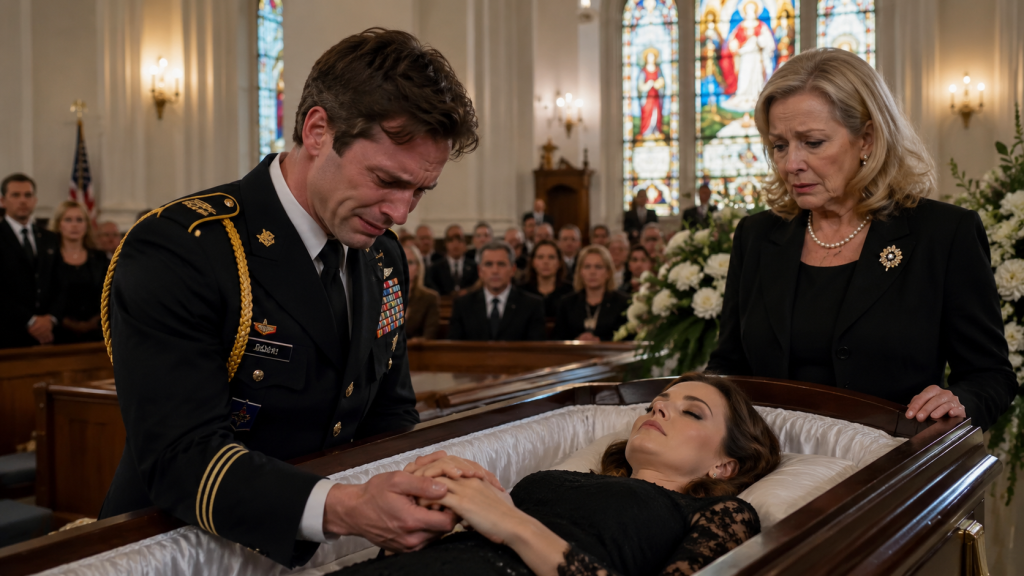
I returned home from military service hoping to see my wife’s smile. Instead, I found a coffin in the middle of my living room. The first thing I noticed was not the coffin itself. It was the silence.
No neighbors whispering in the hallway. No relatives crying in the kitchen. No pastor murmuring prayers over folded hands. Just my mother standing beside polished dark wood, wearing a black dress and an expression colder than marble.
My duffel bag slid from my shoulder and hit the floor.
I was still in uniform.
Dust from the road clung to my boots.
My hands still smelled faintly of metal, aircraft fuel, and the cheap soap from the base bathroom where I had shaved before coming home.
I had imagined this moment for eleven months.
Emily running into my arms.
Her round belly pressing against me.
My mother pretending to be happy.
My brother Caleb standing awkwardly in the background, maybe sober for once.
I had imagined laughter.
I had imagined tears.
I had imagined placing my palm on Emily’s stomach and feeling my child kick.
Instead, my wife lay in a coffin under the light of our living room chandelier.
My mother looked at me and said, “She died in childbirth, Daniel.”
Her voice did not break.
She did not blink.
For three seconds, the world made no sound.
Then somewhere upstairs, a newborn cried.
Weak.
Thin.
Alive.
My knees almost gave out.
I looked toward the staircase.
Then back at the coffin.
“No,” I whispered.
Mother folded her hands in front of her. “I am sorry.”
But she did not sound sorry.
She sounded annoyed, as if my grief had arrived at an inconvenient hour.
I took one step toward the coffin.
Then another.
Emily lay inside wearing the blue dress she had chosen for my homecoming. She had shown it to me over video call three months earlier, turning slowly in front of the mirror with one hand on her belly.
“You like it?” she had asked.
“I love it,” I had said.
“You better. I want you to remember me looking beautiful when you come home.”
I remembered laughing.
Now that same dress was smoothed over her body, too neat, too carefully arranged. Her dark hair had been brushed around her face. Her lips were pale. Her hands rested near her sides.
No hospital bracelet.
No medical papers.
No flowers from a clinic.
No doctor waiting to explain what happened.
Only my mother, Margaret, and my younger brother, Caleb, watching me like guards.
Caleb leaned against the fireplace with a glass of whiskey in his hand.
He looked tired, but not grieving.
He looked nervous.
“Where is my son?” I asked.
“He survived,” Mother said. “Barely.”
My throat burned. “Where?”
“Upstairs. The nurse fed him earlier.”
“What nurse?”
Mother’s mouth tightened. “A woman from the clinic.”
“What clinic?”
Caleb scoffed. “Daniel, you just walked in. Maybe stop acting like you’re conducting an investigation.”
I turned my head slowly toward him.
He looked away first.
I walked closer to Emily.
Every step felt like I was moving through deep water.
I had spent eleven months in a war zone. I had seen vehicles split open by bombs. I had carried men heavier than me through smoke. I had written letters to families when words were useless.
I knew what shock felt like.
This was different.
This room was staged.
Training had taught me that death left details behind.
So did lies.
And everything in that room was wrong.
The curtains were closed even though it was still afternoon.
The coffee table had been cleared except for a silver candle holder I had never seen before.
The carpet near the coffin had fresh vacuum lines.
Emily’s phone was not on the table where she always left it.
Her favorite blanket was missing from the couch.
And my mother had no tears in her eyes.
I reached into the coffin and touched Emily’s hair.
Cold.
Too cold.
“Daniel,” Mother said softly.
I ignored her.
I looked at Emily’s face, trying to find the woman who had smiled through bad internet connections and whispered to me every night, “Come home to us.”
Then my eyes lowered.
Her right hand was clenched against her hip.
Not resting.
Clenched.
“What is she holding?” I asked.
Mother’s face changed.
It lasted less than a second, but I saw it.
A flash of fear.
Then she lifted her chin.
“Nothing.”
I looked at her. “Then why did you react?”
“I reacted because you are disturbing your dead wife.”
“She is my wife.”
“And she deserves dignity.”
I bent closer.
Mother grabbed my arm.
“Daniel, stop.”
I looked down at her fingers gripping my uniform sleeve.
Then I looked into her eyes.
“Take your hand off me.”
She obeyed.
Caleb shifted near the fireplace. The ice in his glass clinked.
Emily’s fingers were stiff, but not impossible to move.
I worked gently, thumb first.
Beneath her nails were tiny crescent cuts, as though she had fought to keep her fist closed.
My chest tightened until I could hardly breathe.
“Emily,” I whispered.
Her thumb loosened.
Something small and black slid into my palm.
A memory card.
My mother went white.
Caleb’s glass stopped halfway to his mouth.
“What is that?” he demanded.
I closed my fist around it. “You tell me.”
Mother recovered first.
“Probably something from her phone,” she said quickly. “She was obsessed with recording everything. Pregnancy made her paranoid.”
Paranoid.
That was the word she had used in every email.
Emily is becoming paranoid, Daniel.
Emily thinks I am stealing from you.
Emily cries too easily.
Emily needs rest.
Emily should not be handling finances while pregnant.
I slipped the memory card into the hidden pocket inside my uniform.
Upstairs, the baby cried again.
This time the sound cracked something open in me.
I turned toward the stairs.
Mother stepped in front of me.
“Daniel, wait.”
I did not slow down.
“The baby is fragile,” she said. “The nurse said too much emotion could harm him.”
I looked at her.
“My son needs his father.”
“He needs stability.”
“He needs truth.”
I moved around her and climbed the stairs.
Every step brought back a memory of Emily.
Emily painting the nursery wall pale green because she refused to know the baby’s gender before birth.
Emily arguing with me over crib instructions while I held the phone on video and pretended I knew what I was doing.
Emily sending me pictures of tiny socks and saying, “Look, Daniel, they are smaller than your thumb.”
The nursery door was half open.
Inside, the air smelled of powder, milk, and something sour.
My son lay in the crib wrapped in a gray blanket I did not recognize.
His face was red from crying.
His fists trembled.
He was impossibly small.
I crossed the room and lifted him.
The second I held him against my chest, he quieted.
Not completely.
But enough.
His tiny mouth opened, searching.
His cheek pressed against my uniform.
I bowed my head over him.
“I’m here,” I whispered. “Daddy’s here.”
On the rocking chair beside the crib was Emily’s phone.
The screen was shattered.
Not dropped-on-the-floor shattered.
Crushed.
The case was cracked open along one side.
I picked it up with one hand while holding my son with the other.
Emily had always used cases with hidden compartments.
She said it was silly.
I had told her it was smart.
The back panel was loose.
There was a second memory card slot.
Empty.
I looked down at my son.
Then at the crib.
A corner of paper stuck out beneath the mattress.
I pulled it free.
My hands began to shake when I saw Emily’s handwriting.
Daniel,
If you are reading this, then I was right.
Your mother knows I found the transfers.
Caleb helped her.
They want the trust unlocked after I am gone.
Do not trust the coffin.
Do not trust the doctor.
Check the basement freezer.
Protect our son.
I love you.
Emily.
For a long moment, I could not move.
The paper blurred.
My son made a small sound against my chest.
Behind me, the floor creaked.
Mother stood in the doorway.
Her face was pale as bone.
Behind her, Caleb appeared, eyes wide.
He whispered, “You weren’t supposed to come home today.”
And that was when I smiled for the first time.
Not because anything was funny.
Because they had just confirmed everything.
I folded Emily’s note and placed it in my pocket beside the memory card.
Then I adjusted my son in my arms and looked at them.
“You have ten seconds to move.”
Mother swallowed. “Daniel, you are emotional.”
“Nine.”
“Listen to me.”
“Eight.”
Caleb stepped forward. “Don’t do this.”
“Seven.”
Mother’s expression hardened.
The mask slipped.
“You always were dramatic,” she said. “Just like her.”
I stepped toward them.
Caleb moved aside.
Mother did not.
So I leaned close enough that only she could hear.
“You never understood what my job was, Mother.”
Her lips parted.
“I do not panic,” I said. “I document.”
Then I walked past her.
Downstairs, the coffin waited.
Emily waited.
But first, I went to the kitchen.
The baby formula was unopened.
Three bottles sat by the sink, all dry.
My son had not been fed properly.
A rage so deep it felt quiet moved through me.
I took a clean bottle, prepared formula with the instructions on the container, and fed my son while standing in the kitchen where Emily used to dance barefoot to old country songs.
Mother followed me.
Caleb stayed near the living room.
“You do not know what you are doing,” Mother said.
I looked at my son drinking desperately from the bottle.
“I know enough.”
“She ruined this family,” Mother snapped.
The words came out before she could stop them.
I looked up.
Mother froze.
“How did Emily ruin this family?”
She took a breath. “By turning you against us.”
I almost laughed.
“You did that yourself.”
Her eyes narrowed. “You sent money to a woman who trapped you with a baby.”
“She was my wife.”
“She was beneath you.”
“She was better than all of us.”
Mother’s face twisted.
For a second, I saw the truth I had ignored for years.
She had never disliked Emily.
She had hated her.
Hated that Emily made me happy.
Hated that Emily had access to the accounts.
Hated that my name was no longer attached to hers like a leash.
Before deployment, I had done what many soldiers do when they begin to sense rot at home.
I prepared.
I transferred the house into a military family trust.
I placed Emily and our child as protected beneficiaries.
I locked all major assets behind encrypted authorization.
Not because I expected murder.
Because Emily had cried to me over video calls, whispering that money was disappearing.
Small amounts at first.
Then larger ones.
Contractor invoices for repairs that never happened.
Cash withdrawals signed in my name.
Credit cards opened through family contacts.
When Emily confronted Mother, Mother called her unstable.
When Emily asked Caleb about a forged signature, he laughed and told her pregnancy made women hysterical.
So I gave Emily access to an encrypted evidence vault.
A place where she could upload photos, recordings, documents, anything she feared might vanish.
The only person who knew besides me was Emily.
Or so I had thought.
I finished feeding my son.
He fell asleep against me, one hand curled around the edge of my uniform.
I carried him to the downstairs guest room instead of the nursery and placed him in a clean laundry basket lined with soft towels.
Then I took out my military phone.
Caleb appeared in the doorway.
“Who are you calling?”
I did not answer.
He stepped closer. “Daniel.”
I looked at him.
“Back up.”
He stopped.
I called the one person I trusted in town.
Major retired Aaron Briggs.
He had served with my father before my father died. He was the closest thing I had left to a sane family elder.
When he answered, his voice was cheerful.
“Soldier boy. You home?”
“My wife is dead,” I said.
Silence.
Then his voice changed. “What do you need?”
“Come to my house. Bring Sheriff Lowe. Do not call first. Do not warn anyone.”
“What happened?”
“I found evidence.”
“I’m on my way.”
I ended the call.
Mother had heard enough to understand.
Her face hardened into something cruel.
“You would bring police into your own home before your wife is even buried?”
“I would bring the entire army if I had to.”
Caleb cursed under his breath.
I walked toward the basement door.
Mother moved again.
“Daniel, don’t.”
Her voice had changed.
Not cold now.
Afraid.
I opened the basement door.
A damp chill rose up the stairs.
The basement smelled of detergent, old wood, and freezer frost.
I took each step slowly, listening behind me.
Caleb followed.
Mother followed him.
At the bottom of the stairs, the old chest freezer sat against the wall.
It had belonged to my father.
Emily hated it.
She once said it sounded like a dying tractor.
I lifted the lid.
Inside were bags of frozen vegetables, wrapped meat, ice packs, and a sealed plastic container pushed behind everything.
I moved the food aside.
The container was taped shut.
On top of it, written in Emily’s handwriting, were two words.
For Daniel.
Caleb whispered, “Oh God.”
I turned.
His face had gone gray.
Mother slapped him across the mouth.
“Shut up.”
That slap told me more than any confession.
I carried the container upstairs and set it on the dining table.
Mother stood across from me, trembling with fury.
“You have no right.”
“To open a container with my name on it?”
“She stole private documents.”
“From whom?”
No answer.
I broke the tape.
Inside were envelopes, a flash drive, printed bank statements, and a small digital recorder.
There were copies of transfers from accounts tied to my military pay.
Payments to Caleb.
Payments to a shell company registered under Mother’s maiden name.
Invoices from a fake medical service.
And at the bottom was a folded clinic report.
Emily’s prenatal records.
Healthy mother.
Healthy child.
No major complications.
Expected delivery date still two weeks away.
I looked at Mother.
“She wasn’t due yet.”
Mother’s jaw clenched.
Caleb backed away from the table.
I picked up the recorder and pressed play.
Emily’s voice filled the room.
Shaky.
Breathless.
But clear.
“If something happens to me, my name is Emily Hartwell Reeves. I am thirty-one weeks pregnant. Margaret Reeves and Caleb Reeves have been pressuring me to sign trust documents while Daniel is deployed. Tonight Margaret told me that if I do not sign, she will make sure Daniel comes home to nothing.”
There was a pause.
Then another voice.
My mother’s voice.
“You think you can keep him from us with paperwork? That house was bought with Reeves blood.”
Emily said, “Daniel bought it. Daniel protected it. And I am telling him everything.”
Mother laughed on the recording.
“You won’t get the chance.”
The room became very still.
My son slept in the guest room.
My dead wife lay in the living room.
And my mother stared at the recorder as if it had become a snake.
“That is not what it sounds like,” she said.
I almost admired the instinct.
Even then, she lied.
The doorbell rang.
Mother flinched.
Caleb whispered, “Margaret.”
I looked at both of them.
“Sit down.”
Mother did not move.
I stepped closer.
“Sit. Down.”
This time, she did.
I opened the front door.
Aaron Briggs stood on the porch with Sheriff Lowe and two deputies.
Aaron took one look at my face and removed his hat.
“Where is Emily?”
I stepped aside.
They entered.
Sheriff Lowe saw the coffin and stopped.
His expression darkened.
“Who authorized removal from the hospital?”
Mother stood quickly. “Sheriff, this is a family tragedy. My son is overwhelmed and confused.”
Sheriff Lowe looked at me.
I handed him Emily’s note.
Then the recorder.
Then the memory card.
Then I said, “My wife was not supposed to die. My mother and brother staged this. My newborn has been neglected. I need the house secured, the coffin examined, and both of them separated.”
Mother laughed once.
A sharp, ugly sound.
“You have no proof.”
Sheriff Lowe held up the recorder.
“I believe he does.”
For the first time in my life, my mother looked small.
Not sorry.
Small.
A deputy took Caleb into the kitchen.
Another stayed with Mother.
Aaron walked to the guest room and looked down at my son sleeping in the basket.
His eyes filled with tears.
“What’s his name?”
I swallowed.
“Emily wanted Samuel.”
Aaron nodded. “Samuel it is.”
The medical examiner arrived less than thirty minutes later.
By then, neighbors had gathered outside.
Lights flashed red and blue across the curtains.
Mother sat stiffly on the sofa, refusing water, refusing to speak.
Caleb talked.
He talked because fear made him weak.
He told the deputy that Mother had handled everything.
That she had found a doctor willing to sign papers.
That Emily had gone into labor early after a confrontation.
That there had been bleeding.
That Mother said calling an ambulance would “complicate things.”
Each word struck like a hammer.
I stood in the hallway holding my son and listened without reacting.
Then Caleb said something that made the room stop.
“She was alive when Margaret called me.”
Mother screamed his name.
The deputy ordered her to sit.
Caleb began crying.
“She was alive,” he repeated. “Emily was on the floor. She kept asking for Daniel. She kept saying, ‘Call my husband.’ Margaret said Daniel would ruin everything. She said if Emily survived, we would all go to prison.”
I closed my eyes.
For one second, the soldier in me disappeared.
I was only a husband.
A man who had promised to come home.
A man who was too late.
Aaron put a hand on my shoulder.
“Breathe, son.”
I did.
Barely.
The medical examiner confirmed what my heart already knew.
Emily had not died peacefully.
She had not died in a clinic.
She had fought.
She had protected evidence with her last strength.
And even while dying, she had hidden the truth for me to find.
The memory card from her hand became the final key.
Sheriff Lowe used my laptop to open it while everyone watched.
The video began in the nursery.
Emily had set up the camera on a shelf.
Her face appeared close to the lens, pale and scared.
“If Daniel sees this,” she whispered, “I love you. I am not paranoid. I am not unstable. Your mother is trying to force me to sign over access to the trust. Caleb forged your name. I have copies. I hid them.”
She looked toward the door.
Voices sounded downstairs.
Then the video cut to another clip.
Mother stood in the nursery holding papers.
Emily was off camera.
Mother said, “Sign them, and you can raise the baby here. Refuse, and I will make sure Daniel knows you destroyed this family.”
Emily answered, “Daniel already knows enough.”
Caleb’s voice came next.
“Just sign, Emily. We only need temporary access.”
“No,” Emily said.
Mother stepped closer.
“You stupid girl.”
The clip ended.
Another began.
Shaking.
Blurred.
Emily breathing hard.
The camera seemed to be in her hand or on the floor.
Mother’s voice was clear.
“After everything I gave him, he chooses you.”
Emily cried out.
Caleb said, “Margaret, stop.”
Then the video cut to black.
No one spoke.
Sheriff Lowe closed the laptop.
Mother sat frozen.
Then she said, very softly, “She stole my son.”
I looked at her.
“No. She saved him from you.”
Mother’s face collapsed into hatred.
“You were mine first.”
The words were so twisted, so empty, that I finally understood.
This was not grief.
Not money.
Not even jealousy alone.
It was control.
She had built her life around owning everyone in it.
My father.
Caleb.
Me.
And Emily had been the first person who refused to bow.
The sheriff stood.
“Margaret Reeves, you are under arrest.”
When the deputy pulled her hands behind her back, she did not cry.
She stared at me.
“You will regret this.”
I held my son closer.
“The only thing I regret is not believing Emily sooner.”
Caleb was arrested too.
He sobbed as they led him out.
“I didn’t know she would die,” he kept saying. “I didn’t know.”
But he had known enough.
Enough to lie.
Enough to stand beside the coffin.
Enough to drink whiskey while my wife lay dead ten feet away.
When the police cars left, the house felt hollow.
The coffin was taken for proper examination.
The fake funeral arrangements were stopped.
The living room smelled of wax, cold wood, and betrayal.
Aaron stayed with me until dawn.
He made coffee I did not drink.
He called a real doctor for Samuel.
He contacted a funeral home that treated Emily with dignity.
And when I finally sat down, still in uniform, still holding my son, the sun rose through the curtains Emily had chosen.
Samuel slept against my chest.
His tiny breaths warmed the fabric over my heart.
I looked at the empty place where the coffin had been.
“I’m sorry,” I whispered.
Aaron sat across from me.
“She knew you would find it.”
That broke me.
Not the coffin.
Not the lies.
Not even my mother’s face when she realized she had lost.
It was the faith Emily had kept in me until the end.
She had used her last strength to leave a trail because she believed I would follow it.
Three days later, I buried my wife properly.
Not from my mother’s house.
Not under her arrangements.
Not in the blue dress she had chosen for joy and that they had turned into a costume.
I chose a white dress Emily had worn on our first anniversary.
I placed her wedding ring back on her finger.
And beside her, I placed a small photo of Samuel wrapped in a clean blue blanket.
The church was full.
People came who had ignored my mother’s version.
Neighbors came.
Emily’s coworkers came.
Women from her pregnancy group came with flowers and shaking hands.
One of them told me Emily had been afraid but determined.
“She said you would come home,” the woman whispered. “She said you always kept your promises.”
I had no answer.
At the cemetery, I held Samuel while the pastor spoke.
The wind moved through the trees.
For a moment, I imagined Emily standing beside me, brushing hair from her face, telling me not to forget a hat for the baby.
After the service, Sheriff Lowe approached.
“They found the doctor,” he said quietly.
I looked at him.
“Was he real?”
“A retired physician with a revoked license. He signed the paperwork for cash. He is cooperating.”
“And my mother?”
“Still claiming Emily was unstable.”
Of course she was.
Even in a cell, she would try to control the story.
But Emily had left more than a story.
She had left proof.
The trial began six months later.
By then, Samuel had grown round-cheeked and loud.
He had Emily’s eyes.
Dark, serious, searching.
Every morning, I told him about her.
Not the way she died.
Not yet.
I told him how she sang off-key when she cooked.
How she cried at commercials with lost dogs.
How she once painted one nursery wall three different shades because none of them were “hopeful enough.”
How she loved him before she ever saw his face.
In court, my mother wore pearls.
She looked like a grieving grandmother.
Caleb looked ruined.
The prosecutor played Emily’s recordings.
The jury listened.
Mother stared forward as her own voice filled the courtroom.
“You won’t get the chance.”
For the first time, people heard her without the mask.
Caleb testified against her.
He admitted the forged documents.
He admitted the fake clinic.
He admitted they planned to pressure Emily into signing papers that would eventually unlock assets once I returned.
He claimed he never meant for anyone to die.
The prosecutor asked him, “But when Emily needed medical help, did you call emergency services?”
Caleb lowered his head.
“No.”
“And when Daniel came home, did you tell him the truth?”
“No.”
“And when he reached for the evidence in his wife’s hand, what did you do?”
Caleb cried.
“I tried to stop him.”
Mother refused to testify.
But before sentencing, she asked to speak.
The judge allowed it.
She stood slowly.
Her hair was perfect.
Her hands were steady.
She looked at the courtroom, then at me.
“My son was manipulated by a woman who wanted his money,” she said. “Everything I did, I did to protect my family.”
A murmur passed through the room.
I felt Samuel shift in my arms.
He was asleep.
The judge’s expression hardened.
“Mrs. Reeves,” he said, “your family needed protection from you.”
Mother’s face twitched.
That was the only crack.
She was sentenced first.
Then Caleb.
When they led her away, she turned once.
Not toward me.
Toward Samuel.
Her eyes lingered on him with a possessive hunger that made my blood run cold.
I stepped back, shielding him with my body.
She smiled.
But it did not matter anymore.
She had no house.
No money.
No access.
No family left to command.
The military family trust held.
Emily’s evidence protected everything she had died trying to save.
The house remained mine.
Samuel’s future remained untouched.
My mother’s shell company was seized.
Caleb’s debts came into the light.
Every secret they had buried came up one by one.
A year after Emily’s death, I returned to the house with Samuel on my hip and a box of paint supplies in my hand.
For months, I had thought about selling it.
Every room held ghosts.
The living room where the coffin had waited.
The kitchen where Mother lied.
The nursery where Emily hid her final note.
But one morning, Samuel crawled to the green nursery wall and slapped his tiny palm against it, laughing at sunlight.
And I realized the house did not belong to the nightmare.
It belonged to Emily.
To the life she had tried to build.
So I stayed.
I opened the curtains.
I replaced the carpet.
I turned the basement freezer over to the police and never brought it back.
I changed the locks, the alarms, the names on every emergency contact.
Then I painted the living room a warm cream color because Emily had once said the old gray walls made the house feel like it was waiting for bad news.
On the anniversary of my return, I sat on the porch with Samuel in my lap.
He was old enough to hold a toy truck.
Old enough to say “Dada.”
Not old enough to understand why I sometimes looked at the driveway and went quiet.
Aaron came by with groceries and a small wooden box.
“What is that?” I asked.
“Something Emily’s friend found.”
Inside was a letter.
Not hidden in fear this time.
Saved with love.
Daniel,
If you are reading this someday, I hope it is because I misplaced it somewhere ridiculous and not because something bad happened.
I want you to know that I am proud of you.
Not because you wear a uniform.
Not because you are brave in the way people understand.
But because you are gentle when no one is watching.
You will be a good father.
Our baby will know what safe feels like because of you.
Come home to us.
I pressed the letter to my mouth.
Samuel looked up at me and patted my cheek.
“Dada,” he said.
I closed my eyes.
“I came home,” I whispered.
Not in time to save Emily.
That truth would live with me forever.
But I came home in time to find what she left.
In time to protect our son.
In time to make sure the people who stole her last breath did not steal her voice.
Years from now, when Samuel is old enough, I will tell him the truth.
I will tell him his mother was not weak.
She was not careless.
She was not dramatic.
She was brave.
She was clever.
She was fighting for him before he ever opened his eyes.
And when the people around her tried to bury the truth with her, she held on.
Literally held on.
With stiff fingers.
With broken nails.
With the last strength in her body.
She held on until I came home.
That is the story my son will know.
Not the coffin.
Not the lies.
Not the cold voice of my mother in the living room.
He will know that his mother loved him enough to fight darkness alone.
And his father loved her enough to follow the evidence all the way to justice.
The house is quiet now, but not empty.
There are toys in the hall.
Tiny socks under the couch.
A framed photo of Emily in the nursery, smiling in the blue dress before it became part of the worst day of my life.
In the photo, she is alive.
Laughing.
One hand on her belly.
The other reaching toward the camera, as if telling me to hurry home.
Every night, before I put Samuel to bed, I touch that frame.
Then I look at my son and say the same words.
“Your mother saved you.”
And someday, when he asks how, I will tell him everything.
I will tell him that evil entered our home wearing a familiar face.
I will tell him that blood does not always mean family.
I will tell him that love sometimes leaves clues when it cannot leave footprints.
And I will tell him about the day I came home from war and found a coffin in my living room.
The day I lost my wife.
The day I found my son.
The day my mother turned pale because Emily’s hand was still holding the truth.
THE END! THANK YOU FOR READING!