

Mr. Ellis stayed on the line for another few seconds after his final sentence, as if giving the moment time to settle into something irreversible. Then he spoke again, softer this time, telling Adam he should put the phone on speaker if he wanted to avoid misunderstandings. Adam hesitated, then did it, his hand trembling slightly as he turned toward the porch camera, realizing I could hear everything. Inside my house, I didn’t move. I just listened.
Mr. Ellis continued, explaining that Grandma Ruth had not written the clause out of anger, but out of years of observation. Every emergency drop-off, every unasked favor, every expectation placed on me had been documented in her private notes long before her death. She had anticipated that kindness would be treated as obligation in this family, and she had decided to interrupt it in the only legal way she could.
Adam’s voice finally broke through the silence.
“This is ridiculous,” he said, but it didn’t sound convincing anymore.
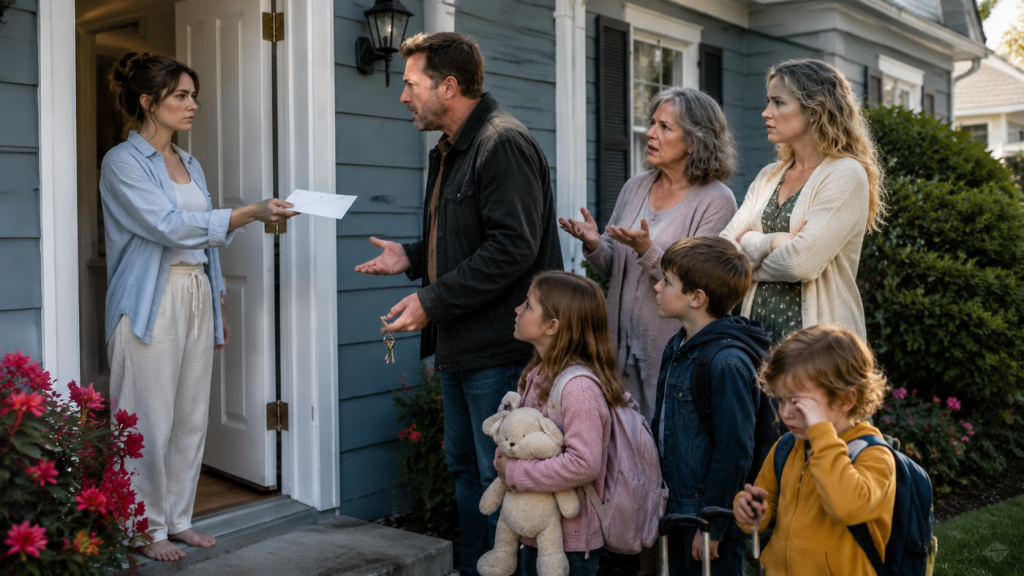
Brooke got out of the car slowly, walking toward the porch as if distance might change the situation. The children stood between them, confused, shifting their weight, still holding their small backpacks. Noah asked if they were in trouble. Ellie looked like she was trying not to cry.
I pressed my hand against the counter inside my kitchen. My heart hurt watching them, but I didn’t open the door.
Mr. Ellis spoke again, now addressing Adam directly through the phone.
“Your mother knew this day would come,” he said. “She also left instructions that if Lily ever felt pressured again after inheritance, additional protections would activate.”
Adam went still.
“What protections?” he asked.
There was a pause.
Then Mr. Ellis answered.
“Financial restrictions tied to the family trust. And a formal review of prior distributions.”
The words landed like something heavy dropping into water.
Brooke turned her head sharply toward Adam.
“Wait… what does that mean?” she asked.
But Adam already knew.
He just didn’t want to say it out loud.
Because now this wasn’t about childcare anymore.
It was about control.
And history.
And money.
Inside my house, I finally sat down. Not because I was calm, but because my legs had stopped feeling steady.
The family chat exploded again.
Mom: Adam, what is going on?
Dad: Fix this immediately.
Brooke: This is insane. Lily is overreacting.
But no one came to the door anymore.
No one told me to open it.
For the first time in years, they were waiting on my decision.
The children sat on the porch step now. Ellie hugged her knees. Mason leaned against Noah. The sound of morning birds felt too normal for what was happening outside my house.
Adam finally turned back toward the camera.
“Lily,” he said, quieter now. “Can we talk. Please.”
That word—please—felt unfamiliar coming from him.
I stood up slowly and pressed the intercom.
“We can talk,” I said. “But not like before.”
A long silence followed.
Then I unlocked the side gate, not the door.
It was the first compromise I was willing to make.
The children came in first.
That part was always going to matter more than the adults.
I opened the gate just enough and knelt slightly.
“You’re not in trouble,” I told them gently. “Come in. You can have breakfast.”
Ellie ran first, followed by Mason. Noah hesitated, looking back at his father before stepping inside.
Adam didn’t stop them.
That surprised me more than anything else.
Brooke stayed outside for a moment longer, then followed slowly, as if entering my yard required permission she hadn’t expected to ask for.
Adam remained at the gate.
Like he wasn’t sure if he still belonged on either side of it.
Inside, I made pancakes the way I always had. The smell filled the kitchen, soft and familiar, almost painfully normal. The children sat at the table like nothing had happened, swinging their legs, talking about cartoons, asking for syrup.
For a few minutes, I let myself exist only in that sound.
Then Adam walked in.
He stopped when he saw the table set.
Not because it was strange.
But because it wasn’t different from every other time I had been expected to do this without question.
Only now, I had been asked.
He sat down slowly, across from me.
Brooke stood near the doorway, arms crossed, no longer confident.
Adam looked at me for a long time before speaking.
“I didn’t think it was a big deal,” he said.
I didn’t answer right away.
Because that sentence was the problem.
Not the flight.
Not the kids.
Not even the door.
It was the assumption that my time, my space, my life could be absorbed without noticing.
“You didn’t think at all,” I finally said.
His jaw tightened, but he didn’t argue.
That was new too.
From the hallway, the children’s laughter echoed. Mason had found the crayons I kept in the drawer. Ellie was drawing something on a napkin.
Adam followed my gaze.
“They love you,” he said quietly.
“I love them,” I replied. “That was never the issue.”
Silence stretched between us again.
Then he leaned forward slightly.
“What did Grandma really leave?” he asked.
That question changed the air.
Because now he wasn’t pretending anymore.
I reached into the drawer beside the counter and took out a sealed envelope I had kept since the reading of the will. I hadn’t opened it fully in front of anyone. Not even myself, all at once.
I slid it across the table.
Adam didn’t touch it immediately.
Brooke moved closer behind him, reading over his shoulder.
Inside were documents. Not just the house transfer, but a second layer of instructions. Clarifications about the trust. Notes about patterns of dependency. And one final handwritten line from Grandma Ruth.
“If Lily ever reads this, it means she finally stopped apologizing for existing in her own home.”
Adam exhaled sharply.
Brooke stepped back as if the words had physically pushed her.
“I didn’t know she felt that way,” Adam said.
“No,” I replied. “You didn’t ask.”
That was the difference.
Not cruelty.
Not money.
Not even intention.
Just awareness.
The absence of it.
From the living room, Ellie called my name, asking if she could have more syrup.
I stood up and walked toward her without looking back at the table.
Because the truth was simple now.
Whatever this conversation became, it could not erase the children’s morning.
It could not undo what had already been learned.
And it could not return me to the version of life where I was always available by default.
When I came back, Adam was still sitting there.
But something in him had changed.
The urgency was gone.
What remained was uncomfortable honesty.
“I don’t want to lose you,” he said.
That time, I believed him.
But belief wasn’t enough to rebuild boundaries.
“I’m not asking you to lose me,” I said. “I’m asking you to see me.”
Brooke looked away.
Adam nodded slowly, like he was finally understanding the cost of not doing that earlier.
Outside, the porch light flickered in the late morning sun.
The same porch where this had started.
But it didn’t feel like the same house anymore.
It felt like something had been reset.
Not repaired.
Reset.
The children finished breakfast and ran outside again, laughing, completely unaware that anything permanent had shifted.
Adam stood up to join them, then paused.
He looked at me one last time.
“Can we try again?” he asked.
I didn’t answer immediately.
Because “again” meant something different now.
It no longer meant repetition of the past.
It meant building something that had never existed between us before.
“I’m here,” I finally said. “But not the same way.”
He nodded.
And for the first time in a long time, he accepted that without pushing back.
After they left that afternoon, the house felt quieter in a way that wasn’t empty.
It felt like it was mine in a way I hadn’t fully understood before.
I stood at the porch for a long time, looking at the empty driveway.
The key under the frog planter was still gone.
The locks were still new.
But for the first time, none of that felt defensive.
It felt like choice.
Inside, Grandma Ruth’s letter stayed on the table.
Not as a warning anymore.
But as permission I had finally used.
And somewhere between the silence and the sunlight, I understood something I had missed for years.
Family wasn’t supposed to mean access without asking.
It was supposed to mean care that respected space.
And this time, I had finally taught my own life how to say no without apology.
THE END! THANK YOU FOR READING!