

Eight minutes after the judge officially ended our marriage, my ex-husband leaned back in his chair with the smug expression of a man who believed victory was already his. Bradley Bennett tossed his pen onto the mediator’s desk and said, “There’s nothing left to divide.”
He said it like a man closing a business deal. Not like a husband ending ten years of marriage. Not like a father signing away the daily lives of his two children. Not like someone who had broken a family slowly, piece by piece, then blamed the wreckage for making too much noise.
Somewhere across the city, his family was already gathered inside a private clinic, waiting to celebrate the pregnancy of the woman he had chosen over me and our children.
His mother, Lorraine, had likely brought flowers.
His sister, Brittany, had probably already taken pictures.
And Tiffany, the beautiful, polished woman Bradley had once called “just a colleague,” was probably sitting there with one hand on her stomach, glowing beneath the approval I had spent ten years trying to earn.
I placed the penthouse keys calmly beside the divorce documents.
Then I opened my handbag and took out two passports.
Connor’s.
Madison’s.
Bradley’s smile slowly disappeared.
For the first time that morning, he looked at me as if I were not furniture he had already removed from his life.
“You’re right,” I said softly. “I won’t stand in the way of your new life.”
Brittany’s eyes narrowed.
Bradley sat forward.
“What are those?” he asked.
I held his gaze.
“The children’s passports.”
His jaw tightened.
“What are you doing, Sarah?”
I slid the passports back into my handbag and stood.
“What I should have done a long time ago.”
What he did not know was that inside my car, a folder was waiting for me.
A folder filled with enough evidence to ruin everything he thought he had safely hidden.
My name is Sarah Bennett.
At exactly nine o’clock that morning, I signed the final page that ended my ten-year marriage.
I thought my hand would shake.
I thought I would cry.
I thought the last stroke of my signature would feel like tearing a page from my own life.
After two children, ten years of vows, and countless quiet humiliations, I expected the ending to break something inside me.
But it did not.
Instead, I felt relief.
Cold.
Sharp.
Final.
The mediator, a tired woman named Elise Porter, looked between Bradley and me as though she had seen this kind of ending too many times to be shocked by it anymore.
“Both parties understand the agreement as written?” she asked.
Bradley barely looked up from his phone.
“Yes.”
I nodded.
“Yes.”
“Custody is granted primarily to Ms. Bennett, with visitation rights to Mr. Bennett as outlined.”
Bradley gave a careless shrug.
“If Sarah wants full custody, she can have it. That’s less responsibility for me.”
The words landed in the room like something dirty dropped on polished marble.
The mediator’s mouth tightened.
Brittany, who had insisted on coming “for moral support,” gave a soft little laugh.
“At least everyone can finally move forward,” she said. “Tiffany is giving this family the fresh start it deserves.”
A fresh start.
That was what they called it.
Not betrayal.
Not lies.
Not hotel receipts tucked behind business folders.
Not perfume on Bradley’s shirts when he swore he had been in meetings.
Not secret weekends away.
Not money quietly disappearing from our joint accounts.
Not Connor sitting alone at the edge of a soccer field, watching other fathers cheer.
Not Madison pressing her face into my shoulder at bedtime and whispering, “Daddy forgot again, didn’t he?”
No.
To them, it was simply a fresh start.
Bradley’s phone buzzed before the ink was even dry.
He did not apologize.
He did not step out of the room.
He answered right there, in front of me, the mediator, and his younger sister.
“Hey, sweetheart,” he said, his voice suddenly warm. “I’m almost finished here.”
That voice.
Once, that tenderness had belonged to me.
Once, he had answered my calls that way.
Once, he had rushed home because I had a fever.
Once, he had cried when Connor was born.
Once, he had held Madison in the hospital nursery and said, “I didn’t know I could love anyone this much.”
But somewhere along the way, the man who said those things had disappeared.
Or maybe he had never been real.
“I’ll be there soon,” he continued. “Mom and everyone are already at the clinic. Don’t worry. Today is important.”
He never said her name.
He did not have to.
Tiffany.
The woman his family had accepted before our marriage was even legally over.
The woman who had once smiled at me across a charity gala and told me I had “such a beautiful home.”
The woman who had walked into my place as if it had always been waiting empty for her.
Bradley ended the call and shoved the papers across the desk without reading them.
“There’s nothing worth fighting about,” he said casually. “The penthouse was mine before we got married. The SUV is mine. The investment accounts are mine. Sarah can keep the furniture if she wants it.”
I looked at the man I had once trusted with my whole life.
“Do you hear yourself?” I asked.
He sighed, annoyed.
“Please don’t make this emotional.”
Brittany leaned back in her chair.
“Sarah, honestly, you should be grateful. Bradley is being generous by not making custody difficult.”
“Generous?” I repeated.
Bradley’s expression hardened.
“Don’t start.”
I almost laughed.
Not because anything was funny.
Because for years, that had been his favorite command.
Don’t start.
Don’t embarrass me.
Don’t make a scene.
Don’t question me.
Don’t overreact.
Don’t turn the children against me.
Don’t make my mother uncomfortable.
Don’t ask where the money went.
Don’t ask who Tiffany is.
Don’t ask why I smell like another woman’s perfume.
Don’t start.
So I did not start.
Not there.
Not in that room.
Not in front of people who had mistaken my silence for weakness.
I reached into my purse and placed the penthouse keys on the table.
The sound was small.
Metal against wood.
But Bradley’s eyes flickered with satisfaction.
“Good,” he said. “You’re finally accepting reality.”
I looked him directly in the eyes.
“No,” I replied. “I finally understood that silence can be more powerful than arguing.”
He believed my calm meant defeat.
That was his first mistake.
Then I pulled out the passports.
Bradley’s eyes sharpened.
“What is that supposed to mean?”
“The children’s visas were approved last week,” I said.
Brittany sat up straighter.
“Visas?”
I nodded.
“We’re going to London.”
Silence filled the room.
For the first time all morning, Bradley looked uncertain.
Then he forced a laugh, but the confidence had already left his face.
“And who exactly is paying for that?”
Before I could answer, a black Mercedes GLS stopped outside the building.
Through the glass wall of the office, I saw the driver step out in a dark suit.
He entered the lobby, spoke briefly to the receptionist, then walked straight toward the conference room.
“Ms. Bennett?” he said politely. “Your car is ready.”
Something shifted in Bradley’s expression.
First confusion.
Then suspicion.
Then something close to fear.
I picked up Madison’s backpack, took Connor’s hand, and rose from my chair.
“From now on,” I said, “the children and I will not interfere with your new life.”
Bradley stood so quickly his chair scraped the floor.
“You can’t just leave the country with my kids.”
I paused at the door.
“You agreed to the custody terms, Bradley. You signed them without reading.”
The mediator cleared her throat.
“Mr. Bennett, the agreement allows international travel with proper notice. Ms. Bennett submitted notice through counsel.”
His face reddened.
“What counsel?”
I gave him a small smile.
“The one you never bothered to ask about.”
Then I walked out.
Connor was waiting in the hall with Madison beside him.
My nine-year-old son looked too serious for his age, his small hand clutching the strap of his backpack.
Madison, only six, held her stuffed rabbit against her chest and watched me with wide, worried eyes.
“Mommy?” she asked. “Is it done?”
I crouched in front of her.
“Yes, sweetheart.”
“Are you sad?”
I touched her cheek.
“A little. But mostly I’m ready.”
Connor looked past me toward the conference room.
“Is Dad coming?”
Before I could answer, Bradley’s voice rang out behind us.
“Sarah!”
Both children flinched.
That small movement told me everything I needed to remember.
They were used to his anger.
Used to his sudden voice.
Used to love that came with conditions and attention that arrived only when convenient.
I stood and took Madison’s hand.
“Not today,” I said softly.
The driver opened the rear door of the Mercedes.
Inside, the air smelled faintly of leather and rain.
The children climbed in first.
I followed.
As soon as the door closed, the driver handed me a thick manila folder.
“Mr. Harrison asked me to give this to you.”
My fingers tightened around it.
“Thank you.”
He nodded and pulled away from the curb.
Through the rear window, I saw Bradley burst out of the building, phone pressed to his ear, Brittany rushing behind him.
For one brief second, our eyes met.
He looked angry.
He looked confused.
But most of all, he looked afraid.
And that fear told me Mr. Harrison had been right.
There was more to Bradley’s secrets than I had known.
I opened the folder carefully.
Financial records.
Wire transfers.
Property documents.
Photographs.
Copies of bank statements.
Shell company registrations.
Receipts for jewelry I had never seen.
Medical invoices from a private fertility clinic.
And there, near the middle of the stack, were photographs of Bradley and Tiffany standing inside an elegant real estate office.
They were smiling as they signed papers for a multimillion-dollar condominium overlooking Central Park.
The dates made my stomach twist.
They had purchased it the same month Bradley told me we needed to cut back on groceries.
The same week he said Connor’s soccer camp was too expensive.
The same day Madison cried because her shoes had become too tight and Bradley told me, “Kids outgrow things. Stop being dramatic.”
I stared at the photo until it blurred.
Not from tears.
From rage.
Connor leaned against me.
“Mom,” he whispered, “is Dad coming later?”
I looked through the window as the city rushed past us.
“No, sweetheart,” I said steadily. “Not this time.”
Madison hugged her rabbit.
“Is he mad?”
I swallowed.
“Maybe.”
“Because of us?”
My heart cracked.
“No,” I said firmly. “Never because of you.”
Connor watched me carefully.
“He always says you make him mad.”
I closed my eyes for one second.
There it was.
The quiet poison children hear when adults think they are not listening.
I pulled both of them close.
“Listen to me. Grown-ups are responsible for their own choices. Your father’s anger belongs to him. Not to you. Not to me. To him.”
Madison nodded slowly, though I knew she was too young to understand all of it.
Connor understood too much.
As we headed toward JFK, Bradley’s family was still across town celebrating Tiffany’s pregnancy.
None of them had any idea that the folder resting on my lap contained proof of hidden assets, stolen marital money, and a medical secret serious enough to turn their celebration into a legal nightmare.
Bradley thought he had left me with nothing.
But he had forgotten one thing.
A quiet woman is not always a broken woman.
Sometimes, she is only waiting until the truth is impossible to deny.
Two weeks earlier, I had met Charles Harrison in a small office above a bookstore in Brooklyn.
He had been my father’s attorney years before.
After Dad passed, Mr. Harrison sent me a note that said, “If you ever need help and cannot say why, call me.”
I kept that note in my nightstand for six years.
I never thought I would use it.
Then one night, while Bradley was supposedly in Boston for a conference, Madison woke up with a fever.
I called him fourteen times.
He did not answer.
At two in the morning, I drove her to urgent care alone while Connor slept in the back seat wrapped in a blanket.
When Bradley finally called the next afternoon, he sounded irritated.
“I was busy, Sarah.”
“Your daughter had a fever of one hundred and four.”
“She’s fine now, isn’t she?”
That was the moment something inside me stopped pleading.
That same night, I found a charge on our joint credit card from a luxury maternity boutique.
I stared at it for ten minutes.
Then I called Mr. Harrison.
He listened without interrupting.
When I finished, he said, “Do not confront him yet.”
“I want answers.”
“You will get them,” he said. “But if he is hiding assets, anger will only warn him. Patience will expose him.”
So I became patient.
I smiled at dinners.
I packed Bradley’s suitcase when he said he had to travel.
I let Lorraine insult my parenting.
I let Brittany post photos with Tiffany from charity events and pretend I did not see them.
I let Bradley believe I was too tired, too hurt, too dependent, and too afraid to fight.
Meanwhile, Mr. Harrison worked.
He found the condo.
He found the wire transfers.
He found the private clinic payments.
He found money moved through Bradley’s mother’s name.
He found signatures.
He found dates.
And finally, three days before the divorce hearing, he called me.
“Sarah,” he said, “you need to sit down.”
I did.
“What is it?”
“The pregnancy.”
My hand went cold around the phone.
“What about it?”
“The dates do not align with what Bradley has been telling people.”
I did not understand at first.
Then I did.
“You mean the baby might not be his?”
“I mean Tiffany signed intake forms at the clinic listing another partner during the relevant timeframe. There are also billing records under Bradley’s corporate account. If he paid for medical services connected to a pregnancy under false pretenses or used marital funds improperly, this becomes very serious.”
I stared at the wall.
For months, Bradley’s family had treated Tiffany’s pregnancy like proof that she had replaced me.
Proof that she was younger.
Better.
Chosen.
Fertile.
Fresh.
Everything they believed I was not.
And now even that story was built on sand.
“What do I do?” I whispered.
“You protect your children first,” Mr. Harrison said. “Then we move.”
That was why the passports were ready.
That was why the visas had been approved.
That was why my brother Daniel, who lived in London with his wife, had already prepared rooms for us.
That was why Connor and Madison’s schools had been contacted.
That was why three suitcases were waiting in the trunk.
And that was why, eight minutes after my divorce, I did not collapse.
I left.
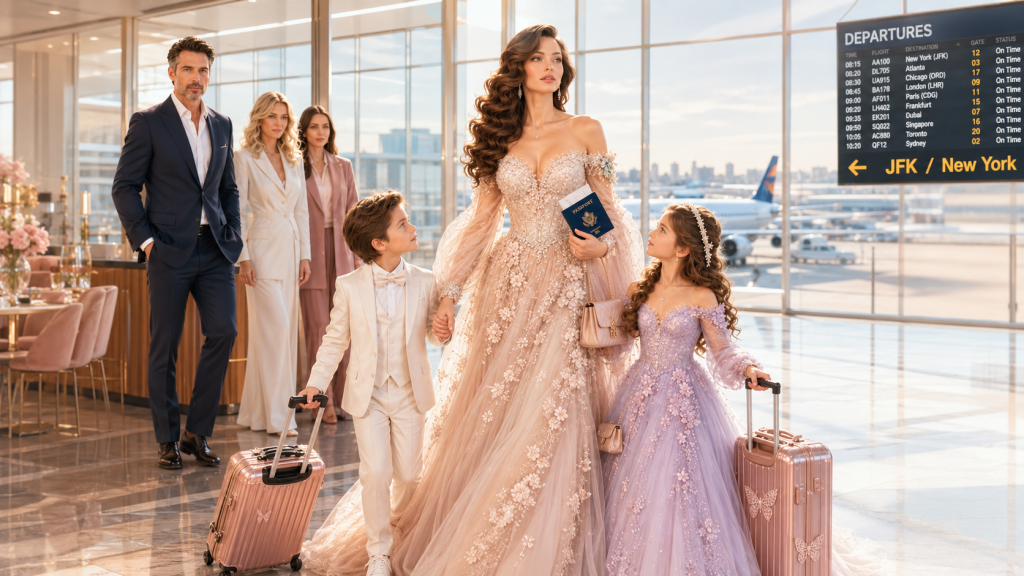
At JFK, the driver pulled up near the international departures entrance.
The airport was alive with movement.
Families dragging suitcases.
Business travelers checking watches.
Children pressing noses to windows.
Announcements echoing above us.
For everyone else, it was just another morning.
For me, it felt like the edge of a new world.
The driver unloaded our bags.
“Mr. Harrison also asked me to tell you that he has filed the emergency motions,” he said quietly.
I nodded.
“Already?”
“Yes, ma’am. And a process server is on the way to the clinic.”
I looked down at the folder in my arms.
“Good.”
Connor tilted his head.
“What’s a process server?”
“A person who gives important papers to grown-ups,” I said.
“Is Dad getting papers?”
“Yes.”
He seemed to think about that.
“Is he in trouble?”
I hesitated.
Then I chose honesty, but gently.
“He has to answer questions about choices he made.”
Connor nodded.
Madison tugged on my sleeve.
“Will there be snacks on the plane?”
A laugh escaped me before I could stop it.
“Yes, baby. There will be snacks.”
That was children.
One moment they carried the weight of adult heartbreak.
The next, they reminded you that life still contained juice boxes and airplane pretzels.
Inside the terminal, my phone began vibrating.
Bradley.
I silenced it.
Then Lorraine.
Then Brittany.
Then Bradley again.
Then a number I did not recognize.
I did not answer.
We checked in.
We went through security.
I kept expecting someone to stop us.
A hand on my shoulder.
An officer saying there was a problem.
Bradley appearing with his expensive lawyer and his practiced outrage.
But no one stopped us.
Because everything I had done was legal.
Everything had been prepared.
For the first time in years, Bradley’s carelessness had helped me.
He had signed away what he did not value.
He had ignored documents because he assumed I was too powerless to use them.
He had mistaken control for intelligence.
While we waited at the gate, I bought the children sandwiches and bottled water.
Madison sat cross-legged on the chair, feeding tiny pieces of bread to her stuffed rabbit.
Connor looked out at the planes.
“Is London far?”
“Pretty far.”
“Do they have soccer?”
I smiled.
“They absolutely have soccer.”
He glanced at me.
“Can I play there?”
My throat tightened.
“Yes. You can play there.”
“With people who show up?”
The question was quiet.
I reached for his hand.
“I’ll show up.”
“I know you will,” he said.
Those four words almost broke me more than the divorce had.
My phone vibrated again.
This time, a message appeared from Bradley.
ANSWER ME NOW.
Then another.
YOU HAD NO RIGHT.
Then another.
WHERE ARE MY CHILDREN?
I stared at the screen.
My children.
Not our children.
Not Connor and Madison.
My children, as if they were possessions he had misplaced.
Then Mr. Harrison called.
I answered immediately.
“Are you at the airport?” he asked.
“Yes. We’re through security.”
“Good. Stay there. Do not engage with Bradley unless necessary.”
“What happened?”
There was a pause.
“The papers were served at the clinic.”
I looked toward the children.
Connor was showing Madison a plane through the window.
“What did he do?”
“Bradley reacted badly.”
“That doesn’t surprise me.”
“Lorraine tried to claim she knew nothing about the accounts in her name.”
“She knew.”
“I believe so. The documents suggest she signed several transfers herself.”
I closed my eyes.
Lorraine Bennett had spent years telling me I was not good enough for her son.
Years criticizing my clothes, my cooking, my parenting, my family, my body after childbirth.
She had called me ungrateful in my own home.
And all the while, she had helped him hide money that should have supported her grandchildren.
“What about Tiffany?” I asked.
Another pause.
“She left through a side entrance.”
I almost laughed.
Of course she did.
Tiffany had always loved entrances.
Grand ones.
Dramatic ones.
A hand placed lightly on Bradley’s arm.
A soft smile across a crowded room.
But exits revealed people more honestly.
“She ran?” I asked.
“She declined to speak without counsel.”
“And Bradley?”
“He is demanding you return.”
“I’m not returning.”
“I know,” Mr. Harrison said. “Your flight?”
“Boarding soon.”
“Good. When you land, your brother will meet you. I will handle things here.”
I lowered my voice.
“Will this hurt the children?”
“The truth may be painful,” he said. “But what Bradley built was already hurting them.”
I looked at Connor.
Then Madison.
He was right.
For years, I had told myself staying quiet protected them.
But silence had not protected them.
It had only protected Bradley.
After we hung up, I finally answered Bradley’s next call.
Not because he deserved it.
Because I wanted him to hear my voice once before we left.
“What did you do?” he hissed.
I could hear chaos behind him.
Lorraine crying.
Brittany shouting.
Someone saying Tiffany’s name.
A nurse asking them to lower their voices.
I looked down at the boarding pass in my hand.
“Nothing you didn’t do first.”
“You sent lawyers to Tiffany’s appointment?”
“I sent evidence to the proper people.”
“You humiliated my family.”
I laughed once, softly.
“No, Bradley. I exposed them.”
“You have no idea what you’ve done.”
“I know exactly what I’ve done.”
His breathing was sharp.
“You think you can run to London and hide?”
“I’m not hiding. I’m taking the children somewhere stable.”
“They’re my kids too.”
“Then you should have remembered that before you called custody less responsibility.”
Silence.
For once, he had no immediate answer.
Then his voice changed.
Lower.
Smoother.
The voice he used when charm failed and manipulation took its place.
“Sarah, listen. We can fix this. Come back. We’ll talk.”
“We talked for years.”
“No, we argued.”
“No,” I said. “I begged. You dismissed me. There’s a difference.”
“You’re angry.”
“I was angry months ago. I’m clear now.”
He exhaled.
“Tiffany is pregnant.”
“Is she?”
The silence on the other end was beautiful.
Sharp.
Complete.
Then he said, “What does that mean?”
“It means maybe you should ask her.”
“You had no right to look into her medical records.”
“I did not look into anything illegally. But you used marital funds and company accounts. You created the paper trail.”
He cursed under his breath.
There he was.
Not the polished businessman.
Not the perfect son.
Not the generous husband his family pretended he was.
Just a man whose secrets had finally become inconvenient.
“Sarah,” he said, quieter now, “please. Don’t take Connor and Madison away from me.”
I looked at the children.
Madison was laughing because Connor had put two pretzels under his lip like tusks.
They looked lighter already.
Not healed.
Not untouched.
But lighter.
“You took yourself away from them long before today,” I said.
“That’s not fair.”
“No, Bradley. What wasn’t fair was Connor waiting after games while you sent excuses. What wasn’t fair was Madison making birthday cards you never came home to read. What wasn’t fair was me telling them you loved them while you spent their college money on Tiffany’s condo.”
“I can explain.”
“You always can.”
“Sarah—”
“No. You had ten years to be a husband and father. You chose something else.”
The gate agent announced our boarding group.
I stood.
“Goodbye, Bradley.”
“Don’t hang up.”
“I already did.”
Then I ended the call.
My hand trembled afterward.
Only a little.
But Connor saw.
He stood and wrapped his arms around my waist.
“Are we okay?”
I kissed the top of his head.
“We’re going to be.”
Madison held up her rabbit.
“Bunny says we’re brave.”
I smiled through the ache in my chest.
“Bunny is right.”
We boarded the plane.
Madison insisted on the window seat.
Connor sat in the middle.
I took the aisle.
As the aircraft filled with passengers, I watched my children settle into their seats.
Connor studied the safety card like it was a serious responsibility.
Madison pressed her palm to the window.
“Mommy,” she whispered, “are we flying away forever?”
I buckled her seat belt.
“No. We’re flying toward something better.”
“Will Dad visit?”
I paused.
“I don’t know.”
“Do you want him to?”
Children ask questions like doors opening in dark rooms.
You can either slam them shut or let in a little light.
“I want him to become the kind of father you deserve,” I said. “But that is something he has to choose.”
She thought about that.
“Can people choose better?”
“Yes.”
“Will he?”
I looked out the window at the gray runway.
“I hope so.”
But hope was not the same as waiting.
I had spent too many years waiting for Bradley to become the man he pretended to be in public.
I had waited through forgotten anniversaries.
Through apologies without change.
Through birthdays he missed.
Through dinners where his mother spoke over me.
Through nights when he came home smelling like champagne and someone else’s skin.
Through mornings when he kissed the children quickly, already looking at his phone.
Waiting had become a room I lived in.
And today, finally, I had walked out.
As the plane began to taxi, my phone buzzed one last time before airplane mode.
A message from Brittany.
You destroyed everything.
I stared at it for a moment.
Then I typed back.
No. I stopped helping you hide it.
I sent the message.
Then I switched off my phone.
The plane turned toward the runway.
Madison grabbed my hand.
Connor grabbed the other.
The engines roared.
New York blurred outside the window.
And as the plane lifted from JFK, I felt something in me loosen.
Not happiness.
Not yet.
Freedom does not always arrive smiling.
Sometimes it arrives exhausted.
Sometimes it arrives with swollen eyes and legal folders and children asking questions you wish they never had to ask.
Sometimes freedom is not a celebration.
Sometimes it is simply the first breath you take after years underwater.
I held my children’s hands until the clouds swallowed the city.
By the time we landed in London, rain streaked the windows of the plane.
Madison woke up confused, her hair messy, her rabbit crooked in her arms.
Connor looked nervous but tried to hide it.
“Is Uncle Daniel here?” he asked.
“He promised he would be.”
We followed the crowd through immigration.
My heart pounded until the officer stamped our passports.
That sound felt like a door opening.
On the other side of arrivals, Daniel was waiting with a cardboard sign that said WELCOME HOME, BENNETT CREW.
Beside him stood his wife, Priya, holding three umbrellas and crying already.
Madison spotted them first.
“Uncle Danny!”
She ran.
Daniel dropped the sign and caught her in his arms.
Connor tried to act older, walking instead of running, but when Daniel opened one arm, my son folded into him like he had been holding himself together for too long.
Priya hugged me last.
Not quickly.
Not politely.
She held me like someone pulling a survivor from deep water.
“You’re here,” she whispered.
“I’m here.”
“You’re safe.”
That was when I finally cried.
Not loudly.
Not dramatically.
Just one broken breath against her shoulder.
Because no one had said that to me in years.
You’re safe.
Daniel took the suitcases.
Priya took Madison’s hand.
Connor walked beside me.
Outside, London was gray and wet and unfamiliar.
But the air felt honest.
No penthouse full of ghosts.
No mother-in-law arriving uninvited.
No Tiffany’s perfume in the elevator.
No Bradley’s footsteps in the hallway making my stomach tighten.
Just rain.
Traffic.
My brother’s old Volvo.
And two children staring out at a city that did not know our history.
Daniel’s house was in a quiet neighborhood with brick buildings, narrow streets, and flower boxes under the windows.
The guest rooms were small but warm.
Madison’s bed had a yellow blanket.
Connor’s had a blue one.
Priya had placed books on both nightstands.
At dinner, Daniel made pasta badly, as he had always done.
Priya rescued it with sauce.
Madison laughed for the first time that day.
Connor asked if he could try out for a local football club.
“Football,” Daniel corrected.
Connor grinned.
“Right. Football.”
That night, after the children fell asleep, I sat at the kitchen table with tea cooling between my hands.
Daniel sat across from me.
Priya leaned against the counter.
“What happens now?” Daniel asked.
“Mr. Harrison files everything. Hidden assets. Misuse of marital funds. Custody enforcement. Possibly fraud.”
Daniel’s expression darkened.
“He really thought he could just walk away?”
“He thought I wouldn’t fight.”
Priya crossed her arms.
“Men like that always confuse kindness with permission.”
I looked toward the hallway.
“I should have left sooner.”
Daniel shook his head.
“No.”
“I let the children live inside that tension.”
“You survived the best way you knew how,” he said. “Now you know more. So you’re doing more.”
I wanted to believe that.
Some nights, I did.
Some nights, guilt crawled into bed beside me anyway.
Over the next few weeks, London became a rhythm.
School visits.
Grocery stores.
Raincoats.
New routines.
Madison became fascinated by double-decker buses.
Connor joined a youth football practice and came home muddy, exhausted, and smiling.
I found a small flat near Daniel’s neighborhood using money from an account my father had left in trust for me, money Bradley had never been able to touch because he had never known it existed.
That had been my father’s final protection.
Not wealth.
Not luxury.
A door.
A way out.
Meanwhile, back in New York, Bradley’s perfect new life collapsed in stages.
First, the court froze several accounts.
Then Lorraine was ordered to provide records for transfers made in her name.
Then Bradley’s company launched an internal review after Mr. Harrison sent documents showing corporate funds had been used for personal expenses.
Then Tiffany’s lawyer sent Bradley a letter stating that she would not participate in “public accusations regarding paternity.”
That phrase told me everything.
Bradley called from new numbers.
I did not answer unless Mr. Harrison advised me to.
When I did speak to him, I kept every conversation short and documented.
He tried anger first.
Then guilt.
Then charm.
Then fatherhood.
“I miss them,” he said one evening.
“They’re available for scheduled video calls.”
“You took them too far.”
“You signed the agreement.”
“I didn’t understand what I was signing.”
“That has become a pattern for you.”
He hated that.
Good.
One Sunday, Connor agreed to a video call.
I sat nearby, out of frame.
Bradley appeared on the screen looking thinner, tired, less polished.
“Hey, buddy,” he said. “How’s London?”
Connor shrugged.
“It’s okay.”
“Playing soccer?”
“Football.”
Bradley forced a laugh.
“Right. Football.”
Silence stretched.
Then Bradley said, “I miss you.”
Connor looked down.
“You missed me before too.”
Bradley blinked.
“What?”
“You missed games. And my school thing. And my birthday dinner. Mom said you were busy.”
Bradley swallowed.
“I was working.”
Connor looked at him with the clear, devastating honesty of a child.
“No, you weren’t.”
I almost stepped in.
I almost softened it.
Old habits.
Protect Bradley.
Explain for Bradley.
Make the children carry less of Bradley’s shame.
But I stayed still.
Bradley’s face crumpled slightly.
“Connor, I made mistakes.”
“Are you going to make them again?”
“I’m trying not to.”
Connor nodded slowly.
“Okay.”
It was not forgiveness.
It was not rejection.
It was a door left barely open.
And Bradley, for once, seemed to understand he had no right to kick it wider.
Madison’s call was shorter.
She showed him Bunny.
She showed him her new rain boots.
Then she asked, “Do you live with Tiffany now?”
Bradley froze.
“No.”
“Where is her baby?”
He looked away.
“There isn’t going to be a baby in my life right now.”
Madison frowned.
“Oh.”
Then she said, “Mommy makes pancakes here.”
Bradley gave a sad little smile.
“That sounds nice.”
“It is,” she said.
Then she handed the tablet back to me and ran off.
After I ended the call, I stood in the kitchen for a long time.
Not because I missed Bradley.
Because I was mourning the version of him I had once promised the children they had.
Months passed.
The legal case moved slowly, but it moved.
Hidden assets were uncovered.
The Central Park condo was pulled into the divorce proceedings.
Lorraine’s involvement became impossible for her to deny.
Brittany stopped texting me after Mr. Harrison warned her that harassment would be documented.
Tiffany disappeared from social media.
Bradley resigned from his company before they could remove him publicly.
He did not lose everything.
Men like Bradley rarely do.
But he lost the illusion that everything was his to control.
And that mattered.
One afternoon, almost a year after the divorce, I returned to New York for a final hearing.
I did not bring the children.
Daniel and Priya kept them in London.
I walked into the courthouse wearing a navy dress, low heels, and my mother’s pearl earrings.
Bradley was already there.
For a moment, I barely recognized him.
He looked older.
Not old.
Just less protected by arrogance.
Lorraine sat behind him, pale and stiff.
Brittany was not there.
Neither was Tiffany.
Bradley stood when he saw me.
“Sarah.”
“Bradley.”
He looked like he wanted to say something rehearsed.
Maybe an apology.
Maybe a defense.
Maybe a version of both that made him feel less guilty.
Instead, he said, “How are the kids?”
“They’re good.”
“Connor still playing?”
“Yes.”
“And Madison?”
“She lost two teeth and now believes the tooth fairy prefers British coins.”
He smiled faintly.
Then the smile faded.
“I deserved that.”
“You deserved worse.”
He nodded.
“I know.”
I studied his face.
For years, I had wanted him to say those words.
I had imagined them curing something.
They did not.
They were only words.
Useful, maybe.
Late, definitely.
But not enough to rebuild what he had burned.
Inside the courtroom, the judge reviewed the amended settlement.
The hidden assets were accounted for.
Funds were ordered into trusts for Connor and Madison.
Bradley was required to repay misused marital money.
International custody terms were clarified.
Visitation would be structured.
Supervised at first.
Therapy required.
Communication documented.
No surprise visits.
No using the children as messengers.
No interference from Lorraine.
When the judge finished, she looked at Bradley.
“Mr. Bennett, your previous conduct has made these restrictions necessary. Parenthood is not a title you claim when convenient. It is a responsibility demonstrated over time.”
Bradley lowered his eyes.
“Yes, Your Honor.”
Then she looked at me.
“Ms. Bennett, the court acknowledges the steps you took to protect your children within the law. I hope the next chapter is quieter for all of you.”
Quieter.
That word stayed with me.
After the hearing, Bradley followed me into the hallway.
“Sarah.”
I stopped.
“I’m not asking you to forgive me,” he said.
“Good.”
He nodded.
“I just wanted to say… you were right. About all of it. I was selfish. I was cruel. I let my family disrespect you because it was easier than standing up to them. I used money to hide what I didn’t want to face. And I hurt the kids.”
I folded my arms.
“Yes.”
He flinched, but he accepted it.
“I’m in therapy.”
“I hope it helps.”
“I want to be better for them.”
“Then be consistent.”
“I will.”
“Do not promise me. Show them.”
He looked at me for a long moment.
Then he said, “You’re different.”
I almost smiled.
“No. I’m just not yours anymore.”
That was the last time I saw Bradley in New York as my husband.
After that, he became what he should have been all along.
A person with responsibilities.
Not power.
Not ownership.
Responsibility.
When I flew back to London, Connor and Madison met me at arrivals with Daniel and Priya.
Madison launched herself into my arms.
Connor tried to act calm but hugged me hard.
“Did it go okay?” he asked.
“It went okay.”
“Do we have to go back?”
I shook my head.
“No. Not unless we choose to visit.”
Madison gasped.
“So this is home?”
I looked at Daniel.
At Priya.
At my children.
At the gray London sky beyond the glass.
Then I smiled.
“Yes,” I said. “This is home.”
That night, we made pancakes for dinner because Madison insisted celebrations did not need rules.
Connor spilled flour on the counter.
Madison dropped blueberries on the floor.
Daniel burned the first pancake.
Priya laughed until she cried.
And I stood in the middle of that warm, messy kitchen, realizing something I had forgotten during all those years in Bradley’s penthouse.
A home is not marble floors.
It is not skyline views.
It is not expensive furniture chosen to impress guests.
A home is where your children stop flinching.
A home is where laughter does not have to ask permission.
A home is where peace is not a temporary visitor.
Later, after everyone slept, I opened the balcony door and stepped into the cool night air.
The city hummed softly around me.
My phone sat on the table behind me.
No angry messages.
No threats.
No demands.
Just quiet.
For years, I thought divorce would be the worst thing that ever happened to me.
I thought losing Bradley would mean losing my life.
But the truth was, I had been losing myself while trying to keep him.
I lost my voice one swallowed argument at a time.
I lost my confidence one insult at a time.
I lost my peace one lie at a time.
And then, slowly, quietly, I took it back.
With passports.
With evidence.
With help.
With courage I did not know I still had.
Bradley once told me there was nothing left to divide.
He was wrong.
There was a life left to divide.
The old one from the new.
The fear from the freedom.
The woman who stayed silent from the woman who finally walked away.
And when I looked through the balcony doors at Connor asleep on the couch with a football under his arm, and Madison curled beside him with Bunny tucked under her chin, I knew exactly what I had taken from that courthouse.
Not revenge.
Not victory.
Not even justice, though I had earned some of it.
I had taken my children.
Their passports.
The truth.
And the future Bradley had been foolish enough to think belonged only to him.
The next morning, Madison woke me before sunrise.
“Mommy,” she whispered, climbing into my bed. “I had a dream.”
I brushed hair from her face.
“Was it scary?”
She shook her head.
“We were flying again. But this time, nobody was chasing us.”
Connor appeared in the doorway, pretending he had not come to listen.
“And where were we going?” I asked.
Madison smiled.
“Home.”
Connor leaned against the doorframe.
“We’re already there.”
I pulled them both into bed with me.
Outside, rain tapped softly against the window.
Inside, my children were warm, safe, and laughing beneath the blankets.
And for the first time in years, I did not wonder what Bradley would do next.
I did not wonder who would call.
I did not wonder what secret would come spilling out of the dark.
I simply held my children and listened to the rain.
Because sometimes the happiest ending is not loud.
Sometimes it is not dramatic.
Sometimes it does not arrive with applause or grand speeches.
Sometimes it is just a mother, two children, and a quiet morning in a city far from everything that once broke them.
And that was enough.
More than enough.
It was everything.
THE END.
THE END! THANK YOU FOR READING!