

My fiancé left me after I was told I did not have much time left — so I hired a stranger to stand beside me at the altar as my last wish. For nearly a year, my fiancé had helped me plan the wedding I had dreamed about for most of my life. His name was Aaron.
He had proposed to me under a row of white lights in my parents’ backyard, with my mother crying into both hands and my father pretending he had something in his eye. Aaron had knelt in the grass, held up my grandmother’s ring, and told me he wanted every ordinary day with me.
At the time, I believed him.
I believed the way his voice shook.
I believed the way he looked at me.
I believed the promise in front of our families when he said, “I choose you, Clara. For everything.”
Everything.
That word became cruel later.
My father had already paid for the venue, the flowers, the dress, the catering for one hundred and twenty guests, the string quartet, the photographer, even the little white candles my mother insisted would make the reception feel softer.
The invitations had been sent.
Relatives from three states had booked flights.
My bridesmaids had their dresses hanging in garment bags.
My mother had cried during my final fitting when I stepped out in ivory lace and asked, “Is it too much?”
She had touched her mouth and whispered, “No, sweetheart. It is exactly you.”
I remember laughing that day.
I remember thinking I was lucky.
Then my doctor said one word that changed everything.
Terminal.
The word did not sound real at first.
It sounded like a word from someone else’s life. A word on a medical drama. A word whispered in hospital hallways by families who were not mine.
But Dr. Benson sat across from me in a bright, freezing exam room, her hands folded gently over my test results, and said it again in a softer way.
“The cancer has progressed faster than we hoped.”
Aaron sat beside me.
I reached for his hand before she finished speaking.
My fingers wrapped around his so tightly my knuckles turned pale. I thought he would squeeze back harder. I thought he would tell me we would fight. I thought he would ask about options, treatments, miracles, anything.
Instead, his hand went still.
Not away.
Not yet.
Just still.
Dr. Benson spoke carefully after that. There were treatments to slow things down. There were medications for comfort. There were guesses, not promises. Months, maybe less, maybe more if my body responded.
I stared at a poster on the wall showing a smiling woman drinking tea beside a window.
Aaron stared at the floor.
When we left the hospital, the sky was painfully blue.
People were walking their dogs. A woman pushed a stroller past us. Somewhere nearby, someone laughed into a phone.
The world had no respect for my disaster.
Aaron drove us home without music.
At a red light, I turned to him and tried to smile.
“Well,” I whispered, “this is not exactly what we planned.”
He did not smile back.
He just nodded, his jaw tight.
I told myself he was scared.
I told myself anyone would be scared.
For two days, he stayed close but distant. He made me soup I did not ask for. He answered my mother’s calls in the other room. He sat beside me on the couch but did not touch me unless I touched him first.
On the second evening, I woke from a nap to the sound of a zipper.
At first, I thought he was looking for something.
Then I walked into the kitchen and saw the suitcase beside the door.
Aaron stood by the counter with red, swollen eyes. His hair was messy, like he had been pulling at it. In one hand, he held his car keys.
I stopped in the doorway.
“What are you doing?”
He looked at me, and I saw it before he said anything.
The answer.
The leaving.
“I’m sorry,” he said quietly.
My heart gave one dull, heavy beat.
“For what?”
He swallowed.
“I can’t do this.”
I blinked at him.
For one ridiculous second, I thought he meant the wedding. Maybe he meant we should move it up. Maybe he meant he could not stand waiting. Maybe he meant he was overwhelmed.
“What do you mean?” I asked.
He looked toward the suitcase.
“I thought I could be strong enough. I wanted to be. I really did. But I can’t watch you disappear, Clara. I can’t marry you knowing I’m going to lose you.”
The room tilted.
“You’re going to lose me anyway,” I said.
His face twisted.
“I know.”
“So you would rather lose me by walking away?”
He covered his mouth with one shaking hand.
“I’m sorry.”
At first, I thought he meant he could not handle the illness.
Then I realized the truth.
He meant he could not handle me.
Not the hospital visits. Not the pain. Not the thin version of me that might come later. Not the fear. Not the responsibility of standing beside a woman who might not make it to old age with him.
I was no longer a bride to him.
I was a tragedy.
And he did not want to be trapped inside it.
I laughed once, but it sounded broken.
“You promised everything.”
He closed his eyes.
“I know.”
“You stood in my parents’ yard and said you chose me for everything.”
“I know.”
“Then say it honestly,” I whispered. “Say you only meant the easy parts.”
His eyes opened.
He looked at me like I had slapped him.
But he did not deny it.
That was the worst part.
He picked up the suitcase.
I stood there, too weak to scream, too stunned to cry.
At the door, he turned back.
“I will always love you,” he said.
I shook my head slowly.
“No. You will always love the version of me who did not need you.”
His mouth opened, but nothing came out.
Then he left.
The door clicked shut behind him with the softness of a final breath.
For a while, I did not move.
I stared at the empty place where his suitcase had been.
Then I sank to the kitchen floor.
My mother found me there an hour later after I failed to answer her calls. She had a key, thank God. She came in calling my name and stopped when she saw me.
I was sitting with my back against the cabinets, holding my engagement ring in my palm.
“Oh, Clara,” she whispered.
I did not tell her everything.
I did not have to.
She sat on the floor beside me, pulled me into her arms, and rocked me the way she had when I was little and feverish.
My father arrived ten minutes later.
He did not cry at first.
He walked through the house once, as if Aaron might be hiding somewhere and he could drag him back by the collar.
Then he came into the kitchen, saw the suitcase gone, and his face changed.
I had seen my father angry before.
I had never seen him look betrayed for me.
“He left?” he asked.
I nodded.
My father’s hands curled into fists.
My mother said softly, “Tom.”
He looked down at me, and the anger broke into grief.
He knelt in front of me.
“I am so sorry, sweetheart.”
That was when I cried.
Not because Aaron had left.
Not only because of that.
I cried because my father’s apology made the whole thing real.
The man who was supposed to stand beside me at the altar had decided my ending was too heavy for him to carry.
The wedding was supposed to be three weeks later.
For three days, everyone spoke around the subject in gentle voices.
Cancel the venue.
Call the guests.
Return what could be returned.
Donate the flowers.
Sell the dress.
My mother moved through the house making lists with trembling hands. My father spoke to vendors in a voice so controlled it scared me.
I sat in my bedroom and watched dust float in the sunlight.
I was tired.
Sick tired.
Heartbroken tired.
Humiliated tired.
Every time my phone buzzed, I hoped it was Aaron.
Every time it was not, I hated myself for hoping.
On the fourth night, I opened the closet and unzipped the garment bag.
My wedding dress hung there like a ghost.
Ivory lace.
Tiny pearl buttons.
A neckline my mother said made me look graceful.
I touched the sleeve and remembered all the years I had imagined wearing it.
As a child, I had wrapped bedsheets around myself and walked down the hallway pretending it was an aisle. My father would hum wedding music badly, and my mother would toss tissues like flower petals.
When I was thirteen, my grandmother told me, “The wedding is not the prize, Clara. The marriage is.”
I knew she was right.
Of course I knew.
But I also knew I might not get the marriage now.
Maybe not with anyone.
Maybe not ever.
And if my time was truly running out, why did I have to let Aaron take the day too?
He had already taken the future I imagined.
Why should he take the one beautiful memory that was already paid for, planned, and waiting?
Maybe it was silly.
Maybe it was pathetic.
Maybe anyone sensible would have canceled everything.
But grief does not always make sensible requests.
That night, a strange thought came to me.
The wedding did not have to disappear.
I only needed someone to stand at the altar.
Not a real husband.
Not a legal marriage.
Just someone kind enough to play the part long enough for me to walk down the aisle in the dress my mother cried over.
Someone to let my father give me away.
Someone to let me have one day where people did not look at me like I was dying.
I opened my laptop.
My hands shook as I searched for local acting agencies.
The first few websites looked too expensive. Some actors had glossy headshots and dramatic reels. Some specialized in commercials, theater, corporate events.
I felt ridiculous.
I typed an email three times and deleted it twice.
Finally, I wrote the truth.
My name is Clara Whitmore. I am supposed to get married on June 14. My fiancé left after I received a terminal diagnosis. The wedding has already been paid for, and my family cannot bear to cancel it. I know this sounds strange, but I am looking to hire someone to stand in as the groom for a symbolic ceremony only. No legal documents. No deception for money. I just want one beautiful day before things get worse. I understand if this request is impossible.
I sent it to the cheapest actor listed as available on my date.
His name was Daniel Hayes.
His headshot showed a man in his early thirties with dark hair, steady eyes, and a small scar near his eyebrow. His resume said he did community theater, voiceover work, and occasional background roles in films shot locally.
I expected silence.
Or disgust.
Or a polite no.
Because really, what kind of person would agree to pretend to marry a dying woman?
The next morning, his reply appeared in my inbox.
It was only one sentence, but it made my breath stop.
I’ll do it under ONE condition.
My stomach twisted.
I clicked the email.
Below that first line, he had written:
You do not pay me. Not a dollar. You let me help make that day beautiful for you, and afterward, you let me disappear quietly if that is what you want.
I read it three times.
Then I cried so hard I had to close the laptop.
My mother thought something was wrong when she found me.
Then I showed her the email.
She read it slowly, one hand pressed against her chest.
“Oh,” she whispered.
My father read it after her. He was silent for a long time.
Then he said, “I want to meet him.”
So did I.
Daniel arrived at my parents’ house two days later wearing a navy sweater and carrying a small bouquet of yellow tulips.
Not roses.
Not anything romantic.
Just tulips, bright and simple.
“For the house,” he said when my mother opened the door. “Not for the performance.”
My mother stared at him for half a second, then stepped aside.
He looked different from his headshot. Warmer. Less polished. More human. There were faint lines near his eyes, like he smiled often but not carelessly.
When he saw me sitting in the living room, he did not freeze. He did not pity-stare at my scarf, my thin wrists, the blanket over my lap.
He just smiled gently.
“Clara?”
I nodded.
“Daniel?”
“That’s me.”
My father stood like a guard by the fireplace.
Daniel noticed but did not seem offended.
We all sat together around the coffee table, and for several minutes, nobody knew how to begin.
Finally, Daniel leaned forward.
“I want to be clear. I am not here to take advantage of anyone’s grief. I am not here to make this weird. I am here because your email sounded like someone asking for dignity, not fantasy.”
That sentence settled something inside me.
My father’s shoulders lowered slightly.
Daniel continued, “I can stand at the altar. I can walk through a symbolic ceremony. I can dance if you want. I can smile for photos. I can answer questions vaguely. But I will not lie about being legally married if anyone asks directly. I also think your closest family should know the truth.”
“They do,” I said.
“My parents know. My maid of honor knows. The officiant will know too. The guests will think…” I stopped.
Daniel finished softly, “That your fiancé came back?”
I flinched.
“No,” I said. “I do not want him to be Aaron.”
Daniel nodded immediately.
“Good.”
I looked at him.
“Good?”
“You deserve a better memory than pretending the man who left suddenly became brave.”
My mother made a small sound and looked away.
My father cleared his throat.
I stared at Daniel, surprised by the anger that flashed through me.
Not at him.
At the truth.
“What would we tell people?” I asked.
Daniel shrugged gently.
“That I’m Daniel. That plans changed. That life is complicated. People will whisper no matter what. Let them.”
I almost laughed.
“You make it sound easy.”
“It won’t be easy,” he said. “But it can still be beautiful.”
That became the plan.
A strange, impossible, fragile plan.
Over the next two weeks, Daniel came by several times.
At first, it was practical.
He met the officiant.
He learned the schedule.
He got fitted for a suit my father insisted on buying, though Daniel protested until my father said, “Son, please do not rob me of something useful to do.”
Daniel stopped arguing after that.
He met my bridesmaids over coffee and handled their suspicious questions with patient honesty. My maid of honor, Jenna, crossed her arms and asked, “Why are you really doing this?”
Daniel looked at me before answering.
“My sister died at twenty-seven,” he said quietly. “She was engaged too. Her fiancé stayed. He married her in a hospital chapel six days before she passed. It was not about pretending everything was fine. It was about saying her life still deserved ceremony.”
The room went still.
“I could not save my sister,” he continued. “But maybe I can help Clara keep one day from being stolen.”
After that, Jenna stopped glaring.
I learned Daniel’s sister’s name was Elise.
I learned he carried her photo in his wallet.
I learned he became an actor because Elise had loved theater and dared him to audition for a play when they were teenagers.
“You were good?” I asked.
“No,” he said. “I was terrible. But she laughed for two hours, so I kept doing it.”
He made me laugh too.
Not all the time.
Some days, my body hurt too much.
Some days, fear crawled up my throat and sat there like a stone.
Some days, I hated the mirror.
But Daniel never forced brightness into the room.
If I was sad, he sat with sadness.
If I was angry, he let me be angry.
If I was quiet, he did not fill the silence just to make himself comfortable.
Once, after a long appointment, I found him in my parents’ kitchen washing dishes while my mother sat at the table crying silently.
He did not look embarrassed.
He just dried a plate and said, “Your mom made soup. She threatened me if I did not eat two bowls.”
My mother laughed through her tears.
That was Daniel’s gift.
He did not fix anything.
He simply stayed.
Aaron called six days before the wedding.
I stared at his name on my phone until it stopped ringing.
Then it rang again.
My mother looked at me from across the room.
“You do not have to answer.”
I knew that.
But some part of me needed to hear what kind of courage arrived weeks too late.
So I answered.
“Clara,” Aaron breathed. “Thank God.”
“What do you want?”
He was quiet.
“I heard you’re still having the wedding.”
My hand tightened around the phone.
“Who told you?”
“Jenna’s cousin posted something about traveling in for it. I thought…” He stopped. “Is it true?”
“Yes.”
“With who?”
I closed my eyes.
“That is not your concern.”
“Clara, please. This is insane.”
I laughed softly.
“You leaving me because I am sick was sane?”
He inhaled sharply.
“I panicked.”
“Yes.”
“I made a mistake.”
“Yes.”
“I want to see you.”
“No.”
His voice cracked.
“I still love you.”
There it was again.
Love.
That word people used as if saying it could erase what they did when love became inconvenient.
“You loved me when I was easy,” I said.
“That’s not fair.”
“No, Aaron. What is not fair is that I was sitting in a doctor’s office being told my life might be ending, and the person holding my hand was already halfway out the door.”
He said nothing.
“I do not hate you,” I continued. “That would take too much energy. But you do not get to come back because you are lonely with your guilt.”
“I can be there,” he said desperately. “I can stand with you.”
I opened my eyes.
“No. Someone else already agreed to stand where you walked away.”
“Who?”
“Someone kinder.”
Then I hung up.
I shook afterward.
Daniel found me on the porch that evening, wrapped in a blanket, watching the sun slide behind the trees.
My mother must have told him.
He sat beside me without asking.
“Aaron called,” I said.
“I figured.”
“He wants to come back.”
Daniel looked at the yard.
“And do you want him to?”
The question was gentle.
Not jealous.
Not leading.
Just honest.
I thought about Aaron’s voice. About the kitchen. About the suitcase.
Then I thought about Daniel washing dishes while my mother cried.
“No,” I said.
Daniel nodded.
“Then don’t let him.”
The wedding morning arrived bright and warm.
For a moment after waking, I forgot everything.
I saw sunlight across my bedroom wall and thought, Today is my wedding day.
Then memory returned.
The diagnosis.
The leaving.
The stranger.
The impossible plan.
My stomach fluttered with terror.
My mother came in carrying tea, already crying.
“Mom,” I said, “you promised not before makeup.”
She wiped her face quickly.
“I am not crying. My eyes are just dramatic.”
Jenna arrived with the bridesmaids, and suddenly the room filled with dresses, curling irons, perfume, and nervous laughter.
No one mentioned death.
No one mentioned Aaron.
For once, my illness was not the center of the room.
I was.
My mother helped me into the dress.
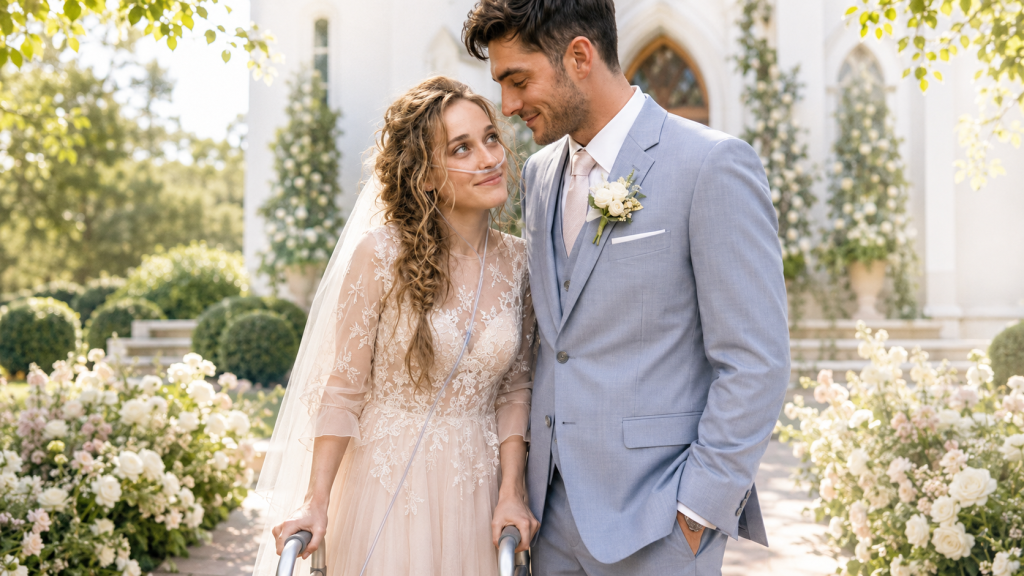
The lace slipped over my shoulders like a memory from another life. The gown was a little loose now, despite last-minute alterations, but Jenna pinned it carefully, hands trembling.
When I turned toward the mirror, everyone went quiet.
I barely recognized myself.
I looked pale, yes.
Fragile, yes.
But I also looked like a bride.
Not a patient.
Not a tragedy.
A bride.
My mother stood behind me, both hands on my shoulders.
“Oh, Clara,” she whispered.
I reached up and covered her hand with mine.
“Was it worth keeping the dress?”
She laughed and cried at the same time.
“Yes.”
Downstairs, my father waited in his suit.
When he saw me, his face broke completely.
He turned away, pressing his fist against his mouth.
“Dad,” I said softly.
He nodded several times before facing me again.
“You look beautiful, sweetheart.”
I smiled.
“Are you ready to walk me down the aisle?”
His eyes filled.
“I have been ready since you were six and wearing a bedsheet.”
The venue was a small historic chapel attached to a garden hall.
White flowers lined the aisle. Candles flickered near the windows. Sunlight poured through stained glass and scattered soft colors over the wooden pews.
Guests murmured as they took their seats.
Some knew enough to look sad.
Some knew nothing and looked confused.
Some whispered when they saw Daniel standing at the altar.
He wore a charcoal suit and a white boutonniere.
When our eyes met from the back of the chapel, he did not perform a grand smile.
He simply looked steady.
Present.
Like a promise he intended to keep for the length of one impossible day.
The music began.
My father tucked my hand into his arm.
I felt him trembling.
“You can stop at any time,” he whispered.
“I know.”
“You owe nobody this.”
“I know.”
“Then why are we doing it?”
I looked down the aisle at Daniel.
Then at my mother in the front row.
Then at all the flowers my father had paid for, all the candles my mother had chosen, all the faces of people who had come expecting love and found something stranger but maybe not less sacred.
“Because I am still here,” I whispered.
My father nodded.
Then we walked.
Every step felt enormous.
People stood.
Some cried.
Some stared.
Halfway down the aisle, I felt my strength dip, and my father slowed immediately.
Daniel noticed.
He took one small step forward, then stopped, letting me come to him.
That tiny restraint nearly undid me.
Aaron would have rushed to look heroic.
Daniel waited so I could remain dignified.
At the altar, my father kissed my cheek.
When he placed my hand into Daniel’s, his voice was low and fierce.
“Take care of this moment.”
Daniel answered, “I will.”
The officiant began.
“Dearly beloved, we are gathered here today not only to witness vows, but to honor courage, love, and the fragile beauty of time.”
My throat tightened.
Daniel held my hands gently, carefully, as if they were something precious.
The officiant spoke of partnership, not legality. Of presence, not possession. Of choosing kindness when life became unbearable.
Then Daniel took a folded paper from his pocket.
He had written vows.
I had not expected that.
He looked at me, and the chapel became so quiet I could hear my own breathing.
“Clara,” he said, “when you first wrote to me, you asked for someone to play a part. But standing here now, I do not feel like I am pretending. I am not your husband. I will not claim a place in your life that was not offered to me. But today, in front of everyone who loves you, I promise this: you are not abandoned. You are not a burden. You are not a sad ending wearing a wedding dress. You are a woman whose life is still worthy of flowers, music, witnesses, and joy.”
Tears blurred his face.
He continued, voice rougher now.
“I promise to stand beside you for this day with honesty. I promise to protect the dignity of this moment. And I promise that when people remember this wedding, they will not remember who left. They will remember who you were brave enough to be after he did.”
A sob escaped my mother.
My father covered his eyes.
I could barely breathe.
The officiant turned to me.
I had written vows too, though mine were short.
I unfolded the paper with shaking hands.
“Daniel,” I began, “you came into my life as a stranger because the man I loved could not stay. I thought I needed someone to help me pretend. But you taught me I did not need to pretend at all. This day is not what I planned. You are not who I expected to meet at the altar. But you are here. And sometimes being here is the kindest thing one person can offer another.”
I looked out at the guests.
Then back at him.
“I do not know how much time I have left. But I know I will remember this day. I will remember that when I felt discarded, someone reminded me I still had worth. Thank you for standing beside me.”
Daniel’s eyes shone.
The officiant smiled softly.
“Then by the power of love, witness, and the sacred dignity of this promise, I invite you to seal this ceremony in whatever way feels true.”
Daniel leaned closer, but waited.
I smiled through tears and kissed his cheek.
The chapel exhaled.
Then, just as the music began, the chapel doors opened.
Every head turned.
Aaron stood in the doorway.
He looked terrible.
Unshaven. Pale. His tie crooked. His eyes fixed on me as if the sight of my dress had wounded him.
For one strange second, nobody moved.
Then murmurs rippled through the chapel.
Aaron stepped forward.
“Clara.”
My father rose from the front pew so fast my mother grabbed his arm.
Daniel did not release my hand.
Aaron walked halfway down the aisle, his face crumbling.
“I’m sorry,” he said. “I was wrong. I know I was wrong. I should have been here.”
I stared at him.
This was the scene some foolish part of me might have wanted weeks ago.
The runaway fiancé returning.
The grand apology.
The chance to restore the story.
But standing there in my wedding dress, with Daniel’s steady hand around mine, I felt no relief.
Only sadness.
Because Aaron had not come back for me.
Not really.
He had come back because the ceremony had gone on without him.
Because my grief had not waited politely for his courage to arrive.
Because someone else was standing where he had chosen not to stand.
“You should leave,” I said.
Aaron flinched.
“Please. Just let me talk to you.”
My father stepped into the aisle.
His voice was calm, but everyone in that chapel heard the steel in it.
“You already made your choice.”
Aaron looked at him.
“Mr. Whitmore, I—”
“No,” my father said. “You packed a suitcase while my daughter was dying. There is nothing you can say in this room that will make that smaller.”
Aaron’s face twisted.
My mother stood too, tears running freely now.
“She needed you,” she whispered. “And you made her comfort your fear.”
Aaron looked back at me.
“I was scared.”
“So was I,” I said.
The words were soft, but they landed hard.
Aaron had no answer.
Daniel finally spoke.
His voice was quiet.
“This is her day. Do not take another part of it.”
Aaron looked at him with pain and anger.
“Who are you?”
Daniel held my hand a little more firmly.
“Someone who stayed.”
Silence fell.
Aaron’s shoulders sank.
For a moment, I saw the man I had loved. Not the coward, not the villain, just a broken human being who had failed at the worst possible time.
And maybe someday, if I had enough time, I would forgive him fully.
But forgiveness was not an invitation.
I slipped the engagement ring from my right hand. I had worn it there that morning, not because I wanted him back, but because I needed to decide what to do with it.
Now I knew.
I walked slowly down the aisle until I stood before Aaron.
He looked hopeful.
That almost made it harder.
I took his hand, placed the ring in his palm, and closed his fingers around it.
“You were part of my life,” I said. “But you do not get to be part of this memory.”
His eyes filled.
“Clara…”
“Goodbye, Aaron.”
I turned away before he could answer.
My father stepped aside for me.
Daniel waited at the altar.
And this time, when I walked toward him, no music played.
No one breathed.
When I reached him, he offered his arm.
I took it.
Then the quartet, bless them, began playing again.
The guests rose slowly, almost uncertainly, and then someone started clapping.
It was Jenna.
Then my mother.
Then my father.
Soon the chapel filled with applause, not loud and festive, but warm, trembling, protective.
Aaron left during it.
I did not watch him go.
The reception was not like any wedding I had ever imagined.
There was no first dance between husband and wife.
Instead, my father danced with me first, holding me carefully as if I were still six years old in a bedsheet gown.
“You scared me today,” he whispered.
“I scared myself.”
He laughed softly through tears.
Then Daniel danced with my mother, because she insisted, and somehow made her laugh by spinning badly on purpose.
My bridesmaids toasted “the bride who refused to let heartbreak cancel the cake.”
People cried.
People whispered.
People hugged me too tightly.
And when the photographer asked if I wanted portraits with Daniel, I looked at him.
He shrugged.
“Only if you want.”
I did.
We stood in the garden beneath an arch of white roses.
Not like lovers.
Not exactly.
Like two people who had found each other at the edge of something terrible and chosen gentleness.
The photographer captured us laughing when the wind caught my veil and wrapped it around Daniel’s face.
That became my favorite photo.
Near sunset, I grew tired.
Daniel noticed before anyone else.
He brought me a chair near the garden wall, then sat on the grass beside me so I would not feel alone.
The reception glowed behind us.
Music drifted through the open doors.
I looked at him.
“Do you regret saying yes?”
He shook his head.
“No.”
“Not even after the dramatic ex-fiancé interruption?”
“That was very theatrical,” he admitted. “But as an actor, I respect the commitment.”
I laughed.
It hurt my ribs, but it was worth it.
Then he grew serious.
“Do you regret it?”
I looked at the garden. At my father dancing badly with Jenna. At my mother holding a glass of champagne and smiling for the first time in weeks.
“No,” I said. “I think this day saved something in me.”
Daniel nodded.
“Good.”
We sat quietly for a while.
Then I asked, “What happens now?”
He looked at me.
“That depends on what you want.”
“You said you would disappear quietly if I wanted.”
“I did.”
“And if I do not want that?”
His expression softened.
“Then I can stay as a friend.”
A friend.
The word was simple.
It did not demand the future.
It did not promise what neither of us could control.
It only offered presence.
I reached for his hand.
He gave it.
Three months passed after the wedding.
Then six.
The doctors were surprised.
My body responded better than expected to a new treatment. Not cured. Not safe. Not guaranteed. But still here.
Still breathing.
Still watching sunrises.
Still eating soup at my mother’s table.
Still getting texts from Daniel that said things like, “I passed a bakery and bought too many muffins. This is your problem now.”
He did not become my husband.
Life is not that tidy.
But he became important.
He drove me to appointments when my parents were exhausted.
He sat through bad news without flinching.
He celebrated small good news like it was a national holiday.
Once, during a quiet afternoon in the hospital infusion room, I asked him why he kept coming back.
He looked at the book in his lap, then at me.
“Because you are still here,” he said, echoing the words I had spoken before walking down the aisle.
A year after the wedding-that-was-not-a-wedding, my father framed my favorite photo from the garden.
In it, my veil was wrapped around Daniel’s face, and I was laughing so hard my eyes were closed.
For a long time, I had thought the perfect wedding meant the right man waiting at the altar.
I was wrong.
Sometimes the most beautiful day is not the one that follows the plan.
Sometimes it is the day you stand in the ruins of the life you expected and discover you are still worthy of being seen.
Aaron left because he could not face my ending.
Daniel arrived because he understood that I was more than an ending.
And me?
I walked down the aisle anyway.
Not because I was pretending.
Not because I was desperate.
But because my life, however long or short, still deserved flowers.
Still deserved music.
Still deserved witnesses.
Still deserved joy.
And on the day I thought I had been abandoned, a stranger stood beside me and helped me remember the truth.
I was not alone.
I was not unloved.
I was not already gone.
I was still here.
THE END! THANK YOU FOR READING!