

My Son Disappeared After His 18th Birthday — Six Years Later, He Came Back And Said, “My Stepdad Needs To Tell You What He Did!” After my first husband died, the world became smaller. Not quieter. Not easier. Just smaller.
There was only me, my son, and the little house with the blue front door that my husband had painted the summer before his heart gave out. His name was Daniel. My husband’s name was Michael. And for years after Michael passed away, Daniel was the only reason I got out of bed in the morning.
He was six when we buried his father.
I still remember his small hand gripping mine so tightly at the cemetery that my fingers ached. He did not cry loudly like the adults did. He just stared at the coffin with those wide brown eyes and asked me, very softly, “Is Daddy cold?”
That question broke something inside me.
From that day forward, I promised myself I would protect him from every cold thing this world could offer.
I worked two jobs.
I packed his lunches.
I learned how to fix broken faucets, patch holes in walls, change tires, and pretend I was not lonely after he went to sleep.
Daniel was a gentle child.
He was thoughtful, sensitive, and careful with people’s feelings in a way most children were not. If I cried while doing dishes, he would quietly bring me a towel. If I forgot to eat dinner after a long shift, he would make toast and set it beside me without saying anything.
He loved drawing, music, old movies, and fabrics.
By the time he was twelve, I began noticing little things around the house.
My makeup would be slightly moved.
A scarf I had folded in the closet would appear in his room, tucked beneath his pillow.
One afternoon, I came home early from work and found him standing in front of my bedroom mirror wearing one of my skirts.
He froze when he saw me.
His face went white.
The skirt was too long for him, slipping around his skinny waist, and his hands flew up like he had been caught stealing money from my purse.
“Mom,” he whispered, “I can explain.”
I stood in the doorway for a moment, not because I was angry, but because I was afraid of saying the wrong thing.
Then I walked over, knelt in front of him, and adjusted the waistband so it would not fall.
“You don’t have to explain before you’re ready,” I told him.
His eyes filled with tears.
“You’re not mad?”
“No,” I said. “You are my child. Nothing about clothes could make me stop loving you.”
He cried then.
Not loudly.
Just the silent kind of crying that children do when they have been holding fear for too long.
After that, Daniel slowly began trusting me with more of himself.
He told me he did not always feel the way people expected him to feel. He told me certain clothes made him feel calm, beautiful, real. He told me he was afraid people would laugh, afraid they would hate him, afraid he would disappoint me.
I told him he could never disappoint me by being honest.
For years, our home was a safe place.
Not perfect.
Never perfect.
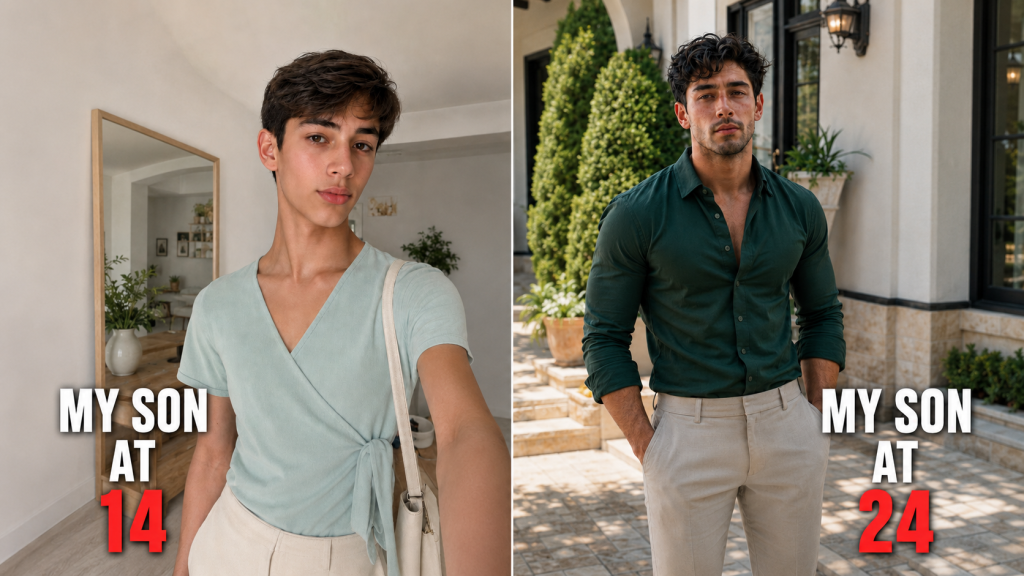
There were still difficult days. There were still cruel kids at school, relatives who made comments at holidays, and strangers who looked too long.
But inside our house, Daniel could breathe.
Then I met Robert.
I was forty-two then, tired in a way that had settled into my bones. Robert came into my life through a friend from church. He was a retired military man, tall, broad-shouldered, polite in public, and confident in a way that made people listen when he spoke.
At first, I mistook control for strength.
He opened doors.
He fixed the porch steps without being asked.
He told me I should not have to carry everything alone.
After years of being the only adult in the house, those words sounded like shelter.
Daniel was sixteen when Robert and I married.
I wish I could say I saw the warning signs before then.
Maybe I did.
Maybe I chose not to look closely enough.
Robert liked rules.
He liked schedules.
He liked things placed exactly where he believed they belonged.
He called it discipline.
At first, I thought Daniel and Robert only needed time.
Daniel was quiet around him, guarded in a way he had never been with me. Robert seemed polite enough, but his eyes would linger too long whenever Daniel wore something colorful, something soft, something he considered “too much.”
The comments started small.
“You’re letting him hide from the real world.”
“Boys need structure.”
“You’ve babied him too much.”
At first, I pushed back.
“He is not hiding,” I said. “He is figuring out who he is.”
Robert would sigh, like I was a naive woman who did not understand danger.
“I know the world better than you do, Elena. The world will eat him alive if you don’t toughen him up.”
I hated that phrase.
Toughen him up.
As if kindness was a weakness.
As if softness was a disease.
As if my son needed to be broken before he could survive.
By Daniel’s seventeenth birthday, our house had changed.
The warmth had thinned.
Dinner conversations became careful.
Daniel stopped leaving his sketchbooks on the table.
His colorful shirts disappeared into the back of his closet.
The makeup he used to experiment with quietly vanished from the bathroom drawer.
Once, I found a pair of heeled boots hidden under a loose floorboard in his room.
I sat on the bed holding them, my throat burning with guilt.
When Daniel came in and saw me, his shoulders dropped.
“I wasn’t wearing them outside,” he said quickly.
The fact that he sounded like he was confessing a crime made me hate myself a little.
“You don’t have to hide from me,” I said.
He looked toward the hallway.
“I’m not hiding from you.”
That should have been enough to wake me up.
But waking up is not always one moment.
Sometimes it is a thousand small alarms you ignore because admitting the truth means admitting you failed someone.
Robert’s cruelty grew sharper.
He never shouted when other people could hear.
That was one of the things I learned too late.
In public, he was calm, charming, respectable.
In private, he was ice.
He told Daniel he was embarrassing me.
He told him no one would hire him if he kept acting strange.
He told him men in the real world would not tolerate weakness.
He told him if Michael were alive, he would be ashamed.
That was the one time Daniel screamed.
“My father loved me!”
Robert stood so still, so cold, and said, “Your father is not here. I am.”
I stepped between them that night.
I told Robert never to speak for Michael again.
He apologized to me later.
Not to Daniel.
To me.
He said he had gone too far because he cared. He said he was trying to save Daniel from a hard life. He said I was too emotional to see what needed to be done.
I wanted to believe my marriage could be fixed.
I wanted to believe Robert had a rough way of showing concern.
I wanted to believe love could soften him.
But love does not soften a person who sees gentleness as something to destroy.
The night everything broke was Daniel’s eighteenth birthday.
I had planned a small party.
Just family, a few neighbors, a cake, and Daniel’s favorite pasta.
He had been nervous all week. I thought it was because birthdays had always made him miss Michael. I did not know he had been counting the hours until he was legally an adult because Robert had been reminding him of it for months.
“You’ll be eighteen soon,” Robert had told him. “Then excuses end.”
I found that out later.
That night, Daniel wore a dark green jacket he had bought himself. It was not flashy, but it was elegant, with silver buttons and a soft collar. He looked nervous when he came downstairs.
I smiled at him.
“You look handsome,” I said.
His face softened.
“Thanks, Mom.”
Robert was standing by the dining room table.
He looked Daniel up and down.
I saw the disapproval flash across his face, but before I could say anything, my sister came in with balloons, and the house filled with noise.
For the first hour, the party almost felt normal.
Daniel laughed with his cousins.
He helped me light the candles.
He let my mother kiss his cheek.
Then Robert stood up with a glass in his hand.
“I want to make a toast,” he announced.
Everyone quieted.
Daniel’s smile faded.
I felt something twist in my stomach.
Robert began politely enough.
He spoke about responsibility, adulthood, and how boys become men by learning discipline.
Then his voice changed.
He looked directly at Daniel.
“You’ve had too many people lying to you,” he said. “Too many people telling you that feelings matter more than reality.”
The room went still.
“Robert,” I said quietly.
He ignored me.
“You are eighteen now. The world will not clap for confusion. It will not respect weakness. If you want to earn respect, you need to stop playing dress-up, join the army, and learn how to become a real man.”
For a moment, nobody moved.
Daniel’s face went empty.
Not angry.
Not embarrassed.
Empty.
As if something inside him had stepped away from the room.
My mother whispered, “Robert, that’s enough.”
But it was too late.
Daniel set down his fork.
He stood.
He looked at me.
I expected him to cry. To yell. To ask me to defend him.
Instead, he just said, “Happy birthday to me.”
Then he walked upstairs.
I followed him, but Robert grabbed my wrist.
“Let him go,” he said. “He needs to learn.”
I pulled my arm away.
“Do not touch me.”
But by the time I reached Daniel’s room, the door was locked.
I knocked.
“Daniel, sweetheart, open the door.”
No answer.
“I’m sorry. I’m so sorry. Please talk to me.”
Still nothing.
I stood there for twenty minutes, whispering apologies through the wood.
Eventually, Robert came upstairs and told me to stop humiliating myself.
The guests left quietly.
The cake sat untouched on the counter.
At midnight, I returned to Daniel’s room.
The door was open.
His bed was made.
His drawers were empty.
And on his pillow was a note.
Mom, I love you. But I can’t live in this house anymore. Please don’t look for me. I need to become someone who can survive. I’m sorry.
I screamed his name so loudly that neighbors called to ask if everything was okay.
Nothing was okay.
Nothing was ever okay again.
Because Daniel vanished.
The police took a report, but because he was eighteen, there was only so much they could do. They said adults had the right to leave home. They said his note suggested he had gone willingly. They said they would keep his information on file.
On file.
As if my son were paperwork.
I called hospitals.
Shelters.
Friends.
Old classmates.
I posted online until strangers began accusing me of making things up for attention.
I searched bus stations, train stations, youth centers, cheap motels, and cities where I thought he might go.
Robert acted concerned at first.
Then impatient.
“He left by choice,” he said one night, three weeks later. “At some point, you have to accept that.”
I stared at him across the kitchen table.
“He is my son.”
“And you are my wife,” he said. “You are destroying yourself over someone who chose to leave.”
That was the first time I truly hated him.
But hatred did not free me.
Grief made me weak.
Fear made me confused.
And guilt kept me trapped.
Every morning, I woke expecting Daniel to call.
Every birthday, I baked a cake he never ate.
Every Christmas, I hung his stocking.
Robert hated that.
He said it kept the wound open.
I told him the wound was open because my child was gone.
Six years passed that way.
Six years of checking missing-person groups.
Six years of scanning faces in grocery stores.
Six years of waking from dreams where Daniel was still seventeen, standing in my kitchen, asking if I had seen his sketchbook.
In those years, Robert changed too.
Or maybe he simply stopped pretending.
He became colder.
More controlling.
He decided which friends were “good for me.”
He complained when I visited Daniel’s old school.
He said my grief made people uncomfortable.
Eventually, most of my family stopped coming around.
Not because they did not love me, but because Robert made everything tense.
The house with the blue door became quiet again.
But not like after Michael died.
This quiet was not grief.
It was captivity.
Then, one rainy morning in October, someone knocked on the door.
It was 8:17 a.m.
I remember because I had been staring at the kitchen clock, thinking I had survived another night.
Robert was in the living room reading the newspaper.
I opened the door with a coffee mug in my hand.
And the world stopped.
A young man stood on my porch.
Tall.
Broad-shouldered.
Serious.
His dark hair was cropped short. He wore a navy coat, worn boots, and a canvas bag slung over one shoulder.
For one terrible second, my mind refused to understand what my heart already knew.
Then he looked at me.
Those eyes.
My Michael’s eyes.
My Daniel’s eyes.
The mug slipped from my hand and shattered on the floor.
“Daniel?” I whispered.
His jaw tightened.
“Hi, Mom.”
I nearly collapsed.
I reached for him, ready to pull him into my arms, ready to touch his face and prove he was real.
But he lifted one hand.
“Don’t,” he said quietly.
The word struck me harder than if he had shouted.
I froze.
Behind me, Robert’s newspaper rustled.
Daniel’s eyes moved past my shoulder.
His expression changed.
Not fear.
Not anymore.
Something colder.
Something earned through years of surviving.
“I want him to tell you the truth,” Daniel said. “Right now.”
Robert stood slowly.
“What is this?”
Daniel stepped into the house.
Rain clung to his coat.
He looked around the hallway, at the framed family photo still hanging near the stairs. The one from before his eighteenth birthday. The one where his smile already looked strained.
Then he pointed straight at Robert.
“My stepdad needs to tell you what he did.”
I turned around.
Robert’s face had gone pale.
For the first time since I had known him, he looked afraid.
“What is he talking about?” I asked.
Robert folded the newspaper carefully.
Too carefully.
“Your son has obviously been through a lot. We should all sit down and—”
“No,” Daniel said. “No more calm voice. No more acting reasonable. Tell her.”
Robert’s eyes narrowed.
“Be careful.”
Daniel laughed once.
It was a bitter sound.
“I was careful for six years.”
My legs felt weak.
“Daniel,” I said, “what happened?”
He looked at me then.
For the first time, I saw the boy beneath the man.
The hurt was still there.
Buried deep, but alive.
“I left that night because I thought you had chosen him,” he said.
The words cut through me.
“No,” I whispered. “No, I never—”
“You didn’t come after me.”
“I did,” I said, crying now. “I searched everywhere. I called everyone.”
Daniel looked at Robert.
“Did you tell her?”
Robert said nothing.
My skin went cold.
“Tell me what?”
Daniel opened his canvas bag and pulled out a folder.
It was old, worn at the edges, protected inside a plastic sleeve.
He handed it to me.
My fingers trembled as I opened it.
Inside was a letter.
Not the short note I had found on his pillow.
A different letter.
Longer.
Written in Daniel’s teenage handwriting.
Mom, if you are reading this, it means I had to leave tonight. I did not want to. I swear I did not want to leave you. But Robert said that once I turned eighteen, he could send me away. He said he had friends who could make sure I ended up somewhere that would fix me. He said if I told you, he would make you think I was lying. He said you were tired of me too, but too weak to say it.
I pressed my hand over my mouth.
The words blurred.
I kept reading.
He said if I did not leave on my own, he would make me disappear from your life anyway. He said you would be better without me. Mom, I don’t know what to believe anymore. I love you. I’m sorry. Please forgive me.
I looked up slowly.
Robert was staring at the floor.
“This was in his room?” I whispered.
Daniel shook his head.
“I left it on my desk. Right beside the note you found.”
I turned to Robert.
My voice barely existed.
“You found this.”
He said nothing.
“You found this letter.”
His jaw flexed.
“I was protecting you.”
The room tilted.
“Protecting me?”
“You were already unstable,” Robert said. “You would have chased after him and made everything worse. He needed to learn what life was like without being coddled.”
Daniel stepped forward.
“No. You wanted me gone.”
Robert looked at him with contempt.
“You wanted to leave.”
“I was scared,” Daniel said. “I was eighteen and scared because a grown man had spent two years convincing me I was a problem that needed to be removed.”
I gripped the letter so tightly the paper bent.
“Robert,” I said, “what else did you do?”
Silence.
Daniel reached into the folder again.
“There’s more.”
He pulled out printed copies of emails.
My emails.
Dozens of them.
Messages I had sent to an address Daniel had used in high school.
The first one made my heart stop.
Daniel, please come home. I love you. I am looking for you. Nothing Robert said matters. You are my son. Please call me.
But beneath it was a response.
From Daniel’s account.
Mom, stop looking for me. I don’t want contact. I am happier without you.
My hands began to shake harder.
“I never received your emails,” Daniel said.
I stared at him.
“What?”
He looked at Robert again.
“Because he had my old password.”
Robert’s face hardened.
“You have no proof.”
Daniel gave a small nod.
“I didn’t. Not then.”
Then he pulled out a phone.
“Three years after I left, I got into the old account. I found the login history. I found the replies. I found everything.”
I could not breathe.
Six years.
Six years of believing my son did not want me.
Six years of grieving while Robert stood beside me, pretending to comfort me.
“You replied to my emails?” I asked Robert.
He said, “I did what had to be done.”
The sentence fell into the room like a death.
Daniel’s eyes filled with tears, but he did not let them fall.
“You told her I rejected her,” he said. “You told me she stopped looking.”
I remembered all the times Robert had said it.
He does not want to be found.
He is punishing you.
You need to let him go.
I remembered collapsing on the bathroom floor after receiving that first cold reply.
Robert had held me that night.
He had held me while I sobbed over a wound he had made.
Something inside me went silent.
Not numb.
Clear.
For years, I had been drowning in guilt. But now, for the first time, I could see the hand that had held my head underwater.
I turned to Daniel.
“Where did you go?”
His face softened, just a little.
“Chicago first. Then Portland. I slept in a shelter for a while. Worked kitchens. Warehouses. Anything I could find.”
My knees nearly gave out.
“My baby.”
“I survived,” he said.
But his voice cracked.
“I changed my name for a while. I tried to become someone who couldn’t be hurt by him anymore. I cut my hair. Changed how I dressed. Joined a job training program. Found friends. Found people who didn’t make me explain myself every day.”
I looked at his clothes, his serious face, his strong hands.
“Are you happy?” I asked.
The question sounded small.
He looked down.
“I’m alive.”
That answer destroyed me.
Robert scoffed.
“You see? He made something of himself. Maybe I did him a favor.”
Daniel moved so fast I flinched, but he did not touch Robert.
He only stepped close enough to make Robert lean back.
“You don’t get to take credit for my survival,” he said. “You get the blame for what I had to survive.”
Robert looked at me.
“Elena, listen to me. He is manipulating you.”
I laughed.
I did not mean to.
The sound came out broken and sharp.
“For six years,” I said, “you watched me mourn.”
Robert’s mouth tightened.
“You were obsessed.”
“I was a mother.”
“You were weak.”
The last thread snapped.
I walked to the front door and opened it.
Rain blew across the threshold.
“Pack your things,” I said.
Robert stared at me.
“What?”
“Pack your things and leave my house.”
“This is our home.”
“No,” I said. “This was Michael’s home. Then it was mine and Daniel’s. You were only ever a guest who overstayed.”
His face darkened.
“You’re going to choose him after everything?”
I looked at Daniel.
Then back at Robert.
“I should have chosen him sooner.”
Robert’s expression twisted.
For a second, I saw the man Daniel had lived with.
Not the respectable veteran.
Not the charming husband.
The man behind closed doors.
“You’ll regret this,” he said.
Daniel quietly lifted his phone.
“I’ve already sent copies of everything to a lawyer,” he said. “And to Mom’s sister. And to myself.”
Robert’s eyes flickered.
Daniel continued.
“If you threaten her, if you touch her, if you try to twist this, everyone sees what you did.”
Robert looked between us.
Then, for the first time, he had nothing to say.
He went upstairs.
I stood in the hallway shaking while he packed.
Daniel did not come closer.
He stood near the door like he might run again if the air changed too quickly.
That hurt.
But I understood.
Trust does not return just because truth does.
When Robert came down with two bags, he paused beside me.
“You’re making a mistake.”
I looked at him one last time.
“No,” I said. “I made the mistake years ago. Today I am correcting it.”
He left without another word.
The door closed behind him.
The silence that followed was enormous.
I turned to Daniel.
He was staring at the broken coffee mug on the floor.
“I can clean that,” he said automatically.
The words shattered me.
Even after everything, some part of him still wanted to help.
“No,” I said. “Leave it.”
He nodded.
Neither of us moved.
Six years stood between us.
Six years of birthdays, holidays, fear, unanswered prayers, and stolen messages.
I wanted to hug him.
I wanted to beg forgiveness until my voice disappeared.
I wanted to go back to that night and tear Robert away from him before the toast, before the humiliation, before my son ever believed he had to leave to survive.
But there is no door back to the past.
There is only the terrible work of walking forward.
“I’m sorry,” I said.
Daniel closed his eyes.
I stepped back, giving him space.
“I am sorry I did not protect you better. I am sorry I explained away things I should have stopped. I am sorry I let him make this house unsafe for you. I am sorry you had to become strong because I failed to be strong first.”
His face trembled.
For one second, he looked eighteen again.
Then he whispered, “I waited for you.”
I pressed both hands to my heart.
“I know.”
“I waited at the bus station until morning,” he said. “I thought maybe you would come.”
A sob escaped me.
“I went to the bus station,” I said. “The next afternoon. Robert told me you probably left town already. I should have gone sooner. I should have pushed harder. I should have—”
“Mom.”
The word stopped me.
Daniel’s eyes were wet now.
“I didn’t come back to punish you.”
I shook my head.
“You have every right to.”
“I came back because I was tired of him living in your house.”
My tears fell freely.
“He won’t again.”
Daniel looked toward the stairs.
“My room still there?”
“Yes,” I whispered. “I couldn’t change it.”
He nodded slowly.
“Can I see it?”
We climbed the stairs together.
His room was almost exactly as he had left it.
The posters.
The books.
The old desk.
The curtains I had washed every spring even though no one slept there.
On the shelf sat a framed photo of him and Michael fishing at the lake.
Daniel picked it up.
His thumb brushed the glass.
“I used to talk to Dad when things got bad,” he said.
“I did too.”
He looked at me.
For the first time that morning, something gentle passed between us.
Not forgiveness.
Not yet.
But recognition.
We were both people who had loved the same man.
Both people who had been hurt by the same absence.
Both people who had survived Robert in different ways.
Daniel sat on the edge of the bed.
I stayed by the door.
“I don’t know how to do this,” he said.
“Neither do I.”
“I’m not the same person.”
“I know.”
“I don’t want to pretend the last six years didn’t happen.”
“I won’t ask you to.”
He looked down at his hands.
“Sometimes I still don’t know who I am.”
I took a careful breath.
“You don’t have to know everything today.”
His mouth trembled.
“You’re not disappointed?”
The question took me back to him at twelve years old, standing in my skirt, terrified that love could vanish over something as small as fabric.
I shook my head.
“Never.”
His face crumpled.
And this time, when I opened my arms, he came to me.
He did not fall into me like a child.
He stepped carefully, like someone approaching a bridge that might not hold.
But when I wrapped my arms around him, he held on.
My son was taller than me now.
Stronger.
Changed.
But beneath the coat, beneath the years, beneath all the pain Robert had caused, I felt the heartbeat I had known since before he was born.
I cried into his shoulder.
He cried into mine.
For the first time in six years, my house did not feel haunted.
It felt wounded.
Wounds can heal.
Hauntings only wait.
In the weeks that followed, life did not become easy.
Robert tried to call.
I blocked him.
He sent messages saying Daniel had poisoned me against him.
I saved every one and sent them to the lawyer.
My sister came over the next day and stayed with us. She cried when she saw Daniel, then apologized for every holiday she had allowed Robert to ruin with silence.
Daniel did not move back in permanently.
He had a life now.
A small apartment, a job, friends, and a counselor who had encouraged him to come back only when he felt ready.
But he visited.
At first, only for an hour.
Then for dinner.
Then one Sunday afternoon, he came over and helped me repaint the front door.
The blue had faded over the years.
Michael’s blue.
Our blue.
Daniel stood on the porch holding a paintbrush, looking at the door like it was something from another lifetime.
“Same color?” he asked.
I smiled through the ache in my chest.
“Same color.”
He nodded.
We painted in silence for a while.
Then he said, “I changed my name for a few years.”
I kept brushing paint carefully along the frame.
“What did you choose?”
“Evan.”
I looked at him.
“Do you want me to call you Evan?”
He thought about it.
“No. Not anymore.”
“Okay.”
“But I’m not exactly the old Daniel either.”
I nodded.
“Then I’ll learn who you are now.”
He looked at me for a long moment.
Then he smiled.
It was small.
Tired.
But real.
That smile was the first piece of sunlight I had seen in six years.
Healing did not come all at once.
Some days Daniel was angry.
Some days I was drowning in guilt.
Some conversations ended with him needing to leave and me needing to sit alone with the truth.
But he always answered when I texted.
And little by little, he stopped standing near exits.
One night, months after Robert left, Daniel came for dinner.
I made his favorite pasta.
Not as a birthday replacement.
Not as an apology.
Just dinner.
He helped set the table.
When we sat down, he looked at the empty chair where Robert used to sit.
Then he looked at me.
“I used to imagine coming back,” he said.
I swallowed.
“What did you imagine?”
“That you wouldn’t believe me.”
I reached across the table.
He looked at my hand.
Then he placed his over mine.
“I believe you,” I said.
He nodded.
His eyes shone.
“I know that now.”
Outside, the porch light glowed against the freshly painted blue door.
For years, I had believed my son disappeared because he wanted to leave me.
But the truth was worse.
He left because someone made him believe home had already rejected him.
That was the deepest cruelty.
Not just the stolen letter.
Not just the fake emails.
Not even the humiliation.
It was the lie that love had limits.
That a mother’s heart could be turned away from her child by fear, shame, or pressure.
Robert had counted on that lie.
He had built six years of silence on it.
But when Daniel came back, he brought the truth with him.
And truth, once spoken, is stronger than control.
I still keep Daniel’s eighteenth birthday note in a drawer.
Not because I want to remember the pain.
Because I never want to forget what silence can cost.
And beside it, I keep the second letter.
The one Robert tried to hide.
The one that brought my son back to me.
Sometimes, when Daniel visits, he sees me looking at the drawer.
He does not ask me to throw the letters away.
Maybe someday I will.
Maybe someday we will both be ready to stop needing proof of what happened.
But for now, they remind me of the promise I make every morning.
No one will ever stand between me and my child again.
Not a husband.
Not shame.
Not fear.
Not the world.
My son disappeared after his eighteenth birthday.
Six years later, he came home as someone changed by pain, survival, and strength.
And when he pointed at my husband and demanded the truth, I finally saw the man I had married clearly.
But more importantly, I finally saw my son clearly too.
Not as someone broken.
Not as someone needing to be fixed.
As someone who had fought his way back through darkness carrying the truth in both hands.
And this time, when he came home, I opened the door wide enough for all of him.
I kept the story emotional, dramatic, and safe, with line breaks and a complete ending.
THE END! THANK YOU FOR READING!