

I came home for Thanksgiving and found the house freezing cold. At first, I thought the furnace had broken. That was the only explanation my mind could accept as I stood in the front doorway of my parents’ house in Cedar Falls, Ohio, with my suitcase behind me and my breath turning white in front of my face.
The house had always been warm. Too warm, actually. My mother, Elaine Whitaker, kept it like a hotel lobby in winter. She loved cinnamon candles, polished furniture, heavy curtains, and guests telling her how beautiful everything looked. Thanksgiving at her house was usually a performance. Crystal bowls. Matching napkins. My father carving turkey like he was posing for a magazine photo. My older brother, Daniel, laughing too loudly. My younger sister, Paige, posting pictures of pies she had not baked.
But that morning, the house was silent.
No music.
No smell of turkey.
No sound of my father shouting at the football game from the den.
Just cold air, dusty light, and the faint metallic smell of a house that had been abandoned.
I stepped inside and closed the door behind me.
“Mom?” I called.
My voice echoed strangely.
“Dad?”
No answer.
I pulled my coat tighter and looked down the hallway.
The thermostat blinked from the wall.
Forty-nine degrees.
For a few seconds, I just stared at the number, waiting for it to change, as if I had misunderstood it. Then my eyes moved to the kitchen counter.
There was a yellow sticky note stuck near the coffee maker.
My mother’s handwriting was sharp and perfect.
We’re in Cancun. Your flight got in first, so you handle Grandma. Back Sunday. Don’t make a scene.
I read it once.
Then again.
Then a third time, slower.
Cancun.
Thanksgiving.
Grandma.
My grandmother, Evelyn Whitaker, was eighty-two years old. She had broken her hip two months earlier and still needed help standing. She used a walker. She could not go downstairs alone. Some mornings, her hands shook so badly she needed help buttoning her sweater.
She had moved into the downstairs guest room after my grandfather died, because my father had insisted she would be “safer with family.”
Safer.
The word slammed into my chest.
I dropped my suitcase so hard it fell sideways against the wall.
“Grandma?”
I ran toward the guest room.
Her door was open.
The room was empty.
Her bed was half-made, the blankets twisted like someone had tried to get out in a hurry. Her cardigan lay on the floor. A glass of water sat untouched on the bedside table. Her slippers were missing.
Her walker was not beside the bed.
My heart began to pound.
“Grandma!”
I checked the bathroom.
Empty.
The small sitting room beside her bedroom.
Empty.
Then I heard something.
A thin scraping sound.
Wood against wood.
It came from the living room.
I followed it slowly at first, then faster, my boots hitting the hardwood floor.
And then I saw her.
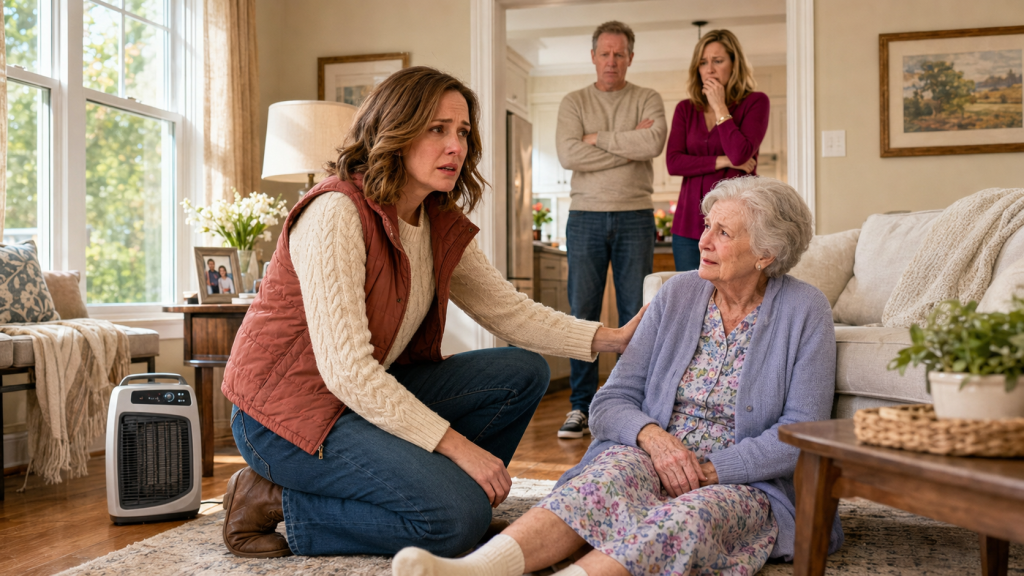
My grandmother was lying on the floor beside the unplugged space heater.
For one horrible second, I could not move.
She was wrapped in a blanket, but it had slipped off her shoulders. Her white hair was loose around her face. Her lips looked pale. Her fingers trembled against the floorboards, making that scraping sound as she tried to move.
The space heater sat inches from her.
Unplugged.
The outlet was empty.
The curtains were drawn.
The lamp beside her was off.
The little table where she always kept her phone was bare.
“Grandma,” I whispered.
I dropped beside her so quickly my knees hit the floor.
Her eyes opened.
Cloudy, tired, but aware.
“Mara?” she breathed.
“It’s me.” My voice cracked. “Oh my God. Grandma, what happened?”
She tried to speak, but her teeth chattered.
I touched her hand and nearly recoiled.
She was ice cold.
“I’m calling 911.”
I grabbed my phone from my coat pocket with shaking fingers.
But before I could dial, her hand shot up and clamped around my wrist.
It startled me.
For a woman who looked so fragile, her grip was strong.
“Don’t tell them yet,” she whispered.
“Grandma, you’re freezing. You fell. You need help.”
“Listen to me.”
Her eyes sharpened.
I froze.
There was something in her face that frightened me more than the cold did.
Not confusion.
Not weakness.
Fear.
She pushed something into my palm.
Something small and hard.
I looked down.
It was a black flash drive, wrapped with a strip of blue tape.
“What is this?” I asked.
Her fingers curled around mine, closing my hand over it.
“The reason they left me here.”
My stomach twisted.
“The reason they took my phone.”
I looked toward the hallway.
The house felt even quieter now.
“Who took your phone?”
She swallowed.
“Your father.”
My mouth went dry.
She took a shallow breath.
“They wanted me to sign.”
“Sign what?”
“Power of attorney. The house. My accounts. Everything.”
I stared at her.
Her eyes filled with tears, but her voice stayed sharp.
“Your father said I was confused. Your mother said no one would believe me. Daniel told me I was selfish. Paige said I was ruining everyone’s future.”
I felt the blood drain from my face.
My father had always complained about money.
Not openly, not in a way strangers would notice. But I had heard the comments my whole life.
Grandma’s house is worth more every year.
Your grandfather left everything tied up.
She doesn’t need that much money at her age.
Family should share.
And Grandma, quiet but stubborn, always answered the same way.
What your grandfather and I built will go where we decided it should go.
I had never asked what she meant.
Now I wished I had.
“What’s on the flash drive?” I whispered.
Her breath hitched.
“Proof.”
Before I could ask more, she shuddered violently.
That snapped me back.
I dialed 911.
When the dispatcher answered, my voice came out steadier than I felt.
“My grandmother fell. She’s eighty-two. She’s conscious, but she’s very cold. The house has no heat. Please send an ambulance.”
The dispatcher asked if she was breathing normally.
I said yes, but she was shaking.
I gave the address.
I did not mention the flash drive.
I did not mention Cancun.
I did not mention the note.
While we waited, I found another blanket in the hall closet and wrapped it around Grandma. I plugged in the space heater, but the outlet did not work. I tried the lamp.
Nothing.
The entire living room circuit had been shut off.
I went to the basement door and found the breaker panel.
The furnace switch was off.
My hands were numb as I flipped it back on.
A low rumble finally came from the vents.
Heat.
Slow, weak heat.
I returned to Grandma and tucked the blanket around her shoulders.
She looked at me with exhausted eyes.
“When they come back,” she whispered, “don’t be alone with them.”
I swallowed hard.
“Grandma, what did they do?”
Her eyes moved to the flash drive in my hand.
“You’ll see.”
The ambulance arrived twelve minutes later.
Two paramedics came in with a stretcher, followed by a police officer because the dispatcher had sent one after hearing the house had no heat.
The officer’s name was Harris.
He looked around the living room, then at the sticky note still on the kitchen counter.
His jaw tightened slightly, but his voice stayed calm.
“Who else lives here?”
“My parents,” I said. “And my grandmother has been staying here since her hip surgery.”
“Where are your parents?”
I looked at the note.
“In Cancun.”
His eyes followed mine.
He read it silently.
Then he looked back at Grandma.
“Ma’am,” he asked gently, “how long were you on the floor?”
Grandma closed her eyes.
“Since last night.”
The room went still.
I covered my mouth with my hand.
Last night.
She had been lying on a freezing floor all night while my family flew to Mexico.
The paramedics lifted her carefully. She cried out once, not loudly, but enough to make my chest ache.
I rode with her to the hospital.
In the ambulance, she drifted in and out of sleep.
Every time her eyes opened, she looked for me.
“Still here,” I told her.
She squeezed my fingers.
At the hospital, they treated her for mild hypothermia, dehydration, bruising, and a possible wrist sprain. Her hip repair had not been damaged, which the doctor called lucky.
Lucky.
I wanted to laugh.
Nothing about this felt lucky.
While Grandma slept beneath warmed blankets, I sat in a plastic chair beside her bed and stared at the flash drive in my palm.
I had not opened it yet.
Part of me was afraid to.
Because once I saw what was on it, I could not pretend this was a misunderstanding.
I could not let my mother explain it away with tears.
I could not let my father call me dramatic.
I could not let Daniel say I was making the family look bad.
I could not let Paige roll her eyes and say Grandma was old.
My family had left her in a freezing house.
They had left her without a phone.
They had left me a note like she was a chore.
I stood and went to the nurses’ desk.
“Is there a computer I can use?”
The nurse gave me a cautious look.
“For medical forms?”
“For evidence,” I said.
Ten minutes later, Officer Harris returned. I had called him from the hallway and told him my grandmother had given me something.
We used a hospital office computer with a nurse present.
I plugged in the flash drive.
There were seven files.
Three videos.
Four audio recordings.
My hands started shaking before I opened the first one.
The first video showed Grandma’s bedroom.
The angle was low, probably from her nightstand. Grandma must have set up an old camera or phone without anyone noticing.
My father stood near the bed, holding papers.
My mother stood by the dresser with her arms crossed.
Daniel leaned against the doorframe.
Paige sat in the chair, scrolling on her phone.
Grandma’s voice came from offscreen.
“I said no, Richard.”
My father’s face hardened.
“Mother, this is ridiculous. We are not stealing from you.”
“I never said stealing.”
“You implied it.”
My mother sighed loudly.
“Evelyn, we have taken care of you for months. Do you know how expensive that is?”
Grandma answered, “I pay you every month.”
“That barely covers anything,” Daniel snapped.
Paige looked up from her phone.
“Grandma, honestly, you don’t even use most of your money. Why are you being so weird about this?”
My father stepped closer.
“It’s only power of attorney. It lets us manage things.”
Grandma’s voice stayed firm.
“It lets you control things.”
My mother’s smile was cold.
“You are confused.”
“I am not confused.”
“You fell last week,” my mother said. “You forgot Paige’s birthday.”
“I did not forget it. Paige did not visit.”
Paige’s face twisted.
“Oh my God.”
The video ended.
I sat back slowly.
Officer Harris said nothing.
I opened the second file.
Audio.
My father’s voice filled the room.
“She’s going to ruin everything.”
My mother answered, “Then push harder.”
Daniel said, “What happens if she tells Mara?”
My name made me flinch.
My father said, “Mara is soft. She’ll cry, then she’ll do whatever sounds peaceful.”
My mother gave a short laugh.
“Not if Evelyn gets to her first.”
There was silence.
Then Paige spoke.
“So take her phone.”
My stomach dropped.
My father said, “We don’t have to make this ugly.”
Daniel replied, “It’s already ugly. We leave tomorrow. If she wants help, she signs.”
My mother’s voice lowered.
“Cold makes people cooperative.”
I stopped the recording.
The nurse turned away, covering her mouth.
Officer Harris’s expression hardened.
“Play the rest,” he said quietly.
So I did.
By the end, there was no misunderstanding left.
There was a video of my father unplugging the space heater.
There was audio of my mother saying, “She can call someone when we get back, assuming she’s still determined to be stubborn.”
There was a video of Daniel taking Grandma’s phone from her side table while she slept.
There was a recording of Paige saying, “This is so dramatic. She’ll be fine. Old people are always cold anyway.”
And there was one final video.
Grandma was alone in her room.
Her hands shook as she looked into the camera.
“If something happens to me,” she whispered, “I did not agree to sign anything. I am not confused. I am afraid of my own son.”
That broke me.
I pressed both hands over my face and cried in a hospital office beside a police officer and a nurse I had never met.
Not loud crying.
Not dramatic.
Just silent, furious tears that burned down my cheeks.
Officer Harris gently removed the flash drive from the computer and placed it into an evidence bag.
“We’ll need a formal statement,” he said.
I nodded.
“What happens now?”
He glanced toward the hallway, where Grandma was sleeping.
“Adult Protective Services will be notified. Given what’s on this drive, this is serious.”
Serious.
The word felt too small.
Over the next two days, I stayed at the hospital with Grandma.
My parents texted me from Cancun on Thanksgiving afternoon.
Mom: Did you get to the house?
Dad: Your mother says you’re not answering.
Daniel: Don’t start drama.
Paige: Are you seriously ignoring everyone on Thanksgiving?
I did not respond.
Instead, I called Grandma’s attorney.
His name was Samuel Price, and when I explained who I was, he said he had been expecting my call.
That surprised me.
“Your grandmother contacted me last week,” he said. “She was worried something might happen.”
I closed my eyes.
“What did she tell you?”
“That your father had been pressuring her to sign financial authority over to him. She asked me to prepare documents protecting her assets in case she became medically vulnerable.”
“Did she sign them?”
“No,” he said. “She wanted to wait until she could speak to you.”
My throat tightened.
“She trusted you,” he added gently.
I looked at Grandma through the hospital room window.
She was asleep, small beneath the white blankets, her silver hair spread over the pillow.
“I wish she had told me sooner,” I whispered.
“Sometimes people are ashamed when family hurts them,” he said.
That sentence stayed with me.
Ashamed.
Grandma had done nothing wrong.
But she was the one who had hidden cameras. She was the one who whispered. She was the one who prepared evidence like a prisoner in her own son’s house.
My parents returned Sunday afternoon.
They came home sunburned and smiling.
I watched them through the front window as their taxi pulled into the driveway. My mother wore a white linen outfit and oversized sunglasses. My father dragged two suitcases behind him. Daniel carried a duty-free bag. Paige was filming herself on her phone, probably complaining about the cold weather.
They had no idea what was waiting.
I had not gone back to my apartment.
I had returned to the house after Grandma stabilized. Officer Harris had photographed the rooms. APS had already opened a case. Grandma’s attorney was with me. So was a woman named Carla from Adult Protective Services.
The sticky note still sat on the kitchen table, sealed in a plastic sleeve.
The house was warm now.
But it felt colder than before.
The front door opened.
My mother stepped inside first.
“Mara?” she called, annoyed already. “Why is your suitcase still in the hall?”
Then she saw me standing in the living room.
Her smile appeared quickly, practiced and fake.
“There you are. We’ve been calling.”
My father stepped in behind her.
“Where’s your grandmother?”
“At the hospital,” I said.
The silence was immediate.
Paige lowered her phone.
Daniel’s face changed first.
Not guilt.
Fear.
My mother removed her sunglasses slowly.
“What do you mean, hospital?”
“I found her on the living room floor,” I said. “Beside the unplugged heater.”
My father set down the suitcase.
“Now, hold on.”
“No,” I said. “You don’t get to start with that.”
My mother’s mouth tightened.
“Mara, your grandmother has been confused. She exaggerates. She must have fallen after we left.”
“She fell before you left.”
Daniel stepped forward.
“You don’t know that.”
I looked at him.
“Yes, I do.”
My father noticed the attorney then.
Samuel Price stepped out from the hallway.
My mother went pale.
“Mr. Price,” she said carefully. “What are you doing here?”
“Representing my client,” he said.
“My mother is your client,” my father snapped.
“Yes,” Mr. Price replied. “And she has made her wishes very clear.”
Paige looked between us.
“What is this?”
Carla from APS entered the room from the dining area.
“This is an adult protective investigation,” she said.
My mother laughed once, sharp and nervous.
“That is absurd.”
I picked up the evidence copy of the flash drive and placed it on the coffee table.
My father stared at it.
His face drained of color.
Daniel whispered, “Where did you get that?”
No one else had to say a word.
That question told the whole room he knew exactly what it was.
My mother turned on him.
“Daniel.”
“What?” he snapped. “I didn’t know she gave it to Mara.”
I felt something inside me go very still.
My family was not confused.
They were not caught in a misunderstanding.
They were only angry they had been caught.
Mr. Price opened his briefcase.
“Mrs. Whitaker has revoked all previous informal permissions regarding her care, residence, and finances. She has also signed updated documents naming Mara as her emergency contact and temporary medical advocate.”
My father’s eyes shot to me.
“You had no right.”
I almost smiled.
“No right?”
“You don’t understand the responsibilities here,” he said. “You live three hours away. You visit on holidays and think you know everything.”
“I know you left your mother on the floor in a freezing house.”
My mother’s face twisted.
“We did not leave her on the floor.”
“But you took her phone.”
Paige started crying.
Not real crying.
Angry crying.
“This is insane. We went on one trip.”
“You went to Cancun for Thanksgiving,” I said, “after unplugging her heater and taking her phone because she wouldn’t sign over control of her money.”
My father pointed at me.
“Be very careful.”
For the first time in my life, I did not shrink from his voice.
I had grown up fearing that tone.
The low warning.
The one that made everyone at the table go quiet.
But all I could see now was Grandma on the floor.
Cold.
Shaking.
Whispering for me not to be alone with them.
“No,” I said. “You be careful.”
Officer Harris arrived five minutes later.
My mother tried to perform for him.
She cried softly. She said she was overwhelmed. She said caretaking was difficult. She said Grandma had become paranoid. She said the family needed privacy.
Officer Harris listened.
Then he said, “We’ve reviewed the recordings.”
My mother stopped crying.
My father looked toward the door.
Daniel sat down heavily on the sofa.
Paige whispered, “Oh my God.”
The officer asked them questions separately.
My father refused to answer without a lawyer.
My mother said she had not understood how cold the house would get.
Daniel said he only took the phone because Grandma was calling people and “upsetting herself.”
Paige said she had nothing to do with any of it.
But the recordings spoke for them.
By Monday, everything had changed.
Grandma was discharged from the hospital into a short-term rehabilitation facility, not back to my parents’ house. Her attorney filed emergency protections. The bank was notified. Her accounts were secured. Her home, the one she had owned with my grandfather, was placed into a trust exactly the way she wanted.
And my father was removed from every position of authority connected to her.
He called me forty-three times in two days.
I did not answer.
Then my mother texted.
You are destroying this family.
I stared at the message for a long time.
Then I wrote back.
No. I’m finally telling the truth about it.
She did not respond.
The hardest visit was the first time I saw Grandma after everything became official.
She was sitting near the window in the rehab center, wearing a soft blue sweater I had brought from her house. Her hands rested in her lap. Sunlight touched her face.
She looked older than she had before Thanksgiving.
But she also looked calmer.
When I walked in, she smiled.
“There’s my girl.”
I sat beside her and took her hand.
“I’m sorry,” I said.
She frowned.
“For what?”
“For not knowing.”
Her fingers tightened around mine.
“Mara, people like your father do not show their worst selves when everyone is watching.”
My eyes burned.
“You should have been safe.”
“Yes,” she said quietly. “I should have been.”
That simple sentence broke something open inside me.
Not because she sounded angry.
Because she sounded honest.
For years, our family had survived by pretending.
Pretending Dad’s temper was stress.
Pretending Mom’s cruelty was honesty.
Pretending Daniel’s selfishness was ambition.
Pretending Paige’s carelessness was youth.
Pretending Grandma was difficult because it was easier than admitting she was being cornered.
I had pretended too.
Maybe not as much as they had.
But enough.
Grandma looked out the window.
“Your grandfather warned me,” she said.
“About Dad?”
She nodded.
“He loved Richard. But he saw him clearly. He used to say, ‘Our son thinks love means ownership.’ I didn’t want to believe that.”
I swallowed.
“What did Grandpa want?”
She smiled sadly.
“He wanted the house sold after I passed, with part going to charity, part to you grandchildren, and part to a scholarship fund in his name. Your father always hated that.”
“Why didn’t you tell me?”
“Because I kept hoping he would become better before he became desperate.”
I sat with that.
Outside, a nurse pushed an elderly man in a wheelchair past the window. Somewhere down the hall, someone laughed at a television show.
Life continued in ordinary sounds, even after terrible things happened.
Grandma turned back to me.
“I am not leaving everything to you, if that’s what you’re afraid of.”
I blinked.
“I don’t care about that.”
“I know,” she said. “That is why I trusted you.”
I cried then.
Not in the hospital office.
Not from shock.
But from the weight of being trusted by someone who had been betrayed by everyone else.
Two weeks later, my father showed up at the rehab center.
He was not allowed inside Grandma’s room without her permission, and she refused.
So he waited in the lobby until I came down.
He looked different.
Smaller, somehow.
His coat was wrinkled. His face was unshaven. For a moment, I saw not the father who had frightened me for years, but a man who had lost control of the story.
“Mara,” he said.
I stopped several feet away.
“What do you want?”
His mouth tightened.
“To talk.”
“About Grandma?”
“About this mess.”
I shook my head.
“That’s not what you should call it.”
His eyes flashed.
“Do you have any idea what people are saying?”
“Yes.”
“This could ruin me.”
I stared at him.
That was what mattered to him.
Not his mother.
Not what she had endured.
Not that she could have died alone in that house.
His reputation.
His job.
His friends.
His image.
“You left her without a phone,” I said.
He looked away.
“She was being impossible.”
“She was saying no.”
“She doesn’t need all that money.”
“It was hers.”
His voice dropped.
“We are family.”
“No,” I said quietly. “Family doesn’t use cold as a weapon.”
He flinched, but only for a second.
Then came the father I knew.
The hard eyes.
The lowered voice.
“You think you’re a hero now? You think that old woman won’t become a burden to you too?”
I stepped closer.
“She is not a burden.”
“She will be.”
I held his stare.
“Then I’ll carry what you dropped.”
His face changed.
For a second, he looked like he might shout.
But there were people around.
A receptionist.
A nurse.
Two visitors near the coffee machine.
People watching.
So he stepped back.
“You’ll regret choosing her over us.”
I answered without hesitation.
“No. I regret not choosing her sooner.”
I walked away before he could say another word.
By Christmas, Grandma had moved into a small assisted-living apartment near me.
Not a cold guest room.
Not a place where she had to hide evidence.
A bright, warm apartment with wide windows, a little kitchenette, and a shelf for Grandpa’s old books. She complained about the food, charmed the nurses, and beat three residents at cards during her first week.
Every Sunday, I brought her soup.
Every Wednesday, we watched old movies.
Sometimes she talked about what happened.
Sometimes she didn’t.
I let her choose.
The investigation continued. Charges and legal consequences moved slowly, as they often do. My parents hired an attorney. Daniel stopped calling me. Paige posted vague quotes online about betrayal and “toxic relatives.”
My mother mailed me a Christmas card with no return address.
Inside, she had written one sentence.
I hope you’re happy with what you’ve done.
I showed it to Grandma.
She read it twice, then handed it back.
“Are you?” she asked.
“Happy?”
“No,” she said. “Happy is not the right word.”
I looked around her warm apartment.
At the blanket over her knees.
At the framed picture of Grandpa on the shelf.
At the small Christmas tree blinking softly in the corner.
“No,” I said. “I’m not happy.”
Grandma nodded.
“Good.”
I looked at her.
She smiled faintly.
“Happy would mean you enjoyed it. You didn’t. You did what was necessary. That is better.”
I kept that card.
Not because it hurt me.
Because it reminded me how people twist accountability into cruelty when they are the ones finally facing consequences.
Months later, Grandma asked me to drive her back to the Ohio house.
I hesitated.
“Are you sure?”
“Yes,” she said. “I want to say goodbye properly.”
The house looked the same from the outside.
White siding.
Black shutters.
Bare trees in the yard.
But when I unlocked the door, the place felt different.
Not haunted exactly.
Just empty of its old power.
No cinnamon candles.
No polished performance.
No Thanksgiving table waiting to impress anyone.
Grandma moved slowly through the rooms with her walker.
She paused in the living room.
The place where I had found her.
I stood close, ready to help if she needed me.
But she did not collapse.
She did not cry.
She looked down at the hardwood floor for a long moment.
Then she lifted her chin.
“Your grandfather hated this floor,” she said.
I blinked.
“What?”
She smiled.
“He said it scratched too easily.”
A laugh escaped me.
It surprised us both.
Then Grandma laughed too.
Softly at first.
Then stronger.
The sound filled the room.
Not because anything was funny.
Because we were still there.
Because my family had tried to make that room the place where her will broke.
Instead, it became the place where the truth started.
Before we left, Grandma stood by the front window.
“I spent many years believing keeping peace was the same as keeping family,” she said.
I said nothing.
She looked at me.
“It isn’t.”
“No,” I said. “It isn’t.”
She reached into her purse and handed me something.
For a second, my heart jumped, remembering the flash drive.
But this time, it was a key.
Small.
Silver.
Ordinary.
“What is this?”
“The key to my new apartment,” she said. “For emergencies. And for soup.”
I laughed, but my eyes filled.
“I can do soup.”
“I know.”
She squeezed my hand.
“That is why you get the key.”
Thanksgiving came again the next year.
I did not go to my parents’ house.
There was no family performance.
No perfect table.
No speeches about gratitude from people who did not understand it.
Instead, I cooked in my small apartment.
The turkey was a little dry.
The mashed potatoes were too buttery.
Grandma said that was impossible.
We ate at my kitchen table with two candles, mismatched plates, and the window cracked open because I had made the apartment too warm.
Halfway through dinner, Grandma lifted her glass of sparkling cider.
“To heat,” she said.
I laughed.
“To heat.”
She smiled.
“And to truth.”
My throat tightened.
I touched my glass to hers.
“To truth.”
For years, I thought family was something you preserved no matter how badly it hurt.
I thought loyalty meant silence.
I thought love meant making excuses for people who counted on your forgiveness before they even apologized.
But that Thanksgiving taught me something different.
Family is not the people who leave you in the cold and tell others not to make a scene.
Family is the person who runs when you call.
The person who believes you.
The person who stays.
My grandmother survived because she was stronger than they expected.
And I changed because, for the first time in my life, I stopped trying to keep peace with people who had declared war quietly.
They came back from Cancun sunburned and smiling, thinking the story would still belong to them.
But Grandma had hidden the truth in her shaking hand.
And when she gave it to me, everything changed.
Not just her future.
Mine too.
THE END! THANK YOU FOR READING!