

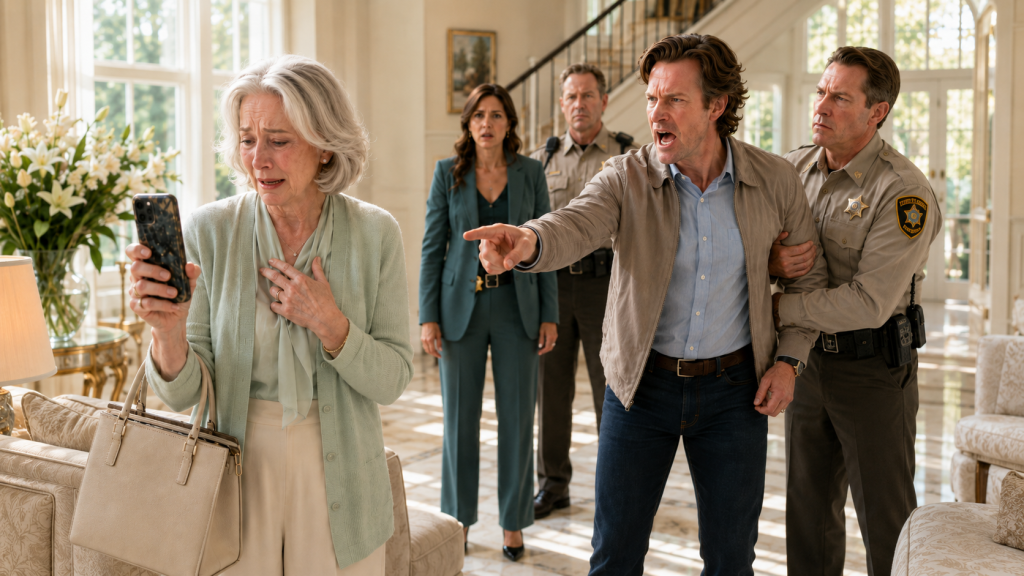
My son held my arm as though I was too frail to remain standing on my own. Then he turned to the officers with a soft, practiced smile and accused me of causing his father’s death so I could inherit everything. I kept my eyes lowered and let him enjoy the performance.
Because after thirty years of believing the fire had buried the truth forever, he had no idea his father’s phone was still inside my purse. My son, Miles Carter, tightened his grip around my arm like I was some helpless old woman. Then he faced the police and said calmly, “She killed my father for the estate.”
I lowered my gaze.
And I let him act.
Detective Nora Bell stood in the marble foyer of Carter House, rainwater dripping from the edge of her coat onto the floor my husband had picked out twenty-nine years ago.
Two officers waited behind her, watching me with careful eyes.
People always treated wealthy widows cautiously.
They expected pearls, pills, hidden truths, and expensive lawyers.
Miles offered them all of it.
“My mother hasn’t been mentally stable for years,” he said in a gentle voice. “My father was planning to change his will before the accident. She knew. Then the lake house burned, and he never made it out.”
“Your father died thirty years ago,” Detective Bell said.
Miles swallowed at the perfect moment.
“Some truths take time to uncover.”
Only then did I look at him.
Forty-two years old.
A touch of gray at his temples.
Still wearing the same hurt expression he had mastered as a boy whenever he broke something and wanted someone else punished for it.
He had his father’s blue eyes and my ability to tolerate lies, but none of my restraint.
Detective Bell turned toward me.
“Mrs. Carter, did your husband ever tell you he intended to change his will?”
“Yes,” I answered.
Miles blinked.
He had not prepared for that.
“He told me many things before he died.”
The detective’s focus sharpened.
“What kind of things?”
I opened my purse.
Miles’s fingers dug harder into my arm.
This time, it was not support.
It was a warning.
Inside my purse was an old black phone sealed in a plastic evidence bag.
Its screen was cracked.
The edges were stained dark from the fire.
For three decades, it had remained locked away in a safe-deposit box beside a cassette tape, three photographs, and a letter I had written to myself on the night everything changed.
Miles stared at the phone.
For the first time that morning, he looked afraid.
“My husband’s phone,” I said. “It was found near the boathouse before the fire reached the main cabin.”
“That’s impossible,” Miles whispered.
Detective Bell took it carefully.
“You kept this for all these years?”
“I was waiting.”
“For what?”
I looked directly at my son.
“For him to accuse me.”
Miles forced a weak laugh.
“This is just another one of her performances. She could have put anything on that phone.”
“No,” I said quietly. “Your father put it there.”
Detective Bell connected the phone to a portable forensic battery.
The screen flickered once.
Then again.
A voicemail icon appeared.
Miles stepped back.
The detective pressed play.
My husband’s voice filled the foyer, rough, shaken, and afraid.
“Eleanor, if you hear this, don’t trust Miles. He locked me inside. He said no one would believe a nine-year-old could plan it. He was wrong.”
Silence fell over Carter House like a dropped curtain.
Detective Bell did not move for several seconds.
The rain outside seemed louder than breathing, louder than the old grandfather clock ticking near the staircase, louder than Miles whispering, “No.”
I kept my hand at my side where his fingers had left red marks on my skin.
Thirty years ago, Miles had been a child with ash on his cheeks and tears ready whenever anyone looked at him.
I had believed the grief had broken him.
I had told every reporter, every relative, every suspicious neighbor that my son had lost his father and deserved mercy.
But my husband’s voice kept playing from that burned little phone.
“He knows about the new will,” Richard said, coughing hard. “He heard me telling Alden I was cutting him out until he got help. Eleanor, he smiled when he pushed the chair under the door.”
One officer turned toward Miles.
Miles’s face changed in pieces, like a mask cracking under heat.
“I was nine,” he said sharply. “Nine-year-olds don’t murder people.”
Detective Bell looked at him.
“No one said murder yet.”
Miles froze.
And that was when I reached back into my purse and removed the cassette tape.
Detective Bell’s eyes moved from the cassette to my face.
“What is that?”
“The night after the fire,” I said, “my husband’s attorney came to see me.”
Miles shook his head.
“Alden is dead.”
“Yes,” I said. “He died twelve years ago. But before he did, he kept his promise.”
The detective took the cassette carefully.
“Promise?”
“To tell the truth if Miles ever tried to destroy me.”
Miles laughed again, but this time it came out wrong.
Too sharp.
Too desperate.
“My mother has been collecting props for thirty years. Do you understand how sick that is? A burned phone, a tape, letters. She probably sits alone at night building stories because she can’t accept that my father loved me.”
I looked at him.
For one brief moment, the little boy was there.
Not innocent.
Never innocent.
But young.
Small.
Angry.
Desperate to be chosen first in a house where he had always been loved and still never felt satisfied.
Richard and I had waited years for a child.
When Miles was born, my husband wept in the hospital room.
He bought a blue blanket from the gift shop and held Miles so carefully the nurses teased him.
For the first five years, Miles was adored.
Then something changed.
It started with little things.
Broken glass hidden in the pantry.
A maid’s ring found under his mattress.
A neighbor’s cat locked in the garden shed.
When corrected, Miles did not cry because he was sorry.
He cried because someone had noticed.
Richard called specialists.
I called therapists.
We sat in offices with pale walls while kind people told us our son was gifted, sensitive, misunderstood.
But Richard saw what I refused to see.
By the time Miles was nine, Richard had begun keeping notes.
He wrote down dates.
Incidents.
Names.
He did not do it to punish our son.
He did it because he was afraid.
Afraid of what Miles might become if money protected him from every consequence.
The week before the fire, Richard changed his will.
Not to disinherit Miles forever.
That was never his intention.
The estate would be placed into a protected trust.
Miles would receive care, education, and supervised support.
But he would not inherit control of Carter Holdings at eighteen.
He would not receive unrestricted access to wealth that could turn his cruelty into power.
Richard told Alden first.
He intended to tell me that weekend at the lake house.
Instead, I received a call at midnight.
The lake house had caught fire.
Richard was trapped inside.
Miles had escaped.
And by sunrise, my husband was gone.
For thirty years, I lived with the story the world accepted.
A tragic accident.
A faulty heater.
A grieving widow.
A traumatized boy.
I buried Richard.
I raised Miles.
I protected him from reporters.
I protected him from relatives.
I protected him from suspicion.
And slowly, terribly, I began to realize that Richard had been right.
Miles did not grow softer with age.
He only grew more polished.
At seventeen, he blamed a housekeeper for stealing watches he had pawned.
At twenty-four, he manipulated an assistant into signing false expense reports.
At thirty-one, he convinced an investor that a failed deal had been my decision, not his.
Every time I confronted him, he smiled like a boy standing beside a broken vase.
“You’re confused, Mother.”
“Your grief makes you imagine things.”
“Father would be disappointed in how suspicious you’ve become.”
That last one always worked.
He knew it would.
For years, I let him sit on charity boards and attend galas and call me “Mother” in front of cameras.
But I never gave him control.
Carter House remained in my name.
The estate remained protected.
Richard’s revised documents remained hidden.
And Miles waited.
He waited for me to age.
He waited for me to weaken.
He waited for a doctor to mention memory.
He waited for one misplaced key, one forgotten lunch, one moment of sadness he could turn into evidence.
Then, six months before Detective Bell came to my door, Miles made his mistake.
He brought me tea in the library.
I had not asked for tea.
He set the cup beside me and said, “Mother, we should discuss practical matters.”
I looked up from my book.
“What matters?”
“The house. The company shares. Your medical directives.”
I smiled faintly.
“I am not dead yet.”
His jaw tightened.
“No one said you were.”
“No,” I said. “But you always speak as if you are rehearsing for the day.”
He laughed softly.
“You make everything cruel.”
“No, Miles. I simply remember who taught you to hide cruelty inside concern.”
His face went still.
For one second, he looked exactly as he had at nine years old.
Then he picked up the teacup and threw it against the fireplace.
Porcelain shattered across the rug.
A maid ran in.
Miles turned instantly, his face pale and wounded.
“She’s confused again,” he said. “She thought I was Father.”
That was the first time he tried to make my staff doubt me.
The second time, he called my physician.
The third, he spoke to the family attorney.
The fourth, he called Detective Bell.
And accused me of murder.
He believed age had made me careless.
He believed loneliness had made me weak.
He believed thirty years of silence meant there was nothing left to fear.
He had forgotten one thing.
Silence is not the same as surrender.
Detective Bell asked us to move from the foyer into the sitting room.
Miles refused at first.
“I want my lawyer.”
“You can call one,” she said. “But right now, I’m asking questions based on allegations you made.”
“I made them because my mother is dangerous.”
Detective Bell held up the evidence bag containing the phone.
“Then you should want us to examine everything.”
Miles’s eyes flicked toward me.
There it was again.
That old expectation.
That I would save him.
That I would soften the room.
That I would say he was upset, tired, grieving some ancient grief.
Instead, I walked into the sitting room and sat beneath Richard’s portrait.
Miles followed slowly.
The two officers stood near the door.
Detective Bell placed the cassette tape on the table.
“Do you have a player?”
“In the music cabinet,” I said.
Miles looked at the cabinet as if it were a coffin.
The detective found the old tape player.
It clicked when she pressed the button.
For a moment, there was only static.
Then Alden Pierce’s voice filled the room.
He had been Richard’s attorney, but more than that, he had been his oldest friend.
“Eleanor,” the recording began, “if you are hearing this, then Miles has forced your hand.”
Miles closed his eyes.
Alden continued.
“Richard came to my office on March seventeenth, two days before the lake house fire. He was distressed. He stated that Miles had discovered the new estate arrangement and had threatened him. Richard did not want police involved because Miles was a child. He wanted treatment, not punishment.”
The tape crackled.
Detective Bell leaned closer.
“Richard asked me to retain copies of the revised will, the trust documents, and his written account of incidents involving Miles. He also asked me to contact Dr. Henley regarding emergency intervention after the weekend.”
I remembered that weekend so clearly that my chest hurt.
Richard had kissed my forehead before leaving.
“Just one night at the lake,” he had said. “Miles and I need to talk somewhere quiet.”
I had wanted to go with them.
Richard said no.
Not because he was shutting me out.
Because he wanted to protect me from a conversation he knew would break my heart.
On the tape, Alden’s voice lowered.
“After the fire, I received a package from a groundskeeper named Samuel Ortiz. Inside was Richard’s damaged mobile phone, three photographs of the boathouse area, and a handwritten note stating that Samuel had seen Miles outside the cabin before smoke was visible.”
Miles sprang to his feet.
“That’s a lie!”
Detective Bell looked up.
“You knew Samuel Ortiz?”
“No.”
“Then how do you know it’s a lie?”
Miles opened his mouth.
Nothing came out.
I looked at the rain sliding down the windows.
“Samuel disappeared two days after giving Alden that package,” I said.
Detective Bell turned toward me.
“Disappeared?”
“He left town. At least, that is what we were told. His sister contacted me years later. She said he had been afraid.”
“Afraid of whom?”
I did not answer.
I did not need to.
Miles’s breathing had changed.
Alden’s tape continued.
“Eleanor, I advised you at the time not to pursue this publicly. Miles was a minor, Richard was gone, and the Carter name would have become a circus. But I regret that advice. I regret it deeply. If Miles ever turns on you, use everything. Do not protect him again.”
The tape ended with a click.
No one spoke.
Then Miles began to clap.
Slowly.
Mockingly.
“My God,” he said. “What a performance. A dead attorney, a missing groundskeeper, a burned phone. Mother, you should have written novels.”
Detective Bell did not smile.
“Sit down, Mr. Carter.”
“I will not.”
“Sit down.”
The room changed.
Not loudly.
Not dramatically.
But power shifted.
Miles felt it.
For the first time in his life, charm was not enough.
He sat.
Detective Bell asked me, “Why not give this to police thirty years ago?”
It was the question I had asked myself for most of my life.
I folded my hands in my lap.
“Because I was a coward.”
Miles looked at me quickly.
I continued.
“I told myself I was protecting a child. I told myself Richard would not have wanted Miles destroyed. I told myself treatment, distance, and controlled money would prevent more harm.”
I looked at my son.
“But the truth is simpler. I could not bear losing both of them in one night.”
For the first time, my voice trembled.
Not enough to break.
Just enough to be honest.
“I had already lost my husband. I could not admit that my son had been the reason.”
Miles whispered, “I was a child.”
“Yes,” I said. “You were.”
His eyes glistened.
For one dangerous second, I almost softened.
Then he said, “And you chose Father over me.”
There it was.
Not grief.
Not remorse.
Ownership.
Even after thirty years, he did not mourn the man who died.
He resented the fact that Richard had tried to stop him.
Detective Bell said, “Mr. Carter, did you lock your father inside the lake house?”
Miles laughed under his breath.
“I want my attorney.”
“That is your right.”
“And I want her evaluated.” He pointed at me. “She has been unstable for years. Everyone knows it.”
“Who is everyone?”
“My wife. My staff. Her staff. Doctors.”
I smiled sadly.
“Miles, your wife left you eight months ago.”
His head snapped toward me.
The detective noticed.
“She left,” I said, “because you tried to have her sign papers giving you access to her inheritance.”
“Shut up.”
The words came out before he could dress them nicely.
Detective Bell’s eyes narrowed.
I reached into my purse once more.
Miles stood again.
“Stop letting her do this!”
One officer stepped forward.
“Sit down, sir.”
I placed three photographs on the table.
They were old.
The colors had faded.
But the images remained clear enough.
The first showed the lake house from the trees.
The second showed a small figure near the side door.
The third showed a chair wedged beneath the handle.
Detective Bell put on gloves before touching them.
Miles stared at the third photograph.
His face emptied.
Not with shock.
With recognition.
“You said the phone was impossible,” Detective Bell said softly. “You said the tape was a performance. What about these?”
Miles said nothing.
I remembered the night Alden gave me the photographs.
He had come to Carter House after the funeral.
He looked twenty years older.
“Samuel took them,” he told me. “He was repairing the boathouse roof. He thought Miles was playing some game. By the time he smelled smoke, it was too late.”
“Why didn’t he help Richard?” I had asked.
Alden’s eyes filled with shame.
“He tried. The side door was blocked. The front hall was already burning. He ran for the emergency phone by the dock, but the line was dead.”
Later, we learned the line had been cut.
At the time, I could not even say the words aloud.
Now Detective Bell said them for me.
“The original fire report mentions damage to the exterior phone line.”
“Yes,” I said.
Miles was breathing through his mouth.
The room felt smaller.
The portrait of Richard watched over us from the wall.
My husband had been handsome in that painting, but not proud.
His expression was gentle.
Patient.
A man who believed love could repair almost anything until love became the thing used against him.
Detective Bell looked at Miles.
“Your father stated on the voicemail that you locked him inside. Alden Pierce stated there were trust documents and notes. Mrs. Carter has provided photographs. You came here today claiming she killed him. Why?”
Miles’s eyes shifted.
I knew that look.
He was searching for the weakest person in the room.
There were none.
So he chose anger.
“Because she stole my life.”
I closed my eyes briefly.
“My God, Miles.”
“No.” He stood again, and this time his voice rose. “No, you do not get to sit there like a saint. This house was supposed to be mine. The company was supposed to be mine. Father promised me everything.”
“You were nine.”
“He said I was his legacy.”
“You were his son. That is not the same as being his owner.”
Miles pointed at Richard’s portrait.
“He was going to throw me away.”
“He was going to get you help.”
“I didn’t need help!”
The words rang through the sitting room.
Afterward, silence.
Miles realized what he had revealed.
His face twisted.
“I was a child,” he said again, weaker now.
Detective Bell spoke carefully.
“Being a child then affects how the law views what happened thirty years ago. It does not make today’s false accusation disappear.”
Miles looked confused.
“Today?”
“You accused your mother of murder. You attempted to influence a criminal investigation. You may have submitted false statements. And depending on what else we find, there may be financial crimes involved.”
For the first time, Miles looked truly frightened.
Not sorry.
Frightened.
He turned to me.
“Mother.”
There it was.
The word he used whenever he wanted rescue.
I thought of him at five, asleep with one hand curled under his cheek.
I thought of him at nine, wrapped in a blanket while firefighters moved behind him.
I thought of him at sixteen, crying after Richard’s birthday dinner because he said he could not remember his father’s voice.
All those years, I had mistaken need for love.
“Mother,” he whispered, “tell them this is a misunderstanding.”
My heart broke quietly.
Not because I wanted to save him.
Because I finally understood that the son I loved had learned to imitate love, but not return it.
“No,” I said.
His expression hardened.
“You owe me.”
“I gave you thirty years.”
“You gave me a cage.”
“I gave you a life your father did not get to finish.”
Miles’s mouth trembled.
Then he did something he had not done since childhood.
He cried.
Not loudly.
Not honestly.
Just enough.
He lowered his face into his hands and shook his shoulders.
One of the officers looked away, uncomfortable.
Detective Bell did not.
Neither did I.
Miles cried for almost a minute.
Then, when no one moved to comfort him, he stopped.
Just like that.
He wiped his eyes.
“You always were cold,” he said.
I nodded slowly.
“Perhaps I became that way because warmth kept burning me.”
Detective Bell asked the officers to escort Miles to another room while she made calls.
He resisted only once.
At the doorway, he looked back at Richard’s portrait.
Then at me.
“You think this ends with me?”
“No,” I said. “I think it begins with the truth.”
They led him away.
When the room emptied, Detective Bell sat across from me.
Her voice softened.
“Mrs. Carter, I need to ask whether there is more.”
I almost laughed.
There is always more in families like ours.
More rooms.
More keys.
More silence.
More things polished until they shine enough to blind outsiders.
“Yes,” I said.
I gave her the letter I had written the night Alden came to me.
The paper had yellowed.
My handwriting looked younger.
Less steady.
But every word remained.
In that letter, I had recorded what Alden told me.
I had written about Samuel Ortiz.
The phone.
The photographs.
The changed will.
The fear that if I spoke, Miles would be consumed by scandal before anyone could understand what he was.
At the bottom, I had written one sentence over and over.
I do not know how to be his mother now.
Detective Bell read it without interrupting.
When she finished, she folded it gently.
“You blamed yourself.”
“Of course I did.”
“Why?”
“Because mothers are told love can fix anything.”
The detective’s expression changed.
Not pity.
Understanding.
“And when it doesn’t?”
I looked toward the hall where Miles had vanished.
“Then we keep loving the memory of who we hoped they would become, even while surviving who they are.”
Detective Bell stayed at Carter House for four hours.
By the time she left, the rain had stopped.
The officers took the phone, the cassette, the photographs, the letter, and copies of Richard’s trust documents.
Miles left with them.
Not in handcuffs at first.
Detective Bell was careful.
Everything had to be done properly.
He walked past me in the foyer with his expensive coat over one arm.
His hair was slightly disordered.
His eyes were red.
For any stranger, he would have looked like a devastated son.
At the door, he paused.
“You’ll regret this.”
I smiled sadly.
“No, Miles. I have regretted everything else.”
He stepped outside.
The police car door closed.
And for the first time in thirty years, Carter House felt quiet.
Not peaceful.
Not yet.
But honest.
That night, I went into Richard’s study.
I had not touched the room in years.
The leather chair still faced the windows.
His books still lined the shelves.
His brass reading lamp still stood on the desk.
For decades, I had preserved that room like a shrine, but really it had been a courtroom where I sentenced myself every day.
I sat in his chair.
Then I opened the bottom drawer.
Inside was a file Miles had never found.
Richard’s final letter to me.
Alden had given it to me with the other documents, but I had only read it once.
I unfolded it with trembling hands.
My dearest Eleanor,
If you are reading this, then I failed to handle this gently.
Forgive me.
I know you will want to protect our son.
I want that too.
But protection without truth becomes permission.
Miles needs help that money cannot buy and love cannot replace.
Do not let my name, my estate, or your guilt become his shield.
I love him.
I love you.
And if I am gone, I need you to survive both losses.
Not just mine.
His too, if it comes to that.
Richard.
I pressed the letter to my chest.
For years, I had thought surviving Miles meant keeping him safe.
Now I understood.
Surviving Miles meant no longer allowing him to use my love as a weapon against me.
Three weeks later, Detective Bell returned.
This time, she came alone.
I met her in the garden room, where morning light fell over the orchids.
She carried a folder.
“Mrs. Carter,” she said, “we recovered enough from the phone to verify the voicemail metadata. It was recorded the night of the fire.”
I closed my eyes.
Even after all those years, confirmation felt like grief starting over.
“And the tape?” I asked.
“Consistent with the period. We’re still authenticating, but nothing suggests fabrication.”
“Samuel?”
Detective Bell sat.
“We found his sister. She kept a letter from him. In it, he wrote that he saw Miles near the side door and later saw the chair blocking it.”
My breath caught.
“He’s alive?”
“No. He died six years ago.”
I looked down.
Another witness gone.
Another person who had carried fear because of my family.
“But his letter helps,” Detective Bell said. “And there is more.”
She opened the folder.
“Miles has been moving money through shell accounts. Some involved Carter Holdings. Some involved charities linked to your name.”
I was not surprised.
That was the terrible thing.
After everything, I was not surprised.
“He planned to have you declared incompetent,” she continued. “Your accusation would have become part of that process. If you had been charged or publicly discredited, he intended to petition for emergency control of your assets.”
“So Richard’s death was not enough,” I said quietly.
Detective Bell’s face softened.
“No.”
I looked out at the garden.
The roses were beginning to open.
Richard had planted them for our tenth anniversary.
Miles had once cut all the blooms off because we would not let him skip school for a sailing trip.
He had stood among the ruined stems and said a deer had done it.
He was seven.
I had believed him.
Or perhaps I had chosen to.
“What happens now?” I asked.
“The old case will be reviewed. Because he was a minor then, it is complicated. But what he did recently is not. Fraud, coercion, false statements, possible elder exploitation. Those are current.”
Elder exploitation.
The phrase almost made me laugh.
Miles would hate that.
Not because of the crime.
Because it made me sound old.
Powerless.
The very image he had tried to create.
“Will there be a trial?”
“Likely.”
“Then I will testify.”
Detective Bell studied me.
“It will be difficult.”
“Detective, I have already lived the difficult part.”
She nodded once.
Before leaving, she paused near the door.
“May I ask one personal question?”
“Yes.”
“Why wait until he accused you? Why not stop him sooner?”
I looked at Richard’s portrait in the hall.
“Because I wanted to give him one last chance not to become exactly who his father feared.”
“And when he did?”
I picked up my tea.
“Then I stopped being his shield.”
Months passed.
The story became public, of course.
Stories like ours always do.
Reporters gathered outside the gates.
Old friends sent careful messages.
Some apologized for believing Miles.
Some pretended they had always suspected.
The board of Carter Holdings held emergency meetings.
Miles’s photograph disappeared from charity websites.
His wife, Caroline, called me one evening from Santa Fe.
For a moment, neither of us spoke.
Then she said, “I should have told you what he was doing.”
“No,” I said. “You survived him. That was enough.”
She cried then.
A real cry.
The kind Miles had never learned.
“I thought I was crazy,” she whispered.
“So did I,” I said. “For many years.”
The trial began the following spring.
The courthouse smelled of old wood and rain.
Miles wore a dark suit and looked younger than he had in years.
Not innocent.
Just carefully arranged.
When I entered, he turned.
For a heartbeat, I saw panic in his eyes.
Then the mask returned.
Poor son.
Cruel mother.
Ancient misunderstanding.
He had played the role for so long I wondered whether even he knew where the performance ended.
The prosecutor played Richard’s voicemail.
The courtroom listened to my husband die all over again.
I kept my hands folded.
I did not cry.
Miles did.
The jury watched him.
I watched the jurors.
Some pitied him at first.
Then came the photographs.
Then Alden’s tape.
Then Samuel’s letter.
Then the financial records showing that Miles had been preparing to strip me of my rights while publicly pretending to protect me.
By the third day, pity had left the room.
When I took the stand, Miles would not look at me.
The prosecutor asked, “Mrs. Carter, why did you keep these materials hidden?”
I answered honestly.
“Because I loved my son more than I trusted the truth.”
The courtroom went silent.
“And what changed?”
I looked at Miles.
“He used that love to accuse me of the one thing he knew had haunted me for thirty years.”
The prosecutor stepped closer.
“Did you kill Richard Carter?”
“No.”
“Did you cause the fire at the lake house?”
“No.”
“Did you benefit from your husband’s death?”
I took a breath.
“I inherited his estate. But I lost my life.”
Miles finally looked at me.
For once, there was no smile.
No tears.
No performance.
Only hatred.
His attorney stood for cross-examination.
He was clever.
Expensive.
Exactly the kind of man Miles liked because he knew how to make cruelty sound like doubt.
“Mrs. Carter,” he said, “isn’t it true that your husband planned to restrict your son’s inheritance?”
“Yes.”
“And isn’t it true that you supported that plan?”
“Eventually, yes.”
“After your husband’s death, you alone controlled the estate.”
“Yes.”
“And now, thirty years later, when your son questions that arrangement, you produce dramatic evidence blaming him as a child.”
I leaned toward the microphone.
“My son did not question the arrangement. He falsely accused me of murder so he could take control of it.”
The attorney paused.
A few people in the gallery shifted.
He tried again.
“You expect this court to believe a nine-year-old planned such a thing?”
“No,” I said.
His eyebrows lifted.
“No?”
“I expect this court to believe what the evidence shows. That a deeply disturbed child acted with intention, and that the adults around him failed to confront the truth because it was too terrible.”
The attorney’s mouth tightened.
“Including you?”
“Especially me.”
He had no answer for that.
Because shame, spoken plainly, is difficult to use against someone.
Miles was convicted on the current charges.
Fraud.
Coercion.
False statements.
Financial exploitation.
As for the old case, the court acknowledged what had happened as far as the law allowed.
There were complications because of his age at the time, the decades that had passed, and the dead witnesses.
But the truth entered the record.
Richard Carter had not been killed by chance alone.
And I had not killed him.
After sentencing, Miles asked to speak to me.
My attorney advised against it.
Detective Bell advised caution.
Caroline told me I owed him nothing.
They were all right.
Still, I went.
Not because he deserved it.
Because I needed to see him without the house, the portrait, the money, or the past standing between us.
He sat behind glass in a pale visiting room.
No tailored suit.
No gold watch.
No audience.
Just my son.
For a while, we stared at each other through the barrier.
Then he picked up the phone.
I picked up mine.
“You ruined me,” he said.
Not hello.
Not Mother.
Not I’m sorry.
I almost smiled.
In a strange way, it was the most honest thing he had ever said.
“No, Miles. I stopped helping you ruin others.”
His jaw moved.
“You could have protected me.”
“I did.”
“Not from this.”
“From this most of all.”
He leaned closer.
His eyes were still Richard’s.
That hurt more than I expected.
“Did you ever love me?”
The question entered me like a blade.
I closed my eyes.
When I opened them, I gave him the truth.
“Yes. More than was wise.”
For the first time, his face flickered.
Something moved beneath it.
A child.
A wound.
A hunger.
Then it was gone.
“If you loved me, you would have burned that phone.”
I looked at him for a long time.
“That is why I kept it.”
He stared.
I continued.
“Because one day, I knew I might need proof that love and obedience are not the same thing.”
His hand tightened around the receiver.
“You chose him.”
I shook my head.
“No. I finally chose truth.”
I placed the phone back on its hook.
He shouted something as I stood.
I did not hear the words.
Or perhaps I chose not to.
Outside, the afternoon was bright.
Too bright for a day like that.
Detective Bell waited near the exit.
She did not ask what Miles had said.
She simply walked beside me down the courthouse steps.
At the bottom, she said, “What will you do now?”
For the first time in thirty years, the question did not frighten me.
“I think,” I said, “I will go home.”
Carter House changed after that.
Not quickly.
Houses that hold secrets do not release them all at once.
I took down Richard’s portrait from the sitting room and moved it to the library, where he had actually liked to sit.
I opened the lake house property, which had remained untouched for decades.
There was no house there anymore.
Only stone foundations, weeds, and the old dock leaning into the water.
I stood there one morning with Caroline beside me.
She had come because she said she needed to see the place.
The wind moved gently over the lake.
No smoke.
No sirens.
No lies.
Just water and sky.
“I thought I would feel him here,” I said.
“Richard?”
I nodded.
“Do you?”
I looked at the empty foundation.
“No. I think he left a long time ago. I was the one who stayed.”
Caroline took my hand.
Together, we walked to the edge of the dock.
Alden’s daughter helped me create the Richard Carter Foundation for Family Intervention and Elder Protection.
Not a glamorous charity.
No champagne galas.
No soft-focus photographs of rich people pretending generosity.
It funded legal help, counseling, emergency housing, and advocates for families trapped by manipulation they could not explain without sounding cruel themselves.
At the opening, Detective Bell attended quietly in the back row.
Caroline came too.
So did two former employees Miles had tried to ruin.
I spoke for only five minutes.
I did not mention Miles by name.
I did not need to.
I said, “There are homes where the danger does not shout. It smiles. It organizes. It explains your fear so convincingly that even you begin to doubt it. This foundation is for those who have been told they are confused when they are only afraid.”
Afterward, an older woman approached me.
Her hands shook as she held mine.
“My daughter says I’m losing my mind,” she whispered. “But I know what she’s doing.”
I squeezed her fingers.
“I believe you.”
She began to cry.
And for the first time, I understood that truth does not only punish.
Sometimes, it opens a door for someone else.
A year after the trial, I returned alone to Richard’s study.
The safe-deposit box was empty now.
The phone was evidence.
The tape was archived.
The photographs were copied and sealed.
But the letter remained with me.
I placed Richard’s final letter in a frame, not for visitors, not for display, but for myself.
Protection without truth becomes permission.
I read that sentence every morning until I no longer needed to.
Miles wrote to me twice.
The first letter blamed me.
The second blamed Richard.
There was no third.
I did not write back.
Some people called that cruel.
Others called it strength.
I no longer cared what they called it.
For thirty years, I had lived according to what others might think.
What would people think if they knew?
What would they think of Miles?
What would they think of me as a mother?
What would they think of Richard’s legacy?
In the end, people thought many things.
Then they went home to their own locked rooms, their own polished tables, their own family stories with missing pages.
I stayed.
I survived.
One autumn evening, I sat on the terrace at Carter House as the sun lowered behind the trees.
The marble floors inside glowed gold.
The old rooms were quiet.
For once, quiet did not feel like fear.
Caroline had sent flowers that morning.
Detective Bell had sent a brief note saying one of the foundation’s emergency cases had been resolved safely.
On the table beside me lay a cup of tea.
No one had brought it to manipulate me.
No one had placed it there as evidence of my weakness.
I had made it myself.
The grandfather clock struck six.
For a moment, I imagined Richard standing in the doorway, smiling that gentle smile of his, asking if I was ready to stop punishing myself.
I answered aloud, though no one was there.
“Yes.”
The house did not echo.
It simply held the word.
I thought of Miles as a baby.
Miles as a boy.
Miles as the man who gripped my arm and told police I had killed his father.
All of them were real.
That was the hardest truth.
Love does not erase what someone becomes.
And wrongdoing does not erase the fact that you once loved them.
Both truths can live in the same heart.
Mine had carried them for thirty years.
But not anymore as chains.
Now they were only scars.
Proof that something had happened.
Proof that I had healed enough to stop hiding it.
The next morning, I called a realtor about the lake property.
“Are you selling?” she asked.
I looked out at the garden where Richard’s roses had opened again.
“No,” I said. “I’m rebuilding.”
Not the same house.
Never the same house.
This one would have wide windows, bright rooms, and doors that opened easily from the inside.
There would be no locked rooms.
No hidden phones.
No silence mistaken for peace.
When the realtor asked what I wanted to call it, I paused.
For thirty years, we had called it the lake house.
Then the fire site.
Then the property.
But as sunlight moved across the floor, I finally knew.
“Call it Richard’s Landing,” I said.
My voice did not break.
That surprised me.
Later, I walked through Carter House and opened every curtain.
Light poured across the marble foyer where Miles had once accused me.
It touched the staircase.
The sitting room.
The place where Detective Bell had played Richard’s message.
The place where my son’s mask had finally cracked.
I stood there alone, no hand gripping my arm, no voice speaking over mine, no lie demanding my protection.
For the first time since the night of the fire, I felt the full weight of my own name.
Eleanor Carter.
Widow.
Mother.
Witness.
Survivor.
And at last, free.
THE END! THANK YOU FOR READING!