

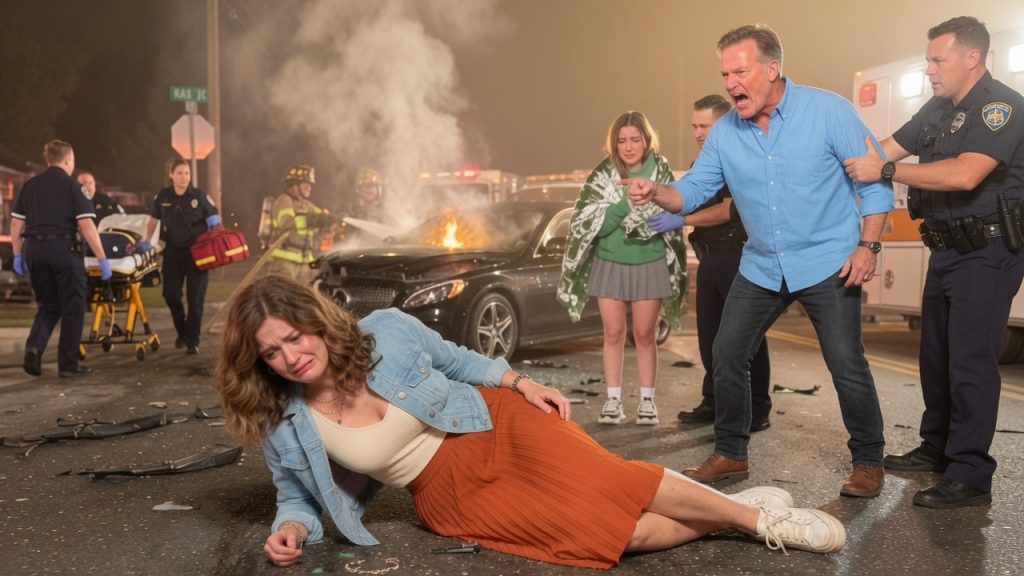
After our car accident, I was still trapped inside when my dad shouted at the paramedics to save my sister first. Then he pointed at me and said, “The other one never meant much anyway. Don’t waste time on her.” I was still conscious. And I heard every word.
I was trapped inside the passenger side of my father’s black Lincoln, my left leg pinned beneath the damaged door while firefighters worked around the twisted metal. Smoke drifted through the air in gray ribbons. Emergency lights flashed red and blue across Riverside Drive, turning the night into a blur of color, sirens, and shouting voices.
My younger sister, Olivia, sat several feet away on the curb, wrapped in a silver emergency blanket.
She was crying for Dad.
She had a cut across her forehead and a broken wrist, but she was awake. She was moving. She was breathing without help.
I could see her.
I could hear her sobbing.
But I could not feel my feet.
“Sir, step back,” one paramedic snapped.
“My Olivia first!” Dad shouted. His voice cracked, but not from worry about me. “She’s all I have. Grace is—”
He stopped.
For one second, I thought shame would save him from saying the rest.
Then he said it anyway.
“Grace is not important.”
The firefighter closest to me paused.
His gloved hands were braced against the crushed door, and for a moment, his eyes met mine through the haze.
He heard it too.
Everyone heard it.
I wanted to tell him I mattered.
I wanted to tell my father that I had packed Olivia’s lunch every school morning since Mom passed away. I wanted to tell him I had worked double shifts at the diner to help pay the bills he forgot. I wanted to remind him that I had turned down Boston University for community college because he said the family needed me.
I wanted to scream that I had spent six years being the invisible glue holding our broken little family together.
But I could barely speak.
My throat burned from smoke. My chest hurt every time I tried to breathe.
And beneath the pain, one thought kept repeating.
He said it out loud.
He finally said it out loud.
Everything had changed only minutes earlier.
Dad had picked us up from Aunt Meredith’s house after dinner. It was supposed to be a normal ride home.
Olivia sat in the back seat, scrolling through her phone, her blond hair falling across her face. She was seventeen, pretty in the effortless way that made adults soften around her. I was twenty-two, tired from work, still wearing my diner uniform under my coat.
Dad was quiet from the moment we got into the car.
Too quiet.
His hands gripped the steering wheel so tightly his knuckles looked white beneath the passing streetlights.
Olivia asked if we could stop for coffee.
Dad refused.
“Not tonight,” he said sharply.
I glanced at him. “Are you okay?”
“I’m fine.”
There was a strange smell inside the car.
Sharp. Chemical. Wrong.
I sat up straighter and looked at the dashboard.
“Dad, do you smell that?”
He didn’t answer.
“Dad?”
He snapped, “Stop being dramatic, Grace.”
That was his favorite word for me.
Dramatic when I cried.
Dramatic when I complained.
Dramatic when I asked for help.
Dramatic when I noticed something everyone else wanted to ignore.
From the back seat, Olivia leaned forward.
“Grace,” she whispered, so quietly I almost missed it. “Don’t be mad. I only told him because I thought he already knew.”
I turned halfway in my seat.
“Told him what?”
She looked at Dad, then back at me.
Her face had gone pale.
Before she could answer, the engine sputtered.
Dad cursed under his breath.
The steering wheel jerked.
The car swerved hard.
Headlights flashed in front of us.
Olivia screamed.
Then everything went dark.
When the world came back, it came in pieces.
The taste of blood.
The smell of smoke.
My father’s voice outside the car.
Olivia crying.
Glass glittering across my lap like tiny pieces of ice.
And then the words that would divide my life into before and after.
“The other one never meant much anyway.”
A paramedic knelt beside me through the broken window.
“Grace, can you hear me?”
I blinked once.
“We’re getting you out.”
Behind him, Dad held Olivia’s hand and kissed her knuckles.
“You’re safe, sweetheart. I’m here.”
Olivia looked past him toward me.
For one brief moment, her expression changed.
It wasn’t fear.
It wasn’t sadness.
It was guilt.
And suddenly, I remembered.
The bank envelope in my backpack.
The acceptance letter.
The apartment deposit receipt.
My plan to leave them both.
I had been accepted into a nursing program two cities away. I had saved enough money for the first month of rent. I had packed most of my important things at Aunt Meredith’s house because I knew Dad would try to stop me if he found out.
I was leaving in three days.
Olivia knew.
She had found the envelope in my bag that afternoon.
And she had told him.
The firefighters finally cut the door away and pulled me free.
Pain exploded through my body so violently that the night went white.
Dad never looked in my direction.
Not once.
I stopped being his unwanted daughter that night.
I became his witness.
I woke up two days later in a hospital room with metal rods in my left leg, bruises across my chest, and an oxygen tube beneath my nose.
The first thing I saw was Aunt Meredith sleeping in a chair beside my bed.
Her gray hair was messy. Her coat was folded over her lap. One hand rested on my blanket, like she had been holding onto me even in sleep.
I tried to say her name, but my throat felt scraped raw.
Her eyes opened instantly.
“Grace?” she whispered.
I blinked.
Her face crumpled.
“Oh, honey.”
She stood and leaned over me carefully, pressing a kiss to my forehead.
“You’re safe,” she said. “You’re in the hospital. Surgery went well. You scared the life out of me.”
I swallowed hard.
“Olivia?”
“She’s okay,” Aunt Meredith said. “Broken wrist, stitches, mild concussion. She went home this morning.”
Of course she did.
Olivia went home.
I stayed broken in a hospital bed.
I turned my head toward the door.
Through the small window, I could see my father in the hallway. He was arguing with a doctor, waving his hands like he was the victim of some terrible inconvenience.
“I’m not paying for unnecessary procedures,” he snapped. “Grace makes her own choices now. She wants to act grown, let her handle it.”
The doctor’s expression hardened.
Aunt Meredith followed my gaze.
Her mouth tightened.
“He tried to refuse consent for part of your treatment,” she said quietly. “The hospital called me because I’m listed as your emergency contact too. Thank God your mother insisted on that years ago.”
My mother.
The thought of her hit harder than the pain.
Mom had died when I was sixteen.
Cancer took her slowly, then all at once.
Before she died, she made me promise to take care of Olivia. She never asked me to take care of Dad. I did that part myself, because someone had to.
A knock sounded at the door.
A police officer stepped in.
He was middle-aged, broad-shouldered, with tired eyes and a notebook in his hand.
“Grace Bennett?” he asked gently.
I nodded.
“I’m Officer Daniel Price. I know this is difficult, but I need to ask if you remember anything before the crash.”
Aunt Meredith’s hand closed around mine.
Dad appeared in the doorway behind him.
“She doesn’t remember anything,” he said quickly.
Officer Price turned around.
“I’ll ask her.”
Dad’s jaw tightened.
“She’s medicated.”
“She’s conscious.”
“She’s confused.”
“I said I’ll ask her.”
For the first time in my life, I watched someone refuse to be pushed around by my father.
Officer Price turned back to me.
“Grace, do you remember anything unusual about the car before the accident?”
I looked at Dad.
He stared back at me.
Not worried.
Not sorry.
Warning.
And suddenly, I was back in that crushed passenger seat, smoke in my lungs, hearing him tell strangers I wasn’t worth saving.
My voice came out thin and broken.
“The smell.”
Officer Price leaned closer.
“What smell?”
“Chemical,” I whispered. “Before the crash. I told him. He said I was dramatic.”
Dad laughed once, sharp and ugly.
“This is ridiculous.”
I kept going.
“Engine sputtered. Steering jerked.”
Officer Price wrote something down.
“Anything else?”
My eyes moved to Aunt Meredith.
“My backpack,” I whispered.
Her face changed.
She stood quickly and reached beneath the chair. She lifted my backpack, the one she must have collected from the wreck or from the hospital’s belongings bag.
“I have it right here.”
Dad stepped forward.
“That’s mine,” he said.
Aunt Meredith pulled it against her chest.
“No, it isn’t.”
His eyes flashed.
“Meredith.”
“Don’t,” she said. “Do not use that tone with me.”
Officer Price looked between them.
“What’s in the backpack?”
Aunt Meredith opened it carefully.
Inside was the bank envelope.
My nursing school acceptance letter.
The receipt for my apartment deposit.
And tucked into the side pocket was a small black voice recorder.
My breath caught.
Mom’s recorder.
She used to carry it in her purse to record reminders during chemo appointments, grocery lists, little messages to herself when her memory started slipping from treatment.
After she died, I kept it.
Sometimes, when the house felt too heavy, I played her old recordings just to hear her voice.
I had forgotten it was in my backpack.
Aunt Meredith picked it up.
The red light was still blinking faintly.
Officer Price stared at it.
“Was this recording during the crash?”
I closed my eyes.
I remembered pressing buttons in my bag at Aunt Meredith’s house, searching for my keys. I must have turned it on by accident.
Aunt Meredith handed it to the officer.
Dad’s face drained of color.
“Don’t touch that,” he snapped.
Officer Price looked at him carefully.
“Why?”
Dad opened his mouth.
Nothing came out.
The officer took the recorder.
He pressed play.
At first, there was only muffled sound.
The rustle of my bag.
Olivia laughing softly.
Aunt Meredith saying, “Call me when you get home, Grace.”
Then the car doors closing.
The engine starting.
A few seconds of silence.
Then my voice.
“Dad, do you smell that?”
His voice followed, cold and irritated.
“Stop being dramatic, Grace.”
The room went still.
The recording continued.
Olivia’s whisper came next.
“Grace, don’t be mad. I only told him because I thought he already knew.”
My own voice asked, “Told him what?”
Then Dad’s voice, low but clear.
“If Grace leaves, she takes the truth with her.”
Aunt Meredith went completely still.
Officer Price stopped writing.
My heart began to pound against my injured ribs.
On the recorder, Olivia sounded frightened.
“Dad, please don’t start again.”
He said, “She thinks she can walk away with your mother’s papers? With the bank statements? With everything?”
My voice on the recording was confused.
“What are you talking about?”
Then came the sputter.
The curse.
The scream.
The crash.
Officer Price stopped the recording.
No one spoke.
Dad’s face twisted.
“That means nothing,” he said. “I was upset. People say things.”
Aunt Meredith looked at him like she had never seen him before.
“What papers?” she asked.
Dad’s eyes cut to her.
“Stay out of this.”
But Aunt Meredith was already looking at me.
“What papers, Grace?”
I swallowed.
“The folder,” I whispered. “Mom’s blue folder.”
For six years, I had kept it hidden in the bottom drawer of my dresser.
Mom gave it to me two weeks before she died.
She had been so thin then, her wedding ring loose on her finger, her voice soft but urgent.
“Don’t open this until you’re ready to leave,” she told me. “And Grace? Don’t let your father know you have it.”
I had been sixteen.
I didn’t understand.
After she died, grief swallowed everything. Dad became angrier. Olivia became needier. Bills stacked up. My own dreams became smaller and smaller.
I forgot the folder for years.
Then, three months before the accident, while packing old clothes, I found it again.
Inside were bank statements, insurance documents, and copies of checks made out to my father from an account in my mother’s name.
There was also a letter.
Not long.
Not dramatic.
Just my mother’s handwriting, shaky but clear.
Grace, if you are reading this, it means you are ready to know. Your father has been using money from your college fund and Olivia’s trust for years. I tried to stop him. I was too sick to fight the way I wanted to. There is more hidden in the safe deposit box. The key is with Meredith. I am sorry I couldn’t protect you better. Please protect yourself.
I had taken the folder to Aunt Meredith’s house that afternoon.
I planned to show it to her after dinner.
But Olivia had gone through my backpack while I helped Aunt Meredith in the kitchen.
And she told Dad.
Officer Price closed his notebook slowly.
“Mr. Bennett, I’m going to need you to come with me.”
Dad’s expression shifted instantly.
From anger to wounded father.
“This is insane,” he said. “My daughter is injured, my family has been through a tragedy, and you’re listening to drugged nonsense?”
“No,” Aunt Meredith said.
Her voice was quiet, but it carried more force than shouting.
“We’re listening to your own words.”
Dad looked at me then.
Finally.
For the first time since the crash, my father looked directly at me.
There was no love in his eyes.
Only rage.
“You ungrateful little girl,” he said.
Officer Price stepped between us.
“That’s enough.”
Dad pointed at me.
“I fed you. I housed you. I gave you everything.”
A bitter laugh scraped my throat before I could stop it.
Everything.
He had given Olivia birthday parties, new clothes, dance classes, braces, a car fund.
He had given me grocery lists, overdue bills, and the responsibility of being the adult in a house where I was still a child.
Aunt Meredith moved closer to my bed.
“No, Charles,” she said. “She gave everything. You took it.”
Dad’s jaw worked.
Then he did something that proved who he really was.
He looked at Olivia, who had appeared silently in the doorway with a cast on her wrist and tears on her cheeks.
“Tell them,” he demanded. “Tell them Grace is lying.”
Olivia froze.
Her eyes moved from Dad to me.
For years, Olivia had been the golden child. The princess. The fragile one. The one I was supposed to protect, even when she hurt me.
But that night, standing in the hospital doorway, she looked small.
Not innocent.
Small.
“Olivia,” Dad said sharply. “Tell them.”
Her lips trembled.
“I can’t.”
Dad stared at her.
“What?”
She began crying harder.
“I heard you on the phone before we left Aunt Meredith’s,” Olivia whispered. “You were talking to someone about the car. You said it only had to scare her. You said if Grace missed her move-in date, she’d lose the apartment and come crawling back.”
The air left the room.
Dad’s face turned gray.
Officer Price turned fully toward Olivia.
“Who was he talking to?”
“I don’t know,” she whispered. “Maybe Mr. Harlan from the garage. I didn’t hear everything.”
Dad lunged a step toward her.
“You stupid girl.”
Officer Price caught his arm before he got close.
Aunt Meredith pulled Olivia into the room and shut the door behind her.
For once, Dad was the one being held back.
For once, his anger did not control the room.
That was the moment I understood something.
My father had not planned to kill me.
Not exactly.
He had planned to frighten me.
Trap me.
Break my independence before it started.
He wanted the car to fail just enough to make me miss my escape. Maybe he thought a minor accident would keep me home. Maybe he thought injuries would make me dependent again.
But cruelty does not become harmless just because the outcome is worse than planned.
The investigation moved quickly after that.
Officer Price had the Lincoln inspected.
The report found tampering in the fuel line and steering system. Not enough to guarantee a crash, according to the mechanic, but enough to make the car dangerous.
Mr. Harlan, Dad’s friend from the garage, denied everything at first.
Then police found security footage of Dad bringing the car in hours before the crash.
Then they found text messages.
Make it look like an old-car problem.
She cannot leave this week.
I only need time.
Mr. Harlan turned on him within twenty-four hours.
Dad was arrested while Olivia and I were still in the hospital.
I did not see it happen.
Aunt Meredith told me later.
“He kept saying you ruined his life,” she said, sitting beside my bed with a paper cup of bad hospital coffee. “Not that he was sorry. Not that he was grateful you survived. Just that you ruined his life.”
I stared at the ceiling.
For some reason, that hurt less than I expected.
Maybe because something inside me had already accepted the truth on Riverside Drive.
Maybe because hearing him tell paramedics not to save me had burned away the last soft, foolish hope that my father secretly loved me beneath all his anger.
He didn’t.
And knowing that was terrible.
But it was also clean.
A wound hurts differently when you stop pretending it is not there.
Olivia came to see me three days later.
Aunt Meredith had gone downstairs to call the lawyer, leaving us alone for the first time since the crash.
Olivia stood near the door in sweatpants and one of Dad’s old hoodies. Her cast was covered in signatures from nurses and friends. She looked younger than seventeen.
“Can I come in?” she asked.
“It’s a hospital room,” I said. “Not really mine.”
She stepped inside.
For a moment, she just stood there.
Then she started crying.
“I’m sorry,” she said.
I looked out the window.
Snow had begun to fall lightly over the hospital parking lot.
“You told him,” I said.
Her face crumpled.
“I didn’t think he’d do anything like that.”
“But you knew he’d try to stop me.”
She wiped her cheek with her sleeve.
“I was scared.”
“Of what?”
“You leaving,” she whispered.
I turned to look at her.
She hugged her cast against her chest.
“When Mom died, you became everything,” she said. “You made breakfast. You signed my forms. You picked me up when Dad forgot. You remembered my medicine. You came to my games. I know I acted like I didn’t notice, but I did. And when I saw the apartment receipt, I panicked.”
My throat tightened.
“So you told Dad.”
“I thought he’d yell,” she said. “I thought he’d make you stay. I didn’t think—”
She stopped.
Because there was no way to finish that sentence without making it worse.
“You didn’t think he would hurt me,” I said.
She nodded.
“But you were okay with him controlling me.”
Her tears fell harder.
“I didn’t understand it like that.”
“I did.”
Silence filled the room.
I wanted to forgive her.
The old Grace would have.
The old Grace would have opened her arms, let Olivia cry against her, told her it wasn’t her fault, promised everything would be okay.
But the old Grace had nearly died in a crushed Lincoln while her father held her sister’s hand and told rescuers not to waste time.
So I said the hardest thing I had ever said to her.
“I love you, Olivia. But I can’t be your mother anymore.”
She looked like I had slapped her.
“I’m not asking you to be.”
“Yes, you are,” I said softly. “You always have. Maybe not on purpose, but you have. And I let you. That part is on me.”
She sat down slowly in the chair beside my bed.
“What happens now?”
“I heal,” I said.
“And then?”
“I leave.”
Her lower lip trembled.
“For nursing school?”
“Yes.”
“What about me?”
I closed my eyes for a moment.
There it was.
The question that had kept me trapped for six years.
What about Olivia?
What about Dad?
What about the bills?
What about the house?
What about everyone except Grace?
I opened my eyes.
“You live with Aunt Meredith until you turn eighteen,” I said. “You go to therapy. You finish school. You learn how to take care of yourself.”
Her tears started again.
“And you?”
“I learn the same thing.”
Aunt Meredith became my legal anchor after that.
She contacted Mom’s old attorney, a sharp woman named Ellen Rhodes who wore navy suits and looked like she could frighten the truth out of a brick wall.
Ellen visited me at the hospital with a leather briefcase and a calm expression.
“Your mother was more prepared than your father knew,” she told me.
She explained that Mom had left documents, account records, and a sealed statement with her office years earlier. She had suspected Dad was misusing funds but had been too sick to pursue it fully before her death.
The safe deposit box contained more proof.
College savings accounts drained.
Life insurance money redirected.
Forged signatures.
A second mortgage I had never known about.
My father had not just taken from me.
He had built our entire life after Mom’s death on theft, control, and lies.
“The good news,” Ellen said, “is that your mother also protected one thing very well.”
“What?”
“The house.”
I blinked.
“Our house?”
She nodded.
“It was never fully your father’s. Your mother placed her half into a trust before she passed. You and Olivia are beneficiaries. Your father had the right to live there while raising you, but he did not have the right to sell it, mortgage it further, or use it as leverage.”
I let out a shaky breath.
“He always said we’d lose it without him.”
Ellen’s smile was sad.
“Men like your father often confuse control with provision.”
After two weeks, I was discharged from the hospital into Aunt Meredith’s care.
I could not walk without assistance.
My leg was wrapped and braced. My ribs ached. My hands shook sometimes when car engines backfired outside.
But Aunt Meredith’s house was quiet.
There was no shouting.
No slammed cabinets.
No list of things I should have done better.
She set up a small bed for me in the downstairs guest room and placed fresh flowers on the windowsill.
The first night, I woke up crying from a nightmare.
Aunt Meredith came in with a blanket and sat beside me without asking questions.
After a long time, she said, “Your mother would be proud of you.”
I broke then.
Not quiet tears.
Not the controlled crying I had trained myself to do in bathrooms and laundry rooms where no one could hear.
I sobbed like a child.
Because I had wanted to hear that for so long.
Because part of me had believed that leaving meant failing Mom’s last request.
Because I had spent years confusing sacrifice with love.
Aunt Meredith held my hand until the storm passed.
“She asked you to take care of Olivia,” she said softly. “She never asked you to disappear.”
Dad’s trial did not happen right away.
There were hearings.
Statements.
Lawyer meetings.
Insurance questions.
Medical paperwork.
Every part of justice moved slower than pain.
Dad tried to contact me twice.
The first letter came three weeks after the accident.
Grace, you know this has all been misunderstood. I was scared. I said things I didn’t mean. Your sister needed me. You were always stronger. I trusted you to survive because you always do. Don’t let outsiders destroy this family.
I read it once.
Then I handed it to Ellen.
The second letter was shorter.
You owe me the truth.
I almost laughed.
Then I realized he truly believed that.
He believed my silence belonged to him.
My labor belonged to him.
My future belonged to him.
Even my truth, the one thing I had left, was something he thought I owed.
I did not write back.
Olivia changed slowly.
At first, she cried constantly and followed Aunt Meredith around the house like a frightened child. Then she became angry. Then quiet. Then angry again.
Therapy helped.
So did consequences.
For the first time in her life, Olivia had chores she could not charm her way out of. She had to manage her own school assignments. She learned to cook eggs without burning them. She learned to apologize without adding excuses to the end.
Sometimes she sat with me during my physical therapy exercises.
At first, I hated having her there.
I hated the pity in her eyes when I struggled to lift my foot.
But one afternoon, after I snapped at her to stop staring, she said, “I’m not staring because you’re weak. I’m staring because you keep trying even when it hurts.”
I didn’t know what to do with that.
So I just nodded.
By spring, I could walk with a cane.
By summer, I moved into my apartment near the nursing college.
Not the original one. I had lost that deposit after the accident, but Ellen helped recover some money from Mom’s protected accounts. Aunt Meredith helped me find a small place with yellow kitchen cabinets and windows that faced a row of maple trees.
On move-in day, Olivia came with Aunt Meredith.
She carried a box labeled BOOKS even though it was clearly too heavy for her.
“You don’t have to prove anything,” I told her.
She shifted the box higher.
“I know.”
But she carried it anyway.
When the last box was inside, Aunt Meredith ordered pizza, and we sat on the floor because my furniture had not arrived yet.
For the first time in years, I ate dinner without listening for Dad’s mood in the next room.
Olivia looked around my tiny apartment.
“It’s nice,” she said.
“It’s mine,” I replied.
She smiled a little.
“That’s better.”
Later, while Aunt Meredith took a phone call in the hallway, Olivia stood near the door.
“I know you’re not my mom,” she said quietly.
I looked up.
“And I know I treated you like you were supposed to stay forever.”
I didn’t answer right away.
She took a breath.
“I’m trying not to do that anymore.”
“I can see that.”
Her eyes filled with tears, but she did not make them my responsibility.
That mattered.
“I miss you,” she said.
“I miss you too.”
“But you’re still leaving me.”
“No,” I said. “I’m living my life. There’s a difference.”
She nodded slowly.
“I’m learning that.”
Dad pleaded guilty before the trial.
His lawyer called it a tragic lapse in judgment.
The prosecutor called it reckless endangerment, fraud, and abuse.
I called it what it was.
The day of sentencing, I walked into the courtroom with my cane in one hand and Aunt Meredith beside me.
Dad sat at the defense table in a gray suit that looked too big on him. His hair had more white in it than I remembered.
When he saw me, his expression shifted.
For one second, I saw the old performance begin.
The tired father.
The misunderstood man.
The victim of an ungrateful daughter.
But I was not the same daughter anymore.
When it was my turn to speak, I stood slowly.
My leg trembled.
My hand tightened around my cane.
But my voice did not break.
“Your Honor, my father did not just cause a crash,” I said. “He created a home where love had conditions. He taught me that my worth depended on how useful I was. He took my mother’s money, my education, my childhood, and almost my life.”
Dad looked down.
I continued.
“On the night of the accident, I was trapped and conscious. I heard him tell paramedics not to waste time on me. For a long time, I thought those words destroyed me. But they didn’t. They freed me. Because after hearing that, I never had to wonder again whether I was loved by him.”
The courtroom was silent.
I looked directly at my father.
“You said I never meant much anyway. You were wrong. I meant enough to survive. I meant enough to tell the truth. And I mean enough to walk away.”
Dad’s mouth tightened.
But he said nothing.
He was sentenced that afternoon.
Not forever.
Not as long as some people thought he deserved.
But long enough.
Long enough for me to finish my first year of nursing school.
Long enough for Olivia to graduate high school.
Long enough for Aunt Meredith to sell the old house legally through the trust and divide what remained according to Mom’s wishes.
I never went back inside that house.
I asked Aunt Meredith to collect my few things.
She brought me Mom’s blue folder, the voice recorder, and a framed photo of Mom standing on the beach with her hair blowing across her face, laughing at something outside the picture.
I placed the photo on my desk.
On difficult nights, when studying anatomy made my head ache and my leg throbbed from the weather, I looked at that picture and remembered her words.
Please protect yourself.
For years, I thought protecting myself meant enduring everything quietly until everyone else was safe.
Now I knew better.
Protecting myself meant leaving.
It meant speaking.
It meant letting people be disappointed when I refused to bleed for them anymore.
One year after the accident, I returned to Riverside Drive.
Not with Dad.
Not with Olivia.
Alone.
The guardrail had been repaired. The skid marks were gone. The broken glass had long since been swept away.
Cars passed like nothing had ever happened there.
I stood on the sidewalk with my cane and watched the river move beneath the bridge.
For months, I had hated that place.
In my nightmares, I was always back inside the car, pinned and helpless, waiting for someone to decide whether I was worth saving.
But standing there in daylight, I realized something.
That road was not where my life ended.
It was where the lie ended.
The lie that I was less important.
The lie that family meant obedience.
The lie that survival was all I deserved.
My phone buzzed in my pocket.
A message from Olivia.
Passed my final exam. Aunt Meredith cried. I only cried a little. Hope class went okay. Proud of you.
I stared at the words for a long time.
Then I typed back.
Proud of you too.
I slipped the phone away and took one more look at the road.
I could still remember the sirens.
The smoke.
The firefighter’s eyes meeting mine through the broken window.
I never learned his last name, but I remembered what he said as they pulled me free.
“Stay with us, Grace. You’re not done.”
He was right.
I was not done.
I was not my father’s unwanted daughter anymore.
I was not Olivia’s replacement mother.
I was not the keeper of everyone else’s secrets.
I was Grace Bennett.
Nursing student.
Survivor.
Witness.
And finally, after years of being treated like a spare piece in my own family, I was becoming the person my mother had tried so hard to protect.
THE END! THANK YOU FOR READING!