

I was having dinner at an upscale restaurant with my daughter and her husband when I learned that betrayal does not always arrive shouting. Sometimes it comes in a crystal glass. Sometimes it wears pearls and a white coat. Sometimes it kisses your cheek and tells you to sleep well.
The restaurant was called Aurelia, a place with gold-rimmed plates, candles inside frosted glass, and waiters who moved through the dining room as if sound itself had been forbidden. I had chosen it because Claire said she missed having “real dinners” with me.
That was how she put it.
Real dinners.
As though the meals I made for her when she was a child had not been real. As though the casseroles after school, the birthday cakes baked at midnight, the soups carried to her bedroom when she was sick, and the coffee I brewed during her medical school exams were something smaller than love.
But I went.
Because I was seventy-one years old, widowed, and still foolish enough to believe a daughter’s invitation could mean a daughter’s heart had softened.
Claire sat across from me in a cream silk blouse beneath her white physician’s coat. She had come straight from the hospital, or at least that was what she said. Her hair was twisted into a perfect knot at the back of her neck, and the diamond earrings Evan bought her caught the candlelight every time she moved.
Evan sat beside her, one hand resting near her chair like a quiet claim.
He had always done that.
Claimed space.
Claimed conversations.
Claimed credit.
He was not loud. Loud men are easier to distrust. Evan Vale was charming in the way expensive knives are charming, polished enough to reflect your face before they cut you.
“How have you been sleeping, Mom?” Claire asked.
I looked up from my salmon.
“Well enough.”
Evan smiled.
“That means badly.”
Claire gave a soft laugh, the kind she used when she wanted strangers to think she was patient with me.
“She doesn’t like admitting things anymore,” she said. “She thinks if she says she’s fine, that makes it true.”
My fork paused above my plate.
“I am sitting right here, Claire.”
“I know, Mom.” She reached across the table and patted my wrist. “No one is attacking you.”
That was new.
Lately, every disagreement had become proof that I was confused. Every correction became defensiveness. Every memory I stated clearly was treated as something delicate and unreliable.
I had spent thirty-two years as a forensic scientist for the state. I knew the difference between uncertainty and evidence. I knew how easily a false story could be built when one person controlled the language.
“She forgot her appointment last week,” Evan said.
“I canceled that appointment,” I replied.
Claire sighed.
“You canceled it after I reminded you twice.”
“No,” I said evenly. “I canceled it because the cardiologist moved his office, and I preferred to wait until Dr. Rosen returned from leave.”
Evan leaned back.
“That sounds complicated.”
“It wasn’t.”
Claire’s expression tightened for half a second before she softened it again.
“We’re just concerned, Mom.”
Concern had become their favorite costume.
Concern was why Evan had installed a new security system in my home and insisted he needed the codes.
Concern was why Claire had asked me to send her copies of my bank statements.
Concern was why Evan had placed a thick envelope on my breakfast table that very morning, sliding it toward me beside my orange marmalade like it contained nothing more serious than travel brochures.
Durable Power of Attorney.
Financial Management Authorization.
Healthcare Proxy.
A few neat places for my signature.
“You don’t have to sign today,” Evan had said.
But his pen was already uncapped.
Claire had watched me from the opposite side of the table, her fingers wrapped around her coffee mug.
“It’s just practical, Mom. You live alone. What if something happens?”
“I have an attorney.”
Evan smiled.
“Attorneys make things slower.”
“And sons-in-law make things faster?”
His smile did not change, but something behind his eyes cooled.
Claire had looked embarrassed, not by him, but by me.
“Please don’t make this difficult.”
Difficult.
That was another word they had started using.
Difficult meant I still had opinions.
Difficult meant I asked questions.
Difficult meant I did not hand over what they wanted with gratitude.
At Aurelia, the dessert course arrived with three spoons and one shared dark chocolate torte. I did not want dessert, but Claire insisted.
“You used to love chocolate,” she said.
“I still do.”
“Then enjoy it.”
Evan poured himself the last of the red wine and motioned to the waiter.
“Another for Margaret, please.”
“I don’t need another.”
“Oh, come on,” he said lightly. “One night out won’t hurt. It’ll help you sleep.”
I was about to refuse again when Claire’s phone buzzed. She glanced down, then stood abruptly.
“We have to go.”
“So soon?”
“The charity reception,” Evan said, already reaching for his wallet. “Claire promised we’d make an appearance.”
Claire came around the table and kissed my cheek.
Her perfume was expensive and clean, something with white flowers and a sharp undertone.
“Don’t worry about the bill, Mom. Evan’s got it.”
I almost laughed. Evan always had the bill when there was an audience.
He squeezed my shoulder as he passed.
“Finish your wine, Margaret. It’ll help you sleep.”
Then they left through the gilded doors together, Claire slipping into her white coat as though kindness were something she could put on over anything.
I watched them disappear into the rain-dimmed night.
A minute later, the waiter returned.
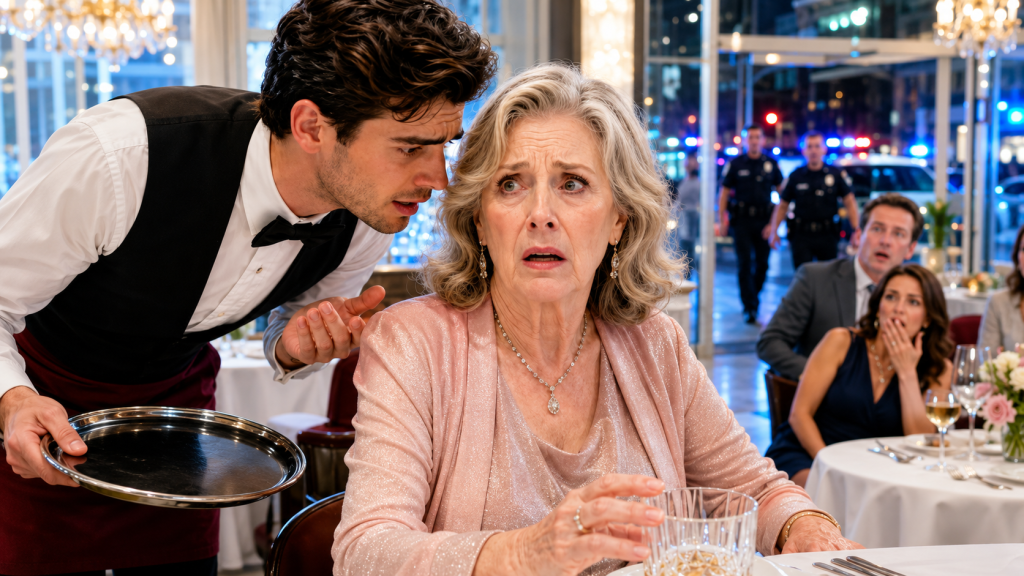
He was young, perhaps twenty-five, with dark hair and a nervous face. His name tag read Daniel. He set a crystal glass beside my plate, but his fingers trembled so badly the stem clicked against the table.
“Ma’am,” he whispered, without looking at me, “please don’t drink what they ordered for you.”
I stared at him.
The room continued around us. Silverware chimed softly. A woman laughed near the windows. Somewhere behind me, a bottle was uncorked.
“What did you say?”
Daniel leaned closer, pretending to clear Claire’s dessert spoon.
“Please let me replace that drink before you take another sip.”
I looked down.
The liquid in the glass was pale amber.
Not red wine.
Not anything I had ordered.
“Explain,” I said.
His throat moved.
“I heard your son-in-law near the service station. He handed something to another server and said it had to go into your drink. That server refused. Mr. Vale did it himself.”
For a moment, I felt nothing.
Not fear.
Not anger.
Just a clean, terrible quiet.
It was the kind of quiet I had known in laboratories at three in the morning, when a result came back and turned suspicion into truth.
“How much did you see?”
“Enough to be scared.”
“Did anyone else hear?”
“The other server. Maybe the bartender saw part of it, but I don’t know.”
I looked toward the doors Claire and Evan had used.
Only hours earlier, my daughter had called me forgetful.
Evan had laughed when he suggested I needed someone to manage my finances.
I had mistaken cruelty for impatience.
Now I saw preparation.
I slid the glass away from me.
“Bring me a clean napkin, a sealed container, and your manager. Quietly.”
Daniel stared.
He had expected panic.
Perhaps tears.
Instead, he saw the woman I had been before Claire decided age had made me harmless.
“Now,” I said.
He nodded and vanished.
I sat very still.
My hands did not shake.
That surprised me. Later, when I replayed the moment in my mind, I would realize it was not calmness. It was training. Thirty-two years of preserving evidence had risen inside me like muscle memory.
Do not contaminate.
Do not accuse before documentation.
Do not give the guilty time to rewrite the scene.
The manager arrived with Daniel three minutes later. Her name was Elise, and she had the controlled expression of a person who had handled drunk executives, public arguments, and marriage proposals gone badly.
“What seems to be the concern, Mrs. Whitmore?”
I looked at Daniel.
“Tell her what you told me.”
His face went pale, but he did.
Elise’s composure thinned with every sentence.
When he finished, she turned toward me.
“Would you like us to call the police?”
“Yes,” I said. “But first, I want that drink secured. Bring me a sterile food container from your kitchen, unused gloves, and two staff members who are willing to sign as witnesses that this glass came from my table.”
Elise blinked.
Daniel looked at me with something like awe.
“For thirty-two years,” I said, “I worked as a forensic scientist for the state. We are going to do this properly.”
They moved quickly after that.
Elise returned with a sealed food container. Daniel brought gloves. Another server, a woman named Priya, joined us, visibly frightened but steady.
I photographed the glass on the table before anyone touched it.
I photographed its position beside my plate.
I photographed the bill folder, Evan’s receipt still inside.
Then, wearing gloves, I poured the amber liquid into the container, sealed it, and signed across the lid with a black marker. Daniel signed beneath my name. Elise signed after him. Priya signed last.
I placed the container on a clean napkin and took another photograph.
Only then did I call Detective Lena Ortiz.
Lena had been a young homicide detective when I first met her. Back then, she had stormed into my lab angry because a judge had excluded a piece of evidence she believed should have saved her case.
I told her the judge was right.
She hated me for three weeks.
Then I helped her rebuild the case properly, and the man who had killed two women went to prison without appeal.
After that, Lena trusted my judgment more than my kindness.
She answered on the fourth ring.
“Margaret?”
“Lena, I need you at Aurelia.”
A pause.
“Are you hurt?”
“Not yet.”
Her voice changed.
“Tell me.”
I did.
She did not interrupt once.
When I finished, she said, “Do not leave. Do not confront anyone. Do not let the restaurant dispose of anything from that table.”
“I know.”
“I know you know,” she said. “I’m saying it because I don’t like how calm you sound.”
“I’m seventy-one, not fragile.”
“No,” Lena said. “You’re angry.”
She was right.
But anger, when aged properly, becomes discipline.
Before she arrived, my phone buzzed.
CLAIRE: Did you finish your drink, Mom?
I stared at the screen.
A second message appeared.
CLAIRE: Please answer. We’re worried.
Worried.
My daughter had learned to sharpen that word until it could pierce skin.
I looked at the sealed container.
Then I typed: Delicious. Feeling sleepy already.
Three dots appeared immediately.
CLAIRE: Good. Go home and rest. We’ll handle everything tomorrow.
I read the sentence three times.
We’ll handle everything tomorrow.
Everything.
The word opened something cold inside me.
Daniel stood near the table, pretending to polish water glasses. He had not left me alone.
“What are they planning?” he whispered.
I looked toward the rain beyond the windows and remembered the power-of-attorney papers Evan had pushed across my breakfast table.
“They think tomorrow belongs to them,” I said. “Let’s make sure it doesn’t.”
Detective Ortiz arrived twenty minutes later in a black raincoat, her silver badge hidden beneath the collar like a secret. Two officers came with her, plainclothes, quiet-eyed, careful.
She did not ask if I was sure.
She looked at the sealed container, the signatures, the untouched table, and then at me.
“Margaret,” she said quietly, “tell me everything from the beginning.”
By midnight, the drink was locked in evidence, Daniel’s statement had been recorded, and Aurelia’s security footage had been preserved. Elise gave the officers access to the service station camera, the bar camera, and the hallway camera near the private dining rooms.
Evan was visible in all three.
In one clip, he stood too close to a server, blocking the view with his body.
In another, he looked around before removing a small vial from his jacket pocket.
In the third, he returned to the table with the glass himself, smiling.
Lena watched the footage without expression.
“What was in the drink?” Elise asked softly.
“We’ll know soon,” Lena said.
But I already had an idea.
There are substances that mimic a fall.
Substances that cloud memory.
Substances that make a seventy-one-year-old widow appear confused, unstable, or incapacitated.
Substances that turn independence into paperwork.
Lena drove me home herself.
A patrol car followed without lights and parked two blocks away beneath an old sycamore tree. Another unmarked car waited near the corner of my street.
“Do you want to stay somewhere else?” Lena asked as we sat in my driveway.
“No.”
“Margaret.”
“If they believe I am suspicious, they will change their plan. If they believe I drank it, they will move.”
Her jaw tightened.
“You are not bait.”
“I am evidence.”
“You always did have a terrible sense of humor.”
I smiled, but only slightly.
“My husband used to say the same.”
At the mention of Thomas, the car seemed to grow quieter.
He had been gone four years.
A stroke took him in the garden on a Sunday morning. One moment he was trimming roses. The next, he was on the ground, one hand still wrapped around the shears.
Claire had cried at the funeral, but even then, Evan had been watching the house.
Not grieving.
Calculating.
The Whitmore house sat on two acres at the end of a tree-lined road, a white brick colonial with black shutters, wide steps, and a study where Thomas had kept every letter I ever wrote him. It was too large for one person, everyone said.
Too much maintenance.
Too much responsibility.
Too much value to sit in the hands of an aging widow.
That was what Evan meant, though he was too polished to say it.
Lena walked me inside and checked every door.
“You call Claire,” she said. “Speaker on. Keep your tone slow. Make them believe you’re impaired.”
I placed my phone on the kitchen island and dialed.
Claire answered before the first ring finished.
“Mom?”
Her voice was too sharp.
Too awake.
“Hi, darling,” I murmured.
“Are you home?”
“Yes.”
“Did you get there safely?”
“Mmm.”
Evan’s voice sounded in the background.
“Ask if she locked up.”
Claire said, “Did you lock the door?”
I glanced at Lena.
She shook her head.
“I don’t remember,” I said.
“Mom,” Claire said, pretending alarm, “you need to be careful.”
“I’m just so tired.”
A rustle.
Then Evan came on the line.
“Margaret, listen to me. Leave the front door unlocked in case Claire needs to check on you.”
There it was.
The last piece.
Not tomorrow.
Tonight.
“Alright,” I whispered.
“Good,” Evan said. “Go lie down. Don’t take any other medication. We’ll handle everything.”
I let my breathing slow.
“Evan?”
“Yes?”
“Thank you for taking care of Claire.”
A pause.
Then his voice softened into something almost victorious.
“Of course.”
I ended the call.
Lena’s eyes were hard.
“We move now,” she said into her radio.
I looked toward the dark hallway leading to Thomas’s study.
“No,” I said. “We wait.”
“Margaret—”
“If they come in and find officers standing in the foyer, they’ll claim they were checking on me. But if they enter quietly, with my legal folder, after telling me to leave the door unlocked…”
Lena stared at me.
Then, reluctantly, she nodded.
“You get five minutes in that study after they enter. Then my people come in.”
“Three,” I said.
“Don’t bargain with me on your own safety.”
“Fine. Five.”
I turned off every downstairs light except the small green-shaded lamp on Thomas’s desk. The house settled around me with old familiar sounds: the hum of the refrigerator, the creak of pipes, the soft ticking of the clock in the hall.
I sat in Thomas’s leather chair with my phone on the desk, the line open to Lena’s device.
In the top drawer was the letter he wrote me one month before he died.
Margaret, if I go first, do not let loneliness make you generous to wolves.
At the time, I had cried over that sentence.
Now I understood it.
At 1:17 a.m., the front door opened.
No knock.
No call.
No daughter saying, “Mom, it’s me.”
Just the careful turn of a knob.
Claire stepped in first.
“Mom?” she whispered.
Evan followed carrying my legal folder.
He had taken it from my breakfast table when he left earlier that day. I had noticed it missing after dinner and said nothing.
Claire moved through the foyer in soft-soled shoes.
Her white coat was gone now. She wore dark slacks, a gray sweater, and gloves.
Gloves.
That nearly broke me.
Not because they proved guilt.
Because my daughter had put them on before entering her mother’s house.
Evan closed the door behind him.
“Keep your voice down,” he murmured.
“I don’t like this,” Claire whispered.
“She drank enough. You said she sounded out of it.”
“She did.”
“Then stop shaking.”
“I’m not shaking.”
“Yes, you are.”
I sat very still.
They moved into the living room first.
Claire called softly again.
“Mom?”
Evan opened a drawer in the entry table.
“Where does she keep the medication list?”
“Kitchen binder.”
“She’ll be groggy by now.”
“Evan…”
“What?”
“This feels different.”
He laughed under his breath.
“Because you’re finally doing something necessary?”
Necessary.
The word struck me harder than hatred would have.
A cruel act can hide itself inside necessity. People use it when they want forgiveness before the damage is even done.
I rose from the study chair.
The floor creaked beneath me.
Both of them froze.
I stepped into the doorway, one hand resting lightly on the frame.
Claire gasped.
Evan’s face changed so quickly I almost missed it. Surprise. Fear. Calculation. Then concern.
Always concern.
“Margaret,” he said. “You scared us.”
“Did I?”
Claire stared at me.
“Mom, why are you standing in the dark?”
“I was waiting for you.”
Her mouth opened.
Closed.
Evan lifted the folder slightly, then lowered it.
“We were worried. You sounded strange on the phone.”
“So you entered my house without knocking.”
“You told us to leave the door unlocked.”
“No,” I said. “You told me to.”
Claire took a step forward.
“Mom, please don’t start this. You had wine. You’re confused.”
I looked at her gloves.
“Am I?”
She saw where I was looking and pulled her hands behind her back.
Evan moved smoothly between us.
“Margaret, let’s sit down.”
“No.”
“Claire is your daughter. She was worried.”
“Then why is she wearing gloves?”
Silence.
Outside, rain tapped against the windows.
Claire’s eyes filled with tears, but I had seen my daughter truly cry before. This was performance struggling to become real.
“I didn’t want to touch anything if you were sick,” she said.
“That is a fascinating medical explanation.”
Evan’s face hardened.
“You need help.”
“I needed help tonight,” I said. “A waiter gave it to me.”
Claire went pale.
Evan did not.
That was how I knew he had planned for this possibility.
“What waiter?” he asked.
I smiled.
“The one who saw you put something in my drink.”
Claire’s breath caught.
Evan laughed.
It was soft and disappointed, as if I had embarrassed myself.
“That is an outrageous accusation.”
“Yes,” I said. “It is.”
He nodded once.
“Claire, call Dr. Havers. Tell him your mother is having paranoid delusions.”
Claire did not move.
“Claire,” he snapped.
I looked at her.
“Do you know what he put in the drink?”
She whispered, “Mom…”
“Do you?”
Her tears spilled over now.
Evan turned on her.
“Do not answer that.”
The front door opened again.
This time, loudly.
Detective Ortiz entered with two officers behind her.
“Actually,” Lena said, “I’d like her to answer.”
Evan went still.
For the first time since I had known him, he had no expression prepared.
Claire made a small sound like a child.
“Detective Ortiz,” I said. “Thank you for coming.”
Lena’s gaze moved to the folder in Evan’s hand.
“Mr. Vale, put that on the table.”
“This is absurd,” he said. “We came to check on my mother-in-law.”
“With gloves,” Lena replied.
“My wife is a doctor.”
“Then she knows gloves are not needed to check on a conscious relative unless she is avoiding leaving prints.”
Claire covered her mouth.
Evan placed the folder on the table slowly.
An officer moved toward him.
“Hands where I can see them.”
Evan laughed again, but this time it cracked at the edge.
“You can’t seriously believe this. She is elderly. She’s been declining for months. Ask Claire.”
Lena looked at my daughter.
“Dr. Vale?”
Claire’s shoulders trembled.
Evan said, “Claire.”
It was not a warning.
It was a command.
My daughter looked at him, and for one aching second, I saw the girl she had been at seven years old, standing in my kitchen with chocolate on her chin, crying because she had broken a blue plate and thought I would stop loving her.
Then she looked at me.
“He said it wouldn’t hurt her,” Claire whispered.
The room became very still.
Evan’s head turned slowly.
“Claire.”
“He said it would only make her sleep. Maybe seem confused the next day. He said she wouldn’t remember refusing the papers.”
“Stop talking.”
“He said if we didn’t do something now, the estate would get tied up in lawyers and charities and people who didn’t care about family.”
Evan moved toward her.
An officer stepped between them.
Lena’s voice stayed calm.
“What was supposed to happen tonight?”
Claire shook her head.
“I can’t.”
“Yes, you can,” I said.
Her face collapsed.
“We were going to bring the documents back. If she was too drowsy to understand, Evan said we could record her agreeing. He said with my medical statement and the signed forms, no one would question it.”
“What medical statement?” Lena asked.
Claire pressed both hands to her face.
Evan said nothing now.
That frightened me more than his denials.
Claire looked at the folder.
“In there.”
Lena opened it with gloves.
Inside were the power-of-attorney forms, a healthcare directive, and a typed letter on Claire’s professional letterhead.
To whom it may concern, Margaret Whitmore has demonstrated increasing cognitive decline…
I stopped listening after the first line.
Cognitive decline.
Forgetfulness.
Impaired judgment.
Vulnerable to financial mismanagement.
My daughter had written those words about me.
Not because they were true.
Because she needed them to become useful.
Lena folded the letter back into place.
“Mr. Vale, Dr. Vale, you need to come with us.”
Evan finally found his voice.
“You have no proof of a crime.”
Lena tilted her head.
“We have restaurant footage, witness statements, a preserved drink sample, text messages, your late-night entry, and documents you brought into the victim’s home after telling her to leave the door unlocked.”
Victim.
The word did not feel like mine.
I had spent most of my life examining victims through evidence: hair fibers, blood patterns, chemical residues, bruising, fracture lines, torn cloth, broken glass.
Now I stood in my own house and heard the word placed around me.
Claire sobbed as the officers guided her toward the door.
“Mom, please. I was scared.”
I did not move.
“Of me?” I asked.
She shook her head.
“Of losing everything.”
“You were not losing everything,” I said. “You were inheriting someday.”
Evan laughed bitterly.
“Someday,” he said. “That’s the word rich old people use to keep everyone begging.”
I looked at him.
“There it is.”
His eyes sharpened.
“What?”
“The truth. It took you long enough.”
He leaned toward me as much as the officer allowed.
“You think you’re so clever. You think a lab coat from thirty years ago makes you untouchable. But you’re old, Margaret. The world moves faster than you now.”
I stepped closer.
“No, Evan. People like you move faster. That is why people like me learned to document.”
His face twisted.
For a second, I saw what Claire must have seen behind closed doors: not charm, not intelligence, but hunger.
When they took him out into the rain, he did not look back.
Claire did.
That was worse.
She looked back with pleading eyes, as though she expected motherhood to overrule evidence.
Maybe once, it would have.
Not that night.
After the police cars left, Lena stayed.
The house smelled faintly of rain and old wood.
I sat at the kitchen island while she made tea badly, using twice as many leaves as necessary.
“You always were terrible with kitchens,” I said.
“And you always criticized people in crisis.”
“I am not in crisis.”
She set the mug in front of me.
“You are.”
I wrapped both hands around it.
The warmth reached my fingers slowly.
“What happens now?”
“The drink gets tested. We process the footage. Claire’s statement helps, if she keeps cooperating. Evan will lawyer up.”
“Of course.”
“He may claim she misunderstood.”
“She’s a physician. That will be difficult.”
“She may claim he manipulated her.”
I looked at the hallway.
“She was manipulated,” I said. “But not enough to become innocent.”
Lena sat across from me.
“No.”
The word was gentle.
That made it harder.
By morning, the story had already begun to leak in controlled whispers. Not to the press, not yet, but through the circles Claire had tried so hard to impress.
The hospital placed her on administrative leave.
Evan’s firm suspended him pending investigation.
My attorney, Harold Bishop, arrived at nine o’clock with a leather briefcase and the expression of a man who had been waiting years for me to admit danger existed.
“I told you I disliked him,” Harold said.
“This is not the time to be smug.”
“I am seventy-six. Time for smugness is limited.”
Despite everything, I laughed.
He updated my estate documents that morning.
Not because I wanted revenge, but because clarity is a kindness to the living and protection against the greedy.
Claire was removed from every medical and financial authority.
Evan, of course, had never been named, though he had behaved as if my estate already had his initials engraved on the gate.
I added a new clause requiring independent medical evaluation by two unrelated specialists before any claim of incapacity could affect my affairs.
I increased donations to the forensic science scholarship Thomas and I had founded.
And Daniel, the waiter with trembling hands, became the first named recipient of a new award for civic courage.
Harold looked up when I said that.
“The waiter?”
“He saved my life.”
“Possibly.”
“No,” I said. “Certainly. Even if the substance was not lethal, he saved the life I had built.”
Harold nodded.
“That is a different kind of murder, I suppose.”
“Yes,” I said. “It is.”
The lab results came back two days later.
The drink contained a sedative in a dose high enough to seriously impair me, especially combined with alcohol.
Not necessarily enough to kill.
Enough to make me confused.
Enough to make me compliant.
Enough to make a recording sound convincing if someone asked leading questions while I slurred answers from a sofa.
Enough to turn my refusal into something they could later call consent.
When Lena told me, I was standing in my garden beside Thomas’s rose bushes.
The shears still hung in the shed where he had left them years ago.
“Margaret,” Lena said over the phone, “I need you to prepare yourself. Claire’s attorney is trying to frame her as coerced.”
I closed my eyes.
“Was she?”
“Maybe emotionally. Maybe financially. Not legally enough to erase what she did.”
“What about Evan?”
“He’s claiming the vial contained a sleep supplement you requested because you were embarrassed about insomnia.”
I almost admired the speed of the lie.
Almost.
“He placed it in my drink without my knowledge.”
“We know.”
“He entered my home.”
“We know.”
“He carried legal papers.”
“We know.”
I opened my eyes.
The roses were beginning to bloom.
Thomas had loved the pale yellow ones best.
“Does Claire know what he is saying?”
There was a pause.
“I don’t think so.”
“She will.”
“She may not believe it.”
“Then she will learn slowly.”
Learning slowly had become Claire’s inheritance.
The first time she called from holding, I did not answer.
The second time, I let it ring until silence returned.
The third time, Harold advised me not to speak to her directly.
The fourth time, she left a message.
I sat in Thomas’s study and listened.
“Mom, it’s me. I know you probably hate me. I know you should. But please understand, Evan told me we were protecting you. He said your lawyer was taking advantage of you. He said you were giving money away because you were lonely. He said if we didn’t step in, strangers would get everything Dad worked for. I know how that sounds. I know. But I thought… I thought I was saving what was ours.”
What was ours.
There it was, wrapped in tears.
Not saving me.
Saving what was hers.
The message continued.
“I never wanted you hurt. I swear on my life. I thought you would just sleep. I thought tomorrow we would talk and you would understand. Please, Mom. Please don’t let them destroy my career. I made one mistake.”
One mistake.
A phrase people use when the truth contains too many decisions.
She had taken Evan’s calls.
She had written the medical statement.
She had entered my house wearing gloves.
She had asked whether I finished the drink.
She had listened when he told me to leave the door unlocked.
That was not one mistake.
That was a staircase.
And she had taken every step.
I deleted the message only after Harold saved a copy for evidence.
For three weeks, my life became interviews, legal filings, quiet visits from detectives, and sleepless nights where I walked from room to room remembering every version of Claire.
Claire at five, asleep with a picture book open on her chest.
Claire at twelve, furious because I would not let her go to a concert two towns away.
Claire at nineteen, calling home from college because she had failed her first anatomy exam and believed her future was over.
Claire at thirty-four, marrying Evan beneath a canopy of white roses while Thomas squeezed my hand and whispered, “I don’t trust his smile.”
I had said, “You don’t trust anyone who wears cufflinks before noon.”
But Thomas had been right.
He was often right about people.
I was right about evidence.
People had always been harder for me.
The hearing was held on a Thursday morning in a courtroom with bad lighting and polished benches. I wore navy blue, Thomas’s favorite pearls, and flat shoes because I had no intention of appearing fragile for anyone.
Claire sat at the defense table with her attorney.
She looked smaller without her white coat.
Evan sat separately with his own counsel, which told me everything I needed to know about loyalty among thieves.
He did not look at Claire.
Not once.
Daniel testified first.
His voice shook at the beginning, but steadied as he described what he saw. The server who had refused Evan testified next. Then Elise. Then Priya. Then the detective who collected the restaurant footage.
When the video played, the courtroom became silent.
There was Evan near the service station.
Evan with his body angled carefully.
Evan looking around.
Evan holding the vial.
Evan returning with the glass.
Evan smiling at me as he told me to finish my drink.
Claire lowered her head.
I did not look away.
A person should see the truth when it finally enters the room.
Then my text messages were read aloud.
CLAIRE: Did you finish your drink, Mom?
CLAIRE: Please answer. We’re worried.
ME: Delicious. Feeling sleepy already.
CLAIRE: Good. Go home and rest. We’ll handle everything tomorrow.
The prosecutor paused after that.
Sometimes silence is the strongest witness.
When the legal folder was entered into evidence, Claire began to cry.
Her attorney objected to nearly everything.
Evan’s attorney argued that concern for an elderly relative had been misinterpreted.
Then Detective Ortiz testified about the late-night entry, the gloves, and the open phone line.
Finally, the prosecutor asked me to speak.
I walked to the stand.
The oath felt familiar.
I had taken it many times as an expert witness.
But never as a mother.
“Mrs. Whitmore,” the prosecutor said, “did you consent to being given any substance in your drink that night?”
“No.”
“Did you ask your son-in-law to place anything in your drink?”
“No.”
“Did you ask your daughter or son-in-law to enter your home after midnight?”
“No.”
“Had you agreed to sign the documents found in Mr. Vale’s possession?”
“No.”
“Why not?”
I looked at Claire.
She was staring at her hands.
“Because I understood them.”
The prosecutor nodded.
“What did you understand?”
“That they would have given control of my finances, medical decisions, and personal affairs to people who had stopped seeing me as a person and started seeing me as an obstacle.”
Evan’s attorney stood.
“Objection.”
The judge allowed the answer.
The prosecutor asked, “Mrs. Whitmore, when did you first become concerned about your daughter and son-in-law’s intentions?”
I could have answered with the breakfast papers.
The bank statements.
The security codes.
The jokes about forgetfulness.
Instead, I told the deeper truth.
“When they began speaking about my life as though it were already theirs to manage.”
The courtroom remained quiet.
Claire looked up then.
Our eyes met.
For a moment, everything else fell away: the lawyers, the judge, the evidence, Evan sitting stiffly beside a man paid to make him seem less monstrous.
There was only my daughter and me.
I wanted to see remorse.
I saw fear.
There is a difference.
The judge ordered the case forward.
Charges were filed.
Evan was remanded after the prosecutor argued he posed a flight risk due to financial resources and professional connections. Claire was released under strict conditions, her passport surrendered, her medical license still suspended.
As they led Evan out, he finally looked at me.
No charm remained.
Only hatred.
“You ruined your own family,” he said.
I stood slowly.
“No,” I replied. “I preserved what was left of it.”
Claire flinched.
Good.
Some truths should hurt.
After the hearing, Daniel was waiting outside the courtroom, still wearing the dark suit someone had clearly helped him choose. His mother stood beside him, holding his arm.
He looked embarrassed when he saw me.
“Mrs. Whitmore.”
“Daniel.”
“I’m sorry you had to go through all that.”
I almost smiled.
“You were braver than most people twice your age.”
He looked down.
“I was scared.”
“Bravery without fear is just ignorance.”
His mother squeezed his arm.
I took an envelope from my handbag.
“This is not payment,” I said. “You cannot be paid for integrity. It is a letter confirming the scholarship fund in your name. If you want to continue school, train in hospitality management, law, forensic science, or anything else, it will help.”
His eyes widened.
“I can’t accept that.”
“You can.”
“I only did what anyone should do.”
I glanced toward the courthouse doors, where my daughter had just disappeared with her attorney.
“No, Daniel. You did what many people convince themselves is too dangerous to do.”
His mother began crying before he did.
I left before gratitude could become uncomfortable.
The trial itself did not come quickly.
Trials rarely do.
Life continued in strange, uneven pieces.
I learned to sleep with the alarm system set to codes only I knew.
I changed the locks.
I donated Claire’s childhood bedroom furniture to a family shelter, then sat on the bare floor afterward and wept so hard I frightened myself.
Not because I regretted giving it away.
Because the room had been a museum of a daughter who no longer existed.
Or perhaps one who had existed only because I loved her enough to miss the cracks.
Lena visited every Sunday for tea after that.
She claimed it was because she liked my garden.
She hated gardening.
Harold called too often.
Daniel sent a handwritten note after enrolling in a criminal justice program, saying he had decided he wanted to help people before the worst happened, not only after.
That letter stayed on my refrigerator.
Claire sent more messages through her attorney.
Apologies.
Explanations.
Requests.
One letter arrived in her handwriting six months after the hearing.
I did not open it for three days.
When I finally did, I sat at the kitchen table in the morning light and read every word.
Mom,
I don’t know how to write this without sounding like I’m still making excuses. Maybe I am. I thought I was stronger than I was. I thought because Evan loved me, his plans must have a reason. I thought because I was your daughter, whatever I did could still be forgiven someday. That was the most arrogant thought I have ever had.
I did not protect you. I protected my life with him. I protected the version of myself that wanted your money to feel like proof that I mattered. I told myself Dad would have wanted the estate to stay with family, but Dad would have hated what I became.
I don’t expect you to answer. I don’t expect you to come to court for me. I just want you to know I am finally telling the truth, even when it does not help me.
I am sorry.
Claire
I read it twice.
Then I folded it and placed it in the drawer with Thomas’s letter.
Forgiveness did not come.
But something else did.
A small release.
Not for her.
For me.
The trial began nearly a year after that dinner at Aurelia.
By then, my hair had grown whiter at the temples, Daniel had finished his first semester with excellent grades, and Evan had lost the sleek confidence that once made rooms bend toward him.
Claire testified against him.
That shocked everyone except me.
Evan had tried to save himself by blaming her. He claimed she had invented the medical concerns. He claimed she had supplied the sedative. He claimed he was merely a worried son-in-law obeying his physician wife’s guidance.
Claire’s face remained pale but steady as the prosecutor questioned her.
“Did your husband tell you the substance would impair your mother?”
“Yes.”
“Did you know your mother had not consented?”
“Yes.”
“Did you agree to enter her home that night?”
“Yes.”
“Why?”
Claire closed her eyes for a moment.
“Because I wanted what she had, and I had convinced myself that wanting it for family made it less ugly.”
Evan stared at her with open fury.
She did not look at him.
For the first time in years, my daughter made a choice without checking his face.
It did not erase what she had done.
But truth rarely erases.
It reveals.
The jury found Evan guilty on multiple counts connected to attempted financial exploitation, unlawful administration of a substance, conspiracy, and burglary.
Claire accepted a plea agreement that included probation, loss of certain medical privileges pending board review, community service, mandatory counseling, and a permanent protective order limiting contact with me unless I initiated it.
People later asked if I thought that was too lenient.
They did not understand.
Prison would have been simpler.
Claire had to live with herself.
That can be a longer sentence.
After the verdict, I walked out of the courthouse alone.
Reporters waited on the steps, but Lena and Harold shielded me from most of them.
One question cut through.
“Mrs. Whitmore, do you have anything to say to older people who feel pressured by family?”
I stopped.
The microphones lifted.
I had no prepared statement.
I thought of the glass.
The amber liquid.
Daniel’s trembling hand.
Claire’s message.
Evan’s smile.
Then I said, “Do not confuse pressure with love. Love does not need your signature before breakfast. Love does not call your caution confusion. Love does not ask you to become smaller so someone else can feel secure.”
No one spoke for a second.
Then I walked down the steps.
Aurelia reopened under stricter policies after the investigation. Elise wrote me a formal apology, though she had done nothing wrong. I returned there once, not for dinner, but for Daniel’s scholarship ceremony.
He stood near the same dining room where he had saved me, wearing a navy suit and trying not to cry while his mother took too many photographs.
The restaurant had placed fresh flowers on every table.
No candles.
Bright light.
Clear glasses.
I appreciated that.
When Daniel saw me, he hurried over.
“You came.”
“Of course.”
“I didn’t think you’d want to be here again.”
I looked around.
For a moment, memory tried to place Claire across from me, Evan beside her, the amber drink shining under gold light.
Then the present returned.
Daniel alive with hope.
Elise smiling near the podium.
Lena pretending she was not emotional.
Harold complaining about the parking.
“I will not let one terrible night own every beautiful room it touched,” I said.
Daniel nodded slowly.
“I like that.”
“So do I.”
Months later, in spring, I finally opened the garden shed.
Thomas’s shears hung where they always had.
I took them down, cleaned the rust from the hinge, oiled the joint, and carried them to the rose bushes.
My knees hurt when I bent.
My hands were not as strong as they used to be.
But they were mine.
The house was mine.
My name, my mind, my choices, my grief, my future.
Mine.
As I trimmed the pale yellow roses, my phone buzzed on the stone bench.
For a moment, my body remembered fear.
Then I saw the name.
Claire.
I did not answer immediately.
The protective order allowed contact only if I permitted it, and I had not. But her attorney had forwarded a request earlier that week. Claire wanted to apologize in person after her counseling program ended. No pressure, the message said. No expectation.
I stared at her name until the screen went dark.
Then I kept pruning.
A few minutes later, a voicemail appeared.
I did not play it.
Not yet.
Maybe one day I would sit across from my daughter in a room with bright windows and no documents on the table. Maybe I would hear her apology and find something in me willing to answer.
Maybe I would not.
Both possibilities belonged to me.
That evening, I made tea in Thomas’s study and opened the drawer where I kept his letter and Claire’s apology.
I read Thomas’s sentence again.
Do not let loneliness make you generous to wolves.
Below it, in my own handwriting, I added a new line.
And do not let betrayal convince you that every door must stay locked forever.
I placed the letter back carefully.
Outside, rain began to fall, soft against the windows.
Not the hard rain from that night.
A gentler rain.
The kind that washes dust from leaves.
The kind that makes the garden smell alive again.
I sat in the green lamplight, listening to the house settle around me, and for the first time in a long while, I did not feel like a widow waiting for footsteps in the dark.
I felt like a woman who had survived her own family’s plan and still had the courage to choose what came next.
The world had tried to make me old in the cruelest way.
Invisible.
Doubtful.
Manageable.
But I had spent my life listening to evidence, and the evidence said I was still here.
Still clear.
Still dangerous to anyone who mistook silence for surrender.
And somewhere across the city, my daughter was learning that blood can explain a bond, but it cannot excuse a betrayal.
Some lessons arrive gently.
Ours arrived in a crystal glass.
I did not drink it.
And because I did not, I lived long enough to watch the truth do what truth always does when someone protects it carefully.
It rose.
It spoke.
And it changed everything.
THE END! THANK YOU FOR READING!