

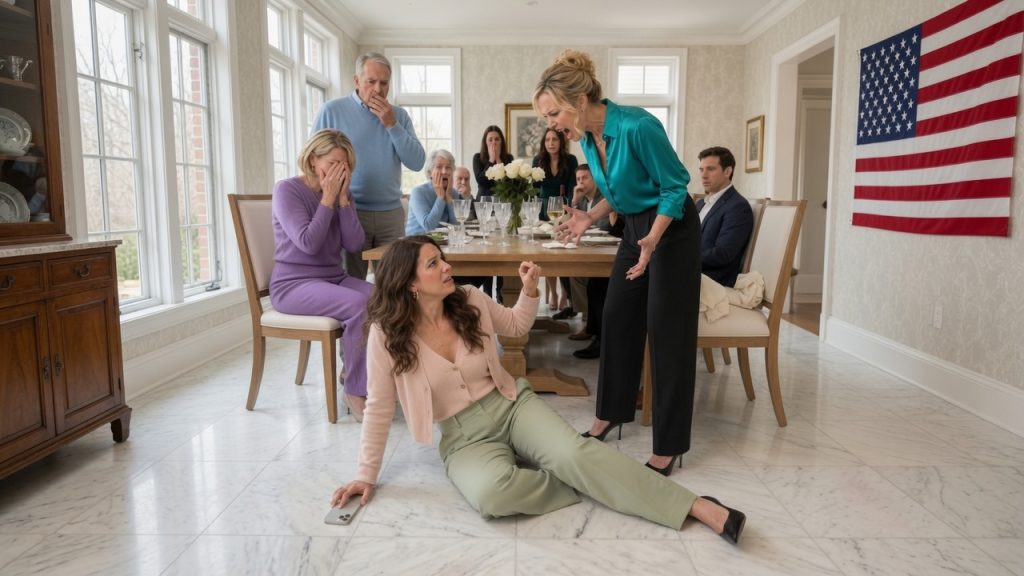
My Family Laughed As My Sister Mocked Me At My Father’s Birthday Dinner And Told Me To Eat On The Floor—Everything Changed The Moment My Phone Buzzed. “Get off the table! Eat on the floor!” My sister, Vanessa Whitmore, shouted the words loudly enough for every guest in the dining room to hear.
The room went quiet for half a second. Only half a second. Then she shoved my chair sideways with the sharp snap of her hip, and because I had already been half-standing, I lost my balance. My hand reached for the edge of the table, but my fingers only brushed the white linen cloth.
A wineglass trembled.
A fork clattered against a plate.
Then I crashed onto the polished oak floor of my father’s dining room.
Pain shot through my elbow.
A hot sting crawled up my wrist.
For a moment, I stayed exactly where I had fallen, one knee bent under me, one hand pressed flat against the floor, my face inches from the legs of the table where I had eaten birthday dinners since I was a child.
And then the laughter started.
My cousin Mason laughed first, loud and careless.
Then his wife joined in.
Then Aunt Donna covered her mouth and whispered, “Oh my God,” but the grin on her face betrayed her.
Vanessa’s husband, Blake, leaned back in his chair and pretended to cough into his fist while his shoulders shook.
At the head of the table, my mother, Patricia Whitmore, lifted her wineglass and looked at me with that same cold approval she had given Vanessa our entire lives.
She didn’t laugh.
She didn’t need to.
Her silence said enough.
This was my father’s home.
My father’s birthday dinner.
My father was not in the dining room because his doctors had advised against noise, stress, and too many visitors. He was resting in the downstairs guest suite, attended by a nurse, while the people who claimed to love him celebrated upstairs with wine paid for by my account, flowers ordered by my assistant, and catered food charged to a card in my name.
Everyone in that room knew it.
Everyone knew I had paid for the dinner.
Everyone knew I had kept that house from foreclosure twice.
Everyone knew I had paid my father’s medical bills after Vanessa conveniently “forgot” to submit the insurance documents.
And still, they laughed.
Vanessa stood over me in her cream-colored designer dress, one hand resting on her narrow waist, her gold bracelet flashing beneath the chandelier.
“Don’t be so dramatic, Daniel,” she said. “You should be thankful we even invited you.”
Invited me.
To my father’s house.
To a dinner I had paid for.
For a man I had been quietly caring for while they posted smiling photos online and called themselves a close family.
I slowly pushed myself up.
The room watched me.
Maybe they expected me to yell.
Maybe they expected me to cry.
Maybe they expected me to leave humiliated, the way I had done too many times before.
But I didn’t give them any of those things.
I stood.
I brushed dust from my sleeve.
Then I smiled.
It was not a warm smile.
It was not a forgiving smile.
It was the kind of smile a person gives when they have finally stopped hoping people will become better.
That smile unsettled Vanessa.
I saw it instantly.
Her lips tightened.
Her eyes sharpened.
She had always known how to win when I was hurt.
She had no idea what to do when I was calm.
“Enjoy this dinner,” I said quietly. “It’s the last one you’ll ever take from me.”
The laughter began to die.
Blake lowered his hand from his mouth.
Aunt Donna shifted in her seat.
My mother’s wineglass paused halfway to her lips.
“What exactly is that supposed to mean?” Vanessa asked.
I looked at her for a moment.
Then I reached into my jacket pocket and took out my phone.
No speech.
No threats.
No dramatic announcement.
Just my thumb moving across the screen.
First, the banking app.
Then the family trust portal.
Then the Whitmore Logistics account authorization panel.
For three years, Vanessa had been living off accounts that were never hers.
She had learned how to call secretaries, charm bankers, pressure accountants, and use our father’s declining health as a shield.
Whenever someone questioned her, she would say, “Dad approved it.”
Whenever I objected, she would say, “You’re just jealous he trusts me more.”
But I knew the truth.
Vanessa had isolated him.
She had told him I was too busy to visit.
She had told me he was too tired to see anyone.
She had taken his phone during bad days and sent texts pretending to be him.
She had hosted parties in his home while I paid the property taxes.
She had leased luxury cars through company accounts while I covered his specialists.
She had let everyone believe she was the devoted daughter while I quietly carried the bills, the legal work, the insurance claims, the mortgage extensions, and the ugly paperwork no one wanted to touch.
She believed kindness was the same as weakness.
She believed silence meant defeat.
She believed I would keep absorbing humiliation because that was what I had always done.
But six weeks before that birthday dinner, everything had changed.
My father had been in a hospital room in Boston, pale beneath white blankets, his voice weak from another round of treatment.
I had come in late after a twelve-hour workday, still wearing my suit, carrying the overnight bag he liked me to bring because he hated hospital socks and wanted his own slippers.
He had waited until the nurse left.
Then he held out his hand.
I took it.
His fingers were thin, but his grip was desperate.
“Daniel,” he whispered.
“I’m here, Dad.”
His eyes filled with tears.
Not from pain.
From fear.
“Don’t let Vanessa sell the house,” he said.
I froze.
“What?”
He swallowed hard.
“Don’t let them drain what I built.”
I sat beside him, and for the first time in years, my father told me everything.
He told me about documents Vanessa had asked him to sign when he was medicated.
He told me about withdrawals he didn’t remember approving.
He told me about Blake pressuring him to “modernize” Whitmore Logistics by selling company shares.
He told me my mother had encouraged him not to “upset Vanessa” because Vanessa had “earned her place.”
And then he cried.
My father, the man who built a trucking company from one battered delivery van into a regional logistics firm, cried like a child.
“I was ashamed,” he whispered. “I didn’t want you to know how badly I let it happen.”
I held his hand tighter.
“You didn’t let anything happen,” I told him. “They took advantage of you.”
He shook his head.
“I need you to fix it.”
So I did.
Quietly.
Legally.
Completely.
Over the next six weeks, attorneys came to the hospital.
Doctors signed capacity statements.
A private accountant reviewed the books.
The trust was revised.
The house was protected.
The remaining company shares were secured.
The accounts were placed under trustee control.
My father signed every page while clear, alert, and fully aware.
He removed Vanessa’s access.
He removed my mother’s informal privileges.
He appointed me trustee and durable power of attorney.
But I had not revoked everything immediately.
Not yet.
My father wanted one last test.
“Let them show you who they are when they think nothing has changed,” he told me.
So I waited.
I watched.
And on his birthday, they showed me.
My phone buzzed once in my hand.
The screen displayed two words.
ACCESS REVOKED.
Vanessa’s smile vanished.
It was as though someone had erased it with a blade.
“What did you do?” she asked.
I slipped the phone back into my pocket.
“Finished dinner,” I said.
Then I turned and walked out.
No one stopped me at first.
They were too stunned.
Behind me, Vanessa’s voice rose.
“Daniel!”
I kept walking.
“Daniel, come back here!”
I passed through the hallway lined with framed family photos.
In most of them, Vanessa stood in the center.
Vanessa at graduation.
Vanessa at Christmas.
Vanessa on vacation.
Vanessa beside our father at company events, smiling like the rightful heir.
I appeared in the background sometimes.
A shoulder.
A blurred face.
A quiet boy standing just outside the circle.
At the bottom of the stairs, I paused outside my father’s room.
The nurse looked up from her chair.
“Is everything all right?” she asked softly.
I looked past her.
My father was asleep, his chest rising and falling under a blue blanket.
For once, he looked peaceful.
“Yes,” I said. “Everything is finally all right.”
Then I left the house.
By the next morning, my phone displayed seventy-three missed calls.
Vanessa had called twenty-six times.
My mother had called eighteen.
Blake had called nine.
The rest came from cousins, aunts, and people who had laughed while I was on the floor.
The messages changed hour by hour.
At first, they were angry.
Vanessa: You are disgusting. How dare you embarrass me in front of everyone?
Mother: Your behavior last night was cruel and unnecessary. Call me immediately.
Blake: Big mistake, buddy.
Then came confusion.
Vanessa: The house manager says the household card was declined. Fix it.
Mother: Why can’t I access the trust account?
Blake: Did you freeze the company card too?
Then came panic.
Vanessa: Daniel, answer me.
Mother: This has gone far enough.
Blake: We need to talk before lawyers get involved.
I was standing in my kitchen, drinking black coffee, when my father’s nurse called.
“Mr. Whitmore is asking for you,” she said. “He seems calm, but he wants you here before your family arrives.”
“They’re coming?”
“They already called the front desk.”
I set down my cup.
“I’ll be there.”
The rehabilitation center smelled faintly of antiseptic and lavender air freshener.
My father was sitting by the window when I entered his room, a blanket over his knees, his silver hair combed neatly back.
He looked older than he had the day before.
But his eyes were clear.
“Did it happen?” he asked.
I nodded.
His shoulders dropped with relief.
“Good.”
I sat beside him.
“I’m sorry it happened at your birthday dinner.”
He gave a tired laugh.
“That wasn’t my birthday dinner. That was Vanessa’s stage.”
I looked down.
For years, I had wanted him to see it.
To really see it.
Now that he did, I wished it hadn’t cost him so much.
“I should have stopped it earlier,” he said.
“You were sick.”
“I was proud,” he corrected. “There’s a difference.”
Before I could answer, voices erupted in the hallway.
Vanessa’s voice cut through first.
“You cannot keep us out. I am his daughter.”
Then my mother.
“This is outrageous. Tell Daniel to come out here right now.”
The door flew open.
Vanessa stormed in wearing oversized sunglasses, though we were indoors. Her perfect blond hair was less perfect than usual, pulled back in a rushed clip. Her designer dress from the night before had been replaced by a wrinkled blouse and dark trousers.
My mother followed close behind, gripping her purse like a weapon.
Blake entered last, jaw tight, eyes moving quickly around the room as though searching for something he could control.
Vanessa pointed at me.
“What did you do?”
My father turned slowly toward her.
“Lower your voice.”
She stopped.
Not because she respected him.
Because she was shocked he had spoken with authority.
“Dad,” she said, softening instantly. “Daniel is trying to take everything from us.”
“No,” my father said. “He protected what was left.”
Vanessa’s mouth opened.
Mother stepped forward.
“Robert, sweetheart, you’re confused. Daniel has always been sensitive. He misunderstood a family argument.”
My father looked at her with such sadness that even she fell quiet.
“I’m not confused, Patricia.”
Her face tightened.
Vanessa removed her sunglasses.
Her eyes were red, but not from guilt.
From fury.
“That house is mine,” she snapped.
“No,” my father said. “It never was.”
The words landed like a plate shattering.
Vanessa stared at him.
“What?”
“The house was mine,” he said. “Now it belongs to the trust. Daniel controls it as trustee.”
Mother’s face drained of color.
Blake stepped forward.
“That can’t be legal.”
“It is,” I said.
He glared at me.
“You manipulated a sick man.”
My father reached for the folder beside his chair.
His hands trembled.
I quickly took it and placed it on his lap.
He rested his palm on top of it.
“No one manipulated me,” he said. “For the first time in years, someone listened.”
Vanessa laughed once, sharp and ugly.
“This is insane. You’re punishing me because Daniel threw a tantrum at dinner?”
My father looked at me.
“Show them.”
I opened the folder.
Inside were bank records, forged signatures, credit statements, company withdrawals, property documents, and a letter written in my father’s shaky handwriting.
The room went still.
Vanessa saw the first page and took a step back.
“What is that?”
“Evidence,” I said.
Blake’s face hardened.
Mother whispered, “Robert…”
My father ignored her.
“Read the highlighted line, Vanessa.”
She didn’t move.
So I read it aloud.
“Electronic authorization submitted while Robert Whitmore was admitted under sedation.”
Vanessa’s throat worked.
“That was for household expenses.”
I turned the next page.
“Forty-two thousand dollars to a private travel concierge?”
Her face flushed.
“That was a business trip.”
“Three tickets to Monaco?”
Blake shifted.
“That was exploratory networking,” he said.
I almost laughed.
My father didn’t.
He looked at Blake with cold disgust.
“You used my company to fund vacations.”
Blake said nothing.
I turned another page.
“Attempted listing agreement for the Beacon Hill house. Signed by Robert Whitmore.”
My mother closed her eyes.
My father’s voice went quieter.
“I never signed that.”
Vanessa’s composure cracked.
“You were going to lose the house anyway! I was trying to help.”
“You were trying to sell it before I died,” he said.
The silence after that was brutal.
For the first time in my life, Vanessa had no immediate answer.
My mother walked to my father’s chair and knelt beside him.
“Robert,” she said softly, “we are your family. We made mistakes, yes, but Daniel is turning you against us.”
He looked down at her.
“I turned myself against you when I saw the statements.”
Her eyes glistened.
But I had seen my mother cry before.
She cried when she was caught, never when she caused pain.
“You always choose him when he plays victim,” Vanessa said.
I looked at her.
“Last night, you pushed me onto the floor and told me to eat there.”
She scoffed.
“It was a joke.”
“Everyone laughed.”
“Because you looked ridiculous.”
My father’s hand tightened on the folder.
“And that,” he said, “is why you are being removed from the house today.”
Vanessa blinked.
“What?”
“The locks are being changed at noon,” I said.
Her head snapped toward me.
“You can’t do that.”
“I can. You don’t live there legally. You’ve been staying there under Dad’s permission, and that permission has been revoked.”
Blake’s phone buzzed.
He looked down.
The color left his face.
I knew what he had just received.
Whitmore Logistics had frozen all executive discretionary cards.
Vanessa turned to him.
“What?”
He didn’t answer.
His phone buzzed again.
Then hers did.
Then my mother’s.
One by one, the consequences arrived in their hands.
The household accounts were frozen.
The company vehicles were recalled.
The private staff had been notified to report only to the trustee.
The attorney had sent formal notice regarding financial review.
The realtor handling the attempted house listing had been subpoenaed for documents.
Vanessa stared at her screen.
For the first time, fear entered her eyes.
Not sorrow.
Not regret.
Fear.
“What do you want?” she whispered.
I thought about that.
For years, I had wanted an apology.
I had wanted my mother to admit she favored Vanessa.
I had wanted my cousins to stop treating me like the family wallet.
I had wanted my father to defend me.
I had wanted a seat at the table without paying for the table.
But standing in that room, watching them panic over money they had never earned, I realized I didn’t want any of that anymore.
“I want Dad safe,” I said. “I want the house protected. I want the company repaired. And I want every dollar you stole accounted for.”
Vanessa’s face twisted.
“You’d destroy your own sister?”
“No,” I said. “You did that when you mistook my silence for permission.”
My mother stood slowly.
“This family will never recover from this.”
My father looked at her.
“Maybe it shouldn’t recover the way it was.”
That was the last thing he said to them that morning.
The attorney arrived twenty minutes later.
Vanessa tried to argue.
Blake demanded copies of documents he had no right to receive.
My mother sat in the corner, pale and silent, as if realizing the performance was over and the audience had gone home.
By noon, the locks on the house were changed.
By three, Vanessa’s luxury SUV was returned to the company lot.
By evening, three staff members came forward with stories about Vanessa ordering them to lie about my father’s visitors.
Within a week, the accountant found more.
A hidden credit line.
A forged reimbursement request.
Payments to Blake’s consulting firm for services never performed.
Vanessa called me every day.
Sometimes she screamed.
Sometimes she cried.
Sometimes she said Dad was confused.
Sometimes she said I had always hated her.
I answered only once.
It was late on a Thursday evening.
I was sitting beside my father while he watched an old baseball game with the volume low.
My phone rang.
Vanessa.
I let it ring twice.
Then I answered.
“What?” I said.
For once, her voice was small.
“Daniel, please. I don’t have anywhere to go.”
I looked at my father.
His eyes stayed on the television, but I knew he was listening.
“You have the condo Dad bought you ten years ago,” I said.
There was silence.
“I rented it out,” she muttered.
“Then stay with Blake.”
Another pause.
“He left.”
I closed my eyes.
Of course he had.
Men like Blake loved money, not consequences.
Vanessa inhaled shakily.
“I’m your sister.”
I looked around my father’s quiet room.
At the medical equipment.
At the blanket over his knees.
At the man who had built everything they tried to drain.
“You were my sister when you laughed at me on the floor,” I said.
She began to cry.
“Daniel—”
“No,” I said. “You don’t get to cry because the floor finally found you too.”
Then I ended the call.
Months passed.
The legal process moved slowly, but it moved.
Vanessa avoided criminal charges only because my father, tired and merciful despite everything, agreed to a repayment settlement instead of pressing further.
Blake disappeared from the family with impressive speed.
My mother moved into a smaller apartment and told anyone who would listen that I had torn the family apart.
Some believed her.
Most didn’t.
The records were too clear.
The witnesses were too many.
And my father, for the first time in years, stopped hiding.
He moved into the restored first-floor suite of the Beacon Hill house.
Not as a prisoner.
Not as a prop.
As the owner of his life again.
I visited every evening after work.
Sometimes we talked about the company.
Sometimes we watched baseball.
Sometimes we sat in silence.
One night, he asked me to wheel him into the dining room.
The long table was still there.
The same chandelier hung above it.
The same polished floor reflected the warm light.
I stopped near the chair Vanessa had shoved aside.
My father looked at it for a long moment.
“I heard what happened that night,” he said.
I looked down.
“The nurse told you?”
He nodded.
“I’m sorry.”
I swallowed.
“It wasn’t your fault.”
“Yes,” he said softly. “Some of it was.”
I didn’t answer.
He reached for my hand.
“I spent too many years rewarding the loudest person in the room,” he said. “I mistook Vanessa’s demands for strength and your patience for distance.”
My chest tightened.
“I didn’t know how to fight for a place here.”
“You shouldn’t have had to.”
For a while, neither of us spoke.
Then he looked toward the table.
“Sit down, Daniel.”
I pulled out a chair.
“No,” he said.
I paused.
He pointed to the head of the table.
“My chair.”
I stared at him.
“Dad…”
“Sit.”
Slowly, I walked to the head of the table and sat down.
The chair felt strange beneath me.
Too large.
Too important.
Too heavy with years of silence.
My father smiled faintly.
“That’s where the person who protects the family sits,” he said.
My throat burned.
For most of my life, I had been treated like an outsider in my own home.
The quiet son.
The responsible son.
The one they called only when bills needed paying, when emergencies needed fixing, when disasters needed cleaning.
But that night, in the same room where they had laughed as I fell, my father looked at me with pride.
Not pity.
Not guilt.
Pride.
A phone buzzed on the table.
Mine.
For a second, I thought it might be Vanessa again.
But it was a message from the attorney.
Settlement signed.
Full repayment schedule accepted.
No further access permitted.
I set the phone down.
My father watched me.
“Good news?” he asked.
I looked around the dining room.
At the table.
At the floor.
At the empty chairs where people had once mistaken cruelty for power.
Then I smiled.
This time, it was real.
“Yes,” I said. “Very good news.”
THE END! THANK YOU FOR READING!