

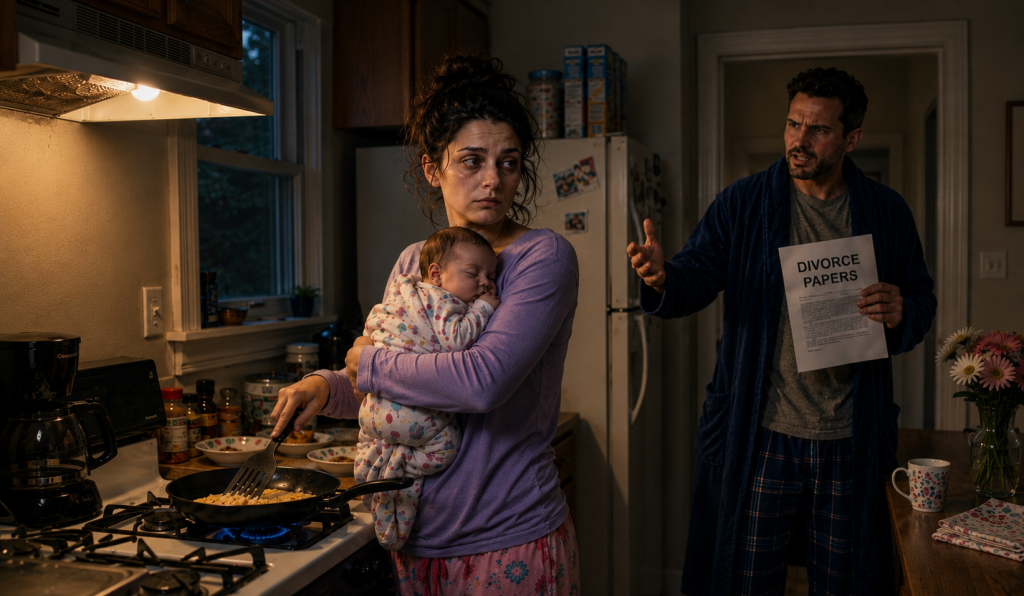
At 4:30 A.M., my husband came home, saw me holding our two-month-old baby while I cooked breakfast for his whole family, and said one word.
“Divorce.”
I didn’t cry.
I didn’t beg.
I turned off the stove, packed one suitcase, and left.
He thought I had nothing.
He forgot what I did before I became his wife.
The front door clicked open at exactly 4:30 a.m.
The kitchen tile was cold under my bare feet. Bacon grease clung to the air, sharp and heavy, mixing with burnt coffee and the sour little smell of a baby bottle warming too long in a mug of water.
I had been awake since midnight with our two-month-old son tucked against my chest, his breath dampening the front of my T-shirt while I cooked breakfast for Mark’s whole family.
His parents were arriving at eight.
His sister had texted me at 1:17 a.m. to remind me that his mother liked her eggs soft and her toast dry, as if I were staff she had forgotten to tip.
The refrigerator hummed.
Mark’s key scraped in the lock.
My son, Noah, had finally fallen asleep, one tiny fist curled into my shirt, and I remember tightening my arm around him before I even turned around.
Some part of me already knew that whatever had walked into that kitchen was not my husband coming home.
It was the end wearing his navy suit.
Mark stepped inside with his tie loose and his hair damp from the fog. He looked at the table I had set. The folded napkins. The stack of clean plates. The pan still hissing on the stove. The bottle beside the coffee.
Then he looked at me like I was already furniture.
“Divorce,” he said.
No apology.
No explanation.
Just one word dropped into a kitchen where his wife was barefoot, exhausted, and holding his newborn son.
For one second, my heart hit my ribs so hard I thought the baby would wake.
But Noah only sighed, warm and small, with milk on his breath and his cheek pressed against my collarbone.
I did not ask who she was.
I did not ask how long.
I did not ask whether his parents knew.
Women are taught to believe details make betrayal bearable.
They do not.
Details only give betrayal a floor plan.
So I reached over, turned off the stove, and tightened my arm around my son.
Mark blinked.
My silence bothered him more than my pain.
“Did you hear me?” he asked.
“I heard you.”
I walked past him into the bedroom, pulled my old navy suitcase from the closet, and packed like someone making an inventory.
Diapers.
Bottles.
Two sleepers.
My laptop.
My birth certificate.
The baby’s hospital discharge papers.
Then the folder I had kept behind the loose back panel of my nightstand.
My hands did not shake.
That scared me more than crying would have.
By 4:52 a.m., I was standing in the driveway with Noah in his car seat, my suitcase beside my old SUV, and the porch flag tapping softly in the morning wind.
Mark leaned against the doorframe with his phone in his hand.
“Where are you going?” he asked, like I was being dramatic.
“Out.”
His mouth twitched.
He thought I meant my mother’s.
He thought I meant a cheap motel.
He thought I would be back before lunch because his family would arrive and somebody still had to serve breakfast.
Men like Mark do not fear quiet women.
They mistake restraint for permission.
At 6:08 a.m., I was sitting at the kitchen table of Mrs. Henderson, the retired partner who had trained me ten years earlier.
Her house smelled like peppermint tea and lemon furniture polish, and a small American flag sat in a jar by the window beside a stack of old tax journals.
She did not hug me right away.
That was why I trusted her.
“He said it while you were holding the baby?” she asked.
I nodded.
“And you left?”
“I packed one suitcase.”
Mrs. Henderson smiled without warmth.
“Good. Let him think that was all you had.”
I looked down at Noah sleeping in the car seat by my foot.
“His family thinks I’m helpless.”
“No,” she said, sliding a yellow legal pad toward me. “They need you to be helpless. That’s different.”
At 7:31 a.m., Mark’s mother called.
I let it ring.
Then his sister.
Then Mark again.
By 8:04, he texted.
My parents are here. Don’t embarrass me.
I read it twice while my son made tiny sleeping sounds beside my ankle.
Then I opened my laptop.
Before I married Mark, before I learned which serving bowl his mother preferred and which shirts needed dry cleaning, I was a senior corporate auditor.
I knew how to read what men hid between line items.
I knew how shell companies breathed.
I knew how family money disappeared through consulting fees, vendor advances, and bank transfers scheduled at 2:13 a.m.
For eight months, I had documented everything.
Screenshots.
Account numbers.
Wire transfer ledgers.
A county clerk filing connected to a property Mark swore he never owned.
A folder labeled HOME EXPENSES that had nothing to do with our home.
Not suspicion.
Not jealousy.
Proof.
The first thing Mrs. Henderson did was call a forensic accountant she trusted.
The second thing she did was make me print every document twice.
At 9:46 a.m., Mark texted again.
You’ll get nothing if you make this ugly.
I stared at those words, then looked at the baby bottle cooling beside my coffee.
He still thought the marriage was the only thing I could lose.
Mrs. Henderson placed the first printed report in front of me.
“Start with the account he opened three weeks before the baby was born.”
I turned the page.
There was Mark’s signature.
There was the transfer I had never authorized.
And beside it, in black ink, was a name that made Mrs. Henderson stop breathing for half a second.
Cassandra Vale.
Mark’s sister.
The same woman who had texted me about eggs and dry toast was listed as co-owner on an account filled with money from our household trust.
Mrs. Henderson leaned back slowly.
“Well,” she said. “That explains why she was so comfortable ordering breakfast.”
My phone buzzed again.
Mark.
Where are you?
Then another message.
Mom is furious.
I almost laughed.
His mother was furious because nobody was standing in the kitchen flipping bacon.
She did not yet know the floor beneath her son was already cracking.
At 10:22 a.m., Mrs. Henderson called a family attorney named Laura Chen.
Laura arrived at 11:05 in a gray coat, carrying a leather briefcase and the calm face of a woman who had destroyed louder men before lunch.
She looked at Noah first.
Then at me.
“Are you safe?”
“Yes.”
“Does he have access to your car, bank cards, phone account, or medical records?”
“Yes to almost all of it.”
She put her briefcase down.
“Then we move quickly.”
For the next two hours, the kitchen became a war room.
Mrs. Henderson made tea.
Laura made calls.
The forensic accountant, Mr. Bell, joined through video and began highlighting every suspicious transfer in yellow.
I sat at the table nursing my son under a blanket, watching the life I had been forced to shrink into suddenly unfold back into something sharp and useful.
There was the account Mark opened three weeks before Noah was born.
There was the apartment lease in another county.
There were monthly payments labeled client entertainment.
There was a vendor company registered to Cassandra’s husband.
There were withdrawals from the trust my grandmother had left me before she died.
That trust was supposed to protect me.
Mark had called it unnecessary.
His mother had called it insulting.
Cassandra had once joked that a wife who kept separate money was “planning her escape.”
Now I knew why they hated it.
Because they had already been trying to reach it.
At 12:18 p.m., Mark called again.
This time I answered.
“What did you do?” he asked.
His voice was no longer bored.
It was tight.
Small.
Behind him, I heard his mother talking fast, asking where the serving tray was, asking why my phone kept going to voicemail.
“I turned off the stove,” I said.
“What?”
“That’s what I did.”
“Emily, don’t play games with me.”
I looked at my son.
His eyes were open now, dark and quiet, studying my face like he already knew the sound of his father’s voice meant trouble.
“You said divorce,” I told Mark. “I agreed.”
He went silent.
Then he laughed once.
“You agreed? You think walking out with a suitcase means you agree? You have no job. You have a baby. You have no idea how expensive life is.”
Mrs. Henderson looked up from her tea.
Laura held out her hand for the phone.
I put it on speaker.
Mark continued.
“You’ll come home by tonight. My mother said we can discuss boundaries after breakfast. Cassandra thinks you’re having some kind of postpartum episode.”
Laura wrote something down.
I said, “Mark, do not diagnose me through your sister.”
“Don’t get smart.”
That was the moment something inside me finally went cold.
Not broken.
Cold.
For two years, I had lowered my voice.
I had kept peace.
I had smiled when his mother inspected my shelves.
I had apologized when Cassandra came late and blamed me for dinner being dry.
I had let Mark call my old career “stressful little office work,” because correcting him felt like feeding a fire.
But there is a kind of peace that is not peace at all.
It is surrender wearing an apron.
“Mark,” I said quietly, “from this point forward, you can speak to my attorney.”
Laura leaned toward the phone.
“Mr. Vale, this is Laura Chen. Any further communication regarding your wife, your child, marital property, or financial matters should be directed through my office.”
Silence.
Then Mark said, “Who the hell is this?”
Laura smiled.
“Someone who reads bank statements very carefully.”
She ended the call.
At 2:16 p.m., the first certified packet went out.
One to the bank’s fraud division.
One to the board of Mark’s company.
One to the trustee overseeing my grandmother’s account.
One to the county clerk.
And one to Mark’s attorney, though Laura said men like him usually delayed hiring one because they believed anger counted as strategy.
At 3:07 p.m., Cassandra called me.
I let Laura answer.
Cassandra started crying before Laura finished saying hello.
“Emily is confused,” Cassandra said. “She just had a baby. She doesn’t understand what she’s doing.”
Laura’s face did not change.
“Ms. Vale, are you confirming you had access to the joint account ending in 4472?”
“What? No. I mean, Mark asked me to help with family paperwork.”
“What family paperwork required your name on a business account?”
Cassandra hung up.
Mrs. Henderson looked at me.
“Panic has a sound,” she said. “You’ll hear it a lot this week.”
She was right.
By evening, Mark had sent twenty-one messages.
Some were angry.
Some were sweet.
Some were so fake I almost felt embarrassed for him.
Don’t destroy our family.
Think of Noah.
You’re overreacting.
I love you.
My mother is crying.
You’re being cruel.
Come home and we’ll forget today happened.
That last one made me stare at the screen for a long time.
Forget today happened.
As if women are filing cabinets men can close whenever the evidence becomes inconvenient.
That night, I slept in Mrs. Henderson’s guest room with Noah beside me in a borrowed bassinet.
For the first time since he was born, nobody knocked on my door asking why laundry was still in the dryer.
Nobody told me I was holding him too much.
Nobody complained that dinner was late.
At 2:00 a.m., Noah woke hungry, and I fed him under the small lamp beside the bed.
His tiny fingers opened and closed against my skin.
I whispered, “I’m sorry.”
Not because I had left.
Because I had stayed long enough for that house to feel normal.
The next morning, Mark’s mother arrived at Mrs. Henderson’s house.
I saw her through the window before she rang the bell.
Evelyn Vale stood on the porch in a cream coat, pearls at her throat, anger pressed into every line of her face.
Cassandra stood behind her, pale and restless, sunglasses hiding her eyes even though the morning was cloudy.
Mark was with them.
Of course he was.
He had always been brave when standing behind his mother.
Mrs. Henderson opened the door only halfway.
“Can I help you?”
Evelyn looked past her.
“Emily, stop this nonsense and come outside.”
I stood in the hallway with Noah in my arms.
For years, Evelyn had spoken to me like a woman correcting a stain.
That morning, I noticed something new.
She was nervous.
“Mrs. Vale,” I said, “you need to leave.”
Her mouth opened.
“You ungrateful girl. My son gave you a life.”
I almost smiled.
“No. My grandmother did. Mark tried to steal it.”
Cassandra gasped.
Mark stepped forward.
“Don’t say that in public.”
Mrs. Henderson’s eyebrows rose.
“You are standing on my porch at 8:30 in the morning. This is already public.”
Evelyn pointed at me.
“You have a baby. You cannot raise him alone.”
I looked down at Noah.
He was awake, staring toward the doorway with solemn little eyes.
“I would rather raise him alone than raise him in a house where his mother is treated like a servant.”
Mark’s jaw tightened.
“You’re making a mistake.”
“No,” I said. “I made the mistake two years ago. This is the correction.”
His face changed then.
For the first time, I saw the man under the husband.
Not charming.
Not powerful.
Afraid.
“Emily,” he said softly. “Let’s talk privately.”
Laura appeared behind me.
“No.”
Evelyn’s face went red.
“Who are all these people?”
Mrs. Henderson smiled.
“Witnesses.”
That word worked like a slap.
Mark grabbed his mother’s arm and pulled her back.
Cassandra stared at me.
There was hatred in her eyes, but beneath it something weaker.
Fear.
Good.
By Friday, the temporary custody hearing was scheduled.
Mark showed up in a tailored suit with his mother beside him and a lawyer who kept checking his phone.
I wore a dark blue dress Mrs. Henderson had bought me the day before.
Noah slept against my chest in a soft gray wrap.
The courtroom smelled like paper, old wood, and rainwater from everyone’s shoes.
Mark’s lawyer tried to paint me as unstable.
Exhausted.
Emotional.
Recently postpartum.
Laura let him speak.
Then she stood.
“Your Honor, my client left the marital home after her husband came home at 4:30 in the morning and announced he wanted a divorce while she was holding their infant and preparing breakfast for his extended family. Since then, Mr. Vale has repeatedly threatened her financially and allowed his relatives to harass her.”
Mark looked furious.
His mother whispered something.
Laura continued.
“We are also submitting documentation suggesting Mr. Vale improperly transferred funds connected to protected assets belonging to my client.”
The judge looked over his glasses.
“Improperly transferred?”
Laura handed over the first folder.
Then the second.
Then the third.
Mark’s lawyer stopped checking his phone.
The judge read for a long moment.
The room became so quiet I could hear Noah breathing.
Finally, the judge looked at Mark.
“Mr. Vale, did you open an account with your sister three weeks before your child was born?”
Mark’s mouth tightened.
“My sister helped with family finances.”
“That was not my question.”
Mark’s lawyer touched his sleeve.
Mark said nothing.
The judge looked at Laura.
“Temporary custody remains with the mother. Visitation supervised until further review. Mr. Vale is restrained from accessing, moving, transferring, or altering any marital or trust-related assets pending investigation.”
Evelyn made a small sound, like someone had stepped on her pride.
The judge looked directly at Mark.
“And Mr. Vale?”
“Yes, Your Honor?”
“Do not contact your wife except through counsel.”
For the first time since 4:30 that morning, I breathed like my lungs belonged to me.
Outside the courthouse, Mark waited near the steps.
He was not supposed to approach me.
But men like Mark always believe rules are written for other people.
“Emily,” he said.
Laura stepped forward.
“Careful.”
Mark ignored her.
His eyes were on Noah.
“My son shouldn’t be kept from me.”
I held Noah closer.
“You should have thought of that before you treated his mother like nothing.”
His face twisted.
“You’re enjoying this.”
“No,” I said. “I’m surviving it.”
That shut him up.
For three weeks, the investigation widened.
The apartment lease was real.
The woman living there was real too.
Her name was Brittany.
She worked in Mark’s office.
She had believed he was separated.
That was what she told the investigator, anyway.
I did not hate her.
That surprised me.
Maybe because she had not stood in my kitchen and watched me bleed myself empty for a family breakfast.
Maybe because she was just another woman Mark had lied to.
The deeper wound was not Brittany.
It was the paperwork.
Mark had forged my electronic consent on two transfers.
He had used my old login credentials.
He had rerouted a distribution from my trust into a business account Cassandra could access.
Cassandra’s husband had billed Mark’s company for consulting work that did not exist.
Evelyn had received monthly payments from an account labeled household support.
Household.
That word made me laugh when Laura showed it to me.
I had been the household.
Cooking.
Cleaning.
Nursing.
Bleeding.
Smiling.
Apologizing.
And while I stood barefoot in that kitchen, they had been paying themselves for the privilege of using me.
One month after I left, Mark asked for mediation.
Laura advised me to attend.
Not because he deserved it.
Because sometimes watching a man negotiate with consequences is healing.
The mediation room was bright and cold.
Mark sat across from me.
He looked thinner.
His perfect hair had lost its discipline.
Cassandra was not there.
Her lawyer had advised distance.
Evelyn was not there either.
For once, Mark had to sit without his mother’s hand up his back.
He looked at me for a long time.
“You changed,” he said.
I almost laughed.
“No. I stopped shrinking.”
His lawyer cleared his throat.
“We’re prepared to offer a reasonable settlement.”
Laura folded her hands.
“Your client is not offering anything. He is returning what was taken.”
Mark flinched.
“I didn’t steal from you.”
I slid one page across the table.
“Then explain my signature.”
He looked down.
For months, I had imagined this moment.
I thought I would feel rage.
Triumph.
Maybe grief.
Instead, I felt tired.
Not weak tired.
Finished tired.
The kind of tired that closes doors.
Mark rubbed his face.
“I was under pressure.”
“From who?”
“My family. The business. Everything was on me.”
I looked at him.
I remembered the night Noah was born.
I remembered Mark standing beside the hospital bed, texting while I shook from surgery and asked him to hand me the baby.
I remembered his mother entering the recovery room without knocking.
I remembered Cassandra saying I looked “bigger than expected” five days after giving birth.
I remembered myself laughing softly because I was too tired to defend my own body.
“No,” I said. “Everything was on me. You were just spending it.”
He stared at the table.
His lawyer whispered to him.
Mark swallowed.
“What do you want?”
Laura began listing terms.
Full repayment of misused funds.
Legal fees.
Protected custody agreement.
Supervised visitation until parenting evaluation.
No contact from Evelyn or Cassandra.
Sale of the marital home or full buyout at appraised value.
Formal admission that I had not abandoned the home.
Independent audit of all accounts connected to my trust.
Mark’s face turned gray.
“That will ruin me.”
I looked at him.
“No. It will reveal you.”
He had no answer for that.
The divorce finalized seven months after the morning he said the word.
By then, Noah could roll over.
He had a laugh that sounded like hiccups.
He loved grabbing Mrs. Henderson’s glasses and trying to eat the corner of her tax journals.
I moved into a small white house with blue shutters, three blocks from a park.
The first night there, I unpacked the navy suitcase I had carried out of Mark’s house.
At the bottom was the yellow legal pad Mrs. Henderson had given me.
On the first page, in her sharp handwriting, she had written:
Let him think that was all you had.
I framed it.
Not because I wanted to remember the pain.
Because I wanted to remember the moment I stopped asking permission to save myself.
Mark’s supervised visits began in a family center with bright murals on the wall.
The first time he saw Noah there, he cried.
I stood behind the glass with the supervisor beside me.
Part of me hurt for him.
That was the cruel thing about loving someone once.
Your heart does not always receive the news as quickly as your mind does.
But sympathy is not surrender.
I watched him hold our son awkwardly, carefully, like he was finally realizing babies were not accessories to a life.
They were witnesses.
Months passed.
Cassandra’s husband lost two major contracts after the audit report became public within the company.
Cassandra moved out of state.
Evelyn sent one handwritten letter, full of blame disguised as prayer.
I gave it to Laura and never replied.
Mark resigned from his position before the board could vote.
The official wording was personal reasons.
Mrs. Henderson read it over breakfast and snorted into her tea.
“Personal reasons,” she said. “That’s rich.”
I smiled.
Noah sat in his high chair banging a spoon against the tray.
The kitchen smelled like pancakes and strawberries.
Nobody criticized the toast.
Nobody texted instructions.
Nobody came home at dawn carrying divorce like a weapon.
One year after I left, I returned to work.
Not full time at first.
Just consulting.
Then audits.
Then investigations.
My first case back involved a family business where money had been disappearing through fake vendor payments.
When I found the pattern, my hands were steady.
My boss said, “You have a gift for seeing what people think is invisible.”
I thought of Mark.
Of Cassandra.
Of Evelyn.
Of the account opened three weeks before Noah was born.
“No,” I said. “I just learned not to look away.”
On Noah’s first birthday, Mrs. Henderson hosted a small party in her backyard.
There were blue balloons tied to the fence.
A little cake with clouds on it.
A small American flag near the lemonade pitcher.
Noah wore a striped shirt and smashed frosting into his hair.
Mrs. Henderson cried when he said something that sounded almost like “Nana.”
Laura came too, bringing a gift wrapped in silver paper.
Inside was a tiny wooden train.
“For future escapes,” she joked.
I laughed harder than I expected.
Later, after everyone left, I sat on the porch with Noah asleep against my shoulder.
The evening was warm.
The sky was pink over the trees.
My phone buzzed.
A message from an unknown number.
It was Mark.
I know I destroyed everything.
I stared at the words.
Then another message came.
I thought you had nothing because I never understood what you were.
For a long time, I did not answer.
Then I typed:
No, Mark. You knew what I was. You just thought marriage had buried her.
I blocked the number.
Inside the house, the dishwasher hummed.
A bottle warmed safely on the counter.
My son sighed in his sleep.
And I realized something that made tears finally rise to my eyes.
I had not lost my family that morning.
I had carried my family out in my arms.
Everything else was just furniture, paperwork, and people who mistook kindness for weakness.
At 4:30 a.m., Mark had said one word.
Divorce.
He meant it as an ending.
But he had forgotten what I did before I became his wife.
I knew how to follow hidden trails.
I knew how to protect what mattered.
And most of all, I knew how to leave before the fire reached my child.
So I turned off the stove.
Packed one suitcase.
Walked into the dark.
And built a life bright enough that my son would never have to wonder why his mother stayed where she was not loved.
THE END! THANK YOU FOR READING!