

I woke to the smell of antiseptic and the soft hum of the company medical room refrigerator. For three seconds, I did not know where I was. Then the ceiling tiles sharpened above me, my mouth tasted metallic, and the memory returned in fragments. The champagne toast in Conference Room A.
My husband’s hand at the small of my back. Vanessa Hale smiling too brightly as she handed me a glass. Then darkness. I kept my eyes half-closed when I heard voices beyond the half-open door. “Are you sure she took it?” Vanessa whispered.
My husband, Grant Whitmore, let out a quiet laugh.
“Relax. By tomorrow morning, everything will be ours.”
Everything.
My company.
My patents.
My mother’s trust.
The voting shares I had refused to transfer to him.
The new merger deal worth eighty million dollars.
My pulse slammed so hard I thought the monitor beside me would betray me, but it was not connected.
They had not called an ambulance.
They had not called a doctor.
They had brought me here because they needed me alive, weak, and easy to move.
Vanessa spoke again.
“What if she wakes up?”
“She won’t be clear enough to understand anything,” Grant said. “The paperwork is ready. She’ll sign the emergency authorization, the board will accept it, and by the time her attorney hears anything, it’ll be finished.”
I stared at the phone lying on the chair beside the bed.
Grant had made one mistake.
He still believed I trusted him.
Three months earlier, when my CFO found irregular transfers hidden under consulting fees, I had hired a private investigator.
Two weeks later, I learned Grant had been meeting Vanessa at a hotel in Arlington.
One week after that, my attorney, Ruth Caldwell, drafted a contingency plan.
If I became medically incapacitated under suspicious circumstances, Grant lost all temporary authority.
If any emergency document appeared with my signature, it would trigger an injunction.
If my phone sent one exact sentence, Ruth would move immediately.
My fingers trembled as I reached for the chair.
Outside the door, Grant said, “I’ll bring her home tonight. In the morning, she’ll be too sick to question why the board already voted.”
Vanessa giggled softly.
“And after that?”
“After that, my love, Evelyn becomes a footnote.”
I unlocked my phone with my face, praying the dim room was enough.
It opened.
I found Ruth’s name.
My thumb shook once.
Then steadied.
Execute the plan. Now.
The message delivered.
I heard Vanessa’s heels click away.
Grant pushed the door open wider and stepped inside, wearing the concerned husband expression he had practiced for years.
“Evelyn,” he said softly. “You scared me.”
I looked at him and smiled.
“Did I?”
For half a second, something flickered in his eyes.
Fear.
Then he covered it with tenderness.
“My darling, you collapsed. Everyone was worried.”
“Everyone?” I asked.
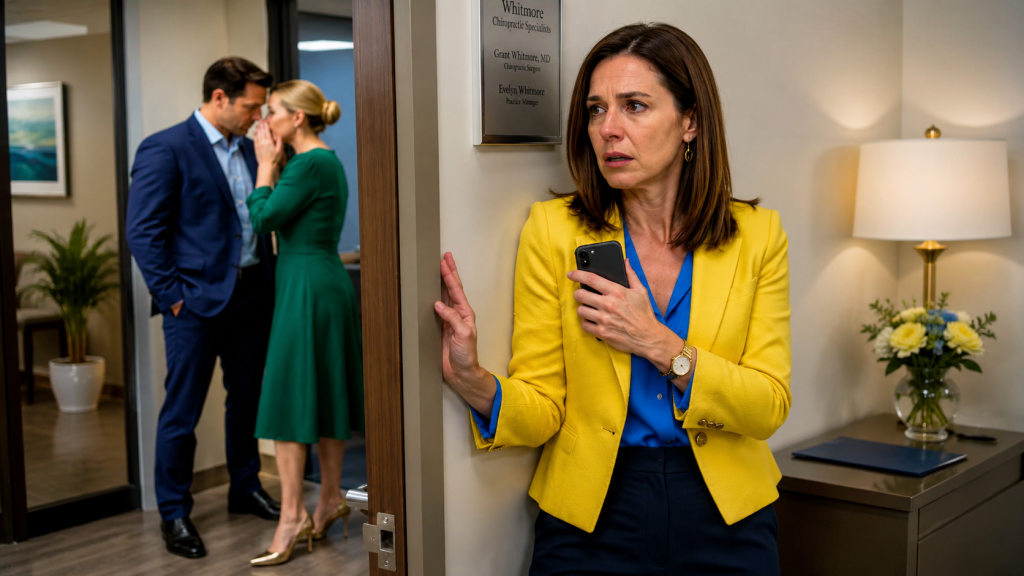
He came closer, lowering his voice.
“Well, the board was unsettled. The merger partners were there. It was embarrassing, of course, but your health comes first.”
Of course.
My health had never come first with Grant.
Not when I worked eighteen-hour days building Whitmore Biotech from a borrowed lab and three unpaid interns.
Not when I sold my mother’s wedding ring to make payroll.
Not when he begged me to put his name on the company after we married because “a husband should not look like an accessory.”
I had given him a title.
Chief Strategy Officer.
I had given him an office.
I had given him introductions, respect, and trust.
But I had never given him control.
That was what he could not forgive.
Grant sat on the edge of the medical bed and reached for my hand.
His palm was warm and dry.
Mine was cold.
“I need to get you home,” he said. “You need rest.”
“I should go to a hospital.”
His fingers tightened.
“No need. The nurse said it was stress.”
“What nurse?”
He paused.
“The company nurse.”
“We don’t have a company nurse on Fridays.”
His smile stayed in place, but only just.
“She was called in.”
I looked toward the doorway.
“Where is she?”
“Evelyn, don’t start interrogating everyone. You fainted. You’re confused.”
There it was.
The tone.
Soft enough to sound caring.
Sharp enough to warn me.
I lowered my eyes like a tired wife.
“Maybe you’re right.”
Relief loosened his face.
“Good. I’ll take care of everything.”
I almost laughed.
Instead, I let him help me sit up.
The room tilted hard. For one terrifying second, black spots swarmed my vision.
Whatever had been in that drink had not fully worn off.
Grant watched me carefully.
Too carefully.
He needed me weak enough to sign, but not so weak I looked unconscious.
My phone vibrated once against my thigh.
Grant’s eyes darted toward it.
“Who is that?”
“I don’t know.”
“Let me check.”
He reached.
I pulled the phone back and coughed.
“It’s probably Clara asking about the merger.”
Grant’s jaw flexed at the mention of Clara, my CFO.
He hated Clara because she could smell lies like smoke.
“She can wait,” he said.
I nodded, then glanced down when he turned to collect my coat.
Ruth’s reply filled the screen.
Already in motion. Security notified. Do not leave alone.
My lungs opened for the first time since I woke.
Grant returned with my coat draped over his arm.
“We’ll use the private elevator,” he said. “No need for everyone to see you like this.”
“No,” I said gently. “Let’s go through the lobby.”
His eyes narrowed.
“Why?”
“If people saw me collapse, they should see I’m okay.”
He studied me.
I forced my face to soften.
“Please, Grant. I’m already embarrassed enough.”
Vanity was a language he understood.
Finally, he nodded.
“All right. But lean on me.”
I did.
Not because I trusted him.
Because I needed him close enough to see the trap close.
The hallway outside the medical room was empty, but the office felt different.
Too quiet.
Lights still burned in the glass conference rooms.
A half-empty champagne flute sat abandoned on a table.
Someone had dropped a folder near the elevators.
When we reached the lobby, I saw them.
Two board members.
My head of security, Miles.
A pair of investigators I did not recognize.
And Ruth Caldwell, seventy-two years old, silver-haired, small as a bird, and feared by every judge in three counties.
She stood near the reception desk with her leather briefcase in both hands.
Grant stopped walking.
“What is this?” he muttered.
I let my head rest weakly against his shoulder.
“Probably business.”
His phone rang.
He looked at the screen.
Then answered.
“Not now.”
He listened.
The color drained from his face.
“What do you mean the accounts are frozen?”
Ruth looked at me.
I gave her the smallest nod.
She moved forward.
“Mr. Whitmore,” she said, her voice calm. “Step away from my client.”
Grant hung up.
“Ruth, this is a family matter.”
“No,” she said. “This is attempted fraud, corporate coercion, and possibly poisoning.”
People in the lobby froze.
Vanessa appeared near the executive elevators, clutching a tablet.
The moment she saw Ruth, she stopped.
Then she turned to leave.
Miles stepped into her path.
“Ms. Hale,” he said. “Please remain where you are.”
Grant’s hand tightened around my waist.
“Evelyn is ill. I’m taking my wife home.”
Ruth’s eyes sharpened.
“Your wife texted me because she overheard you discussing a plan to take control of her company while she was incapacitated.”
Grant laughed.
It was too loud.
“She’s delirious. Listen to her. She doesn’t know what she heard.”
I lifted my head.
“I heard everything.”
His smile vanished.
The room went silent.
I looked at Vanessa.
“I heard you ask if I took it.”
Vanessa’s lips parted.
“I—I meant medication. You looked unwell.”
“You handed me champagne.”
“That’s ridiculous,” Grant snapped.
Ruth opened her briefcase.
“Security has already preserved the conference room footage. The glass has been bagged. The medical room has been sealed. The emergency authorization documents submitted twenty minutes ago have been flagged as fraudulent.”
Grant stared at her.
Submitted twenty minutes ago.
So he had already started.
My heart twisted, not because I was surprised, but because some foolish part of me still remembered the man who brought soup to my mother during chemotherapy.
Had that man ever been real?
Or had Grant always been waiting for a richer door to open?
One of the board members, Thomas Bell, stepped forward.
“Grant,” he said quietly, “did you file documents claiming Evelyn authorized you to vote her shares?”
Grant straightened.
“Evelyn and I discussed this privately.”
“No,” I said. “We did not.”
Thomas looked ashamed.
He had pushed me for months to give Grant more influence.
He had called me guarded.
Difficult.
Overprotective.
Now he could barely meet my eyes.
Ruth handed a document to the investigators.
“By existing board resolution and trust directive, Grant Whitmore is suspended from all company authority pending investigation.”
Grant’s face hardened.
“You can’t do that.”
“I already did,” Ruth said.
Vanessa tried again to step around Miles.
He blocked her.
“Move,” she hissed.
“Not until the investigators speak with you.”
She looked at Grant, panic shining through her perfect makeup.
“Grant?”
That one word betrayed them more than any evidence could.
Not Mr. Whitmore.
Not sir.
Grant.
Soft.
Intimate.
Desperate.
I looked at my husband.
“So she gets to know the plan, but your wife doesn’t?”
He turned toward me, and for the first time, the mask cracked completely.
“You were never going to let me have anything.”
The words hit harder than any confession.
“I gave you everything I could.”
“No,” he said bitterly. “You gave me a chair beside your throne.”
“My throne?” I whispered. “I built this company from nothing.”
“And you never let me forget it.”
I stared at him.
All those years.
All those small punishments.
The way he grew cold when newspapers called me the founder.
The way he corrected people who introduced him as my husband.
The way he hated every room where I was respected more than him.
It had never been about love.
It had been about ownership.
Ruth touched my arm.
“Evelyn, paramedics are on the way.”
Grant’s eyes flashed.
“You called an ambulance?”
“Yes,” Ruth said. “Because that is what innocent husbands do when their wives collapse.”
The sirens arrived five minutes later.
By then, Grant had stopped pretending.
He demanded lawyers.
He threatened board members.
He accused Clara of staging a coup.
Vanessa cried quietly into her hands until one investigator asked for her phone.
Then she stopped crying.
At the hospital, blood tests confirmed I had been given a strong sedative.
Not enough to kill me.
Enough to confuse me.
Enough to make a signature look plausible.
Enough to steal a company while I slept.
When Detective Marlow came into my room near midnight, he carried a folder and the tired expression of a man who had seen too many greedy people ruin their lives.
“Mrs. Whitmore,” he said, “your attorney gave us permission to speak with you if you feel able.”
“I feel angry,” I said. “That will have to be enough.”
He almost smiled.
“We recovered messages between your husband and Ms. Hale. They discussed timing, documents, and your drink.”
My stomach turned.
“Did she admit anything?”
“Not yet. But she’s scared. People like that usually start talking when they realize love does not come with legal protection.”
I looked toward the dark window.
Outside, the city lights blurred.
“What about Grant?”
“He says you’re unstable.”
I laughed once.
It hurt my throat.
“Of course he does.”
“He also says you invented the affair because you were jealous of Ms. Hale.”
That did make me smile.
“Detective, I’m fifty-six years old. I built a biotech company in an industry that tried to bury me before I had gray hair. If I wanted to destroy a secretary over jealousy, I would not need to drug myself first.”
This time, he did smile.
“No, ma’am. I suppose not.”
After he left, Ruth sat beside my bed.
She looked smaller under the hospital lights.
Older.
But her eyes were fierce.
“You could have died,” she said.
“I know.”
“I told you Grant was dangerous.”
“You told me he was ambitious.”
“I was being polite.”
For the first time that night, my composure broke.
Tears slid sideways into my hair.
“I married him, Ruth.”
Her hand covered mine.
“Yes.”
“I defended him.”
“Yes.”
“I let him sit at my mother’s table.”
Ruth’s face softened.
“Evelyn, betrayal is not proof you were foolish. It is proof someone was cruel.”
I closed my eyes.
My mother would have liked that sentence.
She had never trusted Grant.
Not fully.
On my wedding day, while everyone else admired the flowers, she had taken my hands and said, “A man who loves your light will not ask you to dim it.”
I had laughed then.
I was forty-eight, successful, stubborn, and lonely.
Grant had made me feel cherished.
He remembered my coffee order.
He sent flowers to the lab.
He said he admired strong women.
I did not understand then that some men admire strong women the way hunters admire rare animals.
They want the trophy.
Not the strength.
By morning, the story had reached the press.
Founder hospitalized after suspicious collapse.
Executive suspended.
Merger delayed.
Shares frozen.
The board wanted me to make a statement.
Ruth wanted me to rest.
Clara wanted to burn the entire building down.
She arrived at the hospital with a tote bag full of files and a face full of fury.
“I knew it,” she said before even sitting. “I knew those consulting payments were dirty. I should have pushed harder.”
“You pushed enough.”
“No, Evelyn. Enough would have been dragging him out by his expensive tie.”
Despite everything, I laughed.
Then I winced.
Clara’s eyes filled.
“Oh, God. I’m sorry.”
“Don’t cry,” I said.
“I’m not crying. My eyes are making a legal statement.”
That was Clara.
Brilliant.
Loyal.
Terrible at emotions.
She placed the files on the bed.
“I found more. Shell companies. Transfers routed through Vanessa’s cousin. A lease in Bethesda. Jewelry purchases. And this.”
She handed me a printed email.
It was from Grant to Vanessa.
Subject: After E.
I read the first line and stopped breathing.
Once Evelyn is removed, we move fast.
Removed.
Not divorced.
Not bought out.
Removed.
My hands shook.
Clara took the paper back gently.
“I’m sorry.”
Something cold settled inside me.
Not fear.
Clarity.
For months, I had tried to handle Grant quietly.
I wanted evidence for divorce.
I wanted clean separation.
I wanted dignity.
But Grant had not wanted separation.
He wanted erasure.
“Call the board,” I said.
Ruth looked up.
“You need rest.”
“I will rest when my company is safe.”
Clara nodded once.
That afternoon, from my hospital bed, I attended the emergency board meeting by video.
No makeup.
No jewelry.
Hospital gown under a gray cardigan Ruth had brought from my house.
My face looked pale on screen.
Good.
Let them see what their hesitation had allowed.
Thomas Bell could barely look at me.
The chairwoman, Miriam Shaw, cleared her throat.
“Evelyn, we are grateful you’re recovering.”
“Are you?” I asked.
Silence.
Miriam blinked.
“Of course.”
“Then let us not waste time pretending this is only about my recovery. My husband attempted to steal voting control while I was unconscious. Someone inside this company helped him. Some of you were prepared to approve it.”
Thomas looked down.
I continued.
“For years, I was told I should trust Grant more. That excluding him from founder-level authority looked personal. That a wife should not embarrass her husband in front of investors.”
No one spoke.
“I trusted the company documents instead of my emotions. That is why Whitmore Biotech still belongs to its shareholders, employees, and the patients waiting for our research. Effective immediately, I am requesting a full internal audit, suspension of all Grant-approved contracts, and removal of Vanessa Hale from all access pending investigation.”
Miriam nodded.
“Approved.”
Thomas raised his hand.
“I owe you an apology, Evelyn.”
“Yes,” I said. “You do.”
His face reddened.
“I thought you were being unfair to Grant.”
“You thought a woman protecting her own company was being emotional.”
He swallowed.
“Yes.”
I let the silence sit.
Then I said, “Learn from it.”
The motions passed unanimously.
Grant was finished at Whitmore Biotech before lunch.
But at home, the betrayal waited in quieter forms.
Two days later, Ruth drove me to the house so I could collect what mattered.
I had not let Grant choose that house.
My mother had.
A brick colonial with a white porch and old maple trees.
She had said it looked like a place where tired women could finally sleep.
Grant had filled it with glass furniture, abstract sculptures, and cold rooms nobody used.
Now police tape crossed the study door.
Investigators had searched it the night before.
I walked upstairs slowly.
My body still felt heavy.
In the bedroom, Grant’s closet stood open.
Half his suits were gone.
His watch drawer was empty.
But on my vanity, my mother’s pearl earrings remained.
I picked them up and sat down.
For the first time since the medical room, I cried properly.
Not pretty tears.
Not silent tears.
The kind that bend your shoulders.
Ruth stood in the doorway and said nothing.
That was why I loved her.
She never rushed grief.
When I could breathe again, I opened the bottom drawer of my vanity and removed the blue folder hidden beneath winter scarves.
Inside were copies of my mother’s trust documents, old letters, and one envelope marked For when you doubt yourself.
My mother had written it during her last year.
I had never opened it.
I opened it then.
My dearest Evelyn,
If you are reading this, someone has made you question your worth.
Do not let them.
You were never difficult.
You were discerning.
You were never cold.
You were careful with the fire God gave you.
People will call you hard when they cannot bend you.
Let them talk.
Stand straight anyway.
I pressed the letter to my chest.
Ruth wiped her eyes quickly and pretended she had not.
Downstairs, the front door opened.
A male voice called out.
“Evelyn?”
Grant.
Ruth stiffened.
“He is not supposed to be here.”
I stood.
My knees trembled, but I stood.
Grant appeared at the bottom of the stairs.
He looked terrible.
Unshaven.
Tie loose.
Eyes wild.
For a moment, I saw the man beneath the polish.
Not strong.
Not brilliant.
Just greedy and frightened.
“Evelyn,” he said. “Please. We need to talk.”
Ruth stepped in front of me.
“You need to leave.”
He ignored her.
“I made mistakes.”
I descended two steps.
“Mistakes?”
“I panicked.”
“You drugged me.”
His face twisted.
“I didn’t know Vanessa put that much in the glass.”
Ruth inhaled sharply.
There it was.
A confession.
Grant realized it too late.
His eyes darted toward Ruth’s purse.
Her phone was recording.
“You trapped me,” he whispered.
“No,” I said. “You finally told the truth.”
He gripped the banister.
“You don’t understand what it’s like being married to you.”
I laughed softly.
“Careful, Grant. You are about to blame me for your crimes.”
“You made me feel small!”
“No. I made you feel seen. You just hated what there was to see.”
His face darkened.
For a second, I thought he might come up the stairs.
Then two officers entered behind him.
Ruth had pressed the emergency alert on her phone the moment he walked in.
Grant turned.
One officer said, “Mr. Whitmore, you need to come with us.”
He looked back at me.
“Evelyn, please. Don’t do this.”
Those words almost broke my heart.
Not because I wanted to save him.
Because I remembered how many women had heard those words after being harmed.
Don’t do this.
As if consequences were cruelty.
As if justice were betrayal.
I held my mother’s letter in one hand and the banister in the other.
“I’m not doing anything, Grant. I’m finally letting you answer for what you did.”
They took him away from the house he had tried to inherit by destroying me.
The weeks that followed were ugly.
There were headlines.
There were depositions.
There were reporters outside the office.
There were old acquaintances who called not to comfort me, but to collect details.
Vanessa accepted a deal first.
Of course she did.
She handed over messages, financial records, hotel receipts, and audio files.
Grant had promised to marry her after he took control of the company.
He had promised her stock.
A penthouse.
A title.
A future.
I wondered if she loved him.
Then I wondered why I cared.
At the preliminary hearing, I saw them both.
Vanessa looked smaller without her perfect office armor.
Grant looked furious.
Not remorseful.
Furious.
When the prosecutor described the sedative, the fraudulent paperwork, and the shell transfers, Grant stared at the table like the facts themselves had betrayed him.
Then Ruth handed me a note.
Do not look for sorrow where there is only pride.
I folded it into my palm.
When I was called to speak, I walked slowly to the front.
The courtroom was quiet.
I did not look at Grant at first.
I looked at the judge.
“My name is Evelyn Whitmore,” I said. “Before marriage, Evelyn Hart. I am the founder and majority voting shareholder of Whitmore Biotech. I am also a woman who woke up in a medical room and heard her husband planning to erase her.”
Grant shifted behind me.
I continued.
“For months, I suspected financial betrayal. I prepared legal protections because I was afraid of losing my company. I did not understand I was protecting my life.”
My voice trembled.
I let it.
“I am not here because I want revenge. Revenge would require me to care what happens to Grant Whitmore’s soul. I am here because no person should be allowed to use marriage as a disguise for theft, coercion, or harm.”
The judge listened without interruption.
Finally, I turned toward Grant.
He would not meet my eyes.
That told me more than any apology could have.
The case continued for months.
Grant’s attorneys tried everything.
They said I was controlling.
They said I had staged the incident to avoid giving him a fair divorce settlement.
They said Vanessa was unstable.
They said the sedative could have come from somewhere else.
But evidence has a way of being patient.
Bank records do not get embarrassed.
Security cameras do not soften the truth.
Text messages do not forget.
In the end, Grant pleaded guilty to multiple charges related to fraud, conspiracy, and reckless endangerment.
Vanessa received a lesser sentence for cooperating.
I did not celebrate.
The day Grant was sentenced, I went to my mother’s grave.
It was raining lightly.
The cemetery grass shone silver.
I placed white roses beside her stone and stood there with my coat collar turned up.
“You were right,” I whispered.
The wind moved through the trees.
I could almost hear her answer.
Of course I was.
Six months later, I returned to Conference Room A.
The same room where the champagne toast had happened.
The table had been replaced.
The carpet cleaned.
The glassware banned from executive events by Clara, who claimed champagne was now “a hostile beverage.”
The merger survived.
Not because of Grant.
Despite him.
Our research received funding.
Our employees stayed.
The company did not collapse.
Neither did I.
That morning, the board gathered for my official return.
Miriam stood.
Thomas stood.
Clara stood last, wiping her eyes and pretending it was allergies.
I walked to the head of the table.
For years, I had thought strength meant never showing the wound.
Now I understood strength was walking back into the room where they tried to destroy you and taking your seat anyway.
“I’ll keep this brief,” I said.
Clara coughed.
“No, she won’t.”
A ripple of laughter moved through the room.
Even I smiled.
“I built this company to save lives,” I said. “Somewhere along the way, I forgot mine was included.”
The room went still.
“That will not happen again. Not for me. Not for anyone here. From this day forward, no emergency authorization can be approved without independent medical verification, outside counsel, and direct board review. No spouse, executive, or partner gets unchecked authority because of a title.”
Miriam nodded firmly.
“Agreed.”
I looked around the table.
“And one more thing. The company name will change.”
Whispers rose.
Clara’s eyes widened.
I clicked the remote.
The screen behind me lit up.
Hart Biotech.
My mother’s name.
My name.
The room went silent.
Then Clara began clapping.
One by one, the others joined.
I stood there listening, not as a queen on a throne, not as a wife who had survived her husband, but as myself.
Evelyn Hart.
Daughter of a woman who taught me to stand straight.
Founder of a company no one would steal.
Survivor of a marriage that confused possession with love.
After the meeting, I walked alone to the lobby.
The receptionist had placed fresh flowers near the front desk.
Sunlight poured through the glass doors.
For the first time in a long time, the building felt warm.
My phone buzzed.
A message from Ruth.
Proud of you. Your mother would be unbearable today.
I laughed out loud.
Then I typed back.
She would demand a better logo.
Ruth replied instantly.
She would be right.
Outside, reporters waited by the curb.
For months, I had avoided them.
But that day, I stopped.
A young journalist stepped forward.
“Mrs. Whitmore, do you have any comment?”
I looked at her.
Then at the building behind me.
Then at the wedding ring no longer on my finger.
“Yes,” I said. “My name is Evelyn Hart.”
The cameras flashed.
“And I am still here.”
THE END! THANK YOU FOR READING!