

My wife died giving birth to our daughter, and I hated that baby from her very first cry.
Six weeks later, I walked into her room determined to let her cry herself out, until I saw something tied around her wrist.
It was a little red bracelet.
I hadn’t put it on her.
And under her pillow was my dead wife’s cell phone, powered on.
My name is Ignacio.
Before my daughter was born, I was a different man.
One who laughed loudly.
One who would buy street corn with chili for his wife at midnight.
One who danced badly in the kitchen just to make her smile.
One who talked to her belly like a fool in love.
“You’re almost here, my girl,” I used to say, pressing my hand against Marina’s stomach. “Your mommy and I are waiting for you.”
Marina would laugh and say, “She knows your voice already.”
My wife’s name was Marina.
And Marina never left the hospital.
I still remember the white hallway.
The smell of bleach.
The nurse looking down instead of looking me in the eyes.
The doctor saying words that refused to become real.
Complication.
Hemorrhage.
We did everything we could.
Lies.
Nobody does everything they can when they hand you a baby wrapped in a pink blanket and tell you the woman of your life is no longer breathing.
They put the baby in my arms.
So tiny.
So warm.
So alive.
And all I could think was:
She stayed.
Marina didn’t.
From that day, every cry split my skull.
Every diaper.
Every bottle.
Every sleepless dawn.
Every tiny breath coming from the crib reminded me of the same terrible truth.
My wife was in the ground.
And this girl was breathing in her place.
My mother came over every morning to help.
My mother-in-law sat beside the crib and prayed the rosary until her fingers trembled.
The neighbors brought casseroles and whispered, “Poor little thing. She needs her daddy.”
I nodded.
I thanked them.
But inside, I was rotting.
I didn’t hold her more than necessary.
I didn’t sing to her.
I didn’t call her “my love.”
I called her “the girl.”
As if refusing to say her name could keep her from becoming real.
Marina wanted to name her April.
I couldn’t do it.
April sounded too soft.
Too hopeful.
Too much like spring.
And there was no spring left in my house.
Only silence.
Only bottles lined beside the sink.
Only Marina’s yellow dress hanging behind the bedroom door because I couldn’t bring myself to move it.
Only a crib in a room painted pale cream, waiting for a mother who would never walk through the door.
That night, the crying started at 3:12.
I know because I had spent weeks staring at the clock like a condemned man.
First, it was a whimper.
Then a scream.
Then that high-pitched wail that seemed to scrape my bones.
I covered my face with the pillow.
“Shut up,” I whispered.
But she didn’t.
I hit the mattress and sat up, furious, barefoot, shaking with rage and shame.
The hallway was dark.
In the living room, a photo of Marina in her yellow dress still hung above the table.
She was smiling beside the crib she never got to use.
I didn’t look at it.
I couldn’t.
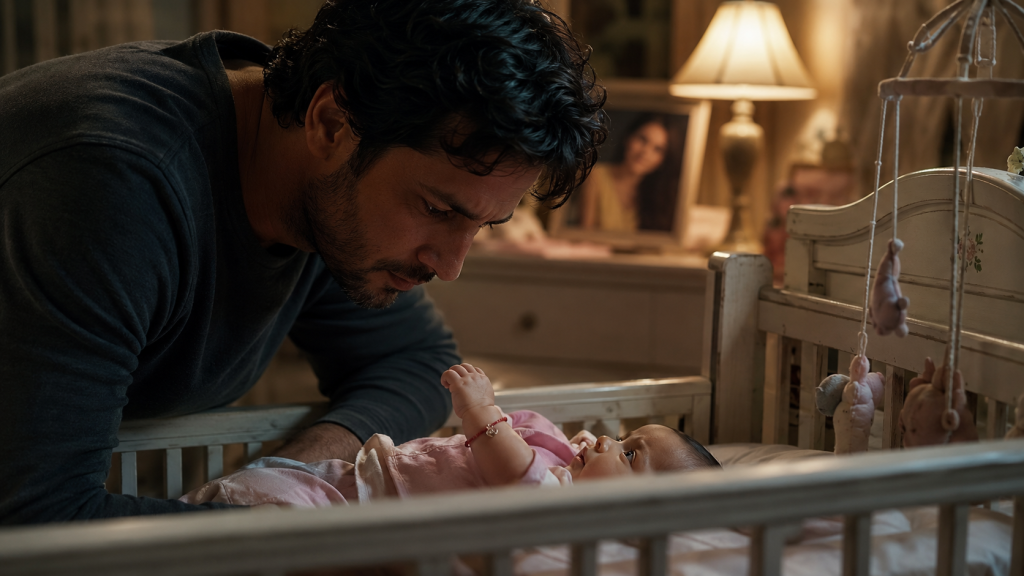
I pushed open the nursery door.
The baby was red-faced, kicking, her tiny fists clenched.
“What do you want?” I said to her, as if she could answer. “What more do you want from me?”
Then she lifted one tiny hand.
And I saw the bracelet.
A little red string around her wrist.
With a tiny St. Christopher medal.
My blood froze.
Marina had bought that bracelet in Savannah when she was seven months pregnant.
We had been walking by the river when she stopped at a small shop window.
Inside, there were candles, baby charms, little silver medals, and red protection bracelets.
She bought one and held it against her belly.
“For our daughter,” she said.
I laughed. “She isn’t even born yet.”
“She will be,” Marina said. “And I’ll put it on her myself. Promise me no one else will.”
I promised.
Nobody knew where she kept it.
Nobody.
I stepped closer to the crib.
The baby stopped crying instantly.
As if she had only been waiting for me.
Under her little pillow, there was a lump.
I reached in carefully and pulled out Marina’s old cell phone.
The one I had turned off the day of the wake.
The screen was lit up.
It had an alarm set for that exact time.
3:12 AM.
And one audio file was open.
The title made my heart stop.
“Ignacio, listen to this before you blame April.”
I felt the room closing in.
The baby looked up at me with Marina’s eyes.
And when I pressed play, my wife’s voice returned from the dead.
“My love,” Marina whispered, “if you’re hearing this, it’s because nobody told you the truth.”
My knees gave out beside the crib.
I gripped the phone so hard my fingers hurt.
Marina’s voice trembled, but it was still her.
Soft.
Warm.
Alive in a way my house had not been alive for six weeks.
“Ignacio, please listen until the end. I know you. I know your heart. And I know that when pain has nowhere to go, it looks for someone to blame.”
I covered my mouth.
The baby made a tiny sound, not crying now, just watching me.
“Our daughter did not kill me,” Marina said. “April did not take me away from you.”
Hearing her say the name broke something in me.
April.
The name I had refused to speak.
The name Marina had chosen while sitting in bed with baby books spread over her lap.
“I need you to know something,” Marina continued. “During my last appointment, the doctor found signs that the delivery could be dangerous. Very dangerous. I was supposed to tell you that night. I tried. But you were painting the nursery, and you had blue paint on your cheek, and you were so happy.”
I remembered that night.
Marina had stood in the doorway for a long time, rubbing her belly.
I had asked, “You okay?”
She had smiled.
“Just tired.”
The recording continued.
“I didn’t tell you because I knew what you would do. You would choose me. You would beg me to choose myself. And I love you for that. But I had already chosen both of you. I wanted to fight for us. For you. For her.”
I shook my head.
“No,” I whispered. “No, Marina.”
“I recorded this because I was scared. Not of dying. I was scared of what grief might do to you.”
The baby moved her hand again.
The red bracelet caught the faint nightlight.
“If I don’t come home, promise me something. Don’t let our daughter grow up paying for my death. Don’t let her first story be that she ruined your life. She didn’t ruin anything. She is the piece of me that stayed.”
I bent over the crib and sobbed.
Not loudly.
Not dramatically.
Just broken.
Like a man whose bones had finally remembered they were tired.
Then Marina said something that made me stop breathing.
“There is another file after this one. Play it only when you are holding her.”
I stared at the phone.
My hands were shaking.
Holding her?
For six weeks, I had avoided that.
I had lifted her like a duty.
Fed her like a chore.
Changed her like a punishment.
But held her?
No.
Not really.
The recording ended.
Another file appeared.
“The whole truth begins here.”
I looked at April.
For the first time, I said her name.
“April.”
Her eyes opened wider, as if she recognized it.
Or maybe she recognized me finally becoming human.
I reached into the crib.
My hands were clumsy.
Afraid.
But she didn’t resist.
She settled against my chest like she had been waiting six weeks to arrive there.
She was warm.
So small.
Her head fit beneath my chin.
Her tiny hand pressed against my shirt.
The smell of baby powder and milk rose around me.
And beneath it, impossibly, I smelled Marina’s lavender soap.
I pressed play.
Marina’s voice returned.
“Are you holding her?”
I almost laughed through my tears.
Of course she knew.
“That’s good,” Marina said. “She needs to hear your heartbeat. And you need to feel hers.”
April squirmed against me.
Her cheek rested on my chest.
“Ignacio, there are things I didn’t tell you because I wanted to protect you. Maybe that was wrong. Maybe love should tell the truth even when it hurts.”
I held April tighter.
“My mother knew about the risk,” Marina said. “So did your mother. I made them promise not to tell you unless I didn’t survive.”
My stomach twisted.
My mother.
My mother-in-law.
All those weeks in my house, watching me turn cold toward my own child, and they had said nothing.
“I asked them to keep quiet because I wanted you to hear it from me,” Marina continued. “Not from a doctor. Not from a grieving mother. From me.”
I leaned back against the crib, sliding down to the floor with April in my arms.
“I also asked them to put the bracelet on her when the time was right. I told Mama where the box was. I told her if you were drifting too far away from April, she should help me bring you back.”
My eyes moved to the red bracelet.
So that was it.
Not a ghost.
Not a miracle.
A mother’s plan.
A wife’s love reaching through death with more patience than I deserved.
“And the phone,” Marina said softly, “I gave it to your mother. I set the alarm for 3:12 because that was the time you first felt April kick.”
I remembered.
It had been 3:12 in the morning.
Marina had shaken me awake, laughing.
“Ignacio! She moved!”
I had placed both hands on her stomach and felt the smallest push under my palm.
I had cried then too.
But those tears had been full of joy.
Now the same time had brought me to my knees.
“I wanted you to remember that before she was born, you loved her,” Marina whispered. “You loved her before you were afraid. Before you were angry. Before the hospital. Before goodbye.”
April made a tiny noise and curled her fingers around my shirt.
My anger, which had felt so large for weeks, suddenly looked small.
Ugly.
Cowardly.
It had not protected Marina.
It had only wounded April.
The next morning, I carried April into the kitchen.
My mother was there, washing bottles at the sink.
She turned and froze.
Because April was in my arms.
Not over my shoulder like a burden.
Not at a distance.
Against my chest.
“Did you do it?” I asked.
My mother’s face crumpled.
“She asked me to.”
“You watched me hate my own daughter.”
Tears filled her eyes.
“I watched my son drowning. And I didn’t know how to pull you out.”
“You could have told me.”
“Would you have listened?”
I wanted to say yes.
But I remembered myself in those weeks.
The closed doors.
The bottles left untouched until April screamed.
The way I flinched when anyone said her name.
No.
I would not have listened.
My mother dried her hands with a towel and stepped closer.
“Marina knew you better than anyone,” she said. “She said grief would make you cruel before it made you honest.”
That sentence hit me harder than anger could.
Because it was true.
“Where is the box?” I asked.
My mother went to Marina’s sewing basket and pulled out a small white box.
Inside were folded notes.
Not one.
Many.
Each had a date written in Marina’s handwriting.
For her first smile.
For her first tooth.
For her first birthday.
For her first day of school.
For when she asks about me.
For when Ignacio forgives himself.
I touched that one last.
My hands began to shake again.
My mother whispered, “She wrote them during her last month.”
I opened the note addressed to me.
Ignacio, my love,
If you are reading this, then you have started to come back.
I am proud of you.
Not because you were perfect.
You were never perfect.
I loved you because when you were wrong, your heart always found its way home.
Please don’t waste April’s childhood punishing yourself.
You will think you deserve it.
You don’t.
She deserves a father.
And you deserve to know her.
Tell her I loved yellow flowers.
Tell her I sang off-key.
Tell her I wanted to meet her more than I was afraid to leave.
And when she smiles, don’t look away.
That will be me saying hello.
I pressed the letter to my mouth.
For the first time since Marina died, I didn’t ask why she left.
I asked what she had trusted me to become.
That day, I called my mother-in-law.
When she arrived, she saw April in my arms and began crying before I said a word.
“I’m sorry,” I told her.
She shook her head, covering her mouth.
“I hated her,” I confessed.
“No,” she whispered. “You hated the pain.”
“I let her cry.”
“You were broken.”
“That doesn’t excuse it.”
“No,” she said softly. “But it can be repaired.”
She reached for April’s little foot.
“She looks like Marina when she sleeps.”
I looked down.
For six weeks, I had refused to see it.
But now I saw everything.
The curve of her mouth.
The tiny line between her brows.
The way her fingers opened and closed slowly, like Marina’s did when she was thinking.
My daughter was not a thief.
She was a message.
A living letter.
A piece of Marina placed in my care.
That night, April cried again.
At 2:47.
Then at 4:09.
Then at 5:30.
But this time, I got up.
Not because I had to.
Because she needed me.
I warmed the bottle.
I checked her diaper.
I sat in the rocking chair Marina had chosen.
The one I had avoided.
April cried against my shoulder while I rocked her.
“I know,” I whispered. “I know. I miss her too.”
Her crying slowed.
Mine started.
“I’m sorry,” I told my daughter. “I’m sorry I blamed you. I’m sorry I made you carry something that was never yours.”
She blinked up at me.
Six weeks old.
Too young to understand words.
But maybe babies understand voices.
Maybe they know when a heart has finally opened.
“I’m your dad,” I said. “I’m late. But I’m here.”
From that night on, I played Marina’s recordings one by one.
Not all at once.
I couldn’t.
Some days, one message was enough to leave me sitting on the kitchen floor, holding April while the sunlight came in through the blinds.
Marina had recorded instructions for silly things.
“Don’t let your mother put cinnamon in the baby formula. She means well, but no.”
“April likes soft music. I know because she kicks when I sing.”
“If she has my hair, good luck. Buy detangler.”
Other messages broke me.
“If April ever asks why other children have mothers at school, tell her this: some love stays in a house even when the person leaves.”
“If you remarry someday, don’t feel guilty. Just make sure she loves April gently.”
“If you are angry at me, that’s okay. I chose a path that hurt you. But I chose it with love.”
I was angry sometimes.
At Marina.
At the doctors.
At God.
At myself.
But not at April.
Never again at April.
Weeks became months.
The house changed slowly.
Not all at once.
Grief doesn’t leave because you open a curtain.
But I opened one curtain.
Then another.
I washed Marina’s yellow dress and placed it carefully in a memory box instead of leaving it hanging like a ghost.
I put April’s name above the crib in wooden letters.
A P R I L.
The first time I said it while smiling, my mother cried.
April began smiling for real around three months.
Marina had been right.
When she smiled, I couldn’t look away.
It felt like being forgiven by someone too small to know I needed forgiveness.
On April’s first birthday, I opened Marina’s letter for that day.
My family gathered in the backyard.
There were yellow flowers everywhere.
A small cake.
A candle shaped like the number one.
April wore the red bracelet, now loosened and carefully adjusted.
Before the cake, I stepped away and opened the envelope.
My hands still trembled when I saw Marina’s handwriting.
Happy birthday, my beautiful April.
And happy survival day, Ignacio.
I know people may not call it that.
They may call it the anniversary of my death.
But I want you to call it the day our daughter began, and the day you began again.
Please don’t spend today at my grave all morning.
Bring me flowers if you want.
But then go home.
Eat cake.
Take pictures.
Let April put frosting in her hair.
Laugh.
If you laugh today, I will not be angry.
I will be near.
So I laughed.
When April smashed cake between her fingers and smeared frosting across her cheek, I laughed until I cried.
And for once, the tears did not feel like drowning.
Years passed.
April grew into a little girl with wild curls and serious eyes.
She loved yellow flowers without anyone telling her to.
She hated bedtime.
She loved music.
She asked questions constantly.
“Why is the moon following us?”
“Do ants have houses?”
“Did Mommy like pancakes?”
That last question came when she was four.
We were sitting at the kitchen table.
She had syrup on her chin.
I froze for only a second.
Then I said, “Your mommy loved pancakes. But she always burned the first one.”
April giggled.
“Like you?”
“Exactly like me.”
“Did she love me?”
The room went quiet.
Not empty quiet.
Holy quiet.
I put down my fork and looked at my daughter.
“She loved you before she saw your face.”
April thought about that.
“Did she hear me cry?”
My throat tightened.
“No, mi vida. But she knew your voice in her heart.”
April reached across the table and touched the red bracelet, now kept in a small frame near Marina’s photo because she had outgrown it.
“Is that mine?”
“Yes.”
“From Mommy?”
“Yes.”
“Can I hear her?”
I had waited for that question.
I had feared it.
But Marina had prepared for it too.
There was an audio file labeled:
For when April asks.
I sat April on my lap and pressed play.
Marina’s voice filled the kitchen.
“Hello, my sweet girl.”
April went completely still.
“If your daddy is playing this, it means you are old enough to ask about me. I wish I could hold you. I wish I could braid your hair badly and embarrass you at school and kiss your face too much. But since I can’t, I want you to know this. You were wanted. Every second. Every heartbeat. Every kick. Every dream. You were wanted.”
April leaned back against me.
Her small hand found mine.
“Your daddy loved you too,” Marina continued. “Even if he was sad for a while. He loved you before you were born. I heard him talk to you every night. He thought I was asleep, but I heard everything.”
April turned to look at me.
“You talked to me?”
I nodded, tears running down my face.
“What did you say?”
I kissed her hair.
“I said your mommy and I were waiting for you.”
April smiled.
And there it was.
Marina saying hello.
When April was six, she asked to visit the hospital where she was born.
I didn’t want to go.
Even after years, the thought of that white hallway made my chest tighten.
But April was holding Marina’s photo in both hands.
“I want to know where Mommy saw me,” she said.
So we went.
The hospital looked smaller than my nightmares.
Cleaner.
Less cruel.
The hallway was still white.
The smell of bleach was still there.
But April’s hand was in mine.
That changed everything.
A nurse at the desk looked up.
For a moment, she stared.
Then her eyes filled with recognition.
“Ignacio?”
I knew her too.
She had been there that night.
Nurse Elena.
The one who had placed April in my arms.
She came around the desk slowly.
“This is her?” she whispered.
“This is April,” I said.
April lifted her hand politely.
“Hello.”
Nurse Elena covered her heart.
“She looks like her mother.”
“I know,” I said.
And for the first time, those words did not hurt.
They healed.
Elena led us to a small chapel inside the hospital.
She told April that Marina had prayed there once during her pregnancy.
April knelt, not fully understanding, and whispered something I couldn’t hear.
On the way out, Elena touched my arm.
“Your wife asked me to tell you something, but I never got the chance.”
My body went cold.
“What?”
Elena swallowed.
“She said, ‘Tell him not to close the door when the baby cries.’”
I closed my eyes.
For six weeks, I had done exactly that.
Closed doors.
Closed heart.
Closed life.
April tugged my hand.
“Daddy?”
I looked down.
“Yes?”
“Are you sad?”
I crouched in front of her.
“Yes. But I’m okay.”
She touched my cheek with her small hand.
“Mommy is in the love, right?”
I smiled through tears.
“Yes, baby. She is in the love.”
Years later, when April turned ten, she found the letter Marina had written for her first day of school.
We had missed it somehow.
It had slipped behind the lining of the memory box.
April opened it with careful fingers.
My sweet girl,
If school feels scary, remember this:
You come from brave love.
Not perfect love.
Not easy love.
Brave love.
Your daddy is brave too.
He had to learn how to live with a broken heart and still make breakfast.
That is not small.
Be patient with him.
He is learning too.
April read it twice.
Then she looked at me and said, “Were you really broken?”
I sat beside her on the floor.
“Yes.”
“Because of Mommy?”
“Because I lost her.”
“And because of me?”
The question pierced me.
I had dreaded it for years.
I could have lied.
But Marina had taught me that love tells the truth.
“At first,” I said carefully, “I was so hurt that I blamed the wrong person. I blamed you in my heart. And that was wrong. You were just a baby. You needed me, and I was lost.”
April was quiet.
Then she said, “But you came back.”
I nodded.
“Yes. I came back.”
She leaned against me.
“Good.”
That was all.
No punishment.
No speech.
Just good.
Children can be more merciful than adults deserve.
When April was fifteen, she wore the red bracelet again.
Not the original; that one was too fragile.
A jeweler had helped us preserve the tiny St. Christopher medal on a new red cord.
She tied it around her wrist before her school recital.
She was singing.
Marina would have laughed at the irony because Marina always sang off-key.
Backstage, April was nervous.
“What if my voice cracks?”
“Then you keep singing.”
“What if I forget the words?”
“Then you look at me.”
She frowned.
“That won’t help.”
“It helped me.”
She softened.
Before she went onstage, she touched the bracelet.
“Do you think she hears?”
“I think love hears differently than we do.”
April hugged me.
Then she walked into the light.
And when she sang, her voice shook at first.
Then it grew strong.
I sat in the audience, holding Marina’s old phone in my jacket pocket.
The same phone.
The one that had saved me.
After the recital, April asked if she could keep it.
“Not to use,” she said quickly. “Just… to have.”
I gave it to her.
Inside were all the recordings.
All the messages.
All the pieces of Marina that time had not taken.
April held it like treasure.
“Dad?”
“Yes?”
“I don’t think Mommy is gone.”
I looked at her.
She smiled.
“I think she’s just spread out.”
I laughed softly.
“Spread out?”
“Yeah. In me. In you. In Abuela. In yellow flowers. In pancakes. In songs. In the bracelet.”
I looked at my daughter.
The baby I had blamed.
The child I had nearly failed.
The girl who had become the strongest proof that Marina’s love had survived.
“Yes,” I said. “That sounds right.”
On April’s eighteenth birthday, I gave her the final letter.
The one Marina had written:
For when Ignacio forgives himself.
April read the name on the envelope and looked at me.
“This one is for you.”
“I know,” I said. “But I want you here.”
We sat together on the porch.
The sunset turned the sky gold.
The same color as Marina’s yellow dress.
I opened the letter.
My love,
If you are reading this, then our daughter is grown, or nearly grown.
You did it.
You stayed.
You learned her cries.
You packed her lunches.
You answered impossible questions.
You survived birthdays, fevers, school mornings, and lonely nights.
You probably made mistakes.
Of course you did.
So would I have.
But she knows love because you chose to give it after pain tried to turn you into someone else.
Now listen to me.
Forgive yourself.
Not because the first weeks didn’t matter.
They did.
But because they were not the whole story.
A terrible beginning does not have to become the ending.
You came back to her.
That is the part I want you to remember.
I loved you then.
I love you still.
And every time April laughs, please hear me laughing too.
Marina.
By the time I finished, April was crying.
So was I.
She took my hand.
“You know I don’t remember those first weeks,” she said.
“I do.”
“I know. But I remember everything after.”
I looked at her.
She smiled gently.
“I remember pancakes. And bedtime songs. And you crying at every school event. And you checking my seat belt three times. And you telling me Mommy loved me. I remember love, Dad.”
I broke then.
Not like before.
Not like the hospital.
This breaking felt like release.
April hugged me.
And I finally believed Marina.
A terrible beginning did not have to become the ending.
That night, after April went to bed, I sat alone in the nursery that had become a guest room.
The crib was gone.
The rocking chair remained.
Marina’s photo sat on the shelf.
The red bracelet rested in its frame.
I picked up the old phone and played the first recording again.
“My love,” Marina’s voice whispered, “if you’re hearing this, it’s because nobody told you the truth.”
I smiled through tears.
“I know the truth now,” I said into the quiet room.
The truth was not that Marina died and April lived.
The truth was that Marina loved so fiercely, she left a path behind her.
A bracelet.
A phone.
A name.
A daughter.
A way home.
For six weeks, I thought my daughter had taken my wife from me.
But I was wrong.
April did not take Marina’s place.
She gave me a place to put all the love that had nowhere to go.
And every year, on her birthday, we bring yellow flowers to Marina.
We stay for a while.
We tell her everything.
April talks the most.
She tells her mother about school, work, boys, dreams, and all the things I pretend not to worry about.
Then we go home.
We eat cake.
We laugh.
And whenever April smiles, I never look away.
Because I know exactly what it is.
It is Marina saying hello.
And it is my daughter reminding me that love does not end in the room where grief begins.
Sometimes, love cries from a crib at 3:12 in the morning.
Sometimes, it waits under a pillow in an old cell phone.
Sometimes, it wears a little red bracelet.
And sometimes, it forgives a broken father by reaching for his finger and holding on until he finally comes back.