

When I found out that my ex-wife had married a poor laborer, I went to her wedding with the intention of mocking her.
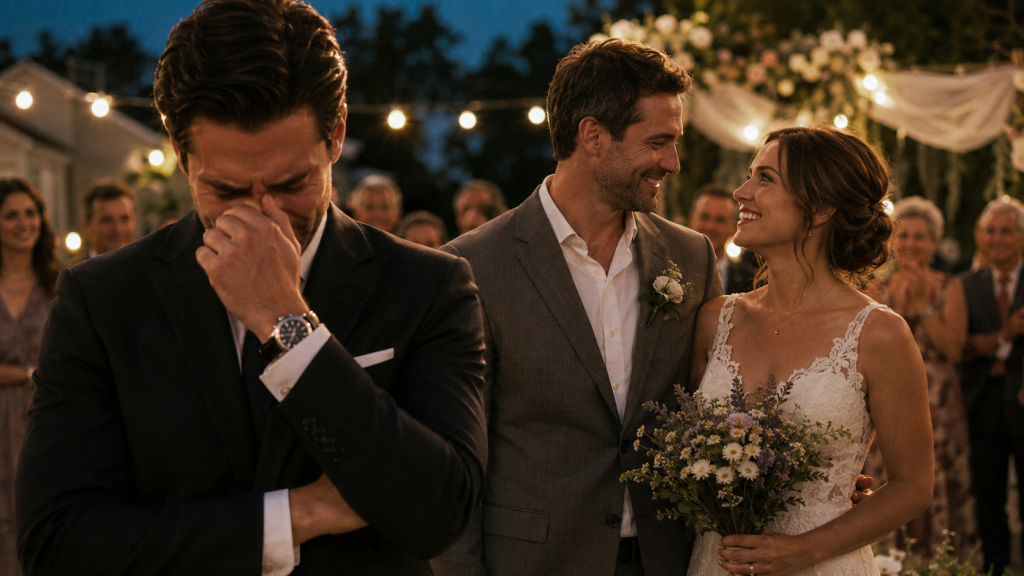
But the moment I saw the groom, I turned around and burst into tears of pain.
My name is David Harris.
I am thirty-two years old, and I live in New York City.
For most of my adult life, I believed success could be measured by the size of your office, the brand of your car, and the kind of people who looked at you with envy when you walked into a room.
I thought money made a man important.
I thought status made a man worthy.
And because of that foolish belief, I destroyed the only real love I had ever been given.
Her name was Sophie Moore.
I met Sophie when we were both students at Columbia University.
She was not the loudest girl in the room.
She was not the kind who dressed to impress rich boys or laughed too loudly at parties.
Sophie was quiet, gentle, and kind in a way that made people feel safe around her.
She worked part-time at the campus library, stacking books, helping tired students find research papers, and sometimes slipping me coffee when I stayed too late studying economics.
Back then, I had big dreams.
I wanted money.
I wanted power.
I wanted people to say my name with respect.
Sophie wanted something much simpler.
She wanted a small home, a loving family, and a life where people treated each other gently.
At the time, I thought that was sweet.
Later, I thought it was weak.
That was my first mistake.
We fell in love during our second year.
She used to sit beside me under a tree near campus while I talked about the future.
“I’m going to work in international sales,” I told her once. “One day, I’ll be running a company.”
Sophie smiled and squeezed my hand.
“I believe you,” she said.
She always believed me.
Even when I did not deserve it.
After graduation, I was hired by a large international company in Manhattan.
The salary was better than anything my parents had ever imagined for me.
I had a bright office, expensive suits, and coworkers who spoke about investments and luxury vacations like they were talking about groceries.
Sophie, despite all my attempts to help her, only found work as a receptionist at a small hotel.
She was never embarrassed by it.
But I was.
I began to feel uncomfortable introducing her to my colleagues.
When people asked what she did, I answered quickly, then changed the subject.
Sophie noticed.
Of course she noticed.
She noticed everything.
One night, after a company dinner, she looked at me quietly in the taxi.
“You were ashamed of me tonight,” she said.
I looked out the window.
“I wasn’t ashamed,” I lied.
“You didn’t even introduce me properly.”
I sighed, irritated.
“Sophie, these people are important. They talk about business, investments, growth. You don’t understand that world.”
She was silent for a long moment.
Then she asked softly, “And you think I don’t belong beside you anymore?”
I should have taken her hand.
I should have told her she belonged beside me more than anyone.
Instead, I said the cruelest sentence of my life.
“I think I deserve someone who can match where I’m going.”
Sophie’s face changed.
It was not anger.
It was not shock.
It was heartbreak.
The kind that happens quietly.
A few weeks later, I left her.
No dramatic fight.
No explanation that made sense.
Just cold words, packed boxes, and a goodbye that still burns in my memory.
The woman I chose after Sophie was Valerie Richards.
Valerie was rich, elegant, and powerful.
She was also the daughter of my company’s CEO.
Everyone congratulated me when we started dating.
Some called me lucky.
Some called me smart.
I called it progress.
I believed marrying Valerie would open every door I had ever wanted to walk through.
And it did.
But some doors open into prisons.
Valerie and I got married in a hotel ballroom with crystal chandeliers and imported flowers.
Her father gave a speech about ambition.
My coworkers clapped.
People admired my suit, my watch, my new life.
But there was no warmth in that room.
No softness.
No love.
Only performance.
Five years passed.
I became Deputy Director of Sales.
I had a corner office.
I had a BMW.
I lived in a luxury apartment with a view of the city.
And I was miserable.
Valerie treated me like a project her father had funded.
Whenever she was angry, she reminded me where I came from.
“Without my dad, you’d still be a miserable salesman,” she said one night.
Another time, during dinner with her friends, she laughed and said, “David likes to pretend he was born into this world, but he still eats like he grew up counting pennies.”
Everyone laughed.
I smiled because I had learned to survive by smiling.
Inside, I was disappearing.
I missed being loved.
I missed being seen.
Most of all, though I never admitted it, I missed Sophie.
Then one evening, at a gathering, an old college friend named Brian mentioned her.
“Hey, David,” he said, holding a glass of wine. “Remember Sophie Moore?”
My heart tightened, but I acted casual.
“Of course.”
“She’s getting married soon.”
The room seemed to grow quieter.
“Married?” I asked. “To whom?”
Brian shrugged.
“Some construction worker. Name’s Michael Carter, I think. Not rich. Pretty poor, from what I heard. But people say she’s happy.”
I laughed before I could stop myself.
“Happy with a poor laborer?”
Brian frowned.
“Why do you say it like that?”
I adjusted my cufflinks.
“Because Sophie never knew how to pick the right people.”
The words tasted bitter, but pride kept me from swallowing them.
That night, I could not sleep.
Sophie was getting married.
The woman who once cried because I left her was now choosing another man.
A poor man.
A man who probably owned one suit.
A man who could give her nothing compared to what I had.
So I made a decision that proved just how small I had become.
I decided to go to the wedding.
Not to congratulate her.
Not to apologize.
I went to show her what she had lost.
The wedding was in a small town in Upstate New York.
I drove there in my BMW, wearing my most expensive navy suit and a watch Valerie had bought for me with her father’s money.
As I got closer, the tall buildings disappeared.
The roads became quieter.
The air felt cleaner.
The wedding was held in a backyard behind a modest white house.
There were wooden chairs, string lights, wildflowers, and long tables covered with simple white cloth.
No security.
No photographers shouting directions.
No orchestra.
No champagne tower.
Just people laughing, children running across the grass, and older women placing food on tables with happy hands.
I parked near the front.
Several guests turned to look at my car.
I liked that.
For a moment, I felt powerful again.
I stepped out, adjusted my jacket, and walked toward the backyard like a man entering a room that belonged to him.
Then I saw Sophie.
She stood beneath an arch covered in flowers.
She wore a simple white dress.
No diamonds.
No expensive veil.
No designer perfection.
And yet she looked more beautiful than Valerie had on our wedding day.
Not because of the dress.
Because of her face.
Sophie was glowing.
She was calm.
She was happy.
Truly happy.
My chest tightened.
Then I looked at the groom.
And my heart stopped.
The man standing beside Sophie was not just some poor laborer.
I knew him.
Seven years earlier, before Valerie, before the promotion, before I had become someone I barely recognized, I had been in a terrible car accident on a rainy highway.
My car had slid off the road and flipped into a ditch.
I remembered the smell of gasoline.
The broken glass.
The pain in my ribs.
People had stopped on the roadside, but no one came close.
They were afraid.
Then one man ran through the rain.
He climbed down into the ditch, smashed what remained of the window, and pulled me out with his bare hands.
I remembered his voice.
“Stay with me, brother. Don’t close your eyes.”
He stayed beside me until the ambulance arrived.
I never got his full name.
I never thanked him properly.
I only remembered his face.
And now that face stood beside Sophie.
Michael Carter.
The poor laborer I had come to mock was the man who had saved my life.
My legs weakened.
Suddenly, my expensive suit felt like a costume.
My watch felt heavy.
My pride collapsed inside me.
Michael noticed me first.
His eyes widened slightly with recognition.
Then he smiled.
Not a mocking smile.
Not a bitter smile.
A kind one.
The same kind smile he had given me in the rain seven years ago.
Sophie followed his gaze.
When she saw me, her expression changed, but only for a moment.
There was surprise.
Then calm.
No hatred.
No anger.
That hurt more than anger would have.
Michael walked toward me.
“David, right?” he said.
My throat felt dry.
“You remember me?”
He smiled.
“Hard to forget someone you pulled out of a wrecked car.”
I could barely breathe.
“I never knew your name.”
“Michael Carter.”
He held out his hand.
I stared at it.
This man had saved my life.
And I had come to laugh at him.
Still, he offered me his hand.
I shook it with shame burning through me.
“Sophie told me you might come,” Michael said. “I’m glad you’re here.”
Glad.
He was glad.
I almost broke right there.
Then Sophie approached us.
“Hello, David,” she said softly.
Her voice was the same.
Gentle.
Steady.
But she was no longer the girl waiting for me to choose her.
She had chosen herself.
And she had chosen better.
“Sophie,” I said.
I wanted to say a thousand things.
I wanted to say I was sorry.
I wanted to say I was a fool.
Instead, I only whispered, “You look beautiful.”
“Thank you.”
Michael looked at her with such tenderness that I had to look away.
The ceremony began soon after.
I sat in the back row.
I told myself I would leave, but my body would not move.
I watched Sophie walk toward Michael.
I watched him tear up before she even reached him.
I watched his rough hands tremble as he took hers.
The officiant spoke about love, patience, loyalty, and choosing each other every day.
Each word felt aimed at me.
Then Michael began his vows.
“Sophie,” he said, his voice breaking, “I don’t have much to offer you in the way the world measures things. I don’t have a big house. I don’t have a fancy car. I don’t have a rich family name.”
He paused.
“But I promise you this. You will never feel alone beside me. You will never have to shrink yourself to make me feel bigger. You will never have to wonder if you are enough. Because to me, you are more than enough. You are home.”
People wiped their eyes.
I lowered my head.
Those were the words I should have spoken years ago.
Then Sophie gave her vows.
“Michael, when I met you, I was still carrying old wounds. I thought love meant proving myself. I thought I had to become more impressive to be chosen.”
Her eyes glistened.
“But you taught me that real love does not ask us to perform. It gives us room to breathe. You never made me feel small. You made me remember I was worthy.”
I closed my eyes.
Pain moved through me like fire.
Because I knew I was the wound she was talking about.
When they kissed, everyone stood and clapped.
I stood too.
But I was not celebrating.
I was grieving.
Not because Sophie was gone.
She had been gone for years.
I was grieving the man I could have been.
During the reception, I stayed near the edge of the yard.
People danced under the lights.
Children chased each other through the grass.
Old men laughed loudly.
Women carried plates of homemade food.
No one cared about status.
No one asked about salary.
No one measured anyone by their clothes.
For the first time in years, I saw what happiness looked like when it was not trying to impress anybody.
Then an elderly woman came to stand beside me.
“You’re David, aren’t you?” she asked.
I turned.
“Yes.”
“I’m Michael’s mother.”
My stomach tightened.
I expected judgment.
Instead, she smiled sadly.
“My son told me about the accident. Said he pulled a young man from a car once. Said he always wondered if that man lived a good life.”
I looked at Michael across the yard.
He was laughing as Sophie tried to fix a flower pinned crookedly on his jacket.
“I don’t know if I did,” I admitted.
Michael’s mother looked at me carefully.
“Then start now.”
Those three words stayed with me.
Start now.
A little later, Sophie found me standing alone near the fence.
“You came a long way,” she said.
I nodded.
“I came for the wrong reason.”
She did not pretend not to understand.
“I know.”
The honesty cut me.
“I wanted to make you feel small,” I said. “I wanted to show you I was successful.”
Sophie looked at me quietly.
“And did you?”
I laughed bitterly.
“No. I think I showed myself how empty I am.”
For the first time, her eyes softened with sadness.
“David, I loved you once. Truly. But you were always running toward a life you thought would make people respect you. You never noticed the people who already loved you.”
I swallowed hard.
“I’m sorry, Sophie.”
She looked down for a moment.
Then she said, “I forgave you a long time ago. Not because you asked. Because I needed peace.”
That broke me.
Tears filled my eyes.
I turned away, ashamed.
But Sophie placed a gentle hand on my arm.
“I hope you find peace too.”
Before I could answer, Michael walked over with two plates of food.
“Sophie said you never ate properly when you were nervous,” he said, handing me one.
I stared at him.
He remembered nothing bad about me.
He only treated me like a guest.
Like a human being.
“Why are you being kind to me?” I asked.
Michael seemed surprised.
“Because you’re here.”
“That’s not a reason.”
He looked toward Sophie.
“It is to me.”
I had no answer.
I ate with them.
Not at the head table.
Not as someone important.
Just as a guest among ordinary people.
And somehow, that simple plate of food felt more honest than every expensive dinner I had attended with Valerie.
Near the end of the night, there was a small speech.
Michael’s best friend stood up and told everyone how Michael had worked double shifts for months, not to buy a luxury honeymoon, but to repair the small house where he and Sophie would live.
“He said Sophie deserved a home where every window opened and every room felt safe,” the friend said.
Everyone laughed and clapped.
Sophie cried.
Michael kissed her forehead.
I looked at them and finally understood.
Love was not about giving someone the most expensive life.
It was about becoming the safest place in their life.
I had failed at that.
Completely.
When the reception ended, I walked toward my car.
Michael followed me.
“Leaving already?” he asked.
I nodded.
“I think I’ve taken up enough space tonight.”
He smiled gently.
“You didn’t ruin anything, David.”
“I almost wanted to.”
“But you didn’t.”
His grace was unbearable.
I took a deep breath.
“Michael, seven years ago, you saved my life. I never thanked you.”
“You don’t have to.”
“Yes,” I said. “I do.”
My voice cracked.
“Thank you. For pulling me out of that car. And for loving Sophie the way she deserved.”
Michael looked at me for a long moment.
Then he said, “Take care of yourself, David.”
I drove back to New York that night in silence.
The city lights looked different.
My apartment looked different.
My life looked different.
Valerie was sitting in the living room when I entered, scrolling on her phone.
“You’re late,” she said without looking up.
I stared at her.
The expensive furniture.
The cold walls.
The perfect apartment with no warmth.
Then she looked at my face.
“What happened to you?”
“I went to Sophie’s wedding,” I said.
Valerie laughed.
“That receptionist?”
I flinched.
Not because she insulted Sophie.
Because I realized I had once spoken the same way.
Valerie continued, “Let me guess. She married some loser?”
I looked at my wife, and for the first time, I saw the truth clearly.
The cruelty I hated in her had been living inside me too.
“No,” I said quietly. “She married a better man than I’ll ever be if I don’t change.”
Valerie stared at me.
“What is that supposed to mean?”
“It means I’m done living like this.”
The next months were painful.
I did not become a perfect man overnight.
Real change is not dramatic music and one apology.
Real change is waking up every morning and choosing not to be the person you were yesterday.
I filed for divorce.
Valerie called me ungrateful.
Her father threatened my position.
I lost my job before the year ended.
For the first time since college, I had no title to hide behind.
No powerful family name protecting me.
No luxury office.
No beautiful illusion.
I moved into a small apartment in Queens.
I sold the BMW.
I took a consulting job that paid far less but let me breathe.
At first, I felt like I had lost everything.
Then, slowly, I realized I had only lost the things I used to pretend I was happy.
One Sunday morning, almost a year after Sophie’s wedding, I received a small envelope in the mail.
There was no return address.
Inside was a photo.
Sophie and Michael standing in front of their little house.
The windows were open.
Flowers grew near the porch.
Sophie was laughing.
Michael had one arm around her shoulders.
On the back of the photo, someone had written:
“We are doing well. I hope you are too. Start now. —Sophie”
I sat at my kitchen table and cried.
Not the sharp, selfish tears I had cried at her wedding.
These were different.
They were quieter.
Cleaner.
They were the tears of a man finally accepting the truth.
I could not undo what I had done.
I could not go back and love Sophie properly.
I could not erase the years I wasted chasing admiration from people who never cared about my heart.
But I could start now.
So I did.
I began calling my parents more often.
I apologized to old friends I had ignored.
I volunteered on weekends at a shelter, not for praise, not for photos, but because I wanted to remember what it felt like to be useful without being impressive.
And sometimes, when I passed construction workers on the street, men with dusty boots and tired hands, I thought of Michael Carter.
The poor laborer I had gone to mock.
The man who saved my life twice.
Once from a wrecked car.
And once from becoming a wrecked soul.
I still live in New York City.
I am still David Harris.
But I am not the same man who drove to that backyard wedding wearing pride like armor.
I learned that day that money can buy comfort, but not peace.
Status can open doors, but not hearts.
And sometimes the man you think is beneath you is the very man standing on higher ground.
Sophie did not lose when I left her.
I did.
But her happiness taught me something my success never could.
A person’s worth is not measured by what they own.
It is measured by how deeply they love, how gently they forgive, and how much peace they bring to the people beside them.
And every time I remember Sophie standing under those warm string lights, smiling at the man I once called poor, I no longer feel jealousy.
I feel gratitude.
Because that was the night my pride died.
And finally, after years of chasing the wrong life, I began to live.