

Karma in the Restroom
Three weeks after my wife died giving birth to our twin daughters, I was still waking up every morning expecting to hear her breathing beside me.
For the first few seconds after opening my eyes, I would forget.
I would turn toward her side of the bed, ready to tell her that one of the babies had finally slept for almost three hours.
Then I would see the untouched pillow.
The neatly folded blanket.
The framed photograph from our wedding sitting on the nightstand.
And it would all come back.
My wife, Laura, was gone.
She had been thirty-two years old.
She had entered the hospital smiling, teasing me about how pale I looked, and promising that everything would be fine.
She never came home.
Our daughters did.
Emma and Grace were born seven minutes apart.
They were small, healthy, and completely dependent on a father who could barely remember to eat.
I loved them more than I knew how to explain.
But loving them did not make me confident.
Every cry sounded like an emergency.
Every cough made me reach for my phone.
Every time one of them refused a bottle, I wondered whether I was failing.
Laura had read every parenting book she could find.
She had organized the nursery, labeled drawers, washed tiny blankets, and created a feeding schedule on the refrigerator.
I had assumed she would be there to guide me.
Instead, I was raising two newborn daughters while carrying a grief so heavy that some days it felt difficult to stand.
My mother came whenever she could, but she lived almost two hours away and had arthritis that made long drives painful.
Laura’s sister, Megan, visited after work, yet she had three children of her own.
Most nights, it was just me and the twins.
I slept on the floor between their bassinets because I was afraid I would not hear them from the bedroom.
I learned how to warm two bottles at once.
I learned how to hold one crying baby against my shoulder while changing the other.
I learned that grief did not pause because diapers needed changing.
Three weeks after Laura’s funeral, I noticed that the twins were already outgrowing several of their newborn onesies.
The sleeves looked too tight.
Emma’s feet pressed against the bottom of her favorite yellow sleeper.
Laura had bought most of their clothes before they were born.
Each outfit felt like something she had chosen personally for them.
Packing away those tiny clothes felt like packing away another piece of her.
Still, the girls needed larger sizes.
That Saturday morning, I decided to take them to the mall.
It was our first trip somewhere that was not a doctor’s office or a relative’s house.
I almost changed my mind five times before leaving.
I packed diapers, wipes, bottles, blankets, extra clothes, pacifiers, burp cloths, formula, and two small stuffed rabbits Laura had bought during her pregnancy.
The diaper bag looked as though I was preparing for a weeklong expedition.
I placed Emma and Grace in the double stroller, checked their straps three times, and drove to the shopping center.
The mall was crowded.
Families moved between stores carrying bags and cups of coffee.
Children laughed near the fountain.
Couples walked hand in hand.
Everywhere I looked, I saw ordinary lives continuing.
That was one of the strangest things about losing Laura.
The whole world should have stopped.
Traffic should have frozen.
Stores should have closed.
The sky should have gone dark.
Instead, people continued buying shoes and laughing over lunch as though my entire life had not been torn apart.
I kept my eyes on the stroller.
Emma slept with one tiny hand beside her cheek.
Grace stared upward with serious blue eyes that looked so much like Laura’s that I sometimes had to look away.
I found a children’s clothing store and bought several onesies, sleepers, socks, and two soft pink hats.
Laura had hated dressing the twins exactly alike.
“They’re sisters, not matching decorations,” she had told me.
So I chose different colors whenever possible.
For a few minutes, the shopping trip felt manageable.
Then both babies started crying.
Grace cried first.
Emma joined her seconds later.
Their voices rose together, sharp and urgent.
Several shoppers turned toward me.
I checked the time.
They had eaten recently.
I touched their cheeks.
No fever.
Then I smelled the unmistakable answer.
Both diapers were soaked, and Grace’s sleeper was beginning to leak.
“It’s okay,” I whispered. “Daddy’s got you.”
The words sounded more confident than I felt.
I hurried toward the nearest restroom.
The men’s restroom was beside a department store entrance.
I pushed the stroller inside and looked around.
There were sinks, urinals, and three stalls.
No changing table.
I checked each stall as though one might magically appear.
Nothing.
I stepped back into the hall and searched for a family restroom.
There was none nearby.
I asked an employee at a cosmetics counter.
“The family restroom is closed for repairs,” she said. “There might be another one near the food court, but that’s on the opposite side of the mall.”
Both babies were screaming now.
Grace’s clothes were wet.
The food court was at least a ten-minute walk away through heavy crowds.
I looked toward the women’s restroom.
A changing-table symbol was displayed beside the door.
I stood there for several seconds, arguing with myself.
I knew I did not belong in that room under ordinary circumstances.
I also knew my daughters could not remain in dirty diapers while I crossed the entire mall hoping another facility was open.
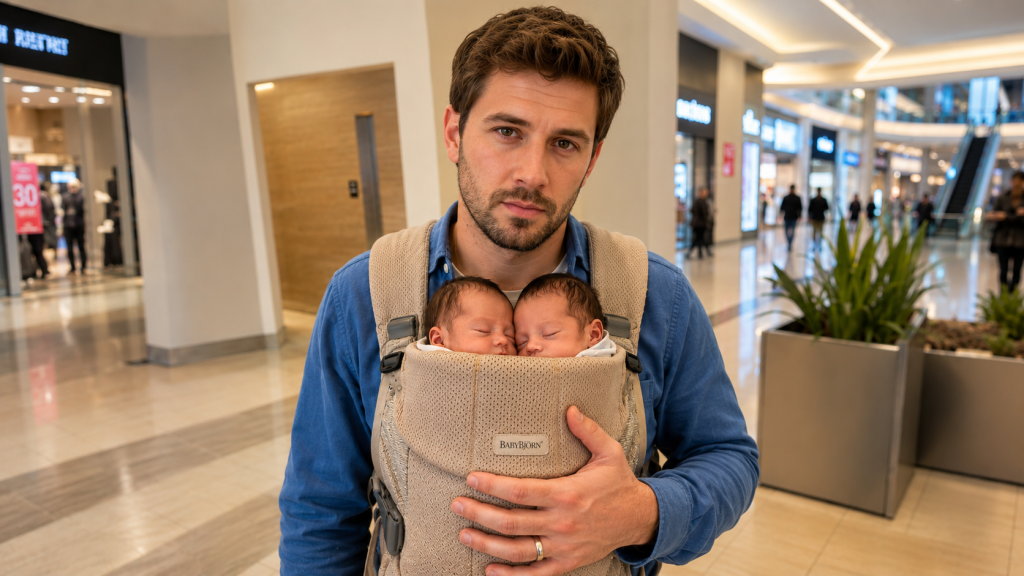
I took the babies from the stroller and placed them carefully in the twin sling across my chest.
Then I moved the stroller to the side and entered the women’s restroom.
“Excuse me,” I called before stepping fully inside. “I’m a father with two newborns. The men’s room has no changing table.”
There was no answer.
The room appeared empty.
I kept my eyes down and moved directly to the changing station.
“I’m sorry,” I whispered, though no one was there to hear me.
My hands were shaking.
I laid Grace on the table first.
Emma cried against my chest while I tried to clean her sister with one hand.
Grace kicked her legs and screamed.
“I know,” I murmured. “I know, sweetheart. I’m trying.”
I had just fastened Grace’s clean diaper when I heard heels striking the tile.
Sharp.
Fast.
Angry.
A woman appeared from the row of stalls.
She looked to be in her forties.
Her blond hair was styled perfectly, and she wore a cream-colored designer coat with a silk scarf around her neck.
She stopped the moment she saw me.
Her face tightened.
“What are you doing in here?”
“I’m sorry,” I said immediately. “The men’s room has no changing table, and the family restroom is closed. I only need a minute.”
“You need to leave.”
“I will. I just have to change the other baby.”
Emma’s crying grew louder.
The woman stared at her with disgust.
“You can’t even calm them down.”
The words struck harder than they should have.
I swallowed.
“They need clean diapers.”
“This is why babies need mothers,” she said. “Not men who don’t know what they’re doing.”
For a second, I could not breathe.
She could not have known.
There was no way she could have known that Laura had died.
But the sentence found the deepest wound inside me and pressed directly into it.
“My wife passed away three weeks ago,” I said quietly.
The woman’s expression did not soften.
Instead, she crossed her arms.
“That doesn’t give you the right to invade a women’s restroom.”
“I’m not trying to invade anything.”
“You’re making me uncomfortable.”
“I announced myself before I came in. I haven’t looked at anyone. I just need to change my daughter.”
“I don’t care. You don’t belong here.”
I turned back toward the table.
Emma’s face had turned red from crying.
“Please,” I said. “Give me two minutes.”
The woman pulled out her phone.
“I’m calling security.”
My stomach dropped.
“There’s no need for that.”
“I’ll decide what’s necessary.”
I tried to stay calm.
Exhaustion pressed behind my eyes.
I had barely slept since the hospital.
I was standing in a restroom with two crying newborns, and a stranger was treating me like a criminal for trying to care for them.
“I’m almost finished,” I said.
The woman stepped closer.
“Do you even understand who you’re talking to?”
I looked at her.
“I work for the largest rental company in this city,” she said. “I know every major property manager and landlord in the area. One call from me, and you’ll never find a place to live here again.”
My hands went cold.
I was renting the small house where Laura and I had planned to raise our daughters.
My lease renewal was approaching.
The threat was probably empty, but at that moment, I was too exhausted to think clearly.
Behind me, Grace began crying again.
The woman pointed toward the door.
“Get out.”
“I haven’t changed Emma yet.”
“That is not my problem.”
I reached for a clean diaper.
The woman grabbed the handle of the diaper bag and pulled it from the changing table.
It fell to the floor.
Bottles, wipes, clothes, and pacifiers scattered across the tile.
I stared at her.
“Why would you do that?”
“Because you’re refusing to leave.”
I bent to collect the items while keeping both babies secured against me.
A bottle rolled beneath the sink.
The woman opened the restroom door.
“Out.”
“I’m trying to pick up their things.”
She placed her hand on my shoulder and shoved.
It was not hard enough to knock me down, but I stumbled.
Grace screamed.
Something inside me changed.
I turned carefully, shielding both babies with my arms.
“Do not touch me again.”
My voice was low.
The woman stepped back, but only for a second.
Then she looked into the hallway and raised her voice.
“There’s a man refusing to leave the women’s restroom!”
People stopped walking.
Heads turned.
I felt every eye move toward me.
The woman pointed as though she had caught me doing something shameful.
“He came in here with those babies, and now he’s becoming aggressive.”
“That is not what happened,” I said.
“Someone call security!”
“I was changing my daughters.”
“She’s lying,” a voice said from behind me.
An elderly woman stood near the sinks.
I had not realized she had entered.
She held a cane in one hand and a shopping bag in the other.
“I saw everything,” she continued. “He explained why he was here. You knocked his bag onto the floor and pushed him.”
The blond woman’s face tightened.
“Stay out of this.”
“No,” the elderly woman replied. “I don’t think I will.”
Another woman stepped from a stall.
“He didn’t bother anyone,” she said. “He kept his eyes down the entire time.”
The blond woman looked between them.
Then she lifted her phone.
“I’m calling the police.”
“Please do,” the elderly woman said. “I’d like to tell them what I witnessed.”
The woman hesitated.
For the first time, she seemed uncertain.
But pride pushed her forward.
She made the call.
I gathered the babies’ supplies with the help of the woman from the stall.
“My name is Maria,” she told me quietly. “Don’t worry. We’ll stay.”
“Thank you.”
She picked up the bottle that had rolled under the sink.
“You didn’t do anything wrong.”
I wanted to believe her.
The blond woman moved into the hallway and began telling everyone that she had found a dangerous man inside the restroom.
By the time I stepped out, a small crowd had formed.
The babies continued crying.
My hands shook as I tried to place them back into the stroller.
The woman stood near the entrance, speaking loudly.
“In a few minutes, the police will teach you the rules.”
That was when a man’s voice cut through the hallway.
Cold.
Controlled.
“Excuse me. What exactly is going on here?”
The woman froze.
A tall man in a dark blue suit approached from the direction of the department store.
He looked to be in his late fifties, with silver hair and a composed expression.
The blond woman stared at him.
All the arrogance drained from her face.
“Mr. Hale,” she whispered.
The man glanced at her, then at me, the babies, and the scattered supplies still being placed into the diaper bag.
“Mrs. Whitmore,” he said. “I asked what is happening.”
Her posture changed immediately.
She smoothed her coat.
“There was a man inside the women’s restroom. I asked him to leave, but he became confrontational.”
Richard Hale looked at me.
I recognized his name.
Hale Property Group owned hundreds of apartments and several commercial buildings across the city.
The company’s logo was on the sign outside my own rental office.
“I entered because the men’s restroom has no changing table,” I explained. “The family restroom is closed. Both my daughters needed clean diapers.”
Mr. Hale looked toward the restroom doors.
“No changing station in the men’s room?”
“No, sir.”
He turned to the department store manager, who had just arrived.
“Is that correct?”
The manager nodded nervously.
“Yes. We’ve submitted a request to install one. The family restroom has a plumbing problem.”
Mr. Hale’s expression hardened.
Mrs. Whitmore spoke quickly.
“That still doesn’t give him permission to enter the women’s restroom.”
Maria stepped forward.
“He announced himself and went straight to the changing table.”
The elderly woman lifted her cane slightly.
“And Mrs. Whitmore threw his belongings onto the floor.”
“She pushed him,” another witness added.
Mrs. Whitmore’s face reddened.
“They’re exaggerating.”
Mr. Hale looked at her.
“Did you threaten him with your position at my company?”
Silence.
Mrs. Whitmore’s lips parted.
“I may have informed him that I work in property management.”
“You told me one call would prevent me from finding a home anywhere in the city,” I said.
A murmur spread through the crowd.
Mr. Hale’s expression became unreadable.
“What department are you in?” I asked her, though I suspected he already knew.
Mrs. Whitmore looked at the floor.
“Senior leasing operations.”
“Then you are aware that threatening housing retaliation over a personal disagreement is a serious violation of company policy.”
“I was upset.”
“You represented yourself as having the power to blacklist a grieving father because he used a changing table for his newborn daughters.”
Her face lost color.
“I didn’t know his wife had died.”
“He told you,” Maria said.
Mrs. Whitmore shot her an angry look.
Mr. Hale’s voice became colder.
“And even had his wife been alive, how would that justify humiliating him?”
Before she could answer, two police officers arrived.
One was a middle-aged woman named Officer Daniels.
The other was a younger man whose badge read Rivera.
Mrs. Whitmore rushed toward them.
“Thank goodness. This man entered the women’s restroom and refused to leave.”
Officer Daniels raised a hand.
“We’ll speak to everyone.”
The officers separated us.
Officer Rivera spoke with me while Officer Daniels questioned the witnesses.
I explained everything from the beginning.
I told him about the missing changing table.
I told him I had announced myself.
I told him Mrs. Whitmore had scattered the babies’ supplies and pushed me.
As I spoke, exhaustion overwhelmed me.
My voice cracked.
“I wasn’t trying to make anyone uncomfortable,” I said. “I just needed to change them.”
Officer Rivera’s expression softened.
“I understand.”
Grace had finally stopped crying.
She rested against my chest, one tiny fist curled beneath her chin.
Emma whimpered in the stroller, still wearing a dirty diaper.
Officer Rivera noticed.
“Finish changing your daughter,” he said. “We can wait.”
The department store manager opened a private employee room and brought in a portable changing pad.
I changed Emma while the officers continued gathering statements.
When I returned, Mrs. Whitmore was crying.
Not because she felt sorry.
Because the witnesses had contradicted every part of her story.
The restroom had security cameras outside both entrances.
The footage showed me entering with the babies, calling out before stepping inside, and leaving only after Mrs. Whitmore pushed me into the hallway.
It also showed her standing over me while my belongings lay scattered on the floor.
Officer Daniels approached us.
“Mrs. Whitmore, several witnesses have stated that you made physical contact with this gentleman and interfered with his care of two infants.”
“I barely touched him.”
“You shoved him while he was holding newborn babies.”
“He shouldn’t have been in there.”
“That does not give you the right to push him.”
Mrs. Whitmore looked toward Mr. Hale.
“Richard, please.”
He did not respond.
Officer Daniels turned to me.
“Would you like to file a complaint?”
I looked at Mrs. Whitmore.
Part of me wanted to say yes immediately.
Another part was simply tired.
I did not want court hearings.
I did not want more strangers asking questions.
I wanted to take my daughters home, sit in Laura’s rocking chair, and forget the entire day.
“I don’t know,” I admitted.
Mrs. Whitmore straightened slightly, mistaking my hesitation for weakness.
Then she said the worst possible thing.
“This has been blown completely out of proportion. He’s obviously unstable because of his wife, and those babies would probably be better off with someone else.”
The hallway went silent.
I felt as though she had struck me.
Maria gasped.
Officer Rivera stared at her.
Mr. Hale’s jaw tightened.
I looked down at Emma and Grace.
For weeks, I had privately feared the same thing.
Maybe they deserved someone better.
Someone rested.
Someone experienced.
Someone who did not cry while washing bottles at two in the morning.
Mrs. Whitmore had taken my deepest fear and said it aloud before a crowd.
But then the elderly woman stepped beside me.
She placed one hand gently on my arm.
“My husband raised our son alone after I spent a year battling cancer,” she said. “A father is not a substitute parent. He is a parent.”
Maria nodded.
“And these babies are lucky to have someone who will carry them through a crowded mall just to make sure they are clean and comfortable.”
Officer Daniels looked directly at me.
“Nothing I’ve seen today suggests you are anything except a caring father.”
Something in my chest loosened.
I turned toward Mrs. Whitmore.
“Yes,” I said. “I want to file a complaint.”
Her eyes widened.
“You’re serious?”
“I asked you for two minutes. You threatened my home, pushed me while I was holding my daughters, and then suggested they should be taken from me.”
Officer Daniels nodded.
“All right.”
Mrs. Whitmore was not handcuffed, but she was issued a citation for harassment and escorted to a private security office while the complaint was processed.
Before leaving, she looked at Mr. Hale.
“Please don’t make any decisions until I explain.”
Mr. Hale answered calmly.
“You have already explained enough.”
After the officers left, the crowd slowly dispersed.
Mr. Hale remained.
He apologized for his employee’s behavior.
“You don’t need to apologize for her,” I said.
“I disagree. She used my company’s name as a weapon. That makes it my responsibility.”
He gave me his card.
“Call this number Monday morning.”
I looked at it.
“I’m not asking for money.”
“I know. This isn’t about compensation.”
“Then what is it about?”
“Your lease.”
My stomach tightened.
He noticed.
“You said you rent from our company.”
“Yes.”
“Your home will not be affected by anything Mrs. Whitmore threatened. I want that made clear in writing.”
I nodded slowly.
“Thank you.”
He glanced at the babies.
“My daughter died when my grandson was six,” he said quietly. “Her husband raised him alone.”
I looked up.
“He spent years believing everyone saw him as incomplete without her. They didn’t. Most people saw a father doing an impossible job while grieving.”
His words stayed with me.
Mr. Hale shook my hand and left.
Maria and the elderly woman helped me carry the stroller and bags to a quiet seating area.
The elderly woman introduced herself as Evelyn.
She insisted on buying me a coffee.
I refused twice.
She ignored me.
While we sat, Maria fed Grace a bottle, and Evelyn held Emma.
For the first time since arriving at the mall, both babies were calm.
“You’re very good with them,” I told Maria.
“I have four,” she said. “The youngest is eight. I miss this stage.”
“I don’t think I’m going to miss the sleeping part.”
She smiled.
“No. You’ll forget how bad it was. That’s nature’s trick.”
Evelyn looked down at Emma.
“She has your eyes.”
“Everyone says she has Laura’s.”
“Who was Laura?”
“My wife.”
“Then I’m sure she had beautiful eyes.”
I had been trying not to cry in public all day.
That sentence broke me.
I covered my face with one hand.
“I’m sorry.”
“Don’t apologize,” Evelyn said.
“I’m supposed to be stronger than this.”
“No,” she replied. “You’re supposed to survive it. Strength can come later.”
We sat there until I could breathe normally again.
Before leaving, Maria gave me her number.
“My husband and I run a parent support group at our church,” she said. “It’s not religious pressure, I promise. Mostly coffee, advice, and people admitting they have no idea what they’re doing.”
I almost declined.
Then I thought about the empty house.
“I might call.”
“You should.”
Monday morning, I contacted Mr. Hale’s office.
He had already arranged a meeting.
Mrs. Whitmore had been suspended pending an internal investigation.
It turned out that several tenants had previously complained about her.
She had threatened fees, delayed repairs for people she disliked, and spoken cruelly to families applying for affordable apartments.
Most complaints had been dismissed because there had been no witnesses.
My experience at the mall changed that.
Several employees came forward after hearing she was under investigation.
One leasing assistant provided emails showing that Mrs. Whitmore had intentionally rejected qualified applicants after personal disagreements.
Another revealed that she had mocked a single father who requested a ground-floor apartment for his disabled son.
Within a week, she was fired.
Her professional license was also reviewed by the state housing board.
Mr. Hale called me personally.
“I wanted you to hear it from me,” he said. “She will no longer have authority over anyone’s housing.”
I should have felt victorious.
Instead, I felt sad.
Not for her job.
For the people she had frightened before me.
“What happens to the tenants she mistreated?” I asked.
“We’re reviewing every case.”
“Good.”
There was a pause.
“Also,” Mr. Hale said, “our company is funding changing stations in every men’s restroom across the properties we manage.”
I smiled for the first time during the call.
“That matters more than you probably realize.”
“It should have happened years ago.”
The story did not end there.
A local reporter had been at the mall and witnessed part of the confrontation.
Someone else had recorded Mrs. Whitmore shouting in the hallway.
Within days, the video spread online.
I hated seeing myself in it.
I looked exhausted.
My shirt was stained with formula.
My hair had not been combed properly.
But the comments were not what I expected.
Thousands of fathers wrote about struggling to find changing tables.
Widowers shared stories of raising children after losing their partners.
Mothers thanked the women who had defended me.
People began donating portable changing stations to small businesses.
A community organization launched a campaign called “Parents Belong.”
They asked me to speak at an event.
My first reaction was no.
I did not want attention.
I did not want to become known as the widowed father from the restroom video.
Then I imagined Laura.
She had never stayed quiet when something was unfair.
She would have turned the whole humiliating experience into a reason to help others.
So I agreed.
The event took place six weeks later.
Emma and Grace wore the new onesies I had purchased that day at the mall.
My mother sat in the front row.
Megan stood beside her, crying before I even began.
Mr. Hale attended.
So did Maria and Evelyn.
When I stepped to the microphone, my hands shook just as they had at the changing table.
“I thought the hardest part of losing my wife would be missing her,” I began.
The room became quiet.
“I was wrong. The hardest part is making decisions every day without the person who was supposed to make them with me.”
I looked down at my daughters.
“I question everything. I question whether they are eating enough, sleeping enough, growing enough, and whether I am enough.”
My voice caught.
“But that day at the mall, strangers reminded me that asking for help is not failure. A father caring for his children is not trespassing in parenthood. And compassion should matter more than signs on restroom doors.”
The audience stood when I finished.
I did not feel brave.
I felt honest.
Sometimes that is the closest a person can get.
Afterward, a man approached me carrying a toddler.
“My wife died last year,” he said. “I’ve felt like I was the only one.”
“You’re not.”
He nodded, wiping his eyes.
Neither was I.
I began attending Maria’s support group.
At first, I sat in the back and listened.
The group included single mothers, divorced fathers, grandparents raising grandchildren, foster parents, and couples who looked perfect from the outside but were barely holding themselves together.
No one judged me when I admitted that I had once put Grace’s diaper on backward.
They laughed when I confessed that I had warmed a bottle without removing the cap.
They listened when I said I still spoke to Laura in the kitchen.
Months passed.
The twins grew stronger.
Emma became the loud one.
Grace watched everything carefully before smiling.
They learned to roll over, sit up, and reach for each other.
I kept Laura’s photograph in the nursery.
Every night, I told them something about their mother.
I told them how she sang badly while cooking.
How she loved thunderstorms.
How she cried at every dog movie.
How she had chosen their names.
On the first anniversary of Laura’s death, I took the twins to the cemetery.
They were too young to understand.
Emma pulled at the flowers.
Grace stared at the sunlight moving across the grass.
I sat beside the headstone and told Laura everything.
I told her about the mall.
The restroom.
Mrs. Whitmore.
The police.
Mr. Hale.
Maria and Evelyn.
The support group.
The changing-table campaign.
“I was so angry when she said they needed a mother,” I whispered. “Because part of me believed her.”
The wind moved through the trees.
“I still don’t know whether I’m doing this right.”
Grace crawled into my lap.
Emma followed.
I held them both.
“But I’m here,” I said. “Every day, I’m here.”
That became my definition of fatherhood.
Not perfection.
Presence.
Two years later, I returned to the same mall with Emma and Grace.
They were walking now, though not always in the direction I wanted.
The family restroom had been repaired.
The men’s restroom had two changing tables.
A sign outside read:
All caregivers deserve safe, accessible spaces to care for their children.
I stood there longer than necessary.
A young father entered carrying a crying infant.
He looked flustered.
“First baby?” I asked.
He nodded.
“Three weeks old.”
“I have twins.”
His eyes widened.
“I don’t know how you survived.”
I smiled.
“Neither do I.”
I helped him unfold the changing table.
Then Emma tugged at my hand.
“Daddy, snack.”
Grace tugged the other.
“Daddy, bunny.”
I laughed.
“I’m coming.”
As we walked away, I passed a woman near the department store entrance.
For a moment, I thought she looked familiar.
Blond hair.
Cream-colored coat.
Older now, or perhaps simply tired.
Mrs. Whitmore.
She saw me.
Her eyes moved toward the twins.
Then back to my face.
She stepped closer.
“I heard about the campaign,” she said.
I waited.
“I lost everything after that day.”
There was bitterness in her voice, but something else too.
Shame, perhaps.
“You lost your job because of what you did to many people,” I said. “Not just me.”
She looked down.
“I know.”
Emma hid behind my leg.
Grace watched her with Laura’s serious blue eyes.
Mrs. Whitmore swallowed.
“I was cruel to you.”
“Yes.”
“I told myself I was protecting women. But I wasn’t. I was angry, and I liked having power.”
I said nothing.
“I’m sorry.”
For a long moment, I studied her face.
Forgiveness did not mean pretending nothing happened.
It did not mean trusting her.
It did not erase the hallway, the threats, or the sentence about my daughters needing someone else.
But I no longer wanted to carry her inside my grief.
“I hope you treat people differently now,” I said.
“I do.”
“Then make sure you keep doing that.”
I took the twins’ hands and continued walking.
Behind us, Mrs. Whitmore remained silent.
“Who was that?” Emma asked.
“Someone Daddy met a long time ago.”
“Is she your friend?”
“No.”
Grace looked up.
“Is she mean?”
I thought carefully.
“She made a bad choice,” I said. “But people can choose to do better.”
Emma considered this.
Then she announced, “I choose cookies.”
I laughed so loudly that nearby shoppers turned toward us.
“Of course you do.”
We bought cookies and sat beside the mall fountain.
The twins dipped their fingers into the frosting.
Sunlight streamed through the glass ceiling.
For the first time, I noticed that I was not comparing the moment to how it would have been with Laura.
I was simply living it.
That realization brought both comfort and guilt.
Then I remembered something Evelyn had told me.
“Moving forward does not mean leaving someone behind. It means carrying their love with you into places they could not go.”
I looked at Emma.
Then Grace.
Laura was there.
In their eyes.
In the way Grace tilted her head when confused.
In Emma’s fearless laugh.
In every choice I made because of what Laura had taught me about kindness.
My daughters did need their mother.
They would always need the story of who she was.
They would need photographs, memories, and people who loved her.
But they also needed me.
Not a perfect father.
Not a replacement mother.
Just their dad.
The man who warmed bottles at midnight.
The man who cried in the laundry room.
The man who entered the wrong restroom because his daughters needed him.
The man who kept showing up.
As we left the mall, Emma reached up.
“Carry me.”
Grace immediately demanded the same.
I lifted them both, one on each side.
They were much heavier than they had been that first day.
I kissed the tops of their heads.
“Daddy’s got you,” I said.
This time, the words did not feel like a promise I was afraid to break.
They felt like the truth.
THE END