

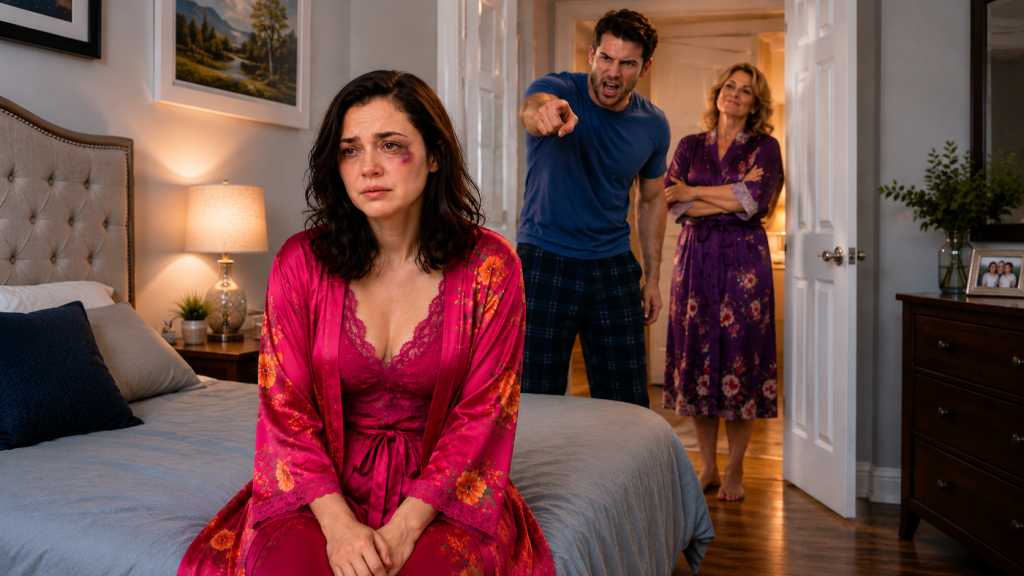
At 3:07 in the morning, my husband ripped the blanket away from my body and shouted, “Get up, useless woman!”
The bedroom was freezing.
Derek had opened the windows before coming upstairs because he knew cold made the pain in my hip worse. I had injured it months earlier after falling down the back steps during one of our arguments.
At least, that was the story he told everyone.
Before I could sit up properly, he grabbed my arm and pulled me toward the edge of the mattress.
My feet slipped against the wooden floor.
I stumbled into the bed frame, and a bolt of pain shot through my side.
Behind him, his mother stood in the doorway wearing a burgundy silk robe and smiling as though she were watching a comedy.
“Careful,” Marlene said. “She’ll blame you if she falls again.”
Derek looked down at me with disgust.
“She blames everyone for everything.”
I pressed one hand against the mattress and forced myself upright.
Begging would not help.
Crying would only entertain them.
Instead, I lifted my eyes toward the smoke detector above the bedroom door.
A tiny blue light blinked once.
Recording.
Derek followed my gaze but saw nothing unusual.
“Are you deaf?” he snapped. “Get dressed and clean the downstairs office. The investors will be here at eight.”
“At eight?” I asked quietly.
“Yes, at eight. Try to make yourself useful for once.”
Marlene folded her arms.
“And cover your face before they arrive. You look dreadful.”
I almost smiled.
They had no idea that the investors were not coming to meet Derek.
They were coming to witness him commit the final mistake that would destroy him.
Two years earlier, I would never have believed my life could become this.
My father, Arthur Bennett, had built Bennett Heritage Construction from one truck, two borrowed ladders, and a toolbox inherited from his father.
By the time I was thirty-five, the company employed more than two hundred people and managed restoration projects across three states.
Dad restored old libraries, courthouses, churches, and historic homes.
He used to say that every building carried a memory inside its walls.
“You don’t destroy the past because it’s inconvenient,” he told me. “You repair it carefully enough that it can stand again.”
I did not realize until much later that he had also been teaching me how to survive.
I met Derek at a charity dinner for historic preservation.
He was charming, attentive, and endlessly interested in my work as a forensic accountant.
He remembered details.
He sent flowers to my office on difficult days.
He listened when I spoke about my mother, who had died when I was sixteen.
Dad liked him at first.
But six months before our wedding, I noticed my father becoming cautious around him.
He never directly told me not to marry Derek.
Dad knew that commanding me to leave someone would only make me defensive.
Instead, he asked questions.
“Does Derek celebrate your success,” he once asked, “or does he tolerate it?”
I laughed at the time.
I told him he was being overprotective.
After our wedding, Derek’s behavior changed so gradually that I barely noticed it.
He complained that my work consumed too much time.
He criticized my friends.
He said my clients were exploiting me.
When I received praise, he reminded me of my mistakes.
When I disagreed with him, he called me arrogant.
Then he apologized, bought gifts, and promised he was only afraid of losing me.
I mistook possession for love.
When Dad died suddenly from a heart attack, I stopped functioning.
One moment, I had been speaking to him about a renovation project in Richmond.
The next morning, he was gone.
Grief hollowed me out.
I could not sleep.
I forgot meals.
I stared at documents without understanding the words.
Derek stepped into the empty spaces.
He handled calls.
He spoke to attorneys.
He attended company meetings.
He told everyone I needed rest.
At first, I felt grateful.
Then his mother moved into the guest wing.
“Only temporarily,” Marlene said.
She arrived with twelve suitcases.
Within three months, she had replaced the household staff, redecorated my mother’s sitting room, and moved family photographs into storage.
Derek began telling people that Bennett Heritage was now “our family company.”
By “our,” he meant his and Marlene’s.
Not mine.
Whenever I questioned a decision, Derek reminded me that I was fragile.
“You signed the authorization,” he would say.
“I don’t remember signing that.”
“You were heavily medicated after your father died.”
If I protested, Marlene would shake her head.
“This is why Derek has to handle everything. You’re confused again.”
They repeated the lie until even I began doubting myself.
Then, six weeks before that night, I found a letter from my father.
It had been hidden inside an old ledger in his private office.
The envelope was addressed to me in his handwriting.
My hands shook as I opened it.
Claire,
If you are reading this, something has happened to me, or I finally gathered the courage to tell you what I should have said sooner.
I do not trust Derek with the company.
I have seen inconsistencies in several proposals he brought to the board. I believe he is testing how closely we monitor financial controls.
Please remember who you are.
You were finding lies inside numbers before most people understood what an audit was.
Trust evidence.
Trust yourself.
And remember that the house and controlling interest in Bennett Heritage belong to you alone.
Love always,
Dad.
I sat on the floor for nearly an hour.
Then I stopped grieving like a helpless daughter.
I started thinking like a forensic accountant.
I reviewed company records late at night after Derek fell asleep.
At first, I expected to find carelessness.
Instead, I found theft.
Payments had been issued to vendors that did not exist.
Invoices had been duplicated and altered.
Consulting fees had been sent to shell companies registered under obscure names.
Several trails led to accounts connected to Marlene.
The total was nearly four million dollars.
Worse, someone had forged my signature on documents transferring voting authority to Derek.
The signature looked convincing.
But it was based on the way I had signed my name ten years earlier.
My current signature had changed after an injury to my right hand.
Derek had copied it from old paperwork.
That was his first major mistake.
His second was believing I would confront him immediately.
I did not.
I smiled when he criticized me.
I apologized when Marlene insulted me.
I pretended to be confused.
Meanwhile, I contacted Elena Ruiz, an attorney I had known since college.
We met secretly in a coffee shop forty miles away.
When I showed her the files, she studied them in silence.
“This is bigger than financial misconduct,” she finally said. “Forgery, wire fraud, embezzlement, conspiracy. Claire, this could send them both to prison.”
“I need proof that cannot be explained away.”
“You already have records.”
“They will say I authorized the transactions.”
“Then we prove you didn’t.”
“They will say I’m unstable.”
Elena leaned across the table.
“Are they hurting you?”
I looked down.
That was enough of an answer.
She helped me create an encrypted evidence archive.
Then I contacted a licensed security company and installed hidden cameras in areas where I had the legal right to record.
The smoke detector in our bedroom contained one camera.
Another was hidden inside a clock in Dad’s office.
A third faced the company safe.
For weeks, I collected evidence.
Derek threatening me.
Marlene discussing false invoices.
The two of them mocking my grief.
One evening, the office camera captured Derek practicing my signature.
Another recording showed Marlene shredding vendor records.
Still, Elena advised patience.
“We can freeze the accounts now,” she said. “But they may claim they acted under your permission. We need them to take something after they know you have withdrawn authorization.”
So we built a trap.
We created a controlled account containing funds that appeared to belong to Bennett Heritage.
The money was monitored by the bank’s fraud division.
Access required documents that Derek had no legal right to sign.
Then Elena arranged for three supposed investors to meet him at the house.
They were not investors.
One was an investigator working with the district attorney.
Another represented the bank.
The third was a forensic technology specialist.
Derek believed they wanted to fund a major luxury development.
He planned to impress them by showing that he controlled the company.
But before morning arrived, he lost his temper.
At 3:07 a.m., he pulled me from bed.
At 3:19, he ordered me to clean the office.
At 3:28, Marlene told him to take my phone away.
At 3:34, Derek shoved my coat at me and said, “If you don’t like how we run things, leave.”
So I did.
I went into the bathroom and locked the door.
My hands shook as I uploaded the latest recording.
Derek pounded against the wood.
“Open this door!”
“I’m changing.”
“You have thirty seconds.”
I stared at my reflection.
My face was pale.
There was a bruise near my cheekbone from two nights earlier.
For years, I had thought courage would feel powerful.
It did not.
It felt like terror with a direction.
I sent Elena one message.
Begin.
Then I climbed out through the laundry-room window.
The ground was covered in frost.
I had no shoes, only pajamas beneath my coat.
I ran until my hip nearly gave out.
Three blocks from the house, a city bus slowed beside me.
The driver opened the door.
He was a gray-haired man named Walter, though I did not learn that until later.
“Ma’am,” he said, “are you in danger?”
I tried to answer, but my teeth were chattering.
He removed his jacket and wrapped it around my shoulders.
Then he radioed dispatch and drove me directly to the police station.
Inside, an officer approached.
“My husband hurt me,” I whispered. “And I have proof.”
The room tilted.
When I woke, I was in a hospital bed.
Officer Naomi Brooks sat near the window.
Elena stood beside me, gripping my hand.
“You’re safe,” she said.
“No,” I whispered. “Not yet.”
Elena leaned closer.
I looked at the clock.
It was 6:42 a.m.
Derek’s meeting would begin in just over an hour.
“Freeze the company accounts,” I said. “But leave the controlled account accessible.”
Officer Brooks frowned.
“You want him to move the money?”
“I want him to prove he will steal even after my authority has been formally revoked.”
Elena understood immediately.
“You’re letting him steal one more thing.”
I nodded.
“His own future.”
At 7:10, Elena filed an emergency notice suspending Derek’s financial authority.
The document was delivered electronically to his company email, personal email, and phone.
He opened it at 7:22.
We knew because the tracking software recorded the exact time.
At 7:24, the office camera showed him throwing a glass across the room.
Marlene entered moments later.
“What happened?” she demanded.
“She revoked my authority.”
“Can she do that?”
“It’s her company.”
Marlene’s expression hardened.
“Not after today.”
Derek opened the safe.
He removed a folder containing the forged authorization documents.
Then he logged into the controlled account.
The hospital television had been connected to the secure camera feed.
I watched from bed as he typed.
“He knows he has no authority,” Officer Brooks said.
“Yes.”
“And he’s doing it anyway.”
“Yes.”
Marlene stood behind him.
“Transfer everything,” she said. “Once it reaches the overseas account, she’ll never get it back.”
Derek hesitated.
For one second, I saw fear in his face.
Then Marlene placed a hand on his shoulder.
“She’s weak,” she said. “She always has been.”
Derek completed the transfer.
Two million dollars moved from the controlled account into a monitored destination account.
The transaction triggered an automatic alert.
At that exact moment, the supposed investors arrived.
Derek had no idea that his crime had just been witnessed in real time.
He straightened his jacket and walked into the conference room wearing the confident smile he used in public.
Marlene entered carrying coffee.
“Gentlemen,” Derek said, “welcome to Bennett Heritage.”
The investigator, posing as investor Charles Lane, shook his hand.
“We understand you have full authority to negotiate on behalf of the company.”
“Complete authority,” Derek replied.
“And your wife?”
Derek laughed.
“My wife is not involved in business decisions.”
Marlene set down the coffee tray.
“Claire has been emotionally unwell since her father’s death. My son has carried this company by himself.”
The bank representative opened a folder.
“We were informed that Mrs. Bennett revoked your authority this morning.”
Derek’s smile disappeared.
“That notice is invalid.”
“On what grounds?”
“She lacks capacity.”
“Has a court declared her legally incapacitated?”
“No, but we have medical concerns.”
The investigator leaned back.
“Did those concerns prevent her from owning the company?”
Derek’s jaw tightened.
“I don’t understand where this is going.”
The office camera captured everything.
Marlene stepped forward.
“My daughter-in-law is unstable. She disappeared last night after becoming hysterical.”
“Did you report her missing?” the investigator asked.
“We were about to.”
“Did you contact a hospital?”
Marlene faltered.
Derek interrupted.
“This meeting is over.”
He turned toward the door.
Officer Brooks looked at me.
“Ready?”
I took a breath.
“Yes.”
Police vehicles entered the driveway at 8:36 a.m.
Derek saw them through the front window.
He rushed toward the office, probably intending to destroy documents.
But the technology specialist had already locked the computer remotely.
When Derek pulled open the safe, two detectives entered behind him.
“Derek Wallace,” one said, “step away from the safe.”
“This is my house.”
“No,” a familiar voice answered. “It isn’t.”
I stood in the hallway with Elena beside me.
The hospital had discharged me after documenting my injuries.
Officer Brooks had wanted me to remain under observation, but I insisted on being present.
Derek stared at me.
For the first time in years, he looked uncertain.
Marlene appeared behind him.
Her face twisted with rage.
“You ungrateful little—”
“Stop,” Elena said. “Every word is being recorded.”
Marlene froze.
Derek looked toward the smoke detector in the hallway.
Then toward the clock in Dad’s office.
Understanding spread across his face.
“You recorded us?”
“I preserved evidence.”
“This is illegal!”
“It isn’t,” Elena said. “Claire is the sole owner of the residence, and the cameras were installed in common areas and rooms she occupied. Your attorney can challenge admissibility if you’d like.”
“My attorney?”
Two detectives approached Derek.
One held out handcuffs.
He stepped backward.
“You can’t arrest me. I run Bennett Heritage.”
“No,” I said. “You stole from it.”
Marlene pointed at me.
“She gave him permission! She signed everything!”
Elena opened a file.
“The signature analysis is complete. The documents were forged.”
“That’s a lie.”
“We also have video of Derek practicing Claire’s signature and audio of you instructing him to destroy company records.”
Marlene’s mouth opened, but no words came.
Derek looked at her.
“You said the cameras were disconnected.”
“I thought they were!”
The detectives exchanged glances.
It was the first time either of them realized they had been betraying each other too.
Derek’s expression changed.
“This was her idea,” he said quickly, pointing at his mother. “She established the accounts. She told me Claire was too unstable to notice.”
Marlene stared at her son.
“You coward.”
“You handled the transfers!”
“Because you asked me to!”
Their alliance collapsed in less than thirty seconds.
They shouted over each other, each trying to shift responsibility.
The investigators let them talk.
Every accusation added another thread to the case.
Finally, the detectives placed Derek in handcuffs.
Marlene tried to retreat upstairs.
Officer Brooks stopped her near the staircase.
“Where are you going?”
“To get my medication.”
“An officer will accompany you.”
“This is outrageous.”
“No,” I said quietly. “What you did was outrageous.”
She turned toward me.
Despite the police, despite the cameras, despite the evidence, she still tried to frighten me with the look she had used for two years.
“You think you’ve won?” she hissed. “Without Derek, you’re nothing. You couldn’t even get out of bed without him.”
I walked closer.
My hip hurt.
My hands trembled.
But my voice did not.
“I got out of a window without him.”
Officer Brooks almost smiled.
Marlene was arrested minutes later.
The investigation lasted eleven months.
During that time, every hidden part of their scheme came into view.
They had created seven shell companies.
They had forged board resolutions.
They had diverted insurance payments.
They had even planned to mortgage the house without my knowledge.
The total theft exceeded five million dollars.
The controlled transfer became the strongest part of the prosecution because Derek had completed it after receiving formal notice that his authority had been revoked.
He could no longer claim confusion.
He could not say I had approved it.
The recorded conversation proved intent.
Marlene’s attorney tried to portray her as an elderly mother manipulated by her son.
Then prosecutors played the video of her ordering Derek to transfer the money overseas.
Her defense collapsed.
Derek attempted a different strategy.
He claimed I had invented the accusations because our marriage was failing.
Then Elena introduced hospital records, photographs, bus surveillance footage, police reports, and months of recordings.
The jury watched him pull me from bed.
They heard him call me useless.
They heard Marlene laugh.
I sat in the courtroom without looking away.
During cross-examination, Derek’s attorney asked why I had waited so long to report the abuse.
“Because I was afraid,” I answered.
“Yet you installed cameras and conducted a financial investigation.”
“Yes.”
“That sounds calculated.”
“It was.”
A murmur moved through the courtroom.
The attorney raised his eyebrows.
“So you admit you planned this.”
“I planned to survive it.”
He had no response.
The trial lasted three weeks.
Derek was convicted of fraud, forgery, conspiracy, theft, unlawful financial access, and charges connected to the abuse.
Marlene was convicted of conspiracy, fraud, evidence destruction, and receiving stolen funds.
When the judge announced the sentences, Derek turned toward me.
For one brief moment, I saw the man I thought I had married.
Not because he looked loving.
Because he looked terrified.
He finally understood what it meant to have no control.
Marlene did not look at me.
She stared straight ahead as though refusing to acknowledge reality might still change it.
The court ordered the seizure of their assets.
The overseas accounts were recovered.
The luxury apartment Marlene had secretly purchased was sold.
The cars, jewelry, and investment properties bought with stolen money were liquidated.
Restitution returned most of the funds to Bennett Heritage.
But money was not the hardest thing to recover.
After the arrests, I returned to the house alone.
The silence felt unfamiliar.
For years, silence had meant danger.
It meant Derek was angry.
It meant Marlene was listening.
It meant something bad was approaching.
Now silence was simply silence.
I walked through the rooms slowly.
My mother’s sitting room had been stripped of everything she loved.
Dad’s office smelled like dust and coffee.
In the bedroom, the blanket still lay twisted on the floor where Derek had thrown it.
I stood in the doorway for several minutes.
Then I picked it up.
Not because anyone ordered me to.
Because I chose to.
The next morning, I called a contractor.
His name was Thomas, and he had worked with Dad for twenty-eight years.
When he arrived, he removed his cap and hugged me.
“We’ve been waiting for you,” he said.
“For me?”
“The company. The crews. Everyone.”
“I don’t know whether I’m ready.”
Thomas looked toward Dad’s office.
“Your father never expected you to become him. He expected you to become yourself.”
I returned to Bennett Heritage gradually.
At first, I worked four hours a day.
Then six.
I hired an independent compliance team and replaced every financial control Derek had compromised.
Employees who had been fired for questioning him were invited back.
Some returned.
Others did not.
I apologized to each of them personally.
One woman named Angela had tried to warn me about suspicious invoices a year before the arrests.
Derek dismissed her and told the staff she had stolen confidential data.
When I called her, she was quiet for a long time.
“I should have listened,” I said.
“You were surviving something we couldn’t see,” she answered.
“That doesn’t erase what happened to you.”
“No. But what you do next matters.”
I offered her the position of compliance director.
She accepted.
Together, we rebuilt the company.
We also created the Arthur Bennett Integrity Fund to help employees report financial misconduct without fear of retaliation.
But I wanted to do something beyond business.
Walter, the bus driver who had stopped for me, visited the office one afternoon.
He looked uncomfortable in the conference room.
“I didn’t do anything special,” he insisted.
“You opened a door.”
“It was a bus door.”
“It was the first safe door I reached.”
We laughed.
I learned that Walter had once lost a sister to domestic abuse.
He had promised himself he would never ignore someone who looked afraid.
With his permission, I donated funding to expand late-night transportation services for people escaping dangerous homes.
Officer Brooks helped connect us with local shelters.
Elena joined the board.
We named the project Open Door.
The house took longer to repair than the company.
I removed Marlene’s furniture.
I restored my mother’s sitting room.
I placed family photographs back on the walls.
In Dad’s office, I kept the hidden camera inside the clock.
Not because I still feared someone was watching me.
Because it reminded me that the truth had been there even when no one else could see it.
One rainy afternoon, almost two years after the arrests, Elena visited me.
She found me sitting on the floor surrounded by old blueprints.
“You know,” she said, “most people use chairs.”
“I’m reorganizing.”
“You’ve been reorganizing for four hours.”
“I found something.”
I handed her a folded sketch.
It was one of Dad’s early plans for the house.
In the corner, he had written a note.
Claire says every house needs a window low enough for a dog to look through. Add one beside the laundry room.
Elena read it twice.
“The laundry-room window,” she said.
“The one I climbed through.”
Dad had installed it when I was nine because I wanted our dog to see the garden.
Decades later, that same window became my escape.
I pressed the paper to my chest and cried.
Not the silent tears I had learned to hide from Derek.
Not the exhausted tears of grief.
These were different.
They carried relief, sorrow, and love all at once.
Elena sat beside me.
“Your father helped you get out,” she whispered.
“Yes,” I said. “He did.”
The following spring, Bennett Heritage completed the restoration of a community center for families rebuilding their lives after abuse.
We repaired the roof, expanded the childcare rooms, and created private offices for legal counselors.
At the opening ceremony, I stood behind a podium in the sunlight.
Employees, survivors, police officers, attorneys, and community members filled the courtyard.
Walter sat in the front row.
Officer Brooks stood beside Elena.
Thomas had placed Dad’s old toolbox near the stage.
For a moment, I could not speak.
Then I remembered my father’s words.
You don’t destroy the past because it’s inconvenient.
You repair it carefully enough that it can stand again.
“My name is Claire Bennett,” I began. “For a long time, I believed strength meant never being afraid. I was wrong. Strength is being afraid and still taking one more step toward the door.”
The crowd remained silent.
“Sometimes that door is a police station. Sometimes it is a lawyer’s office, a shelter, a hospital, a bus, or a friend’s home. Sometimes it is a small window beside a laundry room.”
A few people smiled through tears.
“What matters is that when someone reaches that door, we open it.”
After the ceremony, a woman approached me.
She looked to be in her late fifties.
Her hands shook as she held one of the Open Door brochures.
“My daughter is living with someone like Derek,” she whispered. “She keeps saying it isn’t bad enough to leave.”
I took her hand.
“She does not have to wait until it becomes worse.”
“What should I do?”
“Believe her. Do not judge her. Help her protect documents, money, medication, and evidence. And when she is ready, keep the door open.”
The woman hugged me.
As she walked away, I realized that what had happened to me would always be part of my story.
But it would no longer control the ending.
That night, I returned home.
The restored house glowed beneath warm lights.
I walked upstairs and entered the bedroom.
The smoke detector still blinked above the door, though the camera had been removed.
For a second, I remembered Derek shouting.
Marlene laughing.
The cold floor beneath my feet.
Then I opened the windows.
Spring air moved through the room.
I was not opening them because someone wanted me cold.
I was opening them because the night smelled like rain and new grass.
On the bedside table sat my father’s letter.
Beside it was a photograph of him standing in front of the company’s first truck.
I touched the frame.
“They lost everything,” I said softly.
But that was not entirely true.
Derek and Marlene had lost their money, freedom, reputation, and control.
I had lost years I would never recover.
Yet I had also found something they never knew existed.
The woman I had been before them.
She had not disappeared.
She had been waiting beneath the grief, beneath the fear, beneath every lie they told me.
Waiting for the right moment.
Waiting for one blinking blue light.
Waiting for me to remember who I was.
At 3:07 that morning, Derek thought he was dragging a frightened woman out of bed.
He did not know he was waking up the person who would expose him.
He thought the house belonged to him.
He thought the company belonged to him.
He thought my silence meant surrender.
But silence can hold many things.
Fear.
Pain.
Evidence.
A plan.
And sometimes, it holds the final seconds before the truth stands up and walks out the door.