

My Brother Secretly Sold My $6.3 Million Farmhouse for $3 Million—Then I Came Home and Started Laughing. My brother called me while I was standing in the airport security line and told me he had sold my farmhouse. Not asked. Not warned. Sold.
“I got three million dollars for it,” Brandon said, sounding as if he expected me to congratulate him. “Honestly, Clara, you should thank me. That old place was just sitting there.” My suitcase was already on the conveyor belt. My passport was in my hand. I was supposed to be flying to Zurich for the first real vacation I had taken in four years.
Instead, I stepped out of line.
“You sold my farmhouse?” I asked.
Brandon laughed softly.
It was the same laugh he had used since childhood whenever he believed I was overreacting.
“Don’t sound so dramatic,” he said. “You live in the city. You barely use it.”
The farmhouse was worth $6.3 million.
It sat on eighty acres of restored apple orchards, wildflower fields, and lakefront land that our grandmother had left to me before she passed away.
I had rebuilt it beam by beam after an electrical fire nearly destroyed the east wing.
I paid the taxes.
I employed the caretakers.
I restored the orchard.
I turned the old barn into a retreat center for foster children aging out of the system.
Brandon called it my “country hobby.”
I called it the only place that had ever felt like home.
“Where is the money?” I asked.
For the first time, he hesitated.
Then he cleared his throat.
“I spent it.”
My chest went cold.
“You spent three million dollars?”
“It was an investment.”
“On what?”
Another pause.
Then he said, “Tessa’s business.”
Tessa was Brandon’s girlfriend of eleven months.
She described herself online as a luxury lifestyle entrepreneur.
As far as I knew, her company sold scented candles, expensive bath salts, and business courses teaching people how to become wealthy through positive thinking.
Her social media pages were filled with rented sports cars, hotel balconies, and inspirational captions about cutting negative people out of your life.
Apparently, I had now financed all of it.
“She needed the money more than you,” Brandon continued. “Her company is about to explode. We’re talking nationwide stores, celebrity partnerships, international shipping. You’ll get your money back.”
“My money?”
“Our money,” he corrected. “We’re family.”
I closed my eyes.
Airport announcements echoed above me.
People hurried past with coffee cups and carry-on bags.
A little girl ran toward her father, laughing as he lifted her into his arms.
The ordinary world continued moving while mine tilted sideways.
“You had no right to sell that property,” I said.
“Technically, I had power of attorney.”
“No, you didn’t.”
“You signed paperwork before you left for surgery two years ago.”
“That authorization expired after ninety days.”
“Well, the buyer accepted it.”
I tightened my grip on the phone.
“Who bought the farmhouse?”
“You’ll meet him when you get here.”
“When I get there?”
“Tessa and I are at the property now. We’re handing over the keys.”
I looked toward the departure board.
My flight to Zurich was boarding in forty-five minutes.
I had spent months planning that trip.
I had booked a quiet hotel near the lake, train tickets through the mountains, and reservations at restaurants where no one knew my name or expected anything from me.
For four years, I had postponed every vacation because someone needed me.
My company needed me.
The foster foundation needed me.
My mother needed help after surgery.
Brandon needed a loan.
Then another loan.
Then help with rent.
Then money to replace a car he had wrecked while driving without insurance.
I had always been the dependable one.
Brandon had always been the person everyone protected from consequences.
“You’d better not make this ugly,” he said.
I opened my eyes.
“It is already ugly.”
“Clara, listen to me. This is done. The documents are signed. The money has been transferred. Family should support family.”
“You stole my property.”
“I made a business decision.”
“You committed fraud.”
His voice hardened.
“Don’t threaten me. I’m your brother.”
I ended the call.
Then I stepped out of the security line, collected my luggage, and canceled my flight.
By the time I reached the rental-car counter, Brandon had begun texting me.
Don’t make this ugly.
Tessa already paid suppliers.
The buyer is waiting.
Everyone wins here.
You have other properties.
Grandma would have wanted us to share.
That final message almost made me throw my phone across the terminal.
Grandma had known exactly what Brandon was like.
That was why she had left the farmhouse to me.
When we were children, our parents sent us to spend every summer with her.
Brandon hated the farm.
He complained about the insects, the mud, the early mornings, and the smell of horses from the neighboring property.
I loved everything about it.
Grandma taught me how to prune apple trees, repair fences, bake bread, and sit quietly beside someone who was grieving without trying to fix them.
When I was fourteen, I found her crying in the barn after Grandpa died.
I sat beside her for nearly an hour.
Neither of us spoke.
At the end, she took my hand and said, “You understand that some things must be cared for, Clara. Your brother only understands what things can buy him.”
At the time, I thought she was being unfair.
Years later, I understood.
I called my attorney, Miriam Cole, from the airport parking garage.
She answered on the second ring.
“Aren’t you supposed to be flying to Switzerland?”
“Brandon says he sold the farmhouse.”
Silence.
Then Miriam said, “He did what?”
“He claims he used an old power-of-attorney document and sold it for three million.”
“That authority expired nearly two years ago.”
“I know.”
“Do you have proof of the supposed sale?”
“He says the buyer is at the property.”
“Do not sign anything,” she said. “Do not make threats. Do not physically confront anyone. I’m contacting the county recorder and the trust office now.”
“I’m driving there.”
“I’ll meet you.”
My next call was to Owen Mercer, the farmhouse property manager.
Owen had worked for my grandmother before he worked for me.
He knew every gate, tree, pipe, and loose floorboard on the property.
When he answered, his voice was tense.
“Miss Clara, I was about to call you.”
“Is Brandon there?”
“Yes. He arrived this morning with Tessa and a man claiming to represent a development company. They ordered me to turn over the keys.”
“Did you?”
“No.”
Relief loosened something in my chest.
“They showed me documents,” Owen continued. “Your signature looked wrong. I locked the main gate and told them nobody was entering until I spoke with you.”
“Thank you.”
“Brandon threatened to fire me.”
“He cannot fire you.”
“I know. He also said they’re going to turn the main house into a luxury wellness resort.”
I almost laughed then, but rage was still winning.
“Is anyone inside?”
“No. I moved the retreat guests to the guest cottages near the lake as a precaution.”
The old barn was scheduled to host twelve young adults from our transition program that weekend.
They had grown up in foster care and were attending workshops on budgeting, job interviews, housing applications, and college enrollment.
Brandon knew that.
He had chosen to sell the property anyway.
“Keep everyone away from the front drive,” I told Owen. “I’m six hours away.”
“I’ll be here.”
During the drive, Miriam called with updates.
No valid deed had been recorded.
No legitimate title company had approved a transfer.
The farmhouse had been placed into the Hawthorne Conservation Trust six months earlier, something Brandon apparently did not know.
I had created the trust after a development company offered to buy the lakefront acreage and divide it into luxury vacation lots.
I refused.
The trust protected the orchards, wetlands, shoreline, and retreat center from being sold or developed without multiple levels of authorization.
I remained the controlling trustee, but even I could not casually sell the land.
Any transfer required my notarized approval, biometric identity verification, a unanimous vote from the trust board, and review by the conservation commission.
Brandon had attempted to sell something that legally could not be sold in the manner he described.
“What about the three million?” I asked.
“We don’t know yet,” Miriam said. “If money changed hands, we need to identify the source.”
“He said he invested it in Tessa’s company.”
“That may be what he believes.”
“You think she lied to him?”
“I think people who commit one kind of fraud are often comfortable committing another.”
By the time I turned onto the country road leading to the farmhouse, the sun was beginning to sink.
The orchards stretched over the hills in neat rows.
White blossoms moved in the evening breeze.
Beyond them, the lake reflected the pale gold sky.
For a moment, I remembered being nine years old, running barefoot between those trees while Grandma called us in for supper.
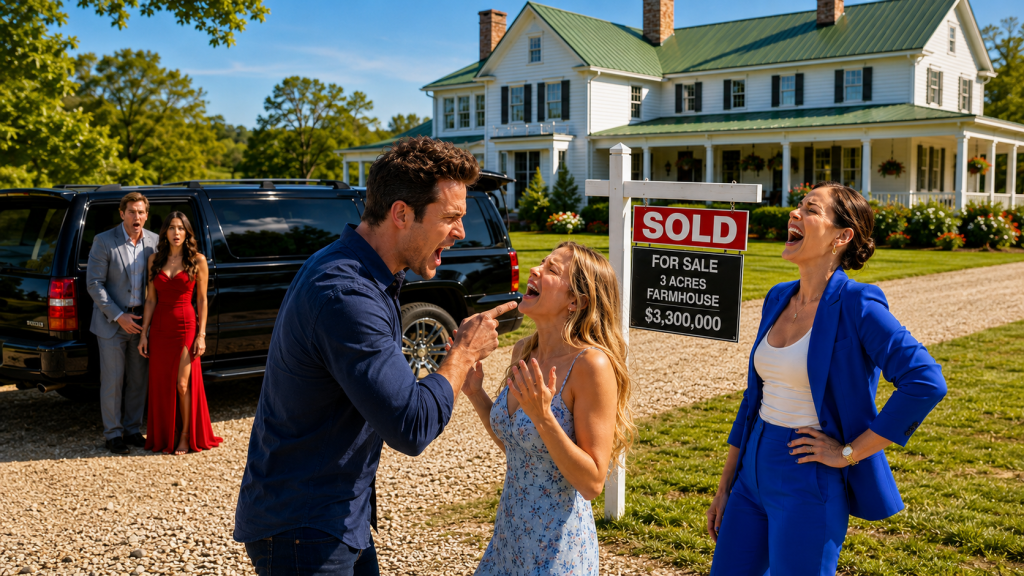
Then I saw the sign.
SOLD.
It leaned crookedly beside the driveway as if someone had pushed it into the ground in a hurry.
Brandon stood in front of the locked iron gate.
Tessa was beside him in a cream-colored suit and oversized sunglasses.
A man wearing a cheap navy suit stood several feet away holding a leather folder.
Brandon spread his arms when I stepped out of the rental car.
“See?” he called. “No disaster.”
I closed the car door.
“Tessa’s business is saved,” he continued. “The buyer is happy. You’re about to receive a huge return on investment. Everyone wins.”
Tessa smiled.
She had already posted photos of herself at the farmhouse.
I had seen them during the drive.
Standing before my grandmother’s orchard, she had written, “Big dreams require bold decisions.”
Another photograph showed her beside the gate with the caption, “Our future wellness empire begins today.”
I looked at the man in the navy suit.
Then I looked at the farmhouse.
Then at the locked gate.
And I started laughing.
It came out before I could stop it.
Not a polite laugh.
Not a nervous laugh.
A deep, breathless laugh that made my eyes water.
Brandon’s confident expression collapsed.
“What’s funny?” he demanded.
I wiped my eyes.
“What’s funny is that you sold a farmhouse you don’t own to a buyer who doesn’t exist, using a deed that became invalid six months ago.”
Tessa slowly lowered her sunglasses.
The man in the suit stopped moving.
Brandon stared at me.
“What are you talking about?”
I pulled a folded copy of the trust certificate from my handbag.
“Six months ago, the entire property was transferred into a protected conservation trust. No sale is valid without approval from the trust board, the conservation commission, and me.”
“That’s impossible,” Brandon said.
“It is already recorded.”
“You’re lying.”
Behind me, another vehicle stopped.
Miriam stepped out carrying her briefcase.
A county investigator emerged from the passenger side.
Behind them came a sheriff’s vehicle.
Two deputies approached the gate.
The man in the navy suit began backing away.
One deputy noticed.
“Sir, please remain where you are.”
Tessa turned toward Brandon.
“You told me everything was legal.”
“It is legal,” he snapped. “She’s bluffing.”
Miriam joined me.
“She is not bluffing.”
Brandon pointed at the papers in the man’s folder.
“We have a signed deed.”
“You have a forged document,” Miriam replied.
“I had power of attorney.”
“Your temporary medical authorization expired twenty-one months ago. It also never granted you permission to sell real estate.”
The man in the suit looked at Brandon.
“You said she had authorized everything.”
“She did.”
“I did not,” I said.
The man’s face turned pale.
“I was only hired to facilitate the transaction,” he said quickly. “I’m not the buyer.”
Brandon spun toward him.
“Shut up, Leonard.”
The deputy’s eyes sharpened.
“So there is no buyer?” he asked.
Leonard swallowed.
“There was supposed to be an investment group.”
“Which group?” Miriam asked.
Leonard looked at Tessa.
Tessa stepped backward.
Brandon followed his gaze.
For the first time since I arrived, my brother looked genuinely uncertain.
“Tessa?” he said.
She folded her arms.
“Don’t look at me.”
“You introduced Leonard.”
“He works with investors.”
Leonard shook his head.
“No, I don’t. Tessa paid me five thousand dollars to pretend to represent a buyer. She said it was a temporary arrangement until financing cleared.”
Brandon’s mouth fell open.
“You said the purchase money came from the Harrison Capital Group.”
Tessa removed her sunglasses completely.
“Brandon, not here.”
“Where did the three million come from?”
Her silence answered before she did.
Miriam looked at me.
Then she looked at Brandon.
“Did you transfer money from an account under your control?”
Brandon’s breathing became shallow.
“I borrowed against Clara’s assets.”
“You did what?” I asked.
He looked at Tessa.
She refused to meet his eyes.
“She said the sale proceeds were being advanced,” he murmured. “She said we needed to move quickly before her product launch.”
Miriam spoke carefully.
“Whose assets did you use as collateral?”
Brandon’s face drained of color.
“My mother’s house,” he admitted.
I stared at him.
Our mother was seventy-one years old.
Her house was fully paid off.
It was the one piece of financial security she had after our father died.
“You mortgaged Mom’s house?”
“She signed the forms.”
“Did she understand them?”
“She trusted me.”
“That was not my question.”
Brandon looked toward the ground.
He had convinced our mother that she was signing paperwork related to estate planning.
Instead, he had used her home to secure a fraudulent loan.
The lender believed the farmhouse sale would repay it.
Tessa had taken most of the money.
According to the bank records later recovered, she transferred it through a series of companies registered under different names.
Her “business expansion” included a leased mansion, designer clothing, luxury travel, payments to influencers, and nearly four hundred thousand dollars sent to an offshore account.
Her actual candle company had less than twelve thousand dollars in sales during the previous year.
Brandon had not saved her business.
He had funded her escape plan.
The deputies separated everyone.
Leonard handed over the false documents and admitted he had been promised another fifty thousand dollars if he convinced me to sign a confirmation agreement.
Tessa tried to leave.
A deputy stopped her near her car.
“You cannot detain me,” she protested.
“We can while we determine your involvement in a suspected fraud.”
She pointed at Brandon.
“This was his idea.”
Brandon laughed once.
It sounded broken.
“My idea? You told me Clara had cheated me out of my inheritance. You said I deserved half the property.”
“You believed what you wanted to believe.”
“I gave you everything.”
“You gave me money that wasn’t yours.”
Their argument became louder.
I stopped listening.
I looked beyond them toward the farmhouse.
The windows glowed in the evening light.
The red barn stood against the orchard.
A group of young people watched from a distant cottage, worried and confused.
Owen waited near the side gate.
I walked toward him.
“Are you all right?” he asked.
“Yes.”
“That laugh of yours frightened them more than shouting would have.”
“I think I frightened myself.”
He smiled faintly.
“Your grandmother used to laugh like that when someone tried to cheat her at livestock auctions.”
The mention of Grandma tightened my throat.
“She knew this would happen someday,” I said.
“She knew your brother.”
By midnight, Brandon, Tessa, and Leonard had all been taken to the county office for questioning.
Tessa was later arrested after investigators discovered she had prepared false corporate records, fake purchase documents, and fraudulent loan applications.
Leonard cooperated and received a reduced charge.
Brandon was charged with forgery, attempted property fraud, identity theft, and financial exploitation of a vulnerable adult because of what he had done to our mother.
I did not celebrate his arrest.
I thought I would feel triumphant.
Instead, I felt tired.
He was still my little brother.
I remembered teaching him how to tie his shoes.
I remembered holding his hand on the first day of school.
I remembered protecting him from our father’s temper and giving him half my allowance whenever he spent his too quickly.
Perhaps that had been the beginning of the problem.
Everyone had protected Brandon so thoroughly that he never learned the difference between being loved and being rescued.
Our mother called me the next morning.
“Please don’t let them put him in prison,” she cried.
I stood in Grandma’s kitchen, looking at the worn wooden table.
“Mom, he mortgaged your house.”
“He made a mistake.”
“He lied to you.”
“Tessa manipulated him.”
“He forged my signature before Tessa ever entered his life.”
Her breathing trembled.
“He’s your brother.”
“And you are his mother. Neither relationship gives him permission to destroy us.”
“What will happen to my home?”
“We’ll save it.”
I did.
It cost me nearly eight hundred thousand dollars to settle the fraudulent loan, legal expenses, and penalties before foreclosure proceedings could move forward.
I could have refused.
Legally, I was not responsible.
But my mother would have lost the house she had lived in for thirty-eight years.
I protected her one final time.
Then I placed the property into a trust that Brandon could never access.
I also told her something she had never expected to hear from me.
“I will help you recover,” I said. “But I will not help you excuse him.”
She did not speak to me for three weeks.
During that time, the farmhouse retreat continued.
The twelve young adults attended their workshops.
We held sessions in the restored barn while lawyers and investigators worked quietly in the background.
One evening, a nineteen-year-old named Kayla stayed behind after everyone else had left.
She had spent most of her life moving between foster homes.
She was preparing to attend community college but was terrified she would fail.
“Can I ask you something?” she said.
“Of course.”
“Why didn’t you cancel the retreat after everything happened?”
I considered the question.
“Because this place exists for more than my family’s problems.”
She looked toward the orchard.
“My foster mother used to take every good thing and ruin it when she got angry.”
“I’m sorry.”
“I thought people were just allowed to do that when they were family.”
I sat beside her.
“They are not.”
“But what if stopping them hurts them?”
“Boundaries often hurt people who benefited from us having none.”
She was silent for a moment.
Then she nodded.
That conversation stayed with me.
For years, I had believed strength meant solving every crisis without complaint.
I had built a company, restored the farmhouse, supported our mother, rescued Brandon, and created a foundation.
But I had never asked why the same people kept arriving at my door with disasters.
The answer was uncomfortable.
I had taught them that I would absorb every consequence.
Brandon’s trial began eight months later.
Tessa accepted a plea agreement and testified against him.
She claimed he had been the mastermind.
He claimed she had manipulated him.
The truth was that they had manipulated each other.
Tessa appealed to Brandon’s resentment.
Brandon gave her access to money, documents, and family information.
Neither cared who would be harmed as long as they received what they believed they deserved.
I testified for nearly four hours.
Brandon would not look at me at first.
Then the prosecutor displayed the forged deed on a screen.
My copied signature appeared at the bottom.
Brandon finally raised his head.
Our eyes met.
For a second, he looked like the boy I remembered.
Scared.
Ashamed.
Waiting for me to save him.
I did not look away.
But I did not save him.
He pleaded guilty before the jury reached a verdict.
The judge sentenced him to several years in prison, followed by probation and financial restitution.
At sentencing, Brandon asked to speak.
He stood in a gray suit that hung loosely from his shoulders.
“I told myself Clara didn’t need the farmhouse,” he said. “I told myself Grandma should have divided everything equally. I told myself I was taking back something stolen from me.”
His voice cracked.
“But the truth is that Clara worked for everything she had, and I hated her for making my excuses look small.”
Our mother began crying behind me.
Brandon looked directly at me.
“I’m sorry.”
I believed he was sorry.
But regret after consequences is not the same as integrity before them.
“I hope you become someone who understands why,” I told him later.
He nodded.
That was the last time we spoke for almost two years.
The farmhouse survived.
The orchard flourished.
The retreat program expanded.
We converted another outbuilding into temporary apartments for young adults leaving foster care.
Owen supervised the renovation.
Kayla became one of our first residents and later returned as a financial-literacy mentor.
My mother eventually stopped asking me to fix Brandon’s legal problems.
She began attending counseling and admitted that protecting him had harmed both of us.
Healing did not happen all at once.
It arrived in awkward conversations, uncomfortable silences, and decisions that would once have made me feel guilty.
Two years after the attempted sale, I finally took the trip to Switzerland.
Before I left, I stood at the farmhouse gate where the false SOLD sign had once leaned.
The sign was gone.
In its place stood a new wooden plaque.
HAWTHORNE FARM RETREAT
A PLACE TO BEGIN AGAIN
Owen had carved it by hand.
My mother stood beside me.
“Your grandmother would be proud,” she said.
“I hope so.”
“She always knew you would protect this place.”
I looked across the orchard.
“I used to think protecting it meant never letting anything happen to it.”
“What do you think now?”
“I think it means knowing what deserves to stay and what must be allowed to leave.”
Three weeks later, while I was sitting beside Lake Zurich, I received a letter forwarded from Brandon.
He was approaching the end of his sentence.
The letter contained no excuses.
He wrote that he had begun teaching basic business skills in a prison education program.
He admitted that he had once believed business meant finding the fastest path to money.
Now, he wrote, he understood that trust was an asset too, and he had spent all of his.
At the end, he asked whether he could visit the farmhouse after his release.
Not live there.
Not work there.
Just visit.
I folded the letter and looked across the water.
For the first time, I did not feel responsible for answering immediately.
Forgiveness was not a gate someone else could demand that I open.
It was a path I could choose to walk when I was ready.
I sent him a short reply.
“When you are released, we can meet in a public place and talk. What happens after that will depend on the person you have chosen to become.”
It was not rejection.
It was not rescue.
It was a boundary.
And for the first time in my life, that felt like peace.
People still ask why I laughed when I arrived and saw the sold sign beside my farmhouse.
They assume I laughed because I knew Brandon’s plan had failed.
That was only part of it.
I laughed because he had been so certain that my silence meant ignorance.
He thought kindness meant weakness.
He thought family meant unlimited access.
He thought ownership was nothing more than a name on an old piece of paper.
But the farmhouse had never truly been valuable because of the land, the lake, or its $6.3 million appraisal.
It was valuable because of what had been built there.
Memories.
Second chances.
Safety.
A future for people who had spent their lives being treated as disposable.
Brandon tried to sell all of that for three million dollars.
In the end, he received nothing.
Tessa lost her false empire.
My mother learned to stop confusing protection with love.
And I finally understood that preserving a home sometimes requires closing the gate—even when the person standing outside shares your blood.
THE END.
THE END! THANK YOU FOR READING!