

My Sister Tried to Leave Her Four Children at My Apartment While She Flew to Bora Bora. “My apartment is only ten minutes from the airport,” my sister texted me at eleven that night. “Luke surprised me with a Bora Bora vacation, so we’re leaving the kids at your place for two weeks.”.
I typed back, “I’m not home.” Her reply came almost immediately. “Mom still has your spare key. She’ll meet us there and let us in.” I stared at the screen for a few seconds, smiled once, then called the front desk. By the time Hannah reached my building with four children, four suitcases, and the confidence of a woman already halfway to paradise, the doorman had received an entirely different set of instructions.
At 11:02 p.m., my phone buzzed across the coffee table and pulled me out of that thin place between exhaustion and sleep.
The apartment was cold. The television was muted. Strips of city light slipped through the blinds like pale silver threads.
My airline badge was still clipped to my belt, as if my body had made it home before the rest of me did.
When I saw the name on the screen, my stomach tightened.
Hannah.
My sister never texted that late unless she needed money, help, or someone else to absorb the consequences of her own choices.
I opened the message.
“Your place is closer to the airport. We’re dropping the kids off for two weeks. Luke surprised me with Bora Bora!”
For a moment, my tired brain refused to process it.
Four children.
Two weeks.
Bora Bora.
There was no question.
No apology.
No “Is this okay?”
No “Sorry for the late notice.”
Just a decision.
A decision about my apartment, my schedule, and my life, made without my permission.
I replied, “I’m not home.”
The typing bubbles appeared instantly, disappeared, and then appeared again.
“Mom has your spare key. She’s meeting us there and letting us in. We’ll drop them off on the way to the airport. Don’t make this weird.”
I sat there in my uniform pants, shoes kicked beneath the couch, staring at the blue light of my phone while the refrigerator hummed quietly in the kitchen.
In my family, “Mom has your spare key” had never really meant “for emergencies.”
It meant access.
It meant assumed permission.
It meant my home was available whenever someone else failed to plan.
My name is Mark Collins. I am thirty-four years old, and I work as a commercial airline pilot.
To strangers, that sounds impressive.
To my family, it means I must have spare cash, spare time, and no valid reason to refuse because I do not have a wife or children waiting at home.
Hannah is thirty-one. She is married to Luke, and they have four children under ten.
Their lives are always one broken van, one late payment, or one “temporary favor” away from landing at my door.
Luke talks about cryptocurrency like it is a guaranteed rescue plan. He is convinced that one lucky investment will fix every bad decision he has ever made.
Then there is my mother, Linda.
She has a talent for turning the word “family” into a weapon.
Somehow, that weapon is always aimed at me.
Two nights earlier, I had driven to my parents’ house after one of the worst flight stretches I had worked in years.
New York to London.
London to Rome.
Rome back to JFK.
Then down to Miami through delays, turbulence, and a passenger who wandered toward the galley as if he were touring a museum.
I had slept perhaps six hours in two days.
That morning, Mom had texted me.
“Family dinner tonight. Everyone will be there. Don’t disappoint your nieces.”
So I went.
The second I opened the front door, noise hit me like a wall.
Cartoons blasted from the living room. Children skidded across the hardwood floor in socks. The house smelled like overcooked potatoes.
From the kitchen, my mother’s voice cut through everything.
“Mark, you’re late.”
“I just landed,” I said, dropping my overnight bag near the door. “I came straight from the airport.”
Hannah sat at the dining table, scrolling on her phone while one of her children smeared macaroni across a plastic plate.
She glanced up with the same smug expression she had worn since we were teenagers.
“Must be nice,” she said. “Flying all over the world while the rest of us deal with actual responsibilities.”
I was too exhausted to respond.
Mom walked in, wiping her hands on a dish towel, and I knew from her expression that dinner had only been the excuse.
“We were discussing Hannah’s van,” she said. “The mechanic says it isn’t safe for the children anymore. We thought you might help.”
There it was.
No greeting.
No concern.
No question about how tired I was.
Just another problem placed in front of me like an extra dish at dinner.
“I just finished paying off my car,” I said. “And my student loans. I’m trying to rebuild my savings.”
Mom’s mouth tightened.
“Oh, Mark, please. You make more in a month than your father made at your age. Family helps family. You don’t want your nieces and nephews riding around in something dangerous, do you?”
The room fell into that familiar silence.
Forks paused over plates.
One child kept kicking the table leg.
My father stared at the television as if the game required his full concentration.
Hannah did not even pretend to be embarrassed.
“Family helps family” sounds beautiful when it goes both ways.
When my mother said it, it meant I gave, they took, and if I resisted, I became selfish.
I looked around that table and saw everyone waiting for me to surrender.
Not because they had asked kindly.
Not because I had offered.
Because I always had before.
I had paid Hannah’s rent twice after Luke lost money on investments.
I had covered a dental bill for one of the children.
I had bought school supplies, birthday presents, groceries, and plane tickets.
I had even missed a flight assignment once because Hannah called me at four in the morning claiming she had an emergency.
The emergency was that Luke had taken their only car to a poker game and she needed someone to drive one of the children to a soccer tournament.
I did it.
I always did it.
And every time I helped, the favor stopped being remembered as generosity.
It became precedent.
That was why, when Hannah’s text came two nights later at 11:02 p.m., I did not shout.
I became very still.
At 11:05, I opened my building app.
My mother was still listed as an emergency key holder from two years earlier, when I had been sick with a fever and she came over to feed my cat.
I had never removed her because trust is easy to ignore when no one has abused it yet.
At 11:07, I changed the access permissions through the resident portal.
At 11:09, I took screenshots of every message Hannah had sent.
At 11:11, I called the front desk.
Ray, the night doorman, answered on the second ring.
I had known him for three years. He knew my flight schedule, my usual coffee order, and that I tipped him every Christmas even though I was barely home enough to pass through the lobby.
“Good evening, Mr. Collins,” he said. “Is everything okay?”
“Not exactly. I need Linda Collins removed from my key authorization list. Immediately.”
There was a pause, followed by the sound of typing.
“Done.”
“And if anyone arrives tonight saying they are dropping off children, luggage, or anything else for me, they are not allowed upstairs. No access. No exceptions.”
Another brief silence followed.
This time, Ray’s tone became firmer.
“Understood.”
I hung up and leaned back against the couch.
For the first time that night, my heartbeat began to settle.
At 11:34, Hannah texted again.
“Five minutes away. Kids are exhausted, so don’t make us carry everything twice.”
I did not respond.
At 11:39, my phone rang.
Mom.
I let it ring until it stopped.
At 11:41, a notification appeared from the building app.
Visitor arrival.
A few seconds later, the front desk called.
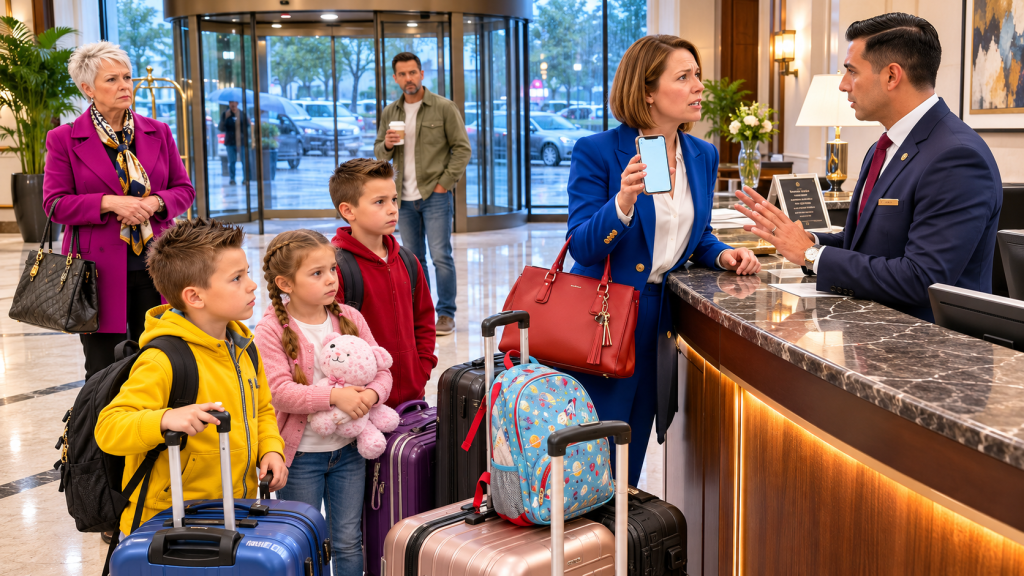
“Mr. Collins,” Ray said evenly, “I have Hannah, Luke, Mrs. Collins, four children, and four suitcases here in the lobby.”
In the background, Hannah’s voice rose sharply.
“Tell him to stop being ridiculous. Mom has the key.”
Ray answered, “She did, ma’am.”
Then Hannah snapped something I could not understand, and my mother’s voice pushed through the line as though she owned the building.
“Mark,” she demanded, “open this door right now.”
I stood and walked to the window.
From my apartment, I could see the lobby entrance glowing against the dark street below.
Hannah stood near the glass doors with one sleepy child leaning against her leg.
Luke waited beside the luggage, looking irritated that reality had interrupted his island vacation.
My mother held up the spare key as if it still meant something.
For one bitter second, I wanted to go downstairs.
I wanted to tell them everything I had swallowed for years.
Every unpaid loan.
Every ruined weekend.
Every missed birthday.
Every emergency that somehow became mine.
Instead, I took a slow breath.
“Ray, please put me on speaker.”
The lobby became quiet enough for me to hear the suitcase wheels stop moving.
And for the first time in my life, my mother’s key opened absolutely nothing.
“No one is entering my apartment tonight,” I said.
Hannah’s face flushed with disbelief.
“Mark, stop acting childish. Our flight leaves in two hours.”
Mom stepped closer to the desk.
“After everything this family has done for you, this is how you repay us?”
I almost laughed.
“Everything you have done for me? Name one time you asked instead of demanded.”
Luke finally spoke.
“Come on, man. They’re just kids.”
“Exactly,” I replied. “They’re your children, not mine.”
My oldest nephew, Ethan, looked up at his parents. He was nine years old, old enough to understand that something was wrong but not old enough to know whose fault it was.
I felt sorry for the children.
They had been pulled from their beds, packed into a car, and told that Uncle Mark would take care of them.
None of that was their fault.
But feeling sorry for them did not mean I had to surrender my home.
Hannah pulled out her phone.
“Fine. I’ll tell everyone what kind of brother you are.”
“Go ahead,” I said. “And I’ll post every text showing that you planned to leave four children in my apartment for two weeks without permission.”
The confidence disappeared from her face.
Mom’s grip tightened around the useless key.
Ray quietly folded his hands behind the counter.
Before anyone could respond, the lobby doors opened and two Port Authority police officers walked inside.
They were not there because of us.
They had stopped by the building after responding to a minor traffic accident outside, and Ray had asked them to step inside because the argument was escalating.
The taller officer looked from Hannah to the children and then toward the speakerphone on the desk.
“Is there a problem?”
“No,” Luke said quickly. “Family disagreement.”
“Yes,” I said through the speaker. “There is a problem. They are attempting to leave four children at my home without my permission.”
The officer’s expression changed.
He turned to Hannah.
“Do you have confirmed childcare arrangements?”
“My brother is watching them.”
“No, I’m not,” I said.
“He agreed earlier,” Mom insisted.
“No, I didn’t.”
Ray turned his monitor slightly toward the officers.
“Mr. Collins contacted the desk before they arrived. He clearly denied them access.”
Hannah’s voice sharpened.
“This is ridiculous. We’re their parents. We can decide who watches them.”
The shorter officer shook her head.
“You can choose a willing caregiver. You cannot force someone to take responsibility for your children.”
Luke looked at his watch.
“We’re going to miss the flight.”
The officer stared at him.
“That sounds like a travel problem, not a childcare plan.”
For the first time that evening, Luke seemed to understand that no amount of irritation would change what was happening.
He dragged a hand down his face.
“Hannah, call your friend Melissa.”
“She’s in Connecticut.”
“Call your mother.”
“I am standing right here,” Mom said indignantly.
Luke looked at her.
“Then take the kids.”
Mom recoiled as if he had suggested she carry them to Bora Bora herself.
“I can’t watch four children for two weeks. Your father has his appointments, and I have my book club.”
The words hung in the lobby.
Even through the phone, I felt something shift.
For years, Mom had volunteered my time as if it belonged to the family.
But the moment responsibility landed at her feet, she had reasons.
Real reasons, in her mind.
My job, exhaustion, schedule, and boundaries had never counted.
Her book club did.
Hannah stared at her.
“You promised Mark would do it.”
“I said he should do it.”
“That’s not the same thing,” the female officer said.
One of the younger children began crying.
The sound cut through my anger.
I closed my eyes.
For one dangerous second, guilt rushed in.
That was how my family had always controlled me.
They created a crisis, placed innocent people in the middle, and waited for me to rescue everyone.
But this time, I recognized the pattern before it swallowed me.
“Hannah,” I said, keeping my voice calm, “take your children home.”
“You’re really going to ruin this trip?”
“I didn’t book a vacation without arranging childcare.”
“Luke already paid for everything.”
“That was his decision.”
“You’re jealous,” she snapped. “That’s what this is. You travel constantly, but the second I get to go somewhere, you have to destroy it.”
I looked around my quiet apartment.
My unopened mail sat on the counter.
A half-eaten sandwich waited beside the sink.
My suitcase had not been unpacked from the previous trip.
People imagined that pilots spent their lives strolling through European cities and sleeping in luxury hotels.
The reality was red-eye flights, missed holidays, fatigue, medical examinations, constant training, and responsibility for hundreds of lives.
I traveled because it was my job.
Not because someone else was caring for my responsibilities while I escaped them.
“I’m not jealous,” I said. “I’m finished being used.”
The lobby fell silent.
Hannah looked as though I had struck her.
Mom recovered first.
“You are going to regret saying that.”
“No,” I replied. “I regret waiting this long.”
The officers advised them to leave before the situation escalated further.
Luke began loading the luggage back onto the cart.
Hannah kept arguing until Ethan tugged at her sleeve and said he wanted to go home.
That quiet request did what none of us could.
It ended the confrontation.
They walked back through the lobby doors at 12:06 a.m.
Mom remained behind for a moment.
She placed the useless spare key on the front desk.
“You have changed,” she said toward the speaker.
“Yes,” I answered.
Then she left.
I thought that would be the end of it.
I was wrong.
By eight the next morning, I had seventeen missed calls.
Three were from Hannah.
Six were from Mom.
Two were from my father.
The rest came from relatives who had heard a carefully edited version of the story.
According to Hannah, I had agreed months earlier to watch the children and canceled while they were standing in the airport lobby.
According to Mom, I had frightened the children by calling the police.
According to one aunt, I had always been cold and selfish, and success had made me arrogant.
I poured coffee, sat at my kitchen table, and read every message.
Then I created a family group chat.
I uploaded screenshots of Hannah’s original text, including the time stamp.
I posted my response telling her I was not home.
Then I posted her message saying Mom would use my spare key.
Finally, I wrote one sentence.
“I never agreed to watch the children, and I did not call the police. Please stop repeating false information.”
The replies arrived almost instantly.
My aunt wrote, “There are two sides to every story.”
I answered, “Those are Hannah’s own words.”
My father called.
This time, I answered.
“Was humiliating your sister really necessary?” he asked.
“I didn’t humiliate her. I refused to let her enter my home.”
“You could have helped.”
“I had a flight assignment beginning the next afternoon.”
“You could have called out.”
I stared at the wall.
“Do you understand what you’re asking? Calling out without cause affects my record, my crew, the passengers, and the airline.”
“You have vacation time.”
“My vacation time is not Hannah’s emergency childcare fund.”
Dad sighed as if I were being deliberately difficult.
“You know how your mother gets. It would be easier to apologize.”
There it was.
The family motto no one ever said aloud.
Give Linda what she wants because resisting her is uncomfortable.
I had spent my entire life making myself uncomfortable so everyone else could remain comfortable.
“No,” I said. “It would be easier for you. Not for me.”
He became quiet.
Then he said, “Your mother is very upset.”
“She should be upset with herself for trying to give someone access to my apartment without permission.”
“She was only helping your sister.”
“With my home.”
“She didn’t think you would mind.”
“She didn’t care whether I minded.”
Dad had no answer to that.
He ended the call a minute later without saying goodbye.
That afternoon, I reported for my flight.
For the next four days, I flew a rotation through Madrid and Paris.
Usually, distance softened family conflict.
This time, the messages continued.
Mom sent photographs of the children looking disappointed.
Hannah sent a screenshot of the money she claimed they had lost on the trip.
Luke sent me a payment request for half the cancellation fees.
I declined it.
Then something unexpected happened.
My cousin Rachel called.
Rachel was two years older than Hannah and lived in Ohio. We had never been especially close, but she had spent enough time around my family to understand the dynamics.
“I saw the group chat,” she said. “You were right.”
I sat on the edge of my hotel bed in Paris, surprised.
“You’re the first person to say that.”
“You’re probably not the first person they’ve treated this way. You’re just the first one who kept evidence.”
She told me that Mom had once volunteered Rachel to host Hannah’s family for Thanksgiving without asking.
Rachel refused.
For the next year, Mom described her as unwelcoming.
“Aunt Linda creates obligations on behalf of other people,” Rachel said. “Then she acts shocked when they object.”
Hearing someone else describe it so clearly loosened something inside me.
I was not cruel.
I was not imagining the pattern.
I was not selfish for wanting control over my own life.
When I returned home, I changed the physical lock on my apartment door, even though the building had already removed Mom’s authorization.
Then I updated my emergency contacts.
I listed my friend Daniel, another pilot who lived nearby, and Ray’s front-desk number.
A week later, I received an email from my building manager.
Mom had come during the afternoon and demanded the spare key be returned to her.
When management refused, she claimed she was my legal emergency contact and threatened to contact an attorney.
The manager asked whether I wanted her permanently restricted from entering the residential floors.
I answered yes.
That decision triggered another explosion.
Mom arrived at my apartment building on Saturday morning with Dad.
Ray called before allowing them into the lobby.
“They say they want to speak with you,” he said.
I considered refusing.
Then I realized I was tired of fighting through text messages.
“I’ll come down.”
When the elevator doors opened, Mom was standing beside the same front desk where her key had failed.
She looked smaller in daylight, but no less angry.
Dad stood beside her with his hands in his pockets.
“You banned your own mother from your building,” she said.
“I restricted someone who tried to enter my home without permission.”
“I gave birth to you.”
“That doesn’t give you ownership of my apartment.”
Her face went pale.
“I cannot believe how disrespectful you’ve become.”
“No, Mom. I’ve become direct. You’re used to me staying quiet.”
Dad glanced toward Ray, embarrassed that someone else could hear us.
“Can we discuss this upstairs?”
“No.”
Mom’s eyes widened.
“No?”
“We’ll speak here.”
“This is a family matter.”
“It became a building matter when you tried to misuse my spare key.”
She crossed her arms.
“All this over one vacation.”
“It isn’t about one vacation.”
I began listing everything.
The van.
The rent payments.
The dental bill.
The four-in-the-morning soccer emergency.
The holidays I had rearranged.
The loan Luke never repaid.
The way Mom volunteered my money and time without asking.
Dad looked at the floor.
Mom interrupted repeatedly.
Each time, I continued.
“I helped because I loved you,” I said. “But you treated my help as an obligation. Hannah did not ask me to watch her children. She informed me. You did not ask whether she could use my apartment. You promised her access to it.”
“I knew you would refuse if we asked,” Mom said.
The words escaped before she could stop them.
Even Dad looked at her.
I nodded slowly.
“That is exactly the problem.”
Mom opened her mouth, but nothing came out.
She had just admitted that the entire plan depended on denying me a choice.
Dad finally spoke.
“Linda, we should go.”
She turned on him.
“You’re taking his side?”
“I’m saying this isn’t helping.”
For once, he did not hide behind the television or tell me to apologize.
He placed a hand gently on her arm.
She pulled away.
Before leaving, she looked at me and said, “When you need your family, remember this.”
I met her eyes.
“I will remember all of it.”
Three weeks passed without contact.
The silence was painful, but it was also peaceful.
I began to realize how much of my daily anxiety came from waiting for the next family crisis.
My phone could ring without my stomach tightening.
My days off actually belonged to me.
I went grocery shopping without receiving a last-minute request to pick up supplies for Hannah.
I met friends for dinner and did not leave early because Mom had manufactured an emergency.
Then, one Thursday afternoon, Ethan called me from Hannah’s phone.
“Uncle Mark?”
His small voice immediately softened me.
“Hey, buddy. Is everything okay?”
“Mom and Dad are fighting.”
I sat upright.
“Are you safe?”
“Yes. They’re in the kitchen.”
He hesitated.
“Mom says you don’t love us anymore.”
Anger flashed through me, but I kept it out of my voice.
“That isn’t true. I love you very much.”
“Then why couldn’t we stay at your house?”
Because your parents tried to abandon responsibility without warning.
Because your grandmother used you to pressure me.
Because adults sometimes weaponize children when they cannot tolerate boundaries.
But Ethan was nine.
He deserved an explanation that did not place him in the middle.
“Because adults have to ask before making plans involving another person,” I said. “And I had work. It was never because of you.”
“Mom said you made them lose a lot of money.”
“The vacation was booked before they arranged for someone to care for you. That was an adult mistake. It wasn’t your fault.”
He became quiet.
Then he asked, “Can I still call you?”
“Always.”
After we hung up, I sent Hannah one message.
“Do not tell the children I don’t love them because I refused your demand. Keep them out of this.”
She responded an hour later.
“You’ve already broken the family. Don’t lecture me.”
I did not answer.
Two months later, the situation changed again.
Luke’s cryptocurrency investments collapsed.
I learned about it when Dad called and asked whether I could lend Hannah twenty thousand dollars to prevent foreclosure.
This time, he sounded less demanding.
Almost embarrassed.
“No,” I said.
“Mark, they could lose the house.”
“I’m sorry they’re in that position.”
“The children need stability.”
“I agree. Their parents need to create it.”
Dad sighed.
“Your mother says you have enough.”
“Mom doesn’t know what I have. And whatever I have is not hers to assign.”
He did not argue.
A few days later, Hannah sent me a long message.
For the first time, it did not contain an insult.
She explained that Luke had hidden the extent of their financial problems.
The Bora Bora trip had not truly been a gift. He had placed it on two credit cards because he believed an investment payout was coming.
It never came.
They were behind on the mortgage, the van payment, and several bills.
Then she wrote, “I know you’re angry, but I don’t know what to do.”
I read the message three times.
The old version of me would have transferred money immediately.
The new version of me called her instead.
“I won’t give you twenty thousand dollars,” I said. “But I’ll pay directly for a financial counselor, and I’ll help you review the bills.”
She became angry at first.
She accused me of controlling her.
I remained calm.
“A gift would delay the problem. You and Luke need a plan.”
“What about the children?”
“I’ll help with groceries for them for the next month. I’ll pay the store directly. I won’t give Luke cash.”
There was a long silence.
Finally, she agreed.
The financial counselor discovered debts Hannah had never known about.
Luke had opened credit cards, borrowed against his retirement account, and invested money that should have covered their mortgage.
Their marriage nearly ended.
For the first time, Mom could not blame me for the disaster.
The numbers were too clear.
Luke entered a debt-management program and sold several expensive items he had bought while pretending to be successful.
Hannah began working part-time at a dental office.
They sold the unsafe van and bought an older but reliable used vehicle within their actual budget.
I helped by watching the children twice during scheduled appointments.
The difference was that Hannah asked.
She asked a week in advance.
She accepted when I said I was unavailable one afternoon.
She thanked me when I helped.
Those changes seemed small to anyone outside the family.
To me, they were enormous.
Mom resisted longer.
For months, she communicated through Dad or sent messages that contained apologies shaped like accusations.
“I’m sorry you misunderstood my intentions.”
“I’m sorry that helping your sister felt like such a burden.”
I did not accept them.
Eventually, Dad began attending counseling on his own.
I never expected that.
He later told me he had spent forty years avoiding conflict with Mom by allowing everyone else to absorb it.
“I thought keeping her calm meant keeping the family together,” he said. “I didn’t see what it was costing you.”
It was not a perfect apology.
But it was honest.
Mom’s real apology came nearly a year after the night in the lobby.
She asked to meet me at a coffee shop.
Not my apartment.
Not her house.
Neutral ground.
She sat across from me, both hands wrapped around a cup she barely touched.
“I knew you might say no,” she said quietly. “That’s why I didn’t ask.”
I waited.
She looked down.
“I told myself it was because Hannah deserved a vacation. But I knew I was taking away your choice.”
“Yes.”
“I thought because you were single, your time was more available.”
“My life is not less important because I’m not married.”
“I know that now.”
Her voice trembled.
“I was angry when you changed the lock because I realized I had lost control.”
It was the most honest thing she had ever said to me.
“I don’t want you to control me,” I replied. “I want a mother who respects me.”
She nodded slowly.
“I’m trying.”
I did not immediately forgive everything.
Real trust is not rebuilt by one conversation.
But I allowed her to try.
She never received another spare key.
That was not punishment.
It was a boundary.
The following summer, Hannah planned a smaller vacation with the children.
Three nights at a lake two hours away.
A month before the trip, she called.
“Would you be able to feed our dog while we’re gone? It’s okay if you can’t.”
I checked my schedule.
“I can do the first two days. You’ll need someone else for the third.”
“Thank you. I’ll ask Melissa.”
No argument.
No guilt.
No surprise children in my lobby.
Before hanging up, Hannah hesitated.
“I’ve never properly apologized for that night.”
I remained quiet.
“I thought because you had always helped, you would keep helping no matter how I treated you,” she continued. “That wasn’t fair. And telling the children you didn’t love them was cruel.”
“Thank you for saying that.”
“I’m sorry, Mark.”
“I forgive you.”
Forgiveness did not mean pretending the night had never happened.
It meant the memory no longer controlled me.
A few months later, I returned from a flight and found a small envelope waiting at the front desk.
Inside was a handmade card from Ethan.
He had drawn an airplane flying above four smiling children.
Beneath it, he had written, “Uncle Mark loves us, but we have to ask first.”
I laughed so loudly that Ray looked up from behind the counter.
“Good news?” he asked.
“The best.”
I still help my family.
I attend birthdays.
I buy thoughtful gifts.
I sometimes watch the children when my schedule allows.
I helped Ethan build a model airplane for school, and I taught the younger children how to track my flights online.
But I no longer rescue adults from consequences they created intentionally.
I do not lend money without written terms.
I do not cancel work because someone else failed to plan.
No one has unrestricted access to my home.
And when Mom says, “Family helps family,” I agree with her.
Then I remind her that real help is requested, not demanded.
Real help respects the person giving it.
Real help does not require threats, guilt, or stolen access.
That night, Hannah arrived in my lobby believing my apartment, time, and obedience belonged to her.
Mom stood beside her holding a key she thought gave her authority over my life.
But the key did not fail because I changed an electronic permission.
It failed because I finally understood something I should have learned years earlier.
A boundary is not cruelty.
Saying no does not make someone selfish.
And love without respect is not love.
It is control wearing a familiar face.
My mother’s spare key never opened my apartment again.
But strangely, losing that key eventually opened something far more important.
It opened the possibility of having a family that asked instead of assumed.
A sister who respected my answer.
A father who finally spoke honestly.
A mother who began to understand that her children were not possessions.
And a life that truly belonged to me.
All because, at eleven o’clock one night, I finally refused to open the door.
THE END! THANK YOU FOR READING!