

The Woman Who Chose Me. Two years ago, I was thirty-four years old and working as an orderly at Rosewood Haven, a small nursing home on the edge of town. It was not the career I had imagined for myself. When I was younger, I had wanted to become a paramedic. I liked the idea of arriving when someone was frightened and making the situation better.
But life has a way of changing plans. I had grown up in foster care, moving through six homes before I turned eighteen. College was never financially possible, and after several years of temporary jobs, I accepted a position at Rosewood Haven. At first, I told myself it was only temporary.
Then temporary became eight years.
The work was exhausting, often thankless, and sometimes heartbreaking.
But it also mattered.
I helped residents get dressed in the morning. I pushed wheelchairs through the garden. I carried meal trays, changed bedding, fixed televisions, found missing glasses, and listened to stories that families had stopped having time to hear.
Most residents had someone.
Children arrived on Sundays carrying flowers.
Grandchildren ran through the halls during holidays.
Relatives called to ask about medications, appointments, and birthdays.
And then there was Gloria Bennett.
Gloria was eighty-two when I met her.
She was small and silver-haired, with bright blue eyes that seemed to notice everything. Her body had grown fragile, but her mind was sharp.
On my first morning assigned to her hallway, I carried a breakfast tray into her room.
She looked at the oatmeal, then at me.
“Is this breakfast,” she asked, “or punishment?”
I stared at the bowl.
“It’s supposed to be oatmeal.”
“That is what the kitchen claims.”
I tried not to laugh.
She pointed toward the chair beside her bed.
“You’re new.”
“I’ve been here eight years.”
“Then you’re new to me.”
I introduced myself.
“I’m Daniel.”
She studied my face for a moment.
“You have kind eyes, Daniel.”
I did not know how to answer that.
No one had ever described my eyes before.
Then she pushed the oatmeal away.
“Bring me tea and two pieces of toast. Burn one slightly.”
“Why burn one?”
“So I can complain about it.”
That was Gloria.
Sharp-tongued.
Stubborn.
Funny when she did not mean to be.
And somehow able to make every room feel warmer.
Most people at Rosewood Haven had family photographs covering their walls.
Gloria had none.
There were no framed wedding pictures, no pictures of children, and no holiday cards taped beside her mirror.
She had a small vase of artificial daisies, three mystery novels, an old radio, and one faded blue hospital bag.
The bag was always beside her.
It rested on her lap when she sat near the window.
It hung from the handle of her wheelchair when she went to the dining room.
At night, she placed it beside her pillow.
The canvas had faded from navy blue to gray. One handle had been repaired with thick white thread, and a hospital logo was barely visible on the side.
No one was allowed to touch it.
The first time I learned this, I was helping change her bedsheets.
The bag was resting near her feet.
I reached for it.
Gloria’s hand closed around my wrist.
She did not squeeze hard, but the fear in her eyes startled me.
“Leave it.”
“I was only moving it to the chair.”
“I said leave it.”
Her voice shook.
I immediately stepped back.
“I’m sorry.”
For several seconds, she held the bag against her chest.
Then the fear slowly disappeared from her face.
“It is not your fault,” she said. “I should not have spoken to you that way.”
“You don’t need to explain.”
“Good.”
She looked toward the window.
“Because I’m not going to.”
For the next few months, I did not ask about the bag.
Gloria and I slowly became friends.
Every afternoon, I brought her tea.
She liked it strong, with one spoonful of honey.
Sometimes I sat with her after my shift ended.
She told me stories about growing up in a farmhouse with four sisters, about working as a nurse, and about taking trains across the country when she was young.
She had once danced in a hotel ballroom with a jazz musician.
She had once been arrested during a protest for refusing to leave the steps of city hall.
She had once driven through a snowstorm to deliver a baby when the roads were closed.
“Were you married?” I asked one evening.
Her smile faded.
“No.”
“Did you ever want to be?”
“Once.”
She did not say anything more.
I understood that the conversation was over.
Gloria asked many questions about my life.
She knew I had grown up without parents.
She knew I rented a small apartment above a bakery.
She knew I had no wife, no children, and no relatives I spoke to regularly.
“Does it bother you?” she asked one afternoon.
“What?”
“Being alone.”
I looked at her.
“Sometimes.”
“Only sometimes?”
I smiled.
“Most of the time.”
She nodded as if she had expected that answer.
“Loneliness is strange,” she said. “You can become so used to carrying it that you forget it is heavy.”
I thought about those words for days.
As the months passed, Gloria became more than a resident to me.
She became the person I looked for when I arrived at work.
She became the person who noticed when I was tired or worried.
She saved cookies from lunch because she knew I often skipped meals.
On my birthday, she gave me a card made from folded notebook paper.
Inside, she had written:
To Daniel, who makes people feel less forgotten.
It was the first birthday card I had received in seven years.
I kept it in my wallet.
Gloria’s health began to decline the following winter.
She had always suffered from heart problems, but now she became breathless after walking only a few steps.
She spent more time in bed.
Some mornings, she could not finish her breakfast.
Still, she refused to complain.
“If death is coming,” she once said, “it can wait until I finish my tea.”
Then, one rainy afternoon, I found her struggling to breathe.
Her lips had turned pale.
I called the nurse, and within minutes, paramedics rushed her to the hospital.
As they lifted her onto the stretcher, Gloria clutched the faded bag against her chest.
I rode with her.
At the hospital, doctors worked quickly to stabilize her.
I waited outside the examination room, pacing until a nurse finally told me Gloria had survived the immediate crisis.
When I entered her room, she looked tiny beneath the white blankets.
The bag was beside her hand.
“You came,” she whispered.
“Of course I came.”
“You weren’t required to.”
“I know.”
She watched me for a moment.
“You always come.”
I pulled a chair beside her bed.
The doctor explained that Gloria’s heart was failing.
Medication might give her more time, but there would be no recovery.
When the doctor left, the room became very quiet.
Rain tapped against the window.
Gloria stared toward the ceiling.
“Daniel?”
“I’m here.”
“I need to ask you something.”
Her voice was so serious that I leaned closer.
She reached for my hand.
Her fingers felt cold.
“I have one last wish.”
I tried to smile.
“More tea?”
“Do not joke. I have practiced this speech.”
“All right.”
A sad smile touched her face.
“I know this will sound strange.”
She tightened her fingers around mine.
“I don’t have much time left. I have spent so many years alone, and I do not want to leave this world without ever having someone I could call my husband.”
I thought I had misunderstood her.
She looked directly into my eyes.
“Will you marry me?”
For several seconds, I could not speak.
Gloria waited calmly.
“You want me to marry you?”
“Yes.”
“Gloria, I care about you, but—”
“I know what this is not.”
Her voice was gentle.
“I am not confused. I am not asking for romance. I am asking for kindness.”
She looked down at our joined hands.
“When I was young, I thought I would marry and build a family. Then life happened. Years passed. The people I loved disappeared. I told myself it did not matter.”
Her eyes filled with tears.
“But it did matter.”
I swallowed hard.
“People will misunderstand.”
“People misunderstand nearly everything worth doing.”
“The nursing home may not allow it.”
“I already asked.”
I stared at her.
“You already asked?”
“I spoke with the administrator and my lawyer. They said that if you agree freely and I am mentally capable, there is no legal reason we cannot marry.”
“You planned everything.”
“I had time while you were pacing outside.”
Despite myself, I laughed.
Gloria smiled.
Then her expression became serious again.
“I am not asking you to sacrifice your future. I am asking for one week, perhaps less. I want to know what it feels like to have someone stand beside me and choose me.”
I looked at the woman who had become the closest thing to family I had ever known.
I knew people might judge me.
They might think I wanted money.
They might think I had manipulated a dying woman.
They might say our marriage was foolish or improper.
But Gloria had spent a lifetime feeling unwanted.
If a simple ceremony could bring her peace, I could not refuse.
I squeezed her hand.
“Yes.”
Her eyes widened.
“Yes?”
“I’ll marry you.”
For the first time since arriving at the hospital, Gloria looked completely unafraid.
She lifted my hand to her cheek.
“Thank you, Daniel.”
The hospital administrator insisted on several evaluations before allowing the ceremony.
A doctor confirmed that Gloria was mentally competent.
Her lawyer arrived with documents.
The director of Rosewood Haven asked me three times whether I understood how the marriage might appear.
“I understand,” I said.
A nurse named Martha volunteered to find flowers.
The hospital chaplain offered to perform the ceremony.
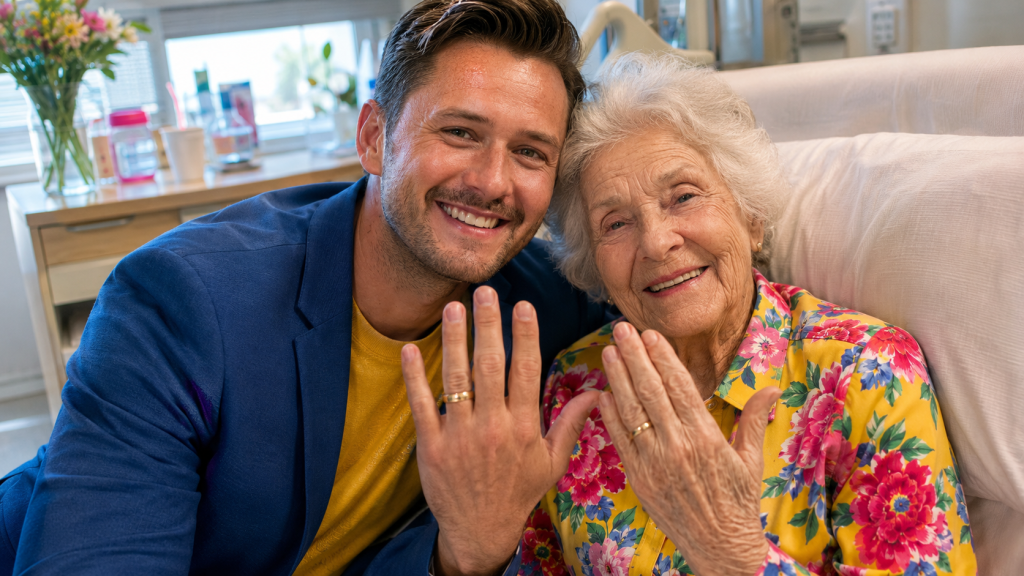
One week later, Gloria and I were married in a quiet hospital room.
She wore a pale blue dress provided by one of the nurses.
Martha brushed her silver hair and pinned a small white flower above her ear.
I wore the only suit I owned.
It had been purchased for a job interview years earlier and was slightly too small across the shoulders.
The room smelled of roses and antiseptic.
Six nurses attended.
The administrator came from Rosewood Haven.
Gloria’s lawyer stood near the window.
There were no family members.
No photographer.
No music except for a song playing softly from someone’s phone.
When the chaplain asked whether I took Gloria as my lawful wife, my voice nearly broke.
“I do.”
Gloria smiled.
When it was her turn, she looked at me with tears in her eyes.
“I do.”
The chaplain pronounced us husband and wife.
I bent and kissed Gloria gently on the forehead.
Everyone clapped.
Gloria laughed.
It was the happiest sound I had ever heard.
After the ceremony, she introduced me to every nurse who entered the room.
“This is my husband,” she said proudly.
The first time, I smiled.
The tenth time, I was crying.
That evening, I sat beside her bed as the sun disappeared behind the hospital buildings.
Gloria held my hand beneath the blanket.
“You have made an old woman very happy,” she said.
“You’ve made me happy too.”
“That was not part of the agreement.”
“It happened anyway.”
She smiled weakly.
“Daniel, promise me something.”
“What?”
“When the time comes, do not be angry.”
“Angry about what?”
“About the things I was too afraid to tell you.”
I looked toward the faded hospital bag.
“Is this about the bag?”
She followed my gaze.
“Yes.”
“What’s inside it?”
“The truth.”
I waited.
She closed her eyes.
“Not yet.”
I wanted to press her, but she looked exhausted.
“All right,” I whispered.
“Soon.”
For the next two days, Gloria drifted in and out of sleep.
I stayed with her.
I fed her ice chips.
I read her favorite mystery novel aloud, though I suspected she was no longer following the story.
On the third night after our wedding, I woke in the chair beside her bed and realized the room had become strangely still.
Gloria was awake.
She was watching me.
“Daniel,” she whispered.
I stood and moved closer.
“I’m here.”
She reached toward me.
I took her hand.
“Thank you for coming back.”
“I never left.”
“I know.”
Her breathing was shallow.
She looked peaceful.
“I am not alone anymore.”
“No,” I said, fighting tears. “You’re not.”
A faint smile appeared on her lips.
“My husband.”
Then she closed her eyes.
A few moments later, Gloria was gone.
I remained beside her long after the nurse entered.
I held her hand until it was no longer warm.
The funeral took place four days later.
Only eleven people attended.
Most were staff members from Rosewood Haven.
The hospital chaplain spoke about Gloria’s kindness, humor, and courage.
I stood beside her coffin wearing the same suit I had worn at our wedding.
In one pocket was our marriage certificate.
In the other was the birthday card she had made for me.
After the service, people hugged me and left.
Rain began to fall.
I remained beneath the awning, unable to make myself walk toward my car.
That was when Gloria’s lawyer approached.
His name was Samuel Price.
He was in his seventies, with gray hair and a serious expression.
He carried the faded hospital bag.
“Mr. Bennett,” he said.
Hearing Gloria’s surname attached to mine felt strange.
“Daniel is fine.”
He handed me the bag.
It was heavier than I expected.
“This belongs to you now.”
I stared at it.
“Gloria never let anyone touch this.”
“I know.”
“Did she tell you what’s inside?”
“Some of it.”
“Why didn’t she give it to me herself?”
“Because she was afraid.”
“Of me?”
“Of losing you before she could give you what you gave her.”
I looked down at the worn canvas.
Samuel placed a hand on my shoulder.
“She picked you for a reason.”
Before I could ask what he meant, he walked through the rain toward his car.
I carried the bag home.
For nearly an hour, it sat unopened on my kitchen table.
I made coffee but forgot to drink it.
I walked around the apartment, returning repeatedly to the bag.
Gloria’s final words echoed in my mind.
Do not be angry about the things I was too afraid to tell you.
Finally, I sat down.
The zipper resisted at first.
Then it opened.
Inside were neatly folded baby clothes, yellowed with age.
A tiny knitted hat.
A white blanket with blue stitching.
An old silver locket.
A bundle of letters tied with ribbon.
Several official documents.
And a sealed envelope with my name written across the front.
Daniel.
My hands began to tremble.
I opened the envelope.
The letter inside was several pages long.
My dear Daniel,
If you are reading this, then you kept your promise, and I am gone.
There is no gentle way to tell you what I should have told you while I was alive.
You asked why I chose you.
The truth is that I did not meet you for the first time at Rosewood Haven.
I met you thirty-four years ago.
You were only three days old.
I stopped breathing.
I read the sentence again.
Then again.
The room seemed to tilt.
I continued reading.
At the time, I was working as a maternity nurse at St. Matthew’s Hospital. One winter night, a young woman arrived alone and frightened. She gave birth to a baby boy. She named him Daniel.
You.
I pushed away from the table.
“No.”
The word escaped my mouth before I could stop it.
I searched through the bag.
Beneath the letters was a faded photograph.
Gloria was much younger, perhaps in her forties.
She stood in a hospital room holding a newborn wrapped in the white blanket with blue stitching.
On the back, someone had written:
Gloria and baby Daniel, February 9.
February 9 was my birthday.
I returned to the letter.
Your mother’s name was Elizabeth Carter. She was seventeen years old. Her parents did not know she was pregnant. She was terrified they would reject her.
She loved you, Daniel.
Please believe that.
But love does not always make people brave.
Two days after giving birth, Elizabeth disappeared from the hospital.
She left a letter asking that you be placed for adoption.
My throat tightened.
I had been told almost nothing about my biological mother.
Only that she had been young and had surrendered me shortly after birth.
According to Gloria, the hospital social worker began arranging temporary foster care.
But something went wrong.
I kept reading.
On your third night, there was a severe storm. The power failed in part of the hospital. During the confusion, I found a woman attempting to leave the maternity ward carrying you.
She was not your mother.
She had lost her own child earlier that year and had entered the hospital using a false name.
I stopped her before she reached the stairwell.
The authorities took her away, but the hospital administration wanted the incident hidden.
They feared scandal.
They changed records, silenced employees, and warned us that speaking publicly would cost us our jobs.
My hands shook harder.
Gloria had saved me from being kidnapped.
But the letter continued.
I promised Elizabeth before she disappeared that I would make sure you were safe.
I tried.
I truly tried.
For several weeks, I visited your temporary foster home.
Then the agency transferred you without notifying me.
Your records were changed during the investigation, and I lost track of you.
For years, I searched.
I wrote letters to agencies, hospitals, churches, and government offices.
The bundle tied with ribbon contained those letters.
Most were stamped with words such as RETURNED, CONFIDENTIAL, or NO RECORD FOUND.
Gloria had searched for me for decades.
I found a copy of my original birth certificate.
Mother: Elizabeth Carter.
Father: Unknown.
A small hospital identification bracelet had been taped to the paper.
BABY BOY CARTER.
Then I found another document.
It was a foster placement form carrying the name Daniel Carter.
My childhood records had always listed me as Daniel Reed.
The letter explained why.
After the attempted kidnapping, a hospital administrator had altered my file to protect the hospital from legal action. When I entered foster care, the wrong surname followed me.
I stared at the documents until the words blurred.
Gloria had known who I was.
But how had she recognized me after thirty-four years?
The answer was on the next page.
You had a birthmark on your left shoulder shaped like a small crescent.
I remembered bathing you after your mother left. You cried whenever I put you down, so I carried you against my chest while finishing my paperwork.
I never forgot that birthmark.
The first week you worked on my hallway, your uniform sleeve tore while you were helping another resident. I saw the mark.
At first, I thought it was impossible.
Then you told me you had been born at St. Matthew’s Hospital on February 9 and had entered foster care as a newborn.
I contacted Samuel.
Together, we quietly obtained the records necessary to confirm the truth.
I dropped the letter.
She had confirmed my identity.
She had known for months.
Maybe longer.
A wave of anger surged through me.
Why had she not told me?
Why had she allowed me to believe we were strangers?
Why had she asked me to marry her before revealing something so important?
I returned to the final pages.
I know you will ask why I remained silent.
The answer is shame.
After I lost track of you, I stopped searching for several years.
I told myself there was nothing more I could do.
But the truth is that I was tired and afraid.
By the time I started searching again, too much time had passed.
I carried the bag because it contained the proof of my greatest failure.
When you appeared at Rosewood Haven, I believed fate had given me a chance to make things right.
But I was afraid that if I told you immediately, you would see only the nurse who lost you.
I wanted you to know me first.
Not as part of a tragedy.
Not as a guilty stranger.
Simply as Gloria.
Tears fell onto the paper.
I wiped them away.
The last section was written in unsteady handwriting.
The marriage was selfish of me.
I wanted, just once, to say you were my family.
But it was not only for me.
There are records and legal matters that Samuel will explain.
More importantly, there is someone else you must find.
Your mother did not abandon you forever.
She came back.
My heart stopped.
According to the letter, Elizabeth returned to St. Matthew’s Hospital six months after my birth.
She had told her parents the truth.
They had agreed to help her raise me.
But by then, my records had been altered, and I had already been moved between foster homes.
The hospital told Elizabeth that I had been adopted.
That was a lie.
She spent years searching too.
Inside the bag was a final envelope addressed to Gloria.
It had been mailed nine years earlier.
The return address belonged to Elizabeth Carter.
My mother.
I opened it carefully.
Dear Gloria,
I don’t know whether this letter will reach you, but I found your name in an old hospital directory.
I have spent most of my life searching for my son.
The hospital told me he was adopted, but I no longer believe them.
A retired employee recently admitted that records were changed after an incident in the maternity ward.
Please tell me what happened.
Please tell me whether Daniel survived.
I have never stopped loving him.
There was a telephone number at the bottom.
I called it immediately.
The number was disconnected.
For the rest of the night, I sat at the table surrounded by documents, baby clothes, and letters.
Grief and anger twisted together inside me.
Gloria had saved my life.
Gloria had searched for me.
Gloria had also hidden the truth.
By dawn, I had not slept.
At nine in the morning, I called Samuel Price.
“I read the letter.”
“I expected your call.”
“You knew everything.”
“I knew what Gloria had discovered.”
“Why didn’t anyone tell me?”
“Because Gloria asked me to wait.”
“That wasn’t her decision to make.”
“No,” he said quietly. “It wasn’t.”
His agreement made me angrier.
“What did she mean when she said there were legal matters?”
“Come to my office.”
An hour later, I sat across from Samuel in a room lined with law books.
He placed a thick folder on the desk.
“Gloria left you her estate.”
I stared at him.
“What estate?”
“She owned property and investments valued at approximately two million dollars.”
I almost laughed.
Gloria had lived in one of the smallest rooms at Rosewood Haven.
“She was wealthy?”
“Comfortable. She inherited land from her parents and invested wisely.”
“I don’t want her money.”
“I suspected you might say that.”
“This makes everything look worse. People will think I married her for it.”
“The will was signed eleven months before your marriage. Your inheritance does not depend on being her husband.”
That silenced me.
Samuel opened the folder.
“Most of the money is placed in a charitable trust.”
“For what?”
“To help young adults leaving foster care.”
I looked at him.
“She established scholarships, housing assistance, and emergency medical support.”
“What did she leave me?”
“The apartment building where you currently live.”
I blinked.
“My building?”
“She purchased it six years ago through a management company.”
I stared at Samuel.
“Gloria owned my apartment?”
“Yes.”
I thought of the rent increases that had stopped three years earlier.
The broken furnace that had been replaced immediately.
The anonymous note informing tenants that no one would be evicted during the pandemic.
Had Gloria been behind those decisions?
Samuel slid another document toward me.
“She also left you funds to locate Elizabeth Carter.”
“Is she alive?”
“We don’t know.”
“Can you find her?”
“I have already begun.”
For the next several weeks, I lived between grief and discovery.
I returned to work at Rosewood Haven, but Gloria’s empty room was unbearable.
Her artificial daisies were gone.
Her books had been donated.
Only a pale rectangle on the wall showed where her calendar had hung.
Some coworkers treated me kindly.
Others whispered.
One afternoon, I overheard two employees talking near the laundry room.
“He married her and inherited everything.”
“I knew there had to be money involved.”
I walked past without defending myself.
Part of me believed I deserved their suspicion.
I had agreed to a marriage I barely understood.
I had trusted Gloria completely.
Now every memory felt different.
Had she cared for me because I was Daniel, the lost baby?
Or because of the man I had become?
Three days later, Samuel called.
“We found Elizabeth.”
I gripped the phone.
“Where is she?”
“She lives in Oregon.”
“Is she alive?”
“Yes.”
The room spun.
“Does she know about me?”
“Not yet.”
“Why not?”
“I thought you should decide how to contact her.”
I sat on the edge of my bed.
For thirty-four years, I had imagined my mother in different ways.
Sometimes she was cruel.
Sometimes frightened.
Sometimes dead.
Sometimes living happily with another family, never thinking of me.
Now she was real.
Alive.
Waiting somewhere without knowing I had been found.
“Give me her number,” I said.
Samuel emailed it.
I stared at the digits for nearly twenty minutes before calling.
A woman answered after four rings.
“Hello?”
Her voice was older than the one I had imagined.
I could not speak.
“Hello?” she repeated.
“Is this Elizabeth Carter?”
“Yes.”
“My name is Daniel.”
Silence.
I heard her inhale sharply.
“What did you say?”
“My name is Daniel. I was born at St. Matthew’s Hospital on February 9.”
A sound came through the phone.
Half sob.
Half gasp.
“Oh, my God.”
I closed my eyes.
“Gloria Bennett found me.”
For several seconds, neither of us spoke.
Then Elizabeth began to cry.
“I knew you were alive.”
Her words broke apart.
“I knew it. I knew they had lied to me.”
I pressed my hand over my mouth.
“I’m sorry,” she whispered. “Daniel, I am so sorry.”
I had imagined this moment my entire life.
I had rehearsed angry speeches.
I had thought I would demand explanations.
But hearing her cry, I felt like a frightened child again.
“Why did you leave me?”
“I was seventeen.”
Her voice trembled.
“My father was violent. My mother was terrified of him. I hid the pregnancy until I went into labor.”
She explained that she had planned to return after speaking with an aunt who had offered to help her.
But when she returned home, her father locked her inside the house and took her identification.
It took months before she escaped.
“When I came back to the hospital, they told me you had been adopted by a family in another state.”
“I wasn’t adopted.”
“I know that now.”
She cried harder.
“I searched everywhere. I hired investigators when I could afford them. I wrote to Gloria because someone told me she had worked that night.”
“Why didn’t Gloria answer?”
“She did.”
That shocked me.
“What?”
“Gloria wrote back nine years ago.”
Elizabeth said Gloria had explained the attempted kidnapping and admitted losing track of me.
They had communicated several times.
“Then why didn’t she connect us sooner?”
“She was trying.”
Elizabeth’s voice softened.
“She told me the records had been changed. She had only fragments of information.”
“But she recognized me months ago.”
“I didn’t know that.”
Gloria had not told Elizabeth either.
Anger returned.
“She hid the truth from both of us.”
“Yes,” Elizabeth whispered. “Maybe she was afraid.”
“That doesn’t excuse it.”
“No.”
Her answer was gentle.
“But fear makes people do things they later regret. I know that better than anyone.”
We talked for nearly three hours.
Elizabeth had never married.
She had worked as a school librarian for thirty years.
She had no other children.
She had kept a box of birthday cards she wrote to me every February but could never send.
Before ending the call, she asked if she could meet me.
I wanted to say yes.
I wanted to say no.
Instead, I said, “I need time.”
“I understand.”
Two days later, a package arrived.
Inside were thirty-four birthday cards.
One for every year of my life.
The first card was written in the shaky handwriting of a seventeen-year-old girl.
Dear Daniel,
Today you are one year old.
I don’t know where you are, but I hope someone held you when you woke up.
I hope they made you laugh.
I hope you know, somehow, that your mother loves you.
I read every card.
By the final one, I was sobbing.
A week later, I flew to Oregon.
Elizabeth waited at the airport near the baggage claim.
I recognized her immediately.
Not because I had seen a photograph.
Because she had my eyes.
She stood frozen as I approached.
Her hair was gray, and her hands trembled at her sides.
For a moment, we simply looked at each other.
Then she said, “You’re taller than I imagined.”
I laughed through my tears.
She covered her mouth.
“May I hug you?”
I nodded.
When she wrapped her arms around me, I felt thirty-four years of absence between us.
It did not disappear.
But it became something we could finally begin to cross.
I stayed in Oregon for five days.
Elizabeth showed me the room where she kept my birthday cards.
She showed me newspaper clippings about missing children, old letters to government agencies, and receipts from private investigators.
She had not forgotten me.
She had built her entire life around the hope that I might someday be found.
On my final evening, we sat on her porch watching the sun sink behind the trees.
“Do you hate Gloria?” she asked.
I thought carefully.
“No.”
“Are you angry with her?”
“Yes.”
“That is allowed.”
“She should have told me.”
“She should have.”
I looked toward the mountains.
“But she saved me.”
“Yes.”
“And she spent years trying to find me.”
“Yes.”
“I think she believed she had to earn my love before telling me the truth.”
Elizabeth nodded.
“People who carry guilt often believe love must be earned.”
I thought about Gloria asking me to marry her.
At first, I had believed her wish came only from loneliness.
Now I understood there had been something deeper.
For one week, she had been able to call me family.
Not because she wanted my money or my future.
Because in her heart, she had been my family since the night she saved me.
When I returned home, Samuel gave me one final recording.
“Gloria made this the day before your wedding,” he said.
I watched it alone.
Gloria appeared on the screen in her hospital bed.
Her voice was weak.
“Hello, Daniel.”
She paused to catch her breath.
“If you are watching this, then you know everything, and you are probably angry.”
A faint smile appeared.
“You have every right to be.”
She looked down at her hands.
“I told myself I was protecting you, but the truth is that I was protecting myself.”
Her eyes filled with tears.
“When I recognized you at Rosewood Haven, I felt as though God had returned the child I had lost.”
“You were no longer a baby, of course. You were a grown man with kindness in your eyes and sorrow hidden behind your smile.”
“I wanted to tell you immediately.”
“But each day you came back. You brought me tea. You listened to my stories. You treated me like I mattered.”
“I became afraid that the truth would destroy the only family I had ever known.”
She lifted her gaze toward the camera.
“I did not choose you because you were the baby in my hospital bag.”
“I chose you because you became a good man despite everything the world took from you.”
Tears blurred the screen.
“I am sorry I was not brave enough to tell you myself.”
“I hope one day you can forgive me.”
The recording ended.
I sat in silence for a long time.
Then I took Gloria’s hospital bag and returned to Rosewood Haven.
The administrator allowed me into her old room.
It had already been prepared for a new resident.
The walls were bare.
Fresh sheets covered the bed.
I sat beside the window where Gloria used to drink her tea.
“I forgive you,” I whispered.
The words did not erase my anger.
Forgiveness rarely works that way.
But they allowed me to carry the love without being crushed by the secrets.
Over the next year, I worked with Samuel to expand Gloria’s charitable trust.
We named it the Gloria Bennett Homeward Foundation.
It provided temporary apartments, job training, counseling, and scholarships for young adults leaving foster care.
I left my job as an orderly and became the foundation’s director.
The apartment building Gloria left me became transitional housing.
The bakery remained on the first floor.
The smell of bread still drifted through the hallways every morning.
But the upper apartments were renovated for young people who had nowhere else to go.
No one was forced to leave on their eighteenth birthday with a garbage bag full of clothes, as I had been.
Each apartment contained a bed, a desk, dishes, clean towels, and a handwritten note.
You are not forgotten.
Elizabeth moved closer the following spring.
We did not pretend the lost years had never happened.
We moved slowly.
We met for lunch.
We argued.
We cried.
We celebrated birthdays together.
On my thirty-sixth birthday, she baked a cake and placed thirty-six candles on it.
“You know this is a fire hazard,” I said.
“I missed thirty-five of them. I’m using every candle.”
For the first time in my life, someone sang “Happy Birthday” to me with tears in her eyes.
Afterward, Elizabeth handed me one final card.
This one was not written to a missing child.
Dear Daniel,
Today you are thirty-six.
This year, I know where you are.
This year, I was able to hold you.
This year, I do not have to wonder whether you know I love you.
Thank you for finding your way home.
I keep Gloria’s hospital bag in my office at the foundation.
The baby clothes remain inside.
So do the letters, the photographs, the hospital bracelet, and her silver locket.
Sometimes young people ask me why an old bag is displayed behind my desk.
I tell them it belonged to a woman who made mistakes.
A woman who was frightened.
A woman who carried guilt for more than thirty years.
But also a woman who saved a child, searched for him, found him, loved him, and used everything she owned to help others like him.
One rainy afternoon, a young man named Marcus came into my office.
He was eighteen and had recently aged out of foster care.
He had no job, no permanent home, and no family willing to take him in.
He sat across from me with his arms folded.
“I don’t need charity,” he said.
“Good,” I replied. “Because we don’t offer charity.”
He looked suspicious.
“What do you offer?”
“A beginning.”
His eyes moved toward the hospital bag.
“Is that yours?”
“It is now.”
“What’s inside?”
I smiled.
“A second chance.”
Marcus rolled his eyes.
“That sounds like something from a movie.”
“It does.”
“But it’s true?”
“Yes.”
He studied me for a moment.
Then he unfolded his arms.
“All right,” he said. “Tell me about the apartment.”
I showed him the available room upstairs.
When he saw the bed and desk, he tried to hide his reaction.
“No one else lives here?” he asked.
“This room is yours.”
“For how long?”
“Until you’re ready for the next step.”
“And if I mess up?”
“We help you fix it.”
His eyes filled with tears, but he looked away.
“Why are you doing this?”
I thought of Gloria sitting beside the nursing-home window.
I thought of Elizabeth’s birthday cards.
I thought of every foster home where I had waited for someone to choose me.
“Because someone once made me feel less forgotten.”
Years have passed since Gloria asked me to marry her.
People still misunderstand when they hear the story.
Some think our marriage was strange.
Some believe she manipulated me.
Others insist I must have known about her money.
They do not understand that the inheritance was never the most important thing Gloria left me.
She gave me the truth about my beginning.
She led me back to my mother.
She gave a home to young people who would otherwise have none.
And for one short week, she gave both of us something we had spent our lives missing.
A family.
I sometimes return to Gloria’s grave with Elizabeth.
We bring tea in a small thermos.
One cup for me.
One for Elizabeth.
And one that we pour gently into the grass beside the headstone.
Her name is carved into the stone.
GLORIA BENNETT
BELOVED NURSE, FRIEND, AND FAMILY
Below it are words I chose myself.
SHE MADE THE FORGOTTEN FEEL FOUND.
The last time we visited, Elizabeth placed a white flower beside the stone.
“I wish I could have thanked her,” she said.
“She knew.”
“Do you think so?”
“Yes.”
I looked at the name on the headstone and remembered Gloria smiling in her hospital room.
This is my husband, she had told everyone.
At the time, I believed I was simply giving a lonely woman one final piece of happiness.
I had no idea she had spent thirty-four years waiting to give me something in return.
My history.
My mother.
My purpose.
And a place where I finally belonged.
I touched the wedding ring I still wore on a chain around my neck.
Gloria had picked me for a reason.
But in the end, I understood something she may never have realized.
I had chosen her too.
Not because of the secret inside her bag.
Not because she had saved me as a baby.
Not because of the building, the trust, or the money.
I chose her because when the world had taught both of us to expect abandonment, she kept opening her heart.
Imperfectly.
Fearfully.
But sincerely.
And sometimes family is not the person who shares your name from the beginning.
Sometimes family is the person who sees your loneliness because they carry the same loneliness inside themselves.
Sometimes family arrives late.
Sometimes it remains only for a week.
Sometimes it leaves behind a faded hospital bag filled with painful truths.
But love does not become less real because it arrives in an unexpected form.
Gloria died believing I had made her final wish come true.
What she never fully understood was that she had also answered mine.
All my life, I had wanted someone to look at me and say:
You belong to me.
You are worth searching for.
You are worth choosing.
And through every letter, every hidden document, every cup of tea, and every frightened decision, Gloria had been saying those words all along.
THE END
I can also reshape this into a shorter Facebook version, a two-part version, or a narrated YouTube script.
THE END! THANK YOU FOR READING!