

My 5-year-old daughter used to bathe with my husband, and they would stay in the bathroom for more than an hour each time. For a long time, I told myself I was overthinking. I told myself that Scott was simply an involved father and that I should be grateful. Other mothers complained that their husbands never helped with bedtime, never changed diapers, never remembered school events. Scott did all of those things.
At least, that was what everyone saw. “You’re lucky,” my sister, Rachel, once told me. “Most fathers wouldn’t have that kind of patience.” At the time, I smiled and agreed. Now, remembering those words makes my stomach twist.
My daughter, Emily, had always been gentle and soft-spoken. Even as a toddler, she rarely threw tantrums. She loved coloring books, strawberry yogurt, and a worn stuffed rabbit named Benny that she carried everywhere.
She trusted people easily.
She trusted her father most of all.
Scott began handling her evening baths when she was three. At first, it seemed practical. I worked as an office administrator for a dental clinic, and on busy days, I often came home exhausted. Scott worked from home as an insurance consultant and had more control over his schedule.
“I’ve got bath time,” he would say. “Go put your feet up.”
Back then, I thought it was love.
I thought he was taking care of both of us.
The baths were short at first. Twenty minutes, maybe thirty if Emily brought her bath toys into the tub.
Then they became longer.
Forty minutes.
Fifty minutes.
Sometimes more than an hour.
Whenever I knocked, Scott always answered quickly.
“Almost done.”
If I asked why it was taking so long, he would laugh.
“She loves playing in the water. You know how kids are.”
Sometimes I heard splashing.
Sometimes I heard his voice, too low for me to understand.
But other times, the bathroom was strangely quiet.
When they finally came out, Scott acted completely normal. Emily did not.
She would cling tightly to her towel and walk quickly toward her bedroom. Her eyes stayed lowered, and she often refused to let me help her put on pajamas.
“I can do it,” she would insist.
At first, I believed she was becoming independent.
Then she started changing in other ways.
She stopped wanting to sleep alone.
She began waking from nightmares and crying without remembering—or without telling me—what she had dreamed.
She became frightened when bathroom doors were closed.
One afternoon, I reached over to fix the collar of her dress, and she flinched so violently that she almost fell from her chair.
“Sweetheart, it’s just me,” I said.
She stared at me with wide eyes.
Then she forced a smile that looked far too old for her little face.
“I know, Mommy.”
That moment stayed with me.
It followed me through work, through dinner, and into bed.
That night, I watched Scott sleeping beside me and tried to silence the voice inside my head.
He was my husband.
We had been married for eight years.
He had held my hand while I gave birth. He had cried when the doctor placed Emily in his arms. He had built her crib himself and painted stars across her bedroom ceiling.
He could be impatient and controlling, but he had never hit us.
He paid the bills.
He remembered birthdays.
He told people that his family was everything to him.
How could I suspect him of something terrible?
What kind of wife looked at the man she loved and imagined the worst?
So I ignored my instincts.
That was the guilt I carried later—the knowledge that my body had been warning me long before my mind was ready to listen.
One Saturday evening, after another bath that lasted nearly seventy minutes, Emily came downstairs in her pajamas.
Her hair was wet, and she was holding Benny against her chest.
Scott followed behind her, smiling.
“All clean,” he announced.
Emily did not look at him.
I sat beside her on the couch while Scott went into the kitchen.
She curled her legs beneath herself and stared at the television without really watching it.
I placed my hand gently over hers.
“What do you and Daddy do in the bathroom for so long?”
Her fingers tightened around Benny’s ear.
She lowered her head.
Her eyes filled with tears.
She did not answer.
I tried to keep my voice calm.
“You’re not in trouble, sweetheart.”
Still nothing.
“You can tell me anything.”
Her lips trembled.
Finally, in a voice so quiet I nearly missed it, she said, “Daddy says I’m not supposed to talk about the games.”
The room seemed to tilt.
“What kind of games?”
Emily shook her head.
“He said you’d get mad.”
“I won’t be mad at you.”
“He said you might send him away.”
My throat closed.
From the kitchen, I could hear Scott opening cupboards and humming as if it were an ordinary evening.
I pulled Emily close.
“No matter what anyone says, you can always tell me the truth.”
She began crying.
Not loudly.
That would have been easier.
She cried silently, her tiny shoulders shaking while she pressed her face into my chest.
I did not push her for more information. I did not want to frighten her or accidentally shape her words. I only held her and repeated that she had done nothing wrong.
When Scott returned, Emily immediately wiped her face.
“What happened?” he asked.
“She’s tired,” I said.
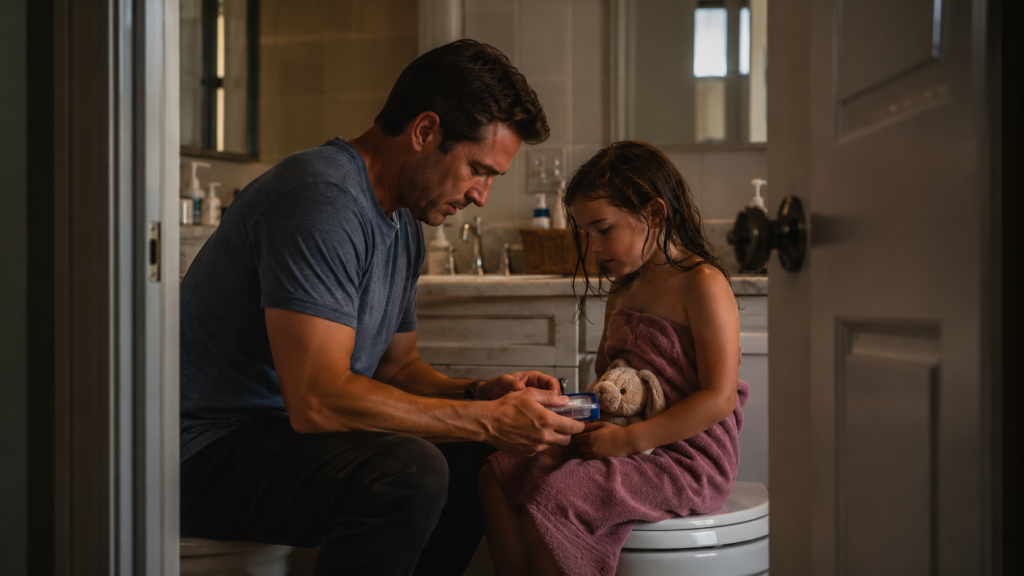
He looked at me for a second longer than necessary.
Then he smiled.
“Bath time wore her out.”
That night, I could not sleep.
Scott lay beside me, breathing steadily, while fear moved through my body like ice water.
I considered waking him and demanding answers.
I considered taking Emily and leaving immediately.
But another voice kept whispering that I might be wrong.
What if the “games” were innocent?
What if Scott had invented some silly princess activity and asked Emily to keep it secret because they were planning a surprise?
What if I accused him of something unforgivable and destroyed our family over a misunderstanding?
Then I remembered Emily’s tears.
Children could misunderstand many things.
Fear like that was harder to misunderstand.
The following morning, I called Rachel from the parking lot of a grocery store.
“I need to ask you something,” I said.
She immediately heard the panic in my voice.
“What happened?”
I told her about the long baths, Emily’s behavior, and what she had said about secret games.
Rachel went silent.
When she finally spoke, her voice was steady.
“Listen to me. Do not confront him while you’re alone. Do not question Emily repeatedly. And don’t let him take her into that bathroom again.”
“You think—”
“I don’t know what I think,” she interrupted gently. “But this is serious. You need professional help.”
I gripped the steering wheel.
“What if I’m wrong?”
“Then trained professionals will help you understand that. But if you’re right, every minute matters.”
I wanted to take Emily and leave that day.
Before I could decide what to do, Scott suggested another bath after dinner.
“She got paint in her hair,” he said.
I looked at Emily.
Her face changed instantly.
It was only a flicker, but I saw it.
Fear.
“I’ll bathe her,” I said.
Scott’s smile stiffened.
“You’ve been working all day.”
“I don’t mind.”
“She prefers when I do it.”
“I said I’ll handle it.”
For several seconds, neither of us moved.
Then he laughed.
“Okay. No need to bite my head off.”
I bathed Emily myself.
The entire process took fifteen minutes.
She refused to sit in the tub and asked to stand beneath the shower instead. She kept the curtain open and made me promise not to leave the room.
When I asked if the water was comfortable, she nodded.
When I asked whether anything hurt, she became quiet.
I stopped asking.
Afterward, I helped her dress and tucked her into bed.
Scott stood in the doorway.
“Daddy can read your story tonight,” he said.
Emily grabbed my arm.
“Mommy.”
It was one word, but it contained everything.
“I’m reading tonight,” I told him.
His face darkened.
Only for a moment.
Then the pleasant expression returned.
“Fine.”
After Emily fell asleep, I searched online for advice about children disclosing possible abuse. The guidance was consistent: stay calm, ensure immediate safety, avoid leading questions, write down the child’s exact words, and contact professionals.
I wrote everything I remembered in a notebook.
The dates.
The unusually long baths.
The nightmares.
The flinching.
The exact sentence Emily had used.
Daddy says I’m not supposed to talk about the games.
My handwriting shook so badly that some words were almost unreadable.
I slept beside Emily that night and locked her bedroom door.
The next morning, Scott acted as though nothing had happened.
He made pancakes.
He kissed my forehead.
He asked whether I wanted coffee.
His normal behavior made me feel as though I were losing my mind.
Before leaving for work, I called my supervisor and said there was a family emergency. Then I contacted a child-protection hotline.
The woman who answered spoke calmly.
She asked whether Emily was currently safe.
“Yes,” I said. “She’s with me.”
“Is the person you are concerned about in the home?”
“Yes.”
“Can you take the child somewhere safe without alerting him?”
I looked through the kitchen window. Scott was outside, loading recycling into the bin.
“Yes.”
The woman told me to leave with Emily and contact law enforcement. She warned me not to examine Emily myself, not to interrogate her, and not to tell Scott exactly what she had said.
I packed a small bag while pretending we were going to visit Rachel.
Scott walked back inside as I zipped it closed.
“Where are you going?”
“To Rachel’s.”
“Why?”
“She needs help organizing her spare room.”
He glanced at the bag.
“For one afternoon?”
“Emily might stay overnight.”
His eyes moved from me to our daughter.
“No.”
The word came out too quickly.
I forced myself to remain calm.
“She’s stayed with Rachel before.”
“I said no.”
Emily froze beside me.
Scott noticed her reaction and changed his tone.
“I just thought we could have family time tonight.”
“We can do that another night.”
He stepped closer.
“You’ve been acting strange since yesterday.”
“I’m tired.”
“You’re hiding something.”
My heartbeat thudded in my ears.
Before I could answer, Rachel pulled into the driveway. I had texted her to come without explaining why.
She walked to the door with a cheerful smile.
“Ready, girls?”
Scott’s attention shifted toward her.
That gave me the courage to take Emily’s hand and walk out.
He followed us onto the porch.
“When will you be back?”
“I’ll call you.”
“What does that mean?”
Rachel moved between us slightly, pretending to adjust the strap of her purse.
“It means we’re stealing them for a girls’ night,” she said lightly.
Scott did not laugh.
He stared at me until I placed Emily in the car.
The moment we turned the corner, my entire body began shaking.
Rachel drove directly to the police station.
I expected uniformed officers behind a front desk. Instead, we were taken into a quiet room where a detective named Maria Alvarez introduced herself.
She wore plain clothes and spoke gently.
Emily stayed with Rachel in another waiting area while I explained everything.
Detective Alvarez listened without interrupting.
When I finished, she asked, “Did you see anything directly?”
“No.”
“Did Emily describe any specific act?”
“No. She only mentioned games and said she wasn’t allowed to talk about them.”
“Have you questioned her beyond what you told me?”
“No.”
“That was the right decision.”
Her words brought no relief.
“What happens now?”
“We make sure she remains safe. A trained forensic interviewer will speak with her in a child-friendly setting. Depending on what she says, medical professionals may also evaluate her.”
“Will Scott be arrested?”
“Not based only on suspicion. We need evidence and a proper investigation.”
The answer frightened me.
“What if he comes to get her?”
“We can help you seek an emergency protective order. Do not return home alone.”
I pressed both hands against my face.
“I should have noticed earlier.”
Detective Alvarez leaned forward.
“Mrs. Carter, people who harm children often work very hard to appear trustworthy. The responsibility belongs to the adult who created the danger, not the parent who was deceived.”
I wanted to believe her.
I could not yet forgive myself.
The forensic interview took place that afternoon at a children’s advocacy center.
The building did not look like a police facility. The walls were painted with trees and clouds. Shelves held toys, puzzles, and picture books.
A specialist named Ms. Harper explained that Emily would speak with her alone while investigators observed from another room.
“You won’t be able to watch,” she told me. “That helps us protect the integrity of the interview.”
I nodded, though the idea of being separated from Emily terrified me.
Before entering the room, Emily looked up at me.
“Am I in trouble?”
I knelt and held her hands.
“No. You have never been in trouble.”
“Is Daddy mad?”
“You don’t have to worry about Daddy right now.”
She thought about that.
Then she whispered, “I don’t want him to be gone forever.”
My heart broke.
Children could love someone and still be afraid of them.
They could miss someone who had hurt them.
Nothing about trauma was simple.
The interview lasted almost an hour.
When Ms. Harper returned, her face was professional but sorrowful.
Detective Alvarez asked Rachel to take Emily into the playroom.
I remained seated.
“What did she say?”
The detective closed the door.
“We have enough to continue the investigation immediately.”
The words landed like stones.
I felt as though I had known and not known at the same time.
“Did he hurt her?”
“We believe she experienced inappropriate behavior and coercive secrecy. I can’t give you every detail right now, and it’s best that she not have to repeat them to family members.”
My breath left me.
I stared at the carpet.
“What kind of mother lets this happen?”
“A mother who was manipulated,” Ms. Harper said. “A mother who noticed changes, listened when her child spoke, and brought her to safety.”
“I let her go into that bathroom.”
“You didn’t know what was happening.”
“But I suspected.”
“And when you understood the danger, you acted.”
I began crying so hard that I could no longer speak.
They gave me time.
Then Detective Alvarez asked whether there were cameras or electronic devices in the bathroom.
“I don’t know.”
She asked about Scott’s phone, laptop, cloud-storage accounts, and security system.
I remembered something.
Months earlier, Scott had installed a small device near the top of the bathroom cabinet. He told me it was a humidity sensor connected to the ventilation fan.
I had never questioned it.
“There’s a black device above the cabinet,” I said.
Detective Alvarez wrote it down.
“Anything else?”
“He keeps an old laptop locked in his office.”
“Do you know the password?”
“No.”
“Do not attempt to access it. We’ll handle that through the proper legal process.”
Officers went to our house that evening with a search warrant.
Scott called me seventeen times.
I did not answer.
Then the messages began.
Where are you?
Why are police at the house?
What did you tell them?
Bring Emily home immediately.
You are destroying our family.
The final message was different.
We need to talk before this becomes something you can’t undo.
Detective Alvarez instructed me not to respond.
Rachel and I stayed with Emily at a confidential temporary location arranged through a family-safety organization.
That night, Emily asked whether she could sleep in my bed.
I held her until she fell asleep.
Around midnight, Detective Alvarez called.
Officers had found recording equipment disguised as a household device.
They had also seized Scott’s computers and phone.
I stopped breathing.
“Was he recording her?”
“The investigation is ongoing,” she said carefully. “But the equipment’s placement is significant.”
A terrible sound escaped me.
Rachel took the phone from my hand and finished the conversation.
I went into the bathroom and became sick.
For the next several days, time lost its shape.
I signed forms.
I answered questions.
I met lawyers, social workers, and counselors.
Emily underwent a medical examination conducted by a pediatric specialist trained to work with children.
The doctor warned me beforehand that the examination might not provide clear physical evidence.
“Many forms of abuse do not leave injuries,” she explained. “A normal examination does not mean nothing happened.”
Emily was frightened, but the staff moved slowly and allowed her to stop whenever she needed.
Afterward, she received a small stuffed dog and a bravery certificate.
She smiled for the first time in days.
That smile nearly destroyed me.
Scott was arrested three days after the search.
The police did not tell me everything they found, but they said digital evidence supported Emily’s disclosure. The charges included offenses involving child exploitation, unlawful recording, and abuse.
His attorney quickly released a statement claiming there had been a misunderstanding.
Scott’s mother called me.
“What have you done?” she screamed.
I stood in Rachel’s kitchen, gripping the phone.
“What he did is the reason he was arrested.”
“My son would never harm Emily.”
“You don’t know that.”
“I know my child.”
“So did I,” I whispered. “Or I thought I did.”
She accused me of filling Emily’s head with lies because I wanted a divorce.
She said Scott had always been a wonderful father.
She reminded me that he volunteered at school events and donated money to children’s charities.
As if kindness performed in public erased cruelty hidden behind a locked door.
I ended the call.
Then I blocked her number.
Some members of our community supported us. Others did not.
A neighbor asked whether Emily might have misunderstood a game.
One of Scott’s friends said the charges were “probably exaggerated.”
A woman from our church told me privately that I should pray for my marriage and avoid making permanent decisions while emotions were high.
I stared at her.
“My daughter was afraid in her own home.”
“Of course, but forgiveness—”
“Forgiveness does not mean access.”
She stopped talking.
I left the church and never returned.
The hardest part was helping Emily understand that she was not responsible.
At first, she asked about Scott constantly.
“Is Daddy in jail because I told?”
“No,” I answered. “He is there because of choices he made.”
“If I didn’t tell, would he still be home?”
“That would not make his choices okay.”
“Does he hate me?”
“No adult is allowed to blame a child for telling the truth.”
She would look down at Benny and become quiet.
Her therapist, Dr. Lena Brooks, taught me not to overwhelm her with reassurance or questions. Instead, I followed Emily’s lead.
We created predictable routines.
Breakfast at seven-thirty.
School at eight-thirty.
Therapy on Tuesdays.
A story every night.
The bathroom door always remained open unless Emily chose otherwise.
She picked her own clothes and decided who could hug her.
We practiced saying “no,” “stop,” and “I need Mom.”
Dr. Brooks explained that recovery was not a straight road.
“Some days she may seem completely fine,” she said. “Other days, a smell, a sound, or a closed door may bring fear back.”
“What should I do when that happens?”
“Stay calm. Remind her that she is safe now. Let her know that her feelings make sense.”
Emily began drawing pictures during therapy.
In the early drawings, the people had no mouths.
The houses had no windows.
There was always a black square in the corner of the bathroom.
Weeks later, she drew herself holding my hand outside beneath a yellow sun.
Dr. Brooks did not call it a breakthrough.
She simply placed the drawing in Emily’s folder.
I kept a copy in my purse.
The criminal case moved slowly.
Scott remained in custody while his attorney challenged evidence and requested delays.
Every court date reopened the wound.
Sometimes I saw him across the courtroom.
He looked thinner, but otherwise he was still the man I had married.
The familiarity was horrifying.
Once, he turned toward me and mouthed, “I love you.”
I felt nothing.
Then I felt rage that he believed love was a word he still had the right to use.
My divorce attorney helped me secure temporary custody orders and exclusive access to our finances.
Scott had controlled more of our money than I realized. Several accounts were hidden. He had transferred funds shortly before his arrest, possibly preparing for the moment his secrets were discovered.
The house was no longer safe for us emotionally, so I decided to sell it.
Packing was difficult.
Every room held two versions of our life.
The version I remembered and the version I now understood.
Family photographs showed birthdays, vacations, Christmas mornings, and school plays. In nearly every picture, Scott was smiling.
I wondered how often he had smiled while hiding what he was doing.
I threw away the photographs that included him.
Rachel stopped me.
“Keep a few in a sealed box,” she said. “Emily may want them someday.”
“Why would she?”
“Because those memories belong to her, too. She gets to decide what they mean when she’s older.”
I hated that she was right.
I placed the photographs in a storage container and labeled it PRIVATE.
Then I packed it away.
The bathroom was the last room I entered.
The police had removed the recording device and sections of cabinet trim during their search. Small marks remained on the wall.
I stood in the doorway and remembered every time I had walked past while the door was closed.
Every time I had heard, “Almost done.”
Every time I had chosen reassurance over suspicion.
The guilt returned so violently that I had to lean against the wall.
Then Emily appeared behind me.
“Mommy?”
I turned quickly.
She looked into the bathroom, then at me.
“We don’t have to live here anymore, right?”
“No.”
“Will the new house have a bathroom?”
Despite everything, I almost laughed.
“Yes, sweetheart.”
“Can it have a yellow shower curtain?”
“It can have any curtain you want.”
She thought for a moment.
“And no locks.”
“We can remove the lock.”
She reached for my hand.
“Okay.”
That was how healing often looked.
Not like a grand victory.
Like a yellow shower curtain.
Like a five-year-old asking for control over a door.
We moved into a small rental house near Rachel’s neighborhood.
It had two bedrooms, a narrow kitchen, and a backyard with a crooked maple tree.
Emily chose the room facing the garden.
We painted the walls pale green and added glow-in-the-dark stars to the ceiling.
The first night, she had a nightmare.
The second night, too.
On the third night, she slept until morning.
I stood in her doorway watching her breathe and cried quietly with relief.
Months passed.
Emily started kindergarten again after taking time away.
Her teacher knew only what was necessary. A school counselor helped create a safety plan, including approved adults for pickup and permission for Emily to use a private staff bathroom if the regular one felt overwhelming.
At first, she stayed close to her teacher.
Then she became friends with a girl named Lucy who loved dinosaurs.
One afternoon, Emily came home excited because Lucy had traded her a triceratops sticker for a glittery moon.
Her happiness felt miraculous.
I learned not to treat every good moment as proof that the pain was over.
I also learned not to treat every difficult moment as proof that healing had failed.
Life became both.
There were therapy appointments and cartoons.
Court documents and birthday cupcakes.
Nightmares and playground laughter.
The trial was scheduled nearly a year after Scott’s arrest.
Prosecutors met with me several times to explain what would happen. Because of Emily’s age, they sought special protections so she would not have to face Scott directly in open court.
I dreaded the possibility that she might testify at all.
The prosecutor, Mr. Daniels, assured me they would rely heavily on the recorded forensic interview and digital evidence.
“We will not put her through anything unnecessary,” he said.
A week before jury selection, Scott accepted a plea agreement.
Part of me was relieved.
Another part wanted the entire truth spoken publicly.
I wanted everyone who had defended him to see the evidence.
I wanted a courtroom full of witnesses to understand exactly why Emily had cried when I asked about the bathroom.
But Mr. Daniels reminded me that a plea prevented Emily from enduring a prolonged trial and guaranteed significant prison time.
At sentencing, I was permitted to read a statement.
I stood at a wooden podium with my hands trembling.
Scott sat behind his attorney.
I did not look at him at first.
I looked at the judge.
“My daughter was five years old when she learned that an adult could turn trust into fear,” I began. “She was taught that secrets mattered more than her comfort and that telling the truth would destroy her family.”
My voice cracked.
I paused.
Then I continued.
“But she told the truth anyway. She told it in pieces, with tears and silence, and she was braver than any child should have to be.”
Scott lowered his head.
I finally looked at him.
“You told her I would be angry with her. You were wrong. I am angry with you.”
The courtroom remained silent.
“You told her she would be responsible if you went away. You were wrong again. You are responsible for where you are.”
His shoulders moved as though he were crying.
I felt no pity.
“You did not only violate her safety. You tried to steal her trust in herself. But you failed. She is learning that her voice matters. She is learning that her body belongs to her. She is learning that adults are supposed to protect children, not frighten them into silence.”
I took one breath.
“You will not define the rest of her life.”
The judge sentenced Scott to many years in prison and imposed restrictions that would remain after his release.
His mother sobbed behind me.
I walked out without speaking to her.
Outside the courthouse, sunlight reflected off the windows of nearby buildings.
Rachel waited on the steps.
“Is it over?” she asked.
“The court part is.”
She hugged me.
Neither of us pretended that a sentence could undo what happened.
There was no perfect ending.
There was only safety, accountability, and the slow work of rebuilding.
Emily was six by then.
We did not tell her every detail of the sentence. Dr. Brooks helped me explain it in language she could understand.
“Daddy broke important rules that protect children,” I said. “A judge decided he has to stay somewhere far away.”
“For how long?”
“A long time.”
“Until I’m big?”
“Yes.”
She considered that.
“Can he come to my school?”
“No.”
“Our house?”
“No.”
“Can he take me to the bathroom?”
“No. Never again.”
Her shoulders relaxed.
Then she asked whether we could make macaroni and cheese.
Children sometimes carried unbearable truths and ordinary hunger at the same time.
We made dinner.
As the years passed, Emily remembered more than I wished she had and less than I feared she might.
Some memories arrived unexpectedly.
At seven, she panicked when a hotel bathroom had a dark ventilation grille similar to the device in our old house.
At eight, she asked why I had not opened the door sooner.
That question nearly broke me.
We were sitting on the back steps while she ate a frozen fruit bar.
“I didn’t understand what was happening,” I told her.
“You knew the baths were long.”
“Yes.”
“Why didn’t you stop them?”
I wanted to defend myself.
I wanted to explain manipulation, denial, marriage, trust, and fear.
But she did not need excuses.
She needed honesty.
“I should have listened to my worried feeling sooner,” I said. “I am deeply sorry that I didn’t.”
She stared at the grass.
“Were you scared of Daddy?”
“Yes.”
“Even though you were a grown-up?”
“Yes.”
That surprised her.
“I thought grown-ups weren’t scared.”
“Grown-ups get scared, too. Sometimes fear makes people slow to understand things.”
She licked melting juice from her thumb.
“But you believed me.”
“I did.”
“And you went to the police.”
“Yes.”
She leaned against my shoulder.
“Okay.”
I did not know whether she had forgiven me.
I did not ask.
Forgiveness was not something I had the right to demand from her.
I could only keep showing up.
When Emily was ten, she decided she no longer wanted Benny on her bed.
She placed the stuffed rabbit in a cardboard box.
“Are you sure?” I asked.
“I’m not a baby.”
“You can keep him without being a baby.”
She shook her head.
“I don’t want him in my room.”
Later, Dr. Brooks explained that Benny had been present during both comforting and frightening moments. Emily had the right to choose what objects stayed near her.
I stored him in the private box with the old photographs.
At twelve, Emily gave a presentation at school about personal boundaries.
She never mentioned her own story.
She simply told her classmates that surprises had an ending, but unsafe secrets were designed to keep someone frightened.
She said trusted adults should never ask children to hide behavior that made them uncomfortable.
When she showed me her note cards afterward, my eyes filled with tears.
“Was it bad?” she asked.
“No. It was powerful.”
She rolled her eyes.
“Mom, don’t make it emotional.”
“I’ll try.”
“You always say that.”
She smiled.
That smile no longer looked forced.
Years after the arrest, I still occasionally woke from dreams about the old bathroom.
In the dreams, I stood outside the door and could not turn the handle.
Sometimes I heard Emily calling.
Sometimes there was only silence.
Therapy helped me understand that I had trauma, too.
For years, I believed I had no right to struggle because Emily had suffered more.
My therapist corrected me.
“Your pain does not compete with hers,” she said.
I learned to sit with the guilt without letting it consume me.
I could acknowledge my delayed response while placing responsibility where it belonged.
Scott had created the secrecy.
Scott had manipulated our trust.
Scott had chosen to harm a child.
The blame was his.
My responsibility was what I did afterward.
I believed Emily.
I removed her from danger.
I reported the truth.
I stayed through every nightmare, interview, court hearing, and difficult question.
I could not rewrite the beginning.
I could help her build the rest.
When Emily turned sixteen, she asked to see the private box.
I placed it on the kitchen table.
Inside were photographs, legal documents, a few of Scott’s letters that I had never given her, and Benny.
She picked up the rabbit first.
“He looks smaller,” she said.
“You were smaller.”
She held him for a moment.
Then she set him down.
Next, she examined photographs from before everything happened.
There was one of Scott holding her at the beach. Both of them were laughing.
She stared at it for a long time.
“Was I happy?”
“In that moment, I think you were.”
“Does that make me stupid?”
“No.”
“I loved him.”
“I know.”
“Sometimes I still remember good things.”
“That’s allowed.”
She looked at me.
“How can someone do terrible things and still have good memories?”
“People are complicated. The good memories don’t excuse what he did. And what he did doesn’t mean you imagined every good moment.”
She nodded slowly.
Then she opened one of his letters.
He had written it from prison when she was nine, insisting that he loved her and asking for forgiveness.
Emily read half a page before pushing it away.
“He talks about himself a lot.”
“Yes.”
“He says he made mistakes.”
“He made choices.”
Her eyes hardened.
“That’s different.”
“Yes.”
She gathered the letters and placed them back into the box.
“Can we throw those away?”
“They belong to you. You decide.”
We burned them in the metal firepit behind the house.
Emily watched the paper curl and darken.
She did not cry.
When the flames died, she carried Benny back to her room.
She placed him on a shelf rather than her bed.
That was her choice, too.
Today, Emily is older, stronger, and louder than the frightened five-year-old who once lowered her eyes when I asked about secret games.
She laughs with her whole body.
She argues with me about curfews.
She wants to study psychology, though she may change her mind several times before college.
She still attends therapy when she needs it.
She dislikes closed bathroom doors but no longer panics when she sees them.
She knows that healing does not mean forgetting.
It means the memory no longer controls every room she enters.
Sometimes people ask how I knew something was wrong.
The truth is that I did not know all at once.
I noticed fragments.
A bath that lasted too long.
A towel clutched too tightly.
A child who flinched at an ordinary touch.
Tears at a simple question.
A secret described as a game.
Any one of those things could have had another explanation.
Together, they formed a warning I could no longer ignore.
I wish I had acted sooner.
I will carry that regret for the rest of my life.
But regret is not the only thing I carry.
I carry the memory of Emily walking into the advocacy center even though she was afraid.
I carry the picture she drew of us standing beneath a yellow sun.
I carry her voice at twelve, teaching other children that unsafe secrets must be told.
I carry the knowledge that when she finally reached for help, I listened.
Our family did shatter that day.
But not in the way Scott predicted.
He had taught Emily that telling the truth would destroy us.
Instead, the truth freed us from him.
It exposed the darkness hidden behind a normal-looking door.
It brought police officers, counselors, doctors, attorneys, teachers, and relatives into a circle of protection around one small child.
It gave Emily back the right to say no.
It gave her back the right to be believed.
Years later, when we renovated the bathroom in our permanent home, Emily chose the design.
She picked white walls, warm wooden shelves, and a bright yellow shower curtain.
There was a simple lock on the door because, by then, privacy had become something she wanted rather than something she feared.
Before the contractor installed it, he asked which way the lock should turn.
Emily stepped forward.
“From the inside,” she said.
The contractor smiled.
“That’s usually where it goes.”
She glanced at me.
We both understood that her answer meant more than he knew.
The lock belonged to the person inside.
The choice belonged to her.
The door was hers to close or open.
And no one would ever again teach her that her fear was the price of keeping a family together.
I kept the abuse non-graphic and focused the story on protection, investigation, justice, and the daughter’s long-term recovery.
THE END! THANK YOU FOR READING!