

My brother secretly sold my $6.3 million farmhouse for just $3 million and spent every dollar on his girlfriend’s business.
When I rushed home and saw what he had done, I couldn’t stop laughing.
My brother called me while I was standing in the airport security line and told me he had sold my farmhouse.
Not asked.
Not warned.
Sold.
“I got three million for it,” Brandon said, sounding as if he expected applause. “Honestly, Clara, you should thank me. That old place was just sitting there.”
My suitcase was already moving toward the conveyor belt. My passport was open in my hand.
I was supposed to be flying to Zurich for the first real vacation I had taken in four years.
Instead, I stepped out of line.
“You sold my farmhouse?” I asked.
A woman behind me sighed impatiently, but I barely heard her.
Brandon laughed.
“Don’t sound so dramatic. You live in the city. You barely use it.”
The farmhouse was worth $6.3 million.
It sat on eighty acres of restored apple orchards, wildflower fields, forest trails, and lakefront land my grandmother had left to me before she passed away.
The house itself was more than a century old.
I had rebuilt it beam by beam after a fire nearly destroyed the east wing. I paid the property taxes, hired the caretakers, restored the orchard, and converted the old barn into a retreat center for teenagers aging out of foster care.
Brandon called it my country hobby.
I called it the only place that had ever truly felt like home.
“Where is the money?” I asked.
There was a pause.
Then he said, “I spent it.”
My chest went cold.
“On what?”
“Tessa’s business. She needed it more than you.”
For three seconds, the airport noise disappeared.
I could still see people moving around me, but it felt as if I were watching them through thick glass.
“You spent three million dollars of my money on your girlfriend?”
“She’s practically family.”
“You’ve been dating her for eleven months.”
“Fourteen months,” he corrected. “And her company is about to become huge. This was an investment.”
“What company?”
He exhaled sharply.
“You know her wellness brand.”
I did know it.
Tessa’s company sold powdered supplements, luxury candles, herbal drinks, and online courses promising to help women “unlock their financial energy.”
Her social media was filled with rented sports cars, private jets she did not own, and captions about abundance.
The business had lost money every year since it opened.
“Send me the sale documents,” I said.
“Why?”
“Because you sold my property.”
“I handled everything. There’s no reason for you to get involved now.”
My fingers tightened around my phone.
“How did you sign anything in my name?”
Another pause.
Then he laughed again, but this time the sound was nervous.
“You gave me power of attorney.”
I closed my eyes.
Three years earlier, while I had been recovering from emergency surgery, I had signed a limited power of attorney allowing Brandon to handle utility payments and communicate with contractors at the farmhouse.
It had expired after ninety days.
He knew that.
My attorney knew that.
The county recorder knew that.
Apparently, Brandon’s buyer did not.
“Don’t make this ugly,” he said. “It’s already done.”
I canceled my flight before he finished speaking.
By noon, I was driving a rental car six hours toward the farmhouse.
During the first hour, I called my attorney, Evelyn Shaw.
She had represented my family for nearly twenty years.
When I told her what Brandon claimed to have done, she went silent.
“Clara,” she finally said, “I need you to repeat his exact words.”
I did.
“He said he sold the property for three million dollars?”
“Yes.”
“And he claimed he used your old power of attorney?”
“Yes.”
“That document expired years ago.”
“I know.”
“Do you have any reason to believe he forged your signature?”
“I don’t know.”
Evelyn’s voice became firm.
“Do not confront him alone. Send me every message he has written to you. I am calling the county recorder, the title company, and the sheriff’s department.”
“You think the police need to be involved?”
“If he forged documents and transferred money, this is no longer a family disagreement.”
My next call was to the property manager, Marcus Reed.
Marcus had managed the farmhouse for eight years. He had worked as a contractor before that and knew every inch of the land.
He answered on the second ring.
“Clara, I was about to call you.”
“What happened?”
“Your brother showed up four days ago with a locksmith.”
My grip tightened on the steering wheel.
“Why didn’t you call me?”
“I tried. He told me you were already overseas and had authorized an emergency sale. He showed me paperwork with your signature.”
“That signature was not mine.”
“I suspected something was wrong. That’s why I refused to give him the security codes. But he called someone who claimed to be from a title company. Then a deputy arrived.”
“A deputy?”
“Off-duty security. Not a county deputy. Brandon made it look official.”
I felt sick.
“Where are you now?”
“Across the road at the caretaker’s cottage. He changed the gate lock and told me I was fired.”
“He had no authority to fire you.”
“I know that now.”
“Is anyone inside the farmhouse?”
“Brandon, Tessa, and several people connected to her company. They brought furniture trucks this morning.”
The calm inside me sharpened.
“They moved into my home?”
“They’re acting like they own it.”
“Do not approach them,” I said. “Evelyn is contacting law enforcement.”
Marcus hesitated.
“There’s something else.”
“What?”
“They removed the bronze plaque from the barn.”
I nearly drove off the road.
The plaque displayed my grandmother’s name and explained that the retreat center had been created in her memory.
“What did they do with it?”
“I found it beside the trash containers.”
That hurt more than the forged sale.
My grandmother, Eleanor Hart, had raised Brandon and me after our parents died in a car accident when I was sixteen and Brandon was twelve.
She was patient with him in ways I sometimes could not be.
When Brandon dropped out of college, she helped him find work.
When he lost that job, she paid his rent.
When he crashed her car, she did not call the police.
When he promised to change, she believed him.
Again and again.
I had spent most of my adult life cleaning up the consequences of Brandon’s choices.
I paid for his second attempt at college.
I helped him settle credit card debt.
I hired him at my real estate investment firm, only to discover he had been submitting fake expense reports.
I fired him but still paid for therapy.
Every time I drew a boundary, he accused me of abandoning him.
Every time I gave him another chance, he treated it like permission to take more.
My grandmother had known that.
Shortly before she died, she asked me to sit beside her bed.
“You love your brother,” she said.
“I do.”
“But you keep confusing love with rescue.”
I looked down at my hands.
“He has nobody else.”
“He has himself. He must learn to use that.”
She squeezed my fingers.
“The farmhouse will go to you, Clara.”
I stared at her.
The land had been in our family for four generations.
“What about Brandon?”
“I have provided for him separately.”
“He’ll be angry.”
“Yes.”
“He’ll say I manipulated you.”
“Yes.”
“Why not divide it?”
“Because he will sell his half before the soil on my grave has settled.”
I wanted to argue, but we both knew she was right.
After her death, Brandon inherited $600,000 in investments.
He spent nearly all of it within eighteen months.
I inherited the farmhouse and the responsibility of protecting it.
Six months before Brandon’s call, I had taken one additional step.
I transferred the farmhouse into the Eleanor Hart Family Preservation Trust.
The trust was designed to prevent the land from being sold or mortgaged without approval from all three trustees.
I was one trustee.
Evelyn was the second.
A nonprofit foundation that operated the foster youth retreat was the third.
Even I could not sell the property alone.
Brandon had no legal connection to it at all.
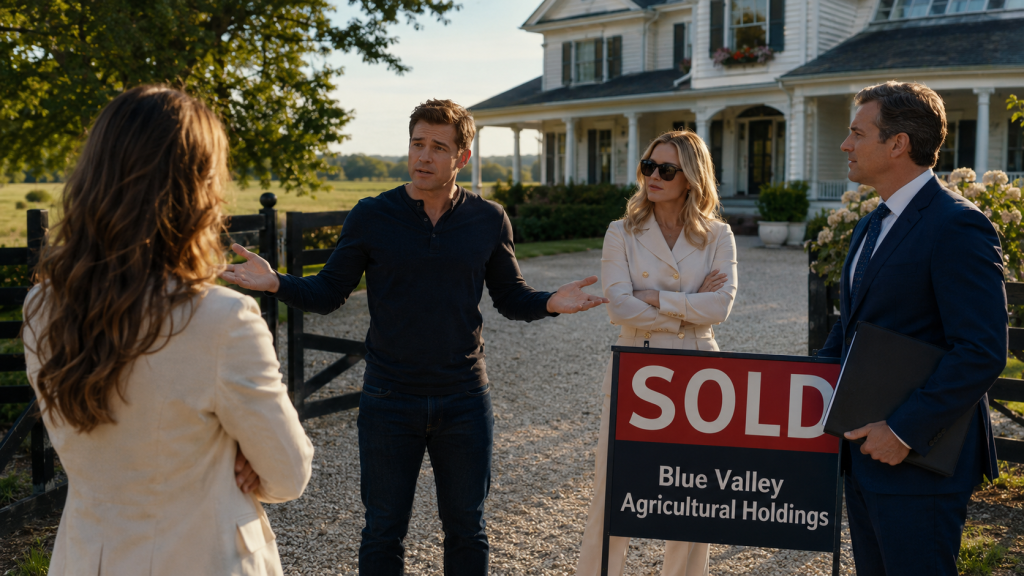
That was why, as I turned onto the road leading toward the farmhouse and saw the red SOLD sign beside the gate, my anger transformed into disbelief.
Brandon stood in the driveway with Tessa and a man in a cheap navy suit.
Tessa wore oversized sunglasses and a white designer coat despite the warm weather. She smiled like someone who had already chosen new curtains.
Behind them, two moving trucks were parked beside the house.
Workers were carrying boxes into my grandmother’s dining room.
Brandon spread his arms when I stepped out of the rental car.
“See?” he called. “No disaster. The buyer is happy, Tessa’s business is saved, and you’re three million dollars richer.”
“I thought you said you spent the money.”
He rolled his eyes.
“I mean richer in the larger sense. Tessa’s company will repay you.”
Tessa lifted her chin.
“With interest.”
I looked at the man in the navy suit.
“Who are you?”
He stepped forward.
“Calvin Ross. I represented the purchasing entity.”
“What entity?”
“Blue Valley Agricultural Holdings.”
I had never heard of it.
“Who owns Blue Valley?”
Calvin glanced at Brandon.
“That information is confidential.”
“You are standing on my property,” I said. “Nothing about this is confidential.”
Brandon gave an irritated sigh.
“Clara, stop trying to intimidate everyone.”
I looked at the farmhouse.
The front doors had been painted bright white.
My grandmother’s climbing roses had been cut away from the porch.
A large banner for Tessa’s company hung across the old barn.
It read:
WELCOME TO THE ABUNDANCE HOUSE.
I stared at it.
Then I saw the locked gate, the fake sold sign, the cheap suit, and Brandon’s proud expression.
And I started laughing.
I could not help it.
At first, it was a quiet laugh.
Then it grew.
Brandon’s smile disappeared.
“What’s funny?”
I wiped tears from my eyes.
“What’s funny,” I said, “is that you sold a farmhouse you don’t own to a buyer who probably doesn’t exist, using a power of attorney that expired three years ago and a deed that became invalid six months ago.”
Tessa lowered her sunglasses.
Calvin stopped breathing.
Brandon’s face stiffened.
“What are you talking about?”
“The farmhouse belongs to a preservation trust.”
“No, it doesn’t.”
“Yes, it does.”
“You inherited it.”
“I transferred it six months ago.”
His eyes darted toward Calvin.
Calvin opened the folder in his hands.
“That wasn’t disclosed.”
“Of course it wasn’t disclosed,” I said. “Because my brother had no authority to disclose anything.”
Brandon stepped closer.
“You can’t put it into a trust without telling me.”
“I didn’t need your permission.”
“I’m family.”
“That does not make you an owner.”
He pointed at the house.
“Grandma wanted both of us to have this place.”
“No. She specifically left it to me.”
“You manipulated her.”
“You inherited six hundred thousand dollars.”
“That wasn’t equal.”
“It was more than enough to build a stable life.”
Tessa removed her sunglasses completely.
“Brandon, you said the farmhouse was partly yours.”
“It is partly mine.”
“No,” I said. “It is not.”
Calvin started flipping rapidly through the documents.
“This deed contains a notarized signature from Clara Hart.”
Evelyn’s SUV turned into the driveway.
Behind her came two sheriff’s vehicles.
I smiled.
“That signature is not mine.”
Brandon took a step backward.
The deputies parked near the gate.
Evelyn climbed out holding a leather briefcase.
She walked toward us with the calm expression of someone arriving at a meeting she had already won.
“Clara,” she said. “Are you all right?”
“I’m better now.”
She turned toward Brandon.
“Mr. Hart, I am Evelyn Shaw, counsel for the Eleanor Hart Family Preservation Trust.”
“I know who you are.”
“Good. Then you understand why you should not say anything further without legal representation.”
Brandon scoffed.
“This is a family matter.”
A deputy stepped closer.
“It stopped being a family matter when forged documents were filed with the county.”
Brandon’s face went pale.
“I didn’t forge anything.”
Calvin looked up from the folder.
“You gave me this deed.”
“The title company prepared it.”
“There is no title company listed here.”
“I hired one online.”
Evelyn held out her hand.
“May I see the document?”
Calvin gave it to her.
She examined the first page, then the second.
“This notary stamp is fraudulent.”
Tessa turned toward Brandon.
“You said everything was legal.”
“It is legal.”
“No,” Evelyn said. “It is not.”
The deputies asked Brandon to step away from the others.
He refused at first.
Then one deputy placed a hand near his belt, and Brandon reluctantly moved beside the patrol car.
Tessa stood frozen in the driveway.
“What happens to my company?” she asked.
I looked at her.
“What exactly did you do with the money?”
She hesitated.
Brandon shouted from beside the patrol car.
“Don’t answer her!”
The deputy told him to remain quiet.
Tessa’s confidence began to crack.
“We paid debts.”
“How much?”
“About nine hundred thousand.”
“What else?”
“We leased an office.”
“How much?”
She looked toward the house.
“One point two million.”
“For an office lease?”
“It’s a flagship wellness center.”
Evelyn stepped beside me.
“Where is the remaining money?”
Tessa folded her arms.
“Marketing, inventory, salaries, vehicles, branding.”
“You spent three million dollars in less than a week?”
“We invested it.”
“Into what?”
She did not answer.
Calvin suddenly cleared his throat.
“I believe I should clarify my involvement.”
Everyone looked at him.
He removed his glasses.
“I was told Blue Valley Agricultural Holdings was purchasing the property as part of a private investment arrangement.”
“Who hired you?” Evelyn asked.
“Mr. Hart.”
“Are you an attorney?”
“No.”
“A licensed real estate broker?”
“No.”
“A title agent?”
“No.”
“What do you do?”
Calvin swallowed.
“I provide business consulting.”
Tessa stared at him.
“You told us you specialized in acquisitions.”
“I help prepare documents.”
“You charged us forty thousand dollars,” Brandon shouted.
Calvin looked offended.
“You asked me to make the transaction appear professional.”
One of the deputies exchanged a glance with the other.
Evelyn rubbed her forehead.
“So there was no actual buyer?”
Calvin looked down.
“Blue Valley Agricultural Holdings was created nine days ago.”
“Who owns it?”
He pointed weakly toward Brandon.
The silence that followed was almost beautiful.
Tessa slowly turned toward my brother.
“You bought the farmhouse from yourself?”
Brandon’s face flushed.
“It was temporary.”
“With Clara’s money?” she demanded.
“It was a financial structure.”
“You told me an international investor bought it.”
“I needed the transaction to move quickly.”
My laughter returned, but this time there was no amusement in it.
Brandon had not merely forged a sale.
He had created a shell company, pretended it was an independent buyer, and used false documents to secure a private loan against property he did not own.
The three million dollars had not come from a buyer.
It came from a lending group that believed the farmhouse was legitimate collateral.
Evelyn understood the situation at the same moment I did.
“Who transferred the three million?” she asked.
Calvin named the lender.
Evelyn’s expression darkened.
“They will demand immediate repayment.”
Tessa shook her head.
“The money is gone.”
“Then they will pursue everyone involved.”
Tessa stepped toward me.
“I didn’t know.”
“You accepted three million dollars belonging to someone else.”
“Brandon told me it was his inheritance.”
“You never questioned why he suddenly had three million dollars?”
“He said he had been treated unfairly.”
“That was enough for you?”
“He showed me documents.”
“Documents prepared by a consultant who is not a lawyer, broker, title officer, or notary.”
Calvin quietly moved farther away.
The sheriff’s deputies entered the farmhouse to speak with the workers.
Within minutes, the moving crew began carrying boxes back outside.
Several of Tessa’s employees emerged from the barn, looking confused and embarrassed.
A woman wearing a shirt printed with the words MANIFEST YOUR MILLIONS asked whether the weekend retreat was canceled.
“Yes,” I said. “Permanently.”
Tessa glared at me.
“You’re enjoying this.”
“No. I’m protecting what belongs to the trust.”
“You have so much. You could let us use the property.”
“That is exactly the attitude that brought you here.”
She opened her mouth, then closed it.
The officers placed Brandon in handcuffs after confirming that the signature on the deed did not match the signature on my passport or the trust documents.
He began shouting.
“Clara, tell them to stop!”
I stood near the gate.
“You forged my name.”
“I was trying to help you.”
“You stole against property that funds a charity.”
“I was going to repay it.”
“With what?”
“Tessa’s company was about to explode.”
Tessa looked away.
“You mortgaged a home you didn’t own, fabricated a buyer, forged my signature, fired my staff, moved strangers into my house, and gave the money to your girlfriend.”
“She believes in me.”
“No, Brandon. She believed you had three million dollars.”
Tessa’s face tightened.
“That’s not fair.”
I looked at her.
“Would you still be standing beside him if he had arrived with three hundred dollars?”
She did not answer.
The deputies placed Brandon in the back of the patrol car.
Before the door closed, he leaned forward.
“Grandma would hate you for doing this.”
That sentence hurt.
For a moment, I was no longer forty-two years old and standing in a driveway.
I was sixteen again, sitting beside my younger brother after our parents’ funeral, promising him I would never leave.
Brandon had carried that promise like a legal contract.
Whenever I refused him money, he said I was abandoning him.
Whenever I held him accountable, he accused me of becoming cold.
Whenever he hurt me, he reminded me that I was all he had left.
But my grandmother’s final lesson returned to me.
Love is not rescue.
I looked at him through the open patrol-car door.
“Grandma loved you,” I said. “But she spent years trying to protect you from consequences. I made the same mistake.”
His expression changed.
For the first time, there was no anger in it.
Only fear.
“Clara…”
“I will not protect you from this.”
The deputy closed the door.
The patrol car drove away.
For the next several hours, the farmhouse became a crime scene.
Investigators photographed the forged documents, the changed locks, the banner on the barn, and the boxes Tessa’s team had moved into the house.
The lender filed an emergency fraud complaint that same afternoon.
Evelyn obtained a court order freezing Tessa’s business accounts.
The company had already spent most of the money, but approximately $420,000 remained.
The leased wellness center was placed under review.
The vehicles were seized.
The inventory had little resale value.
Boxes of powdered drinks and scented candles filled a warehouse that cost nearly twenty thousand dollars a month to rent.
Tessa left the farmhouse before sunset.
She did not say goodbye to Brandon.
She did not even ask where he had been taken.
She simply called a car, loaded three suitcases into it, and disappeared.
Calvin left with an investigator.
Marcus returned after the sheriff removed the unauthorized locks.
He stood beside me on the porch, staring at the damage.
“I’m sorry,” he said.
“This wasn’t your fault.”
“I should have called the police immediately.”
“He had convincing documents.”
“I still should have known.”
I touched the porch railing.
The roses had been cut down almost to the roots.
“Can these grow back?”
Marcus crouched beside them.
“The roots are healthy. They’ll return.”
That answer gave me more comfort than he probably understood.
Inside, the damage was mostly cosmetic.
Tessa had moved my grandmother’s furniture into storage and replaced it with white couches, mirrored tables, and gold decorations.
Someone had hung neon letters over the fireplace.
THE UNIVERSE OWES YOU.
I unplugged the sign.
“No,” I whispered. “It doesn’t.”
The universe did not owe me.
It had taken my parents, my grandmother, and years of peace.
But it had also given me choices.
I could choose what I protected.
I could choose what I forgave.
I could choose when forgiveness no longer meant access.
The legal case unfolded over the next eleven months.
Brandon was charged with forgery, wire fraud, attempted grand theft, identity theft, and conspiracy to commit mortgage fraud.
Calvin cooperated with investigators in exchange for reduced charges.
He provided messages showing that Brandon had planned the scheme for weeks.
The messages were devastating.
Brandon had written that I was too distracted by work to notice.
He claimed I would never press charges because I was “obsessed with keeping the family together.”
He told Calvin that guilt was easier to manipulate than paperwork.
That sentence ended whatever hesitation remained inside me.
Tessa insisted she had been deceived.
But financial records showed she knew the money came from the farmhouse transaction.
She had texted Brandon:
Once the cash clears, Clara can complain all she wants. She won’t risk sending her own brother to prison.
She eventually pleaded guilty to receiving stolen funds and financial conspiracy.
Her company collapsed.
The wellness center never opened.
The rented sports cars disappeared from her social media.
Her millions of followers became thousands, then hundreds.
Brandon’s attorney repeatedly asked me to support a lenient sentence.
My aunt called me.
Two cousins called me.
Even people who had not spoken to me in years suddenly wanted to discuss compassion.
“He’s your only brother,” they said.
“He made a mistake.”
“Prison will destroy him.”
“He already lost his girlfriend.”
“Isn’t losing everything punishment enough?”
I listened.
Then I asked one question.
“If he had done this to you, would you call it a mistake?”
None of them answered directly.
At the sentencing hearing, Brandon looked smaller than I remembered.
He wore a gray suit that did not fit properly.
His hair was shorter.
His hands trembled.
His attorney spoke about our parents’ deaths, Brandon’s childhood trauma, his financial insecurity, and his desire to prove himself.
All of those things were true.
But pain explained his choices.
It did not excuse them.
When it was my turn to speak, I stood before the judge.
“My brother did not steal only money,” I said. “He stole my identity, violated my grandmother’s home, endangered a charitable program, displaced employees, and risked land that has belonged to our family for generations.”
Brandon stared at the table.
“For years, I believed protecting him from consequences was a form of love. I paid his debts. I found him jobs. I forgave lies before he admitted them. I taught him that no matter what he did, I would repair the damage.”
I looked at him.
“That was my mistake.”
His eyes lifted toward mine.
“I do not hate my brother. But love without boundaries becomes permission. I will not give him permission anymore.”
Brandon received a prison sentence of six years, with the possibility of early release after four.
He was also ordered to pay restitution.
The lender recovered part of its loss through seized assets and insurance.
The trust was cleared of liability because the deed and collateral documents were proven fraudulent.
The farmhouse remained protected.
After the case ended, I returned to the property for the spring reopening of the retreat center.
Marcus had restored the porch.
The climbing roses had begun to grow again.
The white paint Brandon chose for the doors had been removed, revealing the original deep green underneath.
The bronze plaque honoring my grandmother was polished and returned to the barn.
That afternoon, twelve young adults arrived for the first retreat of the season.
Some had recently left foster care.
Others were preparing to live independently for the first time.
They attended workshops on budgeting, cooking, employment, housing, and legal rights.
On the second evening, we gathered around a fire near the lake.
A young woman named Maya sat beside me.
She had aged out of foster care three weeks earlier.
She was quiet for most of the night.
Then she asked, “Was this always a retreat center?”
“No,” I said. “It used to be a working farm.”
“Did your family live here?”
“For generations.”
“Do they still?”
“Some memories do.”
She looked toward the farmhouse.
“It must be nice to have a place nobody can take away.”
Her words settled deeply inside me.
“That’s why the trust exists,” I said. “So this place will remain here for people who need it.”
She nodded slowly.
“My caseworker says family is supposed to be permanent.”
“Sometimes it is.”
“And sometimes it isn’t?”
“Sometimes the family we are born into cannot give us what we need.”
She poked the fire with a stick.
“Then what?”
“Then we learn to build safety in other ways. Through friendships. Community. Boundaries. Places where people keep their promises.”
She looked at me.
“Did someone in your family break a promise?”
“Yes.”
“Did you forgive them?”
I watched sparks rise into the dark sky.
“I’m still learning what forgiveness means.”
“Does it mean letting them come back?”
“No,” I said. “Not always.”
Two years after Brandon went to prison, I received a letter from him.
It was the first letter he had written that did not ask for money, legal help, or a character statement.
Clara,
I used to think you had everything and I had nothing.
Every time I saw the farmhouse, I saw proof that Grandma loved you more.
I never looked at what you did to preserve it. I only looked at what I believed I deserved.
I told myself I was taking back something that should have been mine.
The truth is that I wanted to impress someone who made me feel important.
I blamed you because admitting what I had become was harder.
I do not expect forgiveness.
I am sorry for forging your name.
I am sorry for using Grandma’s memory against you.
I am sorry for believing your love made you weak.
You were the only person who kept showing up for me, and I punished you for finally stopping.
Brandon.
I read the letter three times.
Then I placed it in my desk drawer.
I did not answer immediately.
An apology was not a key.
It did not automatically reopen every locked door.
But it was the first honest thing Brandon had given me in years.
Several months later, I wrote back.
I told him the roses had returned.
I told him the retreat center had expanded.
I told him I hoped he continued therapy and accepted responsibility without turning his regret into another request for rescue.
I did not promise money.
I did not promise a home.
I did not promise that everything would return to the way it had been.
Because I no longer wanted the way it had been.
When Brandon was released after serving four and a half years, I did not bring him to the farmhouse.
I met him at a small café near the halfway house where he would be staying.
He looked older.
So did I.
For several seconds, neither of us knew what to say.
Finally, he looked down at his coffee.
“Thank you for coming.”
“I almost didn’t.”
“I know.”
He did not ask me to forgive him.
He did not complain about the sentence.
He told me he had completed accounting classes in prison and wanted to find honest work.
He said he understood if I never trusted him again.
“That may take years,” I said.
“It should.”
He reached into his coat and placed something on the table.
It was a small bronze screw.
I recognized it immediately.
It had once held my grandmother’s plaque to the barn wall.
“I found it in my pocket after they arrested me,” he said. “I don’t know how it got there.”
I picked it up.
“I kept it because it reminded me of the moment I realized what I had done.”
“What had you done?”
“I didn’t just try to steal the house. I tried to erase what it meant.”
For the first time in years, Brandon was not defending himself.
He was not blaming me, our childhood, our grandmother, or bad luck.
He was simply telling the truth.
I closed my fingers around the screw.
“You can’t erase it,” I said.
“I know.”
We sat quietly.
Outside, rain began tapping against the café window.
“I’m not inviting you back to the farmhouse,” I said.
His jaw tightened slightly, but he nodded.
“I understand.”
“Maybe one day.”
He looked at me.
“But that day will depend on what you do next. Not what you say today.”
“That’s fair.”
I left the café without hugging him.
But I did not leave in anger.
A year later, Brandon had kept the same job for eleven months.
He attended counseling.
He made small monthly restitution payments.
He never asked me to reduce them.
He volunteered with a financial literacy program for people leaving prison.
One autumn afternoon, I invited him to the farmhouse for the first time since the fraud.
He arrived alone.
Marcus opened the gate but did not shake his hand.
Brandon understood.
We walked toward the barn.
The apple trees were heavy with fruit.
The wildflower fields had turned gold.
At the barn entrance, Brandon stopped beneath the restored bronze plaque.
He read my grandmother’s name.
Then he touched the place where the missing screw had once been.
I handed it to him.
“You kept it?” he asked.
“Yes.”
He crouched and carefully fastened it into the plaque.
When he stood, his eyes were wet.
“I’m sorry,” he whispered.
“I know.”
“Do you forgive me?”
I looked toward the retreat center, where laughter drifted through the open windows.
“I forgive you enough not to carry hatred,” I said. “But trust is something you rebuild one decision at a time.”
He nodded.
“I can do that.”
“We’ll see.”
We walked through the orchard as the sun dropped behind the lake.
The farmhouse stood in the distance, its windows glowing warmly.
For years, I had believed home was a place where family was always allowed to return.
Now I understood something different.
A home survives because someone protects it.
Sometimes protection means opening the door.
Sometimes it means changing every lock.
And sometimes love means standing at the gate and refusing to let someone enter until they have learned not to destroy what waits inside.
My brother had tried to sell my home for half its value.
He lost the money, his girlfriend, his freedom, and the illusion that I would always save him.
But the farmhouse remained.
The roses returned.
The orchard bloomed.
The young people who came through the retreat center found a place where promises were kept.
And I finally learned that protecting my peace did not make me selfish.
It made me the guardian my grandmother always knew I could become.
THE END! THANK YOU FOR READING!