

The first cruel laugh echoed through the ballroom moments before I reached the altar.
It was not loud enough to interrupt the music, but it was sharp enough to cut through me.
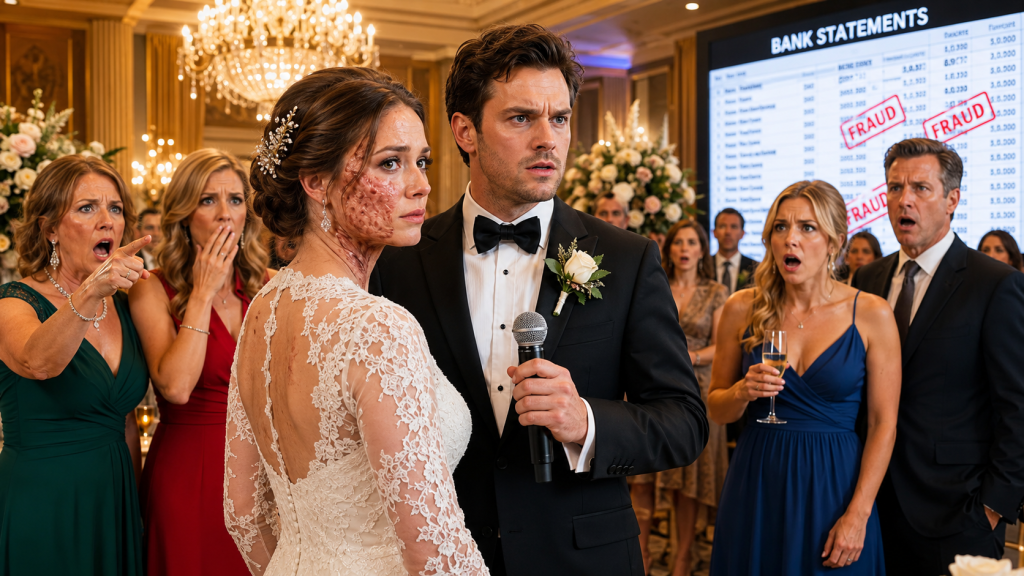
Wrapped in my white wedding gown, I could feel hundreds of eyes following me as I walked beneath the crystal chandeliers of the Grand Wellington Hotel. The scarred left side of my face was fully visible, just as I had chosen.
Thick, uneven burn scars stretched from my temple to my jaw and continued beneath the lace along my neck. Three years earlier, I would have hidden them beneath heavy makeup, lowered my head, and prayed no one looked too closely.
Not today.
Today, I walked with my shoulders straight.
My aunt Vivian leaned toward the woman beside her and whispered loudly enough for several nearby tables to hear.
“The groom has to be blind to marry someone who looks like that.”
A few guests covered their mouths.
Others did not bother.
Vivian’s daughter, Clara, curled her painted lips into a mocking smile.
“Maybe he fell in love with her personality,” she said. “Or perhaps she was simply the cheapest option available.”
Their table erupted in soft laughter.
I tightened my fingers around Daniel’s hand when I finally reached him.
He looked at me with the same warmth he had shown the first time he saw my scars without bandages. There was no pity in his expression. No hesitation.
Only love.
There was a time when those scars had made me wish I could disappear.
After the fire, I had refused mirrors for months. I slept with the curtains closed, avoided crowded places, and convinced myself that strangers could see nothing except damaged skin.
Daniel had never allowed me to speak about myself that way.
The first night I finally let him touch the scar along my cheek, my entire body trembled.
He kissed it gently.
Then he kissed the scar beneath my ear.
Then the one along my neck.
“These are not proof that you were destroyed,” he whispered. “They are proof that you survived.”
At the altar, Daniel gave me a faint smile, but there was a dangerous calm behind it.
“Do you want to leave?” he asked quietly.
I glanced toward Vivian.
She sat in the front row wearing an expensive emerald gown purchased with money that should have belonged to me. Her diamond necklace glimmered beneath the chandeliers.
“No,” I answered. “I want them to keep revealing exactly who they are.”
Daniel nodded.
The ceremony continued.
When the officiant asked Daniel whether he accepted me as his wife, his voice carried across the ballroom without a trace of doubt.
“I do.”
When it was my turn, I looked directly into his eyes.
“I do.”
The applause that followed was scattered and polite.
Some guests smiled sincerely. Daniel’s closest friends stood and cheered. His mother cried into a handkerchief.
But Vivian’s table remained seated.
She had not attended our wedding to celebrate us.
She had come to remind me that, in her mind, I was still the frightened orphan she had controlled for years.
I was eleven when my parents died.
Their private plane disappeared during a storm over the Atlantic. No bodies were recovered, only pieces of wreckage floating across the water three days later.
My father, Alexander Cross, had built Cross Global Industries from a small shipping company into an international logistics empire. My mother, Rebecca, managed the charitable foundation connected to the business.
They were wealthy, respected, and careful.
Their wills placed most of their assets into a trust for me.
Vivian, my mother’s older sister, was appointed my temporary guardian.
She arrived at our home after the memorial wearing black silk and carrying a folder filled with legal documents.
She hugged me in front of the lawyers.
“You are my daughter now,” she whispered.
For the first few months, she behaved like a grieving, protective aunt.
Then the lawyers stopped visiting.
The household staff were dismissed one by one.
My parents’ photographs disappeared from the walls.
Vivian moved Clara into my bedroom and gave me a smaller room near the servants’ staircase.
She told me the company was failing.
She said my parents had left enormous debts.
She claimed the mansion, cars, investments, and business shares had all been sold to cover what they owed.
I believed her because I was a child.
By fourteen, I was doing clerical work for Vivian’s event-planning company after school. She called it “learning responsibility,” but I was never paid.
By sixteen, she was using my name on contracts I did not understand.
When I turned eighteen, she placed documents in front of me and told me they were required to finalize my parents’ estate.
I signed them.
Years later, I discovered that some of those documents had transferred control of several trust accounts into companies Vivian secretly owned.
Others authorized loans under my name.
She had built her luxurious life by slowly draining mine.
Clara grew up believing everything in our house belonged to her.
She wore my mother’s jewelry to parties.
She drove the car my father had purchased shortly before his death.
She invited friends to the family estate and introduced herself as the future owner.
Whenever I questioned anything, Vivian reminded me that she had “taken me in.”
“You would have had nowhere to go without me,” she often said.
By the time I was twenty-six, I had almost accepted her version of my life.
Then I met Daniel.
He came to Vivian’s company as a representative of a hotel group planning a charity gala. He was dressed simply in a dark suit, with no visible signs of wealth.
Vivian assumed he was an ordinary project manager and barely acknowledged him.
I was assigned to assist him.
Daniel noticed small things.
He noticed that I completed work while Clara accepted praise.
He noticed that Vivian never allowed me to sit at the main table during meetings.
He noticed that I stayed late every night but never appeared on the official employee payroll.
One evening, while we were reviewing seating plans, he asked me a question no one had asked in years.
“What do you want?”
I stared at him.
“For the event?”
“For your life.”
I laughed because I did not know how else to respond.
“No one has ever asked me that.”
“Then think about it.”
Over the next several months, Daniel and I became friends.
I learned that he loved old bookstores, strong coffee, and terrible detective movies. He learned that I painted landscapes in secret and had once dreamed of studying architecture.
He never treated me as Vivian’s assistant.
He treated me as though my thoughts mattered.
The night of the fire, we were preparing the ballroom of an old historic hotel for a private dinner.
A faulty electrical panel sparked behind one of the walls.
The fire spread faster than anyone expected.
Smoke poured through the hallways. Alarms screamed. Guests and staff rushed toward the exits.
I was outside when I realized Daniel was missing.
Someone said he had gone back to help an elderly employee.
I did not think.
I ran inside.
The heat was unbearable.
Smoke burned my lungs, and falling debris blocked the main corridor. I found Daniel unconscious near the service staircase with part of a wooden beam trapping his leg.
I pulled at it until my hands blistered.
When flames moved across the ceiling above us, I covered Daniel’s body with mine.
A section of burning material fell against the left side of my face and neck.
I remembered the pain.
Then nothing.
Firefighters found us minutes later.
Daniel recovered after surgery and weeks of physical therapy.
I remained in the hospital for nearly four months.
Vivian visited twice.
The first time, she stood at the foot of my bed and stared at my bandaged face.
“You should have let the firefighters handle it,” she said. “Look what you have done to yourself.”
The second time, she brought documents.
She claimed they were insurance forms.
I was medicated and barely awake, but she insisted I sign them.
A nurse stopped her.
After that, Vivian did not return.
Daniel came every day.
He sat beside my bed, read books aloud, helped me drink water, and stayed through every painful dressing change.
When I finally looked at myself after the bandages were removed, I screamed.
I threw the mirror across the room.
Daniel found me curled against the hospital wall, sobbing.
“My face is gone,” I said.
He knelt beside me.
“No,” he answered. “Your face is here. You are here.”
“You do not understand.”
“I understand that you went into a burning building to save me.”
“I look horrible.”
“You look like the woman who refused to let me die.”
For months, I pushed him away.
I told him his attention came from guilt.
I accused him of confusing gratitude with love.
He waited.
Not passively, but patiently.
He challenged every cruel thing I said about myself.
He took me outside when I was afraid of strangers staring.
He introduced me to survivors who had rebuilt their lives.
He encouraged me to begin painting again.
One year after the fire, he asked me to dinner.
“Is this another therapy exercise?” I asked.
“No,” he said. “It is a date.”
Our relationship grew slowly.
Daniel never rushed me.
The first time we kissed, he touched the scar along my jaw and waited for me to nod before moving closer.
For the first time since the fire, I did not feel damaged.
I felt wanted.
Vivian hated him almost immediately.
Not because she knew who he really was.
She hated him because I became harder to control.
Daniel asked questions about my parents’ estate.
He wanted to know why I had no access to their company records.
He questioned why Vivian controlled every bank account associated with my name.
At first, I defended her.
“She raised me.”
“She exploited you,” he answered.
“You do not know everything she sacrificed.”
“What did she sacrifice?”
I had no answer.
Daniel introduced me to a financial attorney named Marcus Lane.
Marcus reviewed the few documents I possessed and immediately noticed inconsistencies.
My parents’ company had not collapsed.
Cross Global Industries had continued growing after their deaths.
My father’s original shares had been placed in a protected trust for me. According to the legal structure, no guardian could sell or permanently transfer them.
Yet someone had hidden my ownership behind layers of shell companies and false reports.
Marcus hired forensic accountants.
What they found was worse than anything I had imagined.
Vivian had not merely stolen small amounts.
Over fifteen years, she had redirected nearly eighteen million dollars from accounts connected to my trust.
She had forged my signature on loans.
She used my identity to secure financing for her failing businesses.
She sold properties belonging to the estate and kept the proceeds.
She even submitted false medical reports claiming I was psychologically incapable of managing my own assets.
The fire had given her another opportunity.
While I was hospitalized, Vivian attempted to have herself appointed as my permanent financial guardian.
The nurse who stopped her from obtaining my signature had likely saved the rest of my inheritance.
I sat in Marcus’s office staring at copies of the documents.
“I trusted her,” I whispered.
Daniel sat beside me.
“You were a child.”
“I signed things.”
“Because she lied to you.”
“She told everyone I was useless.”
Daniel took my hand.
“She needed you to believe that. Otherwise, you might have discovered how powerful you truly were.”
The investigation continued quietly.
Marcus contacted the board of Cross Global Industries.
Several senior executives had known my parents personally. They had been told that I wanted no involvement in the company and had authorized Vivian to manage communications.
When they learned the truth, they were horrified.
My ownership was confirmed.
I held fifty-one percent of the voting shares.
I was not a poor orphan dependent on Vivian’s charity.
I was the majority owner of a global corporation valued in the billions.
Daniel advised me not to confront Vivian immediately.
“We need evidence strong enough that she cannot destroy it or escape,” he said.
So I remained silent.
Vivian continued treating me like a servant.
Clara continued mocking my scars.
And they continued spending money they believed I would never reclaim.
When Daniel proposed, I said yes before he finished asking.
He chose a quiet garden behind his mother’s home. There were no cameras, no audience, and no expensive decorations.
He placed a simple diamond ring on my finger.
“I cannot promise the world will never hurt you again,” he said. “But I promise you will never face it alone.”
When Vivian learned about the engagement, she laughed.
“Daniel must feel responsible for what happened to you,” she said. “Men like him do not marry women like you unless guilt is involved.”
Clara examined my ring and suggested it was fake.
Neither of them knew that Daniel was not an ordinary hotel employee.
He was Daniel Mercer, founder and chief executive officer of Mercer International Hospitality, one of the largest luxury hotel groups in North America and Europe.
He had attended the charity event under a lower-level title because he preferred observing projects without employees changing their behavior around him.
Vivian had dismissed him because she believed expensive clothes and loud introductions were the only signs of importance.
Daniel found her arrogance amusing.
I found it useful.
When we announced the wedding venue, Vivian suddenly became interested.
The Grand Wellington was one of the most exclusive hotels in the city.
She assumed Daniel had borrowed money or received a discount.
She invited several wealthy acquaintances without asking us.
“These people could be useful for your future,” she told me.
She meant her future.
Marcus suggested we allow them to attend.
The investigation was nearly complete. Court orders were prepared. Law enforcement had reviewed the evidence.
All we needed was the right moment to reveal the truth.
I wanted that moment to happen where Vivian felt most powerful.
At a wedding surrounded by people she desperately wanted to impress.
The reception began after the ceremony.
The ballroom glowed beneath warm golden lights. White roses covered every table. A string quartet played near the windows overlooking the city.
Daniel and I danced.
For several minutes, I forgot Vivian existed.
His hand rested carefully at my waist.
“You are beautiful,” he whispered.
“You are biased.”
“Completely.”
I smiled.
Across the room, Vivian watched us with narrowed eyes.
When the speeches began, Daniel’s mother welcomed me into her family.
She spoke about the first time Daniel told her about the woman who had saved his life.
“He did not describe Elena’s scars,” she said. “He described her courage, her humor, and the way she made him want to become a better man.”
Several guests applauded.
Then Clara stood.
She had clearly been drinking.
“To Daniel,” she announced, lifting her champagne glass. “Most men marry beauty. You married… sacrifice.”
An uncomfortable silence followed.
Clara laughed at her own words.
A few guests at Vivian’s table joined her.
She continued.
“We should all admire a man willing to overlook so much. Elena has never had much to offer, especially after the accident. But Daniel has generously given her a respectable future.”
Vivian rose beside her.
“Our family is grateful,” she said. “We always worried Elena would become everyone’s burden after her face was ruined. Daniel deserves applause for taking responsibility.”
This time, the laughter was louder.
Some guests stared at their plates.
Others watched me with curiosity, waiting to see whether I would cry.
I did not.
Daniel slowly stood.
“Our gratitude?” he repeated.
He reached for the microphone.
The ballroom fell silent.
“I’m not blind,” he said calmly.
His voice filled every corner of the room.
“I see my wife more clearly than anyone here.”
Vivian’s smile weakened.
Daniel turned toward the projector screens.
“Those scars exist because Elena entered a burning building to save my life. She shielded me with her own body while part of the ceiling collapsed. They are not marks of shame. They are evidence of courage.”
His gaze moved toward Clara.
“The scars you find so amusing are the reason I am standing here.”
Clara lowered her glass.
Daniel continued.
“And Vivian, there is one important detail all of you have ignored.”
He unlocked his phone and pressed a button.
The wedding photographs disappeared from the giant screens.
In their place appeared bank statements covered in red markings.
Then loan agreements.
Property transfers.
Copies of forged signatures.
The executive ownership roster of Cross Global Industries.
A murmur spread through the ballroom.
Vivian froze.
“What is this?” she demanded.
Daniel looked directly at her.
“This is a record of every dollar you stole from Elena.”
The room erupted in whispers.
Vivian’s face drained of color.
“That is ridiculous.”
Daniel changed the slide.
A timeline appeared, documenting fifteen years of transactions.
“These records were examined by three independent forensic accounting firms,” he said. “They show that you redirected more than eighteen million dollars from Elena’s trust and estate.”
“That money belonged to me,” Vivian snapped. “I raised her.”
“No,” I said, standing.
My voice surprised even me.
“It belonged to my parents.”
Vivian turned toward me.
“You ungrateful little—”
“Choose your next words carefully,” Marcus said from the back of the ballroom.
He walked forward carrying a sealed folder.
Two investigators entered behind him.
The guests nearest Vivian moved away from her table.
Marcus stopped beside me.
“Elena Cross is the legal majority shareholder of Cross Global Industries,” he announced. “Her ownership was concealed through fraudulent filings submitted by Vivian Hart and several associated companies.”
A new document appeared on the screen.
My name was printed at the top.
Elena Rebecca Cross.
Fifty-one percent ownership.
The ballroom went completely silent.
Clara stared at the screen.
“That cannot be true,” she whispered.
“It is,” Marcus replied.
Vivian’s mouth opened, but no sound came out.
Daniel handed me the microphone.
“For years,” I said, “Vivian told me my parents left nothing. She told me I owed her for feeding me, housing me, and allowing me to work without pay.”
A few guests lowered their heads.
Some of them had attended Vivian’s parties for years. They had seen how she treated me.
They had laughed.
They had never asked questions.
“She used my identity to borrow money,” I continued. “She forged my name, sold properties from my parents’ estate, and told people I was mentally incapable of managing my life.”
Vivian suddenly laughed, but the sound was strained.
“This is a performance. Elena has always been unstable, especially since the fire.”
Marcus opened the folder.
“We expected that response.”
He removed several documents.
“These are the medical reports you submitted to the court. The doctors whose signatures appear on them have confirmed they never examined Elena. Two of them had never even met her.”
Vivian gripped the table.
“I can explain.”
“You will have that opportunity,” one of the investigators said.
Clara grabbed her mother’s arm.
“What are they talking about?”
Vivian ignored her.
She looked at Daniel.
“You planned this.”
“No,” he said. “You created this. We simply collected the evidence.”
The investigators approached Vivian.
She stepped backward.
“You cannot arrest me at a wedding.”
“No one said anything about arresting you here,” Marcus replied. “But criminal complaints have been filed. Emergency asset-freezing orders were approved this morning.”
Clara’s glass slipped from her hand and shattered across the floor.
“Asset freezing?” she asked.
Marcus nodded.
“All properties and accounts connected to the stolen funds are under legal restriction.”
Clara turned toward her mother.
“Our house?”
“Likely purchased with misappropriated money,” Marcus said.
“My car?”
“The same.”
Clara’s face twisted.
“You told me everything belonged to us.”
Vivian snapped, “Be quiet.”
“No!” Clara shouted. “You said Elena had nothing!”
Vivian looked around the ballroom.
The same people who had laughed with her minutes earlier were now avoiding her eyes.
Her high-society friends stepped away as though dishonesty were contagious.
She had spent years building a reputation from stolen money.
It collapsed in less than ten minutes.
Vivian pointed at me.
“You would have been nothing without me.”
For the first time in my life, her words did not hurt.
I looked at her calmly.
“I might have believed that once.”
I touched the scar along my cheek.
“You taught me to feel ashamed of surviving. You taught me to apologize for taking up space. You convinced me love had to be earned through obedience.”
My voice grew steadier.
“But you were wrong.”
Vivian’s eyes filled with rage.
“I gave you a home.”
“You took my home.”
“I raised you.”
“You controlled me.”
“I protected you.”
“You stole from me.”
Each answer pushed her further into silence.
Daniel took my hand.
Vivian looked at him with desperation.
“She is damaged. You will regret this marriage.”
Daniel’s expression hardened.
“The only damaged thing in this room is the illusion you built around yourself.”
A few guests began to applaud.
At first, it was only Daniel’s mother.
Then Marcus joined.
Then several employees from Cross Global Industries stood.
The applause spread across the ballroom.
It was not for the spectacle.
It was not even for revenge.
It was for the truth.
Vivian’s shoulders collapsed.
The investigators escorted her from the room to serve the legal documents and begin a formal interview.
Clara followed, crying about her house, her clothing, and the wedding photographs she had already posted online.
Neither apologized to me.
I did not expect them to.
After the doors closed, the ballroom remained quiet.
Daniel looked at me.
“We can end the reception,” he said softly.
I glanced around the room.
Some guests looked ashamed.
Others waited nervously.
“No,” I said. “This is still our wedding.”
The quartet began playing again.
Daniel held out his hand.
“May I have this dance, Mrs. Mercer?”
I smiled.
“Yes.”
We returned to the dance floor.
For years, I had believed everyone saw my scars before they saw me.
But as Daniel pulled me close, I realized something had changed.
The scars were still there.
The staring had not erased them.
Vivian’s cruelty had not erased them.
Nothing would.
But they no longer controlled the story.
I did.
In the months that followed, the legal case moved quickly.
Vivian’s accounts were frozen.
Several of her properties were seized.
Former employees agreed to testify about forged documents and illegal transfers.
The evidence revealed that she had also defrauded business partners, lenders, and charities.
Clara claimed she knew nothing.
That was partly true.
She had enjoyed the money without asking where it came from.
She eventually moved into a small apartment and found a job for the first time in her life.
Vivian was later convicted of fraud, identity theft, forgery, and financial exploitation.
The judge ordered restitution, though Marcus warned me that not every stolen dollar would be recovered.
I discovered that I did not need all of it back to feel whole.
Justice was not the return of every lost year.
It was the end of Vivian’s control.
I officially joined the board of Cross Global Industries.
At first, I felt unprepared.
Then I remembered how many years I had spent quietly solving problems while others took credit.
I studied the company’s history, met employees, and rebuilt the charitable foundation my mother had created.
We launched a program supporting burn survivors with medical treatment, counseling, education, and employment assistance.
I named it the Rebecca Cross Courage Foundation.
Daniel attended the opening ceremony.
When I stepped onto the stage, cameras flashed.
For one brief moment, the old fear returned.
I imagined every person staring at the left side of my face.
Then I saw a teenage girl in the front row.
She had burn scars along both arms and part of her neck.
She was watching me with tears in her eyes.
After the event, she approached.
“I always wear long sleeves,” she said. “Even in summer.”
I understood immediately.
“You do not owe anyone access to your scars,” I told her. “You can cover them when you want. You can show them when you want. The choice belongs to you.”
She looked at my face.
“Were you scared today?”
“Yes.”
“But you still went onstage.”
“Yes.”
She smiled.
“Then maybe I can wear a short-sleeved shirt someday.”
That moment meant more to me than every court victory.
Daniel and I moved into a quiet house outside the city.
Not the largest house.
Not the most expensive.
Just a warm home with large windows and enough space for my painting studio.
On our first anniversary, we returned to the Grand Wellington.
The hotel staff arranged dinner in the same ballroom where our wedding had taken place.
The room was empty except for one table beneath the chandeliers.
Daniel poured champagne.
“To sacrifice?” he teased.
I laughed.
“To courage.”
He lifted his glass.
“To the most beautiful woman I know.”
I touched my scar.
Once, those words would have made me uncomfortable.
Now, I believed him.
Not because the scars had become beautiful by ordinary standards.
Not because suffering had magically made me stronger.
But because they belonged to me.
They were part of my face, my past, and my survival.
Vivian had spent years trying to convince me that damage made a person less valuable.
She was wrong.
A person’s worth is not determined by flawless skin, inherited wealth, social status, or the approval of cruel people.
Worth is not something another person gives you.
It cannot be stolen by an aunt, mocked by a ballroom, or destroyed by fire.
Daniel reached across the table and traced one finger gently along my hand.
“Where did you go?” he asked.
“I was thinking about the wedding.”
“The good parts or the dramatic parts?”
“Both.”
He smiled.
“Any regrets?”
I looked around the glowing ballroom.
I remembered Vivian’s laughter.
Clara’s cruel toast.
The bank records filling the screens.
The applause when I finally spoke for myself.
“No,” I said. “They came to watch a broken orphan marry a man they thought was blind.”
Daniel raised an eyebrow.
“And what did they see?”
I leaned closer.
“They saw that I was never broken.”
Then I kissed my husband beneath the same lights that had once exposed every scar I wanted to hide.
This time, I did not lower my face.
I let the light touch every part of me.
THE END! THANK YOU FOR READING!