

Thirty minutes after giving birth, I expected my husband to cry, kiss our baby, and call us his family.
Instead, he stared at our newborn daughter and whispered, “I want a DNA test. That baby might not be mine.”
My heart stopped.
But I did not scream.
I picked up my phone and said, “Prepare the divorce papers.”
Then my mother-in-law turned white, because she knew the truth he did not.
Thirty minutes earlier, I had believed the most difficult part of my day was over.
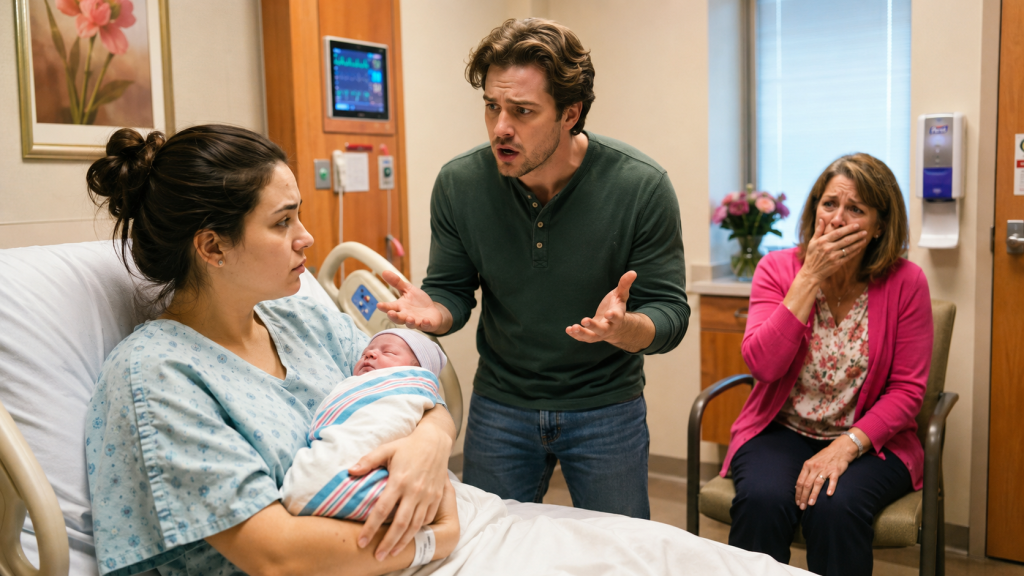
I lay in a hospital bed in Nashville, drained from fourteen hours of labor. My body felt bruised and hollow, my stitches burned, and my hands were still shaking beneath the plastic identification bracelet fastened around my wrist.
Our daughter, Lily, rested against my chest.
She was wrapped in a soft pink blanket, with only her tiny face and one delicate hand visible. Her lips opened and closed as if she were practicing how to speak. Every few seconds, her fingers curled around the edge of the blanket.
She was perfect.
I had imagined this moment throughout my entire pregnancy.
I thought Mark would sit beside me, crying openly as he held our daughter for the first time. I thought he would kiss my forehead and tell me how proud he was. I thought we would look at Lily together and whisper promises about the life we would give her.
Mark had seemed excited for months.
He attended every prenatal appointment.
He recorded the sound of Lily’s heartbeat on his phone.
He spent three weekends painting the nursery pale yellow because he said pink was too predictable. He assembled her crib twice after realizing he had installed one panel backward. He read parenting books in bed and highlighted sections about infant sleep.
The night before my contractions began, he knelt beside my stomach and whispered, “Daddy can’t wait to meet you.”
But now, after she had arrived, he stood at the foot of my bed with his arms folded.
He did not smile.
He did not come closer.
He studied Lily’s face as if she were evidence in the middle of a criminal investigation.
At first, I thought he was overwhelmed.
“Mark,” I whispered. “Come meet your daughter.”
His eyes remained fixed on her.
Then he said, “I want a DNA test.”
For a second, I convinced myself the medication had distorted his words.
I stared at him.
“What?”
His mother, Carol, sat quietly near the window holding a paper cup of coffee. The moment the words left Mark’s mouth, she became completely motionless.
Mark took a slow breath.
“You heard me. I want a DNA test. That baby might not be mine.”
The hospital room fell silent.
I could hear the faint hum of the monitor beside me and Lily’s soft breathing against my chest.
My nurse, Dana, stopped adjusting the IV line. Her expression changed from professional calm to disbelief.
I looked at the man I had spent four years married to.
The man who had been beside me when I took the pregnancy test.
The man who had cried during the first ultrasound.
The man who had rubbed my back through every contraction.
“You’re saying this now?” I asked quietly.
Mark’s jaw tightened.
“I have a right to know the truth.”
“What truth?”
“Whether she’s mine.”
A pain sharper than labor moved through my chest.
I wanted to scream at him.
I wanted to throw something.
I wanted to demand an explanation for how he could turn the most vulnerable moment of my life into an accusation.
But Lily moved against me, and her tiny hand wrapped around my finger.
Something inside me became still.
Cold.
Unbreakable.
Carol suddenly stood.
“Mark, don’t do this.”
He turned toward her.
“No, Mom. I’m not going to raise another man’s child.”
Carol’s hand tightened around her coffee cup.
“You don’t know what you’re saying.”
“I know exactly what I’m saying.”
I lowered my eyes to Lily.
She had my nose. I could already see it. But her dark hair surprised me because both Mark and I had been blond as babies.
Perhaps that was what had disturbed him.
Or perhaps someone had filled his head with poison long before he entered that hospital room.
“Fine,” I said.
Mark’s shoulders relaxed slightly, as though he believed I had agreed to prove myself.
I carefully reached for my phone on the bedside table.
“What are you doing?” he asked.
I unlocked the screen and searched for Rachel Bennett, the attorney who handled the legal contracts for my marketing company.
Rachel answered after two rings.
“Emily? Congratulations. How are you feeling?”
“I need you to prepare divorce papers.”
Every trace of color disappeared from Mark’s face.
Rachel became silent.
“Emily, are you sure?”
“Yes.”
“Do you feel safe?”
“I’m in the hospital. My nurse is here.”
Dana gave me a small nod.
Rachel’s voice became firm and professional.
“All right. Don’t sign anything Mark gives you. Don’t discuss property, custody, or finances without me present. I’ll begin preparing everything today.”
“Thank you.”
I ended the call and placed the phone beside me.
Mark stared at me.
“You’re divorcing me over a DNA test?”
“No,” I said. “I’m divorcing you because thirty minutes after I gave birth, you looked at our daughter and called me unfaithful.”
“I didn’t call you unfaithful.”
“You said she might belong to another man. What else could that mean?”
“I’m asking for certainty.”
“You had four years to decide whether you trusted me.”
His mouth opened, but no answer came.
Carol covered her lips with trembling fingers.
“Oh God,” she whispered. “He doesn’t know.”
Mark slowly turned toward her.
“What don’t I know?”
Carol looked at me first.
There was terror in her eyes, but also guilt.
Old guilt.
The kind that had been carried for decades.
“Mom,” Mark demanded. “What are you talking about?”
Carol lowered herself into the chair as if her legs could no longer support her.
“Your father told me something before he died.”
Mark’s expression hardened.
“My father has been dead for seven years. What does he have to do with this?”
Carol stared at the floor.
“He told me he wasn’t your biological father.”
The silence that followed felt heavier than the first.
Mark gave a short, nervous laugh.
“That’s not funny.”
“I’m not joking.”
“You’re saying Dad wasn’t my father?”
“He was your father in every way that mattered,” Carol said, tears filling her eyes. “He raised you. He loved you. He never treated you differently.”
“Differently from whom?”
Carol closed her eyes.
“Your sister.”
Mark took a step backward.
His younger sister, Amanda, lived in Knoxville with her husband and two children. She and Mark had never looked much alike, but no one had considered that unusual.
“What are you saying?” he asked.
“When I was twenty-two, before your father and I were married, we separated for several months. I became involved with someone else. His name was Thomas.”
Mark’s face twisted.
“You cheated on Dad?”
“We weren’t married yet, and we had ended our relationship. I didn’t know your father and I would reconcile.”
“Then why didn’t you marry Thomas?”
“Because he disappeared when I told him I was pregnant.”
Carol’s voice cracked.
“Your father came back. He knew everything. He chose to raise you as his own.”
Mark shook his head repeatedly.
“No. Dad would have told me.”
“He wanted to. I begged him not to.”
“Why?”
“Because I was afraid.”
“Afraid of what?”
“That you would search for Thomas. That you would reject the man who spent his life loving you. That the truth would destroy our family.”
Mark stared at her.
“So you lied to me for thirty-six years.”
“I thought I was protecting you.”
“You let me believe Dad was my biological father.”
“He was your father.”
“That’s not what I asked!”
Lily startled at the sound of his raised voice and began to cry.
Dana stepped forward.
“Sir, you need to lower your voice or leave the room.”
Mark ignored her.
He pointed toward the baby.
“What does this have to do with Lily?”
Carol’s shoulders shook.
“Two weeks ago, you called me and said you were worried because the baby might have dark hair. You told me Emily’s doctor had mentioned her blood type during an appointment.”
I looked at Mark.
“What?”
He avoided my eyes.
Carol continued.
“You said you had read online that two parents with certain blood types couldn’t have a baby with another type. You believed your father’s blood type was the same as yours.”
Mark said nothing.
The truth began forming in my mind.
At thirty-four weeks, my doctor had discussed possible blood incompatibility and confirmed my blood type in front of Mark. Later that evening, he asked whether anyone in my family had type B blood.
I thought he was simply curious.
Apparently, he had started investigating instead.
Carol wiped her cheeks.
“The blood type you believed you inherited from your father proves nothing, Mark. He wasn’t your biological father.”
Mark looked as though the room had tilted beneath him.
“I asked you directly,” he said. “I asked whether there was anything unusual in our family.”
“And I told you to let it go.”
“You knew I suspected Emily.”
“I didn’t know you would accuse her in the hospital.”
“You knew enough!”
“Yes,” Carol cried. “And I should have told you. I should have told you years ago.”
Mark sank into the chair beside the wall.
For the first time since Lily’s birth, he looked at her without suspicion.
His expression collapsed.
“Emily,” he whispered.
I held Lily closer.
“No.”
“Please.”
“No. You do not get to say my name like that now.”
“I made a mistake.”
“A mistake is forgetting the car seat. A mistake is buying the wrong diapers. You accused me of giving birth to another man’s child while I was still bleeding from delivering her.”
“I was scared.”
“So was I. I was terrified throughout labor. But I trusted you to stand beside me.”
“I didn’t know about my father.”
“This is not about your father.”
“It explains why I thought the blood type—”
“It explains your confusion,” I said. “It does not excuse your cruelty.”
Dana helped me adjust Lily against my chest.
Carol sat silently, crying into her hands.
Mark stood again.
“I still want the test.”
I stared at him.
After everything he had learned, he still wanted proof.
Dana looked at me with concern.
I felt strangely calm.
“You’ll get it,” I said. “Not because you deserve reassurance, but because one day Lily may need medical information about her biological family. We will do the test properly, through an accredited laboratory, with the results documented for court.”
“For court?”
“For custody.”
Mark’s face tightened.
“You’re serious about the divorce.”
“I have never been more serious about anything.”
He walked toward me, but Dana stepped between us.
“Sir, she needs rest.”
“I need to talk to my wife.”
“She has told you what she wants.”
Mark looked at me.
“Emily, don’t destroy our family because I panicked.”
I laughed once, though there was no humor in it.
“You destroyed the family you claimed you were protecting.”
He left the hospital room ten minutes later.
Carol remained.
She sat quietly while I fed Lily for the first time. Dana dimmed the lights, checked my blood pressure, and left us alone.
Carol finally spoke.
“I am so sorry.”
I did not answer.
“I should have told him,” she continued. “When he started asking questions, I should have told him.”
“Yes.”
“I was ashamed.”
“And now that shame has been passed down to my daughter.”
Her eyes filled again.
“I never wanted that.”
“But it happened.”
Carol looked at Lily.
“May I come closer?”
I hesitated, then nodded.
She moved beside the bed but did not touch the baby.
“She’s beautiful,” she whispered.
“She is.”
“Mark has always been afraid of being made a fool of. His father’s brothers used to tease him because he didn’t look like the rest of the family. I think a part of him always sensed something.”
“That may explain his fear. It doesn’t justify what he did.”
“I know.”
For the first time, Carol did not defend him.
She did not tell me marriage required forgiveness.
She did not ask me to reconsider the divorce.
She simply sat beside me and accepted the consequences of the secret she had kept.
The next morning, Rachel arrived at the hospital.
She carried a leather folder, a notebook, and the expression of a woman prepared for war.
Rachel was in her early forties, with sharp eyes and a calm voice that made people listen.
She kissed my cheek, looked at Lily, and said, “She is absolutely beautiful.”
Then she pulled a chair beside my bed.
“Tell me everything.”
I described the accusation, Carol’s confession, Mark’s insistence on a DNA test, and the conversation Dana had witnessed.
Rachel wrote down every detail.
“Do you believe Mark might try to remove Lily from your care?”
“No. He barely held her.”
“Has he ever been physically aggressive?”
“Never.”
“Financially controlling?”
I paused.
“Not exactly. We have separate business accounts, but our household accounts are shared.”
“Change your banking passwords today. Not because I believe he will steal from you, but because divorce can make predictable people behave unpredictably.”
My marketing company had existed before I married Mark. I had grown it from a freelance operation into a small agency with twelve employees.
Mark worked as a regional sales director for a medical equipment company. He earned good money, but the house had been purchased largely with income from my business.
Our prenuptial agreement protected the company.
At the time, Mark had joked that he would never touch money I had built myself.
Now I was grateful Rachel had insisted on precise language.
She explained that Tennessee law presumed a child born during marriage was the husband’s legal child, but a DNA test could establish biological certainty.
“His demand will likely make him look unreasonable,” she said. “Especially given the timing.”
“I don’t want revenge.”
“Good. Courts don’t care about revenge. They care about the child.”
“I want Lily protected.”
“Then we will focus on that.”
The DNA test was performed before I left the hospital.
A technician swabbed the inside of Lily’s cheek, then Mark’s.
Mark avoided looking at me throughout the procedure.
When the technician finished, he stepped closer.
“Can we talk privately?”
Rachel stood beside my wheelchair.
“Anything you need to say can be said in front of counsel.”
His eyes flashed with irritation.
“I’m not speaking to you.”
“You will be if you want access to my client.”
I looked at Rachel.
“It’s okay.”
She stepped several feet away but remained in the room.
Mark lowered his voice.
“I’m sorry.”
“For which part?”
“All of it.”
“That is not specific enough.”
He swallowed.
“I’m sorry I accused you. I’m sorry I ruined Lily’s birth. I’m sorry I listened to people who didn’t know anything.”
“People?”
His eyes shifted.
That was the first moment I realized Carol’s secret was not the only reason for his accusation.
“Who were you listening to?”
Mark rubbed the back of his neck.
“Jason.”
His best friend.
Jason had disliked me from the beginning. He believed marriage had changed Mark and frequently complained that Mark no longer joined him for weekend trips or late nights at bars.
“What did Jason say?”
“He said the baby’s features didn’t make sense. He saw the ultrasound photo and joked that she had a different nose.”
“An ultrasound photo?”
“I know it sounds ridiculous.”
“It does.”
“He also said you had been spending a lot of time with Daniel from your office.”
Daniel was my operations manager.
He was fifty-eight years old, married, and had three grandchildren.
“Daniel covered meetings when I was sick during pregnancy.”
“I know.”
“Apparently, you did not.”
Mark looked down.
“Jason kept saying successful women always had options. He said I was naive to trust you completely.”
“And you believed him.”
“I let it get into my head.”
“You chose the opinion of a bitter friend over four years of marriage.”
“I was afraid to ask you before the birth.”
“So you waited until I was exhausted and trapped in a hospital bed.”
He had no answer.
I felt something inside me close permanently.
Not because he had been confused.
Not because he had requested a test.
Because he had prepared the accusation in advance.
He had walked into that room already convinced I was guilty.
“You should leave,” I said.
“Emily—”
“Leave.”
Rachel stepped forward.
Mark walked away without holding Lily.
I moved into my mother’s house after leaving the hospital.
My mother, Susan, transformed her guest bedroom into a temporary nursery. She washed tiny clothes, prepared meals, and woke with me during the night even when I insisted she needed rest.
For the first week, I moved through life in a fog of feeding schedules, medication, tears, and exhaustion.
Some nights I cried because my marriage was ending.
Other nights I cried because I felt guilty for crying while holding such a beautiful baby.
My mother never told me what decision to make.
She simply sat with me.
“Missing the man you thought he was does not mean you should return to the man he proved himself to be,” she said.
Mark sent messages every day.
I’m sorry.
Please let me see Lily.
I’ve blocked Jason.
I’ll go to counseling.
Please don’t end our marriage.
Rachel advised me to keep all communication in writing.
I agreed to supervised visits at my mother’s home.
During his first visit, Mark stood in the living room holding a stuffed rabbit he had purchased from the hospital gift shop.
When my mother placed Lily in his arms, he began to cry.
Real tears.
The tears I had expected in the hospital.
“She’s so small,” he whispered.
I watched from the other side of the room.
He kissed her forehead.
“I’m sorry, Lily.”
Part of me wanted to believe that was enough.
But apologies could not erase memory.
I would always remember his folded arms.
His cold voice.
The way he had looked at our daughter as if her existence were an offense committed against him.
Two weeks later, the DNA results arrived.
Rachel asked whether I wanted to open them privately.
“No,” I said. “Mark wanted certainty. He can hear it with me.”
We met in Rachel’s conference room.
Mark sat across from me. Carol sat beside him, pale and nervous.
Rachel opened the sealed report.
“The probability of paternity is greater than 99.99 percent,” she read. “Mark is Lily’s biological father.”
Mark closed his eyes.
Carol began crying.
I felt no triumph.
Only sadness.
Mark looked at me.
“I knew she was mine.”
“No, you didn’t.”
“I mean, after Mom told me—”
“You still insisted on the test.”
He nodded slowly.
“You’re right.”
Rachel placed the report on the table.
Mark pushed a folder toward me.
“What is this?” I asked.
“A written apology. And proof that I started therapy.”
I did not open it.
“I also requested a leave of absence from work,” he continued. “I want to help with Lily.”
“You can help by following the parenting schedule our attorneys establish.”
His face fell.
“So that’s it?”
“That’s what?”
“There’s no chance for us?”
I looked at him for a long moment.
“I loved you,” I said. “I might still love parts of you. But love without trust becomes a place where one person is always waiting to be accused again.”
“I’ll never accuse you again.”
“You cannot promise what kind of man you will become under pressure.”
“I can change.”
“I hope you do. Lily deserves a father who changes.”
“And you?”
“I deserved a husband who trusted me before he needed to lose me.”
Carol reached across the table.
“Emily, please don’t punish Lily by breaking up her family.”
I turned toward her.
“A home with married parents is not automatically a healthy family. Lily will be safer with two peaceful homes than one home poisoned by suspicion.”
Carol slowly withdrew her hand.
She nodded.
“You’re right.”
It was the first time I had ever heard her say those words to me.
The divorce lasted seven months.
Mark did not fight the prenuptial agreement, but custody negotiations were difficult.
At first, he requested equal overnight custody immediately, despite having no experience caring for a newborn alone.
Rachel argued for a gradual schedule.
He received frequent daytime visits, followed by short unsupervised periods as Lily grew older.
To his credit, he attended parenting classes.
He learned how to prepare bottles, change diapers, recognize fever, and soothe Lily when she cried.
He continued therapy.
He also ended his friendship with Jason.
Months after the DNA results, Jason sent me a message claiming he had only been protecting his friend.
I never responded.
People often called cruelty protection when they did not want to accept responsibility for the damage they caused.
Carol asked to meet me alone before the divorce was finalized.
We sat in a quiet café near my office.
She looked older than she had before Lily’s birth.
“I found Thomas,” she said.
I set down my cup.
“Mark’s biological father?”
She nodded.
“He died three years ago.”
“Does Mark know?”
“Yes. He located a daughter Thomas had later in life. Mark has a half-sister in Kentucky.”
“How is he handling it?”
“Poorly. But honestly.”
Carol folded her hands.
“Mark said learning the truth made him understand what he did to you. He spent his entire life believing one story about himself. When it collapsed, he realized how quickly he had tried to collapse your story too.”
I remained silent.
“I’m not asking you to take him back,” she added. “I know I have no right.”
“Then why did you want to meet?”
“To apologize without defending myself.”
She took a breath.
“I kept the truth from Mark because I wanted to preserve the image of a perfect family. When he began questioning Lily, I still chose silence. I protected my secret at the expense of your dignity.”
Her honesty surprised me.
“I cannot undo what happened,” she said. “But I want you to know I will never lie to Lily about her family history.”
“That matters.”
“I also understand if you don’t want me involved in her life.”
I looked through the café window.
Carol’s deception had contributed to the disaster, but she had not instructed Mark to accuse me.
And Lily deserved the opportunity to know her grandmother, provided Carol respected boundaries.
“You may be involved,” I said. “But there will be no secrets presented as protection.”
“Agreed.”
“And if you ever undermine me as Lily’s mother, the arrangement ends.”
“I understand.”
The divorce was finalized on a rainy Tuesday morning.
Mark and I stood outside the courthouse beneath separate umbrellas.
He looked thinner.
For several seconds, neither of us spoke.
Then he handed me a small yellow envelope.
“What is this?”
“A letter for Lily. Not for now. For when she’s old enough to understand.”
I looked at him cautiously.
“What does it say?”
“The truth.”
“All of it?”
“All of it.”
I placed the envelope in my bag.
“I won’t give it to her without reading it first.”
“I expected that.”
He looked toward the courthouse steps.
“I’m sorry our marriage ended.”
“So am I.”
“I wish I could go back to that hospital room.”
“What would you do differently?”
He gave a broken smile.
“I would walk straight to you. I would kiss you. I would hold Lily and thank you for bringing her into the world.”
My eyes filled with tears.
“That’s what I was waiting for.”
“I know.”
“But you cannot return to that moment.”
“No.”
We stood quietly as rain struck the pavement.
Then Mark said, “I’ll spend the rest of my life making sure she knows none of this was her fault.”
“That is the most important promise you can keep.”
Three years passed.
Lily grew into a joyful little girl with dark curls, bright eyes, and endless questions.
She loved yellow because of the nursery Mark had painted before she was born.
She loved music, blueberries, and wearing rain boots even when the sky was clear.
Mark became a dependable father.
He was not perfect, but he showed up.
He never missed a medical appointment.
He learned how to braid Lily’s hair badly, then practiced until the braids became almost respectable.
He kept extra clothes, toys, and medicine at his apartment.
We communicated through a parenting application at first, but over time, the anger between us softened into something more practical.
Not friendship exactly.
Respect.
He never again asked me to reconsider the divorce.
He understood that some consequences were permanent.
One afternoon, during Lily’s third birthday party, I watched Mark kneel beside her as she opened presents.
Carol stood nearby holding a plate of cake.
My mother was arranging candles on the table.
For one brief moment, everyone laughed together.
It was not the family I had imagined in the hospital.
But it was still a family.
Different.
Complicated.
Honest.
Later that evening, after the guests left, Lily climbed into my lap and touched the identification bracelet I kept in a small memory box with her hospital hat.
“What’s this, Mommy?”
“They put it on me the day you were born.”
“Was Daddy there?”
“Yes.”
“Was Grandma there?”
“Yes.”
“Did everybody cry?”
I looked at her innocent face.
“Eventually.”
She smiled.
“Because they were happy?”
I kissed her forehead.
“Because sometimes people feel many things at once.”
She accepted that answer and returned to arranging her new toy animals.
That night, after she fell asleep, I opened the yellow envelope Mark had given me outside the courthouse.
I had read the letter before, but something made me read it again.
Dear Lily,
The day you were born should have been one of the happiest days of your mother’s life.
Instead, I allowed fear to become more powerful than love.
I looked at you and questioned whether you were mine.
The truth is that I was the one who did not deserve to claim you in that moment.
Your mother protected you when I failed to protect her.
She chose dignity when I chose suspicion.
I hope that when you are old enough to read this, you will know I spent every year afterward trying to become a better man and a better father.
None of what happened was your fault.
You were loved from the moment you arrived, even by people who were too broken to show it properly.
Your mother taught me that family is not proven by blood alone.
Family is proven by trust, honesty, and the courage to take responsibility when we cause pain.
I am proud to be your father.
I will always be sorry that I did not act like one in the first thirty minutes of your life.
Love,
Dad
I folded the letter carefully.
Perhaps Lily would read it when she was sixteen.
Perhaps eighteen.
Perhaps I would wait until she asked the right questions.
But when that day arrived, I would not hide the truth to preserve anyone’s image.
Secrets had already harmed enough people in our family.
Years later, people still asked whether I regretted ending my marriage so quickly.
They said Mark had been frightened.
They said new parents often behaved irrationally.
They said a DNA test was not worth destroying a family over.
They misunderstood.
The test did not destroy my marriage.
The accusation exposed it.
It revealed that Mark’s trust could be overturned by an online article, a cruel friend, and a resemblance he could not explain.
It revealed that Carol’s silence was stronger than her courage until the consequences became unavoidable.
And it revealed something about me too.
Before Lily was born, I believed strength meant keeping a family together at any cost.
Afterward, I understood that strength sometimes meant refusing to teach your daughter that love required accepting humiliation.
I did not divorce Mark because I hated him.
I divorced him because I loved myself enough to recognize what had broken.
And I loved Lily enough to build her life on truth instead of fear.
On the night of her fifth birthday, Lily asked Mark and me to stand beside her while my mother took a photograph.
Mark stood on one side.
I stood on the other.
Lily held both our hands and smiled at the camera.
Behind us, Carol watched with tears in her eyes.
The photograph did not show a perfect family.
It showed something better.
A family that had survived the truth.
A family with boundaries.
A family where apologies did not erase consequences, but change was still possible.
A family where a child never had to question whether she belonged.
And as Lily squeezed my hand, I remembered the moment she first wrapped her tiny fingers around mine in the hospital.
That was the moment I found my courage.
Mark had demanded proof that Lily was his daughter.
But I never needed a laboratory to tell me she was mine.
She was mine in every sleepless night, every frightened heartbeat, every sacrifice, and every decision I made to protect her.
The DNA report proved who her biological father was.
The years that followed proved who chose to become her family.
And the divorce papers I requested thirty minutes after giving birth were not the ending of Lily’s story.
They were the beginning of a life where she would grow up knowing that trust mattered, truth mattered, and no woman should have to surrender her dignity just to keep a man beside her.
THE END! THANK YOU FOR READING!