

At my daughter’s funeral, my son-in-law pointed at his daughters and announced, “They’re going into foster care. I deserve a fresh start with my new fiancée.”
More than two hundred mourners stood frozen in silence.
He had no idea the girls had already hidden their mother’s notebook, secret recordings, and one final envelope that would destroy his wedding before he ever reached the altar.
“If nobody wants to take responsibility for those girls, I’ll hand them over to Child Protective Services on Monday,” Arturo said. “I’m not wasting my life raising children whose mother is already dead.”
Those were the words my son-in-law chose to say beside my daughter’s coffin.
Not in a whisper.
Not through tears.
Not like a grieving husband standing over the woman he had once promised to love for the rest of his life.
He said them loudly, in the middle of the cemetery in Puebla, while the earth covering Rosa’s grave was still fresh and the scent of white lilies lingered in the damp afternoon air.
My daughter had been buried less than an hour earlier.
She was only thirty-five years old.
Before the mourners had even begun to leave, Arturo was already talking about getting rid of their three daughters as though they were nothing more than an inconvenience standing between him and his new life.
Something inside my chest broke.
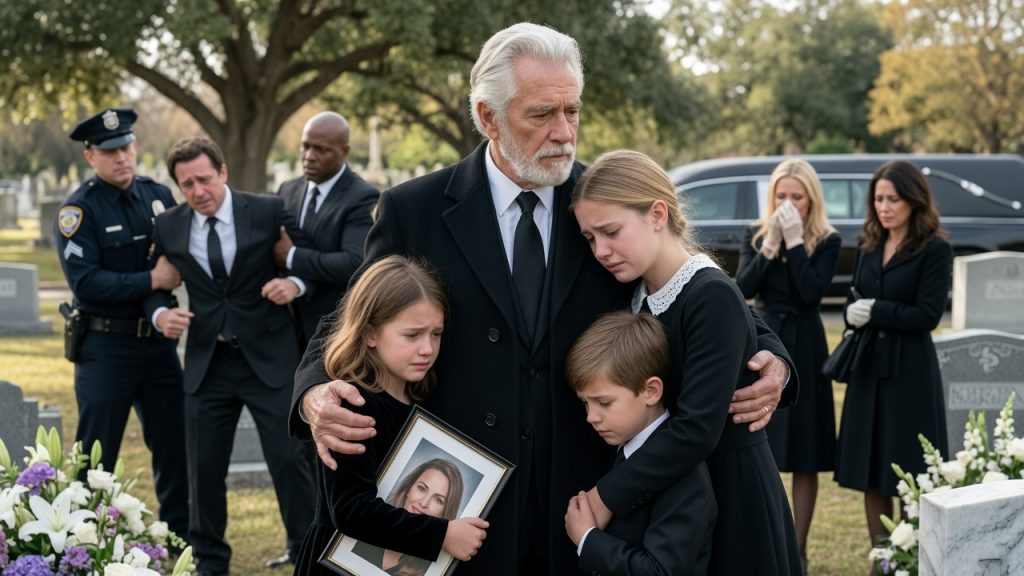
Beside me stood my granddaughters.
Twelve-year-old Lucía clutched her mother’s framed photograph so tightly that her knuckles had turned white.
Nine-year-old Renata stared silently at the freshly covered grave, her face completely empty.
Little Abril, only six years old, buried herself against my black coat, trembling so hard I could feel every shake of her tiny body.
Arturo looked untouched by grief.
His tailored gray suit was immaculate.
His expensive shoes gleamed despite the muddy ground.
A luxury watch rested beneath the cuff of his sleeve.
Not a single tear marked his face.
His phone vibrated.
He glanced down, read the message, and the faintest smile crossed his lips, as though someone, somewhere, was already waiting to celebrate with him.
I looked directly at him.
“What did you just say?”
He released a long, impatient sigh, as if I were the one making the day more difficult.
“Don Julián,” he replied calmly, “don’t do this. Rosa is gone. I have every right to move on with my life.”
“And your daughters?”
His eyes shifted toward the girls for barely a second.
Then he dismissed them with a careless wave of his hand.
“My girlfriend isn’t interested in raising three girls who barely respect me.”
He shrugged.
“You’re their grandfather. If they matter that much to you, then you take them.”
A heavy silence settled over the cemetery.
Several relatives lowered their eyes.
My godmother pressed both hands over her mouth.
Even the priest quietly looked away, unwilling to witness what had just happened.
For one brief moment, I wanted to hit him.
I wanted to wipe that smug expression off his face before another word left his mouth.
But then I felt a tiny hand wrap around mine.
Abril.
She squeezed my fingers so tightly that my anger dissolved into something even heavier.
Heartbreak.
When I looked down at the girls, something immediately felt wrong.
Lucía wasn’t crying.
That frightened me more than anything Arturo had said.
She wasn’t angry.
She wasn’t begging her father to stay.
She simply watched him with a calm, unreadable expression that no twelve-year-old should ever have.
Then she turned toward Renata.
Renata looked back.
Finally, both of them glanced at little Abril.
The three sisters exchanged a silent understanding.
No words.
No tears.
Just one look.
A look that made my stomach tighten.
In that instant, I realized they already knew something.
Something I didn’t.
I knelt beside them.
“You’re coming home with me,” I said softly.
Arturo let out a quiet laugh.
“Perfect. That solves my problem.”
He never hugged his daughters goodbye.
He never kissed their foreheads.
He never asked whether they had clothes, medicine, or even a place to sleep.
He simply turned his back and walked toward a white van waiting outside the cemetery gates.
Inside sat a young woman wearing oversized dark sunglasses.
She smiled the moment she saw him approaching.
He climbed in beside her.
The van drove away.
And he never looked back.
That night, my home felt painfully quiet.
I heated soup.
Warmed fresh tortillas.
Made up the small bedroom where Rosa used to sleep whenever she visited me during the most difficult months of her marriage.
Renata fell asleep wearing one of her mother’s oversized blouses.
Abril refused to let go of my hand until exhaustion finally closed her eyes.
Only Lucía stayed awake.
She sat beside the living-room window for hours, staring into the darkness without saying a single word.
Just after three o’clock in the morning, I heard soft footsteps.
She quietly walked into the kitchen, where I was sitting alone with a cup of untouched coffee.
“Grandpa.”
Her voice was barely louder than a whisper.
I looked up.
She was holding a small purple cloth bag against her chest.
“What is it, sweetheart?”
She swallowed hard.
Then she said the words that made the blood drain from my face.
“Mom didn’t die just because she was sick.”
Every muscle in my body froze.
I stared at her.
“What do you mean?”
Without answering immediately, Lucía carefully placed the little cloth bag on the kitchen table.
Her hands were shaking.
Slowly, she untied the string.
Inside were three things.
An old cellphone.
A worn notebook.
And a small USB drive.
She looked down at them before lifting her eyes to meet mine.
“Mom told us that if anything ever happened to her, we had to give these to someone who still loved her.”
The room fell completely silent.
I looked at the phone.
Then the notebook.
Then the USB drive.
In that moment, I realized my daughter hadn’t left us only with memories.
She had left behind the truth.
I reached for the phone, but Lucía placed her hand over it.
“There’s a password.”
“What is it?”
“Our birthdays.”
She entered six numbers.
The screen illuminated.
Dozens of audio recordings appeared in a folder labeled “Recipes.”
Some were only a few minutes long.
Others lasted nearly an hour.
The earliest had been recorded more than a year before Rosa’s death.
I pressed the first file.
My daughter’s voice filled the kitchen.
It was quiet and frightened.
“February fourth. Arturo came home after midnight again. He said he was meeting a client, but his shirt smelled like perfume. When I asked him about it, he called me paranoid. Later, I found a hotel receipt in his jacket.”
The recording ended.
Lucía stared at the table.
I selected another.
“March seventeenth. Arturo transferred money from the girls’ education account. He says he will replace it before anyone notices. I told him the money belongs to our daughters. He said everything in this house belongs to him.”
Another recording.
“April ninth. The doctor says the treatment is working slowly, but Arturo keeps telling people I am getting worse. He has begun asking questions about the house, my insurance policy, and what happens to my shares in Papá’s workshop if I die.”
My hands began to shake.
Rosa had inherited part ownership of the furniture workshop I had spent nearly forty years building.
The shares were supposed to pass to her daughters if anything happened to her.
Arturo knew that.
He had asked me about it more than once, always pretending he was simply helping Rosa organize her affairs.
I had trusted him because my daughter had trusted him.
Or at least, I believed she had.
I opened the notebook.
Rosa’s handwriting covered every page.
Dates.
Amounts of money.
Names of banks.
Descriptions of arguments.
Copies of account numbers.
She had even written down the license plate of the white van that had carried Arturo away from the cemetery.
Next to it was the name Camila Torres.
The woman in the van.
The new fiancée.
Lucía watched me reading.
“Mom knew about her,” she said.
“How long?”
“Almost a year.”
I looked at my granddaughter.
“And you knew?”
Lucía nodded.
“Mom told me not to say anything because Dad would get angry.”
“What did he do when he got angry?”
She lowered her eyes.
“He shouted. He broke things. He took Mom’s medicine away once and said she could have it back when she apologized.”
My heart felt as though it had been crushed beneath a stone.
“Did he ever hurt you?”
“He never hit us,” Lucía said quickly. “But he told us that if we made trouble, Mom would die faster because of the stress.”
Renata appeared in the doorway behind us.
She had been listening.
“He said Grandpa wouldn’t believe us,” she added.
I stood and pulled both girls into my arms.
They were children.
They should have been worrying about school, games, birthday parties, and which movie to watch on Sunday.
Instead, they had spent months protecting their dying mother from the man who was supposed to protect all of them.
“What is on the USB drive?” I asked.
Lucía’s face became pale.
“Mom said that was the most important part.”
I carried my old laptop into the kitchen and inserted the drive.
A collection of folders appeared.
Bank records.
Emails.
Photographs.
Medical documents.
A copy of Rosa’s will.
And one video file.
The date showed that it had been recorded three weeks before she died.
I clicked it.
Rosa appeared on the screen.
She was sitting in her bedroom, wrapped in a blue shawl.
Her face was thin from illness, but her eyes were clear.
For several seconds, she simply looked at the camera.
Then she spoke.
“If you are watching this, I am probably gone.”
I covered my mouth.
The girls moved closer to me.
“I need you to know that I was sick,” Rosa continued. “But my illness is not the only reason I became weaker.”
She paused to catch her breath.
“Arturo has been controlling my medication, my bank accounts, and my access to the doctor. He tells everyone he takes care of me. Sometimes he does. Other times, he hides my medicine or gives it to me late. He says I am confused because of the treatment.”
My vision blurred with tears.
“I do not know whether he wants me dead,” she said. “I only know he has already planned a life that does not include me or our daughters.”
Lucía began crying silently.
On the screen, Rosa looked down for a moment.
“When I confronted him about Camila, he said I should be grateful anyone was willing to stay near a sick woman. He said that after I died, he would sell the house, take the insurance money, and begin again.”
My fists tightened.
“But the house is not his,” Rosa said.
She looked directly into the camera.
“I changed my will. Everything I own is being placed in trust for Lucía, Renata, and Abril. My father, Julián, will be the trustee and guardian if he is willing.”
The girls looked at me.
I placed my arm around them.
“I am willing,” I whispered.
Rosa continued.
“I have also contacted an attorney. Her name is Elena Vargas. She has copies of these records. If Arturo abandons the girls or tries to take their inheritance, she will know what to do.”
The video ended with Rosa crying.
Not for herself.
For her daughters.
“Papá,” she said in the final seconds, “I’m sorry I didn’t tell you sooner. I was ashamed. I thought I could fix everything. Please don’t let my girls believe they were unwanted. They were the greatest joy of my life.”
The screen turned black.
For a long time, none of us moved.
Then Abril entered the kitchen, rubbing her eyes.
“Is Mommy in the computer?”
Lucía immediately wiped her tears.
“Yes,” she said. “Mommy left us a message.”
Abril climbed onto my lap.
“Can we watch it again?”
I closed the laptop.
“Not tonight, little flower.”
She rested her head against my chest.
“Daddy said Mommy left because she didn’t love us enough to stay.”
I felt a pain so sharp that I almost stopped breathing.
I held her tighter.
“Your mother fought every day to stay with you. Never believe anything different.”
The next morning, I called Elena Vargas.
She answered on the second ring.
The moment I said Rosa’s name, her voice changed.
“Don Julián, I have been expecting your call.”
We met that afternoon in her office.
Elena was a composed woman in her forties with sharp eyes and a quiet voice.
She listened while I explained what Arturo had said at the funeral.
Then she asked to speak to the girls separately.
I waited outside while each child told her story.
When Elena finally returned, she carried a thick folder.
“Rosa came to me six months ago,” she said. “She believed Arturo was misusing her money and trying to isolate her.”
“Why didn’t you contact me?”
“She begged me not to. She was afraid he would retaliate against the children.”
Elena placed the folder on the desk.
“Rosa signed a new will. She also transferred her ownership interest in the workshop into a protected trust for the girls. Arturo cannot legally sell those shares or access the money.”
“What about the house?”
“It belongs to the trust as well.”
I remembered the confidence on Arturo’s face at the cemetery.
He believed he had inherited everything.
He had no idea he no longer owned the roof over his head.
“There is more,” Elena said. “Arturo submitted documents to one of Rosa’s banks claiming she was mentally incapable of managing her accounts.”
“Was she?”
“No. Her doctors confirmed she remained competent. We believe he used a falsified medical letter to gain temporary access.”
“Can he be arrested?”
“That will depend on the investigation. We have enough evidence to report suspected fraud, financial abuse, and possible interference with her treatment.”
The word “treatment” hung between us.
I didn’t want to believe Arturo had intentionally shortened my daughter’s life.
But I could no longer dismiss the possibility.
“What happens to the girls now?” I asked.
“Rosa nominated you as guardian. Since Arturo has openly abandoned them and there are documented concerns about his behavior, we can request immediate temporary custody.”
“I don’t want temporary custody.”
Elena studied me.
“I want them for as long as they need me.”
For the first time, she smiled.
“That is exactly what Rosa hoped you would say.”
The court granted me emergency guardianship two days later.
Arturo didn’t appear.
He sent a message through his attorney saying he had no objection, provided he would not be required to pay immediate expenses.
Elena read the message twice, then shook her head.
“He believes giving up responsibility will protect his finances.”
“Will it?”
“No.”
She began preparing claims for child support, misuse of marital property, and the return of money taken from the girls’ accounts.
Meanwhile, Arturo acted as though none of it mattered.
Photographs began appearing online.
Arturo and Camila at restaurants.
Arturo and Camila beside a swimming pool.
Camila wearing Rosa’s gold necklace.
That necklace had belonged to my late wife.
I had given it to Rosa on her wedding day.
When Lucía saw the photograph, she quietly left the room.
I found her sitting on the steps behind the workshop.
“Mom promised that necklace to me,” she said.
I sat beside her.
“We’ll get it back.”
“She wore it during the funeral.”
“Camila?”
Lucía nodded.
“She waited in the van while Mom was being buried, wearing Mom’s necklace.”
I wanted to drive directly to Arturo’s house.
Instead, I called Elena.
She documented the photograph and added it to the case.
A week later, Arturo arrived at my home.
He did not come to see the girls.
He came because he had discovered he could not sell the house.
He pounded on my front door until I opened it.
“What did Rosa do?” he demanded.
My granddaughters were inside, so I stepped onto the porch and closed the door behind me.
“You’ll have to be more specific.”
“The house. The workshop shares. The bank accounts. Everything is frozen.”
“Nothing is frozen. It simply doesn’t belong to you.”
His face turned red.
“I was her husband.”
“You were also the father of three girls you abandoned beside their mother’s grave.”
“That was an emotional moment.”
“You looked very calm.”
He pointed a finger at my chest.
“You manipulated her while she was sick.”
I almost laughed.
“You should be careful using the word manipulated.”
His expression shifted.
For the first time, I saw fear.
“What does that mean?”
“It means Rosa kept records.”
He stared at me.
“What records?”
I said nothing.
His confidence cracked.
“She was confused,” he said quickly. “The medication affected her memory.”
“The doctors disagree.”
“You don’t know what happened in our marriage.”
“No,” I replied. “But I’m learning.”
He stepped closer.
“Give me the phone.”
I had not mentioned a phone.
That was the moment I knew he understood exactly what Rosa had recorded.
“What phone?” I asked.
His eyes flickered toward the window.
Lucía was standing behind the curtain.
Arturo saw her.
“You little thief!” he shouted. “You took it!”
I pushed him away from the door.
“Leave.”
“That phone is my property!”
“My daughter’s voice is not your property.”
He raised his fist.
For one second, I thought he would strike me.
Then my neighbor opened his gate across the street and lifted his own phone to record us.
Arturo lowered his hand.
“This isn’t over,” he whispered.
“No,” I said. “It’s only beginning.”
Three days later, investigators searched the house where Rosa had lived.
Arturo had already moved most of his belongings into Camila’s apartment, but he had left behind boxes of documents.
Receipts showed expensive jewelry, hotel rooms, and payments for Camila’s beauty business.
Much of it had been paid for with money removed from Rosa’s accounts.
The bank records revealed something worse.
Arturo had borrowed money using forged documents connected to the workshop.
He had also attempted to change the beneficiary of Rosa’s life insurance.
The request had been denied because Rosa’s signature did not match earlier records.
When investigators interviewed Rosa’s nurse, she remembered several occasions when Arturo prevented her from entering the house.
He claimed Rosa was sleeping.
Medical records showed missed treatments and delayed prescriptions during those same weeks.
There was not enough evidence to prove that Arturo had caused Rosa’s death.
But there was enough to prove he had endangered her, isolated her, and taken advantage of her illness.
While the investigation continued, Arturo announced his engagement.
He and Camila planned to marry only six weeks after Rosa’s funeral.
They chose an expensive venue outside Puebla.
According to Camila’s public posts, the wedding would represent “the beginning of a beautiful new chapter.”
The photographs showed hundreds of white roses.
A five-tiered cake.
A live orchestra.
Imported champagne.
Arturo had paid large deposits before Rosa died, using money he expected to replace after receiving her insurance payment.
But the insurance money had been placed under review.
The accounts he expected to inherit were beyond his reach.
The house could not be sold.
The workshop shares belonged to the girls.
And the court had ordered him to begin paying support.
He was running out of money.
Yet he refused to cancel the wedding.
Pride would not allow it.
Then, one evening, Lucía brought me another envelope.
It was cream-colored and sealed with red wax.
Arturo’s name was written across the front in Rosa’s handwriting.
“Mom told me this had to be delivered on his wedding day,” Lucía said.
“Did she tell you what was inside?”
“No.”
“Where was it?”
“In the lining of her suitcase.”
I turned the envelope over in my hands.
“Why the wedding day?”
“She said that was when he would finally tell the truth without speaking.”
I called Elena.
She examined the envelope but did not open it.
“If Rosa instructed Lucía to deliver it, we should respect that,” she said. “But we need to make sure the girls are protected.”
Arturo had invited none of them to the wedding.
He had not contacted them once since the day he came demanding the phone.
Camila, however, had begun presenting herself online as a misunderstood woman who had supported Arturo through a “tragic loss.”
She never mentioned Rosa by name.
She claimed the girls were living happily with relatives because Arturo needed time to heal.
The lies made me sick.
Two days before the wedding, Camila came to my workshop.
She arrived in a red dress, carrying a designer handbag and wearing Rosa’s necklace.
Every employee stopped working when she entered.
She smiled as though she owned the place.
“I need to speak with you privately,” she said.
“You can speak here.”
Her smile tightened.
“This is a family matter.”
“You are not family.”
She touched the necklace.
“Soon I will be Arturo’s wife.”
“That still won’t make you family.”
Several workers turned away to hide their expressions.
Camila lowered her voice.
“Arturo told me you are withholding property that belongs to him.”
“Arturo tells many stories.”
“He says Rosa wasn’t thinking clearly when she changed her will.”
“My daughter knew exactly what she was doing.”
Camila’s hand moved protectively over the necklace.
“Arturo and I are starting a business. We need access to the workshop profits.”
“The workshop belongs partly to me and partly to my granddaughters.”
“They’re children.”
“They will grow.”
She stared at me coldly.
“Arturo deserves compensation for the years he spent caring for a sick wife.”
The entire room went silent.
I looked at the woman my son-in-law had chosen.
She truly believed Rosa’s suffering had been a burden that should be rewarded.
“Take off that necklace,” I said.
Her fingers tightened around it.
“Excuse me?”
“It belonged to my wife. Then my daughter. Now it belongs to Lucía.”
“Arturo gave it to me.”
“He had no right.”
Camila smiled.
“You can’t prove that.”
A small voice spoke behind her.
“Yes, we can.”
Lucía stood in the workshop doorway with Elena beside her.
In her hands was a photograph of Rosa wearing the necklace on her wedding day.
On the back, my late wife had written that the necklace was to pass to Rosa’s eldest daughter.
Camila’s face changed.
Elena stepped forward.
“You can return it now, or we can add possession of disputed estate property to the pending legal complaint.”
Camila unclasped the necklace.
She placed it on the workbench with trembling fingers.
“This family is insane.”
She stormed out.
Lucía picked up the necklace but did not put it on.
Instead, she held it against her heart.
“She thought taking Mom’s things would make her Mom,” Renata said later.
“No one can replace your mother,” I told them.
The morning of the wedding arrived bright and cloudless.
I had no intention of attending.
Neither did the girls.
But at nine o’clock, a courier came to my house.
He carried a package addressed to Lucía.
Inside was a letter from Rosa’s attorney, written months earlier.
It said:
“My sweet Lucía, if your father chooses to marry Camila after I am gone, take the sealed envelope to the wedding venue. You do not need to enter. Give it to the wedding coordinator and ask that it be delivered before the ceremony. Do not stay if you feel afraid. Abuelo Julián will protect you. I am sorry for asking you to carry something so heavy, but one day you will understand that truth must arrive at the moment lies feel safest.”
Lucía read the letter twice.
“I want to deliver it.”
“You don’t have to,” I said.
“Mom wanted me to.”
Renata stepped forward.
“We’re going together.”
Abril nodded, although she did not fully understand.
Elena agreed to accompany us.
We arrived at the venue forty minutes before the ceremony.
Luxury cars lined the circular driveway.
Guests in expensive clothes gathered beneath white arches covered in roses.
Music floated across the garden.
At the entrance, the wedding coordinator tried to stop us.
Then Elena showed her identification and explained that we were only delivering a personal letter from the groom’s late wife.
The coordinator’s expression turned uncomfortable.
Eventually, she took the envelope.
“We will leave now,” Elena said.
But before we reached the car, the venue doors opened.
Arturo emerged.
He had been told we were there.
His tuxedo was black, his hair perfectly styled, and his face twisted with anger.
“What are they doing here?”
Lucía stood beside me.
“We brought something from Mom.”
Arturo stared at the envelope in the coordinator’s hand.
“What is that?”
“A letter,” Lucía said.
“Give it to me.”
The coordinator handed it over.
Arturo examined the handwriting.
All the color disappeared from his face.
“Where did you get this?”
“Mom left it for your wedding day.”
Guests began gathering behind him.
Camila appeared at the top of the steps in a silk robe, surrounded by bridesmaids.
“What’s happening?” she demanded.
“Nothing,” Arturo replied too quickly.
He tried to put the envelope inside his jacket.
Camila descended the steps.
“Is that from Rosa?”
Arturo didn’t answer.
“Open it,” she said.
“Not now.”
“Why not?”
“It’s private.”
Camila looked at the crowd.
Then at us.
Then at Arturo.
“You said she left no letters.”
Arturo gripped the envelope.
“Go back inside.”
Camila reached for it.
He pulled away.
The red wax seal broke between their hands.
Several folded pages fell to the ground.
A smaller envelope and a memory card landed beside them.
The wind caught the first page.
It slid across the stone toward Camila.
She picked it up.
Her eyes moved over the words.
Then she looked at Arturo.
“What is this?”
He lunged for the page.
She stepped back.
“What is this, Arturo?”
Guests had gone silent.
Camila read aloud.
“Camila, before you marry my husband, you deserve to know what he told me about you.”
Arturo’s face hardened.
“Stop reading.”
Camila continued.
“He said you were temporary. He said you were useful because you had access to clients and money. He said once I died, he would marry you long enough to control your business, then leave you with the debt.”
“That’s a lie!” Arturo shouted.
Camila looked at the memory card on the ground.
Rosa’s letter continued.
“If he denies it, listen to the recording marked with your name.”
Elena quietly handed the coordinator a device capable of reading the card.
The coordinator hesitated.
Camila took it herself.
“Play it.”
“Camila,” Arturo warned.
She inserted the card.
Arturo’s voice came through the small speaker.
It was unmistakable.
He was laughing with another man.
“Camila thinks I love her,” the recording said. “Once Rosa is gone, I’ll marry Camila, move the workshop money into her business, and make her sign everything. Then, if the business fails, the debt is hers.”
A male voice asked, “What about your daughters?”
Arturo laughed.
“My father-in-law can keep them. Three girls are nothing but expenses.”
The recording continued.
“And if Camila becomes difficult?”
“I’ll handle her the same way I handled Rosa. Make everyone think she’s unstable. People believe anything when a man says a woman is emotional.”
Camila dropped the device.
Arturo rushed toward her.
She slapped him.
The sound echoed across the entrance.
“You used me.”
“Listen to me,” he pleaded.
“You said Rosa was cruel to you.”
“She was.”
“You said she abandoned the marriage.”
“She did!”
“You said the girls hated you because she poisoned them against you.”
“They did!”
Lucía stepped forward.
“No, Dad. We hate you because we heard what you said when you thought Mom was asleep.”
Arturo looked at his daughter.
For the first time, he seemed to understand that she was no longer afraid of him.
Camila picked up the remaining pages.
Rosa had included copies of messages Arturo had sent to another woman only two weeks earlier.
He had already been planning his next affair.
The final page was addressed to Arturo.
“You believed my death would silence me,” Rosa had written. “But the truth does not die with the person who carries it. Our daughters saw who protected them and who abandoned them. No inheritance can purchase their love. No wedding can make you a good man. You wanted a fresh start, but you cannot build a future on the suffering you caused and expect the foundation to hold.”
Camila tore the veil from her hair.
“The wedding is over.”
Arturo grabbed her arm.
“You cannot humiliate me like this!”
She pulled away.
“You humiliated yourself.”
The wedding guests began leaving.
Some whispered.
Others recorded the scene.
The musicians stopped playing.
The venue manager approached Arturo and demanded immediate payment for the remaining balance.
Arturo claimed there had been a misunderstanding.
His card was declined.
Then another.
Then a third.
Camila laughed bitterly.
“You told me the insurance money cleared yesterday.”
Arturo said nothing.
“You don’t have any money, do you?”
He tried to follow her inside, but her brothers blocked the doorway.
Within twenty minutes, the garden was emptying.
The five-tiered cake remained untouched.
Hundreds of white roses trembled in the wind.
Arturo stood alone on the steps in his tuxedo, holding the remains of Rosa’s letter.
He looked toward his daughters.
For one desperate second, I thought he might apologize.
Instead, he pointed at Lucía.
“You destroyed my life.”
Lucía did not cry.
She did not hide behind me.
She simply answered, “No, Dad. Mom told the truth. You destroyed it yourself.”
We turned and walked away.
Arturo was arrested three weeks later.
The charges did not include murder.
The authorities could not prove beyond doubt that he had intentionally caused Rosa’s death.
But they had evidence of fraud, forgery, financial abuse, theft, and deliberate interference with her medical care.
His former friend cooperated with investigators.
So did Camila.
She handed over messages, bank records, and recordings of her own.
It turned out Arturo had encouraged her to invest borrowed money into an expansion plan based on profits he claimed he would receive from my workshop.
She lost much of what she had invested, but she escaped the marriage before losing everything.
The white van was sold.
The luxury watch disappeared.
The expensive suits stopped mattering.
Arturo eventually accepted a plea agreement and received a prison sentence.
He was also ordered to repay money taken from Rosa and the girls.
Most of it had already been spent.
Recovery would take years.
But the girls were safe.
That mattered more than anything.
Life in my home changed slowly.
At first, all three girls slept in the same room.
They were afraid that if they closed their eyes separately, someone else they loved might disappear.
Abril woke up calling for her mother.
Renata became angry over small things, then apologized as though she believed love could be withdrawn for making a mistake.
Lucía tried to become an adult overnight.
She packed lunches.
Checked homework.
Counted grocery money.
Watched her sisters constantly.
One evening, I found her washing dishes at midnight.
“You have school tomorrow,” I said.
“There were still plates.”
“They can wait.”
“Mom said we should always help.”
“Helping does not mean carrying everything alone.”
She turned off the water.
“I should have saved her.”
I stood still.
“What?”
“I knew Dad was hiding her medicine. I should have called someone.”
“You were twelve.”
“I could have told you.”
“He frightened you.”
“I should have been braver.”
I dried my hands and knelt in front of her.
“Listen to me carefully. Adults failed your mother. You did not. You protected evidence. You protected your sisters. You gave Rosa’s truth a voice. But saving her was never supposed to be your responsibility.”
Tears filled Lucía’s eyes.
For months, she had held them back.
That night, she finally cried.
She cried for her mother.
For the funeral.
For the words Arturo had spoken beside the grave.
For every night she had listened from the hallway while her parents argued.
For every secret she had been forced to keep.
I held her until morning.
The girls began counseling.
So did I.
I had spent weeks blaming myself for not recognizing what was happening.
Rosa had visited me with bruises beneath her eyes and exhaustion in her voice.
I had believed her when she said treatment was simply difficult.
I had believed Arturo when he said he was taking care of everything.
The counselor helped me understand that shame and fear often keep people silent.
Rosa had not hidden the truth because she did not trust me.
She had hidden it because Arturo had convinced her that speaking would make everything worse.
The workshop became part of the girls’ healing.
Renata loved painting small wooden boxes.
Abril collected smooth scraps of wood and gave each one a name.
Lucía learned how to read invoices and design simple furniture.
On Saturdays, we worked together.
At noon, we ate lunch beneath the old jacaranda tree behind the building.
Rosa had played there as a child.
Sometimes I could almost hear her laughter again.
A year after her death, we returned to the cemetery.
We carried white lilies.
The girls placed them on Rosa’s grave one by one.
Abril sat on the grass.
“Mommy, we’re still together,” she said.
Renata showed the grave a photograph of a wooden box she had made.
Lucía wore her grandmother’s necklace.
For the first time, it looked like what it had always been meant to be.
Not an expensive piece of jewelry.
A promise passed from one generation to the next.
I stood behind the girls and looked at my daughter’s name carved into the stone.
“Your girls are safe,” I whispered.
A warm breeze moved through the cemetery.
Lucía reached into her bag and removed the purple cloth pouch.
Inside was the old phone.
We had copied all the files, but she had kept the original.
“I think Mom should have this,” she said.
She placed the empty purple pouch beneath the flowers but kept the phone.
“Not yet,” Renata said. “We still need her voice.”
Lucía nodded.
That evening, we watched Rosa’s video again.
But this time, we did not stop at the part where she spoke about fear.
There was another file we had overlooked during those first painful days.
It was labeled “For My Girls.”
Rosa appeared in the same blue shawl.
She smiled.
“My beautiful daughters,” she began, “I don’t know how much time I have, so I want to leave you something stronger than sadness.”
She spoke to each child individually.
She told Lucía that being strong did not mean never asking for help.
She told Renata that anger did not make her unlovable.
She told Abril that her mother’s love would remain in every song, every flower, and every person who cared for her.
Then Rosa looked directly into the camera.
“Never measure your value by someone’s willingness to stay. People sometimes leave because they are selfish, afraid, or incapable of recognizing what they have. Their departure does not make you less worthy of love.”
The girls sat close together on the sofa.
Rosa smiled through her tears.
“Take care of each other, but also live. Laugh loudly. Celebrate birthdays. Dance at weddings, even after what happened to me. Do not let your father’s choices make you afraid of happiness.”
The video ended.
For several moments, the room remained quiet.
Then Abril looked at me.
“Grandpa, can we have music?”
“What kind?”
“Happy music.”
Renata stood and took her sister’s hands.
Lucía hesitated.
Then she smiled.
It was the first real smile I had seen on her face since before Rosa became ill.
I turned on the radio.
The girls danced in the living room beneath the yellow light.
They stumbled over each other.
They laughed.
Abril pulled me from my chair, and although my knees protested, I danced with them.
Our steps were clumsy.
Our hearts were still wounded.
But the house no longer felt empty.
Rosa had left behind evidence that exposed Arturo.
She had left a notebook that protected her daughters’ inheritance.
She had left recordings that stopped another woman from marrying a dangerous man.
But her greatest gift was not revenge.
It was not the canceled wedding.
It was not the money, the house, or the workshop shares.
Her greatest gift was the truth she left for her daughters.
They had never been burdens.
They had never been unwanted.
They had been loved so fiercely that even a dying mother found the strength to protect them from beyond the grave.
Arturo had stood beside Rosa’s coffin and announced that he deserved a fresh start.
In the end, he received one.
Just not the kind he imagined.
He began again behind locked doors, without the fortune he tried to steal, without the woman he intended to deceive, and without the daughters whose love he had thrown away.
The girls began again too.
But their new life was filled with safety.
With counseling.
With school concerts and birthday cakes.
With handmade furniture and Sunday lunches.
With arguments that ended in apologies instead of threats.
With a grandfather who reminded them every day that they had a home.
Years later, Lucía would become an attorney.
She said she wanted to protect children whose voices were ignored.
Renata became an artist and painted a portrait of Rosa that still hangs in the entrance of our workshop.
Abril grew into the loudest, happiest young woman in the family.
At Lucía’s graduation, all three sisters stood together beneath the jacaranda tree.
They held Rosa’s photograph between them.
I watched them laugh as purple flowers fell around their shoulders.
In that moment, I understood something my daughter had known all along.
Truth may arrive quietly.
It may hide inside a child’s cloth bag, an old phone, a worn notebook, or a sealed envelope.
It may wait while lies celebrate and cruel people believe they have won.
But truth is patient.
And when the right moment comes, it does not need to shout.
It only needs to be opened.
THE END! THANK YOU FOR READING!