

On Thanksgiving morning, I woke to a silence so deep that my own home felt strange.
At first, I thought I had slept too late.
Usually, by that hour, the house was already alive.
There would be little feet racing down the hallway, cartoons playing too loudly in the living room, cereal scattered across the kitchen island, and my daughter-in-law, Amanda, calling for someone to find the good serving platter.
My son, Daniel, usually made coffee before leaving for work.
Even when he was rushed, even when he was distracted, he always pressed the button on the old machine and let the smell fill the house.
It was such a small thing.
But after my husband died, I started measuring love in small things.
A cup of coffee.
A chair pulled out.
A child’s hand slipping into mine.
That morning, there was none of it.
No cartoons.
No laughter.
No coffee.
Only silence.
I pulled my robe tighter around me and stepped into the hallway.
The doors to the children’s rooms were open.
Lily’s bed was neatly made, her stuffed rabbit gone from the pillow.
Noah’s dinosaur pajamas were not on the floor where he always dropped them.
The bathroom counter was clean.
Too clean.
My heart started beating faster, but I told myself not to panic.
Maybe Amanda had taken them to the parade.
Maybe Daniel had gone to pick up the turkey.
Maybe someone had left a message I had missed.
I went downstairs.
The kitchen looked like a photograph in a magazine.
No dirty plates.
No grocery bags.
No half-open Costco tray on the counter.
No pie boxes.
No roasting pan waiting beside the stove.
The stainless-steel refrigerator gleamed under the morning light, the same refrigerator Amanda had begged for two years earlier because she said her dream kitchen deserved better than “old lady appliances.”
I had paid for it.
I had smiled when it arrived.
I had told myself that helping them was the same as being loved by them.
Outside, the driveway was empty.
Daniel’s SUV was gone.
Amanda’s white car was gone.
Even the children’s bikes had been moved from the garage.
For a few moments, I simply stood there, staring at the empty space where their cars should have been.
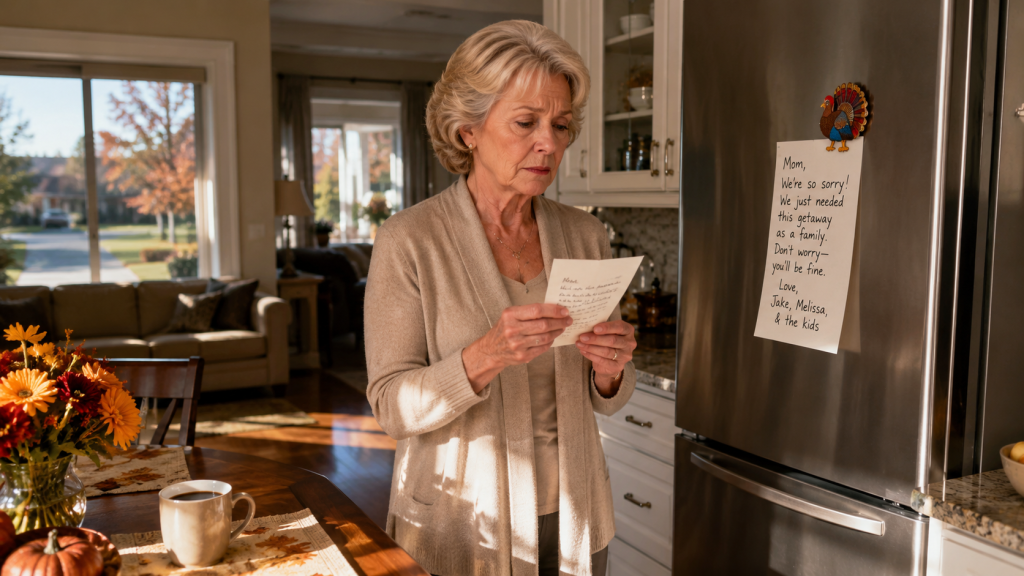
Then I saw the note.
It was folded beneath a little turkey magnet on the refrigerator.
Amanda’s handwriting was neat, confident, and almost cheerful.
Mom, don’t worry. We decided to spend Thanksgiving in Hawaii this year. You wouldn’t have enjoyed the flight. Back in a week. Love, Amanda.
I read it once.
Then again.
Then a third time, because sometimes pain arrives so politely that your mind refuses to recognize it.
They had gone to Hawaii.
For Thanksgiving.
Without telling me.
Without inviting me.
Without even asking if I wanted to come.
I was not angry at first.
That surprised me.
I expected tears. I expected trembling hands. I expected that familiar ache in my chest that had followed me since my husband, Robert, passed away four years ago.
But no tears came.
Something colder settled inside me instead.
Something still.
The words that cut deepest were not Hawaii.
They were not back in a week.
They were we decided.
Not we asked.
Not we talked.
Not we thought of you.
We decided.
As if I were furniture.
As if I were a fixture in their home, useful when needed and invisible when not.
I sat at the kitchen table and stared at the note.
The table was mine.
I had bought it when Daniel and Amanda said they wanted a “family-sized dining room set” for the kids.
The sofa in the living room was mine too.
So was the television, the washer and dryer, half the kitchen appliances, the swing set in the backyard, and the money that had kept their household from collapsing more times than they ever admitted.
When Daniel first asked me to move in, he had done it with tears in his eyes.
“Mom, you shouldn’t be alone in that big house,” he said. “Come live with us. The kids adore you. We’ll take care of each other.”
Amanda had smiled and squeezed my hand.
“It’ll be perfect,” she said. “You’ll have your own room, and the kids will grow up with their grandmother. That matters.”
At the time, I wanted so badly to believe her.
My own house had become unbearable after Robert died.
Every room held a memory.
His slippers beside the bed.
His gardening gloves in the mudroom.
His reading glasses on the nightstand.
I would make dinner for one and still reach for two plates.
So when Daniel offered me a place in his home, I saw it as mercy.
I sold my house.
I moved into the room at the back of theirs.
I told myself this was what family did.
At first, it was sweet.
Lily crawled into my bed in the morning.
Noah asked me to read the same dinosaur book seven times.
Daniel kissed my cheek before work.
Amanda thanked me for helping with school pickup, laundry, dinner, and groceries.
But slowly, the thank-yous disappeared.
The requests became expectations.
Can you watch the kids for an hour?
Turned into:
We have dinner plans. You’re home anyway.
Could you help with groceries this week?
Turned into:
The card is on the counter. We need the usual.
Mom, would you mind covering daycare this month?
Turned into:
We were counting on you.
That sentence became their favorite leash.
We were counting on you.
They counted on me for school supplies.
They counted on me for dentist bills.
They counted on me when Amanda wanted new curtains, when Daniel wanted his truck repaired, when the children needed summer camp, when the mortgage was late, when Christmas came, when birthdays came, when emergencies appeared that never seemed to be their fault.
I gave because I loved them.
Then I gave because saying no caused tension.
Then I gave because I had forgotten how to stop.
And somewhere along the way, my son stopped seeing me as his mother.
Amanda stopped seeing me as family.
I became the quiet woman in the back bedroom who cooked, cleaned, babysat, paid, and smiled.
That Thanksgiving morning, Amanda’s note made the truth impossible to ignore.
They had not forgotten me.
They had excluded me.
There is a difference.
I stood up slowly.
I made coffee.
The first pot I had made for myself in years.
Then I took Amanda’s note off the refrigerator, folded it carefully, and placed it inside the old blue folder I kept in my dresser.
The folder had begun as a place for important documents.
Bank papers.
Insurance information.
Robert’s death certificate.
But over time, I had added other things.
Receipts.
Checks.
Screenshots of transfers.
Mortgage payments I had covered.
Credit card statements Amanda had asked me to pay “just until things got easier.”
A copy of the agreement my attorney had insisted on when I sold my house and gave Daniel money toward this one.
Daniel had rolled his eyes at the time.
“Mom, you don’t need paperwork with me,” he said.
My attorney, Mr. Harlan, had looked him straight in the eye.
“Yes, she does.”
At the time, I was embarrassed.
Now, I was grateful.
Because the truth was simple.
This house was not theirs.
Not entirely.
When Daniel and Amanda bought it, they could not qualify for the loan on their own.
I had provided the down payment from the sale of my home.
A large down payment.
Large enough that my attorney refused to let me hand it over as a gift.
Instead, my name went onto the deed.
Daniel and Amanda could live there.
They could raise their children there.
But I owned sixty percent of the property.
Daniel owned twenty.
Amanda owned nothing.
She knew that.
She had known it from the beginning.
But she also knew I hated conflict.
She had counted on that more than anything.
I finished my coffee and called Mr. Harlan.
He answered on the fourth ring, sounding surprised.
“Evelyn? On Thanksgiving morning?”
“I’m sorry to bother you,” I said.
“You’re never a bother. Is everything all right?”
I looked around the perfect kitchen where no one had thought to leave me a plate, a phone call, or a place at the table.
“No,” I said. “But it will be.”
There was a pause.
Then his voice changed.
Calmer. Sharper.
“What happened?”
I told him everything.
The note.
Hawaii.
The years of payments.
The joint account.
The credit cards.
The money.
The way I had become the unpaid help in a house I had bought into.
When I finished, he sighed.
Not with pity.
With recognition.
“I was afraid of this,” he said.
“You knew?”
“I hoped I was wrong.”
I closed my eyes.
“Tell me what I can do.”
He did.
By noon, I had a list.
By one, I had called my bank.
By two, I had closed the joint household account and moved my direct deposits back into my personal account.
By three, I had canceled the automatic payments I had been making for groceries, utilities, school fees, Amanda’s credit card, Daniel’s insurance, and the mortgage portion they had promised to reimburse me for but rarely did.
By four, I had called a moving company.
The man on the phone asked when I wanted them to come.
“As soon as possible,” I said.
“Tomorrow morning?”
I looked at Amanda’s note on the table.
“Yes.”
That evening, I sat alone in the dining room.
Thanksgiving sunlight faded from the windows.
The neighbors’ houses glowed warmly across the street.
Families arrived carrying pies and casseroles.
Children ran across lawns.
Laughter floated through the cold air.
For a moment, loneliness tried to climb into my chest.
But then I remembered something Robert said to me a few months before he died.
We had been sitting on the porch, watching the grandchildren play.
Daniel had just asked us for money again.
Robert had not said no.
He rarely did when it came to our son.
But later, after Daniel left, Robert looked tired.
“Love should not require you to disappear, Evie,” he said.
At the time, I thought he was being dramatic.
That Thanksgiving night, I finally understood him.
The movers arrived at eight the next morning.
I had already packed most of my belongings.
Not everything.
Just mine.
My clothes.
My books.
Robert’s photographs.
My jewelry box.
My mother’s china.
The quilt my grandmother made.
My medical records.
The blue folder.
The antique lamp Daniel once said made the room look outdated.
The chair Robert had loved.
The movers were careful.
Kind.
They asked no questions, although I could see them noticing the children’s drawings taped to my bedroom wall and the way my hands trembled when I folded the last blanket from my bed.
By noon, my room was empty.
I stood in the doorway and looked at it.
For three years, I had lived in that small room while paying for half the life happening outside it.
I remembered Lily climbing into my lap when she was five and whispering, “Grandma, why does Mommy say you’re lucky we let you live here?”
I had laughed then.
I had told her grown-ups said silly things.
But my heart had cracked quietly.
I wondered how many cracks a heart could survive before it stopped pretending to be whole.
The moving truck pulled away just after two.
I followed in my car.
Not to another big house.
Not to Daniel.
Not to Amanda.
Not to anyone who needed me to shrink so they could feel generous.
I drove forty minutes outside town to a small cottage near a lake.
It belonged to my friend Margaret’s sister, who had moved to Arizona and rented it out furnished.
It was not fancy.
The kitchen was small.
The floors creaked.
The porch needed painting.
But sunlight poured through the windows, and from the living room I could see water shining between the trees.
Best of all, every room was quiet because I chose it.
That first night, I slept for ten hours.
No children woke me.
No one asked where the clean uniforms were.
No one needed a check.
No one knocked on my door at midnight because Amanda and Daniel had decided to attend a last-minute party.
I woke up with sunlight on my face and cried.
Not because I was sad.
Because I had forgotten what peace felt like.
For five days, they did not call.
Not once.
Hawaii must have been beautiful.
I imagined them on the beach, smiling for pictures Amanda would post with captions about gratitude and family.
I imagined Daniel holding a drink with one hand and his phone with the other, never once wondering if I had eaten Thanksgiving dinner alone.
That used to hurt.
Now it confirmed everything.
During those five days, I finished what I had started.
Mr. Harlan filed the necessary papers to request a formal sale or buyout of the property.
Since my name was on the deed and I owned the majority share, Daniel and Amanda had two choices.
Buy me out at fair market value.
Or sell the house.
The house they had treated as theirs.
The house Amanda had decorated with my money while reminding me not to touch “her kitchen.”
The house where they thought I would stay forever because I was too afraid to leave.
I also sent a certified letter through my attorney stating that I would no longer contribute financially to the household.
No mortgage assistance.
No utilities.
No childcare payments.
No groceries.
No credit card rescues.
No “temporary” loans that were never repaid.
I did not write a long emotional message.
I did not accuse.
I did not beg.
The letter simply said the truth.
I was withdrawing support.
I was reclaiming my share.
I was moving forward.
On the fifth day, my phone started lighting up.
The first call came from Daniel.
I watched his name appear on the screen.
For a moment, my thumb hovered above the answer button.
He was still my son.
No matter what he had done, some part of me remembered him as the little boy who brought me dandelions from the yard and called them “sunflowers for Mommy.”
But I did not answer.
The call went to voicemail.
Then Amanda called.
Then Daniel again.
Then Amanda again.
Then an unknown number.
Then another.
By evening, I had eighteen missed calls.
The first voicemail was confused.
“Mom? Hey, we just got back. Where are you? Did you go somewhere? Call me.”
The second was annoyed.
“Mom, Amanda says your room is empty. What’s going on? This isn’t funny.”
The third was Amanda.
Her voice was tight.
“Evelyn, I don’t know what kind of point you’re trying to make, but you scared the kids. You can’t just disappear.”
I almost laughed.
They had left me alone on Thanksgiving morning with a note under a magnet.
But I could not just disappear.
The fourth voicemail came two hours later.
Daniel’s voice had changed.
“Mom, why did the mortgage payment bounce?”
I sat on the cottage porch with a blanket over my knees and listened as the lake turned silver in the evening light.
The fifth voicemail was worse.
“Mom, Amanda’s card isn’t working. The grocery delivery was declined. Did something happen with the bank?”
Then came the sixth.
“Please call me back.”
Then the seventh.
“Mom, what does this letter mean?”
Then the eighth.
“Why is there a lawyer involved?”
By the ninth voicemail, Amanda was crying.
Not soft tears.
Angry tears.
“This is cruel,” she said. “You know we can’t afford to buy you out right now. You know that. We have children. Your grandchildren live here. How could you do this to them?”
I looked down at my hands.
They were steady.
Once, those words would have broken me.
Your grandchildren.
She used them like a key whenever she wanted to unlock my guilt.
But guilt only works when you believe you are doing something wrong.
I was not taking anything from my grandchildren.
I was refusing to keep sacrificing myself for two adults who had learned to spend my life as if it were their inheritance.
On the sixth day, Daniel came to the cottage.
I had not told him where I was.
Margaret had not either.
But Daniel had always been clever when he wanted something.
He knocked at nine in the morning.
When I opened the door, he looked exhausted.
His hair was messy.
His eyes were red.
For a second, he looked like the boy I had raised.
Then he looked over my shoulder at the little cottage and frowned.
“So this is where you are?”
Not, Are you okay?
Not, I’m sorry.
Not, Mom, we hurt you.
So this is where you are?
I almost closed the door.
Instead, I stepped onto the porch and pulled my cardigan tighter.
“What do you want, Daniel?”
He blinked as if the question offended him.
“I want to know what’s going on. We came home and your room was empty. The accounts are frozen. The mortgage didn’t go through. Then a letter came from your attorney saying we have to buy you out or sell the house.”
“That is correct.”
His mouth opened.
Then closed.
“Mom, are you serious?”
“Yes.”
“You’re going to force your own son to sell his home?”
“Our home,” I said quietly. “My name is on the deed.”
He looked away.
“Only because you insisted on that legal stuff.”
“No. Because I paid the down payment.”
His jaw tightened.
“We’re family. Family doesn’t do this.”
I stared at him.
“Family doesn’t leave their widowed mother alone on Thanksgiving with a note under a magnet.”
His face flushed.
“That was Amanda’s idea.”
There it was.
The blame.
Quick and convenient.
“And you went,” I said.
He swallowed.
“The kids were excited. It was already booked.”
“Booked with whose money?”
He looked down.
I did not need an answer.
I already knew.
Some of the money I had given them for “school expenses” had gone toward Hawaii.
That was why Amanda had avoided my eyes the week before.
That was why Daniel had been unusually quiet.
They had not forgotten to tell me.
They had chosen not to tell me because they knew I might ask questions.
Daniel rubbed his face.
“Mom, I’m sorry, okay? We handled it badly. But you’re blowing this out of proportion.”
“No,” I said. “I am finally responding in proportion.”
His eyes sharpened.
“What does that mean?”
“It means I am done paying to be ignored.”
He stared at me for a long moment.
Then his voice dropped.
“Do you want us to beg?”
The words stunned me.
Not because they were cruel.
Because they revealed what he thought this was.
A punishment.
A performance.
A dramatic old woman waiting for an apology big enough to reopen her wallet.
“No,” I said. “I want you to grow up.”
He flinched.
I had never spoken to him like that before.
Maybe that was part of the problem.
I had softened every truth.
Excused every failure.
Protected him from consequences until consequence itself felt like betrayal.
Daniel stepped closer.
“What about Lily and Noah?”
“What about them?”
“They need stability.”
“They need parents who provide it.”
“They need their grandmother.”
I felt the pain then.
Sharp and real.
Because he was right about that part.
Lily and Noah did need their grandmother.
And I needed them.
But needing someone does not mean becoming their servant.
“I will always love them,” I said. “I will always be their grandmother. But I will not be used as a bank account with a bedroom attached.”
His face crumpled.
For one second, I thought he understood.
Then he said, “Amanda thinks you planned this to humiliate us.”
I laughed softly.
It was not a happy sound.
“Amanda thought I would still be there when she came home. That was her plan. Mine was to leave.”
He shook his head.
“You’ve changed.”
“No, Daniel. I remembered who I was before everyone needed something from me.”
He left without hugging me.
That hurt more than I wanted it to.
But I did not call after him.
Two days later, Amanda came.
She arrived in sunglasses and a cream coat, looking like a woman prepared for battle but dressed for church.
I watched her step out of her car and look at the cottage with open disapproval.
When I opened the door, she smiled.
It was the same smile she wore in family photos.
Pretty.
Practiced.
False.
“Evelyn,” she said. “Can we talk like adults?”
“We can try.”
Her smile thinned.
I did not invite her inside.
She noticed.
“I suppose Daniel told you I was upset.”
“He mentioned it.”
“I am upset. We all are. The kids are confused. Lily cried last night.”
That one landed.
Amanda knew it would.
I gripped the doorframe.
“I’m sorry Lily is hurting.”
“Then come home.”
“No.”
Her expression hardened.
“That house is their home.”
“It is also my investment.”
“It’s not always about money.”
I looked at her for a long time.
“That is a strange thing to hear from you.”
Color rose in her cheeks.
“I loved having you with us.”
“No, Amanda. You loved having help.”
“That’s unfair.”
“Is it?”
She looked away.
The porch was quiet except for the wind moving through the bare trees.
Then she tried another voice.
Softer.
“Evelyn, you know how hard life has been for us. Daniel works so much. The kids have expenses. Everything is expensive now. We needed you.”
“I know.”
“Then why are you punishing us for one mistake?”
I reached behind me and picked up the folded note from the small table by the door.
I had carried it with me.
Not because I wanted revenge.
Because I needed to remember.
I handed it to her.
She looked at it and her mouth tightened.
“This?”
“Yes. This.”
“It was just a note.”
“No, Amanda. It was a receipt.”
She frowned.
“A receipt for what?”
“For every year I convinced myself I mattered to you.”
Her eyes flickered.
For the first time, she had no quick answer.
I continued.
“You did not call me. You did not ask me. You did not invite me. You did not even tell me to my face. You left a note on a refrigerator I paid for.”
She swallowed.
“We thought the flight would be too much for you.”
“No, you thought I would say something that made you uncomfortable.”
“That’s not fair.”
“You used money I gave you for the children to take a trip and left me alone on Thanksgiving. Do not speak to me about fair.”
Her eyes filled with tears.
I knew Amanda well enough to know they were not entirely fake.
People can be selfish and still feel sorry for themselves.
“I don’t know what you want from us,” she whispered.
“I want nothing from you.”
That frightened her more than anger would have.
Because when someone wants nothing, they are harder to control.
“You’ll destroy Daniel,” she said.
“No. I stopped preventing him from seeing what his life costs.”
She stared at me.
Then the anger came back.
“You’ll regret this when the kids stop asking about you.”
I felt the blow, but I did not bend.
“If that happens, I will survive it. But one day, they may ask why Grandma left. And when they are old enough, I will tell them the truth kindly.”
Amanda’s mouth twisted.
“You think you’re better than me.”
“No,” I said. “I think I forgot I deserved better than this.”
She left angry.
Daniel called that night.
I answered.
For the first time.
There was silence on the line.
Then he said, “Mom?”
“Yes.”
His voice sounded smaller.
“Amanda told me you won’t change your mind.”
“That’s right.”
“We can’t buy you out.”
“Then the house will be sold.”
He breathed hard.
“Where are we supposed to go?”
“That is something you and your wife need to decide.”
“You’re really going to do this.”
“Yes.”
Another silence.
Then, quietly, “I didn’t think you would ever leave.”
The honesty in that sentence broke something open between us.
“I know,” I said.
He did not apologize.
Not then.
But his voice changed.
The anger drained out, leaving something rawer beneath it.
“I thought because you loved us…”
He stopped.
“Because I loved you, I would keep accepting anything?”
He said nothing.
“That is not love, Daniel. That is exploitation.”
He exhaled shakily.
“I don’t know how we got here.”
“I do,” I said. “One request at a time. One excuse at a time. One silence at a time.”
He started crying then.
Not loudly.
But enough that I heard the boy beneath the man.
“I’m sorry,” he said.
The words were late.
They were not enough to undo everything.
But they were real.
At least, I hoped they were.
“I believe you,” I said.
“Will you come home?”
“No.”
He cried harder.
“I can forgive you from here.”
For three weeks, the legal process moved forward.
Daniel and Amanda tried to find financing.
They could not.
The lifestyle they had built on my support looked good from the outside, but it had no foundation.
Their credit cards were full.
Their savings were almost empty.
The Hawaii trip had been charged across two accounts and paid partly with money meant for bills.
Mr. Harlan kept everything professional.
I stayed quiet.
The house was listed in January.
Amanda refused to speak to me.
Daniel called once a week, sometimes to talk about paperwork, sometimes just to ask how I was.
At first, those conversations were stiff.
Painful.
But slowly, something honest began to grow in the empty space where dependence had been.
He told me he had taken a second look at their finances.
He told me he was ashamed.
He told me he had started therapy after Lily asked why Grandma’s room was empty and he could not answer without crying.
The children came to visit me two weeks after Christmas.
Daniel brought them.
Amanda stayed in the car.
Lily ran into my arms so hard I nearly lost my balance.
“Grandma, did you move because Mommy was mean?” she whispered.
Daniel heard her.
His face went pale.
I knelt in front of her.
“I moved because grown-ups sometimes need their own homes,” I said. “But I did not move away from loving you.”
Noah held up a drawing of a house, a lake, and three stick figures on the porch.
“This is your new house,” he said. “That’s me. That’s Lily. That’s you.”
I cried later after they left.
But it was a clean kind of crying.
The kind that washes instead of drowns.
The house sold in March.
After the mortgage was paid and my share was transferred, I had enough to secure my future again.
Daniel and Amanda moved into a smaller rental across town.
Amanda hated it.
Daniel, to his credit, did not complain to me.
One afternoon in April, he came to the cottage alone.
He brought flowers.
Not expensive ones.
Daffodils from the grocery store.
Robert used to bring me daffodils every spring.
Daniel remembered.
That mattered.
He stood on my porch, holding them awkwardly.
“I know flowers don’t fix anything,” he said.
“No,” I answered. “But they are a start.”
He handed them to me.
Then he looked at the lake.
“I’ve been thinking about Dad.”
“So have I.”
“He would be disappointed in me.”
I did not soften it.
“Yes.”
Daniel nodded, swallowing hard.
“I think I kept telling myself you wanted to help. And then I stopped asking whether helping was hurting you.”
“That is honest.”
“I was afraid if I looked too closely, I’d have to change.”
I placed the flowers on the small table beside the door.
“And now?”
“Now I’m changing because you finally stopped making it optional.”
We sat on the porch for an hour.
He told me about work.
About the kids.
About the budget he and Amanda were trying to follow.
He admitted Amanda was still angry.
“She thinks you ruined everything,” he said.
“I didn’t ruin it,” I said. “I revealed it.”
He nodded slowly.
“I know.”
For the first time in years, he did not ask me for money.
He did not hint.
He did not sigh dramatically.
He simply sat beside me and talked.
That was when I allowed myself to hope.
Not that everything would go back to the way it was.
I did not want that.
I hoped something new might grow.
Something healthier.
Something that did not require me to disappear.
By summer, Lily and Noah visited every other weekend.
They had their own little room at the cottage with bunk beds and a shelf of books.
We made pancakes.
We fed ducks.
We watched old movies.
Sometimes Daniel stayed for dinner.
Sometimes Amanda dropped them off without coming inside.
Then, one Saturday afternoon, Amanda knocked on my door.
She looked different.
Less polished.
Tired.
Human.
I opened the door and waited.
She held a container in both hands.
“I made lemon bars,” she said.
I almost smiled.
Amanda had never once brought food to my home before.
“You can come in,” I said.
She stepped inside and looked around.
The cottage was not grand.
There was no chandelier, no marble counter, no giant television.
But it was warm.
It was mine.
Amanda noticed that too.
Lily and Noah were outside with Daniel, chasing bubbles in the yard.
Amanda watched them through the window.
“They love it here,” she said.
“I’m glad.”
She placed the lemon bars on the counter.
Then she turned to me.
“I was cruel.”
I said nothing.
She pressed her lips together.
“I told myself you liked being needed. I told myself you were lonely and that we were giving you a family. But really, I liked what you made possible.”
The apology did not erase everything.
But it was the first time Amanda had spoken without defending herself.
“That Thanksgiving note,” she continued, voice shaking, “I wrote it because I didn’t want to face you. I knew it was wrong. I knew we used money we should not have used. I knew you would see through it.”
“Yes,” I said.
“I’m sorry.”
The words sat between us.
Fragile.
Late.
But not worthless.
“I hear you,” I said.
Her eyes filled.
“Do you forgive me?”
I looked toward the window where my grandchildren were laughing in the sunlight.
“I am working on it.”
She nodded quickly.
“I understand.”
“No,” I said gently. “I need you to truly understand. Forgiveness does not mean access to my money. It does not mean I move back. It does not mean I pretend it never happened.”
“I know.”
“I hope so.”
She wiped her eyes.
“I don’t want my children to learn love the way I practiced it.”
That was the first thing she said that gave me hope.
Because regret is about feeling bad.
Change is about fearing the damage you might pass on.
A year after that Thanksgiving morning, I hosted dinner at the cottage.
Not because anyone expected me to.
Because I wanted to.
The table was smaller than the one in the old house.
The plates did not match.
The kitchen was crowded.
Daniel carved the turkey.
Amanda made the green beans and, for once, asked where I wanted them placed.
Lily set out napkins.
Noah put a handmade paper turkey in the center of the table.
Before dinner, Daniel stood with his glass of sparkling cider and looked at me.
His eyes were wet.
“I want to say something,” he said.
Amanda reached for his hand.
The children went quiet.
Daniel cleared his throat.
“Last Thanksgiving, I failed my mother. I failed my family. I thought love meant she would always be there no matter how badly we treated her. I was wrong.”
My throat tightened.
He looked directly at me.
“Mom, thank you for leaving.”
A strange sound escaped me.
Half laugh.
Half sob.
Daniel smiled sadly.
“I hated it at first. But you leaving forced me to become someone who could deserve being allowed back into your life.”
Amanda squeezed his hand.
Then she looked at me.
“We are grateful you let us come today,” she said.
I nodded.
Outside, the lake shimmered under the pale November sky.
Inside, my little cottage smelled of turkey, cinnamon, coffee, and something I had once thought I lost forever.
Peace.
After dinner, Lily climbed into my lap even though she was getting too big for it.
“Grandma,” she whispered, “are you happy here?”
I looked around.
At my son washing dishes without being asked.
At Amanda wrapping leftovers for everyone, not just herself.
At Noah asleep on the sofa beneath Robert’s old quilt.
At the small table filled with imperfect people trying, finally, to love each other better.
“Yes,” I said.
“I am.”
That night, after everyone left, I stood in the quiet kitchen.
The silence was back.
But it no longer felt like abandonment.
It felt like belonging.
I made myself one last cup of coffee and carried it to the porch.
The moon rested over the lake.
The air was cold.
My phone sat on the table beside me, quiet and still.
I thought about the woman I had been on that Thanksgiving morning one year before.
The woman standing in a spotless kitchen, reading a note under a turkey magnet, finally understanding that she had been loved only when she was useful.
I wished I could go back and hold her hand.
I wished I could tell her that leaving would hurt.
That people would call her selfish.
That guilt would knock on her door wearing the faces of people she loved.
But I would also tell her this:
One day, you will wake up in a home that belongs to you.
One day, your money will be yours.
Your time will be yours.
Your silence will be yours.
And the people who truly love you will learn to knock with respect, not entitlement.
I took a sip of coffee and smiled into the dark.
For the first time in years, I did not feel like a guest in someone else’s life.
I was home.
💬THE END! THANK YOU FOR READING!