

At eleven o’clock that night, my husband’s daughter appeared at our front door with her husband and two oversized suitcases.
“Dad said we’re moving in,” Madison announced.
She did not ask whether it was convenient.
She did not apologize for arriving so late.
She did not even say hello.
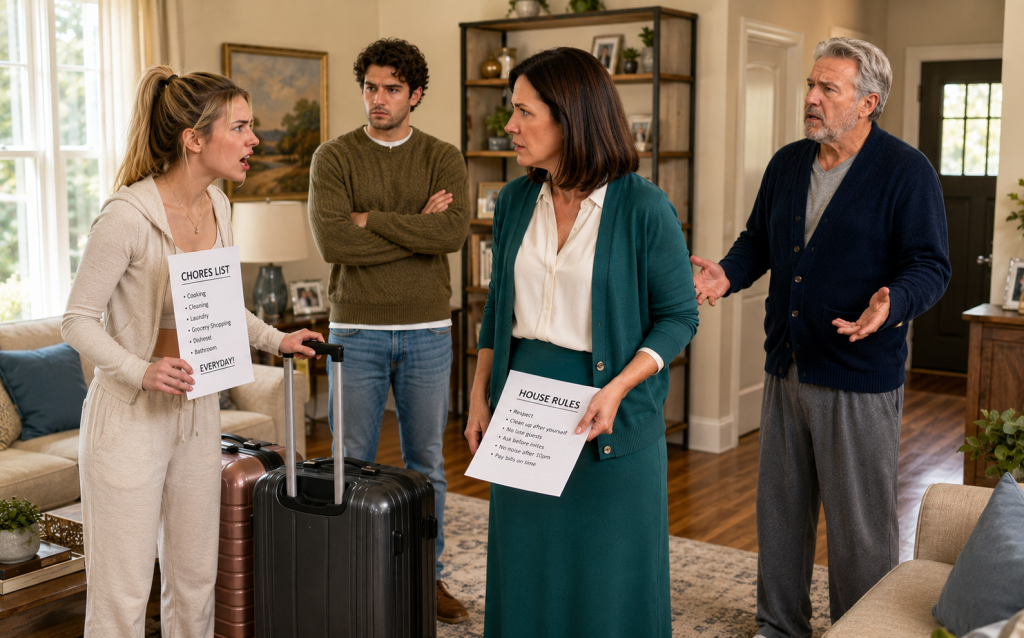
Instead, she pushed one suitcase across the threshold with the toe of her expensive boot and handed me a printed sheet of paper.
I looked down at it.
At first, I thought it might be a list of emergency contacts or information about how long they planned to stay.
It was neither.
It was a chore schedule.
My chore schedule.
Monday: Wash Madison and Evan’s clothes.
Tuesday: Clean guest bathroom.
Wednesday: Prepare meal-prep lunches.
Thursday: Change bedding.
Friday: Grocery shopping.
Saturday: Deep-clean bedroom and bathroom.
At the bottom, written in bold letters, were several dietary instructions.
No greasy food.
Organic produce only.
Evan needs oat milk.
Madison prefers protein pancakes.
Avoid strong cleaning products because of sensitive skin.
I slowly raised my eyes.
Madison stood in the doorway wearing a cream-colored coat and a look of complete confidence. Her husband, Evan, was behind her, staring at his phone as though none of this concerned him.
My husband, Robert, stood several feet away near the staircase.
He said nothing.
That silence told me everything.
He had known they were coming.
He had invited them.
And he had decided that informing me was unnecessary.
“So,” Madison said, glancing past me into the living room, “which room did you prepare?”
I folded the paper in half.
Then I folded it again.
“The guest room is upstairs,” I said.
Madison smiled.
“Perfect. Evan needs space for his computer equipment, so we’ll use your office too.”
“No,” I replied.
The smile remained on my face, but my voice did not invite negotiation.
“My office is private.”
She blinked.
Then she looked toward Robert.
“Dad?”
Robert finally stepped forward.
“Laura, they’ve been through a difficult time.”
That was the first explanation I received.
Not an apology.
Not a discussion.
Just a vague statement designed to make resistance sound cruel.
“What difficult time?” I asked.
Evan sighed impatiently.
“Our landlord sold the apartment building.”
Madison added, “We had thirty days to move.”
“And when did you learn this?”
“Five weeks ago.”
Five weeks.
Robert had known for more than a month, yet he had waited until they were standing inside our house before saying anything.
“How long are you planning to stay?” I asked.
Madison shrugged.
“Until we get settled.”
“That could mean a week or a year.”
“Why are you making this uncomfortable?” she asked. “We’re family.”
Family.
It was a word Madison used whenever she wanted something.
She had never called me family when she refused to attend my birthday dinner.
She had not called me family when she introduced me at her wedding as “Dad’s second wife.”
She had not called me family when she asked Robert to remove me from the family Christmas photographs because I was “not actually related.”
But now that she needed a bedroom, a cook, a laundress, and free housing, I was family.
Robert rubbed his forehead.
“Can we discuss this in the morning?”
Madison immediately headed toward the stairs.
“Good. I’m exhausted.”
Evan dragged both suitcases after her.
Neither of them thanked me.
Neither asked whether I needed help preparing the room.
Within minutes, I heard drawers opening upstairs.
Then came the sound of furniture moving.
I stood in the living room with the folded chore schedule in my hand.
Robert avoided my eyes.
“You should have spoken to me,” I said.
“They had nowhere else to go.”
“They had five weeks.”
“They’re my daughter and son-in-law.”
“And this is my home too.”
He exhaled heavily.
“Laura, please don’t turn this into a battle.”
I stared at him.
“I didn’t bring a battle to this house, Robert. You carried it through the front door.”
He looked tired rather than ashamed.
That hurt more than anger would have.
We had been married for eight years.
Both of us had been widowed before we met.
Robert had one daughter, Madison, from his first marriage. I had no children, but I had built a successful career as an accountant, purchased my own condo, and carefully saved for retirement.
When Robert and I married, we sold his aging suburban house and my downtown condo. Together, we bought the home where we now lived.
Half of the down payment came from me.
My name was on the deed.
My salary had helped pay the mortgage for seven years.
Yet Robert was behaving as though this were his private property and I were merely the woman who kept it clean.
“Go to bed,” he said quietly. “We’ll work it out.”
But I did not go to bed.
After Robert went upstairs, I entered my office and closed the door.
I switched on the desk lamp and opened the fireproof cabinet where I kept our important documents.
The property deed was exactly where I remembered.
Both names were printed clearly.
Robert Clarke.
Laura Bennett-Clarke.
Next came the mortgage records.
Then the bank statements.
Then the prenuptial agreement Robert had insisted upon before our wedding.
“At our age, everyone needs to protect themselves,” he had said.
At the time, I had respected him for being practical.
Now I was grateful.
The agreement stated that neither spouse could grant long-term occupancy rights to another adult without the written consent of the other legal homeowner.
I read that sentence three times.
Then I called my attorney, Margaret Levin.
Margaret was an old friend from my working years. I did not expect her to answer so late, but she did.
“Laura?” she said sleepily. “Is everything all right?”
“No,” I replied. “But it will be.”
I explained the situation.
She listened without interrupting.
When I finished, she asked one question.
“Do they have keys?”
“Madison probably has the old emergency key Robert gave her years ago.”
“Then change the locks. Tell them clearly, in writing, that they do not have permission to establish residency. Do not accept mail addressed to them. Do not let them contribute money unless you create a proper agreement.”
“I was thinking of offering a short-term roommate arrangement.”
“That is reasonable. Put every condition in writing.”
For the next three hours, I worked.
I drafted house rules.
I calculated their fair share of utilities.
I researched rental prices in our neighborhood.
I printed a short-term occupancy agreement that required weekly rent and gave either homeowner the right to terminate the arrangement with notice.
Then I called a twenty-four-hour locksmith and scheduled him for six in the morning.
Finally, I called the non-emergency police number.
I explained that two adults had arrived with luggage after being invited by only one of the two homeowners.
The dispatcher said an officer could come by in the morning to keep the peace while ownership and permission were clarified.
By five-thirty, everything was ready.
At six o’clock, I prepared breakfast.
Two boiled eggs per person.
Dry toast.
Black coffee.
No butter.
No jam.
No bacon.
No fried potatoes.
Nothing rich enough to disturb the supposedly sensitive stomachs of Madison Clarke and her husband.
Madison entered the kitchen first, still dressed in silk pajamas and staring at her phone.
She stopped when she saw the table.
“What is this?”
“Breakfast.”
She looked at the plate as though I had insulted her.
“Dad told you I eat protein pancakes.”
I glanced toward Robert, who was standing near the doorway tying the belt of his robe.
He avoided my eyes.
“Your instructions said you don’t eat greasy food,” I replied pleasantly. “This meal is not greasy.”
Evan wandered in behind her, yawning.
“Where’s the oat milk?”
“In the refrigerator.”
Madison looked at me sharply.
“You’re supposed to pour it for him.”
I smiled again.
It was the same calm smile I had worn when she handed me her ridiculous chore schedule.
Then I placed my own sheet of paper on the kitchen island.
Madison frowned.
“What’s that?”
“My list.”
For the first time that morning, Robert looked directly at me.
I tapped the document.
“These are the house rules. Rent is due every Friday. Two adults will pay a total of two thousand dollars each month. Utilities will be divided equally among the three households. Everyone does their own laundry. Cooking rotates by day. The bathroom-cleaning schedule is posted. Quiet hours begin at ten. Guests must be approved in advance.”
I paused.
“And no one enters my bedroom, my office, or my private pantry cabinet.”
Madison gave a short, mocking laugh.
“You can’t charge us rent. This is Dad’s house.”
“No,” I said calmly. “This is our house. My name is on the deed, and half of the down payment came from the sale of my condo.”
Robert’s face lost its color.
Madison turned toward him.
“Dad?”
He cleared his throat.
“Laura, don’t make this more difficult than it needs to be.”
I opened the drawer beside me and removed the folder.
I spread copies of the deed, mortgage statements, and prenuptial agreement across the island.
Madison’s confidence slowly gave way to confusion.
“You have until noon,” I said. “Sign the roommate agreement, pay the first week’s rent, and follow the rules. Otherwise, take your suitcases and find somewhere else to stay.”
Evan stared at me.
“You’re serious?”
Before I could answer, the doorbell rang.
Madison smirked.
“Good. Maybe someone reasonable finally showed up.”
I walked to the front door and opened it.
A uniformed police officer stood on the porch beside a locksmith holding a metal toolbox.
Behind me, Robert spoke in a low, uneasy voice.
“Laura, what did you do?”
I turned to face him.
“What you should have done when they arrived last night.”
The officer introduced himself as Officer Daniels.
“I understand there is a disagreement about who has permission to stay in the property,” he said.
Robert stepped forward quickly.
“There’s no disagreement. This is my daughter. I invited her.”
Officer Daniels looked at me.
“Are you also an owner?”
“Yes.”
I handed him a copy of the deed.
He examined it.
“Then both owners have equal rights regarding permanent or extended guests, unless another agreement says otherwise.”
I showed him the relevant section of the prenuptial agreement.
Madison crossed her arms.
“We’re not permanent guests.”
“You arrived with two suitcases and told me you were moving in,” I said.
“That doesn’t mean forever.”
“Then signing a short-term agreement should not be a problem.”
Evan picked up the document.
His eyes widened when he saw the rent amount.
“Two thousand dollars a month?”
“For a furnished bedroom, private bathroom, utilities, kitchen access, parking, and storage space in this neighborhood, it is reasonable.”
“We don’t have that kind of money,” Madison snapped.
“Then how were you paying rent at your apartment?”
Her face tightened.
Robert stepped between us.
“Laura, they need time to recover.”
“Recover from what?”
Neither Madison nor Evan answered.
Officer Daniels remained near the entrance.
The locksmith waited silently beside him.
Finally, Robert said, “Evan lost his job.”
That was new information.
I looked at Evan.
“When?”
He stared at the floor.
“Four months ago.”
“And Madison?”
“She quit,” Robert said.
Madison glared at him.
“You promised you wouldn’t discuss our personal business.”
I almost laughed.
She had moved into my home and handed me a chore list, but her finances were private.
“Why did you quit?” I asked.
“My manager was toxic.”
“What did he do?”
“He expected me to be available five days a week.”
I waited for more.
There was no more.
Madison had worked as a marketing assistant. Her manager expected her to work the schedule she had been hired to work, and she considered that toxic.
Evan had been dismissed from a software company after repeatedly missing deadlines.
Their savings were gone.
Their credit cards were nearly maxed out.
And rather than change their spending habits, they had decided to move into our house and turn me into their unpaid servant.
“You knew all of this?” I asked Robert.
He nodded reluctantly.
“And you still said nothing to me?”
“I knew you would react badly.”
“No. You knew I would say no.”
His silence confirmed it.
Madison stepped closer.
“Why are you acting like we’re strangers? Dad’s money will be mine eventually anyway.”
The room became completely still.
Even Robert looked shocked.
Madison seemed to realize she had said too much, but pride kept her from apologizing.
I slowly turned toward her.
“This house is not your inheritance.”
She rolled her eyes.
“Half of it is Dad’s.”
“Yes. Half. The other half belongs to me.”
“For now.”
Robert’s voice sharpened.
“Madison.”
But she continued.
“What? We all know she doesn’t have children. Who else would get it?”
I felt something inside me become very calm.
For years, I had made excuses for Madison.
Her mother had died young.
She was protective of Robert.
She had trouble accepting his second marriage.
I had told myself that patience would eventually bring us closer.
But patience without boundaries had taught her the wrong lesson.
It had taught her that she could disrespect me without consequences.
I picked up the roommate agreement.
“The offer is withdrawn.”
Robert stared at me.
“Laura—”
“They are leaving.”
Madison laughed.
“You can’t throw us out.”
“You were invited by one owner less than eight hours ago. You have not established residency. You have received no mail here, paid no rent, and signed no agreement.”
Officer Daniels nodded.
“That is correct. At this point, if one legal owner withdraws permission, you need to leave.”
Madison turned to her father.
“Do something.”
Robert looked trapped.
For years, he had avoided conflict by giving Madison whatever she wanted.
He had mistaken surrender for love.
Now he expected me to surrender too.
“I think everyone needs to calm down,” he said.
“I am calm,” I replied.
The locksmith lifted his toolbox slightly.
“Would you like the locks changed now?”
“Yes.”
Madison’s face flushed red.
“You planned this.”
“I responded to what you planned.”
Evan rubbed his temples.
“Can we at least stay for a few days?”
“No.”
“Where are we supposed to go?”
“You had five weeks to answer that question.”
Madison pointed toward the staircase.
“Our belongings are upstairs.”
“You may collect them.”
She stormed past me.
Evan followed more slowly.
Robert stood in the kitchen, staring at the paperwork.
“You embarrassed me in front of my daughter,” he said.
I looked at him.
“You invited two adults to live in our home without telling me. You allowed your daughter to hand your wife a servant’s schedule. And you lied by omission for five weeks.”
“I was trying to help her.”
“You were trying to avoid telling her no.”
“That’s not fair.”
“No, Robert. What happened last night was not fair.”
Upstairs, drawers slammed.
Madison shouted something I could not understand.
Officer Daniels stayed near the front door while the locksmith began removing the old lock.
Twenty minutes later, Madison and Evan came downstairs with their suitcases.
Madison had changed into jeans and a sweater, but she was still wearing the expression of someone who believed the world had betrayed her.
At the bottom of the staircase, she stopped.
“I will never forgive you for this.”
I met her eyes.
“You are angry because I refused to let you use me.”
“You destroyed this family.”
“No. I stopped pretending disrespect was love.”
She turned toward Robert.
“You’re really letting her do this?”
Robert looked at his daughter.
Then he looked at me.
For one hopeful second, I thought he might finally speak honestly.
Instead, he said, “Maybe it’s best if you go to a hotel for now.”
Madison’s mouth fell open.
“A hotel? With what money?”
Robert reached for his wallet.
I stopped him.
“No.”
He looked at me sharply.
“I am not controlling your personal spending,” I said. “But do not use our joint account.”
Madison laughed bitterly.
“She controls you now.”
“No,” I said. “I am holding him responsible for decisions that affect both of us.”
Evan opened the front door.
“Come on, Madison.”
But she was not finished.
She reached into her handbag, pulled out the chore list she had given me, and tore it into several pieces.
Then she dropped them onto the floor.
I looked down at the scraps.
“Pick those up.”
She stared at me.
“What?”
“You made the mess. Pick it up.”
Officer Daniels cleared his throat.
Madison’s face tightened.
Slowly, furiously, she bent down and collected every piece.
She carried them to the kitchen trash can and dropped them inside.
Then she and Evan left.
The locksmith completed his work and handed me three new keys.
I gave one to Robert.
I kept one.
The third went into my office safe.
After the officer and locksmith departed, silence settled over the house.
Robert stood by the window watching Madison’s car disappear.
“You could have handled that differently,” he said.
“So could you.”
“She’s my daughter.”
“And I am your wife.”
“She was desperate.”
“She was entitled.”
“You don’t understand because you never had children.”
The words landed harder than I expected.
Robert realized it immediately.
His expression changed.
“Laura, I didn’t mean—”
“Yes, you did.”
I walked into my office and closed the door.
For the first time in eight years, I locked it.
Robert knocked several minutes later.
I did not answer.
I sat at my desk and looked around the room.
The shelves held photographs from my career, certificates I had earned, and small objects collected during trips Robert and I had taken together.
On the corner of my desk was a photograph from our wedding day.
We looked happy.
I had believed that marriage at our age would be simpler.
We had both survived loss.
We had already raised families or built careers.
We understood money, responsibility, and compromise.
But age did not automatically create courage.
Robert had spent decades avoiding difficult conversations with Madison.
And I had spent eight years pretending his weakness did not affect me.
That morning, it finally had.
Around noon, I heard the front door close.
Robert had left without saying goodbye.
He did not return until evening.
I made dinner for myself.
A small piece of salmon.
Roasted vegetables.
A glass of sparkling water.
I ate at the kitchen table alone.
At eight o’clock, Robert entered.
He looked exhausted.
“Madison and Evan are at a motel,” he said.
I continued eating.
“I paid for three nights from my personal account.”
“That was your decision.”
He sat across from me.
“She says she’s done with me.”
“She says that whenever you set a boundary.”
“You don’t know her like I do.”
“No. I know exactly what she has learned from you.”
He frowned.
“What does that mean?”
“She has learned that anger works. She has learned that if she threatens to withdraw her love, you will give her money, attention, or permission. She has learned that your fear of losing her is stronger than your respect for yourself.”
Robert looked down at his hands.
“That is cruel.”
“It is true.”
He was quiet for a long time.
Then he said, “Her mother died when she was sixteen.”
“I know.”
“I promised I would always protect her.”
“Protection is not the same as enabling.”
“You think I failed her.”
“I think you never allowed her to fail safely. Every time she made a poor decision, you removed the consequences. Now she is thirty-four years old and expects everyone else to carry her.”
Robert’s eyes filled with pain.
I softened my voice.
“I am not asking you to stop loving your daughter. I am asking you to stop sacrificing our marriage to protect her from adulthood.”
He stood.
“I need time to think.”
“So do I.”
For the next three days, Robert slept in the guest room.
Madison called him constantly.
Sometimes she cried.
Sometimes she shouted.
Sometimes she accused me of isolating him from his family.
I heard enough through the walls to understand her strategy.
She told him I was controlling.
She told him I had never loved her.
She said I wanted his house and money.
She reminded him that blood came before marriage.
Robert listened.
But for the first time, he did not immediately agree.
On the fourth morning, he asked to speak with me.
We sat in the living room.
He carried a folder.
“I met with Margaret yesterday,” he said.
I was surprised.
“You spoke to my attorney?”
“I asked her to explain the documents you showed us.”
“And?”
“She confirmed everything.”
I waited.
Robert opened the folder.
Inside were bank statements.
“I also reviewed our finances.”
My stomach tightened.
“What did you find?”
He took a breath.
“Over the last three years, I have given Madison and Evan nearly eighty-seven thousand dollars.”
I stared at him.
“From where?”
“My personal investment account.”
“Why didn’t you tell me?”
“I was ashamed.”
The truth finally began to emerge.
He had paid their rent twice.
Covered credit-card bills.
Purchased a car after Evan’s old one was repossessed.
Paid for a vacation they claimed was necessary for their mental health.
Covered Madison’s shopping debt.
And three months earlier, he had withdrawn twenty thousand dollars to help them make a down payment on a home.
They had spent most of it instead.
“I kept thinking the next payment would solve everything,” he said.
“But it never did.”
“No.”
He looked older than he had a week earlier.
“I also realized why Madison was so certain the house would be hers.”
I said nothing.
“I told her that after I died, my share would probably pass to her.”
My chest tightened.
“Probably?”
“I assumed you would stay here for the rest of your life, and then she would inherit it later.”
“You discussed my home as though I were already dead.”
He flinched.
“I didn’t think of it that way.”
“That is the problem, Robert. You didn’t think of me at all.”
He nodded slowly.
“You’re right.”
It was the first time he had said those words without defending himself.
He slid another document across the table.
It was a list of marriage counselors.
“I called three of them.”
I looked at him.
“I don’t want to lose you,” he said. “But I understand that saying that is not enough.”
For several seconds, I could not speak.
Part of me wanted to forgive him immediately.
Another part remembered him standing silently while Madison handed me that chore list.
“I will attend counseling,” I said. “But there are conditions.”
“Name them.”
“No more secret payments.”
He nodded.
“No one moves into this house unless we both agree.”
“Yes.”
“Madison does not receive a key.”
“Agreed.”
“And if she disrespects me, you address it immediately. I will no longer defend my place in my own marriage.”
Robert lowered his head.
“I should have done that years ago.”
“Yes.”
Our first counseling session was painful.
The second was worse.
Robert admitted that he had spent most of his life trying to keep Madison happy because he feared losing the last connection to his first wife.
I admitted that I had tolerated disrespect because I wanted to prove I was not the jealous second wife Madison imagined me to be.
Both of us had acted out of fear.
But only one of us had been expected to pay the price.
Meanwhile, Madison and Evan moved into a small apartment forty minutes away.
Robert refused to pay their deposit.
Evan found temporary work at a delivery warehouse.
Madison took a part-time job at a fitness center.
For two months, she refused to speak to her father.
Robert was devastated, but he did not chase her.
He sent one message.
I love you. I am here when you are ready to have a respectful relationship. I will not provide more money, and I will not discuss Laura as though she is the enemy.
Madison did not respond.
Then, shortly before Thanksgiving, she called.
Not because she had changed.
Because Evan had lost his temporary job.
She asked for five thousand dollars.
Robert said no.
She cried.
He still said no.
She called him selfish.
He remained silent.
Then she said, “Mom would be ashamed of you.”
That was the cruelest weapon she possessed.
For years, it had worked.
This time, Robert replied, “Your mother would want you to build a life, not demand one from everyone else.”
Madison hung up.
Robert sat at the kitchen table for nearly an hour afterward.
I made tea and placed it beside him.
He did not ask me to solve the pain.
I did not tell him he had done the right thing.
I simply sat with him.
Sometimes boundaries do not feel like victory.
Sometimes they feel like grief.
Thanksgiving arrived.
Robert and I planned a quiet meal for six friends.
At noon, the doorbell rang.
When I opened it, Madison stood on the porch.
She was alone.
No suitcases.
No chore list.
She held a small bakery box.
“Can I come in?” she asked.
I looked at Robert.
He stepped beside me.
“For dinner?” he asked.
“For a conversation.”
Her voice was less confident than usual.
I opened the door wider.
She entered and sat in the living room.
For several moments, no one spoke.
Finally, Madison looked at me.
“I was horrible.”
It was not an elegant apology.
But it was honest.
She continued.
“I told myself you were trying to replace my mother. Then I told myself you were stealing Dad’s money. Then I decided anything he gave you was something taken from me.”
Robert’s face tightened with sadness.
Madison looked down.
“When we lost the apartment, I assumed Dad would fix it. He always fixed everything.”
She glanced at him.
“And when he said we could stay here, I thought that meant I was in charge because this was still his house in my mind.”
“It was never only his,” I said.
“I know that now.”
She wiped her palms against her skirt.
“The chore list was disgusting. I don’t know why I thought that was acceptable.”
“You thought it was acceptable because no one had ever made you face the way you treated people.”
She nodded.
“You’re right.”
Robert inhaled slowly.
“Are you here because you need money?”
Madison looked hurt.
Then she shook her head.
“No.”
She opened the bakery box.
Inside was a small pumpkin pie.
“I made it at work. I got a second job at the bakery.”
For the first time, I noticed that her hands were dry and slightly reddened.
Working hands.
“I’m still angry,” she admitted. “But mostly I’m angry at myself.”
Robert sat beside her.
“I love you.”
“I know.”
“But I will not go back to the way things were.”
“I know that too.”
She turned to me.
“I don’t expect you to forgive me today.”
“I don’t.”
The honesty surprised her.
“But,” I added, “I am willing to see whether your actions match your apology.”
She nodded.
“That’s fair.”
Madison stayed for Thanksgiving dinner.
She helped set the table.
She carried dishes to the kitchen.
When dinner ended, she washed every plate without being asked.
It did not erase the past.
Nothing could.
But it was a beginning.
Six months later, Madison and Evan were still in their apartment.
Evan had found permanent work.
Madison continued working two jobs while studying for a professional certificate.
Robert had stopped sending them money.
He had also changed his will.
His share of the house would remain mine if he died first.
Madison would inherit a separate investment account, but only what remained after Robert’s retirement and medical needs were secured.
When he told her, she did not argue.
One Sunday afternoon, Madison visited for lunch.
Afterward, she stood in the kitchen doorway while I poured coffee.
“I still think about that breakfast,” she said.
“The boiled eggs?”
“And the dry toast.”
I smiled.
“It met every requirement on your list.”
She laughed quietly.
“I deserved it.”
“Yes, you did.”
She looked toward the front door.
“Do you still have the new locks?”
“Yes.”
“And I still don’t get a key?”
“No.”
She nodded.
“Good.”
I raised an eyebrow.
“Good?”
“I don’t think I understood boundaries until you locked me out.”
“That was not my intention.”
“Maybe not. But it worked.”
She picked up her handbag.
Before leaving, she paused.
“Laura?”
“Yes?”
“I’m glad Dad married someone who finally told us both no.”
Then she left.
I stood in the quiet kitchen, thinking about everything that had changed.
Robert and I were not perfect.
Madison and I would never have an effortless relationship.
Trust did not return simply because someone apologized.
It returned in small pieces.
A respected boundary.
An honest conversation.
A promise kept.
A meal prepared without expectation.
That night, Robert and I sat together on the porch.
The sun disappeared behind the trees, casting a warm golden light across the yard.
He reached for my hand.
“I should have defended you that night,” he said.
“Yes.”
“I should have asked before inviting them.”
“Yes.”
“I should never have let Madison treat you like an employee.”
“Yes.”
He smiled faintly.
“You’re not going to make this easy for me, are you?”
“No.”
He squeezed my hand.
“I’m grateful you stayed.”
I looked at him.
“I stayed because you changed. Do not confuse that with permission to repeat the mistake.”
“I won’t.”
I believed him.
Not because he said it.
Because for months, his actions had proved it.
The house was peaceful again.
But it was not the same peace we had before.
The old peace had been built on avoidance.
This peace was built on truth.
I had learned that keeping a family together did not require accepting every demand.
Love did not mean unlimited access.
Marriage did not mean surrendering ownership of my voice, my money, or my home.
And kindness did not require becoming invisible.
Sometimes the most loving word a person can say is no.
No, you may not disrespect me.
No, you may not make decisions about my life without me.
No, you may not call entitlement family.
No, you may not enter my home and hand me a list of duties as though I exist to serve you.
That night at eleven o’clock, Madison arrived believing she was moving into her father’s house.
At six the next morning, she learned the truth.
It was my house too.
My marriage too.
My future too.
And from that day forward, no one in the family ever forgot it.
💬THE END! THANK YOU FOR READING!