

My daughter’s text appeared while I was sitting at the bank, moments away from sending twenty-five thousand dollars to pay for her honeymoon.
“You won’t be attending my wedding,” she wrote. “My fiancé doesn’t want you there.”
I stared at the message, then lowered my eyes to the wire-transfer document waiting for my signature.
For a few seconds, I nearly completed the payment anyway.
That was the kind of mother I had become.
The kind who accepted humiliation as long as it allowed her to remain useful.
Then I replied with a single word.
“Understood.”
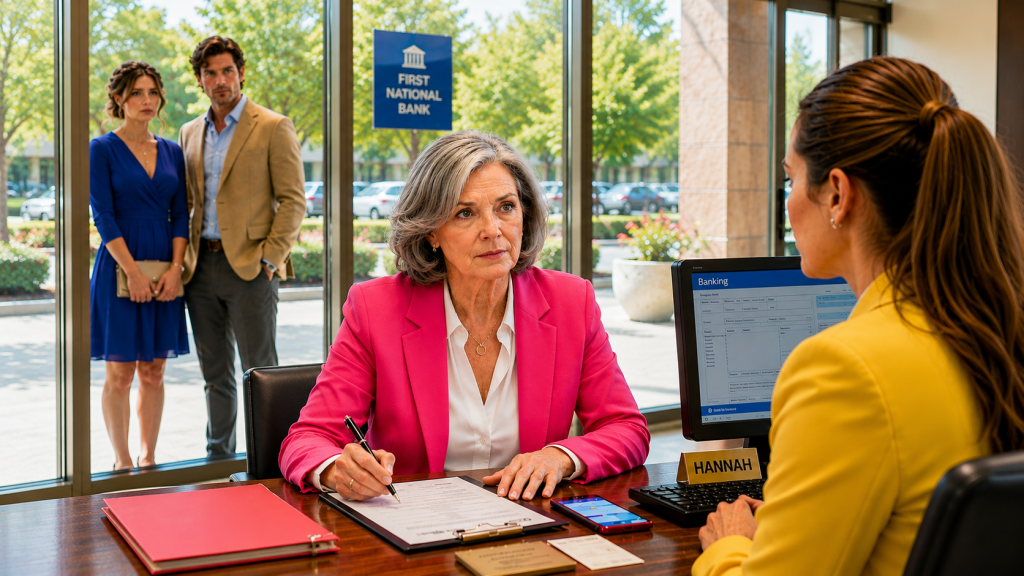
I placed my phone on the desk and looked at the teller.
“Please stop every transfer associated with my daughter.”
The teller froze, her fingers hovering above the keyboard.
Her name tag said Hannah. Her expression was polite and carefully controlled, the kind bank employees wore when they sensed that something painful was unfolding across the desk.
The fluorescent lights buzzed quietly overhead. My purse sat open on my knees, with my checkbook tucked inside. Beneath my blouse, Robert’s wedding ring rested against my chest on the chain I had worn since his death.
“Mrs. Weber,” Hannah said gently, “would you like some time to think about this?”
“No.”
I folded the transfer form once, then folded it again.
“I’ve spent twenty-nine years thinking about it.”
Her eyes briefly moved toward my phone, where the message was still visible.
You won’t be attending my wedding.
I placed the phone inside my purse before she could read any more.
Not because I was embarrassed.
Some pain simply did not require an audience.
Hannah canceled the wire transfer. Then, at my request, she reviewed every recurring payment and scheduled transaction connected to my daughter, Joselyn.
The two-hundred-dollar monthly grocery allowance.
The final payment for the wedding venue.
A deposit for the florist.
A scheduled transfer to Derek’s business account.
Each one disappeared from the screen.
“Would you like printed confirmation?” Hannah asked.
“No, thank you.”
I did not need a receipt to prove that I had finally stopped financing my own rejection.
I walked out of First National Bank without a honeymoon payment and without the old version of myself—the woman who would have sent the money anyway in the hope of keeping a place in her daughter’s life.
My Subaru was parked between a family minivan covered with soccer stickers and an aging pickup truck with a faded university decal.
It was an ordinary Tuesday.
Sunlight reflected normally across the cars.
People crossed the parking lot carrying coffee and shopping bags, unaware that my entire understanding of my family had just changed.
I sat behind the steering wheel for several minutes, my hands resting still in my lap.
I did not cry.
As an engineer, I had learned not to panic when a structure shifted unexpectedly.
You studied it.
You calculated where the pressure had been concentrated.
You identified which parts had carried more weight than they were designed to hold.
And Joselyn’s message had revealed exactly where the burden in our relationship had always been placed.
On me.
I had carried the money, the responsibility, the forgiveness, and the fear of losing her.
Joselyn had carried none of it.
My daughter had not always treated me like an outsider.
Once, she had been the little girl standing beside my drafting table, gripping a yellow measuring tape with both hands while struggling to understand the numbers.
“Why are there so many tiny lines?” she had asked.
“Because small measurements matter,” I told her.
She had nodded solemnly, as though I had shared the deepest secret in the universe.
Once, our Sunday mornings had smelled of pancakes and warm maple syrup, while Robert laughed after burning the first batch, as he always did.
Once, Joselyn had fallen asleep against my shoulder during thunderstorms because she believed I could keep the lightning away.
When Robert died of a sudden heart attack, I became both mother and father.
Joselyn had been seventeen.
One morning, we were a family of three.
By evening, there were only two of us sitting beneath the harsh lights of a hospital waiting room while a doctor explained that Robert could not be saved.
Joselyn collapsed against me.
I held her while my own heart was breaking.
From that day forward, I promised myself she would never feel abandoned.
I checked the oil in her car.
I paid every dollar of her college tuition.
I edited her essays late at night.
I drove her to campus in a Subaru packed so tightly that we had to wedge a laundry basket between the seats.
When she called during her first semester and said she wanted to come home, I drove three hours through freezing rain to sit beside her in a twenty-four-hour diner.
I did not tell her to toughen up.
I did not remind her how much tuition cost.
I bought her hot chocolate and listened until sunrise.
For years, she called every Sunday.
She told me about classes, roommates, dates, disappointments, and dreams.
Then Derek came into her life.
At first, I tried to like him.
He arrived for dinner wearing a fitted navy jacket and a watch that probably cost more than most people’s monthly rent. He brought expensive wine and a bouquet of white roses.
He was polished, confident, and charming enough to draw everyone’s attention whenever he spoke.
But while he praised my home, his gaze moved around the room as though he were estimating the value of everything inside it.
He asked whether my house was paid off.
He wanted to know how many clients my engineering firm served.
He questioned whether I planned to sell the business when I retired.
At one point, he looked at a framed photograph of Robert and me standing in front of our first office.
“So this was the beginning of your little company?” he asked.
I looked at him carefully.
The “little company” employed forty people and held contracts throughout three states.
“Yes,” I replied. “That was the beginning.”
Joselyn laughed as though Derek’s comment were harmless.
“He doesn’t mean anything by it, Mom.”
That sentence became a pattern.
Derek does not mean anything by it.
Derek is just direct.
Derek is under pressure.
Derek has big dreams.
Every insult came with an explanation, and every explanation became my responsibility to accept.
Still, Joselyn seemed happy.
She smiled more often when he was around.
She talked about the house they would buy, the children they would have, and the business empire Derek claimed he was building.
I wanted to believe her future was secure.
So when she asked me to guarantee a loan for Derek’s company, I made the mistake many parents make.
I allowed love to speak louder than experience.
Derek presented a polished business plan for an upscale home-renovation consulting company.
The documents contained market estimates, profit projections, and photographs of luxury properties.
He talked about expansion, investors, and opportunities.
I noticed that several numbers seemed optimistic.
I asked questions.
Derek always had an answer.
Whenever his explanations became vague, Joselyn squeezed my hand beneath the table.
“Please, Mom,” she whispered. “This could change our lives.”
I signed the documents.
One hundred fifty thousand dollars.
My credit history.
My reputation.
My legal responsibility.
Derek hugged me afterward and called me “the best future mother-in-law a man could ask for.”
Three weeks later, he stopped returning my calls about the quarterly reports.
Then came the wedding venue.
Forty thousand dollars for a renovated barn outside town, decorated with hanging lights, exposed beams, and a view across the valley that Joselyn described as magical.
My signature was on the agreement.
The money came directly from my account.
After that, I began sending her a monthly grocery allowance.
Two hundred dollars every month because I knew she preferred expensive coffee and a certain brand of yogurt sold at the market near her house.
Then came the florist.
The photographer.
The dress alterations.
The engagement party.
Each expense arrived with the same promise.
“This is the last thing, Mom.”
The honeymoon was supposed to be the last thing.
Twenty-five thousand dollars for twelve days in Italy.
That was the payment I had been about to make when her text arrived.
By the time I returned home from the bank, the afternoon sunlight had shifted across the kitchen island.
Out of habit, I made Earl Grey tea and poured two cups, even though Robert had been gone for twelve years.
The second cup sat untouched across from me at the oak table he had built the year Joselyn was born.
I pressed my fingers against the wedding ring hanging from my neck.
“I finally understand what you meant,” I whispered.
Years earlier, Robert had once told me, “Franny, you have to stop building things for people who don’t want them.”
At the time, he had been talking about a stubborn client who ignored every recommendation and then blamed our firm when the project failed.
Now I understood that he had left behind a lesson far greater than the situation that inspired it.
I had spent years building bridges toward Joselyn.
She had spent years removing the planks while expecting me to continue paying for the materials.
That evening, I contacted my attorney, Sandra Okafor.
Sandra had represented my company for nearly fifteen years. She was calm, exact, and almost impossible to intimidate.
“I need to restructure everything,” I told her.
Sandra did not respond with surprise or sympathy. The best attorneys rarely allowed emotion to interrupt their questions.
“How much do you want to change?” she asked.
“All of it.”
There was a brief pause.
Then she said, “Tell me exactly what you want done.”
I gave her the complete list.
Remove Joselyn as the primary beneficiary of my personal estate.
Redirect the assets in the family trust.
Cancel the wedding venue.
End my involvement in Derek’s business loan if legally possible.
Stop every allowance and recurring payment.
Use the honeymoon money to establish the Robert Weber Engineering Scholarship at our local community college.
Sandra remained silent for several seconds.
“Frances, you know these decisions are going to create a great deal of conflict.”
“I’m counting on it.”
“Do you believe Derek has misrepresented anything connected to the business loan?”
“I believe he has misrepresented almost everything.”
“Then we will start with the documents.”
The next morning, I drove to Ridgeline Barn and canceled the wedding reservation personally.
The venue manager, Paula, seemed nervous before I had even taken my seat.
She opened the digital contract, clicked through several pages, and looked at me over the top of her laptop.
“Mrs. Weber, because the wedding is less than two months away, a portion of the deposit is nonrefundable.”
“I understand.”
“The remaining balance can be returned to the original account.”
“That will be fine.”
She hesitated.
“There’s something I believe you should know.”
My fingers tightened around the arm of the chair.
“What is it?”
“The groom called us last week.”
“What did he want?”
“He asked whether the deposit could be returned.”
“To whom?”
Paula paused before answering.
“To him.”
The room became completely silent.
“Did he say why?”
“He claimed you had authorized him to handle the cancellation if necessary.”
“I authorized no such thing.”
“I suspected that might be the case. The contract states that only the original payer can approve a refund, so we refused.”
“Do you have a record of the call?”
“Yes. Our business calls are recorded.”
There it was.
A recorded conversation.
A confirmed date.
A request made before I had supposedly been excluded from the wedding because of a personal disagreement.
Derek had already been searching for a way to collect my money before removing me from the celebration I had financed.
I thanked Paula, completed the cancellation forms, and asked her to send the recording to Sandra.
I carried a copy of the contract back to my car inside a plain cream folder.
It looked unremarkable.
That was the strange thing about evidence.
It rarely arrived with dramatic music or a flashing warning.
Sometimes it was nothing more than a date, a signature, and a few lines of ink that someone never expected you to examine.
My phone began ringing before I had even left the parking lot.
Joselyn.
I let the first call go unanswered.
Then the second.
On the third call, I answered.
“What did you do?” she screamed.
“Good morning to you too.”
“The venue manager just called Derek. She said the wedding has been canceled.”
“That is correct.”
“You cannot do that!”
“I signed the contract. I paid the deposit. I canceled it.”
“You’re trying to ruin my wedding because Derek doesn’t feel comfortable having you there.”
“I am not ruining a wedding I was told not to attend.”
“You promised to pay for it!”
“I promised before you excluded me.”
Her breathing became sharp and uneven.
“You’re acting like a child.”
“No, Joselyn. A child believes she can insult someone and still demand their money.”
“This isn’t about money.”
“Then losing mine should not matter.”
She went silent.
For a moment, I could hear traffic moving behind her.
Then her voice changed.
The anger softened into the wounded tone she had used since childhood whenever she wanted me to rescue her.
“Mom, please. We’ve already sent invitations. People have booked hotels.”
“You should ask Derek why he called the venue last week and requested that my deposit be refunded directly to him.”
The silence that followed was different.
Not angry.
Uncertain.
“What are you talking about?”
“You should ask him.”
“He wouldn’t do that.”
“The venue has a recording.”
“You’re lying.”
“No. But someone is.”
I ended the call.
My hands were shaking, but my decision was not.
One week later, a former business partner named Thomas Reed called me.
Thomas and I had worked together on several commercial projects. He was cautious with his words and rarely involved himself in other people’s financial affairs.
The concern in his voice immediately told me the situation was serious.
“Frances, Derek listed you as a personal reference on another loan application,” he said.
My stomach tightened.
“I never authorized that.”
“I assumed you hadn’t.”
“What kind of loan?”
“Eighty-five thousand dollars. He is trying to refinance short-term business debt.”
I reached for a pencil beside my drafting table.
“Go ahead.”
Thomas told me about several credit cards that were nearly maxed out.
A failed cryptocurrency investment had consumed thousands more.
Derek owed money to two private lenders.
He had missed office rent payments.
His company had only three active clients, not the twenty-seven listed in the documents he had shown me.
“What happened to the original one hundred fifty thousand?” I asked.
“We don’t know. The financial statements are incomplete.”
“Did the second lender approve his application?”
“Not yet. I recommended that they contact you directly.”
“Send everything you legally can to my attorney.”
“I already prepared a summary.”
For the first time, I understood that the wedding invitation was not the only thing Derek had taken from me.
He had also confused my generosity with ignorance.
Sandra filed formal notices with the original lender and requested a review of the guarantee based on possible misrepresentation.
She also warned the second lender that I had not authorized the use of my name, financial history, or professional reputation.
Three days later, Derek came to my office.
My receptionist called upstairs.
“There’s a man here demanding to see you.”
“Does his name happen to be Derek?”
“Yes.”
“Send him to the conference room. Ask Marcus from security to remain outside.”
Derek was pacing beside the windows when I entered.
He was not wearing his expensive jacket that day.
His shirt was wrinkled. His hair looked unwashed, and dark circles framed his eyes.
“You had no right to interfere with my loan,” he said.
“I had every right to stop you from using my name.”
“I listed you as a reference. That’s all.”
“You provided private financial information connected to my company.”
“Joselyn gave it to me.”
“That does not make it legal.”
His jaw tightened.
“You’re destroying everything because you weren’t invited to one event.”
“One event I paid forty thousand dollars to host.”
“You embarrassed Joselyn.”
“I received a text informing me that I was banned from my daughter’s wedding while sitting at the bank preparing to send you twenty-five thousand dollars.”
“She was under pressure.”
“From whom?”
He looked away.
I opened the cream folder and placed a printed transcript of the venue call on the table.
“Did pressure also make you request my deposit?”
His face changed.
Only slightly.
But enough.
“That was a misunderstanding.”
“You claimed I had authorized you to receive the refund.”
“I was trying to simplify things.”
“For yourself.”
“You don’t understand how business works.”
I almost laughed.
“I have operated an engineering firm for twenty-three years.”
“That’s different.”
“Yes,” I said. “My company is real.”
His eyes hardened.
“You think you’re better than me.”
“No. I think you lied to me.”
He leaned across the table.
“If you pull out of the guarantee, the company will collapse.”
“If your company depends entirely on deceiving your fiancée’s mother, it has already collapsed.”
“You’ll destroy Joselyn’s future.”
“That sentence stopped working when I realized you were the greatest threat to it.”
For a second, I believed he might shout.
Instead, he straightened his shirt and gave me a cold smile.
“She chose me, Frances.”
“This is not a competition.”
“It is to you. You cannot stand that she doesn’t need you anymore.”
I looked at him carefully.
“Derek, the problem is not that Joselyn no longer needs me. The problem is that both of you believe you are entitled to use me.”
He walked out without another word.
That evening, Joselyn sent me a photograph of her engagement ring sitting on a table beside a handwritten note.
You are forcing me to choose between my mother and my future husband.
I replied:
A healthy future husband would never require that choice.
She did not respond.
The wedding was moved to a smaller hotel ballroom.
I learned about it through a mutual friend.
Joselyn and Derek told people I had suffered an emotional breakdown and withdrawn my support because I could not control the wedding.
For several days, I received cautious messages from relatives.
My sister, Elaine, called from Ohio.
“Joselyn says you canceled everything because she chose a ceremony style you didn’t like.”
“That is not true.”
“She also says you threatened to disinherit her.”
“I changed my estate after she banned me from a wedding I financed.”
Elaine sighed.
“Franny, she’s your only child.”
“I’m aware.”
“You might regret this.”
“I already regret what I allowed.”
Elaine was quiet for a moment.
Then she asked, “What aren’t they telling us?”
I told her everything.
The text.
The attempted venue refund.
The undisclosed debt.
The second loan application.
When I finished, Elaine whispered, “Oh, my God.”
“I don’t need you to choose sides.”
“I think Derek already made everyone choose sides before we knew there was a conflict.”
My sister became the first person in the family to believe me.
The second was my nephew, Calvin, who worked in accounting.
He reviewed the financial summary Thomas had provided and found several inconsistencies.
Two invoices appeared to have been altered.
A payment supposedly made to a contractor had actually gone to a luxury car dealership.
Several business expenses matched dates when Derek and Joselyn had taken weekend trips.
“This is not a struggling company,” Calvin told me. “This looks like personal spending disguised as business activity.”
I sent his findings to Sandra.
Within a week, the lender froze Derek’s remaining credit line and opened an internal investigation.
That was when the calls became relentless.
Derek called from different numbers.
Joselyn left messages accusing me of sabotage.
Derek’s mother, Lorraine, sent a long email explaining that a “real mother” would protect her daughter’s relationship rather than create financial stress.
I read the message twice.
Then I replied:
A real mother also protects her daughter from a man who lies about debt and uses her family’s money without permission.
Lorraine never answered.
Two weeks before the rescheduled wedding, Joselyn came to my house.
It was almost nine at night.
Rain fell steadily against the windows, and I was reviewing project plans in the living room when the doorbell rang.
Through the glass, I saw my daughter standing beneath the porch light.
Her hair was wet.
Her mascara had streaked down her cheeks.
For one terrible second, I saw the frightened college student from years earlier, calling me from a diner because she wanted to come home.
I opened the door.
“What happened?”
She stepped inside without answering.
I brought her a towel and led her to the kitchen.
She sat at the oak table while I made tea.
The second cup was no longer for Robert.
It was for our daughter.
Joselyn stared at the steam rising from the mug.
“Is it true?” she asked.
“Is what true?”
“The debt.”
“Yes.”
“All of it?”
“I only know what the lenders discovered.”
She pressed her palms against her eyes.
“He said it was temporary.”
“What did he tell you?”
“He said the company had a cash-flow problem because clients were late paying invoices.”
“That was not the only problem.”
“He told me you exaggerated everything because you hate him.”
“I do not hate Derek.”
“How can you say that after what you’ve done?”
“Because hatred is not required to recognize danger.”
She looked at me then.
Her face was pale.
“He used my credit cards.”
I did not speak.
“He said it was for wedding expenses. But I found hotel charges from Chicago, Miami, and Denver. I wasn’t with him.”
The truth settled between us.
“Did you ask him about them?”
“He said they were meetings.”
“Do you believe him?”
She began crying.
“I don’t know what to believe.”
I wanted to cross the table and hold her.
Every instinct inside me demanded it.
But I knew comfort without honesty would return us to the same place.
“Why did you ban me from the wedding?” I asked.
Her crying stopped.
She stared down at the table.
“Derek said you were trying to control us.”
“And you agreed?”
“He said you embarrassed him by asking about the business reports.”
“I had guaranteed the loan.”
“I know.”
“You sent me the message while I was at the bank.”
“I didn’t know where you were.”
“Would it have changed anything?”
Her silence answered.
“Did Derek write the message?”
“No.”
“Did he tell you what to say?”
“He said we needed to set boundaries.”
“A boundary would have been refusing my money. You excluded me while continuing to accept it.”
She flinched.
“I wasn’t thinking.”
“You were twenty-nine years old, Joselyn. You were thinking. You simply believed I would pay anyway.”
“That’s not fair.”
“No,” I said softly. “It isn’t.”
She stood so quickly that the chair scraped across the floor.
“I came here because I needed my mother, not an interrogation.”
“And I need a daughter who does not confuse motherhood with unlimited financial access.”
Her face hardened.
For a moment, I thought she would leave.
Then she whispered, “He said if I canceled the wedding, I would lose everything.”
“What does that mean?”
“He convinced me to combine our savings. My name is on the office lease. Some of the credit cards are mine. He said if the company fails, I’ll be responsible too.”
“Bring every document to Sandra tomorrow.”
“I can’t betray him.”
“Joselyn, investigating financial obligations in your own name is not betrayal.”
“You don’t understand. I love him.”
“I loved your father. He never required me to surrender my judgment as proof.”
She picked up her purse.
At the doorway, she turned back.
“Would you still come to the wedding if I invited you?”
I looked at my daughter.
“I would attend a wedding where I was genuinely wanted. I will not attend as an emergency checkbook.”
She left without finishing her tea.
The next morning, she did not go to Sandra’s office.
Instead, she returned to Derek.
For ten days, I heard nothing.
Then the second lender formally denied Derek’s application.
The original lender demanded immediate financial disclosures.
Derek’s business partner resigned.
Two employees quit after their paychecks were delayed.
The hotel contacted Joselyn because the wedding balance had not been paid.
The structure was failing.
Not because I had damaged it.
Because the foundation had never been sound.
Three days before the wedding, my phone rang at six in the morning.
It was Joselyn.
Her voice was barely audible.
“Mom, can you come?”
“Where are you?”
“At the apartment.”
“Are you safe?”
“Yes. Derek isn’t here.”
I drove across town.
The apartment door was unlocked.
Inside, boxes covered the floor.
At first, I thought they were wedding decorations.
Then I saw the open drawers and empty spaces on the bookshelves.
Derek’s clothes were gone.
His laptop was gone.
The television was gone.
Joselyn sat on the floor beside the sofa, holding a stack of papers.
“He left,” she whispered.
I sat beside her.
“When?”
“Sometime during the night.”
“Did he leave a note?”
“He sent an email.”
She handed me her phone.
The message was brief.
He claimed the relationship had become “toxic” because of interference from her family.
He said he needed distance.
He had emptied their joint account.
He had also transferred the remaining business funds to an account Joselyn did not recognize.
“How much was in the joint account?” I asked.
“Almost eighteen thousand dollars.”
“Call the bank immediately.”
She shook her head.
“It’s gone.”
“Call anyway.”
While she spoke with the fraud department, I photographed every document on the floor.
Loan notices.
Credit card statements.
Past-due rent demands.
One document contained my forged signature.
I stared at it for several seconds.
Derek had attempted to add me as a guarantor on a private financing agreement.
The signature was close enough to fool a stranger.
But it was not mine.
I had spent decades signing engineering certifications.
My signature was consistent because legal responsibility required it to be.
Derek had curved the final letter incorrectly.
Small measurements matter.
I sent the document to Sandra.
She called me within minutes.
“Do not touch anything else,” she said. “I’m contacting the police.”
Joselyn overheard.
“The police?”
“He forged my signature.”
Her face went white.
“No. He wouldn’t.”
I handed her the document.
“He did.”
The police arrived an hour later.
They collected copies of the financial records and interviewed Joselyn.
At first, she defended Derek.
Then the detective showed her security footage from the bank.
Derek had withdrawn money from their joint account shortly after midnight.
Another camera captured him loading suitcases into his car.
There was no misunderstanding.
No pressure.
No controlling mother to blame.
Only a man leaving with whatever he could carry.
The wedding was canceled.
This time, not by me.
Guests were notified through a short email.
No explanation was provided.
For several weeks, Joselyn stayed in the apartment because she was too ashamed to return home.
Elaine visited her.
Calvin helped organize the debts.
Sandra guided her through separating her legal obligations from Derek’s business fraud.
I paid none of the balances.
That decision was harder than canceling the honeymoon.
Every time Joselyn sounded frightened, I wanted to write a check.
But Sandra reminded me that rescuing her financially could make it more difficult to prove which obligations belonged to Derek.
More importantly, I knew that removing every consequence would teach her nothing.
I helped her with information.
I helped her meet with attorneys.
I brought groceries once, not as an allowance, but as a mother visiting a daughter in crisis.
I did not pay her debts.
Derek was located in another state six weeks later.
He had attempted to secure financing using forged documents connected to my company.
The criminal investigation expanded.
His former business partner provided records showing that Derek had diverted company funds for personal expenses.
The luxury watch.
The car lease.
The trips.
Even part of Joselyn’s engagement ring had been purchased through the original business loan I guaranteed.
He had used my money to create the image of success that convinced my daughter to trust him.
When Joselyn learned that, she removed the ring and placed it in an evidence envelope.
Months passed.
Autumn settled over the valley.
The trees outside my office turned red and gold.
The Robert Weber Engineering Scholarship was approved by the community college board.
The first scholarship would support a single parent studying civil engineering.
At the small announcement ceremony, I stood beside a photograph of Robert and explained why the fund carried his name.
“He believed education should create independence,” I told the audience. “He believed knowledge should help people build lives that could stand on their own.”
I did not mention the honeymoon.
I did not mention the wedding.
Some endings deserve to become beginnings without dragging every wound behind them.
After the ceremony, I found Joselyn waiting near the back of the room.
She wore a simple gray coat and no jewelry.
“I wasn’t sure you would come,” I said.
“I almost didn’t.”
“Why did you?”
She looked toward Robert’s photograph.
“Dad would have been proud.”
“Yes,” I said. “He would.”
She lowered her eyes.
“I’m proud too.”
It was the first kind thing she had said to me in months.
We walked outside together.
The air was cold, and fallen leaves moved across the pavement.
“Mom,” she said, “can we talk?”
We went to a small café near campus.
This time, I did not automatically pay.
When the server placed the bill on the table, Joselyn reached for it.
“I’ve got it,” she said.
It was only fourteen dollars.
But the gesture meant more than the amount.
She had taken a temporary administrative job and moved into a smaller apartment. She had sold several designer bags and returned the leased car.
She was attending financial counseling.
“I owe you an apology,” she said.
I waited.
“Not just for the wedding message. For everything.”
Her voice shook, but she continued.
“I let Derek convince me that your questions were attacks. Every time you noticed something wrong, he said you were trying to control me. I wanted the life he promised so badly that I treated you like the obstacle.”
“I appreciate your honesty.”
“I knew banning you was cruel.”
The words struck harder than I expected.
“You knew?”
“Yes.”
“Then why did you do it?”
“Because he said if I didn’t prove I was choosing him, he would reconsider the wedding.”
I looked out the window.
Students crossed the campus carrying backpacks and coffee.
“So you sacrificed me to keep him.”
“Yes.”
There was no excuse in her answer.
Only truth.
Tears filled her eyes.
“I thought you would forgive me. I thought you would send the money anyway because you always did.”
“That is what hurt most.”
“I know.”
“No, Joselyn. I don’t think you fully understand. I spent your entire life trying to make sure you never felt abandoned. You used that love as evidence that there would never be consequences for abandoning me.”
She began to cry.
I did not soften the words.
But I slid a napkin across the table.
“I am so sorry,” she whispered.
“I believe you are sorry.”
“Can you forgive me?”
“Forgiveness is not the same as returning to the way things were.”
“I understand.”
“Do you?”
“I’m trying to.”
I took a slow breath.
“I forgive you. But trust has to be rebuilt through actions, not tears.”
She nodded.
“I’ll do whatever it takes.”
“No,” I said. “Do not do whatever it takes. Do the honest things. The consistent things. The ordinary things. Call when you say you will. Tell the truth when it is uncomfortable. Do not ask me to finance your choices. Let time do the rest.”
For the first time in years, she listened without arguing.
Our relationship did not heal in one dramatic moment.
There were no perfect apologies followed by instant closeness.
Healing came slowly.
Joselyn began calling on Sundays again.
At first, the conversations lasted only ten minutes.
Then twenty.
Sometimes we spoke about difficult things.
Sometimes we spoke about soup recipes, weather, or a television show we both liked.
She found a permanent job at a nonprofit housing organization.
Her experience with Derek’s fraudulent business made her interested in helping families recognize predatory contracts.
A year after the canceled wedding, she moved into a modest apartment near my home.
She bought used furniture.
She learned to make coffee at home instead of spending six dollars every morning.
One Saturday, she came to my house carrying a yellow measuring tape.
I recognized it immediately.
The plastic casing was scratched, and Robert’s initials were written on the side.
“I found this in one of my old boxes,” she said.
“You used to carry it around the office.”
“I remember.”
She stood beside the oak table and pulled the tape outward.
“Small measurements matter,” she said.
My throat tightened.
“Yes, they do.”
We spent the afternoon repairing a loose shelf in her apartment.
She measured twice before drilling.
Robert would have laughed.
Two years later, Derek pleaded guilty to multiple financial crimes, including forgery and fraud.
The original lender released me from most of the guarantee after determining that material information had been falsified.
I still lost money.
A considerable amount.
But not as much as Derek had expected to take.
Joselyn was held responsible for several debts in her own name. She paid them slowly.
I never wrote a check to erase them.
She never asked me to.
On the anniversary of the day I canceled the honeymoon transfer, Joselyn came to my house for dinner.
After we ate, she placed an envelope on the table.
Inside was a check for two hundred dollars.
I looked at her.
“What is this?”
“The first repayment.”
“For what?”
“The grocery allowance.”
“Joselyn, I gave you that money.”
“I know. But I accepted it while treating you badly.”
“You don’t owe me for groceries.”
“Then put it into Dad’s scholarship.”
I smiled.
“That I can do.”
She reached across the table and touched the ring hanging from my neck.
“Do you think he would forgive me?”
“Your father adored you.”
“That isn’t what I asked.”
I looked at Robert’s empty chair.
“Yes,” I said. “He would forgive you. But he would also expect you to learn.”
She nodded.
“I’m learning.”
Later that evening, we stood on the porch while the sun disappeared behind the trees.
For years, I had believed love meant keeping every door open, regardless of how often someone walked through it carrying disrespect.
I had believed motherhood required endless sacrifice.
I had believed saying no would make me cruel.
I was wrong.
Love without boundaries does not remain love.
Eventually, it becomes permission.
Permission to take.
Permission to wound.
Permission to return only when something is needed.
The day Joselyn banned me from her wedding, she believed she was removing me from the most important moment of her life.
Instead, she removed the blindfold I had been wearing for years.
Canceling the honeymoon did not destroy our family.
It exposed what was already broken.
Stopping the payments did not mean I stopped loving my daughter.
It meant I finally stopped paying her to keep me close.
Joselyn looked at me beneath the warm porch light.
“Mom?”
“Yes?”
“Thank you for not sending the money.”
I raised an eyebrow.
“That is not something I ever expected to hear.”
“If you had sent it, I might have married him.”
She slipped her hand into mine.
“And I might never have understood what I was becoming.”
We stood quietly together.
Robert’s ring rested against my heart.
Behind us, the house was warm.
The oak table remained strong after nearly three decades because Robert had built it carefully, choosing solid wood and reinforcing every joint.
He had understood something I was only beginning to learn.
The strongest structures are not the ones that carry unlimited weight.
They are the ones designed with clear limits, honest connections, and foundations strong enough to survive the truth.
My daughter and I could not rebuild the past.
But we could build something new.
This time, she would carry her share of the weight.
And this time, I would never again mistake being needed for being loved.
💬THE END! THANK YOU FOR READING!