

At seventy-three, I married my dying high school sweetheart because it was his final wish.
The morning after his funeral, his attorney appeared at my door, looked me directly in the eyes, and said, “Thomas was right. You walked straight into his trap.”
I never imagined I would become a bride at my age.
By seventy-three, I thought I understood the shape of the rest of my life. I expected quiet mornings, careful grocery lists, aching knees, and evenings spent alone with the television playing softly in the background.
Romance belonged to the young.
Marriage belonged to women who still had time to build a future with someone.
I believed that until Thomas returned to my life.
He had been my first love when we were both seventeen.
We grew up in Millbrook, a small town where people knew which church your family attended, what your father did for a living, and whether you had behaved properly at the county fair.
Thomas Caldwell was the son of the town’s most successful hardware-store owner. His family lived in a large white house on Maple Street, with green shutters and a porch that wrapped around the front.
My mother cleaned rooms at the Millbrook Hotel, and my father repaired farm equipment until his back gave out.
Thomas and I came from different worlds, but at seventeen, that did not seem important.
We met in the school library.
I was trying to reach a book from the highest shelf when Thomas stepped behind me and pulled it down.
“You could have asked for help,” he said.
“I nearly had it.”
“You were standing on your toes and threatening the shelf with your eyes.”
I took the book from him and tried not to smile.
After that day, he seemed to appear wherever I was.
He waited beside my locker before class. He carried my books even when I told him I did not need help. He saved me a seat at football games, though neither of us cared much about football.
During our final year of high school, we became nearly inseparable.
Thomas was gentle, funny, and surprisingly uncertain beneath his confidence. He could speak easily to anyone in town, yet when he told me he loved me, his hands trembled.
We made plans the way young people do, as though life would patiently cooperate with every dream.
Thomas wanted to stay in Millbrook and eventually take over his father’s business. He imagined buying a small house near the river. He wanted three children, two dogs, and a vegetable garden that he admitted I would probably have to manage.
I wanted something different.
I had spent my childhood watching my mother count every coin before buying groceries. When my father was injured, I watched her work fourteen-hour days without complaining.
I loved my parents, but I wanted independence.
I wanted an education and a career that no husband, illness, or bad year could take away from me.
When I received a scholarship to study nursing in Chicago, I was overwhelmed with pride.
Thomas was not.
At first, he pretended to be happy. He hugged me and told me I deserved it.
But as the date of my departure approached, his fear grew.
The morning I left, he met me at the bus station.
I can still remember everything about that day.
The sky was gray. The metal bench was wet from an earlier rain. My suitcase was tied shut with one of my father’s old leather belts because the latch had broken.
Thomas stood in front of me wearing the blue jacket I had given him for his seventeenth birthday.
“Don’t go,” he said.
I thought he was joking.
Then I saw the tears in his eyes.
“Thomas, we talked about this.”
“I know, but we can make another plan.”
“What plan?”
“Stay here. We can get married after graduation. Dad will give me more responsibility at the store. You can work at the clinic.”
“I don’t have nursing qualifications yet.”
“You can train later.”
I stared at him.
He was asking me to surrender everything I had worked for because he was frightened of losing me.
“Come with me,” I said.
His expression changed.
“You know I can’t.”
“Then why should I be the one who gives everything up?”
“That isn’t what I mean.”
“It is exactly what you mean.”
The bus driver called for passengers to board.
Thomas reached for my hand.
“Nancy, if you leave, everything will change.”
“I know.”
“Maybe you’ll meet someone else.”
“Maybe you will too.”
“I don’t want anyone else.”
Neither did I.
But love did not erase the future I had fought to earn.
When I pulled my hand away, something hardened in his face.
“You’re choosing a career over us.”
“No. I’m choosing not to disappear inside someone else’s life.”
“You broke my heart,” he said.
The words followed me onto the bus.
I sat beside the window as Thomas remained on the platform.
For one terrible moment, I almost stood up and ran back to him.
Then the bus pulled away.
I watched him grow smaller until the station disappeared.
At first, we wrote letters.
Thomas told me about the store, his parents, and the changes happening in town. I wrote about nursing school, my roommates, and the city.
Then his letters became less frequent.
So did mine.
Pride filled the spaces where love had once lived.
Eventually, the letters stopped completely.
I completed nursing school and began working in a large city hospital. I worked in emergency care, then surgical recovery, and eventually oncology.
I dated occasionally, but nothing lasted.
Some men disliked my long hours. Others expected me to become a quieter, smaller version of myself.
I came close to marriage once in my thirties, but the relationship ended when I discovered my fiancé had been seeing another woman.
After that, I stopped waiting for someone to complete my life.
I traveled when I could. I purchased a modest home. I cared for my parents during their final illnesses and built friendships that lasted decades.
I told myself I was content.
Most of the time, I was.
But sometimes, when a patient mentioned Millbrook or an old song played on the radio, I remembered Thomas.
I wondered whether he had married.
I imagined him standing behind the counter of his father’s store, with a wife and children waiting at home.
I hoped he was happy.
I never asked anyone about him.
Perhaps I was afraid of the answer.
More than five decades passed before life brought me back to Millbrook.
The return was not romantic.
My retirement savings had been damaged by bad financial advice and rising medical expenses. The cost of maintaining my house became impossible, so I sold it and moved into my parents’ old cottage, which had remained in the family.
I had expected my pension to provide a simple but stable life.
Instead, I found myself studying every bill and wondering which repair I could postpone.
When Millbrook Regional Hospital advertised for experienced part-time nurses, I applied.
The administrator nearly laughed with relief when she saw my background.
“We need people who know what they’re doing,” she said. “Especially in oncology.”
I started two weeks later.
The hospital had changed greatly since my childhood. A new wing had been added, the equipment was modern, and most of the staff had not even been born when I left town.
Yet the hallways smelled exactly as hospital hallways always had: disinfectant, coffee, and fear.
One rainy Tuesday morning, I entered Room 214 to begin a patient’s treatment.
I was reviewing the medication schedule when I glanced at the name printed across the top of the chart.
Thomas Caldwell.
My fingers went cold.
For several seconds, I simply stared at the letters.
Caldwell was not an uncommon name, I told myself.
It could be someone else.
Then I looked toward the bed.
The man lying there was frail, pale, and much thinner than the boy I remembered. His silver hair had nearly disappeared, and deep lines marked the corners of his eyes.
But the moment our eyes met, I knew.
Thomas recognized me too.
A soft smile appeared on his face.
“Hello, Nancy,” he said.
My heart began pounding as though I were seventeen again.
“Thomas.”
“You came back.”
“So did you.”
He gave a faint laugh that turned into a cough.
“I never left.”
I moved closer to the bed.
The chart told me what his smile did not.
Stage-four pancreatic cancer.
Metastatic.
The treatments were intended to ease his pain, not save his life.
I forced myself to remain professional.
“I’m going to check your vital signs.”
“You always were good at avoiding difficult conversations.”
“And you always enjoyed making them more difficult.”
His smile widened.
For the first time in fifty-six years, we laughed together.
After that morning, I found reasons to visit his room whenever I was on duty.
At first, we spoke cautiously.
He asked about my nursing career. I asked about the hardware store.
Thomas had taken over the business after his father’s death. Over the years, he expanded it into a regional building-supply company.
He had done well.
Far better than I realized.
But despite his success, he had never married.
“Why not?” I asked one afternoon.
He looked toward the window.
“I was stubborn for a long time.”
“That doesn’t answer my question.”
“I came close once. Her name was Margaret. She was kind, and she deserved someone who loved her completely.”
“You didn’t?”
“I tried.”
His eyes returned to mine.
“But every time I imagined standing at an altar, I saw a girl boarding a bus with a broken suitcase.”
My throat tightened.
“Thomas, we were children.”
“I know.”
“You could have had a family.”
“So could you.”
I looked down at my hands.
“I nearly married someone.”
“What happened?”
“He was unfaithful.”
Thomas’s expression darkened.
“He was a fool.”
“So was I for believing him.”
“No. Trusting someone does not make you foolish. Betraying trust does.”
We sat silently for a while.
Then Thomas reached across the blanket and touched my hand.
His fingers felt thin and cool.
“I’m sorry,” he said.
“For what?”
“For asking you to stay.”
I stared at him.
He continued before I could respond.
“I spent years telling myself that you chose ambition over love. It was easier than admitting I asked you to abandon your future because I was afraid.”
“We were both afraid.”
“You were brave enough to leave anyway.”
“And you were too proud to write after I left.”
“So were you.”
I smiled through sudden tears.
“Yes, I was.”
From that day forward, something changed between us.
The fifty-six years separating us began to disappear.
Thomas told me about his mother’s final years, his business, and the loneliness hidden behind his success.
I told him about the patients who had changed my life, the cities I had visited, and the home I had recently sold.
He remembered details about me that I had forgotten myself.
He remembered that I disliked yellow roses because they reminded me of funeral flowers.
He remembered the name of my childhood dog.
He remembered that I always removed the crust from sandwiches.
One afternoon, I brought him a turkey sandwich from the cafeteria.
He watched as I peeled away the crust without thinking.
“You still do it,” he said.
“Do what?”
“That.”
He pointed to the sandwich.
I laughed so hard I had to sit down.
Thomas’s condition continued to worsen.
He lost weight rapidly. Some days, pain made conversation impossible. On better days, he asked me to sit beside him and describe ordinary things.
He wanted to know what the weather felt like outside.
He wanted to hear about the old shops still standing downtown.
He wanted me to tell him whether the river still flooded the walking path every spring.
I began visiting even when I was not working.
The hospital staff understood.
One evening, Thomas’s physician asked to speak privately with me.
“He may have only a few weeks,” she said.
I nodded, though the words felt like stones falling inside my chest.
“Does he understand?”
“Yes.”
“Does he have family?”
“Only a distant nephew. They are not close.”
The doctor touched my arm gently.
“He talks about you constantly.”
When I returned to the room, Thomas was awake.
“You look upset,” he said.
“I spoke with Dr. Patel.”
“Then you know.”
“I knew before.”
“Knowing and hearing are different.”
I sat beside him.
The silence between us was heavy but not uncomfortable.
Then Thomas reached for my hand.
“Sweetheart,” he said quietly, “I feel awful asking you this.”
The word sweetheart brought tears to my eyes.
He had called me that at seventeen.
I leaned closer.
“What is it?”
“I have loved you my entire life.”
“Thomas—”
“Please let me finish before courage escapes me.”
I nodded.
“I know we cannot recover all the years we lost,” he continued. “I know I don’t have enough time to give you the life you deserve. But there is one dream I never stopped carrying.”
His eyes filled with tears.
“I always dreamed of marrying you.”
My breath caught.
He tightened his fingers around mine.
“Will you marry me, Nancy? It is my final wish.”
For a moment, I could barely breathe.
The practical part of me immediately listed every reason to refuse.
He was dying.
People would misunderstand.
Some might think I was taking advantage of a wealthy, vulnerable man.
Others might assume he was confused by medication or fear.
But none of those voices mattered as much as the look in his eyes.
After spending most of my life wondering what might have happened if I had stayed, I could not walk away from him a second time.
“Yes,” I whispered.
Thomas closed his eyes.
A tear rolled across his cheek.
“Say it again.”
“Yes, Thomas. I will marry you.”
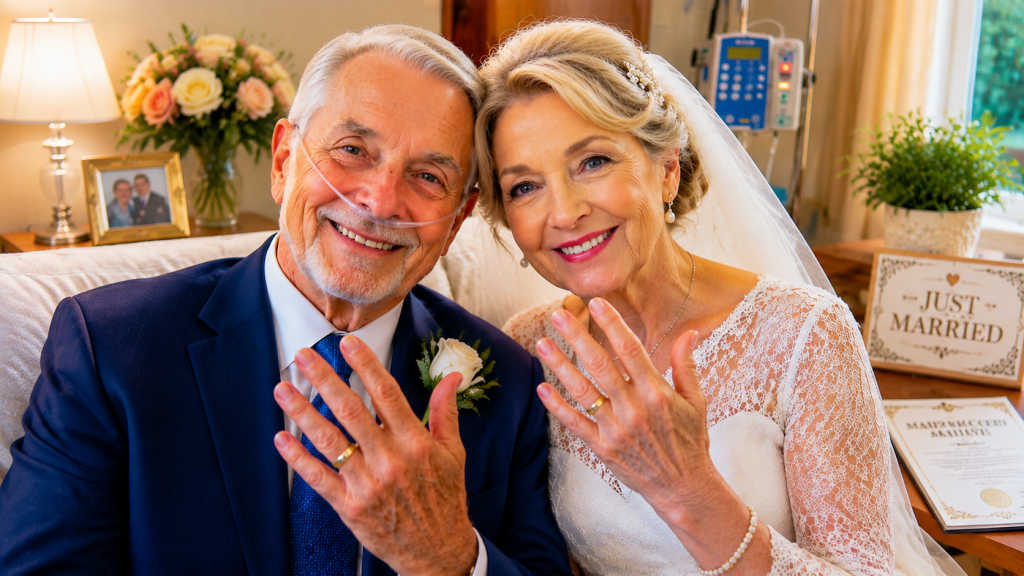
The wedding took place four days later in his hospital room.
There were no flowers because Thomas remembered I disliked funeral arrangements.
There was no music, no crowded reception, and no white dress.
I wore a soft blue suit I found in the back of my closet.
Thomas wore a clean white shirt beneath his hospital blanket.
A nurse named Emily served as one witness. Thomas’s attorney, Mr. Arthur Bennett, served as the other.
Arthur was a serious man in his late sixties, with carefully combed gray hair and sharp eyes.
Before the ceremony, he asked to speak privately with Thomas.
They remained alone for nearly twenty minutes.
When Arthur emerged, he studied me with an expression I could not understand.
“Are you certain about this?” he asked.
“Yes.”
“Do you understand Mr. Caldwell’s condition?”
“Better than most people.”
“And you are marrying him freely?”
“Yes.”
He nodded.
“Then I wish you both peace.”
The hospital chaplain performed the ceremony.
Thomas’s voice was weak, but he spoke every word clearly.
When it was my turn, I held his hands and promised to love him for whatever time remained.
His eyes shone as he slipped a simple gold ring onto my finger.
“I bought that ring in 1972,” he whispered.
I stared at him.
“You kept it?”
“For fifty-four years.”
The chaplain pronounced us husband and wife.
Thomas smiled like the seventeen-year-old boy I remembered.
For one brief month, I was Thomas’s wife.
It was the happiest and most painful month of my life.
We could not travel or share a home in the ordinary sense, so we created a marriage within the walls of his hospital room.
I brought him coffee each morning, though he could barely drink it.
He kept a photograph of me beside his bed.
We watched old movies, listened to songs from our youth, and argued playfully about whether he had truly beaten me at the school picnic sack race.
“You cheated,” I insisted.
“I was faster.”
“You pushed me.”
“I encouraged you from behind.”
On good days, I wheeled him into the hospital garden.
We sat beneath an oak tree and held hands.
People passing by saw two elderly patients or perhaps an aging couple.
They did not know that we were newlyweds.
One afternoon, Thomas asked me whether I regretted leaving Millbrook.
“No,” I said honestly.
His face fell slightly.
I squeezed his hand.
“I regret losing you. But I do not regret becoming the woman I needed to become.”
He considered that.
“Would you have been happy with me?”
“At seventeen?”
“Yes.”
“I think I would have loved you. But I might have resented you too.”
He nodded slowly.
“I might have resented you for wanting more.”
“We would have hurt each other.”
“Then perhaps we met again at the only time we were ready.”
I rested my head against his shoulder.
“Perhaps.”
During our third week of marriage, Thomas asked me to bring him to his house.
The doctors were reluctant, but arrangements were made for a short visit.
His home stood at the edge of town on several acres of land.
It was not the grand mansion I expected. It was a warm brick house surrounded by old trees.
Inside, everything was clean and orderly, but painfully quiet.
There were no family photographs except pictures of his parents.
Then I entered his study.
My breath caught.
A framed copy of our high school graduation photograph stood on the desk.
Beside it was a dried corsage from our senior dance.
On a shelf, carefully preserved inside a glass box, was the blue ribbon I had once worn in my hair.
“You kept all this?” I whispered.
Thomas lowered himself into a chair.
“I kept more than you know.”
He asked me to open the bottom drawer of his desk.
Inside were dozens of envelopes tied with string.
Every envelope had my name written across it.
“What are these?”
“Letters.”
“You wrote to me?”
“Over the years.”
“Why didn’t you send them?”
“Pride. Cowardice. Sometimes I didn’t know where you lived.”
I picked up the first envelope.
It was dated three months after I left Millbrook.
“You never sent any?”
“Not after the first year.”
My eyes filled with tears.
“You could have found me.”
“Yes.”
“Why didn’t you?”
“Because I was afraid you would tell me you were happy without me.”
I knelt beside him.
“I was afraid to ask about you for the same reason.”
Thomas touched my cheek.
“We wasted a great deal of time being afraid.”
Before we left the study, he made me promise not to open the letters yet.
“They will come to you when the time is right,” he said.
I assumed he meant after his death.
I did not realize he had planned something far more complicated.
Thomas grew weaker during the final week.
He stopped eating.
He slept most of the day, waking only for brief moments.
I stayed beside him every night.
One evening, he opened his eyes and whispered my name.
“I’m here.”
“Are you still glad you married me?”
“Yes.”
“Even though I trapped you?”
I thought he was joking.
“You did not trap me.”
A faint smile touched his lips.
“Not yet.”
I frowned, but before I could ask what he meant, his eyes closed again.
Thomas died early the next morning with his hand in mine.
There was no dramatic final speech.
No sudden miracle.
His breathing simply slowed until the room became unbearably quiet.
I pressed my forehead against his hand and cried as though fifty-six years of grief had arrived all at once.
The funeral was held four days later.
The church was filled with townspeople, former employees, business associates, and people Thomas had quietly helped over the years.
I learned that he had paid college tuition for the children of several employees.
He had covered medical bills for families who could not afford treatment.
He had donated building supplies after fires and storms without ever attaching his name to the gifts.
I sat in the front pew wearing the ring he had saved since 1972.
When the service ended, I returned alone to my cottage.
The silence inside felt enormous.
I placed Thomas’s photograph on the kitchen table and slept very little.
The next morning, someone knocked on my door.
It was Arthur Bennett, Thomas’s attorney.
He carried a small wooden box beneath one arm and a thick leather folder in his other hand.
After stepping inside, he gave me a strange smile.
“Thomas was right,” he said. “You finally walked straight into his trap.”
My hands began to shake.
“What trap?”
Arthur placed the wooden box on the table.
“I believe he wanted you to discover that yourself.”
I stared at him.
“Mr. Bennett, my husband has just died. I am not in the mood for riddles.”
“Arthur,” he corrected gently. “And I assure you, Mrs. Caldwell, this was Thomas’s wording, not mine.”
Mrs. Caldwell.
Hearing the name nearly broke me.
Arthur pushed the box toward me.
I slowly lifted the lid.
Inside lay a faded bus ticket dated fifty-six years earlier.
It was the ticket I had used to leave Millbrook.
Beneath it rested the letters from Thomas’s study, tied with a blue ribbon.
There was also a small photograph of us standing outside the school library.
At the bottom of the box lay a sealed envelope.
Across the front, Thomas had written: For my wife, after I am gone.
My vision blurred.
I opened the envelope.
My dearest Nancy,
If you are reading this, then I received the greatest gift of my life. I was allowed to call you my wife, even if only briefly.
I once accused you of breaking my heart by leaving Millbrook. The truth is that I broke my own heart by believing love required you to surrender your dreams.
You became everything you were meant to become.
I have known thousands of people, built companies, purchased properties, and made more money than two people could reasonably spend. None of it meant as much to me as hearing you say yes beside my hospital bed.
You may be wondering about the trap.
The trap was never marriage.
It was never money.
It was my final attempt to make certain you could never again convince yourself that you had to face life alone.
I looked up at Arthur.
“What does that mean?”
He opened the leather folder.
“Thomas revised his estate plan before proposing to you.”
My stomach tightened.
“I don’t want his money.”
“He knew you would say that.”
“I married him because I loved him.”
“He knew that too.”
Arthur removed several documents.
Thomas had left me his home, his personal savings, and a substantial portion of his estate.
The amount was so large that I believed I had misunderstood it.
“This cannot be right.”
“It is correct.”
“I was his wife for one month.”
“You were the person he loved for fifty-six years.”
“I cannot accept this.”
Arthur nodded as though he had expected every word.
“Thomas predicted you would refuse. That is why the estate contains certain conditions.”
“What conditions?”
“The house and personal assets belong to you immediately. The larger funds have been placed into the Caldwell-Nancy Brooks Foundation.”
I stared at the papers.
“My name?”
“Your maiden name. Thomas established the foundation to provide nursing scholarships for students from working-class families.”
My breath caught.
Arthur continued.
“He also directed funds toward cancer support, home nursing services, and emergency assistance for elderly residents struggling with housing costs.”
The room seemed to tilt.
“He did this because of me?”
“Because of what your life taught him.”
Arthur handed me another letter.
Nancy,
You once left me because you understood that love should not cost a woman her future.
I was too young and selfish to understand.
So here is my trap: You cannot refuse the inheritance without also abandoning the students, nurses, patients, and elderly neighbors who will depend on it.
You taught me, without trying, that a meaningful life is not built by holding someone back. It is built by helping others move forward.
The foundation needs someone who understands that.
It needs you.
I covered my mouth.
A cry escaped me before I could stop it.
Arthur reached across the table and steadied the box as I shook.
“Thomas said you would probably scream,” he murmured.
I laughed through my tears.
“That stubborn man.”
“He was extremely proud of this plan.”
“That is the trap?”
“Part of it.”
“There is more?”
Arthur handed me a final document.
Thomas had purchased the old Millbrook Hotel, where my mother had once worked.
The building had been closed for years.
He planned to renovate it into affordable apartments for retired nurses, caregivers, and widowed seniors.
The top floor would become a community health clinic.
“He wanted you to oversee the project,” Arthur explained.
I stared at the faded photograph attached to the proposal.
My mother had spent half her life scrubbing those floors.
Now the building would carry her name.
The Evelyn Brooks Residence and Community Clinic.
I could no longer hold back my tears.
Thomas had not merely left me wealth.
He had transformed every wound from my past into something that could help another person.
My poverty.
My mother’s exhaustion.
My struggle for education.
My fear of losing my independence.
Even our fifty-six years apart had become part of his final gift.
“He planned all this before we married?” I asked.
“Most of it, yes. The marriage did not create your inheritance. The documents make that very clear.”
“Why?”
“Because he was afraid people would accuse you of marrying him for money. He wanted there to be no doubt.”
Arthur leaned back.
“Thomas began preparing the foundation shortly after you returned to Millbrook. He had been following your career for years through professional publications and alumni records.”
“He knew where I was?”
“Yes.”
The revelation hurt.
“He could have contacted me.”
“He knew. He regretted that he did not.”
“Then why wait until he was dying?”
Arthur’s expression softened.
“Because when he learned you had returned, he intended to call you. Before he could, he received his diagnosis. He thought approaching you then would be cruel.”
“So he waited until I walked into his hospital room.”
“Yes.”
I looked again at Thomas’s letter.
The anger I expected never came.
Instead, I felt the full tragedy of two people who had spent a lifetime loving each other from a distance because neither had been brave enough to cross it.
Arthur stood to leave.
“There is one more thing in the box.”
After he departed, I searched beneath the letters.
At the very bottom lay a small silver key and a note.
The key opened a compartment hidden behind a panel in Thomas’s study.
That afternoon, I went to his house alone.
Every room still carried traces of him.
His reading glasses rested on the desk. A sweater hung over the back of a chair. His coffee mug remained beside the sink.
I found the hidden compartment.
Inside was an old portable cassette player and several tapes.
The first tape was labeled Nancy—Bus Station.
I pressed play.
Static crackled.
Then Thomas’s young voice filled the room.
“Nancy, I don’t know whether I’ll ever give you this.”
I sat down hard.
He had recorded the message shortly after I left.
“I’m angry,” his seventeen-year-old voice continued. “But I think I’m angry because you were brave enough to do what I could not. You chose your future. I wanted you to choose me because I thought that would prove you loved me.”
The recording paused.
“I hope you become a nurse. I hope you see the world. And I hope one day I become the kind of man who would ask how he can support your dreams instead of asking you to surrender them.”
I pressed my hands to my face.
The final tape had been recorded shortly before our wedding.
Thomas’s voice was older and weaker.
“My dearest Nancy, tomorrow I am going to ask you to marry me. Arthur says my plan is complicated, but I know you. If I simply leave you money, you will give it away or refuse it. If I leave you responsibility, however, you will stay and finish the work.”
He coughed softly.
“You have spent your life caring for people. My trap is to make certain you continue—but this time, without worrying about whether your pension can pay the electric bill.”
I laughed and cried at the same time.
“You may be furious with me,” the recording continued. “That is all right. You were always beautiful when you were furious.”
The tape ended with a long silence.
Then his voice returned one final time.
“I loved you at seventeen. I loved you at seventy-three. And in every year between, there was some part of me still standing at that bus station, hoping you might look back.”
“I did look back,” I whispered into the empty study. “I always looked back.”
Over the following year, I carried out Thomas’s plans.
The work gave structure to my grief.
The old hotel was renovated carefully. We preserved the original staircase and restored the tall windows.
On the ground floor, we opened a clinic offering free checkups, cancer screenings, medication assistance, and counseling.
The upper floors became affordable apartments for elderly residents.
The first tenant was a retired school cafeteria worker named Dorothy, who had been living in her car after losing her apartment.
When I handed her the key, she cried.
“So did I.”
The scholarship foundation selected twelve nursing students in its first year.
At the ceremony, I told them about a girl who had once boarded a bus with a broken suitcase and no idea what her future would hold.
I told them education had changed her life.
I did not tell them until the end that the girl was me.
Afterward, a young woman approached and hugged me.
“My father told me college was impossible,” she said. “This scholarship proved him wrong.”
In that moment, I understood Thomas’s plan completely.
His final wish had not simply been to marry me.
It had been to make peace with the choice I made at seventeen.
He wanted to honor the future I had chosen rather than compete with it.
Two years after his death, I stood outside the Evelyn Brooks Residence as workers installed a bronze plaque near the entrance.
Beneath my mother’s name were Thomas’s words:
Love should never ask someone to become smaller.
It should give them room to grow.
I touched the ring on my finger.
I still lived in Thomas’s house, though I changed very little.
His letters remained in the study. I read one each Sunday evening.
Some were funny. Some were painful. Several described moments when he had almost called me.
One letter, written on his fiftieth birthday, ended with a sentence I carried in my heart:
Perhaps our story is not over. Perhaps it is only waiting for us to become ready.
Thomas and I did not receive the lifetime together that we once imagined.
We did not raise children, share ordinary breakfasts, argue over bills, or grow old side by side.
We were already old when life returned us to each other.
But for one month, I was his wife.
For one month, he was my husband.
And during that month, we gave each other something more valuable than a perfect past.
We gave each other forgiveness.
People sometimes ask whether I regret marrying a man I knew I would lose.
I always give them the same answer.
Grief was waiting for me whether I said yes or no.
Had I refused, I would still have mourned him.
But I would have carried another unanswered question for the rest of my life.
Instead, I carry his name, his letters, his ring, and the responsibility he placed in my hands.
Thomas was right.
I walked straight into his trap.
It was a trap made from old letters, unfinished dreams, nursing scholarships, warm apartments, and a love that had waited fifty-six years for a second chance.
And even knowing how it ended, I would walk into it again.
THE END! THANK YOU FOR READING!