

The night everything changed began with a simple refusal.
I stood in the kitchen of my townhouse, the one I had bought with my own money years before meeting Daniel, and told him I would not sell it.
I would not move into his mother’s sprawling colonial house across town.
Evelyn had made the suggestion over dinner the previous evening, her voice sweet as poisoned honey, claiming it would help us save money while she “helped” with the household.
I knew better.
She wanted my salary to cover her endless renovations, my time to cook and clean for her, and my silence whenever Daniel lost his temper.
Daniel’s face had darkened immediately.
He set his wine glass down too hard.
“You’re being unreasonable, Mara.
Mom’s alone now.
This is the smart thing.”
“No,” I said.
“This house is mine.
My name is on the deed.
I’m not giving it up.”
What followed was not the first time his anger turned physical, but it was the worst.
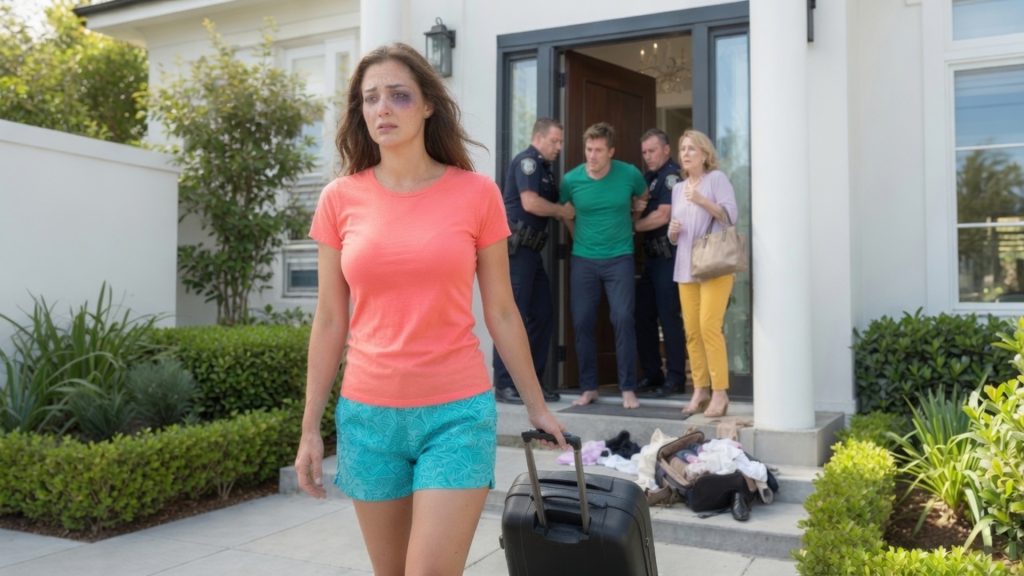
He grabbed my arm hard enough to leave bruises shaped like his fingers.
He shoved me against the counter.
He called me selfish, ungrateful, unstable.
He threatened that if I kept resisting he would make sure everyone knew I was losing my mind.
When I tried to leave the room he blocked the doorway and raised his hand.
The blow landed across my cheekbone.
Another caught my collarbone.
I tasted blood.
I stayed quiet because I had learned that silence sometimes shortened the storm.
By the time he stormed upstairs I was shaking, the marks already rising dark against my skin.
I did not sleep that night.
I lay on the edge of the bed and catalogued every injury the way I catalogued discrepancies in financial records at work.
I was a senior forensic accountant for a federal contractor.
My job was to follow money that people thought they had hidden forever, to reconstruct forged documents, to build cases that stood up in court.
Fear had made me slow to turn those same skills on my own marriage.
But the fear was losing its grip.
Three months earlier, after the first time Daniel’s temper left visible bruises, I had bought a second phone.
I paid cash at a store two towns over.
I kept it under the mattress, wrapped in an old scarf.
On it I stored photographs of every mark taken with the newspaper of the day for a timestamp, voice recordings from the cloud-connected security system Daniel believed he had disabled by unplugging the router, screenshots of Evelyn’s messages pressuring me to transfer the deed “for the family’s future,” bank statements showing loans Daniel had applied for using my Social Security number and forged signatures, and late-night conversations between mother and son about how to paint me as unstable if I ever fought back.
I labeled the encrypted folder Tax Receipts.
No one looked twice at tax receipts.
In my line of work I had seen people hide fortunes inside ordinary file names.
I simply applied the same principle at home.
The next morning the makeup bag landed on the bed with a soft thud.
Daniel was already dressed for work, cuff links gleaming, voice cold and controlled.
“Mom is coming for lunch.
Cover the marks and smile.”
I looked at him without speaking.
The soreness from the previous night still lingered under my skin like a second pulse.
He pointed at the bag.
“Use the concealer.
No one needs to know we argued.”
He leaned closer, the scent of his cologne sharp.
“At noon you’ll serve lunch.
You’ll tell Mom you had an accident in the bathroom.
Then we’ll discuss putting this house on the market.”
“This house belongs to me,” I whispered.
His expression hardened.
“Not for much longer.”
The front door slammed at 7:42 a.m.
One minute later I reached under the mattress and pulled out the second phone.
My hands were steady now.
Focused.
Daniel had always mistaken my silence for obedience.
He was wrong.
Something inside me had become completely still.
Not defeated.
Focused.
I photographed the bruises beside that morning’s newspaper for a clear date stamp, the purple blooming across my cheek and collarbone.
I downloaded the full audio from the security system, the parts Daniel thought he had wiped when he reset the devices.
I opened the Tax Receipts folder and verified every file was intact and backed up to an off-site encrypted drive I kept in a safety deposit box.
Then I called the number I had avoided for five years.
My father answered on the second ring.
“Mara?”
My throat tightened.
We had not spoken since the wedding.
Daniel had made sure of that, slowly cutting me off from anyone who might see through him.
“Dad, I need you.”
There was a brief pause.
Then the voice Daniel had never wanted to hear again, the voice that still carried the quiet authority of a man who had spent decades putting people like Daniel in federal courtrooms.
“Tell me where you are.”
I gave him the address.
I told him everything in clipped, precise sentences the way I briefed a case file.
The loans.
The forgeries.
The messages.
The bruises.
The plan for lunch.
He did not interrupt.
When I finished he said only, “I’m two hours away.
Don’t pack anything you can’t carry in one bag.
Leave the evidence ready.
I’ll be there.”
I moved through the house with the same methodical calm I used when reconstructing a money trail.
I packed the second phone, the encrypted drive, the original deed, the medical photos, a change of clothes, my laptop, and the thin folder of paper copies I kept as a fail-safe.
I left the makeup bag untouched on the bed.
I rearmed the security system with a new code only I knew and changed every password Daniel might have guessed.
At 9:30 a.m. I walked out the front door carrying one suitcase.
I locked the townhouse behind me and drove three blocks to a coffee shop where I sat facing the window and waited, coffee untouched, heart steady.
My father arrived at 11:45 exactly.
His black sedan was silent and unremarkable, the kind of car that disappeared into traffic.
He looked older than the last time I had seen him, the gray in his hair more pronounced, the lines around his eyes deeper, but the steel in his eyes was the same.
He hugged me once, hard and brief, then took the suitcase from my hand without asking questions.
“Show me,” he said.
We returned to the townhouse together.
He sat in the living room armchair that faced the front door, the one I had never let Daniel claim as his own.
I laid the evidence on the coffee table: the drive, the photos, the printouts of forged loan applications, the transcripts of Evelyn’s messages, the audio files ready to play on my tablet.
My father reviewed everything in silence, the way he had once reviewed case files late into the night when I was a child.
When he finished he looked at me and nodded once.
“Good work,” he said.
“Better than most of the junior agents I trained.
You built a clean chain of custody without even knowing you were doing it.”
At noon the front door opened.
Daniel’s laugh came first, bright and false.
“Mara, we’re here.
Mom’s starving.”
Evelyn’s heels clicked across the hardwood.
“Something smells good already, I hope.
I told Daniel you make the best chicken salad.”
Then both of them froze.
The makeup bag still sat closed on the bed upstairs.
My suitcase was gone.
And sitting quietly in the living room was the one person Daniel had never believed I would call.
My father’s voice was calm, almost conversational.
“Hello, Daniel.
Evelyn.
Sit down.
We have things to discuss.”
Daniel’s face went white.
Evelyn’s hand fluttered to her throat.
Neither of them moved at first.
My father simply waited, the same patient stillness I remembered from childhood whenever he was about to dismantle a lie in the kitchen after school.
“I said sit,” he repeated, quieter.
They sat.
I stood beside the coffee table and began the way I would open a case presentation to a team of auditors and lawyers.
“Three months ago Daniel applied for two personal loans totaling eighty-seven thousand dollars using my name, my Social Security number, and forged signatures.
The funds were deposited into a joint account he controls and then transferred in increments to cover renovations on Evelyn’s house and payments on his personal credit cards.
Evelyn has been pressuring me via text and email to transfer the deed of this townhouse into her name under the guise of estate planning and family unity.
On multiple occasions Daniel has used physical force to intimidate me into compliance.
Last night was the most recent.
The photographs, the medical notes from the urgent care visit I made this morning under a different name, the audio recordings from the security system, and the financial documents are all here.
Copies have already been sent to my attorney and to the appropriate federal contacts who handle identity theft and bank fraud.”
Daniel found his voice first.
It shook.
“This is insane.
She’s unstable.
She’s been acting crazy for months.
Mom, tell them.
She’s always been dramatic.”
Evelyn tried, her voice rising into the familiar register of wounded mother.
“Mara has always been difficult.
We’re just trying to help the family stay close.
This house is too much for her alone.
We’re offering a solution.”
My father did not raise his voice.
He simply pressed play on the first audio file.
Daniel’s own words filled the room: the threats from the night before, the order to cover the marks, the plan to force the sale, the cold calculation that no one needed to know.
Then the messages from Evelyn scrolled across the tablet screen, each one more insistent than the last.
Then the bank statements.
Then the side-by-side comparison of the forged signatures against my real ones, the differences glaring under magnification.
Then the photographs of the bruises taken that morning beside the newspaper.
The silence that followed was absolute.
“You will leave this house now,” my father said.
“You will not contact Mara again except through attorneys.
The loan applications constitute identity theft and bank fraud.
The physical injuries constitute assault and battery.
The pressure to transfer property under duress may constitute additional charges under state and federal law.
I have already made two phone calls this morning.
You will both be hearing from people who do not care about your feelings or your family stories.”
Daniel stood so fast the chair scraped across the floor.
“You can’t do this.
She’s my wife.
This is private.
You have no right.”
“She was,” my father corrected, voice still level.
“Divorce papers are being prepared.
Temporary restraining orders will be filed this afternoon.
If either of you sets foot on this property again without invitation, you will be arrested.
If you attempt to contact her employers or spread stories about her mental state, those will be additional counts of harassment and defamation.”
Evelyn began to cry, the soft theatrical tears she used when cornered.
“We’re family.
This is a misunderstanding.
Mara, please.
Think about what you’re doing to all of us.”
I looked at her for a long moment, the woman who had smiled while planning to take everything I owned.
“No.
This is the end of the misunderstanding.
You never wanted family.
You wanted control and free labor and someone else’s money.
I am done providing any of it.”
They left.
Daniel slammed the door hard enough to rattle the frame and the windows.
The silence that followed felt like oxygen after too long underwater.
My father stood and put a hand on my shoulder.
“You did the hard part already.
The rest is just paperwork and time.
And time is something I still have.”
I nodded.
The marks on my face still throbbed.
The makeup bag still sat upstairs, unused.
My suitcase was in the trunk of his car.
And for the first time in years I felt the future open instead of close.
The following days moved in a careful, deliberate rhythm.
I stayed at a hotel the first night under a name my father arranged through an old colleague, then moved into a short-term rental he secured under his consulting company so the address would not appear in any public record linked to me.
My attorney, a woman named Lena I had worked with on two previous financial cases involving domestic asset concealment, filed for divorce on grounds of cruelty and for a temporary protection order the same afternoon.
The bank was notified of the fraudulent loans; a fraud investigation was opened within forty-eight hours and the accounts frozen.
The local police took my statement, the photographic evidence, and the audio files.
Because some of the financial activity crossed state lines and involved federal banking systems, my father’s old contacts in the financial crimes unit ensured the case received appropriate attention and was not buried as a simple domestic dispute.
Daniel tried once to call from a blocked number.
I did not answer.
He tried through two mutual friends who had always taken his side.
They stopped calling after the first protective order was served and they realized the depth of the documentation.
Evelyn sent a long, guilt-laden email filled with references to my late mother’s memory and how disappointed she would be.
I forwarded it unread to my attorney.
The house remained mine.
The deed stayed in my name alone.
I returned to work after a week, the bruises carefully concealed not with makeup for Daniel’s sake but with the quiet professionalism I had always worn like armor.
My supervisor asked no questions beyond whether I needed more time.
I told her I did not.
In the evenings I sat with the evidence files open on my laptop and rebuilt the full timeline the way I rebuilt money trails for the government.
Every text message timestamped and authenticated.
Every transfer mapped from origin to destination.
Every raised voice recorded by the security system and transcribed.
It was almost clinical.
That clinical distance was what kept the fear from returning.
Fear thrives in chaos and secrecy.
I gave it structure and light instead.
My father stayed in town for ten days.
We ate dinner together most nights at quiet restaurants where he always chose the table facing the door.
He did not push me to talk about the marriage or the years of slow isolation.
He simply made sure I ate, that the new deadbolts were installed, that the upgraded security cameras I had ordered were working and feeding to both our phones.
On the last night before he left he said, “You always were better at the quiet work than the loud work.
That’s what kept you safe long enough to get out.
Most people never document while they’re still inside the fire.
You did.”
I believed him.
I had spent five years learning to disappear inside my own marriage.
Documenting had been the first act of reappearing.
The legal process took months.
Daniel contested everything at first with the same confidence he had once used to control me.
He claimed the bruises were from a fall in the bathroom, exactly the story he had ordered me to tell.
He claimed the loans were joint decisions I had authorized verbally and that the signatures were mine.
He claimed I was inventing the entire history of control and that my father had always hated him and was now manufacturing a case.
Each claim collapsed under the weight of the documents and recordings.
The forgeries were confirmed by a certified handwriting expert who testified that the pressure patterns and letter formations did not match my known samples.
The bank statements showed the money had been spent almost entirely on Evelyn’s home renovations and Daniel’s personal credit cards and a boat he had bought without my knowledge.
The audio files were authenticated by the security company as original and unaltered.
The divorce was granted with a favorable property settlement that left the townhouse solely in my name and awarded me the value of the fraudulent loans as additional compensation.
The protection order was made permanent for two years with the option to renew.
Criminal charges for the fraud moved forward separately in federal court; I was told I would likely be called as a witness when the case went to trial.
I sold nothing.
I kept the townhouse.
I paid the remaining mortgage from my own salary and watched the equity grow month by month.
Some nights I still woke to the phantom sound of the front door slamming or the weight of a hand on my arm.
Some mornings I still checked the second phone out of habit even though it no longer needed to hide under a mattress.
Healing was not a straight line.
There were weeks when the silence in the house felt too large and I had to leave the radio on low just to fill the space.
There were days when I replayed the confrontation in my mind and wondered if I had been too cold, too prepared, too much the forensic accountant even in my own escape.
But those days grew fewer.
The woman who had stayed silent for years was learning to inhabit her own voice again.
Evelyn never apologized.
Daniel never admitted fault.
In his deposition he still insisted I had misunderstood everything, that the bruises were accidental, that the loans were for “our future.”
I stopped waiting for either of them to change.
The evidence I had gathered did the speaking for me.
The system I had once used only for strangers’ cases finally worked for my own life.
When the federal indictment was unsealed I did not celebrate.
I simply closed the folder and put it away.
One year later I stood in the living room of my townhouse and looked at the armchair where my father had sat that noon.
The house was quiet.
The security system hummed softly in the background.
On the coffee table lay a single framed photograph: my father and me on the day the final divorce papers were signed.
We were both smiling, the real kind, the kind that does not need to be ordered or covered with concealer.
Outside, spring light came through the windows I had never allowed Daniel to cover with heavy curtains.
The garden I had planted the previous fall was beginning to show green.
I had refused to sell my home.
I had refused to smile on command.
I had refused to stay silent.
And in the end that refusal was enough to bring the entire carefully constructed lie crashing down around the two people who had underestimated me most.
The suitcase was long unpacked.
The makeup bag had been thrown away the same afternoon they left.
The marks had faded into nothing.
But the woman who sat quietly waiting that day—the one Daniel never believed I would call—remained.
Not as a weapon.
As proof that I had always known how to fight.
I had simply chosen the moment when the fight would matter most.
And I won.
In the years that followed I rebuilt more than the house.
I rebuilt friendships Daniel had discouraged.
I took the vacation I had postponed for three summers.
I taught a seminar at the contractor’s headquarters on documenting financial abuse in domestic contexts, careful never to use my own story as the example but weaving the principles I had lived through every case study.
Sometimes colleagues asked how I stayed so calm under pressure.
I told them the truth in the only way I could: that calm is not the absence of fear.
It is the decision to keep moving while the fear is still present.
That decision had saved me.
It could save others.
My father and I spoke every Sunday now.
Sometimes about nothing.
Sometimes about the cases he still consulted on.
He never said he was proud in so many words.
He did not need to.
The quiet way he looked at me across a dinner table said enough.
Daniel remarried within eighteen months, a woman who looked a little like me from a distance.
Evelyn’s house went on the market after the fraud restitution orders hit.
I never drove past it.
I had no need.
The townhouse remained.
The deed remained.
The second phone was retired to a drawer, its purpose fulfilled.
On quiet evenings I sometimes opened the old Tax Receipts folder just to remember the version of myself who had gathered every piece while still living inside the danger.
She had been terrified.
She had also been meticulous.
Both things had been true at once.
And both things had been necessary.
I no longer flinched when a door closed too hard.
I no longer checked the locks three times.
The marks were gone.
The smile I wore now was my own.
And every time I walked through the front door of my home I remembered the exact moment Daniel and Evelyn had frozen in the entryway, the exact second their plan collapsed under the weight of evidence they never imagined I would keep.
That memory no longer hurt.
It steadied me.
I had called the one person Daniel never believed I would call.
And in doing so I had finally called myself home.
THE END! THANK YOU FOR READING!